
HR Governance, Risk, And Compliance (GRC) Platform Market Size and Share
Market Overview
| Study Period | 2020 - 2031 |
|---|---|
| Market Size (2026) | USD 4.93 Billion |
| Market Size (2031) | USD 8.85 Billion |
| Growth Rate (2026 - 2031) | 12.41 % |
| Fastest Growing Market | Asia-Pacific |
| Largest Market | North America |
| Market Concentration | Medium |
Major Players *Disclaimer: Major Players sorted in no particular order Image © Mordor Intelligence. Reuse requires attribution under CC BY 4.0. | |
HR Governance, Risk, And Compliance (GRC) Platform Market Analysis by Mordor Intelligence
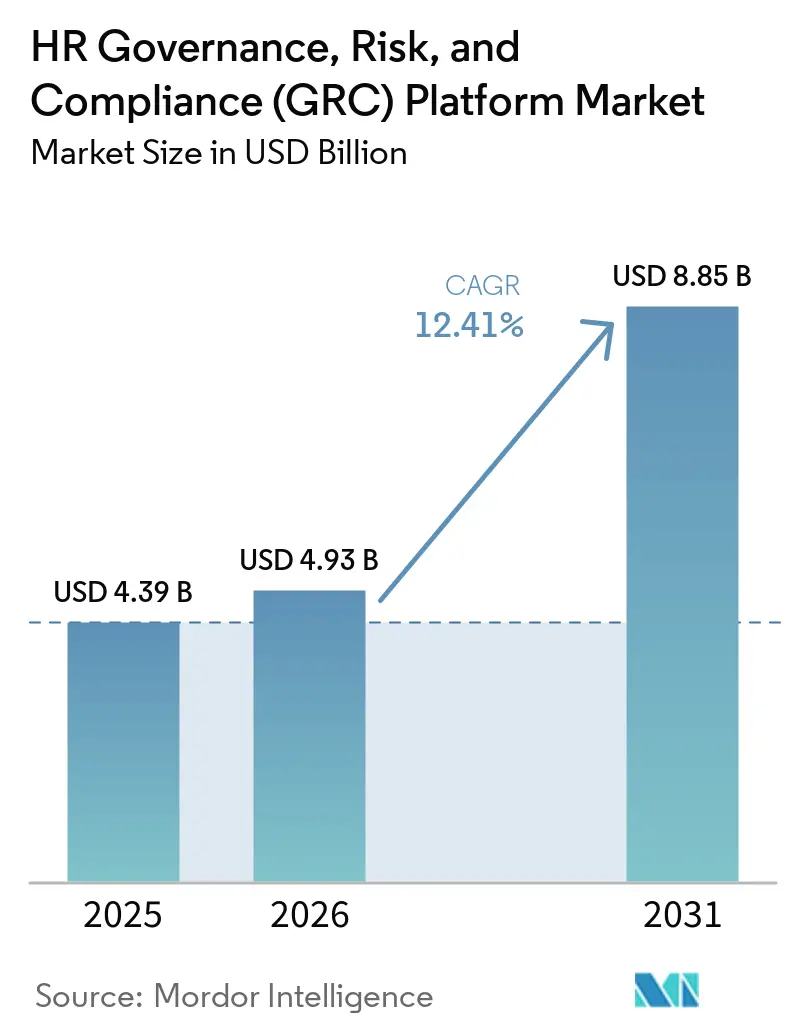
The HR Governance, Risk, and Compliance (GRC) platform market size was valued at USD 4.39 billion in 2025 and is projected to reach USD 8.85 billion by 2031, expanding at a CAGR of 12.41% during the 2026-2031 forecast period. The HR Governance, Risk, and Compliance (GRC) Platform Market is expanding because employers now treat HR compliance as a governance function with direct legal and reputational exposure rather than an administrative task. Regulatory pressure is increasing across major jurisdictions at the same time, making spreadsheet-led tracking insufficient for audit, documentation, and workflow control. Demand is moving toward integrated platforms that connect policy management, case handling, pay governance, whistleblower intake, and reporting within a single system with an auditable record. Competitive activity is centered on broader platform coverage, deeper HCM integration, and the use of AI to reduce setup time and improve workflow execution. Growth in the HR Governance, Risk, and Compliance (GRC) Platform Market is still tempered by long implementation cycles and the risk that larger enterprise GRC suites absorb HR-specific functions into wider compliance stacks.
Key Report Takeaways
- By component, software held 67.14% of the HR Governance, Risk, and Compliance (GRC) Platform Market share in 2025, while services are projected to expand at a 14.53% CAGR through 2031.
- By functionality, policy and procedure management accounted for 38.29% share in 2025, while pay transparency and compensation governance are projected to advance at a 13.09% CAGR through 2031.
- By deployment mode, cloud-based deployment captured 66.18% of the market in 2025, while the hybrid model is projected to grow at a 13.85% CAGR through 2031.
- By organization size, large enterprises held 71.23% share in 2025, while SMEs are projected to record a 14.11% CAGR through 2031.
- By industry vertical, information technology and telecommunications accounted for 36.77% of the market share in 2025, while healthcare and life sciences are projected to expand at a 12.78% CAGR through 2031.
- By geography, North America held 35.68% of the HR Governance, Risk, and Compliance (GRC) Platform Market size in 2025, while Asia-Pacific is projected to grow at a 13.44% CAGR through 2031.
Note: Market size and forecast figures in this report are generated using Mordor Intelligence’s proprietary estimation framework, updated with the latest available data and insights as of January 2026.
Market Trends and Insights
Drivers Impact Analysis of HR Governance, Risk, And Compliance (GRC) Platform Market*
| Driver | (~) % Impact on CAGR Forecast | Geographic Relevance | Impact Timeline |
|---|---|---|---|
| Rising Labor and Whistleblower Compliance Complexity | +3.2% | Global | Short term (≤ 2 years) |
| Shift toward Integrated Cloud-Native Compliance Platforms | +2.8% | North America, Europe, Asia-Pacific | Short term (≤ 2 years) |
| EU Pay Transparency Directive Readiness | +2.4% | Europe, with spill-over to North America and Asia-Pacific | Medium term (2-4 years) |
| Growing Need for Auditable Policy, Hotline, and Investigation Workflows | +1.6% | Global | Medium term (2-4 years) |
| Governance Needs for Employment AI and Automated Hiring Decisions | +1.2% | Europe and North America | Medium term (2-4 years) |
| Expanding Adoption by Small and Medium-Sized Enterprises | +1.0% | Global, with early gains in North America and Europe | Long term (≥ 4 years) |
| Source: Mordor Intelligence | |||
Rising Labor and Whistleblower Compliance Complexity
The pace of labor and whistleblower regulation has moved beyond what most manual compliance processes can absorb. The EU Whistleblower Protection Directive now applies across all 27 member states, and enforcement has become more visible and more immediate in employer planning cycles. The European Commission reported that the EU Court of Justice imposed combined fines of EUR 39 million (USD 44 million) on 5 member states for delayed transposition, which signaled that weak implementation would carry financial consequences. For employers, the challenge is no longer just about policy wording; every report now needs structured intake, routing, follow-up, and evidence retention that can stand up to review. This shift is pushing the HR Governance, Risk, and Compliance (GRC) Platform Market toward platforms that can turn recurring labor risk into a documented operating process.
Shift toward Integrated Cloud-Native Compliance Platforms
Buyers increasingly prefer a single platform that combines policy management, incident reporting, case management, analytics, and training, rather than maintaining a stack of disconnected tools. Mitratech reinforced this direction in March 2026, when it launched its Global GRC Platform, bringing ethics and whistleblowing, policy management, operational resilience, cyber and IT risk, and compliance training into one interface.[1] Cloud-native delivery is a strong part of this shift because it removes version-control bottlenecks, supports faster updates, and makes shared analytics easier to use across business units. Integration with core HCM systems is now a basic buying requirement, as shown by HR Acuity joining the Workday Innovation Partner Program in March 2026. The HR Governance, Risk, and Compliance (GRC) Platform Market is benefiting from integrated cloud platforms that reduce operational friction while compliance expectations are becoming broader and more detailed.
EU Pay Transparency Directive Readiness
The EU Pay Transparency Directive has become a near-term purchasing trigger because employers need operating processes in place before reporting obligations begin to bite. The June 7, 2026, transposition deadline has pushed employers to move from high-level policy discussions into active pay data preparation and governance design. Employers with 150 or more workers will need to publish gender pay gap statistics in 2027 using compensation data from the full 2026 calendar year, which means collection frameworks need to be active now. The pressure is higher because country-level implementation can diverge, so a single regional framework often needs local thresholds, documentation rules, and disclosure workflows built into a shared architecture. This is why the HR Governance, Risk, and Compliance (GRC) Platform Market is seeing pay governance move from a specialist need into a mainstream compliance module.
Growing Need for Auditable Policy, Hotline, and Investigation Workflows
Organizations face greater exposure when they cannot show how a complaint was received, investigated, documented, and closed. HR Acuity reported that discrimination, harassment, and retaliation claims reached 14.7 issues per 1,000 employees in 2024, the highest level in the history of its benchmark study. The same study found that 68% of organizations did not track the number of issues per case, which weakens their ability to explain case complexity to regulators, courts, or boards. HR Acuity also found that employees who witnessed misconduct and reported, investigated, and resolved it were more likely to recommend their employer, with that measure rising from 36% to 55%. The HR Governance, Risk, and Compliance (GRC) Platform Market is therefore gaining support from buyers seeking investigation systems that serve both legal defense and internal trust-building.
Restraints Impact Analysis of HR Governance, Risk, And Compliance (GRC) Platform Market*
| Restraint | (~) % Impact on CAGR Forecast | Geographic Relevance | Impact Timeline |
|---|---|---|---|
| High Implementation and Change Management Burden | -1.8% | Global | Short term (≤ 2 years) |
| Platform Consolidation Pressure from Broader GRC Suites | -1.5% | Global | Medium term (2-4 years) |
| Cross-Border Employee Data Residency Constraints | -0.9% | Europe and Asia-Pacific | Medium term (2-4 years) |
| Works Council Review Slowing Workflow Rollouts | -0.6% | Europe | Long term (≥ 4 years) |
| Source: Mordor Intelligence | |||
High Implementation and Change Management Burden
Implementation remains one of the biggest limits on faster adoption in the HR Governance, Risk, and Compliance (GRC) Platform Market. Enterprise deployments often take 6 to 12 months, and services spending can match 1 to 2 times the annual license fee, which is difficult for mid-market buyers to absorb. The operational burden is higher in HR workflows because HR, legal, employee relations, and compliance teams all need to adopt the same system while working under different permissions and process rules. Long rollouts also create a parallel-system phase in which old and new records sit side by side, weakening the audit trail the platform is supposed to strengthen. Vendors are trying to reduce this drag, and LogicGate said in April 2026 that Config Newton could reduce implementation time-to-value by 25%.
Platform Consolidation Pressure from Broader GRC Suites
Broader enterprise GRC suites are steadily integrating HR-specific functions into broader compliance environments, which changes how buyers compare vendors. Diligent illustrated this in April 2026 when it introduced AI Board Member and a coordinated agentic GRC workforce embedded across the Diligent One Platform. For finance leaders, bundled functionality can lower vendor count and reduce the total cost of ownership, making broader suites more attractive during spending reviews. The risk for specialists is that buyers may accept less workflow depth in exchange for platform breadth, especially when HR controls are purchased as part of a wider governance program. The HR Governance, Risk, and Compliance (GRC) Platform Market will therefore favor vendors that can demonstrate HR-specific regulatory depth, workflow precision, and higher-quality evidence, rather than just broader module coverage.
*Our forecasts treat driver/restraint impacts as directional, not additive. The impact forecasts reflect baseline growth, mix effects, and variable interactions.
HR Governance, Risk, And Compliance (GRC) Platform Market Segment Analysis
By Component:
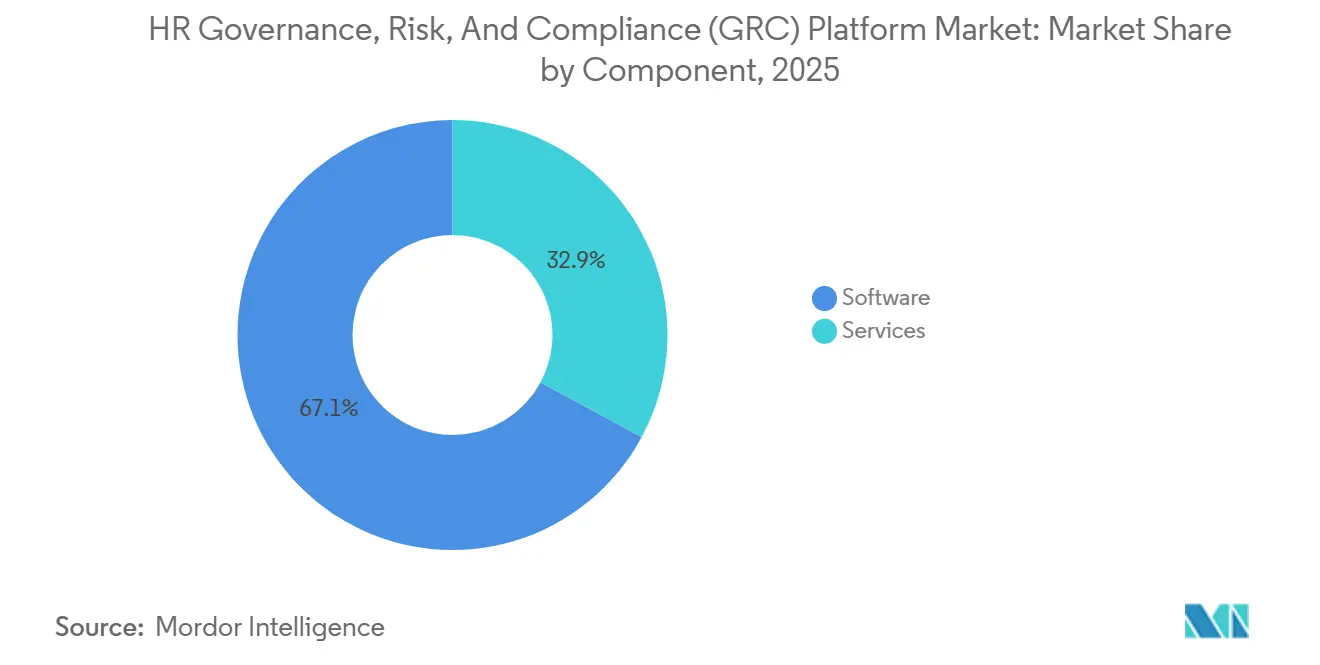
Software Dominates as Service Demand GrowsSoftware held 67.14% of the market in 2025, which shows that buyers continue to prefer configurable recurring platforms over project-led engagement models. This segment led because policy records, investigation histories, attestation trails, and pay governance data become harder to move once centralized in a single system. That creates meaningful switching costs and helps software vendors retain long-term accounts in the HR Governance, Risk, and Compliance (GRC) Platform Market. Software also benefits from the need for standardized controls, internal analytics, and reusable workflow templates that can scale across regions and business units.
Services are projected to grow at a 14.53% CAGR through 2031, which reflects the fact that regulatory complexity is still outpacing the bandwidth of many internal compliance teams. Advisory and managed services are gaining traction because buyers want help with ongoing monitoring, control updates, and program administration, rather than just one-time setup. Implementation and integration work remain central because HR Governance, Risk, and Compliance (GRC) Platform industry deployments often touch HR systems, legal review processes, hotline intake, and reporting layers simultaneously. Vendors are trying to reduce service dependency with faster configuration tools, and LogicGate’s agentic setup approach is one example of that push.
By Functionality:
Policy Management Leads as Pay Governance SurgesPolicy and procedure management accounted for 38.29% of revenue in 2025, giving it the largest share among functionality types. The broad position of this module is logical because every regulated employer needs version control, approvals, and employee attestation even before a complaint or investigation begins. In practice, policy management anchors many buying decisions in the HR Governance, Risk, and Compliance (GRC) Platform Market because other functions depend on a documented rule base. Competitive differentiation is shifting away from simple document storage and toward policy mapping, employee acknowledgment workflows, and tighter linkage with downstream cases.
Pay transparency and compensation governance are projected to grow at a 13.09% CAGR through 2031, making it the fastest-growing functionality. Employers are developing new processes for job evaluation criteria, pay-band governance, and compensation reporting because a static policy file is insufficient for ongoing disclosure obligations. Whistleblowing, case management, and analytics also work best when they are connected, since one complaint can trigger an investigation, require policy reference, and feed into outcome reporting in the same cycle. The HR Governance, Risk, and Compliance (GRC) Platform Market is rewarding vendors that can integrate these functions into a single evidence chain rather than treating them as separate tools.
By Deployment Mode:
Cloud Leads While Hybrid Expands FasterCloud-based deployment accounted for 66.18% of revenue in 2025, making it the leading deployment model across the HR Governance, Risk, and Compliance (GRC) Platform Market. Buyers favored cloud because it lowers infrastructure overhead, supports continuous updates, and makes centralized administration easier for distributed compliance teams. The model also supports faster benchmarking and reporting, which is important when employers need up-to-date views of case handling and policy status across locations. Even so, on-premises deployment still matters in public-sector and defense-adjacent settings where employee data access rules are more restrictive.
Hybrid deployment is projected to expand at a 13.85% CAGR through 2031, which reflects a practical response to data residency and sovereignty concerns. Employers that operate under GDPR, China’s PIPL, or India’s DPDPA often need a structure that keeps sensitive employee data under tighter local control while still using cloud analytics and workflow layers. The European Data Protection Board kept international transfer assessments in focus through its guidance on the interaction between territorial scope and cross-border transfers, which reinforced the need for stronger documentation around employee data movement. This is why hybrid is becoming a workable middle ground in the HR Governance, Risk, and Compliance (GRC) Platform Market, especially for regulated multinationals.
By Organization Size:
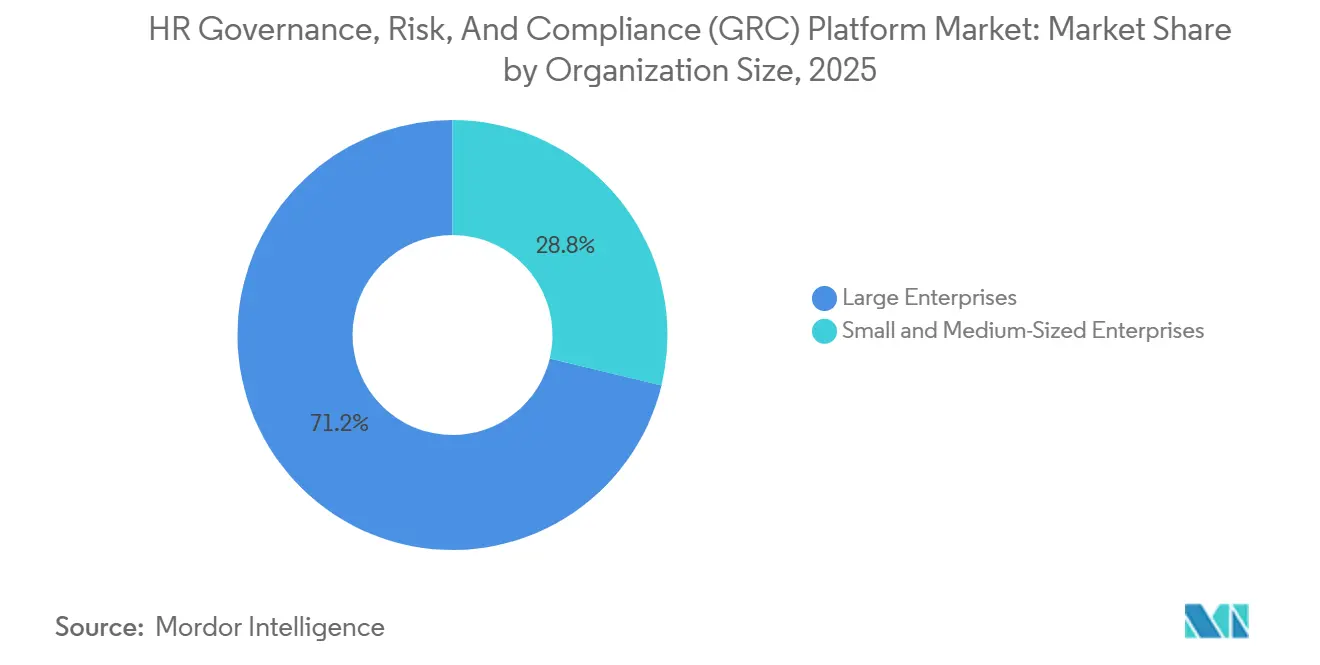
Large Enterprises Lead as SME Urgency BuildsLarge enterprises held a 71.23% share in 2025, keeping them at the center of spending in the HR Governance, Risk, and Compliance (GRC) Platform Market. These buyers moved earlier because they face overlapping obligations across multiple countries, multiple labor regimes, and multiple internal stakeholders. Their scale also makes manual documentation harder to sustain, especially across hotline reporting, investigations, compensation governance, and employee data controls. Large employers, therefore, remain the main revenue base for platforms that can standardize controls while preserving local accountability.
SMEs are projected to grow at a 14.11% CAGR through 2031, making them the fastest-growing segment by organization size. A major reason is that the compliance scope is moving down-market, with whistleblower channel obligations and pay transparency expectations extending to smaller employers in Europe and other regulated jurisdictions. This shift is widening the addressable base for tools that can be deployed quickly without a large compliance team or a long consulting cycle. The HR Governance, Risk, and Compliance (GRC) Platform Market is therefore seeing faster momentum in simplified products built for smaller organizations that still need auditable controls.
By Industry Vertical:
IT and Telecom Leads as Healthcare AcceleratesInformation technology and telecommunications accounted for 36.77% of 2025 revenue, making it the largest vertical. This vertical faces high exposure to AI-assisted hiring, employee monitoring, contractor classification, and equity-sensitive compensation, all of which increase governance needs. It also tends to operate across borders and fast-moving talent models, underscoring the need for repeatable controls in the HR Governance, Risk, and Compliance (GRC) Platform Market. As a result, technology employers were early adopters of integrated platforms that connect workforce governance with case documentation and reporting.
The healthcare and life sciences sector is projected to expand at a 12.78% CAGR through 2031, making it the fastest-growing vertical. The HHS Office for Civil Rights announced in April 2026 that it settled 4 HIPAA Security Rule ransomware investigations and expanded its Risk Analysis Initiative to include documented risk management, raising the standards for evidence and remediation.[2] BFSI remains structurally important because of fit-and-proper, suitability, and conduct obligations, which create auditable HR governance requirements that require consistent oversight. Manufacturing and retail also support demand through large employee populations, higher case volume, and frequent disputes around safety, scheduling, and worker classification.
Geography Analysis
North America HR Governance, Risk, and Compliance (GRC) Platform Market
North America held 35.68% of the HR Governance, Risk, and Compliance (GRC) Platform market share in 2025, making it the largest regional contributor. The United States accounted for most of that spending because federal and state employment rules keep policy control, reporting, and case management requirements active across large employers. Canada added demand as pay transparency measures widened the need for repeatable reporting and compensation governance workflows. Mexico added another layer for multinationals that needed consistent worker-protection records and documented processes across North American operations.
Europe HR Governance, Risk, and Compliance (GRC) Platform Market
Europe was the second-largest region in the HR Governance, Risk, and Compliance (GRC) Platform Market in 2025. The pay transparency transposition cycle, whistleblower enforcement, and tighter review of employment AI are shaping demand in Europe. The European Commission highlighted stronger enforcement momentum when the EU Court of Justice imposed combined fines of EUR 39 million (USD 44 million) on 5 member states for the delayed transposition of whistleblower legislation.[3] Germany, France, and the United Kingdom remain the largest country opportunities because they combine large employer bases with dense compliance obligations. Works council reviews and local labor consultation practices can slow deployment, increasing the need for localized workflow support and structured employee data governance.
APAC, South America and MEA HR Governance, Risk, and Compliance (GRC) Platform Market
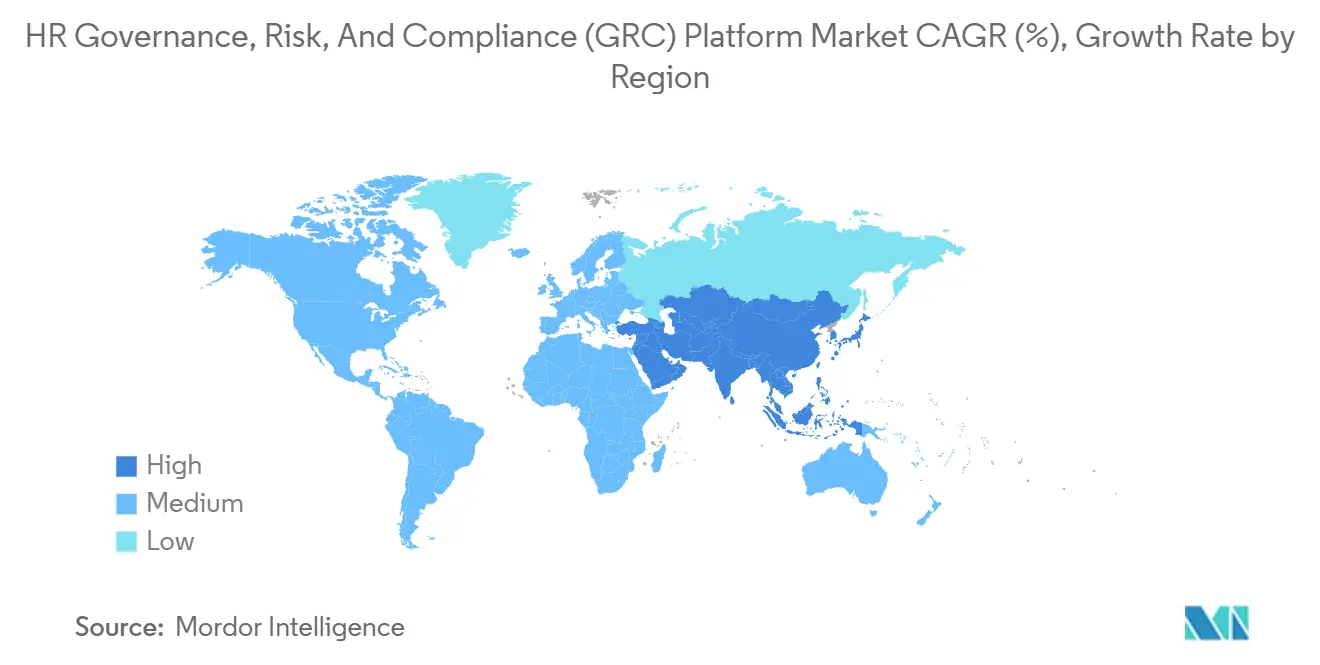
Asia-Pacific is projected to grow at a 13.44% CAGR through 2031, making it the fastest-growing region in the HR Governance, Risk, and Compliance (GRC) Platform market over the forecast period. Regional growth is tied to multinational expansion, fragmented national labor frameworks, and rising scrutiny of employee data handling across India, Japan, South Korea, Australia, and New Zealand. South America remains an emerging opportunity, led by Brazil and Argentina, where global employers are formalizing workforce governance and documentation standards. The Middle East and Africa still represent a smaller base, but the UAE and Saudi Arabia are widening demand as labor protection and broader workforce governance expectations become more structured.
Competitive Landscape
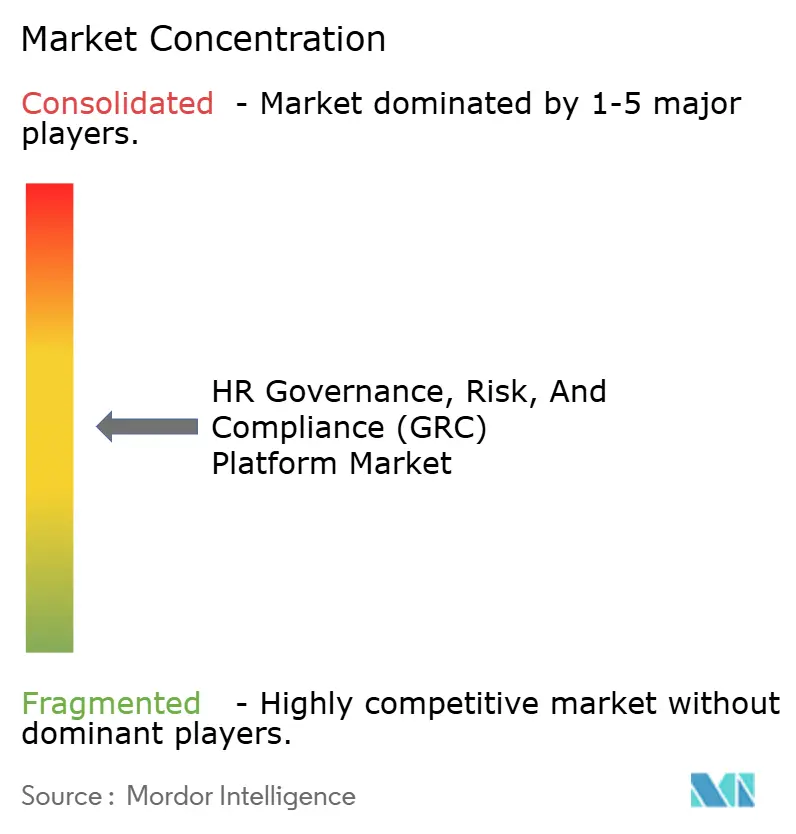
The HR Governance, Risk, and Compliance (GRC) Platform Market shows moderate concentration at the enterprise tier and broader fragmentation across the mid-market and SME tiers. NAVEX Global and Mitratech remain the most visible integrated platform vendors in large accounts because they combine wide module coverage with established enterprise relationships. NAVEX strengthened that position in October 2025 when a consortium led by Goldman Sachs Alternatives, with Blackstone as a significant minority investor, completed a majority-stake acquisition intended to support global expansion and AI-powered platform development. NAVEX also said its platform was trusted by 13,000 organizations, including 75% of Fortune 100 and 500 companies, indicating a strong installed base in large enterprise compliance programs. This installed base matters because it supports cross-sell opportunities, recurring workflow data, and stronger buyer confidence in long-cycle purchases.
Mitratech raised the competitive bar in March 2026 when it launched its Global GRC Platform, bringing together enterprise risk management, AI governance, cyber and IT risk, ethics and whistleblowing, policy management, operational resilience, third-party risk, and compliance training under a single interface. Diligent followed the same broad-platform direction in April 2026 with an AI Board Member and a coordinated agentic GRC workforce embedded across Diligent One.[4] LogicGate addressed implementation friction in April 2026 by introducing Config Newton, which it said could reduce implementation time-to-value by 25%. These moves show that breadth, AI-assisted execution, and faster deployment are becoming core differentiators in the HR Governance, Risk, and Compliance (GRC) Platform Market.
Specialist vendors still have meaningful room to improve on the workflow precision offered by horizontal suites, especially in pay governance, employee relations, and country-specific labor compliance. Syndio remains a notable specialist because it said its platform processes more than 10 million pay decisions for nearly 400 global enterprises, giving it meaningful data depth in compensation governance. HR Acuity also improved its competitive position in 2026 by joining the Workday Innovation Partner Program and announcing partnerships with ELMO Software and Rotageek, which strengthened its HCM connectivity and employee relations workflow reach. The HR Governance, Risk, and Compliance (GRC) Platform Market is therefore likely to reward vendors that combine specialized HR depth with strong integration into wider enterprise systems.
HR Governance, Risk, And Compliance (GRC) Platform Industry Leaders
-
NAVEX Global, Inc.
-
Mitratech Holdings, Inc.
-
Diligent Corporation
-
SAI Global Compliance, Inc.
-
HR Acuity, LLC
- *Disclaimer: Major Players sorted in no particular order
HR Governance, Risk, And Compliance (GRC) Platform Market Companies Covered in this Report
- NAVEX Global, Inc.
- Mitratech Holdings, Inc.
- HR Acuity, LLC
- ComplianceHR, LLC
- Resolver Inc.
- SAI Global Compliance, Inc.
- Ethena, Inc.
- Syndio Solutions, Inc.
- Trusaic, Inc.
- EQS Group AG
- VinciWorks Ltd.
- Whistleblowing Solutions AB
- WorkBright, Inc.
- AllVoices, Inc.
- GAN Integrity Inc.
- LogicGate, Inc.
- Riskonnect, Inc.
- Safecall Ltd.
- LRN Corporation
- Diligent Corporation
Recent Industry Developments in HR Governance, Risk, And Compliance (GRC) Platform Market
- April 2026: Diligent unveiled AI Board Member, a secure AI assistant for directors, and a coordinated agentic GRC workforce embedded across the Diligent One Platform at its Elevate 2026 conference. General availability of autonomous agents is expected in fall 2026, with agents automating multi-step workflows across governance, risk, compliance, and third-party management.
- April 2026: LogicGate introduced Config Newton, the market's first agentic GRC engineer, capable of reducing implementation processes that previously took weeks down to days. The agent is currently deployed by LogicGate's implementation team and is planned for customer access in 2027.
- March 2026: Mitratech launched its Global GRC Platform, unifying enterprise risk management, AI governance, cyber and IT risk, ethics and whistleblowing, policy management, operational resilience, third-party risk, and compliance training under a single interface featuring the ARIES agentic AI ecosystem for more than 8,300 organizations across 75 countries.
- March 2026: GAN Integrity launched AI Analytics and Dashboards, enabling compliance and third-party risk management teams to measure and visualize program effectiveness in real time, leveraging compliance data intelligence that aligns with the US Department of Justice's growing emphasis on data-driven program effectiveness.
Global HR Governance, Risk, And Compliance (GRC) Platform Market Report Scope
The HR Governance, Risk, and Compliance (GRC) Platform Market encompasses systems that address workforce-related risks, policy enforcement, and regulatory adherence. These platforms unify functions like case management, whistleblowing, policy oversight, pay governance, and compliance analytics. Organizations leverage HR GRC solutions to boost transparency, minimize legal risks, and align workforce practices with governance benchmarks. The market's growth is bolstered by rising compliance demands, Environmental, Social, and Governance (ESG) reporting, and a heightened emphasis on ethics and risk management.
The HR Governance, Risk, and Compliance (GRC) Platform Market Report is Segmented by Component (Software, and Services [Implementation and Integration Services, Advisory and Managed Services, and Training and Support Services]), Functionality (Policy and Procedure Management, Whistleblowing and Incident Management, Employee Relations Case Management, Pay Transparency and Compensation Governance, Analytics and Reporting, and Other Functionalities), Deployment Mode (Cloud-Based, On-Premises, and Hybrid), Organization Size (Large Enterprises, and Small and Medium-Sized Enterprises), Industry Vertical (Banking, Financial Services, and Insurance, Healthcare and Life Sciences, Information Technology and Telecommunications, Retail and E-commerce, Manufacturing, and Other Industry Verticals), and Geography (North America, South America, Europe, Asia-Pacific, Middle East, and Africa). The Market Forecasts are Provided in Terms of Value (USD).
Segmentation Overview
| Software | |
| Services | Implementation and Integration Services |
| Advisory and Managed Services | |
| Training and Support Services |
| Policy and Procedure Management |
| Whistleblowing and Incident Management |
| Employee Relations Case Management |
| Pay Transparency and Compensation Governance |
| Analytics and Reporting |
| Other Functionalities |
| Cloud-Based |
| On-Premises |
| Hybrid |
| Large Enterprises |
| Small and Medium-Sized Enterprises |
| Banking, Financial Services, and Insurance |
| Healthcare and Life Sciences |
| Information Technology and Telecommunications |
| Retail and E-commerce |
| Manufacturing |
| Other Industry Verticals |
| North America | United States |
| Canada | |
| Mexico | |
| South America | Brazil |
| Argentina | |
| Chile | |
| Rest of South America | |
| Europe | United Kingdom |
| Germany | |
| France | |
| Italy | |
| Spain | |
| Russia | |
| Rest of Europe | |
| Asia-Pacific | China |
| Japan | |
| India | |
| South Korea | |
| Australia and New Zealand | |
| Rest of Asia-Pacific | |
| Middle East | United Arab Emirates |
| Saudi Arabia | |
| Turkey | |
| Rest of Middle East | |
| Africa | South Africa |
| Nigeria | |
| Rest of Africa |
| By Component | Software | |
| Services | Implementation and Integration Services | |
| Advisory and Managed Services | ||
| Training and Support Services | ||
| By Functionality | Policy and Procedure Management | |
| Whistleblowing and Incident Management | ||
| Employee Relations Case Management | ||
| Pay Transparency and Compensation Governance | ||
| Analytics and Reporting | ||
| Other Functionalities | ||
| By Deployment Mode | Cloud-Based | |
| On-Premises | ||
| Hybrid | ||
| By Organization Size | Large Enterprises | |
| Small and Medium-Sized Enterprises | ||
| By Industry Vertical | Banking, Financial Services, and Insurance | |
| Healthcare and Life Sciences | ||
| Information Technology and Telecommunications | ||
| Retail and E-commerce | ||
| Manufacturing | ||
| Other Industry Verticals | ||
| By Geography | North America | United States |
| Canada | ||
| Mexico | ||
| South America | Brazil | |
| Argentina | ||
| Chile | ||
| Rest of South America | ||
| Europe | United Kingdom | |
| Germany | ||
| France | ||
| Italy | ||
| Spain | ||
| Russia | ||
| Rest of Europe | ||
| Asia-Pacific | China | |
| Japan | ||
| India | ||
| South Korea | ||
| Australia and New Zealand | ||
| Rest of Asia-Pacific | ||
| Middle East | United Arab Emirates | |
| Saudi Arabia | ||
| Turkey | ||
| Rest of Middle East | ||
| Africa | South Africa | |
| Nigeria | ||
| Rest of Africa | ||
Key Questions Answered in the Report
What is the size outlook for the HR Governance, Risk, and Compliance (GRC) Platform Market?
The HR Governance, Risk, and Compliance (GRC) Platform Market was valued at USD 4.39 billion in 2025 and is projected to reach USD 8.85 billion by 2031 at a 12.41% CAGR.
Which component leads spending in HR GRC platforms?
Software led with 67.14% share in 2025 because buyers prefer recurring, configurable platforms with higher switching costs once compliance data is centralized.
Which functionality is growing the fastest?
Pay transparency and compensation governance is projected to expand at a 13.09% CAGR through 2031 as employers prepare for more structured pay reporting and governance obligations.
Why is hybrid deployment gaining traction?
Hybrid is projected to grow at a 13.85% CAGR because employers want cloud flexibility while keeping sensitive employee data under tighter local control.
Which end-user group is creating the fastest new demand?
SMEs are projected to grow at a 14.11% CAGR as compliance obligations increasingly reach smaller employers that need fast and auditable deployment models.
Which region is expanding the fastest through 2031?
Asia-Pacific is projected to grow at a 13.44% CAGR as multinational employers expand in the region and face fragmented national compliance requirements.