
Hospital Linen Supply And Management Services Market Size and Share
Market Overview
| Study Period | 2020 - 2031 |
|---|---|
| Market Size (2026) | USD 13.41 Billion |
| Market Size (2031) | USD 20.09 Billion |
| Growth Rate (2026 - 2031) | 8.42 % |
| Fastest Growing Market | North America |
| Largest Market | Asia-Pacific |
| Market Concentration | Medium |
Major Players *Disclaimer: Major Players sorted in no particular order Image © Mordor Intelligence. Reuse requires attribution under CC BY 4.0. | |
Hospital Linen Supply And Management Services Market Analysis by Mordor Intelligence
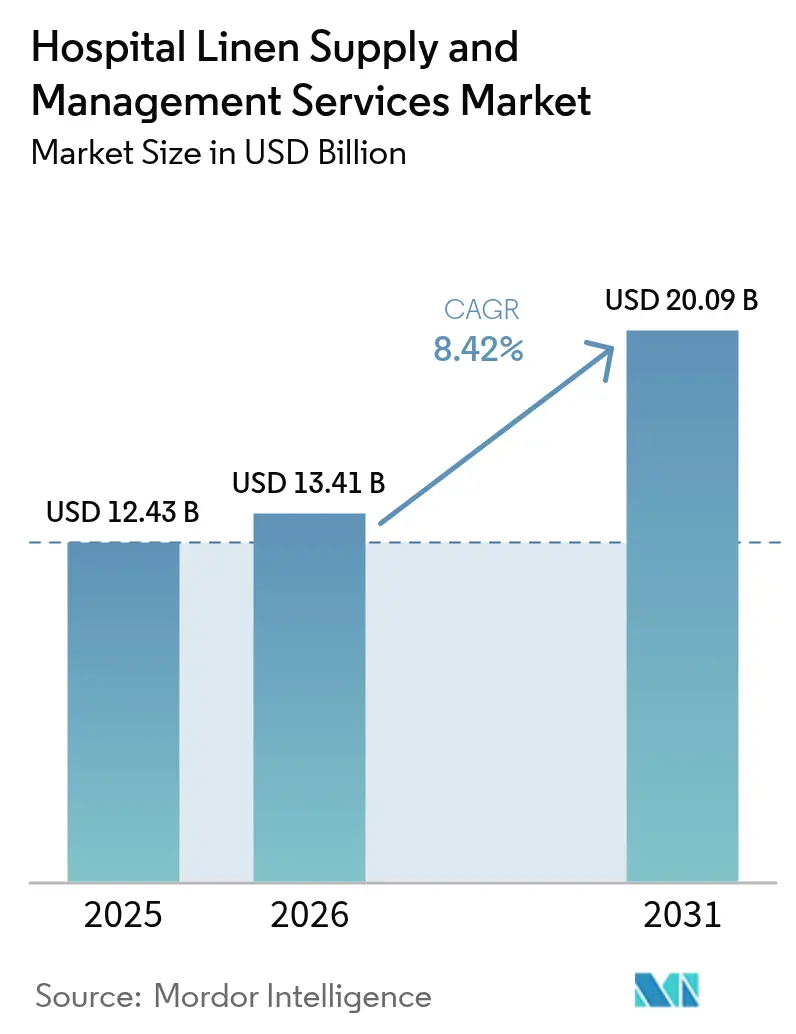
The Hospital Linen Supply And Management Services Market size is projected to expand from USD 12.43 billion in 2025 and USD 13.41 billion in 2026 to USD 20.09 billion by 2031, registering a CAGR of 8.42% between 2026 to 2031.
Demand is expanding as aging populations drive higher bed-occupancy, hospitals outsource to avoid multi-million-dollar laundry investments, and regulators tighten infection-control rules. Outsourcing cuts per-kilogram processing costs by 13% in mid-size facilities and frees capital for clinical priorities. RFID tracking delivers a 33% labor savings and a 20% reduction in linen procurement costs, yet adoption lags in over half of North American hospitals, creating a technology arbitrage for early movers.
Key Report Takeaways
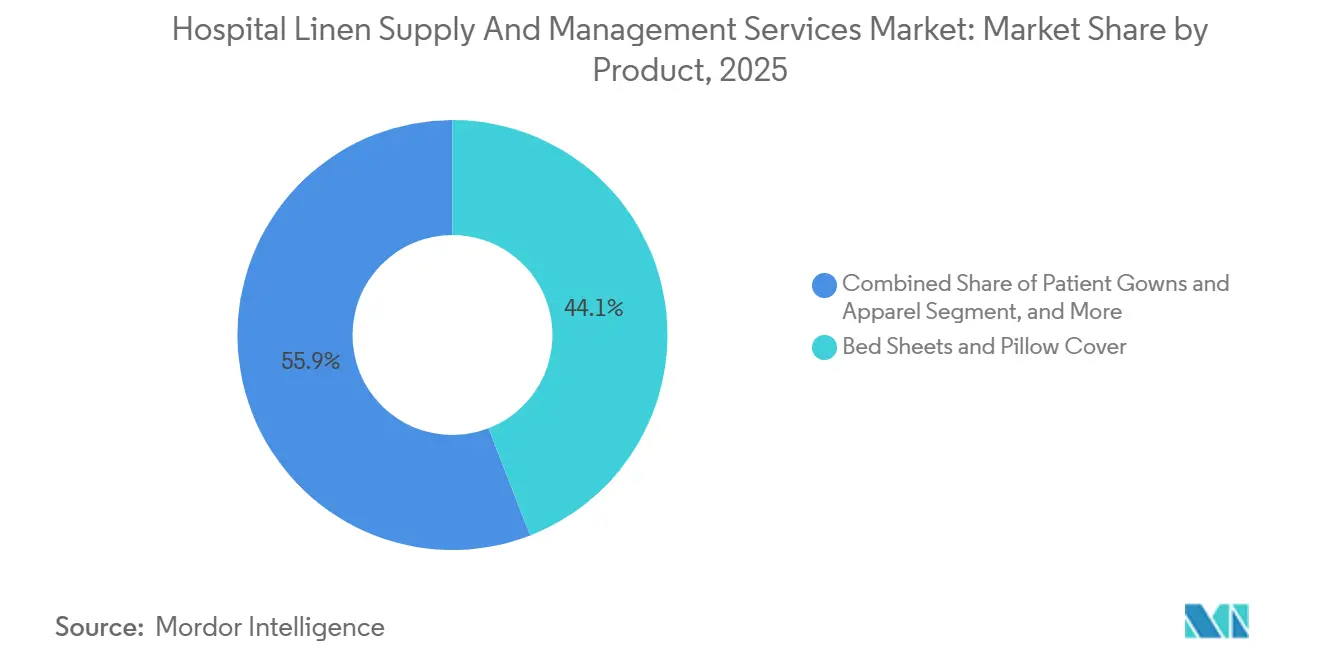
- By product category, bed sheets & pillow covers held 44.12% of the hospital linen supply and management services market share in 2025, while patient gowns & apparel are forecast to expand at a 9.20% CAGR through 2031.
- By material, woven cotton & blends accounted for 72.05% of the hospital linen supply and management services market size in 2025; non-woven disposables are projected to grow at a 9.47% CAGR to 2031.
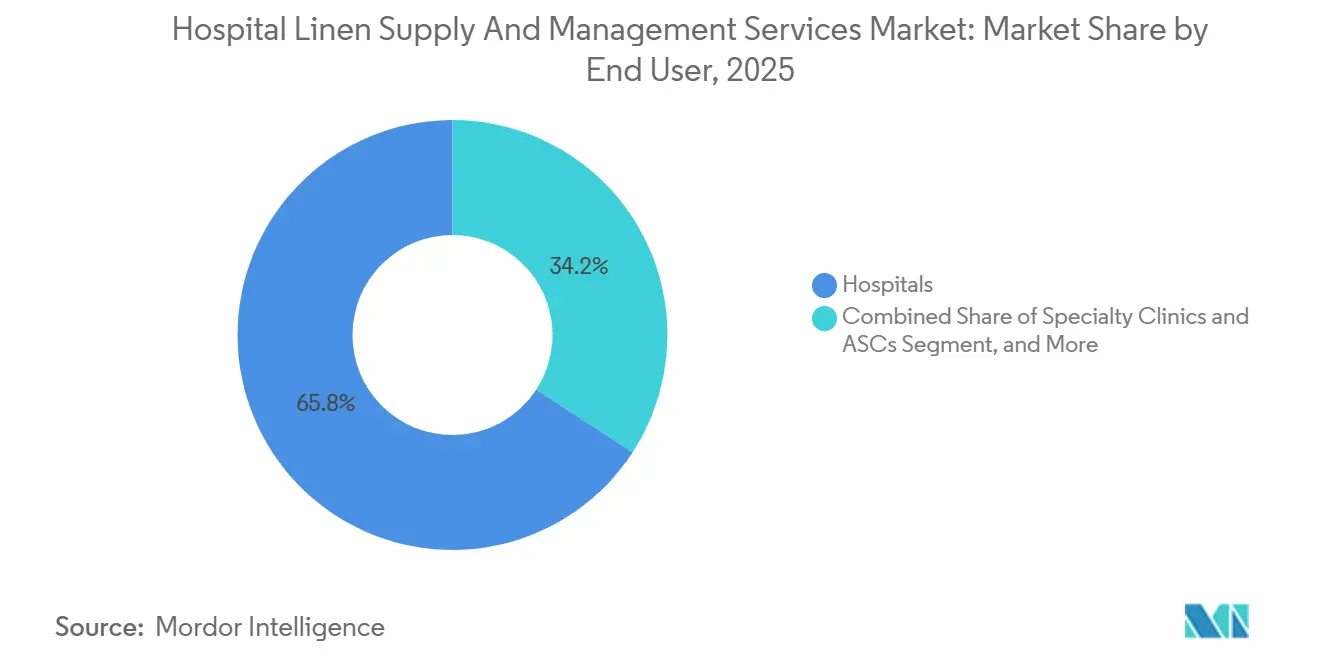
- By end user, hospitals commanded a 65.82% share in 2025, whereas specialty clinics & ASCs record the highest projected CAGR at 10.58% through 2031.
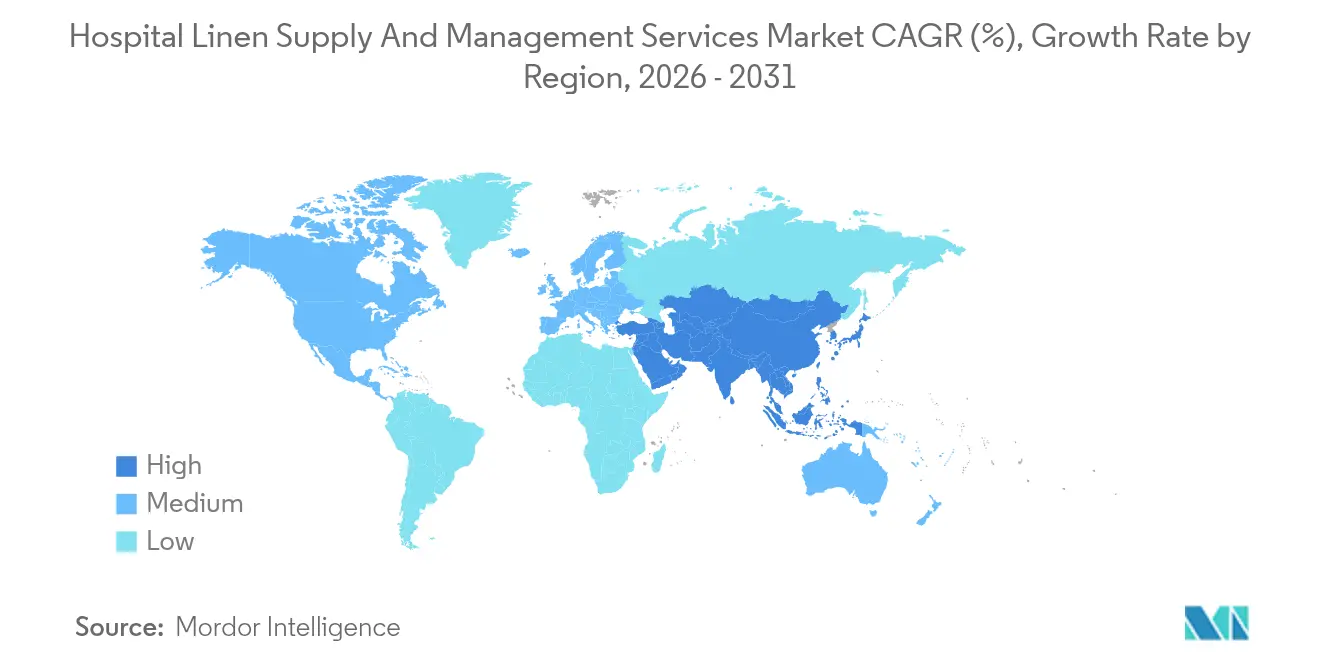
- By geography, North America captured 41.05% revenue in 2025; Asia-Pacific is advancing at a 10.97% CAGR to 2031.
Note: Market size and forecast figures in this report are generated using Mordor Intelligence’s proprietary estimation framework, updated with the latest available data and insights as of 2026.
Market Trends and Insights
Drivers Impact Analysis of Hospital Linen Supply And Management Services Market*
| Driver | (~) % Impact on CAGR Forecast | Geographic Relevance | Impact Timeline |
|---|---|---|---|
| Rising Hospitalization Rates Amplified by Aging Population | +1.8% | Global, concentration in North America, Europe, Japan | Long term (≥ 4 years) |
| Stringent Infection Control Regulations Mandating Hygienic Linens | +1.5% | Global, led by North America and EU | Medium term (2-4 years) |
| Cost Optimization Push Driving Outsourcing of Linen Services | +1.3% | Global, rapid in Asia-Pacific and Latin America | Medium term (2-4 years) |
| Expansion of Healthcare Infrastructure in Emerging Economies | +1.2% | Asia-Pacific core, spillover to Middle East & Africa | Long term (≥ 4 years) |
| Adoption of RFID-Enabled Tracking Increasing Service Efficiency | +0.9% | North America, Europe early; APAC following | Short term (≤ 2 years) |
| Circular Economy Initiatives Favoring Reusable Linen Programs | +0.8% | EU-led, growing in North America and select APAC | Long term (≥ 4 years) |
| Source: Mordor Intelligence | |||
Rising Hospitalization Rates Amplified by Aging Population
The number of people aged 75 and older will rise by 49.9% in the United States by 2037, a cohort that consumes 2.5 times as many inpatient days as younger adults, driving bed occupancy toward 85%.[1] Each occupied bed produces 9-12 pounds of soiled textiles a day. Longer stays tied to chronic diseases increase linen-change frequency, forcing hospitals either to add on-premises laundries costing USD 2 million per 100 beds or to pivot to HLAC-accredited vendors. China’s 60+ population will exceed 300 million by 2030, mirroring the same demand trajectory. As demographic pressure builds, the hospital linen supply and management services market is poised for structural, volume-driven growth.
Stringent Infection Control Regulations Mandating Hygienic Linens
CDC guidelines require 160 °F for 25 minutes or EPA-registered chemistries during laundering, while the Joint Commission obliges quarterly microbial testing and HLAC accreditation for suppliers.[2]These mandates drive capital investment into tunnel washers, ozone injection, and ISO 15797 quality protocols. Antimicrobial textiles infused with copper or silver reduce MRSA and C. difficile transmission by up to 40% and are gaining FDA clearance.[3] Higher up-front linen costs are offset by fewer hospital-acquired infections, aligning economic incentives with regulatory compliance and fueling premium-product demand within the hospital linen supply and management services market.
Cost Optimization Push Driving Outsourcing of Linen Services
A 300-bed Indian hospital cut annual linen expenses by USD 16,800 by outsourcing at USD 0.48 per kilogram, down from USD 0.55 in-house, for a 13% saving. The Texas Medical Center Laundry Co-Op processes 42 million pounds annually for 21 hospitals and saved USD 230,000 in utilities during its first year on a low-temperature peracetic-acid system. Such data confirm that outsourcing unlocks economies of scale, protects margins in value-based reimbursement models, and expands the hospital linen supply and management services market footprint beyond traditional acute-care segments.
Expansion of Healthcare Infrastructure in Emerging Economies
China added 13,000 new hospitals by 2025, and India aims to add 3 million additional beds under Ayushman Bharat. GCC spending will reach USD 159 billion by 2029, adding over 12,000 beds, 69% in Saudi Arabia. New facilities embed long-term linen contracts at the design phase, ensuring multi-year volume visibility for providers operating in the hospital linen supply and management services market.
Restraints Impact Analysis of Hospital Linen Supply And Management Services Market*
| Restraint | (~) % Impact on CAGR Forecast | Geographic Relevance | Impact Timeline |
|---|---|---|---|
| High Initial Capital Required for On-Premise Laundry Automation | -0.6% | Global, acute in small-to-medium hospitals | Medium term (2-4 years) |
| Fluctuating Cotton Prices Affecting Linen Procurement Costs | -0.5% | Global, import-dependent regions | Short term (≤ 2 years) |
| Shortage of Skilled Laundry Workforce in Urban Hospitals | -0.4% | North America, Europe, emerging APAC metros | Medium term (2-4 years) |
| Environmental Concerns Over Water & Energy Use Prompting Scrutiny | -0.3% | EU-led, spread to water-stressed areas | Long term (≥ 4 years) |
| Source: Mordor Intelligence | |||
High Initial Capital Required for On-Premise Laundry Automation
A 100-bed hospital needs USD 2-3 million for tunnel washers, dryers, and finishing lines, plus 5,000 square feet of utility-heavy space. Sub-500-bed facilities cannot amortize these costs, so outsourced providers scale faster, thereby widening the addressable market for hospital linen supply and management services.
Fluctuating Cotton Prices Affecting Linen Procurement Costs
The Cotlook A-Index fell to USD 0.80 per pound in March 2025, yet tariffs on finished textiles add 10-15%, squeezing laundries locked into multi-year fixed-price contracts. Operators hedge by shifting toward polyester blends or sourcing from domestic mills—strategies that contain risk but may raise sustainability questions.
*Our forecasts treat driver/restraint impacts as directional, not additive. The impact forecasts reflect baseline growth, mix effects, and variable interactions.
Hospital Linen Supply And Management Services Market Segment Analysis
By Product:
Patient Gowns Propel Premium GrowthBed Sheets & Pillow Covers delivered 44.12% of 2025 revenue, underpinned by three sheet changes per occupied bed weekly. Patient Gowns & Apparel, however, will grow at 9.20% CAGR, the fastest pace in the hospital linen supply and management services market, as antimicrobial fabrics command premium pricing and hospitals prioritize patient dignity. Surgical Drapes & Wrappers show a structural move toward disposable polypropylene in trauma and cardiac theaters.
Commodity towels and blankets rise mainly with new-bed additions, but the growth edge lies in procedure-specific packs for orthopedic and ophthalmic ASCs that fetch USD 15-25 per kit. Vendors with FDA-cleared antimicrobial portfolios improve margins and enhance stickiness in the hospital linen supply and management services market.

By Material:
Disposable Non-Wovens AccelerateWoven Cotton & Blends owned 72.05% share in 2025 and remains essential for bed and bath linens due to comfort and moisture absorption. Non-Woven Disposables are set to grow 9.47% CAGR as infection-control stakes rise. ASTM-compliant polypropylene drapes offer viral-penetration resistance at a lower per-unit cost and eliminate laundering logistics from OR schedules.
Sustainability pressures moderate disposable adoption in Europe, where landfill levies exceed EUR 100 per ton, steering low-risk procedures back to reusables. Blended polyester-cotton offers price stability amid cotton volatility, though microplastic rules in California and the EU may restrain uptake. These cross-currents shape material strategy within the hospital linen supply and management services market.
By End User:
ASCs Outpace Acute-Care HospitalsHospitals generated 65.82% revenue in 2025, with large medical centers exceeding 15,000 pounds weekly throughput. Yet specialty clinics & ASCs will log a 10.58% CAGR to 2031 as Medicare channels orthopedic and ophthalmic procedures to outpatient settings.
ASCs need same-day turnaround and procedure-pack customization, a service that niche laundries monetize at higher per-pound rates. Long-term care facilities are shifting from in-house to outsourced laundry amid infection-control mandates, creating a new volume stream in the hospital linen supply and management services market for post-acute products such as incontinence pads and pressure-relief covers.
Geography Analysis
North America Hospital Linen Supply and Management Services Market
North America accounted for 41.05% of 2025 revenue, driven by mature outsourcing penetration above 60% and strict HLAC compliance. Private-equity deals such as PureStar’s 2026 acquisition of Emerald Textiles consolidate regional operators into multistate networks. Canada’s single-payer system standardizes linen protocols across provinces, while Mexico’s medical-tourism corridor raises quality benchmarks.
APAC Hospital Linen Supply and Management Services Market
Asia-Pacific, forecast at 10.97% CAGR, will become the fastest-growing region as China’s healthcare spending heads for USD 1.8 trillion by 2030 and India deploys 3 million new beds. Centralized laundry hubs near mega-hospitals in Shanghai and Delhi capture scale advantages, accelerating the diffusion of RFID and ozone technologies in the hospital linen supply and management services market.
EMEA and South America Hospital Linen Supply and Management Services Market
Europe faces slower unit growth but leads on sustainability mandates. Elis SA’s 440 plants across 29 countries capture multi-country contracts by offering traceable, low-impact wash chemistry. The Middle East & Africa benefits from USD 159 billion in GCC healthcare spending, with Saudi Arabia privatizing 290 hospitals by 2030 and generating greenfield contracts under long-term PPP models. South America’s fragmented provider base outsources linen to mitigate currency shocks and tariff costs, though equipment import duties constrain the pace of modernization.
Regulatory Landscape
Hospital linen processing sits within broader healthcare infection-prevention and worker-safety obligations, with oversight remaining with the healthcare facility even when services are outsourced. In the United States, CDC environmental infection-control guidance outlines parameters for hygienically clean healthcare textiles (including thermal and chemical disinfection approaches), while CMS survey and certification guidance places accountability on the governing body to ensure contracted services meet safe handling and infection-prevention requirements. These expectations typically flow into supplier qualification and auditing practices. OSHA requirements, including the Bloodborne Pathogens standard (29 CFR 1910.1030), also shape how laundry workers handle contaminated textiles, increasing demand for compliant workflows, training, and exposure-control programs.
In Europe, BS EN 14065 (RABC) is widely used as a microbiological quality-management benchmark for reprocessed medical textiles, and is reinforced through national health-system guidance such as NHS linen decontamination and processing documents. Across developed markets, accreditation and standards frameworks (for example, Joint Commission-aligned infection control expectations and RABC-based systems) support procurement requirements such as documented risk analysis, validated processes, and traceability. As a result, commercial laundries increasingly operate with auditable quality systems and controlled facility design, including ventilation practices often aligned with healthcare engineering norms such as ASHRAE 170 concepts for pressure relationships and air changes in critical areas.
Competitive Landscape
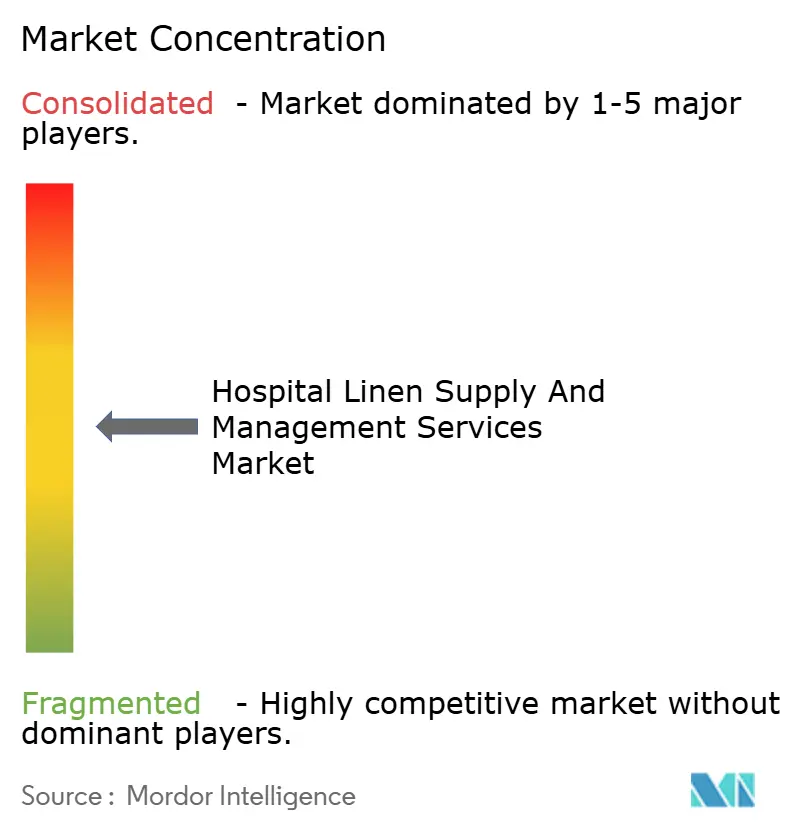
The hospital linen supply and management services market remains moderately concentrated. Private equity is reshaping ownership: PureStar’s 2026 Emerald Textiles deal created a 12-plant network with three depots, and The Pritzker Organization invested in Crown Health Care Laundry Services to assemble a Southeast U.S. platform. The strategy centers on RFID-enabled traceability, AI-driven predictive maintenance, and low-temperature peracetic-acid chemistry that reduces fabric damage by 30-50%.
White space persists in long-term care and home health bundles. NOVO Health Services purchased EcoBrite Linen in December 2025 to expand into nursing-home outsourcing, where penetration had just topped 20%. Disruptors deploy chipless RFID tags priced below USD 0.01, enabling economic tracking of single-use drapes and widening the competitive moat for innovators within the hospital linen supply and management services market.
Hospital Linen Supply And Management Services Industry Leaders
-
Unitex Textile Rental Services, Inc.
-
Emes Textiles Pvt. Ltd
-
ImageFIRST
-
Tetsudo Linen Service Co., Ltd
-
Angelica Corporation
- *Disclaimer: Major Players sorted in no particular order
Hospital Linen Supply And Management Services Market Companies Covered in this Report
- Alsco Inc.
- Angelica Corporation
- Aramark
- Crothall Healthcare (Compass Group)
- Crown Health Care Laundry Services
- Emes Textiles
- Emerald Textiles
- Elis SA
- Healthcare Linen Services Group
- HCSC Industrial Laundry
- ImageFIRST
- Medline Industries (Linen Services)
- Mission Linen Supply
- Rentokil Initial plc (Initial Medical)
- Stalbridge Linen Services
- Synergy Health (STERIS)
- Tetsudo Linen Supply Co., Ltd.
- Unitex Textile Rental Services
- Cintas Corporation
Read Analysis of Hospital Linen Supply And Management Services Companies
Market Opportunities and Future Outlook
Hospitals continue shifting from fragmented, in-house laundry management toward centralized, technology-enabled service models that bundle processing, inventory governance, and compliance documentation. One whitespace is utilization-based contracting enabled by item-level visibility, where RFID tracking supports par-level optimization and loss prevention while linking linen demand to census and surgery schedules. The market already shows quantified operating benefits from RFID deployments, including 33% labor savings and a 20% reduction in linen procurement costs, but adoption still lags in a large share of North American hospitals. Providers with scalable digital platforms can differentiate through real-time reporting for infection-prevention teams and finance leaders, rather than competing mainly on per-pound processing rates.
Sustainability and regulatory quality systems are also influencing vendor selection and product mix, particularly in Europe where BS EN 14065 (RABC) is a common benchmark for microbiological control in processed textiles. Circular-economy programs around reusable medical textiles create a second opportunity lane, with life-cycle evidence highlighting large waste reductions from reusable systems while shifting the focus to efficient reprocessing (water, energy, and chemistry intensity). On the supply side, healthcare linen networks are expanding through consolidation and capacity additions, illustrated by platform-building activity such as ImageFIRST expanding in Texas via acquisition and Unitex investing in plant capacity, which supports multi-site hospital systems seeking standardized service levels across regions.
Recent Industry Developments in Hospital Linen Supply And Management Services Market
- February 2026: TRSA highlighted Unitex developments tied to its plant network and modernization activities, reinforcing Unitex's emphasis on large-scale, purpose-built healthcare laundry capacity. Industry visibility around these projects supports customer confidence in capacity, compliance controls, and service continuity for multi-site health systems.
- December 2025: Unitex Textile Rental Services completed roof-lifting work at its 130,000-square-foot Hartford, Connecticut facility as a key step in a USD 21 million expansion. The project supports a move to more centralized, high-throughput processing, with stated capacity targeted at over 1.2 million pounds per week, strengthening Unitex's ability to serve dense hospital corridors.
- June 2024: ImageFIRST completed the acquisition of Imperial Linen Services, adding a 55,000-square-foot facility and expanding its healthcare laundry footprint in the Texas market. The deal deepens regional density and provides additional processing and logistics capacity that can be leveraged for standardized service delivery across health system accounts.
Hospital Linen Supply And Management Services Market Report Scope and Research Methodology
Market Definition and Coverage
For this study, the market covers outsourced hospital linen supply and management services that help healthcare facilities procure, process, distribute, and manage clean linen for patient care and clinical operations, with revenues captured on a service basis.
Scope exclusions: We exclude sales of linen as standalone products when no ongoing service component is attached.
Segments Covered in This Report
- By Product
- Bed Sheets & Pillow Cover
- Patient Gowns & Apparel
- Towels & Bath Linens
- Surgical Drapes & Wrappers
- Blankets
- Others
- By Material
- Woven Cotton & Blends
- Non-Woven Disposables
- Others
- By End User
- Hospitals
- Large Hospitals (>500 beds)
- Medium Hospitals (100-499 beds)
- Small Hospitals (<100 beds)
- Specialty Clinics & ASCs
- Long-Term Care & Rehab Centers
- Hospitals
- By Geography
- North America
- United States
- Canada
- Mexico
- Europe
- Germany
- United Kingdom
- France
- Italy
- Spain
- Rest of Europe
- Asia-Pacific
- China
- Japan
- India
- Australia
- South Korea
- Rest of Asia-Pacific
- Middle East & Africa
- GCC
- South Africa
- Rest of Middle East & Africa
- South America
- Brazil
- Argentina
- Rest of South America
- North America
Data Sources, Market Sizing, and Validation
Desk Research
Desk work starts by building a practical view of the demand pool for hospital linen services, then mapping it to service intensity. We pull foundational healthcare capacity signals, such as hospital counts, staffed beds, admissions, and procedure volumes, from public sources like the World Health Organization (WHO), the World Bank, OECD health statistics, and national health ministries and statistical offices.
To keep assumptions realistic, we also review infection prevention and laundering guidance from bodies such as the US CDC and similar public agencies, along with open publications from hospital associations and peer reviewed journals that discuss linen utilization and hygiene standards. Company annual reports, investor presentations, and reputable press are used to understand outsourcing mix and typical contract models. Where needed, we reference paid subscriptions for company financials and intelligence, and for patent databases to track process automation signals. The sources listed here are illustrative, and many other public references were used for cross checks, clarification, and validation.
Primary Interviews and Surveys
Primary conversations help confirm what the desk model cannot reliably show, especially how linen pounds processed per bed, changeover frequency, and service level expectations differ across regions and facility types. We spoke with operators, hospital procurement and infection control stakeholders, and logistics or laundry managers across APAC, EMEA, and the Americas. Their inputs were then used to align utilization, pricing, and outsourcing penetration assumptions.
Where answers did not line up, we re checked the underlying drivers and re contacted a smaller set of respondents to settle the ranges before finalizing totals.
Distribution of primary research fieldwork respondents
| Company type | Respondent position | Region |
|---|---|---|
| Top tier: 26% | CXOs: 18% | APAC: 45% |
| Mid tier: 56% | Functional/Unit leaders: 30% | EMEA: 31% |
| Smaller Players: 18% | Managers: 52% | Americas: 24% |
Market-Sizing & Forecasting
Sizing starts with a top down build where hospital capacity and activity indicators are converted into a serviceable linen workload, which is then filtered through outsourcing penetration to estimate addressable spend. The model uses a small set of repeatable inputs such as staffed beds, inpatient days, surgical procedure volumes, average linen weight processed per bed-day, pickup and delivery frequency, and average service price per pound or per piece (varies by contract style).
To keep the estimate grounded, we corroborate totals with selective bottom up checks, such as rolling up sampled provider revenues in key countries, sanity checking implied volumes against known laundry throughput ranges, and reviewing contract value ranges discussed in interviews. Where bottom up coverage is incomplete, gaps are handled through conservative penetration and price ranges anchored to the closest comparable country, then adjusted for wage and energy cost context.
For forecasting, scenario analysis is used because demand is shaped by both healthcare utilization and outsourcing decisions. We project the key drivers (bed additions, admissions, procedure recovery, and outsourcing share) and translate them into revenue using a measured price progression assumption that reflects labor, utilities, and compliance related cost pass through, as confirmed by primary inputs.
Data Validation & Update Cycle
Validation is done in a few simple passes so that outliers do not slip through. We compare outputs against independent signals like hospital capacity growth, healthcare spending direction, and implied linen processing intensity, and then investigate large swings at country level before sign off.
After the first build, the model is reviewed by another analyst who checks unit logic, conversions, and whether assumptions are consistent across regions. If major variances show up between desk inputs and interview feedback, respondents are re contacted and assumptions are tightened. The report is refreshed annually, with interim updates when material events occur, and a final pre delivery review is completed so clients receive the most current view.
Mordor Intelligence's Hospital Linen Supply and Management Services Market Size Versus Other Published Estimates
It is normal to see different market sizes for hospital linen supply and management services because publishers do not always measure the same revenue pool or the same timing. The biggest differences usually come from what gets counted as a service, how disposable linen is treated, which facilities are included beyond hospitals, and how pricing is converted into USD for a given year.
In this study, the gap drivers were checked in a practical way by aligning the demand pool to hospital activity and then validating utilization and price ranges with interviews. Some published numbers lean heavily on supplier revenue totals without reconciling them to bed-days and processing intensity, while others expand scope into broader healthcare laundry or general environmental services, which can lift the headline value.
Benchmark comparison
| Source | Market Size | Gaps in Research Methodology |
|---|---|---|
| Mordor Intelligence | USD 12.43 B (2025) | |
| Trade Journal A | USD 11.47 B (2024) | Uses an earlier base year and appears to mix product oriented line items (linen categories) with service revenues, which can shift totals depending on whether rental and processing are separated. |
| Industry Blog B | USD 12.90 B (2025) | Groups "linen and laundry" together and provides limited clarity on hospital only versus broader healthcare sites, which can inflate the spend pool when non hospital facilities are added. |
The spread largely comes from scope stitching and year anchoring rather than a real disagreement on demand direction. When hospital workload signals and outsourcing share are used as the starting point, and service revenue is separated from one time product sales, the estimate becomes easier to audit and repeat, which is the logic applied by Mordor Intelligence.
Key Questions Answered in the Report
What is the forecast value of the hospital linen supply and management services market in 2031?
The market is projected to reach USD 20.09 billion by 2031.
Which product segment is expanding fastest?
Patient Gowns & Apparel are forecast to grow at 9.20% CAGR through 2031.
Which region shows the highest growth rate?
Asia-Pacific is advancing at a 10.97% CAGR driven by large-scale hospital construction.
How does RFID improve linen operations?
Deployments cut labor costs by 33% and linen purchases by 20%, with payback in under two years.
Why are hospitals outsourcing linen services?
Outsourcing delivers 13% per-kilogram cost savings and removes the need for multi-million-dollar on-premise laundries.