
Healthcare Staffing Market Size and Share
Market Overview
| Study Period | 2020 - 2031 |
|---|---|
| Market Size (2026) | USD 48.16 Billion |
| Market Size (2031) | USD 65.82 Billion |
| Growth Rate (2026 - 2031) | 6.45 % |
| Fastest Growing Market | Asia-Pacific |
| Largest Market | North America |
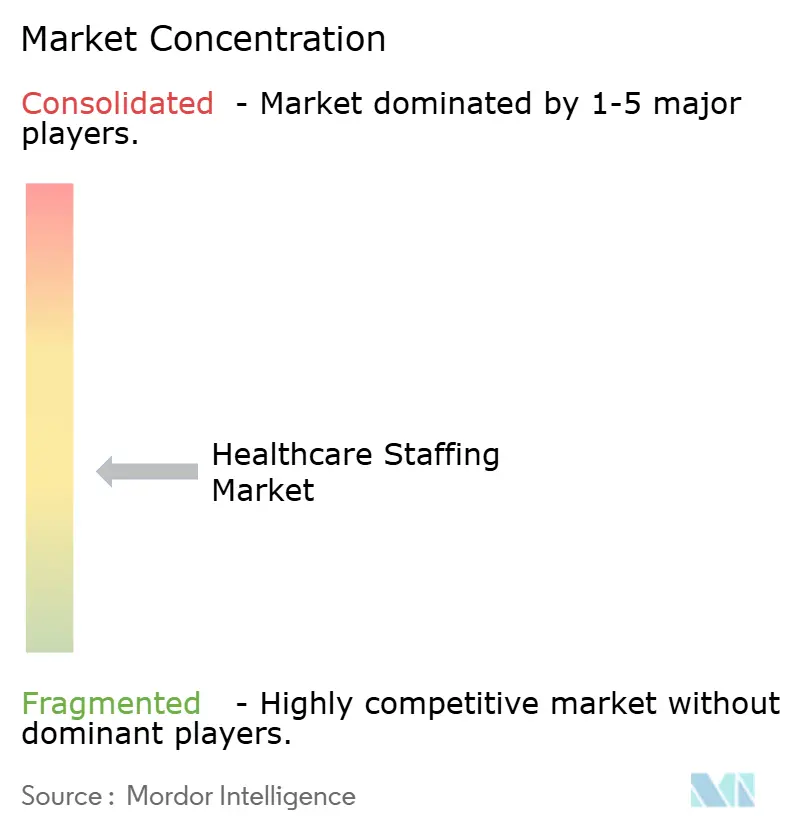
| Market Concentration | Medium |
Major Players *Disclaimer: Major Players sorted in no particular order Image © Mordor Intelligence. Reuse requires attribution under CC BY 4.0. | |
Healthcare Staffing Market Analysis by Mordor Intelligence
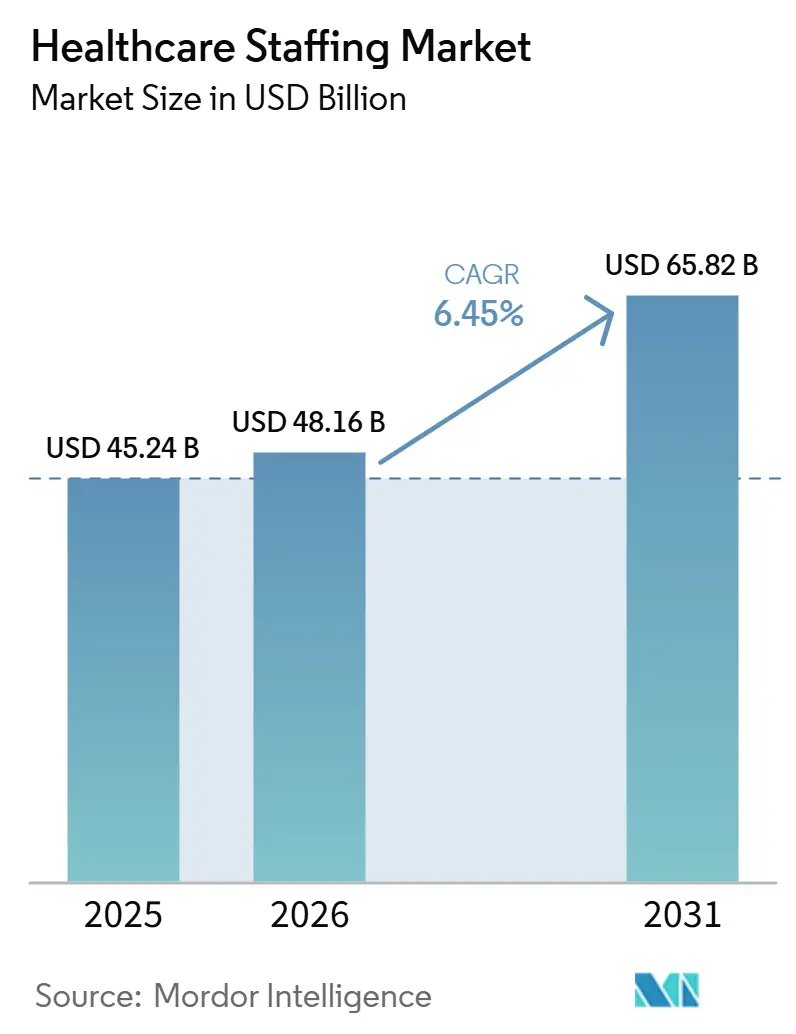
The healthcare staffing market size is expected to grow from USD 45.24 billion in 2025 to USD 48.16 billion in 2026 and is forecast to reach USD 65.82 billion by 2031 at 6.45% CAGR over 2026-2031. Persistent clinician shortages, regulatory staffing mandates, and the widening adoption of flexible labor models keep demand elevated across clinical and non-clinical roles. Hospitals, home-health agencies, and ambulatory centers now treat contingent labor as a core operational lever, using managed service provider frameworks and AI-enabled scheduling to stabilize coverage and reduce premium labor costs. Demographic shifts, notably the acceleration of the 65-plus population cohort, amplify service volumes while simultaneously shrinking the supply of experienced practitioners exiting the workforce. Technology investments—from predictive workforce analytics to integrated credentialing—lower time-to-fill metrics and deepen vendor differentiation, supporting steady expansion of the healthcare staffing market even as travel-nurse bill rates normalize. Intensifying consolidation among leading agencies signals a maturing competitive environment in which scale and digital capability influence client retention and margin performance.
Key Report Takeaways
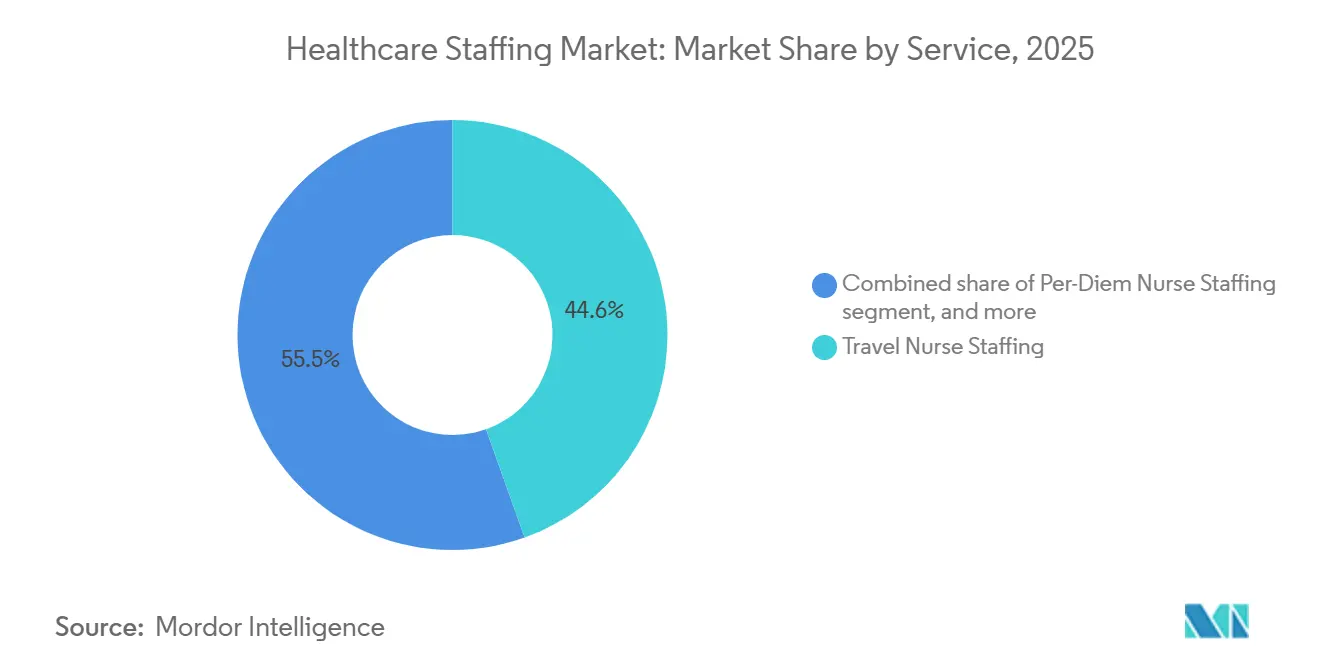
- By service, travel nurse staffing led with 44.55% revenue share in 2025, whereas locum tenens posted the fastest 8.12% CAGR through 2031.
- By end-user, hospitals held 41.88% of the healthcare staffing market share in 2025, while home-health agencies are projected to grow at 9.05% CAGR.
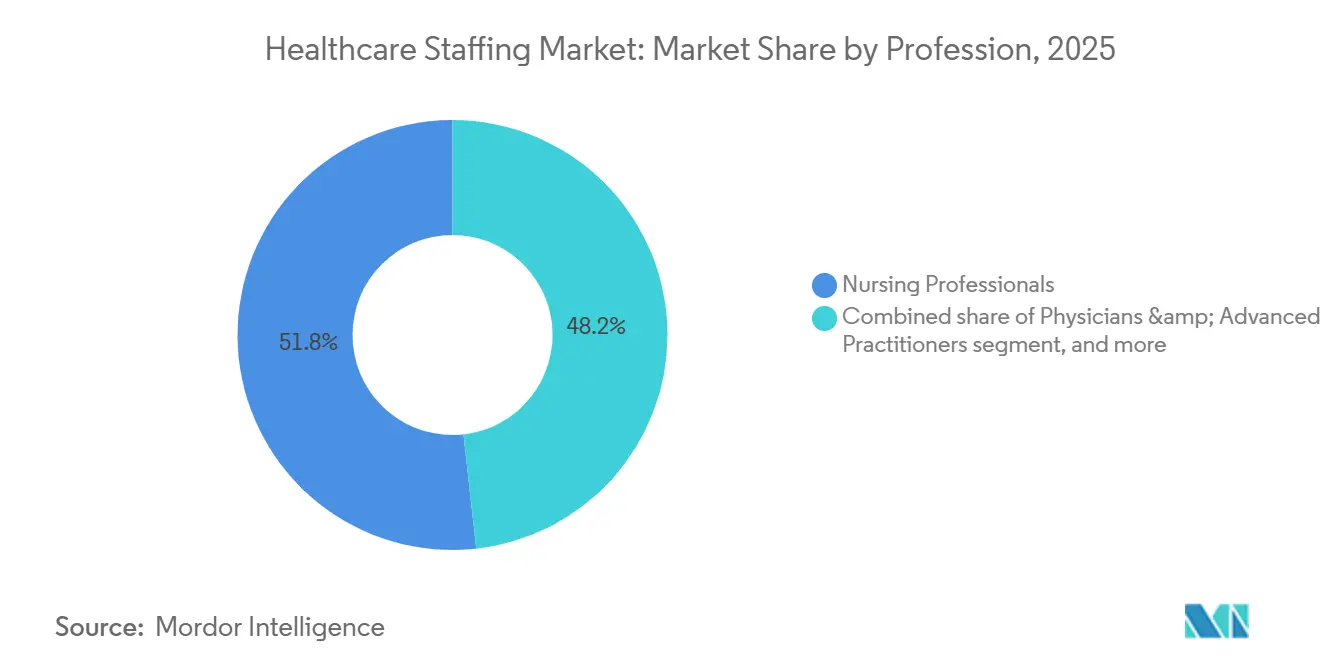
- By profession, nursing commanded 51.76% share of the healthcare staffing market size in 2025; physicians & advanced practitioners will expand 8.34% annually to 2031.
- By delivery mode, on-site models retained 59.72% revenue in 2025, yet remote/tele-staffing is rising at 8.96% CAGR.
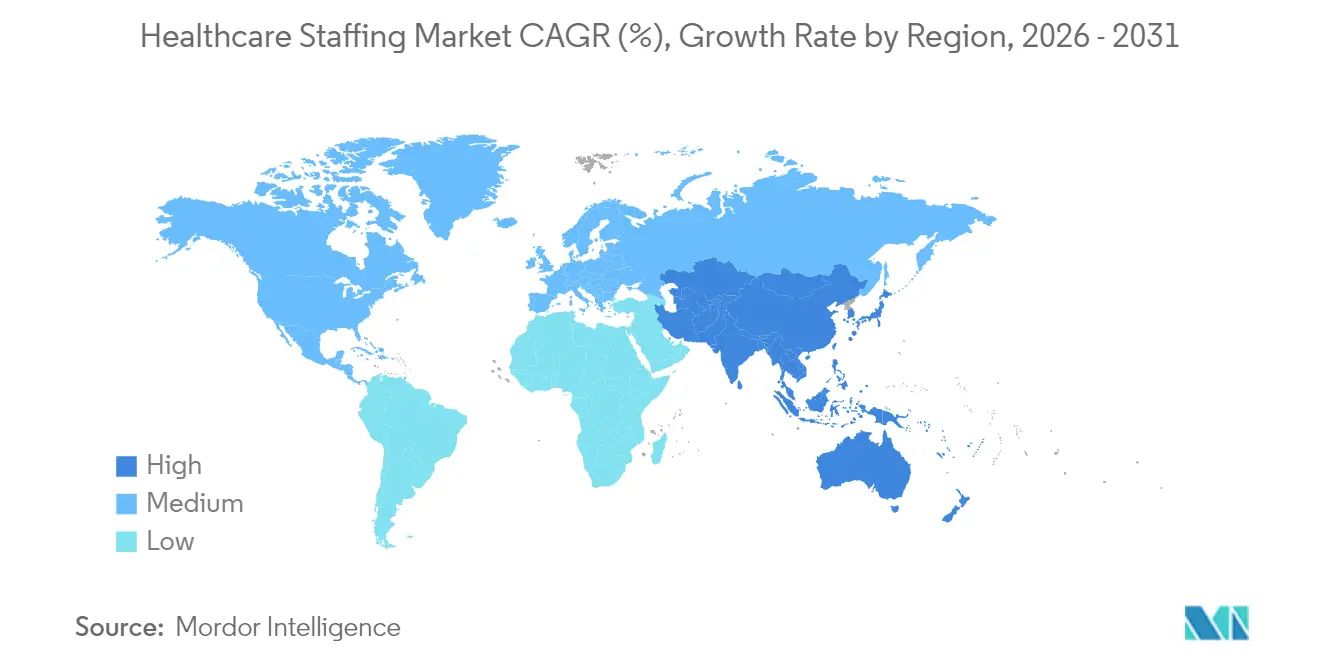
- By geography, North America accounted for 38.10% revenue in 2025; Asia-Pacific is the fastest-growing geography at 7.32% CAGR.
Note: Market size and forecast figures in this report are generated using Mordor Intelligence’s proprietary estimation framework, updated with the latest available data and insights as of 2026.
Global Healthcare Staffing Market Trends and Insights
Drivers Impact Analysis*
| Driver | % Impact on CAGR Forecast | Geographic Relevance | Impact Timeline |
|---|---|---|---|
| Aging population and rising healthcare demand | +1.8% | Global, concentrated in North America & Europe | Long term (≥ 4 years) |
| Increasing healthcare expenditure worldwide | +1.2% | Global, led by developed markets | Medium term (2-4 years) |
| Growing adoption of temporary staffing models for cost optimization | +1.5% | North America & EU, expanding to APAC | Medium term (2-4 years) |
| Technological advancements in recruitment platforms and workforce analytics | +0.9% | Global, early adoption in North America | Short term (≤ 2 years) |
| Regulatory push for quality care and staffing compliance | +0.7% | North America & Europe | Short-to-medium term (≤ 4 years) |
| Expansion of home healthcare and outpatient services | +1.0% | Global, strongest in North America & APAC | Medium term (2-4 years) |
| Source: Mordor Intelligence | |||
Aging Population and Rising Healthcare Demand
Surging longevity deepens care intensity: the United States will see adults aged 65 and older jump from 62 million to 84 million by 2045, while centenarians worldwide quadruple during the same horizon[1]Partners HealthCare, “Aging Population Implications,” partners.org. Older adults over 85 consume triple the care resources of the 65-74 group, driving continuous requisitions for nurses, therapists, and home-care aides. The Bureau of Labor Statistics projects 1.8 million new healthcare jobs each year to 2035, magnifying the recruitment burden[2]Bureau of Labor Statistics, “Employment Projections 2024-2034,” bls.gov. Rural systems, constrained by declining permanent-hire pipelines, collaborate with staffing firms to maintain service lines, particularly in critical-access hospitals. Retirements inside the clinician workforce intensify the gap, pushing agencies to expand international sourcing and cross-training programs.
Increasing Healthcare Expenditure Worldwide
Healthcare spending’s share of gross domestic product, led by the United States at a projected 19.7% of GDP by 2032, reinforces the resource pool available for outsourced labor even amid cost-containment scrutiny[3]Health Affairs, “National Health Expenditure Projections,” healthaffairs.org. Medicare outlays are rising 7.4% annually, spurring providers to balance revenue capture against escalating wage pressures. In contrast, the World Health Organization notes a decline in average per-capita public health spending after pandemic-era surges, prompting systems to toggle between permanent and contingent staff to ride fiscal cycles[4]World Health Organization, “Global Health Spending 2024 Update,” who.int. Temporary staffing contracts enable administrators to flex supply without locking long-term expense, safeguarding service continuity under budget ceilings.
Growing Adoption of Temporary Staffing Models for Cost Optimization
Eighty-two percent of hospital executives deploy locum tenens to bridge vacancies, with 46% citing revenue protection during recruitment lags. The 2024 federal nursing home staffing rule requiring 3.48 hours per resident immediately lifted demand for shift-based coverage, benefiting digital managed-service platforms that offer real-time roster visibility. Health systems recalibrate from high-cost travel contracts toward local or regional pools, using AI-driven rate benchmarking to contain premium pay while maintaining quality metrics.
Technological Advancements in Recruitment Platforms and Workforce Analytics
Artificial intelligence turbocharges the end-to-end hiring funnel: Incredible Health’s platform cuts nurse-placement time by 25% through predictive matching algorithms. Predictive analytics integrate admission forecasts and acuity trends, enabling proactive requisition posting and reducing overtime outlays. Aya Healthcare’s deployment of AI workforce management underpins its multi-year growth strategy and margin resilience. Generative AI now drafts job descriptions and surfaces passive talent, helping agencies identify niche clinicians in competitive subspecialties.
Restraints Impact Analysis*
| Restraints Impact Analysis | (~) % Impact on CAGR Forecast | Geographic Relevance | Impact Timeline |
|---|---|---|---|
| Persistent shortage of qualified healthcare professionals | -1.4% | Global, acute in rural areas | Long term (≥ 4 years) |
| Volatility in hospital budgets and reimbursement rates | -0.8% | North America & EU, regulatory-driven | Medium term (2-4 years) |
| Complex regulatory and credentialing requirements | -0.6% | Global, fragmented across jurisdictions | Short-to-medium term (≤ 4 years) |
| Rising competition and price pressures among staffing agencies | -0.5% | Global | Short term (≤ 2 years) |
| Source: Mordor Intelligence | |||
Persistent Shortage of Qualified Healthcare Professionals
The global deficit could exceed 10 million clinicians by 2030, with the United States alone lacking 195,400 nurses and up to 86,000 physicians in the same window. Education pipelines cannot expand rapidly enough, despite increased nursing school seats. Forty-three US states reported permanent provider closures in rural zones during 2024, underlining maldistribution challenges. International recruitment offers partial relief yet raises ethical questions about draining scarce talent from emerging economies and layers compliance complexity onto agency operations.
Volatility In Hospital Budgets and Reimbursement Rates
Labor already represents 60% of hospital operating costs and rose 22% between 2019 and 2022. Medicare’s 2025 home-health rate cut of 4.067% squeezes margins for agencies whose reimbursement mix skews heavily toward government payers. Providers operating below full census due to staffing caps confront a paradox: latent demand exists, yet cash-flow limitations hinder head-count growth, pushing many facilities to rely on overtime rather than fresh contingent contracts.
*Our forecasts treat driver/restraint impacts as directional, not additive. The impact forecasts reflect baseline growth, mix effects, and variable interactions.
Segment Analysis
By Service: Travel Nursing Stabilizes While Locum Tenens Accelerates
Travel nurse staffing retained 44.55% revenue in 2025 despite a correction from the 2022 pandemic peak. The segment declined from USD 42.7 billion to USD 25.6 billion, and average bill rates fell to USD 106.78. Analysts expect the healthcare staffing market size for travel nurses to level near USD 19.18 billion in 2026, signaling a new equilibrium as hospitals emphasize local float pools. Locum tenens, meanwhile, is pacing at 8.12% CAGR, buoyed by enduring physician shortages and flexible scheduling preferences. Nearly 52,000 doctors practiced as locums in 2024, filling emergency, psychiatry, and primary-care gaps. AI-enabled matching speeds credentialing and curbs idle time, strengthening agency economics across both service lines.
Demand for allied health professionals also rises as imaging, laboratory, and rehabilitation volumes expand, aided by broader scope-of-practice regulations. Per-diem nurse pools continue supporting weekend and surge demands where full-time hires would under-utilize capacity. Overall, each service tier now leans on advanced analytics to forecast site-level needs, enhancing utilization and client satisfaction while anchoring long-term growth trajectories inside the healthcare staffing market.



By End-user: Home-Health Agencies Drive Growth Amid Hospital Consolidation
Hospitals retained 41.88% of 2025 revenue, reflecting their status as the largest employer group. Yet federal minimum staffing mandates and reimbursement headwinds push administrators toward cost-efficient roster models, including integrated MSP partnerships. Ambulatory surgery centers expand staffing needs as procedure migration to outpatient settings persists. Skilled-nursing and rehab units confront elevated vacancy rates, with 21% downsizing beds in the past year.
Home-health agencies represent the fastest-growing end-user at 9.05% CAGR to 2031. CMS’s 2025 home-health payment refresh ties reimbursement more tightly to patient acuity, incentivizing agencies with robust nurse and therapist pools. Investment in AI scheduling and remote patient monitoring boosts productivity, attracting private-equity capital targeting roll-up plays. Value-based care penalties on readmissions further propel referral volumes into the home setting, reinforcing the home-health contribution to the healthcare staffing market.
By Profession: Advanced Practitioners Gain Ground as Nursing Remains Dominant
Nursing preserved a 51.76% hold on 2025 revenue, but burnout and demographic pressure continue to squeeze retention. Demand for critical-care, perioperative, and emergency expertise sustains premium differentials. Travel demand has normalized, yet a modest 5% uptick is forecast for 2025 as clinicians seek flexibility and cultural alignment.
Physicians and advanced practitioners show the quickest trajectory at 8.34% CAGR. Regulatory moves expanding nurse-practitioner scope and physician-assistant autonomy underpin this rise. Nurse practitioner employment is forecast to swell 40% by 2033, while physician assistants will advance 28%, supporting expanded mid-level coverage models within the healthcare staffing market. Allied professionals—in imaging, laboratory science, and rehab—also benefit from modality growth, while non-clinical administrative expertise gains value in revenue-cycle, compliance, and IT implementation.
By Delivery Mode: Remote Staffing Transforms Traditional Models
On-site staffing still generated 59.72% revenue in 2025, upheld by regulatory mandates for physical presence in many clinical tasks. However, digital workforce suites now optimize shift alignment, reduce overtime, and enhance retention through transparent scheduling. Hybrid arrangements, blending on-site care with off-site documentation, emerge in large health systems.
Remote/tele-staffing is scaling fastest at 8.96% CAGR. Telehealth adoption and interstate practice compacts broaden the accessible clinician pool, with virtual care firms offering USD 160-plus hourly rates for multi-state-licensed physicians. Remote care coordinators, teleradiologists, and virtual scribes widen service catalogs, embedding remote supply into the core of the healthcare staffing market. Credentialing, cyber-security, and cross-border compliance remain gating issues but are gradually easing with unified licensure and sandbox pilots.
Geography Analysis
North America dominated the healthcare staffing market with 38.10% revenue in 2025. Robust infrastructure, intricate reimbursement frameworks, and entrenched MSP ecosystems sustain consistent contingent labor utilization. The American Hospital Association warns that workforce gaps could near 100,000 critical workers by 2028, a reality steering hospitals toward technology-enabled vendors and pushing further consolidation. Canada and Mexico present incremental opportunities yet require navigation of distinct licensure and bilingual expectations. Market analysts anticipate a 20% contraction in premium travel nursing within the region as systems pivot to permanent hiring and local float pools, yet overall contingent demand remains resilient due to mandate-driven minimum staffing thresholds.
Europe faces a projected deficit of 1.8 million healthcare workers, with physician density as low as 2.4 per 1,000 residents in some member states. The European Commission has earmarked EUR 65 billion for workforce upskilling and mobility programs to blunt the shortage impact. Germany alone may require 500,000 additional nurses by 2030, spurring cross-border recruitment and English-language training incentives. Post-Brexit immigration hurdles complicate UK workforce planning, but the National Health Service continues to rely on international nurses and locum doctors to sustain service levels. Digital credentialing platforms accelerate onboarding yet face fragmented data standards across jurisdictions, tempering the near-term acceleration of the healthcare staffing market size in Europe.
Asia-Pacific is the fastest-growing territory at 7.32% CAGR, propelled by infrastructure investment and rising chronic-disease prevalence. Japan projects a shortage of nearly 1 million health workers by 2040, prompting bilateral agreements to attract Indonesian and Filipino nurses. Australia is easing restrictions on overseas medical recruitment, though ethical considerations arise around talent drain from lower-income neighbors. India’s burgeoning private hospital sector seeks specialized nurses and allied professionals, yet retention is challenged by competitive salaries in Gulf and North American markets. While regulation, licensure variability, and salary differentials temper velocity, demographic momentum positions Asia-Pacific as a crucial growth lever for the healthcare staffing market.

Regulatory Landscape
Regulation affecting healthcare staffing remains fragmented by jurisdiction, with staffing minimums, licensure portability, and facility compliance obligations shaping contingent labor use across clinical and non-clinical settings. In the United States, the 2024 federal nursing home staffing rule (3.48 hours per resident day) elevated compliance-driven demand for shift coverage, but CMS issued an interim final rule in December 2025 repealing the mandatory minimum staffing standards for long-term care facilities, effective February 2, 2026, following a 10-year implementation moratorium. Enforcement emphasis shifts in the near term toward facility assessment and documentation, while auditing, credentialing, and quality reporting requirements keep influencing vendor selection.
Workforce policy also intersects with staffing supply through public funding and programmatic interventions. For example, the Maryland Department of Labor opened applications for the 2026 cycle of the Direct Care Workforce Innovation Program and the Career Pathways for Healthcare Workers Program, investing USD 750,000 in recruitment and training to strengthen the direct care pipeline. At the federal level, healthcare workforce innovation activity continues through legislative proposals such as S. 4254 (introduced March 2026) under the Public Health Service Act, reinforcing the role of grant and training mechanisms that can expand the addressable talent pool for staffing agencies and provider-run float programs.
Competitive Landscape
The healthcare staffing market remains moderately fragmented; however, deal activity is accelerating as scale and technology become decisive. Aya Healthcare’s USD 615 million purchase of Cross Country Healthcare forged a powerhouse with expanded AI-driven scheduling and analytics capabilities. AMN Healthcare, with USD 3.1 billion in trailing-twelve-month revenue, is investing in predictive talent suites and language-service adjacencies to diversify revenue streams. ShiftMed’s acquisition of CareerStaff Unlimited created the first end-to-end digital managed service platform dedicated to nursing, highlighting investor appetite for vertically integrated solutions.
Digital innovation is the prime differentiator. Ingenovis Health integrated seven legacy brands onto Bullhorn’s cloud talent hub, compressing credential approval times and enhancing candidate experience. AI matching engines now sift credential repositories, align skill tags, and project retention likelihood, giving early adopters measurable speed and fill-rate advantages. White-space specializations such as infection-control staffing and behavioral-health locums attract niche entrants that leverage narrow clinical focus plus tech-forward engagement. Consolidators simultaneously eye adjacent services—revenue-cycle staff augmentation, telehealth provider rosters, and data-driven workforce consulting—to extend client wallet share and raise switching costs, reshaping competitive boundaries inside the healthcare staffing market.
Healthcare Staffing Industry Leaders
Aya Healthcare
Medical Solutions
AMN Healthcare
CHG Healthcare, Inc.
Cross Country Healthcare
- *Disclaimer: Major Players sorted in no particular order

Market Opportunities and Future Outlook
Provider organizations are turning contingent labor from episodic coverage into managed programs, which creates whitespace for integrated offerings that combine staffing with operational tools such as AI-enabled scheduling, workforce analytics, and credentialing. Evidence points to platforms that reduce friction in hiring and deployment (for example, Incredible Health reporting faster nurse placement through predictive matching), alongside large agencies expanding technology-enabled delivery models through MSP frameworks and workforce management suites referenced by major vendors. With travel-nurse bill rates normalizing from pandemic peaks, differentiated opportunities show up more clearly in specialty coverage, including locum tenens for high-need specialties (emergency medicine, psychiatry, anesthesiology) and allied health roles that support expanding diagnostic and rehabilitation volumes.
Regulatory and public program activity supports targeted opportunity pockets rather than uniform, nationwide uplift. State and federal workforce initiatives, including Maryland Department of Labor grants for direct care recruitment and training, along with broader U.S. policy attention to workforce innovation (for example, S. 4254 introduced in March 2026), reinforce grow-your-own pipelines and partnerships with colleges and apprenticeship pathways, which staffing firms can operationalize through recruitment, onboarding, and retention services. In parallel, staffing mandates and credentialing complexity keep driving demand for vendors that can manage multi-jurisdiction documentation and coverage controls, while shifts in care toward home-health and outpatient settings increase demand for nurses, therapists, and care coordinators who can support distributed care models and remote or tele-staffing workflows.
Recent Industry Developments
- June 2026: AMN Healthcare acquired Jaide Health, an AI-enabled medical interpretation and translation solution, to expand language access across the patient journey. The deal extends AMN beyond core staffing into adjacent, technology-led services that can be embedded into workforce workflows for hospitals and health systems. It also strengthens differentiation in non-clinical support capability that can be packaged alongside clinical staffing programs.
- June 2025: Aya Healthcare acquired LocumsNest to advance workforce solutions in the United Kingdom. The transaction broadened Aya's footprint in clinician marketplace and booking capabilities outside the United States, adding a new lever for international sourcing and placement efficiency. It also signaled continued consolidation focused on platform capabilities rather than only scale in traditional agency staffing.
- December 2024: Aya Healthcare announced an agreement to acquire Cross Country Healthcare for approximately USD 615 million in cash. The planned combination highlighted the strategic premium placed on scale and technology-enabled workforce offerings across travel nursing and broader contingent labor lines. It underscored consolidation pressure on mid-sized agencies as large platforms seek integrated scheduling, credentialing, and analytics capability.


Research Methodology Framework and Report Scope
Market Definition and Coverage
The healthcare staffing market covers revenue earned by staffing firms and platforms that source, screen, and place clinical and related professionals into healthcare settings on temporary, contract, or permanent assignments, including on-site and remote staffing.
Scope exclusions: Excludes internal hospital HR costs, informal direct hiring without a staffing intermediary, and wages paid outside staffing-provider bill rates.
Segmentation Overview
- By Service
- Travel Nurse Staffing
- Per-Diem Nurse Staffing
- Locum Tenens Staffing
- Allied Healthcare Staffing
- By End-user
- Hospitals
- Ambulatory Surgical Centers
- Long-term Care & Rehab Facilities
- Home-Health Agencies
- By Profession
- Nursing Professionals
- Physicians & Advanced Practitioners
- Allied Health Professionals
- Non-clinical/Administrative
- By Delivery Mode
- On-site Staffing
- Remote/Tele-staffing
- Geography
- North America
- United States
- Canada
- Mexico
- Europe
- Germany
- United Kingdom
- France
- Italy
- Spain
- Rest of Europe
- Asia-Pacific
- China
- Japan
- India
- Australia
- South Korea
- Rest of Asia-Pacific
- Middle East & Africa
- GCC
- South Africa
- Rest of Middle East & Africa
- South America
- Brazil
- Argentina
- Rest of South America
- North America
Data Sources, Market Sizing, and Validation
Desk Research
Desk research started with the demand pool for clinical labor and how it is shifting by care setting and role. We used public sources such as the US Bureau of Labor Statistics, US Centers for Medicare and Medicaid Services, OECD Health Statistics, and World Bank health indicators to anchor employment trends, utilization, and the macro health spend direction.
To connect staffing demand with supply constraints, we also referred to sources such as the National Council of State Boards of Nursing, WHO workforce publications, and selected peer reviewed studies on burnout, vacancy rates, and care delivery shifts. This was complemented with company filings, investor presentations, credible press coverage, and a paid subscription used for company financials and news screening to keep recent contract wins and pricing commentary in view. These examples are illustrative only, and many other sources were also used for data collection, cross-checking, and clarification.
Primary Interviews and Surveys
Primary work focused on validating what drives bill rates, fill rates, and contract durations across nurse staffing, allied staffing, and physician coverage, and then translating those inputs into a consistent model. We spoke with agency leaders, hospital and health system staffing managers, procurement and MSP contacts, and working clinicians to test assumptions on utilization, shift mix, and how quickly coverage normalizes after demand spikes.
Because the work covers multiple regions, inputs were checked across Americas, EMEA, and APAC so regional differences in credentialing, licensing, and care capacity were reflected before finalizing the totals.
Distribution of primary research fieldwork respondents
| Company type | Respondent position | Region |
|---|---|---|
| Top tier: 36% | CXOs: 12% | APAC: 46% |
| Mid tier: 50% | Functional/Unit leaders: 38% | EMEA: 30% |
| Smaller Players: 14% | Managers: 50% | Americas: 24% |
Market-Sizing & Forecasting
Sizing was built using a top-down and bottom-up approach, with the main spine coming from a top-down demand reconstruction tied to healthcare workforce utilization. In practice, we linked (1) facility staffing needs by care setting, (2) vacancy and turnover signals, and (3) the share of roles typically covered through agencies, which then converts into staffing revenue through bill-rate and hours-worked assumptions.
Several market fingerprints were used as inputs, including average bill rate movements, assignment length trends for travel and per diem coverage, locum tenens utilization patterns, and the adoption of remote or tele-staffing in specific functions. Country and regional splits were then shaped by workforce availability, aging population indicators, health spending growth, and regulatory friction in credentialing and licensing. Where direct datapoints were thin, gaps were handled through range-based assumptions that were then tightened through interviews and cross-checks against public labor series.
For forecasting, we relied mainly on scenario analysis because staffing demand is sensitive to policy, reimbursement pressure, and sudden changes in patient volume. Each scenario adjusted the same core drivers, such as vacancy persistence, wage inflation, and agency penetration by setting, and then the most likely path was selected based on expert consensus gathered in fieldwork.
Data Validation & Update Cycle
Validation happened through repeated cross-checks between the model output and independent signals, such as healthcare employment growth, staffing firm revenue direction, and changes in bill rates reported in public commentary. When values moved outside reasonable bounds, the assumptions were revisited, and follow-up calls were triggered to confirm whether the change was real or a data timing issue.
Before sign-off, the work went through multi-step internal review where inputs, calculations, and regional splits were checked for consistency, and any large variance was reconciled with additional evidence. Reports are refreshed annually, and interim updates are made when material events shift utilization or pricing, followed by a final pre-delivery check so clients receive the latest view.
Mordor Intelligence's Healthcare Staffing Market Size Compared Against Other Published Estimates
Published market numbers for healthcare staffing often do not match because groups draw the boundary differently and they also use different timing for bill rates and utilization. Differences show up quickly in this market since travel, per diem, and locum tenens volumes can shift within a year.
Bill-rate direction, staffing utilization checks by care setting, and staffing firm revenue commentary are the evidence points that keep Mordor Intelligence tied to a defined global staffing revenue pool, instead of blending in adjacent HR services or only counting one country. Gaps also come from how firms treat remote or tele-staffing, whether allied health is fully included, and if the estimate is presented as a conservative or aggressive scenario without clearly stating the assumption set.
Benchmark comparison
| Source | Market Size | Gaps in Research Methodology |
|---|---|---|
| Mordor Intelligence | USD 48.16 B (2026) | |
| Investment Advisory A | USD 46.00 B (2025) | Uses a US-only revenue pool and a single-year snapshot, and the category mix is broader in some places (for example, home health and niche staffing), which can shift what is counted as staffing revenue. |
| Deal Advisory B | USD 28.20 B (2024) | Anchors the estimate to the US market and gives heavier weight to travel nurse revenue, which can understate the total when allied and physician staffing categories are not fully rolled up. |
The spread across sources is mainly explained by geography coverage and what is treated as in-scope staffing revenue versus adjacent services. By keeping the model tied to observable utilization and pricing signals, and then rechecking totals with interview-based penetration and rate logic, a market value is produced that is easier to reproduce and explain.


Key Questions Answered in the Report
What is the current size of the healthcare staffing market?
The market is valued at USD 48.16 billion in 2026 and is projected to reach USD 65.82 billion by 2031 at a 6.45% CAGR.
Which service segment is growing fastest in the healthcare staffing market?
Locum tenens staffing is expanding at an 8.12% CAGR due to physician shortages and flexible coverage preferences.
Why are home-health agencies a key growth area for healthcare staffing firms?
Regulatory incentives promoting aging in place and CMS acuity-based reimbursement boosts have accelerated home-health staffing demand at a 9.05% CAGR.
How is technology reshaping healthcare staffing operations?
AI-enabled platforms streamline candidate matching, forecast staffing needs, and reduce time-to-hire, improving efficiency and margin performance for agencies.
Which region presents the strongest growth outlook for healthcare staffing?
Asia-Pacific leads with a 7.32% CAGR, driven by infrastructure expansion, demographic pressure, and workforce migration initiatives.
What recent consolidation trends are shaping the competitive landscape?
Major deals like Aya Healthcare’s USD 615 million acquisition of Cross Country Healthcare and ShiftMed’s purchase of CareerStaff Unlimited reflect a push toward scale and digital capabilities within the sector.
Page last updated on:





