
Healthcare Facilities Management Market Size and Share
Market Overview
| Study Period | 2020 - 2031 |
|---|---|
| Market Size (2026) | USD 540.07 Billion |
| Market Size (2031) | USD 883.3 Billion |
| Growth Rate (2026 - 2031) | 10.35 % |
| Fastest Growing Market | Asia Pacific |
| Largest Market | North America |
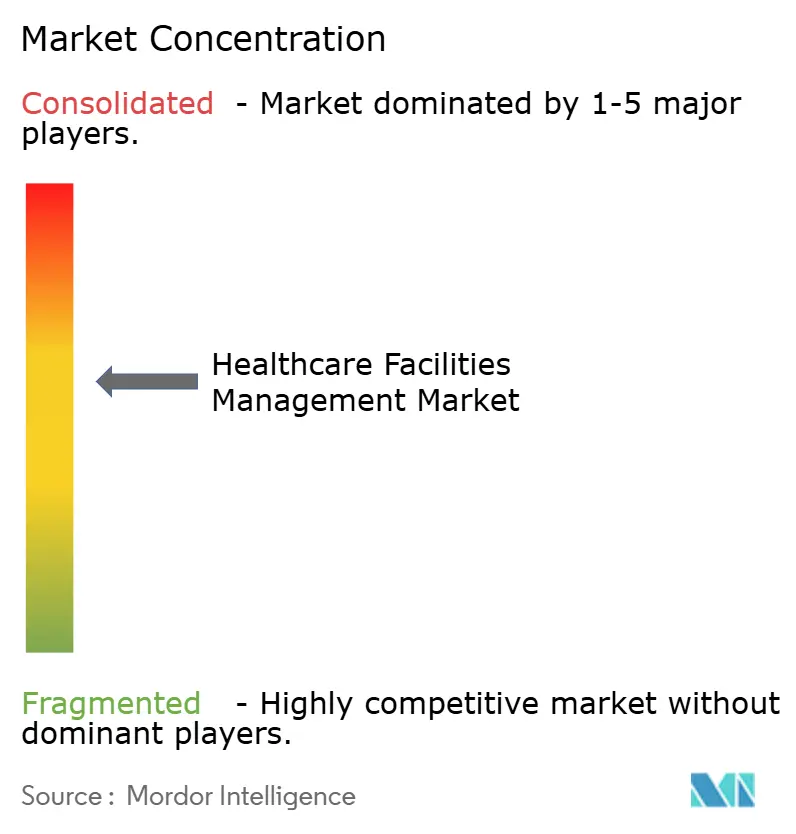
| Market Concentration | Medium |
Major Players *Disclaimer: Major Players sorted in no particular order Image © Mordor Intelligence. Reuse requires attribution under CC BY 4.0. | |
Healthcare Facilities Management Market Analysis by Mordor Intelligence
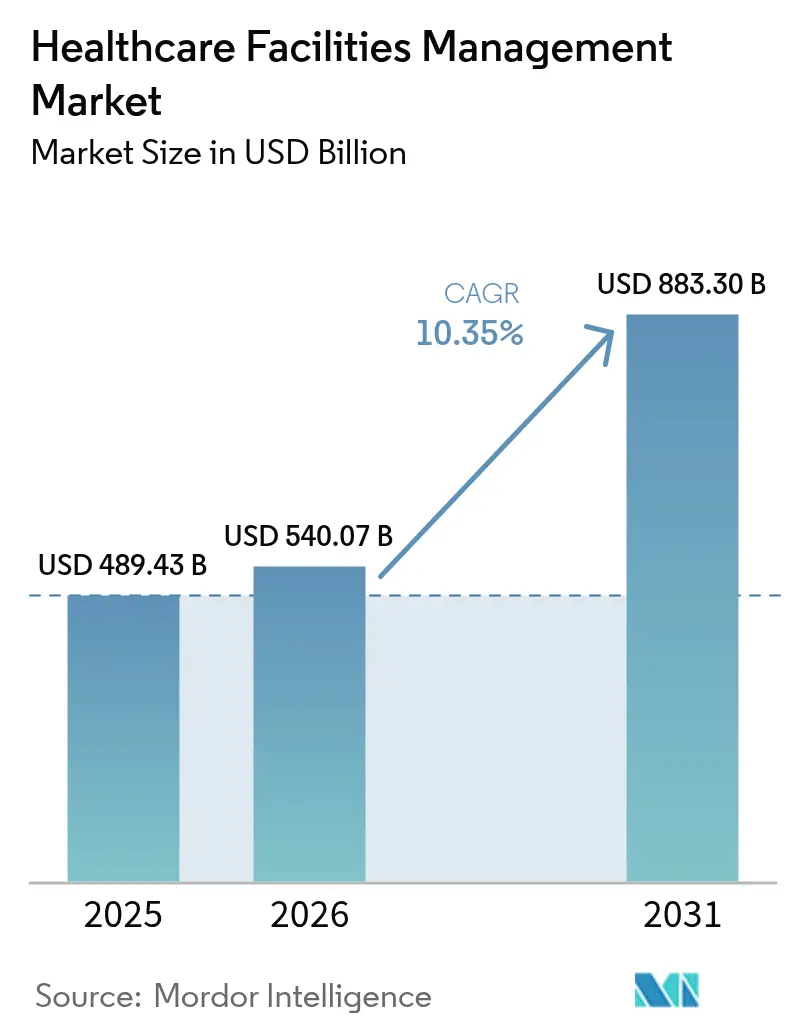
The healthcare facility management market size was valued at USD 489.43 billion in 2025 and estimated to grow from USD 540.07 billion in 2026 to reach USD 883.3 billion by 2031, at a CAGR of 10.35% during the forecast period (2026-2031). The expansion is propelled by rising global healthcare spending, stricter infection-control regulations, and rapid adoption of smart building technologies. Hospitals and outpatient centers invest in integrated services to control costs, maintain accreditation, and improve patient safety. IoT-enabled asset monitoring, predictive maintenance, and automated waste tracking lower downtime and energy use, strengthening the business case for outsourced services. Intensifying focus on value-based care further encourages providers to shift non-clinical operations to specialists capable of demonstrating measurable efficiency gains.
Key Report Takeaways
- By product type, cleaning services led with 27.01% of the healthcare facility management market share in 2025. Laundry and linen services are expected to post the fastest 11.98% CAGR through 2031.
- By end user, hospitals and clinics accounted for 57.82% of the healthcare facility management market size in 2025. Ambulatory surgical centers are forecast to expand at a 11.65% CAGR between 2026 and 2031.
- By geography, North America held 43.10% revenue share in 2025, while Asia-Pacific is set to post an 11.02% CAGR to 2031.
Note: Market size and forecast figures in this report are generated using Mordor Intelligence’s proprietary estimation framework, updated with the latest available data and insights as of 2026.
Global Healthcare Facilities Management Market Trends and Insights
Drivers Impact Analysis*
| Driver | % Impact on CAGR Forecast | Geographic Relevance | Impact Timeline |
|---|---|---|---|
| Growth in healthcare expenditures | 2.8% | Global, with strongest impact in Asia-Pacific and emerging markets | Medium term (2-4 years) |
| Increase in prevalence of chronic diseases | 2.1% | Global, particularly North America and Europe aging populations | Long term (≥ 4 years) |
| Increasing medical tourism in emerging countries | 1.5% | Asia-Pacific, Middle East, select South American markets | Medium term (2-4 years) |
| Regulatory mandates for infection control & waste disposal | 2.3% | Global, with stricter enforcement in developed markets | Short term (≤ 2 years) |
| Shift toward outpatient & ambulatory care facilities | 1.8% | North America and Europe leading, Asia-Pacific following | Medium term (2-4 years) |
| Rising adoption of smart technologies & IoT-enabled asset monitoring | 1.4% | Developed markets initially, expanding to emerging economies | Long term (≥ 4 years) |
| Source: Mordor Intelligence | |||
Growth in Healthcare Expenditures Drives Market Expansion
Global healthcare spending reached USD 9.8 trillion in 2024, and facility management now captures roughly 5% of hospital operational budgets. The Centers for Medicare & Medicaid Services projects United States healthcare outlays will grow 5.1% annually to 2030, sustaining demand for outsourced services[1]Centers for Medicare & Medicaid Services, “National Health Expenditure Projections 2025–2030,” CMS.GOV. Emerging economies show faster momentum: India’s healthcare spend is rising 12% a year, supported by infrastructure upgrades and universal coverage programs. Consistent funding growth enables hospitals to treat facility management as a strategic lever for efficiency rather than a basic overhead expense.
Regulatory Mandates Intensify Compliance Requirements
The Joint Commission’s 2024 infection-prevention standards require more frequent surface disinfection and tighter environmental monitoring across U.S. hospitals[2]The Joint Commission, “2024 Hospital Accreditation Standards,” JOINTCOMMISSION.ORG. In Europe, medical-device rules broaden compliance duties for service teams handling critical equipment. CDC guidance now calls for validated cleaning protocols in all patient areas, driving higher demand for specialized staff training and auditing. Providers with certification depth and digital audit tools gain an edge over smaller regional rivals struggling to meet complex documentation needs.
Technology Integration Reshapes Service Delivery
IoT building-management platforms cut hospital energy costs 15-25%, making them standard in new construction and retrofit projects. Predictive maintenance shortens HVAC and medical-gas downtime by up to 40%, directly protecting patient safety. Automated waste-tracking tools reduce labor costs 20-25% while improving regulatory reporting accuracy. Johnson Controls deployed its OpenBlue suite across more than 500 hospitals, showcasing scalable smart-facility operations.
Outpatient Care Shift Restructures Demand Patterns
Ambulatory surgical centers grew 15% in 2024 as payers favored lower-cost outpatient procedures[3]Ambulatory Surgery Center Association, “Statistical Profile 2024,” ASCASSOC.ORG. These settings still require hospital-grade disinfection, sterile processing, and regulated waste handling, expanding the healthcare facility management market. Dialysis networks expanded 8% and need continuous water-treatment oversight and hazardous-waste removal. Providers able to flex service bundles across diverse outpatient footprints capture rising share.
Restraints Impact Analysis*
| Restraint | % Impact on CAGR Forecast | Geographic Relevance | Impact Timeline |
|---|---|---|---|
| Gap between providers and payers | -1.8% | Global, particularly impacting emerging markets and rural areas | Medium term (2-4 years) |
| Lack of investment in FM in low-income countries | -1.2% | Sub-Saharan Africa, parts of Asia-Pacific and South America | Long term (≥ 4 years) |
| Shortage of skilled FM workforce | -1.5% | Global, with acute shortages in developed markets | Short term (≤ 2 years) |
| Escalating energy costs impacting operating budgets | -0.9% | Global, with highest impact in energy-import dependent regions | Short term (≤ 2 years) |
| Source: Mordor Intelligence | |||
Provider-Payer Gap Constrains Investment Capacity
Flat reimbursement and rising labor costs compress facility management budgets, especially in rural hospitals with slim margins. Medicare rates rose only 2.8% in 2024 while non-clinical costs climbed 6.2%. Value-based contracts force providers to prove ROI on every facility upgrade, delaying approval cycles and favoring outcome-linked service models.
Skilled Workforce Shortage Limits Service Quality
Vacancy rates for certified technicians reached 18%, and nearly one-third of facility managers will retire within five years. Healthcare settings require unique competencies in infection control and life-safety systems, raising wage premiums 25-30% over general commercial sectors. Smaller vendors struggle to fund training pipelines, which widens the skills gap.
*Our forecasts treat driver/restraint impacts as directional, not additive. The impact forecasts reflect baseline growth, mix effects, and variable interactions.
Segment Analysis
By Product Type: Cleaning Services Lead While Laundry & Linen Accelerate
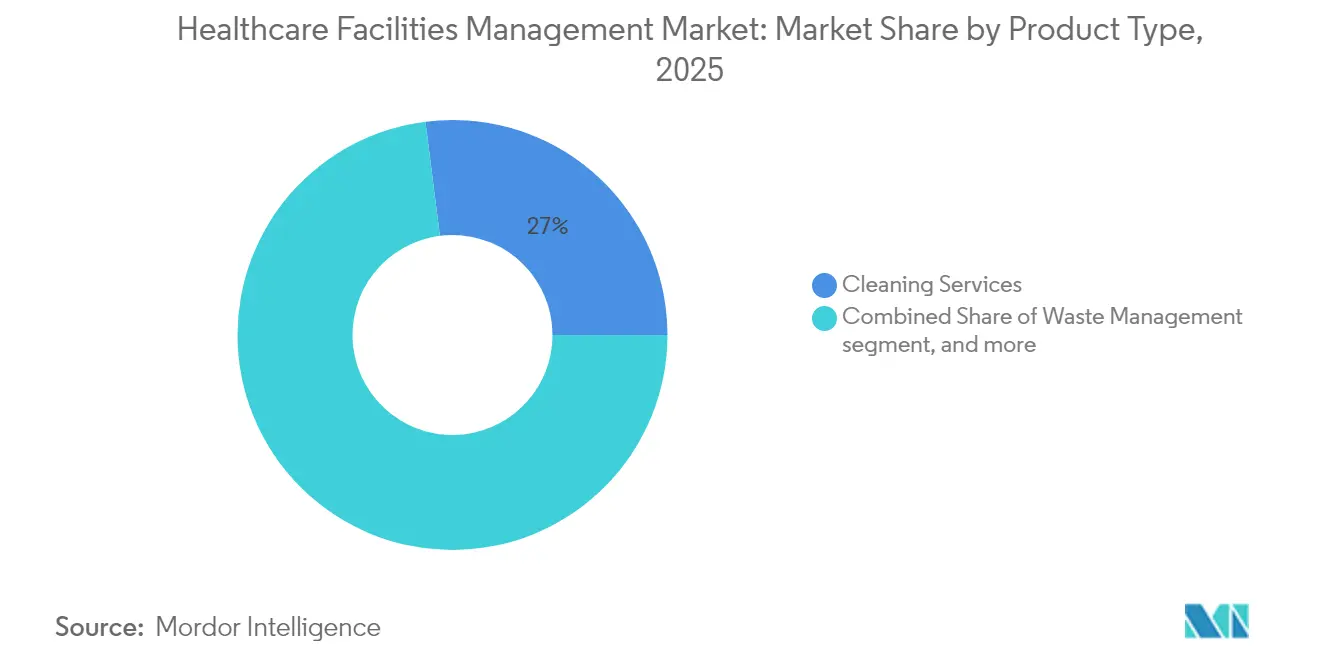
Cleaning services accounted for 27.01% of the healthcare facility management market in 2025, anchored by rigorous disinfection protocols and auditing requirements. The healthcare facility management market size for cleaning alone represented USD 132.2 billion. Heightened awareness of pathogen transmission drives frequent high-touch cleaning cycles, and hospitals increasingly adopt data-driven scheduling to validate performance. Integrated providers bundle cleaning with waste handling and indoor-air monitoring to reduce administrative burden.
Laundry and linen services are on track for a 11.98% CAGR to 2031. Disposable textile trends, antimicrobial fabric treatments, and centralized processing hubs underpin this growth. High-volume outsourcing to regional plants yields cost efficiencies and uniform quality standards. Waste management, security, and catering maintain solid demand, but profit margins hinge on automation adoption and menu-planning software that aligns with patient nutrition protocols.
Technical support plays a stabilizing role as buildings fill with sensors and cloud-connected controls. Predictive maintenance analytics limit equipment failure, while cybersecurity oversight becomes part of traditional security contracts. The healthcare facility management industry shows a clear trajectory toward fully bundled offerings that blend soft and hard services under a single data platform.



By End User: Hospitals Dominate While Ambulatory Centers Surge
Hospitals and clinics captured 57.82% of 2025 revenue. The healthcare facility management market size for this segment stood at USD 282.99 billion, reflecting complex footprints, 24-hour operations, and stringent codes. Multisite health systems increasingly negotiate national contracts that tie fee structures to uptime and patient-safety metrics, raising entry barriers for regional incumbents.
Ambulatory surgical centers are forecast to post a 11.65% CAGR through 2031. Rapid procedure turnover and sterilization needs push operators to outsource cleaning, sterile processing, and biomedical maintenance under performance-linked agreements. Long-term care facilities seek partners that can balance resident comfort with infection-control rigor, while outpatient clinics emphasize scalable service bundles that align with fluctuating daily volumes.
The healthcare facility management industry benefits from diversification across these environments. Suppliers that align digital dashboards, standardized protocols, and specialized staff training capture cross-segment contracts and realize scale efficiencies.

Geography Analysis
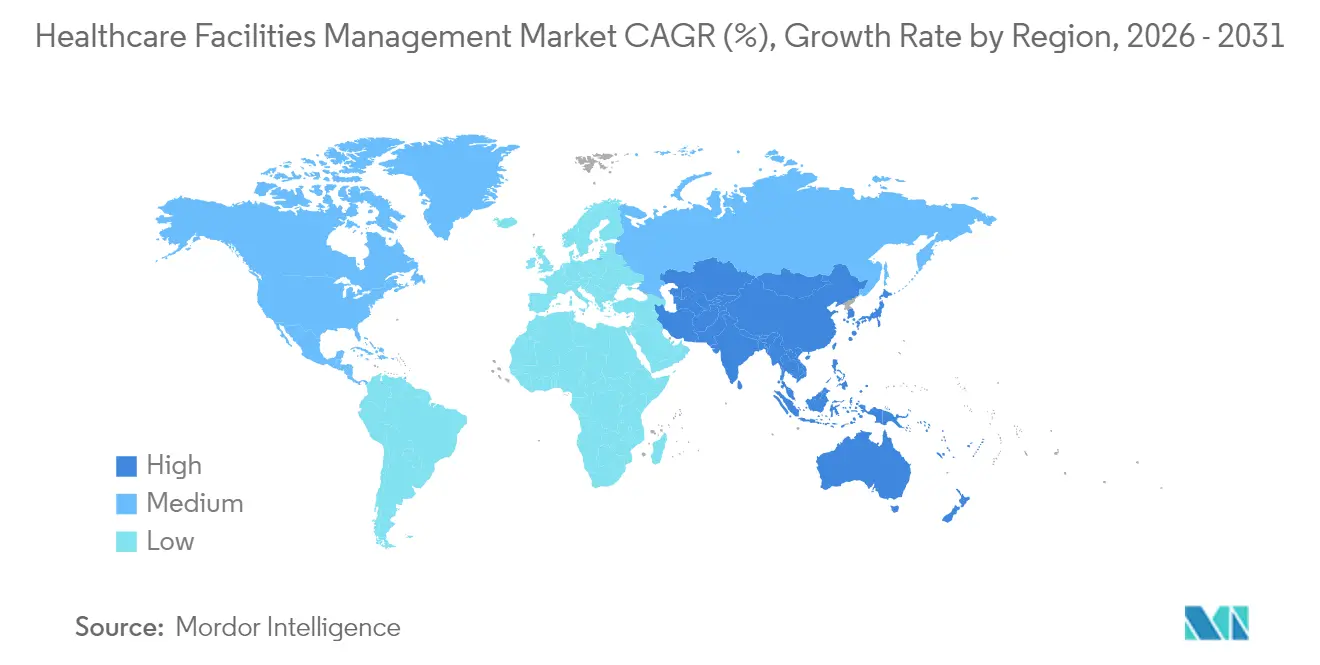
North America held 43.10% of revenue in 2025, supported by high per-capita spending, strict regulatory enforcement, and early IoT adoption. Consolidation among health systems drives nationwide contracts, and aging infrastructure fuels modernization projects with energy-efficiency targets. Federal incentives for carbon reduction further encourage smart-building retrofits.
Asia-Pacific is projected to register an 11.02% CAGR to 2031, the fastest pace worldwide. China accelerated hospital construction 18% in 2024, generating immediate demand for outsourced maintenance and environmental services. India’s medical-tourism receipts reached USD 9.2 billion in 2024, prompting facilities to seek international accreditation and premium facility-management partners. Japan’s demographic shift toward senior care boosts demand for long-term care cleaning, laundry, and safety compliance.
Europe posts steady growth driven by digital-health strategies and Green-Deal sustainability mandates. Service providers offering carbon-tracking dashboards and energy-retrofit expertise gain traction in competitive tenders. Middle East and Africa enjoy infrastructural build-out, particularly in the Gulf Cooperation Council where Vision 2030 programs back world-class medical complexes. South America grows at a more modest clip as macroeconomic headwinds temper new-build activity, though urban private networks in Brazil pursue outsourced expertise to control operating costs.

Regulatory Landscape
Healthcare facilities management is subject to tightening accreditation, safety-code, and environmental requirements that increasingly connect built-environment performance to patient safety and continuity of care. In the United States, Joint Commission updates effective January 1, 2026 (through the Comprehensive Accreditation Manuals) raise expectations for environmental monitoring, documentation, and performance verification, which increases demand for audit-ready cleaning, waste, and maintenance workflows. Parallel adoption cycles (including NFPA life-safety and health-care facilities codes used in many jurisdictions) reinforce requirements around life-safety systems, emergency power, and medical gas resilience, positioning compliance as a core element of hard FM delivery rather than a periodic inspection exercise.
Outside the U.S., accreditation and public-sector assurance frameworks add ESG and resilience expectations to day-to-day operations. Joint Commission International (JCI) 8th Edition standards, effective January 1, 2025 with sustainability requirements enforceable from January 1, 2026, embed environmental stewardship into routine facilities protocols for organizations seeking international accreditation, including medical tourism hubs. In the guidance layer, WHO released late-2024 guidance for safe, climate-resilient, and environmentally sustainable healthcare facilities, while the IFC updated its EHS Guidelines for Health Care Facilities (2025 update summary), shaping lender and owner requirements for waste, WASH, and infrastructure design. In England, the NHS Premises Assurance Model (PAM) for 2026-27 shifts toward a more compliance-based approach, raising reporting and governance expectations for estates and FM teams.
Value Chain Analysis
The healthcare facilities management value chain starts with demand from hospitals, clinics, and ambulatory care operators, which translate clinical and accreditation requirements into service specifications and KPIs such as infection prevention, uptime, response times, and audit documentation. Procurement is influenced by centralized health system sourcing, and in many markets by group purchasing organizations and framework agreements that standardize products and service levels across sites. Delivery then occurs through in-house teams or outsourced FM integrators and specialists covering soft services (cleaning, catering, security, laundry and linen, regulated medical waste handling) and hard services (HVAC, electrical, plumbing, building fabric, life-safety, medical gas support), supported by OEMs and technology vendors providing BMS/CMMS platforms, sensors, robotics, and analytics.
Upstream inputs include disinfectants and consumables, textiles, PPE, spare parts, energy and utilities, and digital layers such as IoT connectivity, cybersecurity controls, and automated reporting tools. Downstream, FM providers deliver documented compliance, verified hygiene outcomes, asset availability, and energy-performance improvements, often packaged into integrated contracts tied to value-based care metrics. Key constraints include skilled labor scarcity for certified technicians, site-specific limits in 24/7 clinical environments, and cybersecurity risks that can slow adoption of connected and predictive-maintenance approaches. Recent contracting reflects these integration and digitization themes, including Mitie securing a GBP 27 million, three-year contract (May 2026) with Kingston and Richmond NHS Foundation Trust for cleaning, portering, and waste management combined with smart technology and cleaning robots, and ISSA launching a healthcare environmental hygiene certification (July 2026) to standardize training and set minimum capability expectations for service providers.
Competitive Landscape
The healthcare facility management market is moderately concentrated. Global leaders such as Sodexo, CBRE, ABM Industries, and ISS combine multiservice portfolios with strong compliance records to win multi-year contracts. IoT integration evolves from differentiator to baseline expectation. Sodexo integrates occupancy analytics to optimize cleaning frequencies and food-service logistics. CBRE leverages its real-estate data to bundle facility management into broader capital-planning engagements. ABM’s SmartClean platform uses real-time sensor inputs to guide crew deployment and document performance. ISS collaborates with cloud vendors to embed predictive analytics.
Regional specialists maintain niche strength in ambulatory, long-term care, and medical-tourism hubs by tailoring protocols to local regulations and cultural expectations. However, escalating technology costs spur alliances or acquisitions as smaller players seek scale. Mergers center on specialized capabilities such as sterile-processing labs or energy-retrofit engineering, broadening service reach without replicating infrastructure.
Healthcare Facilities Management Industry Leaders
ABM Industries Inc.
Aramark Corporation
Ecolab Inc.
Iss World Services A/S
Sodexo SA
- *Disclaimer: Major Players sorted in no particular order

Market Opportunities and Future Outlook
New-build and major expansion projects create a clear whitespace for early-involvement FM models that combine commissioning, maintainability design input, and digital handover into long-term integrated service contracts. Recent examples include Kaiser Permanente breaking ground (April 2026) on an all-electric hospital tower at Sunnyside Medical Center in Oregon targeting LEED Gold, Turner Construction reaching a vertical milestone (March 2026) on a USD 900 million expansion at Geisinger Wyoming Valley Medical Center in Pennsylvania, and Multiplex completing (July 2026) an AUD 835 million acute services building at John Hunter Hospital in Australia. These developments increase demand for providers that can implement hospital-grade cleaning, portering, waste, security, and hard FM readiness while deploying asset data, preventive maintenance plans, and compliance documentation from day one.
Energy and carbon compliance is also shifting from a facilities cost program into a managed risk area, widening the scope for FM providers that pair technical services with continuous utility analytics, retro-commissioning, and audit-ready reporting. The 2025 edition of ANSI/ASHRAE/IES Standard 90.1 adds energy-efficiency requirements such as unoccupied setbacks that increase operational complexity in clinical spaces, which lifts the value of controls expertise and integrated BMS-CMMS workflows. At the same time, healthcare owners are prioritizing high-impact asset classes, such as air handlers and central energy plants, as capital projects, supporting pull-through for bundled hard FM, energy-management, and lifecycle planning services. With IoT and predictive maintenance moving into workflow automation, cybersecurity-capable FM delivery is becoming a differentiator for multi-site systems seeking standardized dashboards, consistent training, and faster compliance closeout across hospitals, ambulatory surgical centers, and outpatient footprints.
Recent Industry Developments
- June 2026: Sodexo extended its long-running partnership with Naples Comprehensive Health (NCH), continuing to provide foodservice and facilities management support. The renewal reinforces the role of incumbent, integrated providers in retaining multi-decade healthcare relationships while expanding standardized operational playbooks across sites.
- October 2025: Aramark Healthcare and the University of Pennsylvania Health System announced a new multi-year, systemwide partnership covering food services, environmental services, and patient transportation across seven hospitals, with implementation beginning in early 2026. The agreement points to ongoing vendor consolidation by large health systems and the shift toward bundled service models managed at enterprise scale.
- June 2024: Waste Management, Inc. signed a definitive agreement to acquire Stericycle, a provider of regulated medical waste management and compliance services. The combination strengthens scale and route density in regulated waste, which can reshape pricing, service coverage, and compliance capabilities for healthcare customers outsourcing waste and related environmental services.


Research Methodology Framework and Report Scope
Market Definition and Coverage
For this study, the market covers outsourced and in-house services that keep healthcare buildings safe, compliant, and operating smoothly, including cleaning, catering, security, waste handling, and technical support across healthcare facilities.
Scope exclusions: Major hospital clinical equipment purchases, medical staffing, and core clinical services are not counted unless they are part of facility operations support.
Segmentation Overview
- By Product Type
- Waste Management
- Security Services
- Catering Services
- Cleaning Services
- Technical Support Services
- Laundry & Linen Services
- Other Product Types
- By End-user
- Hospitals & Clinics
- Long-term Healthcare Facilities
- Ambulatory Surgical Centers
- Outpatient Clinics
- Other End-users
- Geography
- North America
- United States
- Canada
- Mexico
- Europe
- Germany
- United Kingdom
- France
- Italy
- Spain
- Rest of Europe
- Asia-Pacific
- China
- Japan
- India
- Australia
- South Korea
- Rest of Asia-Pacific
- Middle East & Africa
- GCC
- South Africa
- Rest of Middle East & Africa
- South America
- Brazil
- Argentina
- Rest of South America
- North America
Data Sources, Market Sizing, and Validation
Desk Research
Desk work starts with public datasets that explain how many facilities exist and how fast they are expanding, which then anchors the demand pool. We referenced sources such as the World Health Organization, the World Bank, OECD health statistics, US CDC and CMS publications, and national health ministries for facility counts, spending indicators, and policy direction.
To translate that demand pool into service spend, we also used annual reports, investor presentations, and procurement notices from healthcare operators and service providers, plus reputable press coverage for contract wins and outsourcing trends. Where available, we cross-checked company financials and patent databases to sanity check service mix changes (for example, automation in cleaning workflows). These desk sources are illustrative, and many other public documents were reviewed for data collection, clarification, and validation.
Primary Interviews and Surveys
Primary inputs were built through expert discussions and structured surveys with facility heads, service managers, procurement teams, and solution integrators across the Americas, EMEA, and APAC. The respondent input clarified what is typically bundled into healthcare facilities management contracts, how pricing resets are applied in practice, and how service intensity shifts with infection control protocols and occupancy patterns, which helped tighten our assumptions.
Distribution of primary research fieldwork respondents
| Company type | Respondent position | Region |
|---|---|---|
| Top tier: 28% | CXOs: 12% | APAC: 44% |
| Mid tier: 50% | Functional/Unit leaders: 31% | EMEA: 31% |
| Smaller Players: 22% | Managers: 57% | Americas: 25% |
Market-Sizing & Forecasting
Sizing is built using a top-down approach where facility counts and healthcare infrastructure activity are reconstructed by region and then converted into service spending using observed outsourcing penetration and service intensity. The totals are then corroborated through selective bottom-up approximations such as sampled contract values, typical square footage coverage per site, and ASP by service line, which helps correct overstatement in regions with low outsourcing maturity.
Key inputs that shaped the model included hospital and clinic counts, the share of facilities outsourcing soft services versus technical support, waste volumes and regulated medical waste handling requirements, labor cost inflation for housekeeping and security, and energy and maintenance spending pressure in older buildings. For forecasting, scenario analysis was used and then narrowed using expert consensus on variables like outsourcing adoption, wage inflation pass-through, and construction and refurbishment cycles. When bottom-up checks were incomplete for smaller markets, gaps were handled using peer-country benchmarks and adjusted through interview-based sanity checks.
Data Validation & Update Cycle
Outputs were checked against independent signals, including healthcare spending trends, facility expansion plans, and large contract announcements, so unusual jumps could be explained or corrected. Variance checks were run by region and service type, followed by internal review steps where assumptions and arithmetic were re-tested before sign-off.
The report is refreshed annually, and interim updates are triggered when major regulatory changes, large outsourcing shifts, or sharp currency and inflation moves materially change pricing or demand. Before delivery, a final analyst pass is completed to confirm the latest data points and to re-check any outliers that emerged in the most recent period.
Mordor Intelligence's Healthcare Facilities Management Market Estimate Compared With Other Published Estimates
Published market values for healthcare facilities management can look far apart because the timing of currency conversion, how service pricing is updated, and what is treated as facilities spend versus adjacent clinical support are not uniform. Differences also come from whether estimates lean on contract pricing resets or use broad spending ratios that do not move quickly with labor inflation.
In our refresh-led build, the model is re-tested with the latest wage and energy cost signals and with current-year currency timing before the final number is locked, and that update discipline is one reason the figure from Mordor Intelligence can land away from older snapshots that still reflect prior pricing levels.
Benchmark comparison
| Source | Market Size | Gaps in Research Methodology |
|---|---|---|
| Mordor Intelligence | USD 489.43 B (2025) | |
| Industry Data Publisher A | USD 353.93 B (2024) | Uses an earlier base year and a broader service taxonomy that can shift what is counted as facilities spend, and the pricing layer is less explicit on annual labor and energy pass-through timing. |
| Market Research Portal B | USD 325.80 B (2024) | Relies on a 2024 starting point with longer-range projections, which can understate near-term pricing resets, and it may apply generalized growth factors rather than service-line ASP updates tied to contract renewals. |
The spread mainly reflects year selection and how fast pricing assumptions are refreshed when labor and utilities move. When scope boundaries and the timing of currency and ASP updates are made explicit, the resulting number becomes easier to trace back to facility demand drivers and to reproduce for sensitivity checks.


Key Questions Answered in the Report
What is the healthcare facility management market size forecast for 2031?
It is projected to reach USD 883.3 billion by 2031.
What CAGR is expected for global healthcare facility management between 2026 and 2031?
The market is set to advance at a 10.35% CAGR during the period.
Which product segment holds the largest share in healthcare facility management services?
Cleaning services led with 27.01% revenue share in 2025.
Which region shows the fastest growth in healthcare facility management spending?
Asia-Pacific is forecast to grow at an 11.02% CAGR through 2031.
Why are ambulatory surgical centers an attractive end-user segment for facility management providers?
They are expanding at a 11.65% CAGR as outpatient procedures rise, creating demand for hospital-grade disinfection, waste handling, and equipment maintenance.
How are IoT and predictive analytics changing facility management in hospitals?
Sensor-based monitoring and predictive maintenance reduce energy costs up to 25% and cut equipment downtime by as much as 40%, boosting operational efficiency.
Page last updated on:





