
Hepatitis B Vaccine Market Size and Share
| Study Period | 2020 - 2030 |
| Market Size (2025) | USD 8.5 Billion |
| Market Size (2030) | USD 11.54 Billion |
| CAGR (2025 - 2030) | 6.30% |
| Fastest Growing Market | Asia Pacific |
| Largest Market | Americas |
| Market Concentration | High |
Major Players *Disclaimer: Major Players sorted in no particular order |
Hepatitis B Vaccine Market Analysis by Mordor Intelligence
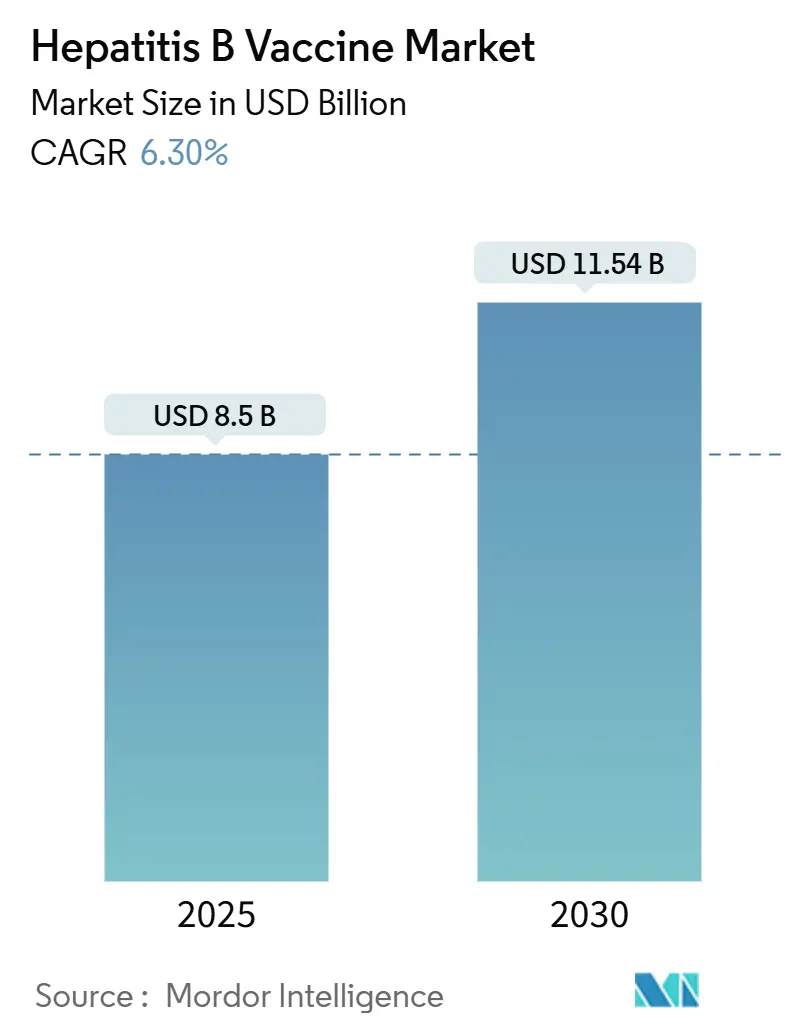
The Hepatitis B Vaccine Market size is estimated at USD 8.5 billion in 2025, and is expected to reach USD 11.54 billion by 2030, at a CAGR of 6.30% during the forecast period (2025-2030).
Hepatitis B is a viral infection of the liver, which can cause cirrhosis and hepatocellular carcinoma. Key drivers supporting market development include growing prevalence, government-led immunization programs, heightened public awareness, and technological innovations. For instance, in November 2024, the Government of India highlighted the success of its Universal Immunization Programme (UIP). This flagship public health initiative played a pivotal role in slashing the under-5 mortality rate from 45 per 1000 live births in 2014 to 32 per 1000 live births by 2020. UIP offers complimentary immunizations against 12 diseases, including Hepatitis B. Similar initiatives by other economies are expected to strengthen the market expansion over the projected period.
Furthermore, technological innovations have played a pivotal role in vaccine development; however, recent advancements in vaccine delivery systems, such as the development of needle-free drug delivery systems, are anticipated to bolster market development further. For instance, in May 2024, the Serum Institute of India (SII) announced a strategic investment in IntegriMedical, acquiring a 20% stake in the company, to advance Needle-Free Injection System technology. IntegriMedical's Needle-Free Injection Systems (N-FIS) represent a significant advancement in drug delivery and needle-free solutions to deliver vaccines. These developments underscore the growing emphasis on innovative healthcare solutions, which are expected to drive significant advancements in the hepatitis B vaccine market.
Government agencies are working to establish vaccine manufacturing facilities in developing regions to make them better prepared for future health emergencies. Such initiatives are expected to create lucrative opportunities for market development over the forecasted period. For instance, in December 2023, in a bid to assist lower-income nations in recovering from the COVID-19 pandemic and enhancing their readiness for future health crises, the Board of Gavi, the Vaccine Alliance, announced USD 1 billion in support for vaccine manufacturing in Africa. In addition, the board also approved the formation of the African Vaccine Manufacturing Accelerator (AVMA), aimed at promoting sustainable vaccine production across Africa, thus driving the hepatitis B vaccine market.
However, low vaccination rates and limited accessibility in the developing regions, stringent approval processes, and complex cold chain logistics are some of the factors anticipated to hamper the market development over the forecasted period.
Global Hepatitis B Vaccine Market Trends and Insights
Prefilled Syringe Segment is Expected to Develop at a Significant Growth Over the Forecast Period
Mass immunization programs, the growing need to eradicate viral diseases, and the demand for faster administration rates have created lucrative growth opportunities for prefilled syringes. Thus, market players are implementing growth strategies such as collaboration and investment to augment the growing demand for prefilled syringes. For instance, in March 2024, SCHOTT Pharma unveiled plans for a new prefillable syringe manufacturing facility in Wilson, United States. With an investment of USD 371 million, this facility aims to bolster the United States supply chain for syringes pivotal in delivering lifesaving injectables, vaccines, and more. This strategic investment is expected to significantly contribute to the development of the hepatitis B vaccine market by ensuring a reliable supply of high-quality prefillable syringes.
Furthermore, marketing authorization of novel vaccines presents significant growth opportunities as regulatory approvals for innovative vaccines highlight their safety, efficacy, and quality, thereby enhancing trust among healthcare professionals and patients. For example, in February 2023, Dynavax Technologies Corporation announced that the United Kingdom's Medicines and Healthcare Products Regulatory Agency (MHRA) had granted marketing authorization for HEPLISAV B. This recombinant, adjuvanted hepatitis B vaccine is approved for active immunization against all known subtypes of the hepatitis B virus in adults aged 18 years and older and is available in prefilled syringes. Such regulatory endorsements are expected to drive the adoption of novel vaccines, presenting significant growth opportunities for the hepatitis B vaccine market during the forecast period.
Contract Development and Manufacturing Organizations (CDMOs) are increasingly supporting vaccine manufacturers by establishing advanced production facilities. These efforts aim to address critical challenges, including scalability, cost optimization, and adherence to regulatory standards. For instance, in November 2024, Pharmaceutics International, Inc. announced a substantial expansion of its prefilled syringe (PFS) capabilities, committing USD 3.6 million to advanced labeling, fill/finish, and automated visual inspection technologies. Thus, CDMOs are playing a vital role in strengthening the vaccine manufacturing ecosystem in turn supporting the hepatitis B vaccine market.
Hence, the above-mentioned factors are expected to strengthen the segment expansion over the forecasted period.


Asia Pacific is Expected to Register the Highest CAGR in the Hepatitis B Vaccine Market
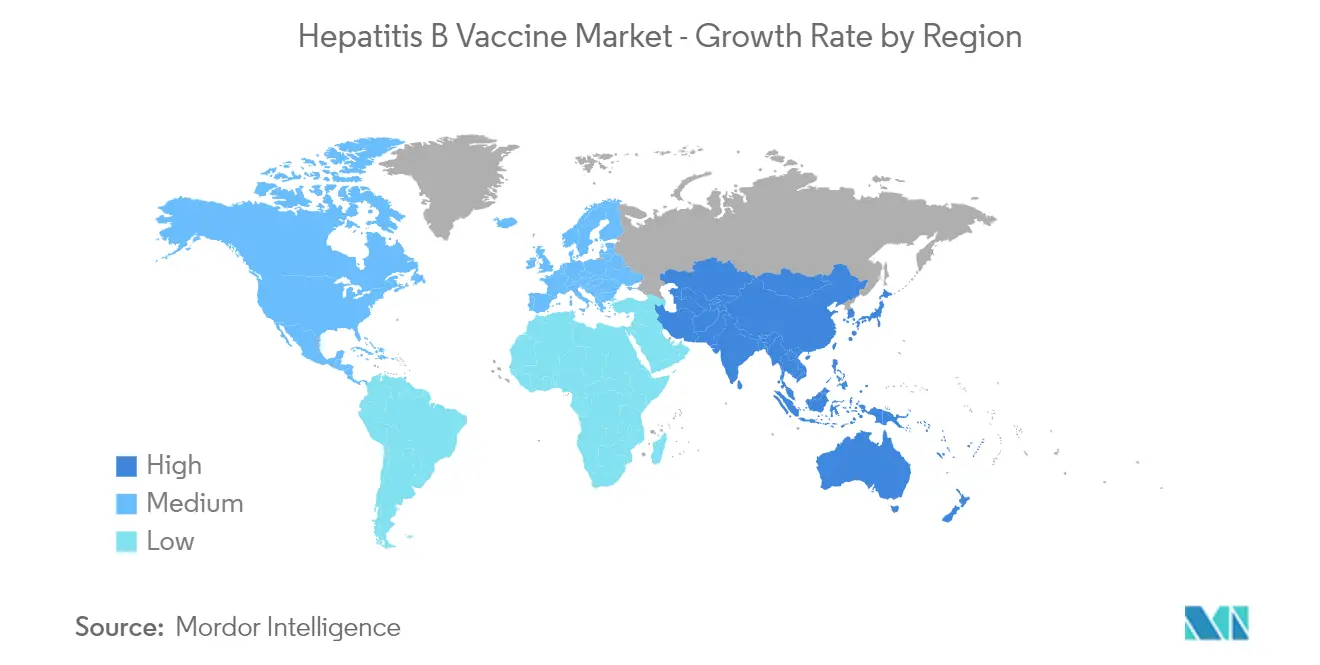
The Asia Pacific region is anticipated to develop at the highest CAGR owing to factors such as the growing prevalence of hepatitis B, foreign investments in routine vaccination programs, and government initiatives, such as national vaccination programs and hepatitis B birth-dose mandates. With the growing infection rate of hepatitis B, the need for widespread immunization is on the rise. For instance, in August 2023, amfAR highlighted that the Asia Pacific region bears a disproportionate burden, accounting for 59% of individuals with chronic HBV, 26% of new infections, and 79% of related fatalities. Additionally, the region contributes to 80% of global liver cancer-related deaths and 59% of deaths associated with liver cirrhosis. These statistics present significant opportunities for market growth in the development and distribution of hepatitis B vaccines.
Foreign governments are significantly contributing to the growth of the hepatitis B vaccine market by providing critical funding, infrastructure support, and enhancing immunization initiatives. For instance, in September 2024, the United States International Development Finance Corporation announced strategic investments in India's private healthcare sector to improve vaccine accessibility. Specifically, a USD 20 million investment was approved for Panacea Biotec Limited to scale up its hexavalent vaccine production capacity to approximately 70 million doses annually. Such investments are expected to drive market development by strengthening manufacturing capabilities and expanding global vaccine distribution networks.
Furthermore, in May 2024, the Government of Japan, in partnership with the Japan International Cooperation Agency (JICA), committed an additional USD 6.9 million to UNICEF. The initiative aims to deliver routine immunization services, protecting 4.1 million women and children from diseases such as Measles, Tuberculosis, Polio, Hepatitis B, and Tetanus. Additionally, in August 2024, UNICEF, in collaboration with the Government of Japan, facilitated the delivery of 60,000 doses of the PENTA-Hib combined vaccine. This vaccine is designed to protect infants during their first year of life from five critical diseases: diphtheria, tetanus, pertussis, Hepatitis B, and Haemophilus influenzae type b (Hib), utilizing a whole-cell pertussis component. These collaborative efforts underscore the growing focus on strengthening immunization programs, which is expected to drive market development.
Therefore, due to the aforementioned factors, the hepatitis B vaccine market in the Asia Pacific region is expected to develop at a significant growth rate over the forecasted period.

Competitive Landscape
The hepatitis B vaccine market is fragmented in nature due to the presence of several companies operating globally as well as regionally. However, few companies take a significant chunk of the market. The competitive landscape includes an analysis of a few international as well as local companies that hold substantial market share and are well known, including Indian Immunologicals Ltd., GSK plc., Merck & Co., Inc., Dynavax Technologies Corporation, Sanofi, LG Chem, Serum Institute of India Pvt. Ltd., CSL, Hookipa Pharma, Shenzhen Kangtai Biological Products Co., Ltd., and AIM Vaccine, among others.
Hepatitis B Vaccine Industry Leaders
Indian Immunologicals Ltd.
GSK plc.
Sanofi
Merck & Co., Inc.
LG Chem
- *Disclaimer: Major Players sorted in no particular order


Recent Industry Developments
- February 2024: TherVacB, an innovative therapeutic vaccine for chronic hepatitis B, entered its Phase Ia clinical trial. Led by Helmholtz Munich, the trial is being conducted at LMU University Hospital Munich, with the University Medical Center Hamburg-Eppendorf as the sponsor.
- November 2023: HOOKIPA Pharma Inc. announced that The Journal of Infectious Diseases has published preclinical data on HB-400, an investigational therapeutic vaccine for chronic hepatitis B developed in collaboration with Gilead Sciences, Inc. The data highlight HB-400's potential to advance a functional cure for chronic hepatitis B.


Global Hepatitis B Vaccine Market Report Scope
Hepatitis B, a viral infection, transmits via infected blood, bodily fluids, unprotected sexual contact, and from mother to child during childbirth. Although antiviral medications can alleviate hepatitis B symptoms, vaccination stands out as the most effective means to curb the disease's spread.
The hepatitis B vaccine market is segmented into vaccine type, age group, packaging type, distribution channel, end-user, and geography. By vaccine type, the market is segmented into single antigen vaccine and combination vaccine. By age group, the market is segmented into pediatric and adult. By packaging type, the market is segmented into ampoules, vials, and prefilled syringes. By distribution channel, the market is segmented into hospitals, government organizations, non-government organizations, and others. By geography, the market is segmented into North America, Europe, Asia-Pacific, South America, and Middle East and Africa. The report also offers the market size and forecasts for 17 countries across the region. For each segment, the market sizing and forecasts have been done on the basis of revenue (USD).
| Single Antigen Vaccine |
| Combination Vaccine |
| Pediatric |
| Adult |
| Ampoules |
| Vials |
| Prefilled Syringes |
| Hospitals |
| Government Organizations |
| Non-Government Organizations |
| Others |
| North America | United States |
| Canada | |
| Mexico | |
| Europe | Germany |
| United Kingdom | |
| France | |
| Italy | |
| Spain | |
| Rest of Europe | |
| Asia-Pacific | China |
| Japan | |
| India | |
| Australia | |
| South Korea | |
| Rest of Asia-Pacific | |
| Middle East and Africa | GCC |
| South Africa | |
| Rest of Middle East and Africa | |
| South America | Brazil |
| Argentina | |
| Rest of South America |
| By Vaccine Type | Single Antigen Vaccine | |
| Combination Vaccine | ||
| By Age Group | Pediatric | |
| Adult | ||
| By Packaging Type | Ampoules | |
| Vials | ||
| Prefilled Syringes | ||
| By Distribution Channel | Hospitals | |
| Government Organizations | ||
| Non-Government Organizations | ||
| Others | ||
| Geography | North America | United States |
| Canada | ||
| Mexico | ||
| Europe | Germany | |
| United Kingdom | ||
| France | ||
| Italy | ||
| Spain | ||
| Rest of Europe | ||
| Asia-Pacific | China | |
| Japan | ||
| India | ||
| Australia | ||
| South Korea | ||
| Rest of Asia-Pacific | ||
| Middle East and Africa | GCC | |
| South Africa | ||
| Rest of Middle East and Africa | ||
| South America | Brazil | |
| Argentina | ||
| Rest of South America | ||


Key Questions Answered in the Report
How big is the Hepatitis B Vaccine Market?
The Hepatitis B Vaccine Market size is expected to reach USD 8.5 billion in 2025 and grow at a CAGR of 6.30% to reach USD 11.54 billion by 2030.
What is the current Hepatitis B Vaccine Market size?
In 2025, the Hepatitis B Vaccine Market size is expected to reach USD 8.5 billion.
Who are the key players in Hepatitis B Vaccine Market?
Indian Immunologicals Ltd., GSK plc., Sanofi, Merck & Co., Inc. and LG Chem are the major companies operating in the Hepatitis B Vaccine Market.
Which is the fastest growing region in Hepatitis B Vaccine Market?
Asia Pacific is estimated to grow at the highest CAGR over the forecast period (2025-2030).
Which region has the biggest share in Hepatitis B Vaccine Market?
In 2025, the Americas accounts for the largest market share in Hepatitis B Vaccine Market.
What years does this Hepatitis B Vaccine Market cover, and what was the market size in 2024?
In 2024, the Hepatitis B Vaccine Market size was estimated at USD 7.96 billion. The report covers the Hepatitis B Vaccine Market historical market size for years: 2020, 2021, 2022, 2023 and 2024. The report also forecasts the Hepatitis B Vaccine Market size for years: 2025, 2026, 2027, 2028, 2029 and 2030.
Page last updated on:
Hepatitis B Vaccine Market Report
Statistics for the 2025 Hepatitis B Vaccine market share, size and revenue growth rate, created by Mordor Intelligence™ Industry Reports. Hepatitis B Vaccine analysis includes a market forecast outlook for 2025 to 2030 and historical overview. Get a sample of this industry analysis as a free report PDF download.


 Your data is secure and never sold or shared.


