
Vaccine Contract Manufacturing Market Size and Share
Market Overview
| Study Period | 2022 - 2031 |
|---|---|
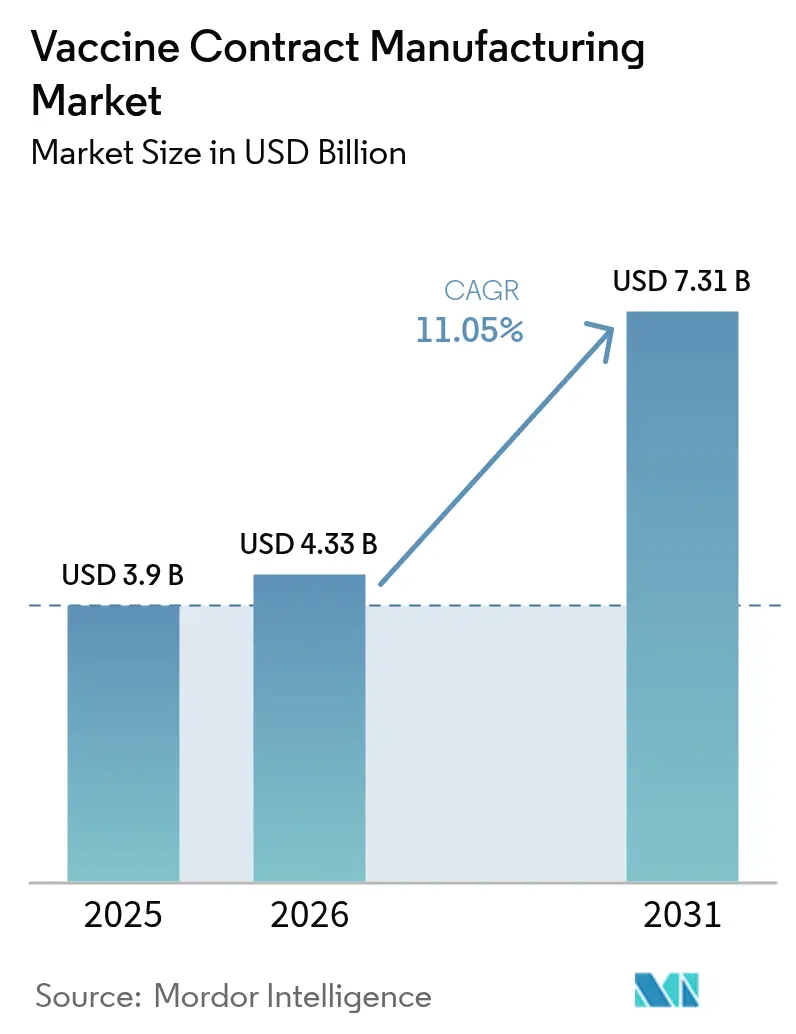
| Market Size (2026) | USD 4.33 Billion |
| Market Size (2031) | USD 7.31 Billion |
| Growth Rate (2026 - 2031) | 11.05 % |
| Fastest Growing Market | Asia-Pacific |
| Largest Market | North America |
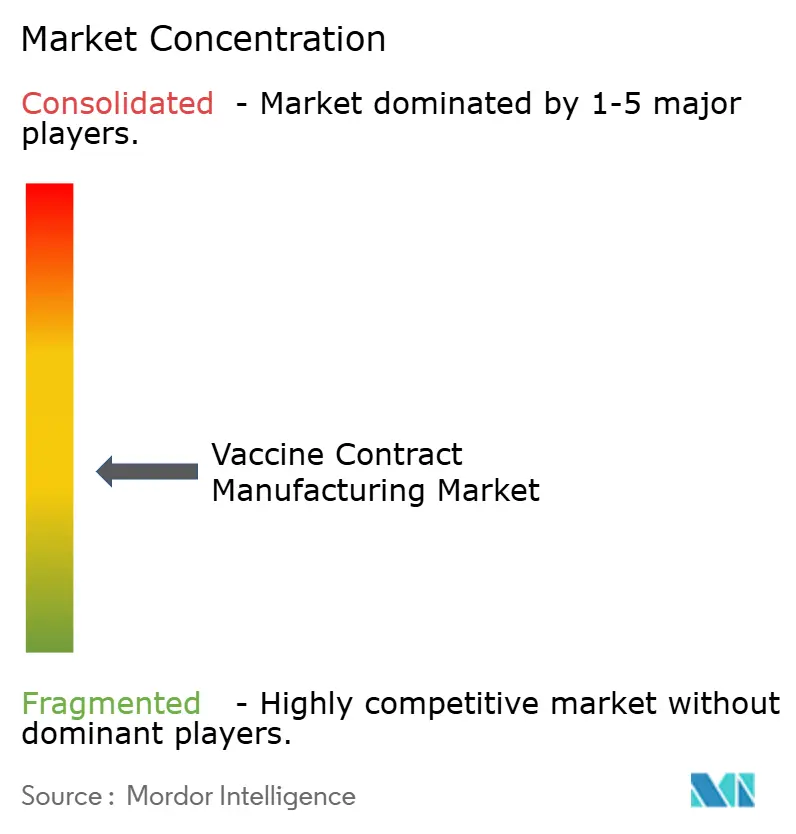
| Market Concentration | Medium |
Major Players *Disclaimer: Major Players sorted in no particular order Image © Mordor Intelligence. Reuse requires attribution under CC BY 4.0. | |
Vaccine Contract Manufacturing Market Analysis by Mordor Intelligence
The vaccine contract manufacturing market size in 2026 is estimated at USD 4.33 billion, growing from 2025 value of USD 3.90 billion with 2031 projections showing USD 7.31 billion, growing at 11.05% CAGR over 2026-2031. Rapid adoption of modular, single-use production lines reduces facility lead-times while allowing quick product changeovers, giving the vaccine contract manufacturing market the agility needed for future outbreak response. Government pandemic-preparedness funds, near-shoring mandates, and an expanding pipeline of RNA and viral-vector candidates keep outsourced capacity tight. CDMOs now win work by pairing platform breadth with regulatory know-how rather than low cost alone. As mRNA, adjuvant, and fill-finish capabilities converge under fewer roofs, buyers have clearer line-of-sight on timelines and quality, further accelerating the vaccine contract manufacturing market.
Key Report Takeaways
- By vaccine type, inactivated vaccines held 33.02% of the vaccine contract manufacturing market share in 2025, while RNA vaccines are projected to post an 18.07% CAGR to 2031.
- By process, downstream processing accounted for 57.62% of the vaccine contract manufacturing market size in 2025.
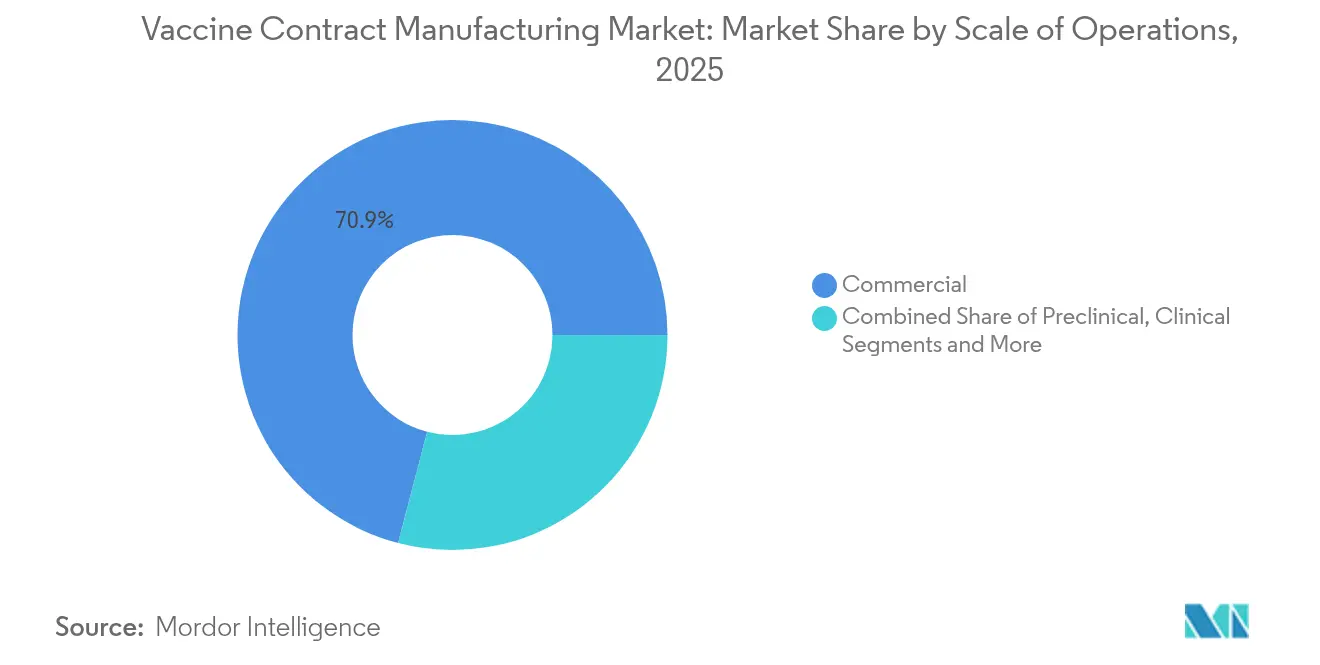
- By scale, commercial-scale production commanded 70.93% share of the vaccine contract manufacturing market size in 2025; preclinical services are expanding at a 13.98% CAGR through 2031.
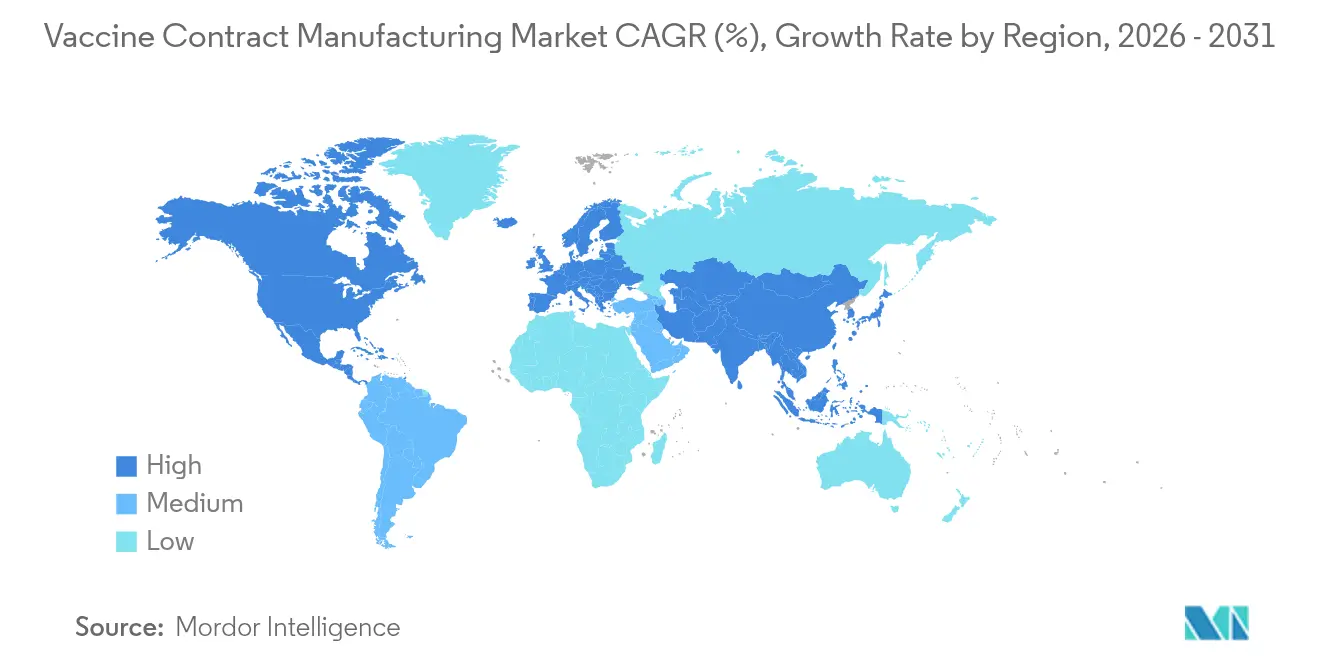
- By region, North America contributed 46.21% of the vaccine contract manufacturing market size in 2025, whereas Asia Pacific is set to grow at an 11.68% CAGR to 2031.
Note: Market size and forecast figures in this report are generated using Mordor Intelligence’s proprietary estimation framework, updated with the latest available data and insights as of 2026.
Market Trends and Insights
Drivers Impact Analysis of Vaccine Contract Manufacturing Market*
| Driver | (~) % Impact on CAGR Forecast | Geographic Relevance | Impact Timeline |
|---|---|---|---|
| Advancements in single-use and modular sites | 2.10% | North America, Europe | Medium term (2-4 years) |
| Government immunization funding pools | 2.80% | Global, Gavi-supported and high-income markets | Long term (≥ 4 years) |
| Expanded pediatric vaccine schedules | 1.40% | Asia Pacific, Middle East & Africa, Latin America | Long term (≥ 4 years) |
| CDMO platform bundling for mRNA & viral tech | 1.90% | North America, Europe, Asia Pacific | Medium term (2-4 years) |
| Near-shoring mandates | 1.60% | North America, Europe, Asia Pacific | Medium term (2-4 years) |
| Digital quality-by-design analytics | 1.20% | Global | Short term (≤ 2 years) |
| Source: Mordor Intelligence | |||


Advancements In Single-Use and Modular Facilities
Single-use bioreactors and prefabricated cleanrooms cut green-field build times from seven years to under two, letting sponsors align capital outlay with demand surges. Wacker Chemie’s EUR 102 million (USD 119 million) modular mRNA plant shows how standardized blocks can be lifted into multiple jurisdictions without lengthy redesigns, giving the vaccine contract manufacturing market elasticity for pathogen shifts. Capital-light developers gain access to late-phase capacity, while regulators now treat modular suites as equivalent to traditional spaces, trimming validation cycles and smoothing global dossier filings.
Government Immunization Initiatives and Funding Pools
Public buyers now couple purchase budgets with local-capacity targets. Gavi’s USD 1.2 billion African Vaccine Manufacturing Accelerator ties grant disbursement to in-country output, and the U.S. Project NextGen steers USD 5 billion of next-generation COVID-19 spending to domestic partners, giving the vaccine contract manufacturing market multi-year volume visibility.[1]Gavi Secretariat, “African Vaccine Manufacturing Accelerator,” gavi.org
Expansion Of Global Pediatric Vaccine Schedules
Routine programs now include HPV, rotavirus, and complex pneumococcal combinations. WHO’s HPV recommendation alone creates tens of millions of additional adolescent doses each year, pushing CDMOs to scale fill-finish and lyophilization lines for thermostable formulations.[2]World Health Organization, “HPV Vaccination Position Paper,” who.int Combination products raise formulation complexity, favoring operators with broad analytical toolkits.
CDMO Platform Bundling For mRNA And Viral-Vector Tech
Lonza’s USD 1.2 billion acquisition of Roche’s Vacaville site folds lipid nanoparticle, mRNA synthesis and viral-vector suites under one quality system, shortening tech-transfer chains and supporting premium pricing. Similar moves by Evonik and Samsung Biologics show buyers’ preference for one-stop capacity that minimizes regulatory hand-offs.
Restraints Impact Analysis of Vaccine Contract Manufacturing Market*
| Restraint | (~) % Impact on CAGR Forecast | Geographic Relevance | Impact Timeline |
|---|---|---|---|
| Escalating Biologics-Grade Raw-Material Costs | -1.80% | Global, with acute impact in cost-sensitive markets | Short term (≤ 2 years) |
| Cold-Chain Gaps In Emerging Markets | -1.20% | Sub-Saharan Africa, Southeast Asia, Latin America | Medium term (2-4 years) |
| Regulatory Lag In Tech-Transfer Validation | -0.90% | Global, with concentration in emerging regulatory markets | Medium term (2-4 years) |
| Post-COVID Idle Capacity Creating Price Pressure | -1.40% | North America & EU, with spillover to APAC | Short term (≤ 2 years) |
| Source: Mordor Intelligence | |||
Escalating Biologics-Grade Raw-Material Costs
More than half of lab suppliers raised catalog prices by end-2023, with chromatography resin inflation outpacing general inputs. This eroded CDMO margins locked into fixed-price master service agreements. Limited lipid vendors intensified cost swings for RNA vaccines, and smaller plants lacked hedging scale.
Cold-Chain Gaps in Emerging Markets
Ultra-cold storage needs to curb mRNA rollout in Africa and parts of Latin America. Single excursion events can wipe entire production lots, driving higher insurance and packaging spend while slowing the uptake of advanced platforms.[3]Nature Editorial, “Global Cold-Chain Inequities for mRNA Vaccines,” nature.com Thermostable R&D is underway, but raises time and validation hurdles for smaller firms.
*Our forecasts treat driver/restraint impacts as directional, not additive. The impact forecasts reflect baseline growth, mix effects, and variable interactions.
Vaccine Contract Manufacturing Market Segment Analysis
By Vaccine Type:
RNA Platforms Drive InnovationThe vaccine contract manufacturing market continues to be led by inactivated products, which secured a 33.02% share in 2025 due to decades-long safety data and established demand from public programs. However, RNA vaccines are posting the strongest expansion at 18.07% CAGR, propelled by adaptable sequence design and shorter pre-clinical timelines. Live-attenuated candidates still serve pediatric clusters where durable mucosal immunity is essential, but growth remains slower as regulators favor non-replicating vectors for new pathogens.
CDMOs run parallel stainless and single-use lines, allowing high-balance-sheet clients to keep legacy volume steady while ramping RNA batches without cross-contamination risk. Adjuvant-ready subunit shots gain traction for elderly and immunocompromised cohorts, supported by new saponin and toll-like receptor agonists that boost titers at lower antigen load. Toxoid volumes plateau, limited to booster campaigns in markets with established herd immunity, yet remain critical for manufacturers seeking steady baseline utilization. The diverging technology mix pushes the vaccine contract manufacturing market to invest in capex-flexible suites that can shift between inactivated and genetic platforms with minimal downtime.



By Process:
Downstream Bottlenecks Create ValueDownstream steps captured 57.62% of 2025 revenue, making purification and fill-finish the most lucrative node in the vaccine contract manufacturing market. Purity specs tightened post-COVID-19, compelling CDMOs to install high-capacity chromatography skids and single-use depth filters that cut changeover hours. In contrast, upstream runs are scaling through fed-batch intensification and microbial continuous modes, trimming the cost of goods but driving more load into downstream bottlenecks.
Between 2026 and 2031, upstream activities are projected to grow at 14.82% CAGR, spurred by improved insect-cell systems for multivalent proteins. To prevent idle stainless systems, plants adopt hybrid seeds—stainless seed trains feeding single-use production bioreactors, balancing speed and depreciation costs. Analytical quality control weaves through each node, now embracing at-line spectroscopy for in-process release. Fill-finish services fetch premium fees because regulators see syringe integrity and particulate inspection as final risk barriers. Vetter’s EUR 1.5 billion dual-site build illustrates the defensive moat around sterile capacity in the vaccine contract manufacturing market.
By Scale of Operations:
Commercial Dominance with Preclinical GrowthCommercial supply held 70.93% of the 2025 value share, reflecting global pediatric schedules and adult booster programs that demand multi-million-dose lots. Yet preclinical orders are rising 13.98% annually through 2031 as oncology vaccines and autoimmune modulators flood discovery stages. Sponsors seek 1-to-5 liter runs with rapid changeovers, prompting CDMOs to carve dedicated suites shielded from GMP commercial traffic.
Clinical-scale lines remain the swing factor, absorbing overflow when commercial plants pause for requalification. Flexible batch sizes—ranging from 50 liters for first-in-human to 2,000 liters for pivotal trials—require modular utilities and mobile isolators. The vaccine contract manufacturing market leverages such infrastructure to shepherd clients from animal proof-of-concept to launch without costly tech transfer. Early engagement builds stickiness; preclinical wins often translate into decade-long commercial contracts once candidates clear Phase III.
By End User:
Human Vaccines Drive Growth with Veterinary OpportunitiesHuman applications dominated 92.05% of 2025 revenue as governments placed pandemic-reserve orders and Gavi expanded procurement budgets. Canine and poultry segments, however, are forecast to record 9.37% CAGR, driven by food-safety imperatives and rising pet ownership in urban Asia. Veterinary rules allow antigen-matching fast-tracks, shortening R&D cycles to three years versus seven in human settings. This makes the vaccine contract manufacturing market attractive for spill-over capacity between flu seasons.
Companion-animal vaccines command a higher price per dose, supporting margins even at smaller lots. Livestock vaccines benefit from multi-antigen blends that reduce farm labor, but stringent reverse-cold-chain demands persist for avian influenza variants. CDMOs experienced in human mRNA and vector technologies now find new revenue in zoonotic-risk mitigation, illustrated by Zoetis’s conditional H5N2 license that taps RNA encapsulation know-how built initially for human respiratory pathogens.
Geography Analysis
North America Vaccine Contract Manufacturing Market
North America contributed 46.21% of vaccine contract manufacturing market revenue in 2025 on the back of sizable public incentives and rapid permitting pathways for green-field bioprocess sites. Merck’s USD 1 billion Durham facility integrates 3D-printed components and generative-AI inspection, setting new benchmarks for cycle-time metrics. Canada augments regional depth, with Moderna’s 100-million-dose Laval plant expected online by 2025, underscoring commitment to reshoring supply.
APAC Vaccine Contract Manufacturing Market
Asia Pacific is the fastest-growing territory, posting an 11.68% CAGR, as China’s biopharma sales hit CNY 650.6 billion in 2023 and India leverages volume efficiencies built on decades of UNICEF procurement. Samsung Biologics’ USD 1.4 billion long-term contract shows multinational trust in Korean quality frameworks, while Indonesia and Thailand roll out tax holidays to lure green-field RNA suites. The region’s skill base widens as universities funnel chemical engineers into GMP apprenticeships, narrowing historical gaps in validation and documentation.
EMEA and South America Vaccine Contract Manufacturing Market
Europe remains a strategic pillar, supported by cohesive EMA guidance and cross-border batch release recognition. Germany’s EUR 600 million pledge to Gavi signals alignment of industrial policy with global health goals, keeping EU plants central to UNICEF tenders. Eastern European states pitch lower labor costs while adopting EU quality codes, drawing second-tier CDMOs seeking cost arbitrage without customs delays. The Middle East & Africa and South America represent smaller shares today but showcase ambitious build programs like the African Vaccine Manufacturing Accelerator. These initiatives could shift the vaccine contract manufacturing market geography by 2030 as technology transfer agreements mature. Infrastructure gaps persist, especially in ultra-cold warehousing, yet funding streams earmark upgrades that dovetail with regional disease-burden priorities.

Regulatory Landscape
Global vaccine contract manufacturing operates under cGMP frameworks where the marketing authorization holder remains accountable for product quality even when manufacturing and testing are outsourced, which makes written Quality Agreements central to defining oversight, deviation handling, and batch disposition across sponsor and CDMO sites. WHO vaccine prequalification is also an important access gate for UN and Gavi-funded procurement, and it requires evidence of a robust quality management system and WHO GMP compliance across the manufacturing and testing locations involved in the supply chain.
In 2026, regulators reinforced validation and inspection rigor that feeds directly into tech transfer timelines. The EMA GMP/GDP Inspectors Working Group initiated revisions to GMP Annex 15 (Qualification and Validation), signaling tighter expectations for qualification and validation lifecycle management, along with stronger data integrity controls across chemical and biological manufacturing steps. WHO also updated its vaccine prequalification procedure (June 2026) and published the eighty-first WHO Expert Committee on Biological Standardization (ECBS) report (July 2026), reinforcing the role of international standards and reference materials in consistency testing and global filing packages.
Competitive Landscape
Competitive intensity in the vaccine contract manufacturing market centers on technology breadth rather than pure volume. Lonza, Samsung Biologics, and Catalent collectively hold roughly one-third of outsourced revenue, bolstered by investments that pull mRNA synthesis, lipid encapsulation, and viral-vector purification under one quality umbrella. Lonza’s Vacaville buyout and Samsung’s Songdo Plant 5 expansion both emphasize dual-suite redundancy, insulating clients from single-site shutdown risks.
Mid-sized specialists gain ground by focusing on niche competencies. Viralvector Core doubles down on insect-cell baculovirus lines, offering sub-18-month tech-transfer commitments that larger peers struggle to match. Meanwhile, Evonik channels BARDA co-funding into U.S. lipid nanoparticle capacity, positioning itself as a critical orchestrator for mRNA supply chains. Vetter and PCI Pharma Services capitalize on fill-finish scarcity, winning multi-year take-or-pay deals that smooth capex recovery.
Digital adoption differentiates operators. Recipharm deploys cloud-based multivariate analysis that predicts deviations, earning on-time batch-release bonuses. FUJIFILM Diosynth’s North Carolina mega-site adds single-use microbial suites next to mammalian lines, touting seamless scale-up from 200 liters to 20,000 liters. The vaccine contract manufacturing market thus rewards firms combining high-mix agility with data-driven batch release. Emerging regional players escalate competition. SK Bioscience’s majority stake in IDT Biologika grants the Korean group a European footprint and vector expertise. Africa-based start-ups leverage Gavi grants to license modular suites from western OEMs, potentially pressuring pricing by the decade’s end. Still, regulatory trust and audit readiness remain high entry barriers, preserving margins for incumbents.
Vaccine Contract Manufacturing Industry Leaders
Lonza
Catalent
Samsung Biologics
WuXi Biologics
Thermo Fisher Scientific
- *Disclaimer: Major Players sorted in no particular order
Vaccine Contract Manufacturing Market Companies Covered in this Report
- Ajinomoto Bio-Pharma Services
- Catalent
- Batavia Biosciences
- CJ CheilJedang (Batavia Biosciences)
- Curia Global
- Emergent Bio Solutions
- FUJIFILM
- CordenPharma
- IDT Biologika
- Lonza Group
- Recipharm
- Richter-Helm BioLogics
- Samsung Group
- Thermo Fisher Scientific
- Wuxi Biologics
- Serum Institute of India
- SK bioscience
- Bavarian Nordic
- BioNTech Manufacturing Services
- Sanofi Pasteur (Valneva JV)

Market Opportunities and Future Outlook
Regional self-reliance programs are expanding the addressable project pipeline for CDMOs that can deliver WHO-prequalifiable quality systems, technology transfer, and sterile fill-finish at scale. In Africa, Biovac secured a financing package from the European Investment Bank and the International Finance Corporation for a USD 253 million Cape Town expansion (April 2026) aimed at end-to-end multi-vaccine manufacturing, creating partnership pathways for drug substance, analytics, and fill-finish contractors that can support qualification and comparability work. Localization agendas in other countries, including Egypts National Strategy for Vaccine Manufacturing Localization (2024-2030) targeting 50% domestic production by 2030, and Kenyas Health Products and Technologies Local Manufacturing Strategy 2026-2030 (June 2026) prioritizing scaling local fill-finish and advanced API capabilities, are also opening more structured procurement and co-investment channels tied to local output.
The more immediate opportunities concentrate in high-value sterile and device-led formats, where buyers are seeking supply stability alongside reduced downstream bottlenecks. Partnerships such as the July 2026 MOU between GC Green Cross and Korea Vaccine for pre-filled syringe (PFS) contract manufacturing point to demand for integrated fill-finish and packaging capabilities, including inspection and container closure integrity aligned with tightened sterility expectations. Large site investments, including GSKs USD 800 million expansion of its Marietta, Pennsylvania site (October 2024) with new sterile liquid vaccine manufacturing facilities, and Jubilant HollisterStiers Montreal fill-finish expansion design program (USD 81 million, August 2024), further support the premium attached to sterile capacity, single-use changeover speed, and compliant validation packages across multi-product vaccine portfolios.
Recent Industry Developments in Vaccine Contract Manufacturing Market
- July 2026: Lonza announced an expanded strategic collaboration with a US-based biopharmaceutical company, adding two biologics programs for commercial production with an option for two additional programs across its US and European network. The multi-program structure is designed to support supply security and aligns with sponsor preferences for multi-site manufacturing strategies that reduce single-facility risk. It also reinforces demand for CDMOs that can run parallel qualification and process validation activities under harmonized quality systems.
- June 2025: Oxford University and Recipharm expanded their malaria vaccine partnership to add R78C and RH5.1 production, with Recipharm responsible for full fill-finish oversight. The step-up in product scope increases workload around aseptic operations, analytical release, and batch documentation, areas where downstream capacity already captures a large share of outsourced value. It also signals continued reliance on external partners to accelerate availability for complex vaccine programs.
- March 2024: Merck opened a USD 1 billion HPV vaccine facility in Durham, North Carolina, featuring generative-AI quality systems. The investment raises the bar for manufacturing execution, inspection, and data integrity practices that CDMOs are benchmarked against during audits and vendor selection. It also underscores the strategic importance of North American capacity in meeting large-volume immunization demand.


Vaccine Contract Manufacturing Market Report Scope and Research Methodology
Market Definition and Coverage
This market tracks the revenue earned from outsourced vaccine manufacturing work carried out for a client, from process development through GMP production, including testing and final fill-finish activities, across human and veterinary vaccines.
Scope exclusions: We exclude monoclonal-antibody therapeutics, small-molecule API contract work, and stand-alone pre-clinical research services that are not tied to vaccine manufacturing output.
Segments Covered in This Report
- By Vaccine Type
- Inactivated Vaccines
- Live-attenuated Vaccines
- RNA Vaccines
- Subunit Vaccines
- Toxoid-based Vaccines
- By Process
- Downstream
- Analytical & QC Studies
- Fill & Finish
- Packaging
- Other Downstream Processes
- Upstream
- Bacterial Expression Systems
- Baculovirus / Insect Expression Systems
- Mammalian Expression Systems
- Yeast Expression Systems
- Other Upstream Processes
- Downstream
- By Scale of Operations
- Preclinical
- Clinical
- Commercial
- By End User
- Human
- Veterinary
- Geography
- North America
- United States
- Canada
- Mexico
- Europe
- Germany
- United Kingdom
- France
- Italy
- Spain
- Rest of Europe
- Asia Pacific
- China
- Japan
- India
- South Korea
- Australia
- Rest of Asia Pacific
- Middle East & Africa
- GCC
- South Africa
- Rest of Middle East & Africa
- South America
- Brazil
- Argentina
- Rest of South America
- North America
Data Sources, Market Sizing, and Validation
Desk Research
Desk research was used to anchor the demand and supply signals that explain outsourced vaccine volumes, capacity pressure, and pricing movement. Public sources such as WHO immunization and vaccine market updates, US CDC vaccination program summaries, EMA and FDA public databases for biologics manufacturing and compliance actions, and OECD and UN Comtrade trade statistics were reviewed to understand shipment flows and active production footprints.
We also referenced company annual reports, investor presentations, manufacturing site announcements, and reputable industry press to map expansions and technology shifts, including single-use adoption and modular lines, and changes in service mix between bulk drug substance and fill-finish. Where needed, we used paid subscriptions for company financials and intelligence, patents coverage, and shipment-level trade checks to cross-check timelines and directionality. These examples are not exhaustive, and many other public and paid sources were consulted for data collection, validation, and clarification.
Primary Interviews and Surveys
Primary work focused on clarifying what is actually outsourced, what is kept in-house, and how pricing is structured across development, clinical, and commercial supply. We spoke with a mix of contract manufacturers, vaccine developers, procurement and quality teams, and technical leaders across APAC, EMEA, and the Americas, then ran follow-up checks to confirm utilization, typical batch sizes, and how regulatory changes typically affect delivery timelines.
Distribution of primary research fieldwork respondents
| Company type | Respondent position | Region |
|---|---|---|
| Top tier: 28% | CXOs: 17% | APAC: 37% |
| Mid tier: 50% | Functional/Unit leaders: 24% | EMEA: 36% |
| Smaller Players: 22% | Managers: 59% | Americas: 27% |
Market-Sizing & Forecasting
The core sizing model is built from the top down by reconstructing the outsourceable vaccine manufacturing pool using immunization demand signals, expected dose output by major platforms, and the share typically produced outside the sponsor network. Once that demand pool is framed, we translate it into value using service mix weights and pricing logic for bulk drug substance, fill-finish, and the testing required for release, then adjust it for practical constraints like capacity availability and compliance downtime.
To keep totals realistic, we corroborate the results with selective bottom-up approximations, such as roll-ups of service revenue disclosures where available, plant expansion and utilization checks, and sampled ASP-times-volume calculations for representative programs. Key inputs used in the model include changes in vaccine doses supplied, the number and scale of fill-finish lines coming online, utilization ranges for single-use versus stainless systems, platform mix shifts (for example, viral vector versus protein-based), and the timing of tech transfer and validation batches, which can pull revenue forward or push it out.
For forecasting, we use scenario analysis since supply additions, regulatory outcomes, and program wins can shift the curve quickly. Assumptions for capacity ramp timing, average service pricing progression, and outsourcing intensity are stress-tested with primary inputs, and any gaps in bottom-up indicators are handled through conservative proxying from similar service lines and region-level manufacturing intensity until better disclosure or interview confirmation becomes available.
Data Validation & Update Cycle
Validation is done through repeated checks that tie the model outputs back to independent signals, such as reported capacity additions, public procurement trends, and observed outsourcing activity in key regions. Outliers are flagged and reviewed, and when a variance cannot be explained by scope or timing, the assumption is reopened and re-tested through follow-up calls or additional document checks.
Before sign-off, the model is reviewed in steps by another analyst so the logic, units, and conversions stay consistent across regions and years. Reports are refreshed annually, and interim updates are made when there is a material event, such as major capacity commissioning, a regulatory action that affects supply, or a meaningful shift in platform demand. Right before delivery, we run a final refresh pass so the numbers reflect the latest available public information and confirmed interview inputs.
Mordor Intelligence's Vaccine Contract Manufacturing Market Size Measured Against Other Published Estimates
Published market sizes for vaccine contract manufacturing can look far apart because each study picks its own timing, currency treatment, and definition of what counts as contract activity. Differences also show up when revenue is booked at contract signature versus at batch release, and when development work is mixed together with commercial supply value.
The spread also comes from how pricing is built. Some estimates apply a single blended rate across all vaccine platforms, while others adjust for fill-finish intensity, testing requirements, and the higher effort linked to certain processes. In addition, some sources mix in adjacent biologics outsourcing or include stand-alone research work, which inflates the total relative to a manufacturing-only boundary.
Benchmark comparison
| Source | Market Size | Gaps in Research Methodology |
|---|---|---|
| Mordor Intelligence | USD 4.33 B (2026) | |
| Industry Report Publisher A | USD 2.38 B (2024) | This figure is anchored to an earlier year and can also reflect a tighter revenue recognition stance where only confirmed manufacturing output is counted, which reduces the size when compared with later-year demand and capacity ramps. |
| Industry Research House B | USD 3.95 B (2026) | The estimate is close in year terms, but differences can arise from applying a single blended ASP across services and not fully adjusting for service mix between bulk production, testing, and fill-finish, which changes the value even when volumes are similar. |
The table signals that timing and pricing mechanics matter as much as the underlying vaccine volume assumptions. By refreshing currency conversions and ASP logic close to publication, and then re-checking the totals against capacity and utilization signals, the 2026 market value stays aligned to what was actively deliverable in that year, a discipline applied by Mordor Intelligence.


Key Questions Answered in the Report
What is the current value of the vaccine contract manufacturing market?
The vaccine contract manufacturing market size stands at USD 4.33 billion in 2026 and is predicted to reach USD 7.31 billion by 2031.
Which region leads the vaccine contract manufacturing market?
North America held 46.21% of global revenue in 2025, supported by major federal funding programs and rapid facility permitting.
Why are RNA vaccines important for contract manufacturers?
RNA vaccines grow at an 18.07% CAGR through 2031, demanding specialized mRNA synthesis and lipid nanoparticle expertise that many CDMOs now bundle with fill-finish services.
What drives outsourced downstream processing demand?
Tight sterility regulations and limited global syringe capacity make purification and fill-finish the highest-value stage, capturing 57.62% of 2025 market revenue.
How do government policies influence manufacturing location?
Initiatives such as Gavi’s African Vaccine Manufacturing Accelerator and the U.S. BIOSECURE Act tie funding to domestic or regional production, pushing sponsors toward near-shored CDMOs.
Which scale of operation is expanding fastest?
Preclinical manufacturing services are advancing at a 13.98% CAGR as more early-stage vaccine pipelines, including oncology candidates, enter animal and Phase I testing.
Page last updated on:


 Your data is secure and never sold or shared.


