
Health Caregiving Market Size and Share
Market Overview
| Study Period | 2020 - 2031 |
|---|---|
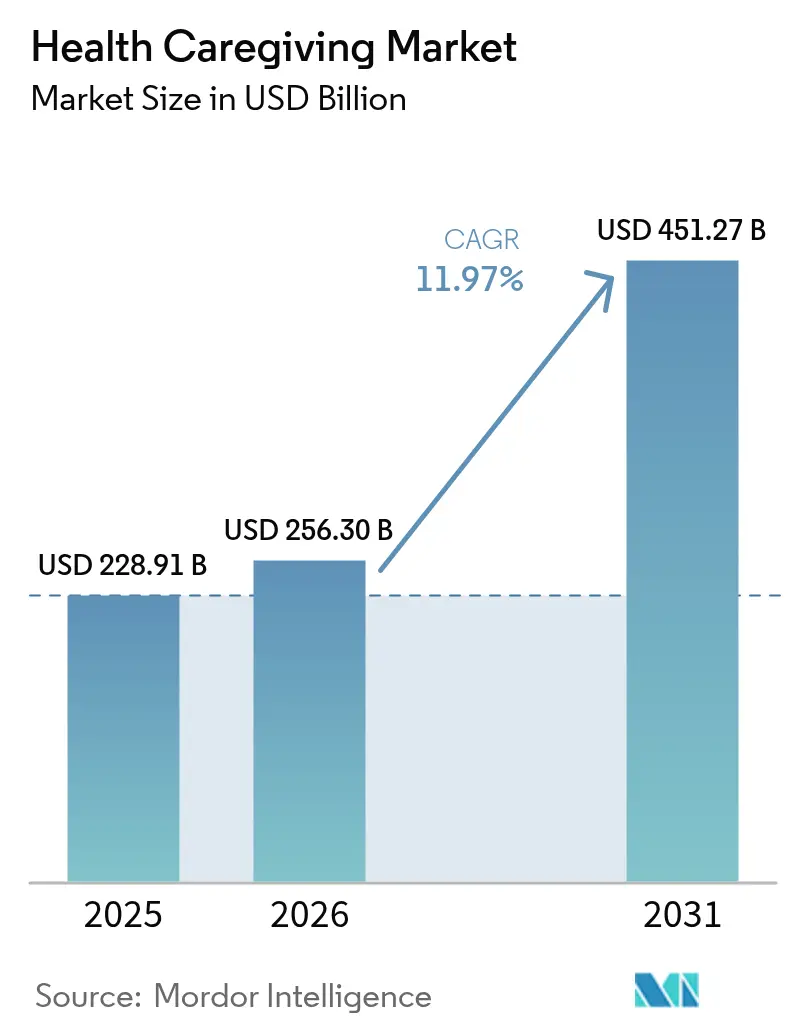
| Market Size (2026) | USD 256.3 Billion |
| Market Size (2031) | USD 451.27 Billion |
| Growth Rate (2026 - 2031) | 11.97 % |
| Fastest Growing Market | Asia-Pacific |
| Largest Market | North America |
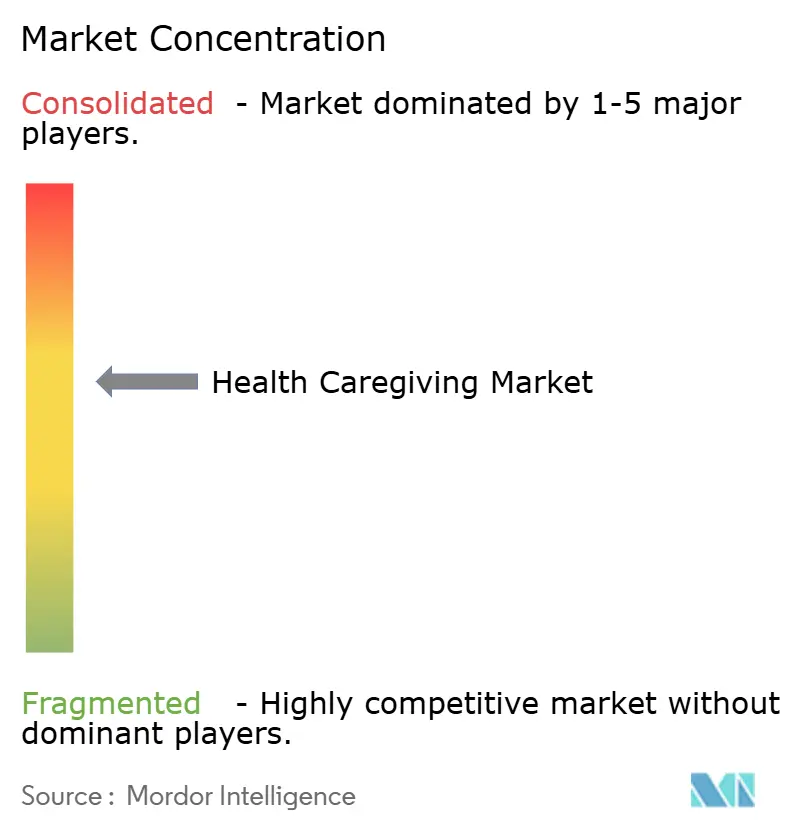
| Market Concentration | Medium |
Major Players *Disclaimer: Major Players sorted in no particular order Image © Mordor Intelligence. Reuse requires attribution under CC BY 4.0. | |
Health Caregiving Market Analysis by Mordor Intelligence
The health caregiving market size in 2026 is estimated at USD 256.3 billion, growing from 2025 value of USD 228.91 billion with 2031 projections showing USD 451.27 billion, growing at 11.97% CAGR over 2026-2031. Growing preference for aging in place, accelerated uptake of connected-care technology, and payer incentives that reward home-based outcomes continue to propel the health caregiving market. Adoption of value-based reimbursement models pushes providers to reduce avoidable hospitalizations, while artificial-intelligence-enabled analytics already cut emergency-department visits by 23% among high-risk groups. Rapid growth of gig-economy caregiver platforms eases labor shortages in urban centers, and expanded public funding for home- and community-based services widens eligibility for remote monitoring benefits. The regulatory framework remains supportive but complex; proposed CMS margin caps coexist with expanded reimbursement for virtual care, and cybersecurity obligations intensify as data breaches affected 133 million people in 2024.
Key Report Takeaways
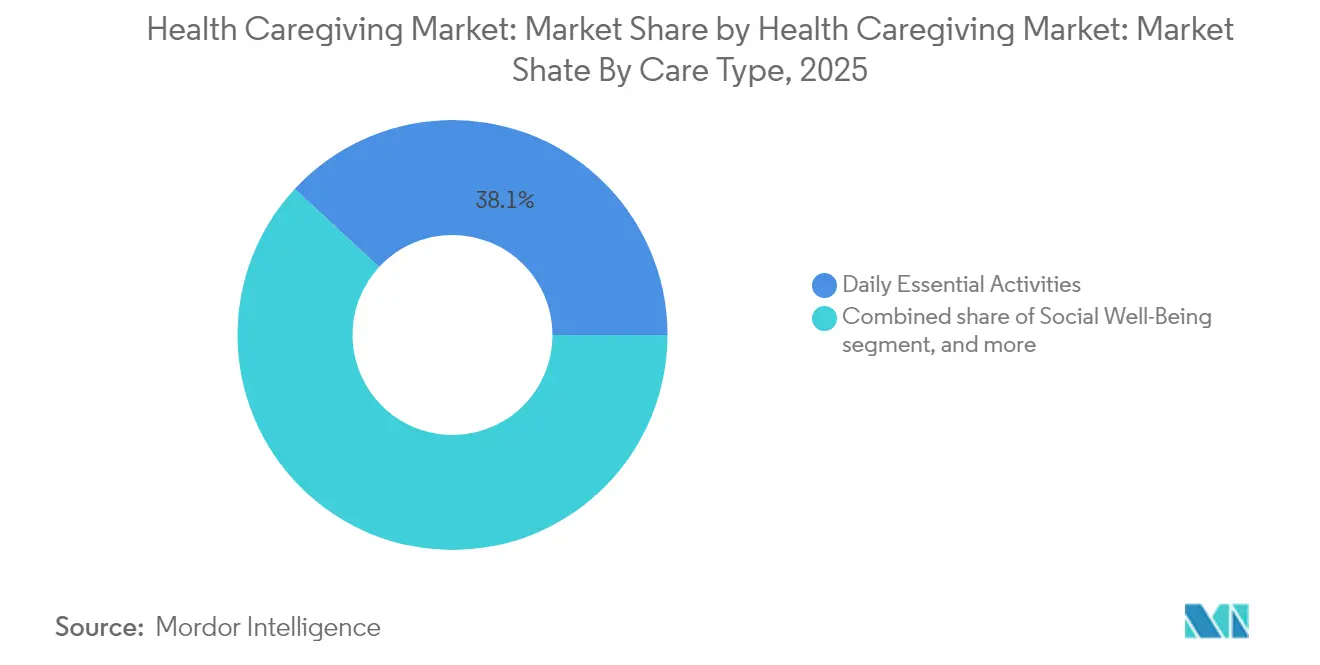
- By care type, daily essential activities led with 38.12% health caregiving market share in 2025, while Institutional/Nursing Care is forecast to expand at a 13.89% CAGR through 2031.
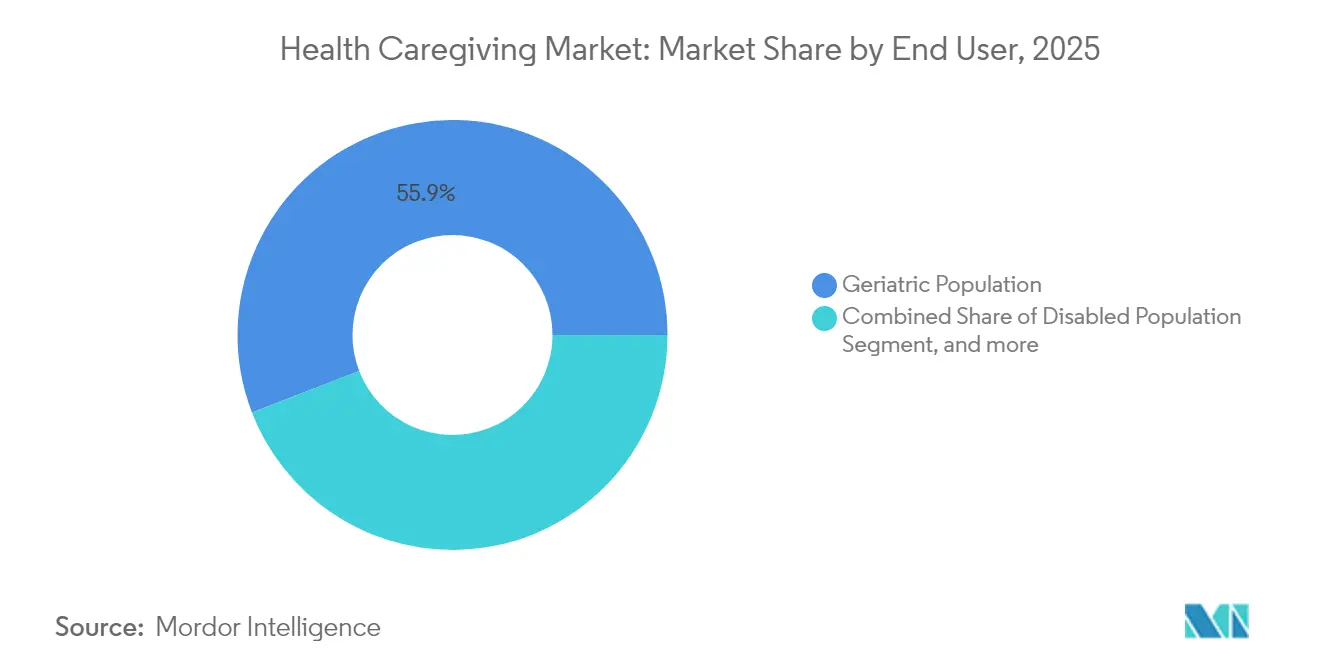
- By end user, the geriatric group accounted for 55.86% of the health caregiving market size in 2025, whereas post-partum mothers and infants are projected to grow at a 14.31% CAGR to 2031.
- By payment source, public funding sources held 57.92% share of the health caregiving market in 2025; private insurance shows the fastest trajectory with a 13.41% CAGR through 2031.
- By geography, North America commanded 40.78% health caregiving market share in 2025, yet Asia-Pacific is expected to register a 13.18% CAGR between 2026 and 2031.
Note: Market size and forecast figures in this report are generated using Mordor Intelligence’s proprietary estimation framework, updated with the latest available data and insights as of 2026.
Market Trends and Insights
Drivers Impact Analysis of Health Caregiving Market*
| Driver | (~) % Impact on CAGR Forecast | Geographic Relevance | Impact Timeline |
|---|---|---|---|
| Rapidly Expanding Geriatric Population | +3.2% | Global, with concentration in North America & Europe | Long term (≥ 4 years) |
| Growing Burden Of Chronic Diseases | +2.8% | Global, particularly APAC emerging markets | Medium term (2-4 years) |
| Accelerated Adoption Of Telehealth & Remote-Patient-Monitoring Platforms | +2.1% | North America & EU leading, APAC following | Short term (≤ 2 years) |
| Expansion Of Value-Based Reimbursement Models | +1.9% | North America primary, EU selective adoption | Medium term (2-4 years) |
| Gig-Economy Caregiver Platforms | +1.4% | Urban centers globally, strongest in North America | Short term (≤ 2 years) |
| AI-Driven Predictive Analytics | +1.0% | Developed markets initially, scaling globally | Long term (≥ 4 years) |
| Source: Mordor Intelligence | |||
Rapidly Expanding Geriatric Population
Adults aged 65 and above increasingly choose to remain at home, with 77% stating this preference in 2024[1]AARP Public Policy Institute, “2024 Home and Community Preference Survey,” aarp.org. Family-care capacity declines as dual-career households and geographic dispersion limit informal support, creating a gap filled by professional services. The monthly cost difference between home-based and nursing-home care averages USD 2,800, steering families and payers toward community options. Medicare Advantage plans reacted by offering supplemental in-home benefits in 89% of plans in 2025, up from 67% two years earlier. These shifts anchor long-term demand and reinforce a supply pipeline for specialized home-care providers.
Growing Burden of Chronic Diseases
Multiple chronic conditions affected 67% of Medicare beneficiaries in 2024. Integrated platforms that combine clinical oversight and daily living support have reduced hospitalizations and emergency visits, demonstrating 38% fewer readmissions among heart-failure patients when remote monitoring pairs with home nursing. Continuous data capture unlocks new revenue streams for providers while lowering payer costs, sustaining healthy margins within the health caregiving market.
Accelerated Adoption of Telehealth & Remote-Patient-Monitoring Platforms
The FDA cleared 47 new remote patient-monitoring devices in 2024, including fall-detection sensors and medication-adherence tools that integrate with electronic health records. Machine-learning systems now predict hospitalization risk 30 days ahead with 84% accuracy. Providers layer these insights onto caregiver workflows, forming hybrid models that deliver clinical accuracy and human empathy, which in turn bolsters user trust and outcome performance across the health caregiving market.
Expansion of Value-Based Reimbursement Models
Medicare Advantage spending on supplemental home-care benefits reached USD 23.7 billion in 2024. CMS launched 12 demonstration projects to test integrated home-based delivery that merges medical and social services. Early evidence shows coordinated home care matches institutional outcomes at 15-25% lower cost, providing a durable catalyst for provider investment and payer alignment in the health caregiving market.
Restraints Impact Analysis of Health Caregiving Market*
| Restraint | (~) % Impact on CAGR Forecast | Geographic Relevance | Impact Timeline |
|---|---|---|---|
| Acute Caregiver Workforce Shortages & High Turnover | -2.1% | Global, most severe in rural areas | Medium term (2-4 years) |
| High Cost Of Care And Uneven Insurance Reimbursement | -1.8% | North America & EU primarily | Short term (≤ 2 years) |
| Escalating Cybersecurity And Data-Privacy Liabilities | -1.2% | Global, regulatory focus in EU & North America | Long term (≥ 4 years) |
| Regulatory Uncertainty From Proposed CMS Access Rule | -0.9% | United States primarily | Short term (≤ 2 years) |
| Source: Mordor Intelligence | |||
Acute Caregiver Workforce Shortages & High Turnover
Home-health turnover reached 82% in 2024, straining care continuity[2]National Association for Home Care & Hospice, “2024 Home Care Workforce Report,” nahc.org. Wage gaps versus hospital roles widen attrition risk, and rural vacancy rates run 34% higher than urban averages. Skill-mix shortages emerge as chronic-disease management and device proficiency become mandatory. These constraints limit near-term expansion capacity in parts of the health caregiving market.
High Cost of Care and Uneven Insurance Reimbursement
Medicare home-health rates rose 2.1% in 2024 while provider costs climbed 6.8%, compressing margins. Private-insurance benefit designs vary, causing coverage gaps and administrative delays. Smaller agencies face resource burdens when juggling multiple payers, hindering entry into new regions and tempering competitive intensity within the health caregiving industry.
*Our forecasts treat driver/restraint impacts as directional, not additive. The impact forecasts reflect baseline growth, mix effects, and variable interactions.
Health Caregiving Market Segment Analysis
By Care Type:
Institutional Services Accelerate Home-Based ComplexityDaily essential activities commanded 38.12% of the health caregiving market in 2025, signaling demand for help with bathing, meals, and mobility. Institutional/Nursing Care is poised for a 13.89% CAGR, reflecting rising acceptance of higher-acuity services at home. Advanced monitoring devices cleared by the FDA in 2024 enable hospital-grade oversight that supports this shift. In a parallel trend, Health & Safety Awareness services pair devices with rapid response teams, while Social Well-Being programs reduce isolation risks. Collectively, these lines are reshaping the health caregiving market size through bundled clinical and non-clinical offerings.
Growth in Institutional/Nursing Care underscores the blurring boundary between medical and supportive functions. Providers integrate skilled nursing, physical therapy, and social services under unified care plans, boosting patient retention and reimbursement rates. As clinical oversight deepens, technology platforms track vitals, medication adherence, and environmental safety in real time, helping agencies scale without escalating labor hours. These changes reinforce the long-term expansion path of the health caregiving market.



By End User:
Post-Partum Care Catalyzes New DemandThe geriatric cohort held 55.86% share of the health caregiving market size in 2025, underpinned by Medicare coverage expansion. Disabled individuals, post-acute patients, and chronic-disease populations require blended support that merges personal assistance and medical supervision. Post-partum mothers and infants, while a smaller share, present a 14.31% CAGR through 2031 as Medicaid coverage for doula services spreads to 23 states.
As family structures evolve, professional post-partum support gains traction, improving maternal outcomes and reducing hospital readmissions for newborn complications. Insurers benefit from lower acute-care costs, encouraging broader coverage. Providers specializing in lactation consulting and maternal mental-health check-ins achieve operational efficiencies due to short episode durations and higher payment rates. These dynamics diversify the health caregiving market and ease reliance on geriatric revenue streams.
By Payment Source:
Private Insurance Expands Benefit ScopePublic programs supplied 57.92% of health caregiving market funding in 2025 through Medicare, Medicaid, and allied waivers. These programs anchor baseline demand and set quality standards. Private insurance, however, is tracking a 13.41% CAGR, driven by competitive benefit designs and employer interest in workforce well-being.
Large insurers increased home-care coverage to manage total cost of care and enhance member satisfaction. Multiline carriers integrate digital triage, home-care nurse visits, and social-needs assessments into bundled products. As private payors scale, reimbursement bureaucracy eases, accelerating credentialing for agencies and spurring tech adoption that supports evidence-based quality metrics across the health caregiving market.
Geography Analysis
North America Health Caregiving Market
North America retained 40.78% of the health caregiving market in 2025 thanks to mature reimbursement structures and high remote-monitoring penetration. U.S. Medicare Advantage enrollment in RPM programs reached 34% in 2024. Canada leverages universal coverage to pivot more services into communities, and Mexico’s rising middle class is fueling private-insurance uptake. Providers focus on technology-driven efficiency that offsets wage pressures and wide service areas.
APAC Health Caregiving Market
Asia-Pacific is forecast to grow at 13.18% CAGR, led by China and India. China’s demographic inversion accelerates demand, while policy shifts invite private capital into elder-care ventures. Japan pioneers robotics for personal assistance, modeling workforce solutions for the region. India’s middle-class growth and expanding insurance base create fertile ground for organized care networks. Australia’s National Disability Insurance Scheme underwrites comprehensive home supports, offering a blueprint for neighboring markets.
Europe Health Caregiving Market
Europe enjoys steady progress as universal systems reposition around home-based care. Germany’s long-term-care insurance funds extensive in-home benefits, France incentives home modifications through tax credits, and the United Kingdom’s NHS sets community-care targets to cut hospital occupancy. Strict GDPR rules raise compliance costs but also heighten public trust in digital solutions, supporting adoption of secure data flows and connected devices in the health caregiving market.
Regulatory Landscape
Regulation is tightening around service quality and patient safety as caregiving shifts into the home. In the United States, the market continues to operate under CMS Conditions of Participation and evolving reimbursement rules, while the proposed CMS home health "Access" rule adds uncertainty around provider margins. Outside the US, governments are increasingly formalizing long-term care and home care as a public responsibility; Brazil enacted Lei No. 15.069 on December 23, 2024 establishing a National Care Policy that integrates federal, state, and municipal action, signaling broader public-system engagement in care delivery.
Standards bodies are also driving convergence in care quality frameworks across geographies. ISO published ISO 25557:2026 on March 23, 2026, setting international guidance for care quality for older persons across home and facility settings, while Health Standards Organization published CAN/HSO 35001:2026 covering home care and support services across acuity levels. At the global level, WHO opened a public consultation on May 18, 2026 for its first framework of global standards for long-term care for older people, creating a reference point for regulators and payers in technology-enabled and integrated caregiving models.
Value Chain Analysis
The health caregiving value chain begins with funding and eligibility determination (public payers such as Medicare and Medicaid, private insurers, and out-of-pocket pay), then flows through referral and care-plan design (health systems, physicians, discharge planners, and case managers). Service delivery is carried out by home care agencies, nursing and therapy providers, gig-economy caregiver platforms, and family caregivers, supported by remote patient monitoring device makers, EHR and care-coordination software, scheduling and billing platforms, and medical supply distributors. Outcomes and compliance reporting feed back to payers under value-based reimbursement models, while cybersecurity and data-privacy controls are increasingly embedded as connected-care usage grows.
Two bottlenecks continue to shape cost and capacity. First, labor supply is structurally constrained in many markets; in the United States, HRSA reported in December 2025 that 92 million people live in a primary care Health Professional Shortage Area, and KFF reported in February 2025 that 41 states cited permanent closures of home care providers within the prior year due to worker shortages. Second, upstream healthcare supply chain disruptions affect in-home clinical episodes and medication management; ASHP reported active U.S. drug shortages rising to 227 by end-Q2 2026 (from 216 at end-2025), and the USP 2026 Annual Drug Shortages Report highlighted that average life science supply disruptions extend beyond five years. Providers respond by diversifying sourcing, redesigning care pathways, and increasing coordination with pharmacies and distributors.
Competitive Landscape
The health caregiving market shows moderate fragmentation. Regional leaders such as Amedisys and LHC Group leverage Medicare certification and clinical depth, while digital players like Honor Technology and Care.com deploy matching algorithms to optimize scheduling and staffing. Health-system entrants, including Encompass Health, extend rehabilitation expertise into the home, combining therapy and nursing within single episodes of care.
Technology integration serves as the primary differentiator. Providers deploying machine-learning risk tools, such as Vesta Healthcare, record a 31% drop in emergency-department use among managed members. Gig-platform models increase caregiver availability in metropolitan areas, helping agencies flex staffing without fixed overhead. Rural markets remain underserved, delivering white-space opportunities for tele-enabled hybrids that coordinate across dispersed geographies. Regulatory guardrails, including CMS conditions of participation and state licensure, elevate entry barriers and reinforce compliance as a competitive asset.
Health Caregiving Industry Leaders
Vesta Healthcare
Seniorlink, Inc.
Lively
Cariloop
HomeTeam
- *Disclaimer: Major Players sorted in no particular order
Health Caregiving Market Companies Covered in this Report
- AccentCare
- Addus HomeCare
- Amedisys
- Bayada Home Health Care
- Brookdale Senior Living
- Care.com
- Cariloop
- Comfort Keepers
- Encompass Health
- HomeTeam
- Honor Technology
- Kindred Healthcare
- Knight Health Holdings
- LHC Group
- Lively
- Right at Home
- Room2Care
- Senior Helpers
- Seniorlink
- Vesta Healthcare
- Visiting Angels

Market Opportunities and Future Outlook
A major near-term opportunity is formalizing and scaling workforce development and caregiver enablement as governments and advocacy groups push more care into communities. In the United States, Senator Tim Kaine introduced the Supporting Our Direct Care Workforce and Family Caregivers Act in June 2026 to create an Administration for Community Living technical assistance center and fund direct-care workforce and family caregiver training, aligning with advocacy priorities outlined in the National Alliance for Caregiving 2026 Policy Agenda (March 2026). With 63 million Americans identified as family caregivers in 2025 and nearly half using digital tools for care management, there is clear whitespace for vendors that integrate caregiver training, documentation, and care coordination into reimbursable workflows for payers and employer-sponsored benefits.
Technology-enabled operating models also provide a pathway to expand capacity without matching labor growth. Home-care operators and platform vendors are investing in automation and analytics to reduce administrative burden and improve care continuity, especially where value-based incentives reward reduced avoidable utilization. Axxess reported in January 2026 that early adopters of AI in home care cite efficiency gains exceeding 25%, supporting continued investment in scheduling optimization, documentation automation, and risk stratification. Outside the US, digitization programs in social care create demand for interoperable data exchange and secure records; England reported high adoption of Digital Social Care Records among registered care providers by July 2025, which supports standardized integrations across home care, nursing, and remote monitoring.
Recent Industry Developments in Health Caregiving Market
- June 2026: Lively launched Lively Axis, an AI-driven platform aimed at automating healthcare payments and benefits workflows. The product focus on streamlining reimbursements and claims processing supports faster benefit access for families and employers that fund caregiving-adjacent services.
- October 2025: Intention Healthcare acquired technology and assets of Vesta Healthcare to expand home-based care platform capabilities across the United States. The deal consolidates care-management technology with service delivery infrastructure, strengthening integrated offerings used by payers and provider partners.
- July 2024: CareAtHome Medical Group partnered with Vesta Healthcare after selection by the Centers for Medicare and Medicaid Services to test the Guiding an Improved Dementia Experience (GUIDE) Model across 11 states, with the model starting in July 2025. The program structure strengthens demand for coordinated dementia care workflows that combine caregiver support, clinical oversight, and technology-enabled monitoring.


Health Caregiving Market Report Scope and Research Methodology
Market Definition and Coverage
For this study, the health caregiving market covers paid and unpaid support provided to people who cannot fully manage daily life due to aging, disability, illness, or recovery needs, and it includes both home and institutional care arrangements.
Scope exclusions: We exclude informal wellness services that are not linked to caregiving needs, along with non-care consumer devices sold without an associated caregiving service.
Segments Covered in This Report
- By Care Type
- Daily Essential Activities
- Health & Safety Awareness
- Social Well-Being
- Institutional / Nursing Care
- Other Care Types
- By End User
- Geriatric Population
- Disabled Population
- Post-Acute / Chronic-Disease Patients
- Post-partum Mothers & Infants
- By Payment Source
- Public
- Private Insurance
- Out-of-Pocket / Self-Pay
- Geography
- North America
- United States
- Canada
- Mexico
- Europe
- Germany
- United Kingdom
- France
- Italy
- Spain
- Rest of Europe
- Asia-Pacific
- China
- Japan
- India
- Australia
- South Korea
- Rest of Asia-Pacific
- Middle East & Africa
- GCC
- South Africa
- Rest of Middle East & Africa
- South America
- Brazil
- Argentina
- Rest of South America
- North America
Data Sources, Market Sizing, and Validation
Desk Research
Desk research started with public health and demographic data to anchor the addressable care population, and then we mapped how care is accessed and paid for across key regions. Sources we leaned on include, for example, the World Health Organization, the World Bank, the United Nations Population Division, the OECD health statistics portal, and the US CDC for burden and aging related indicators.
From there, we used policy and payment references to interpret the service mix, such as government health agency updates, public payer program documentation, and hospital and post-acute care utilization releases. These were supported by company annual reports, investor presentations, and reputable press coverage. For market structure checks, we also referenced paid subscriptions focused on company financials and intelligence, news and financials, and patent databases to understand care delivery models and technology adoption signals. The desk sources listed here are illustrative only, and many other public documents and data tables were reviewed to collect, cross-check, and clarify inputs.
Primary Interviews and Surveys
Primary work was used to confirm what portion of caregiving demand is being served through home settings versus institutional settings, and how reimbursement and out-of-pocket pricing are moving in practice. We interviewed and surveyed a mix of care providers, platform and staffing participants, payer-side experts, and clinicians and administrators involved in discharge planning, with coverage across APAC, EMEA, and the Americas to reduce single-country bias.
Distribution of primary research fieldwork respondents
| Company type | Respondent position | Region |
|---|---|---|
| Top tier: 36% | CXOs: 13% | APAC: 46% |
| Mid tier: 44% | Functional/Unit leaders: 43% | EMEA: 31% |
| Smaller Players: 20% | Managers: 44% | Americas: 23% |
Market-Sizing & Forecasting
Sizing was built using top-down and bottom-up logic. On the top-down side, we reconstructed demand from the caregiving population pool and the care intensity that typically follows aging, disability prevalence, and chronic or post-acute recovery needs. Once those care needs were translated into serviceable hours, visit frequency, and typical care pathways, the totals were filtered through payment source realities and setting mix so the market does not overcount unfunded demand.
To keep outputs grounded, we corroborated results with selective bottom-up approximations, such as sampled provider revenue checks, channel conversations on staffing capacity, and sanity checks using average price per hour or per visit multiplied by plausible volumes. Inputs that mattered most included the 65+ population trend, disability prevalence, post-acute discharge volumes, payer coverage share (public, private insurance, and self-pay), and observed shifts toward aging in place. Forecasting relied on scenario analysis, where we applied expected changes in staffing availability, payment policy direction, and technology enablement to create a base case that primary experts could validate. Where bottom-up coverage was thin in smaller countries, gaps were handled using ratio-based proxies from similar markets, then adjusted back using local wage and utilization signals.
Data Validation & Update Cycle
Validation was done through repeated cross-checks between model outputs and independent signals, including demographic growth, health system utilization, and directional pricing and wage movement, before numbers were finalized. When a region showed an unusual jump, the assumptions were reopened, outlier data points were tested, and respondents were re-contacted if the variance could not be explained through policy or mix changes.
A multi-step review is followed so calculations, unit conversions, and currency handling are checked by another analyst before sign-off. Reports are refreshed annually, and interim updates are made when material events occur, such as major reimbursement changes or step-shifts in labor availability. Right before delivery, a final pass is performed so clients receive the most current view based on the latest available releases and interview feedback.
Mordor Intelligence's Health Caregiving Market Size Compared With Other Published Estimates
Published market values can differ in this space, mainly because caregiving is defined differently by each publisher, and some models mix medical and non-medical care in ways that are not consistent. Variations also come from which settings are counted, which payer flows are included, and how quickly numbers are refreshed after policy or wage changes.
The table shows a spread that largely comes from service boundary choices and from how utilization is converted into dollars, especially when hourly care, institutional nursing care, and post-acute needs are blended together. The table shows USD 256.3 B (2026), and in Mordor Intelligence's model the total is built across defined care types and payment sources, then checked against setting mix signals so adjacent wellness spending and unrelated consumer services are not pulled into the final number.
Benchmark comparison
| Source | Market Size | Gaps in Research Methodology |
|---|---|---|
| Mordor Intelligence | USD 256.3 B (2026) | |
| Global Consultancy A | USD 300.0 B (2025) | This figure appears to use a different base year and may include a wider bundle of home-based services beyond caregiving, which can lift totals when non-care personal services are counted alongside care delivery. |
| Trade Journal B | USD 150.2 B (2026) | This estimate likely narrows the scope toward home-based caregiving and underrepresents institutional or nursing care components, and it can also reflect more conservative assumptions on hours delivered and average pricing. |
Across the three values, the biggest driver is what gets counted as caregiving and how setting coverage is treated, followed by base year alignment and pricing assumptions. Our approach keeps a clear link between demand indicators (population needs and utilization) and the value conversion (pricing and payer mix), which makes the final number easier to explain and repeat when new data arrives.


Key Questions Answered in the Report
How large is the health caregiving market in 2026?
The health caregiving market size is USD 256.3 billion in 2026.
What is the projected growth rate for health caregiving through 2031?
The market is expected to grow at a 11.97% CAGR, reaching USD 451.27 billion by 2031.
Which care type is expanding the fastest?
Institutional/Nursing Care shows the highest growth at a 13.89% CAGR through 2031.
Which region is growing quickest in health caregiving?
Asia-Pacific is projected to post a 13.18% CAGR between 2026 and 2031.
What is the main driver behind increased home-based care demand?
A rapidly aging global population combined with consumer preference for aging in place underpins long-term demand.
How are insurers encouraging home-based caregiving?
Medicare Advantage and private insurers expand supplemental benefits and value-based models that reimburse remote monitoring and in-home services.
Page last updated on:


 Your data is secure and never sold or shared.


