
Guatemala Construction Market Size and Share
Market Overview
| Study Period | 2020 - 2031 |
|---|---|
| Forecast Data Period | 2026 - 2031 |
| Base Year Market Size (2025) | USD 3.40 Billion |
| Market Size (2026) | USD 3.7 Billion |
| Market Size (2031) | USD 5.64 Billion |
| Growth Rate (2026 - 2031) | 8.79 % |
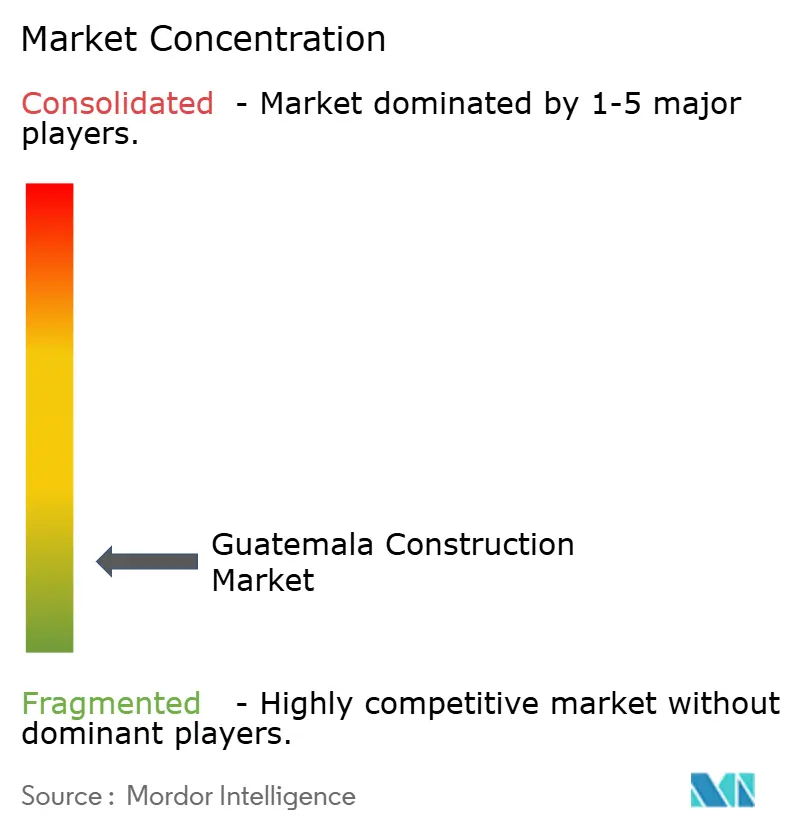
| Market Concentration | Low |
Major Players *Disclaimer: Major Players sorted in no particular order Image © Mordor Intelligence. Reuse requires attribution under CC BY 4.0. | |
Guatemala Construction Market Analysis by Mordor Intelligence
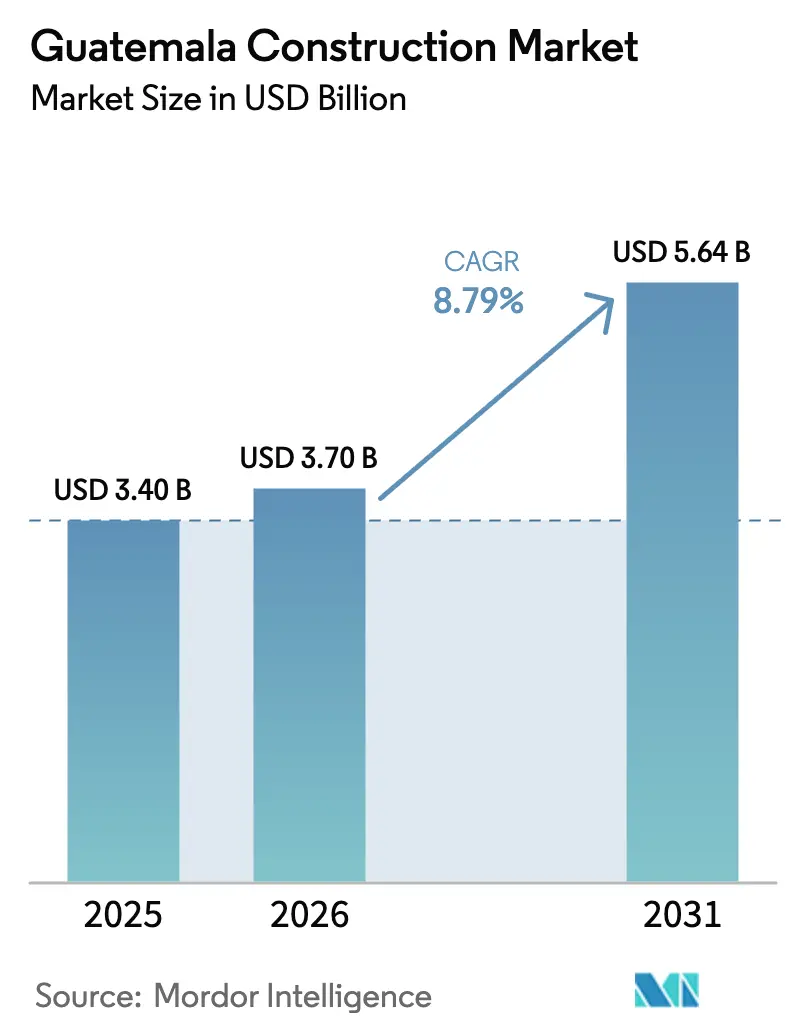
The Guatemala Construction market size is expected to grow from USD 3.40 billion in 2025 to USD 3.70 billion in 2026 and is forecast to reach USD 5.64 billion by 2031 at 8.79% CAGR over 2026-2031. Robust public investment in social housing, rejuvenated infrastructure spending, and rising foreign direct investment in nearshoring–oriented facilities are propelling this expansion. Demand is concentrated in urban centers, especially Guatemala City, where vertical residential formats and commercial complexes dominate new project pipelines. Escuintla’s industrial parks and logistics corridors are underpinning momentum outside the capital, while renewable‐energy projects add a steady pipeline of utility work. Despite persistent headwinds from political risk and skilled-labor shortages, the Guatemala construction market is benefiting from private capital’s growing appetite for industrial, energy, and mixed-use developments, signaling a gradual improvement in investor sentiment.
Key Report Takeaways
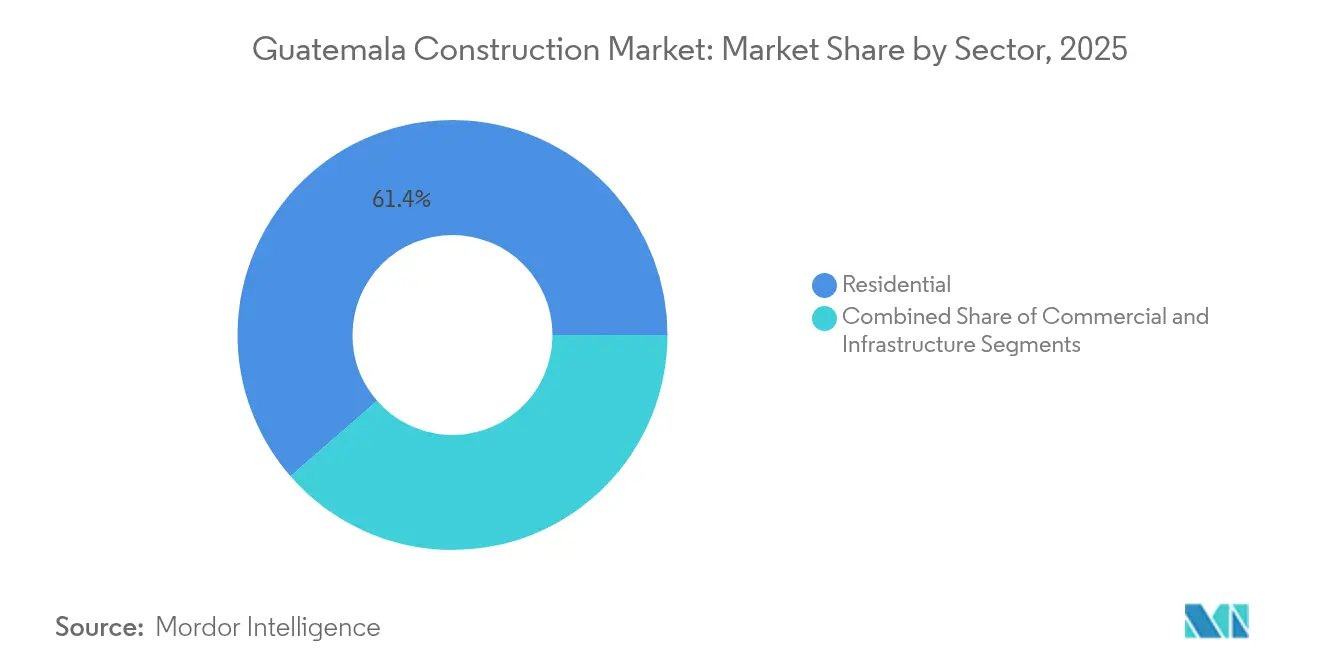
- By sector, Residential segment captured 61.42% of the Guatemala construction market share in 2025. Guatemala construction market size for the infrastructure segment is projected to grow at a 10.26% CAGR between 2026-2031.
- By construction type, New construction captured 57.35% of the Guatemala construction market share in 2025. Guatemala construction market size for new construction is projected to grow at a 9.96% CAGR between 2026-2031.
- By investment source, Public funding captured 64.35% of the Guatemala construction market share in 2025. Guatemala construction market size for private investment is projected to grow at a 10.18% CAGR between 2026-2031.
- By region, Guatemala City captured 45.55% of the Guatemala construction market share in 2025. Guatemala construction market size for the Escuintla Region is projected to grow at a 10.34% CAGR between 2026-2031.
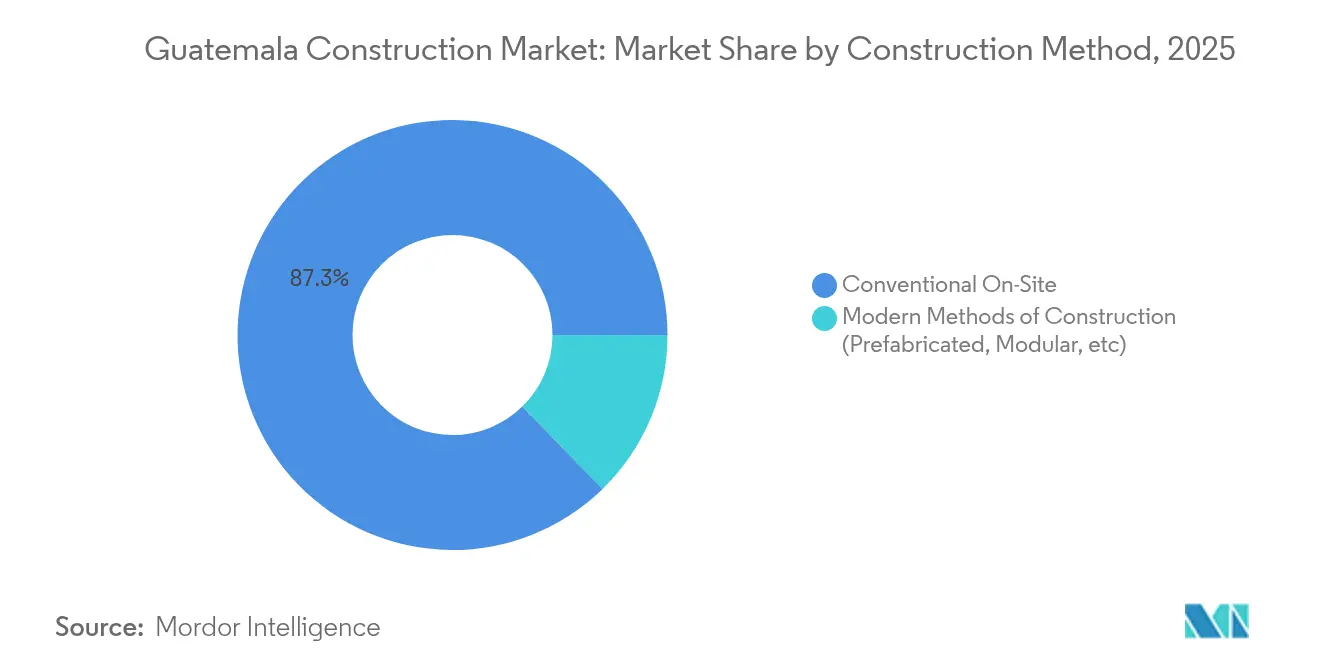
- By construction method, Conventional on-site techniques captured 87.30% of the Guatemala construction market share in 2025. Guatemala construction market size for modern construction methods is projected to grow at an 11.15% CAGR between 2026-2031.
Note: Market size and forecast figures in this report are generated using Mordor Intelligence’s proprietary estimation framework, updated with the latest available data and insights as of 2026.
Market Trends and Insights
Drivers Impact Analysis of Guatemala Construction Market*
| Driver | (~) % Impact on CAGR Forecast | Geographic Relevance | Impact Timeline |
|---|---|---|---|
| Public sector push for affordable housing | +2.3% | Guatemala City, Mixco, Villa Nueva | Medium term (2-4 years) |
| Expansion of national and regional transport infrastructure | +2.8% | Nationwide; corridors to ports | Long term (≥ 4 years) |
| Renewable-energy investments | +1.9% | Escuintla, Quetzaltenango | Medium term (2-4 years) |
| Industrial logistics zones from trade integration | +1.5% | Escuintla, Guatemala City periphery | Short term (≤ 2 years) |
| Source: Mordor Intelligence | |||
Public Sector Push for Affordable Housing to Address Urban Deficits
Government reforms targeting Guatemala’s 1.9 million-unit housing gap center on low-interest mortgages and streamlined permitting. Micro-finance schemes such as Génesis Empresarial combine credit with technical assistance, improving build quality and compliance. Showcase projects like “Trasciende La Parroquia” in Guatemala City illustrate that sustainable features can coexist with cost-effective design. Rising urban land values are driving a 3-7% increase in property prices in 2025, intensifying demand for vertical housing. These dynamics reinforce the Guatemala construction market’s emphasis on mass-scale residential production and modern prefabricated solutions that cut timelines.[1]
Ongoing Expansion of National and Regional Transport Infrastructure
After a decade of under-spending, transport outlays exceed USD 1.6 billion under the National Agency for Economic Infrastructure Alliances. Taiwan’s USD 100 million commitment to the Atlantico road and planning for a USD 7–9 billion inter-oceanic corridor signal generational upgrades. Public-private partnerships are central to execution, leveraging concession models that de-risk large capital projects. Improved highways and rail links shorten freight times from Guatemala City to Puerto Quetzal, boosting competitiveness for exporters. Consequently, the Guatemala construction market is witnessing an uptick in bids for bridges, viaducts, and tunnel packages that demand higher engineering capabilities.
Renewable Energy Investments Fueling Utility and Infrastructure Projects
MPC Energy Solutions’ 65 MWp solar plant and the Transportation System Expansion Plan (PET 2024-2054) create a rolling backlog of transmission builds. Guatemala’s net-exporter status in regional power trade highlights grid resilience and encourages further solar and wind additions. PEG-4-2022 and PEG-5 tenders are contracting new generation capacity, locking in construction workflows for civil works, piling, and substations. Financing remains strong, evidenced by USD 11 million secured for the San Antonio wind farm expansion. These utility projects diversify the Guatemala construction market beyond housing and roads, pulling in specialist EPC firms.
Emergence of Industrial Logistics Zones through Central American Trade Integration
Nearshoring strategies capitalize on Guatemala’s proximity to Mexico and the United States, attracting textiles, BPO, and light manufacturing investors. Escuintla’s industrial parks offer ready land and port access, underpinning warehouse and factory builds. Commitments such as Protela’s USD 45 million facility and Hansae’s USD 300 million complex validate demand for large-scale manufacturing shells. Wal-Mart’s USD 530 million retail-distribution network expansion signals sustained retail logistics growth. Streamlined construction permits under “Guatemala No Se Detiene” reduce lead times, reinforcing the Guatemala construction market’s pivot to time-critical industrial real estate.
Restraints Impact Analysis of Guatemala Construction Market*
| Restraint | (~) % Impact on CAGR Forecast | Geographic Relevance | Impact Timeline |
|---|---|---|---|
| Persistent Political Instability and Corruption Eroding Investor Confidence and Delaying Public Works | -1.8% | National, with heightened impact in rural regions | Medium term (2-4 years) |
| Underdeveloped Capital Markets Limiting Access to Long-Term Local Financing | -1.2% | National | Long term (≥ 4 years) |
| Chronic Shortage of Skilled Construction Labor and Digital Engineering Talent | -0.9% | National, with acute impact in specialized construction segments | Medium term (2-4 years) |
| Source: Mordor Intelligence | |||
Persistent Political Instability and Corruption Eroding Investor Confidence
Political turbulence limits project approvals and prolongs procurement cycles, as underscored in the IMF’s 2024 Article IV report. The UK Government’s risk assessment notes that only one PPP has reached financial close since the 2010 law, highlighting administrative frictions. Although transparency reforms are underway, discretionary decision-making still deters long-horizon investors. Budget reallocations in election years disrupt construction cash flows, delaying mobilization. These uncertainties shave growth from the Guatemala construction market by elevating contingency pricing and discouraging multi-year commitments.
Chronic Shortage of Skilled Construction Labor and Digital Engineering Talent
Guatemala certifies fewer than 2,000 construction apprentices annually, well below demand. Swisscontact’s “Nuevas Oportunidades” program trains returning migrants, yet the skills gap persists. Low technical-education funding and emigration of qualified personnel constrain adoption of BIM and modular systems. FHI 360’s labor assessment links high poverty to limited vocational access, amplifying regional disparities. Consequently, conventional methods dominate because contractors cannot readily staff advanced techniques, slowing the Guatemala construction market’s productivity gains.
*Our forecasts treat driver/restraint impacts as directional, not additive. The impact forecasts reflect baseline growth, mix effects, and variable interactions.
Guatemala Construction Market Segment Analysis
By Sector:
Residential Dominance Meets Infrastructure MomentumThe residential segment accounted for 61.42% of the Guatemala construction market in 2025, supported by state-backed mortgage subsidies and a vibrant micro-finance ecosystem. Vertical condominiums and gated suburban communities have surged as developers respond to land scarcity and shifting lifestyle preferences. Urban property prices rising 3-7% in 2025 further incentivize new unit launches. Luxury towers in Guatemala City’s Zona 14 incorporate green roofs and energy-efficient façades, illustrating demand for sustainable amenities. Infrastructure, while smaller today, is forecast to register the fastest 10.26% CAGR, reflecting commitments to the USD 119 million Atlantico road revamp and the envisioned USD 7–9 billion inter-oceanic corridor. These megaprojects will stretch over a decade, anchoring long-term contractor pipelines.
Infrastructure’s impending scale is reshaping contractor strategies, with local builders forming joint ventures to meet pre-qualification thresholds for bridges, tunnels, and rail packages. Taiwanese funding accelerates early works, positioning procurement for 2026 ground-breaks. Simultaneously, residential developers are adopting prefabrication to compress schedules, evidenced by a 25% rise in eco-friendly housing starts last year. As such, the Guatemala construction market balances high-volume social housing with capital-intensive transport and utilities, broadening opportunity sets across value chains.

By Construction Type:
New Construction Drives Market ExpansionNew-builds represented 57.35% of the Guatemala construction market size in 2025 and are projected to retain dominance with a 9.96% CAGR through 2031. Government roadmaps such as “Guatemala No Se Detiene” prioritize green-field industrial parks, trans-regional highways, and grid extensions, ensuring a robust order book. World Bank program loans earmark USD 2.5 billion for resilient schools and health facilities, creating steady civic demand. Renovation, although smaller, benefits from historic-district upgrades where European investors refurbish colonial assets for boutique hotels, capitalizing on tourism rebounds.
Resilience requirements are raising specifications for new civil works. The Comprehensive School Safety Policy mandates seismic-resistant designs, pushing engineers toward performance-based standards. Insurance providers increasingly condition coverage on adherence to these codes, prompting developers to integrate base isolators and reinforced masonry. Consequently, modern materials suppliers gain traction, and the Guatemala construction market witnesses gradual transitions from unreinforced blockwork to engineered solutions.
By Construction Method:
Technological Transition UnderwayConventional on-site techniques still account for 87.30% of 2025 activity, reflecting entrenched craft traditions and fragmented contractor structures. Yet modern construction methods are expanding at 11.15% CAGR as public housing agencies pilot modular steel and CLT systems. The “Construyendo Guatemala” initiative in Antigua showcases cross-laminated timber’s seismic performance, achieving rapid completion while preserving colonial aesthetics. International EPC firms introduce precast bridge girders and automated rebar cages on transport projects, cutting tilt-up times.
Adoption, however, is uneven. High-profile urban towers deploy BIM for clash detection, while small provincial builds rely on manual drafting. Training gaps and limited supply-chain depth impede mass scaling of industrialized methods. Nonetheless, cost pressures and urban land constraints drive developers to explore volumetric modules for student housing and mid-rise apartments, reinforcing an incremental but irreversible shift within the Guatemala construction market.
By Investment Source:
Public Leadership with Private Sector MomentumPublic funds provided 64.35% of total 2025 outlays, channelled into social programs and flagship infrastructure. ANADIE’s PPP agenda, worth USD 1.6 billion, blends treasury support with private risk capital to extend fiscal reach. As macro-stability improves, private investment is forecast to grow 10.18% annually, led by multinational manufacturers relocating supply chains closer to North-American clients. Renewable-energy developers, backed by international lenders, are another growth node, with grid-connected solar capacity slated to double by 2027.
Private capital also finances mixed-use urban developments, where retail anchors fund public‐realm enhancements via impact fees. This collaborative model reduces fiscal burdens and accelerates permit cycles. Consequently, the Guatemala construction market is evolving toward balanced funding streams, enabling diversification beyond short-tender public works.
Geography Analysis
Guatemala City Construction Market
Guatemala City anchors the Guatemala construction market, with vertical condominiums reshaping the skyline as developers respond to land scarcity. Demand for tech-enabled apartments equipped with smart metering and high-speed fiber is growing quickly. Luxury projects in Zona 10 and Zona 14 couple energy-efficient façades with 24/7 security, sustaining premium valuations. Gated suburban estates on the city fringe cater to middle-income households migrating from congested urban cores, creating a dual-track residential scene that sustains both high-rise and low-density demand. Municipal infrastructure upgrades, including storm-water tunnels and intersection flyovers, reinforce the capital’s dominance in the Guatemala construction market.
Escuintla Construction Market
Escuintla’s industrial surge is anchored by its proximity to Puerto Quetzal, Guatemala’s principal Pacific gateway. Logistics corridors linking the port to Guatemala City facilitate time-sensitive exports, prompting developers to erect cross-dock warehouses and temperature-controlled facilities. Solar and wind farms cluster nearby, requiring substations and service buildings that employ skilled steelwork crews. The PET 2024-2054 transmission plan allocates capital for sub-station upgrades, ensuring reliable energy for expanding factories. Transport upgrades, such as the Atlantico-El Rancho highway section, will trim trucking times, reinforcing Escuintla’s allure for regional distribution nodes within the Guatemala construction market.
Secondary Cities and Rural Guatemala Construction Market
Secondary cities—Quetzaltenango, Mixco, and Villa Nueva—are capturing residential spill-over as housing prices in the capital climb. Génesis Empresarial’s micro-finance loans support self-build and incremental expansions that improve housing stock quality. EU development funds target water, sanitation, and school builds, adding public-works volume. Road widening projects under “Guatemala No Se Detiene” enhance links between these towns and economic hubs, fostering corridor-based growth. Rural regions benefit from electrification efforts like Project Ohio 2025, which extends low-voltage lines to underserved communities. As connectivity improves, localized construction markets emerge, broadening the Guatemala construction market’s geographic footprint beyond its historic core.
Regulatory Landscape
Guatemala operates a fragmented construction-regulation environment, with permitting and land-use controls largely administered at the municipal level through local land management plans (POT), including in Guatemala City where vertical residential and mixed-use projects concentrate. At the national level, the country does not have a single, unified national building code. Instead, technical requirements and compliance practices are shaped by municipal rules, sector-specific frameworks, and the standards ecosystem coordinated by the Ministerio de Economia through the Direccion del Sistema Nacional de la Calidad (DSNC), which oversees norms, accreditation, and metrology.
For large infrastructure delivery, the public-private partnership framework under Decree 16-2010 is structured and overseen by the Agencia Nacional de Infraestructura (ANADIE), which manages APP planning, structuring, and fiscal oversight for projects across transport and other economic infrastructure. Governance and process design for ANADIE has remained an active policy topic, including debate in 2025 around board composition and the role of private sector representatives such as CACIF and the Camara Guatemalteca de la Construccion, influencing investor confidence, bid participation, and the pace of project preparation.
Value Chain Analysis
Guatemala's construction value chain starts with project origination led by public entities, including ANADIE for APP pipelines, and private developers concentrated in Guatemala City and key corridors. The process then runs through feasibility, design, and engineering into procurement and site execution. Integrated local players and mid-sized contractors support delivery across residential, commercial, and civil works, while associations such as the Camara Guatemalteca de la Construccion (CGC), along with groups tied to contractors and housing, coordinate industry practices on safety and contracting norms.
Design, engineering, and construction services are supplied by firms spanning consulting through execution, including AICSA Corporacion (industrial, corporate, and infrastructure projects) and roadwork specialists such as Corporacion San Francisco S.A. Downstream, materials and equipment availability and compliance increasingly depend on standardization efforts, including industry-led initiatives highlighted by the II Encuentro Nacional de Construccion Segura 2025, which focused on consistent technical criteria for construction materials and safety. As specifications tighten, coordination among designers, contractors, and suppliers becomes more critical, especially for higher-engineering transport, utility, and industrial projects.
Competitive Landscape
Guatemala’s construction market is fragmented. Holcim’s USD 200 million acquisition of CEMEX’s assets consolidated the cement segment, granting Holcim control over one grinding mill, three ready-mix plants, and five distribution centers. Local contractors such as Corporacion San Francisco S.A. and Corporacion San Francisco S.A. leverage political networks to secure public tenders for highways and social housing. Mid-sized specialists like Precon supply precast components that cater to growing modular demand. International EPCs, including COMSA Corporación, bring rail expertise, partnering with Guatemalan builders to navigate permitting requirements.
Technology is a key differentiator. Firms adopting BIM and cloud-based project-management platforms reduce rework and improve cash-flow forecasting, outperforming rivals stuck with paper-based processes. Sustainable-construction advocates gain market share by integrating low-carbon concrete and energy-efficient façades, responding to potential carbon-pricing schemes outlined by the Ministry of Environment and the UNFCCC. Skilled-labor shortages nevertheless pose execution risks, prompting larger contractors to invest in on-site training centers and collaborate with Swisscontact’s certification programs.
Segment-specific opportunities are emerging. Renewable-energy EPC packages require electrical and civil expertise, creating niches for firms with ISO-certified safety protocols. Industrial build-to-suit contracts linked to nearshoring demand hybrid funding, combining developer equity with tenant capex guarantees. As foreign developers search for local partners, alliances between Guatemalan contractors and multinational materials suppliers become prevalent, redefining competitive boundaries within the Guatemala construction market.
Guatemala Construction Industry Leaders
-
Corporacion San Francisco S.A.
-
Constructora AICSA S.A.
-
Metro Proyectos S.A.
-
CVG ITSA S.A.
-
Futuros Constructivos Sobre la Roca S.A.
- *Disclaimer: Major Players sorted in no particular order
Guatemala Construction Market Companies Covered in this Report
- Corporacion San Francisco S.A.
- Constructora AICSA S.A.
- Metro Proyectos S.A.
- CVG ITSA S.A.
- Futuros Constructivos Sobre la Roca S.A.
- LGB Guatemala S.A.
- Nabla Group
- ULMA Construction
- Construcciones de Guatemala
- CEMEX Guatemala
- Grupo Cementos Progreso
- Doka Guatemala
- Grupo Macro
- Sika Guatemala
- Grupo Disagro
- Constructora Sigma
- Grupo Deco
- ESR Ingeniería
- Marhnos Guatemala
- Grupo Materiales y Transporte
- INGECO
- PADELA
- Grupo Cayalá
- Megaproyectos S.A.
Market Opportunities and Future Outlook
Opportunity is concentrated where bankable pipelines and enabling frameworks already exist, particularly in public-private partnerships governed by Decree 16-2010 and structured through ANADIE for economic infrastructure such as roads and transport nodes. The 2025 approval of reforms to the Law on Alliances for the Development of Economic Infrastructure creates room for private participation across project preparation and delivery, which supports more consistent tender calendars and sustains demand for contractors and engineering firms that can meet prequalification, governance, and reporting requirements.
On the private side, commercial centers and mixed-use formats align with urban densification and corridor growth. Metroproyectos, which operates 17 commercial centers in Guatemala, continues to pursue housing and commercial developments (as of June 2026), supporting a pipeline for general contractors, specialty trades, and fit-out supply chains. At the same time, the push to standardize technical criteria for materials and safety signaled by national industry forums in 2025 supports differentiated demand for compliant products and certified execution, giving suppliers and contractors that can document performance and safety practices an advantage across residential high-rises, logistics facilities, and utility-related works.
Recent Industry Developments in Guatemala Construction Market
- June 2026: Groundbreaking for Metroplaza El Rancho project in Guatemala. The launch activates the Guatemala construction pipeline for mixed-use developments and reinforces urban redevelopment momentum in the capital region. Execution solidifies Metroproyectos S.A.'s local project portfolio and accelerates near-term activity in city-center districts.
- June 2025: Casting final slab completed for the ATARAH project. The milestone marks a defensive large-scale residential and industrial cluster development for the period and demonstrates the ability to deliver major concrete structures on schedule. This supports near-term project cadence in the capital region and enhances contractor credibility with public and private stakeholders.
- May 2025: Financial close on a 65 MWp solar project in Guatemala. The development expands renewable energy EPC opportunities and supports near-term utility-scale builds. The move broadens the renewable portfolio and unlocks EPC opportunities in the Guatemalan market.
Guatemala Construction Market Report Scope and Research Methodology
Market Definition and Coverage
For this study, the market means the annual value of construction work completed inside Guatemala, covering on-site building and civil works delivered for residential, non-residential, and infrastructure type projects.
Scope exclusions: We exclude off-site design and engineering consulting services and the sale of standalone construction equipment.
Segments Covered in This Report
- By Sector
- Residential
- Apartments/Condominiums
- Villas/Landed Houses
- Commercial
- Office
- Retail
- Industrial and Logistics
- Others
- Infrastructure
- Transportation Infrastructure (Roadways, Railways, Airways, others)
- Energy & Utilities
- Others
- Residential
- By Construction Type
- New Construction
- Renovation
- By Construction Method
- Conventional On-Site
- Modern Methods of Construction (Prefabricated, Modular, etc)
- By Investment Source
- Public
- Private
- By Key Region
- Guatemala City
- Mixco & Villa Nueva
- Quetzaltenango City
- Escuintla Region
- Rest of Guatemala
Data Sources, Market Sizing, and Validation
Desk Research
Desk research starts by building a clear picture of construction activity in Guatemala and then linking it to what gets executed on the ground. We use public macro and construction series such as Banco de Guatemala national accounts and construction indicators, public investment and budget execution releases from the Ministry of Public Finance, and procurement and award notices published through Guatecompras.
To further shape assumptions, we review trade and price signals that influence materials and project costs, such as customs and trade statistics from Guatemala authorities, inflation and cost indices, and reference context from the US International Trade Administration country commercial guide. We also use association releases such as those from the Camara Guatemalteca de la Construccion, along with company filings, investor presentations, and reputable local press to confirm project timing and funding patterns. Paid subscriptions for company financials and intelligence, news and financials, and shipment-level import and export checks are used selectively when public series do not close a data gap. These examples are not exhaustive, and many other sources were used to collect data, validate it, and clarify unclear points.
Primary Interviews and Surveys
Interviews and surveys with developers, contractors, material distributors, public works specialists, and finance leaders in Guatemala and elsewhere in Latin America clarify project timing, contract values, labor constraints, and realized pricing. Respondent input is used to challenge secondary inputs, address gaps in informal or delayed work, and triangulate the final estimate.
Distribution of primary research fieldwork respondents
| Company type | Respondent position |
|---|---|
| Top tier: 30% | CXOs: 15% |
| Mid tier: 50% | Functional/Unit leaders: 30% |
| Smaller Players: 20% | Managers: 55% |
Market-Sizing & Forecasting
Sizing is built using a top-down and bottom-up approach that starts from the country-level construction output pool and then reconstructs it using project execution and spending patterns. In practice, we translate public capital budgets, award pipelines, and macro construction activity into annual delivered value, before aligning it to what is being built on the ground.
Several practical inputs are tracked to keep the model tied to reality, such as government infrastructure outlays, procurement awards and re-tenders, building permit momentum where data is available, cement and key material price movement, and private investment signals around industrial and logistics facilities. Once the first pass is built, totals are corroborated with selective bottom-up checks like sampled project costs per square meter, contractor revenue sanity checks, and rough volume times average price tests for common materials, and then adjusted when gaps are explained consistently.
For forecasting, scenario analysis is used with a small set of drivers that can be defended in simple terms, including public budget execution rates, expected private pipeline conversion, and cost inflation pass-through. When expert inputs disagree, conservative conversion assumptions are kept until a second validation round supports the shift.
Data Validation & Update Cycle
Validation is completed in several steps so outliers are caught early and assumptions remain consistent across years. We compare model outputs against independent signals like procurement activity, budget execution trends, and the direction of construction-related macro indicators, and then investigate any variance that is too large to be explained by timing.
Before sign-off, the work is reviewed across analysts for logic, year-to-year continuity, and unit consistency, and respondents are re-contacted when a key input shifts materially or when new projects change the pipeline. Reports are refreshed annually, with interim updates for material events, and a final pre-delivery check is performed so clients receive the latest updated view.
Mordor Intelligence's Guatemala Construction Market Sizing Compared With Other Published Estimates
Published market values for Guatemala construction do not always match because each publisher sets a different definition of what counts as construction and when project value is recognized. Gaps also come from whether the number reflects completed on-site work, a broader real estate and development footprint, or a national accounts proxy.
By tracking procurement awards, budget execution, and project progress checks, and refreshing cost and pipeline timing inputs, Mordor Intelligence ties the total to on-site works completed within Guatemala and excludes off-site design and engineering services and standalone construction equipment sales.
Benchmark comparison
| Source | Market Size | Gaps in Research Methodology |
|---|---|---|
| Mordor Intelligence | USD 3.40 B (2025) | |
| Industry Magazine A | USD 3.32 B (2023) | Uses an earlier-year snapshot and may blend construction with broader real estate development activity, which can shift what is counted as delivered on-site work. |
| Government Trade Brief B | USD 0.95 B (2022) | Reports construction sector GDP contribution for a quarter, which is not comparable to annual construction value delivered, and it follows different accounting and timing conventions. |
The spread is mainly explained by scope and timing, not only by growth assumptions. When definitions are kept consistent around completed on-site activity and annualized delivery, the market size becomes easier to reconcile with procurement, budgets, and project execution signals.
Key Questions Answered in the Report
What is the current value of the Guatemala construction market?
The Guatemala construction market size is USD 3.70 billion in 2026 and is projected to reach USD 5.64 billion by 2031.
Which segment holds the largest share of the market?
Residential construction leads with 61.42% of the Guatemala construction market share in 2025.
Which region is growing the fastest?
The Escuintla Region is expected to expand at a 10.34% CAGR between 2026 and 2031, the fastest among all regions.
What are the key growth drivers for the sector?
Major drivers include public investment in affordable housing, large-scale transport infrastructure upgrades, renewable-energy projects, and the rise of industrial logistics zones linked to nearshoring.
How significant is private investment in the future market outlook?
Private capital is forecast to grow at a 10.18% CAGR to 2031, supported by manufacturing, logistics, and renewable-energy developments.
What challenges could slow market growth?
Political instability, underdeveloped capital markets, and a shortage of skilled construction labor remain critical constraints on the Guatemala construction market.