
Market Overview
| Study Period | 2020 - 2031 |
|---|---|
| Forecast Data Period | 2026 - 2031 |
| Base Year Market Size (2025) | USD 29.91 Billion |
| Market Size (2026) | USD 31.55 Billion |
| Market Size (2031) | USD 41.19 Billion |
| Growth Rate (2026 - 2031) | 5.48 % |
| Market Concentration | Low |
Major Players *Disclaimer: Major Players sorted in no particular order Image © Mordor Intelligence. Reuse requires attribution under CC BY 4.0. | |
Thailand Construction Market Analysis by Mordor Intelligence
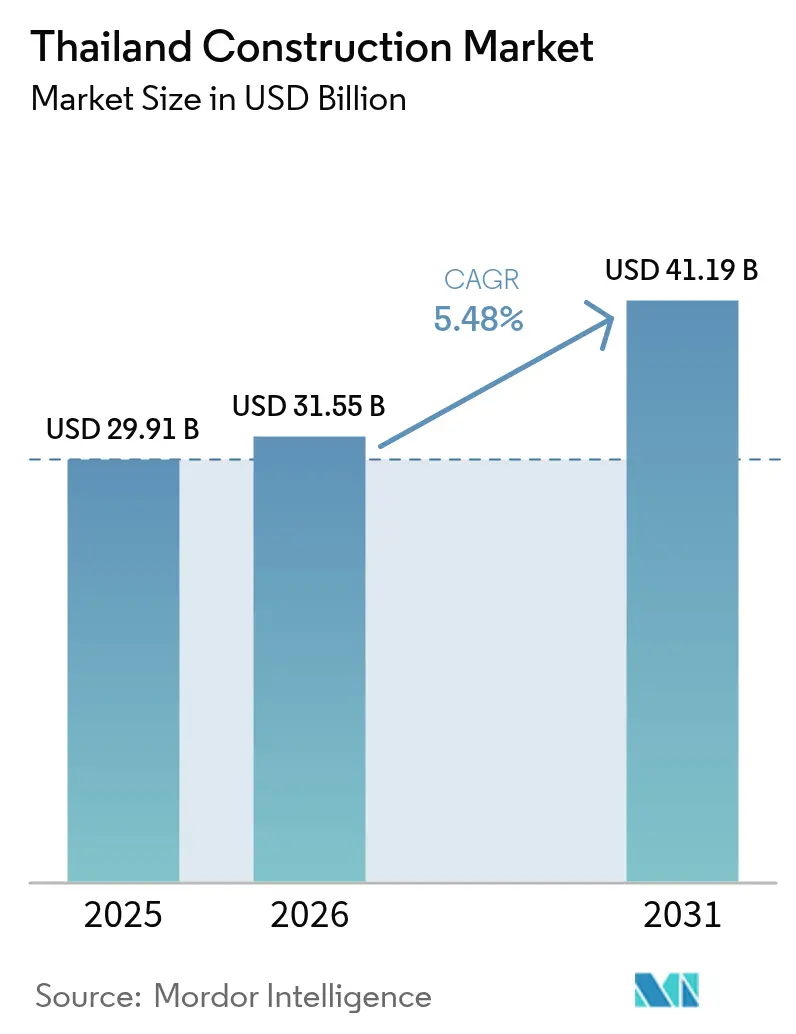
Thailand Construction Market size in 2026 is estimated at USD 31.55 billion, growing from 2025 value of USD 29.91 billion with 2031 projections showing USD 41.19 billion, growing at 5.48% CAGR over 2026-2031. Underpinning this expansion is the government’s USD 75.7 billion nationwide transport upgrade, the USD 14.1 billion Land Bridge corridor, and a wave of private mixed-use schemes that anchor Bangkok and secondary cities as regional logistics and tourism hubs. Large projects such as the USD 9.6 billion Thai-China high-speed rail second phase, the USD 430 million U-Tapao second runway, and the USD 3.9 billion 2025 infrastructure package keep orderbooks full for established contractors while signalling reliable cashflow visibility to suppliers. At the same time, renovation, digital design tools, and low-carbon materials reshape project economics, giving investors fresh opportunities to extract value from Thailand’s ageing building stock. Supply-side obstacles—tight skilled labour, condo oversupply and cost inflation—temper near-term momentum but also accelerate adoption of prefabrication and sustainable construction solutions, setting the Thailand construction market on a structurally stronger footing through 2030[1].
Key Report Takeaways
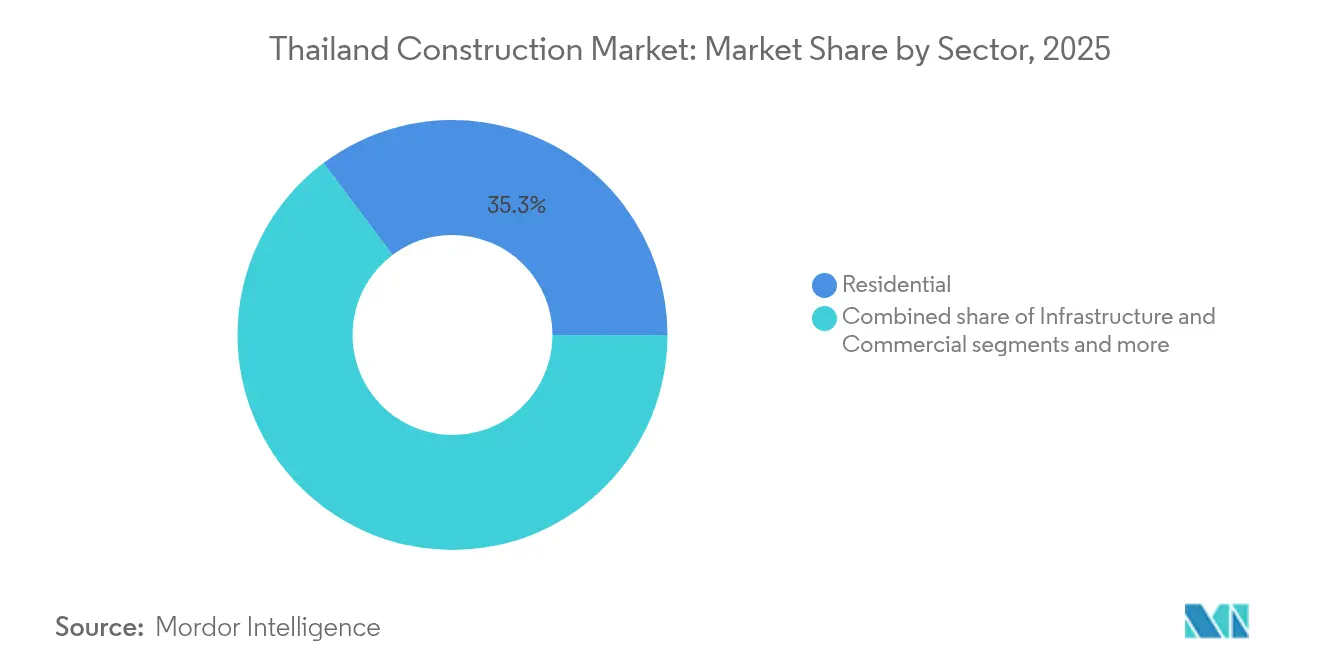
- By sector, residential led with 35.25% of Thailand construction market share in 2025, while infrastructure is advancing at a 5.86% CAGR to 2031.
- By construction type, new construction accounted for 73.50% of Thailand construction market size in 2025; renovation is projected to expand at 6.01% CAGR between 2026-2031.
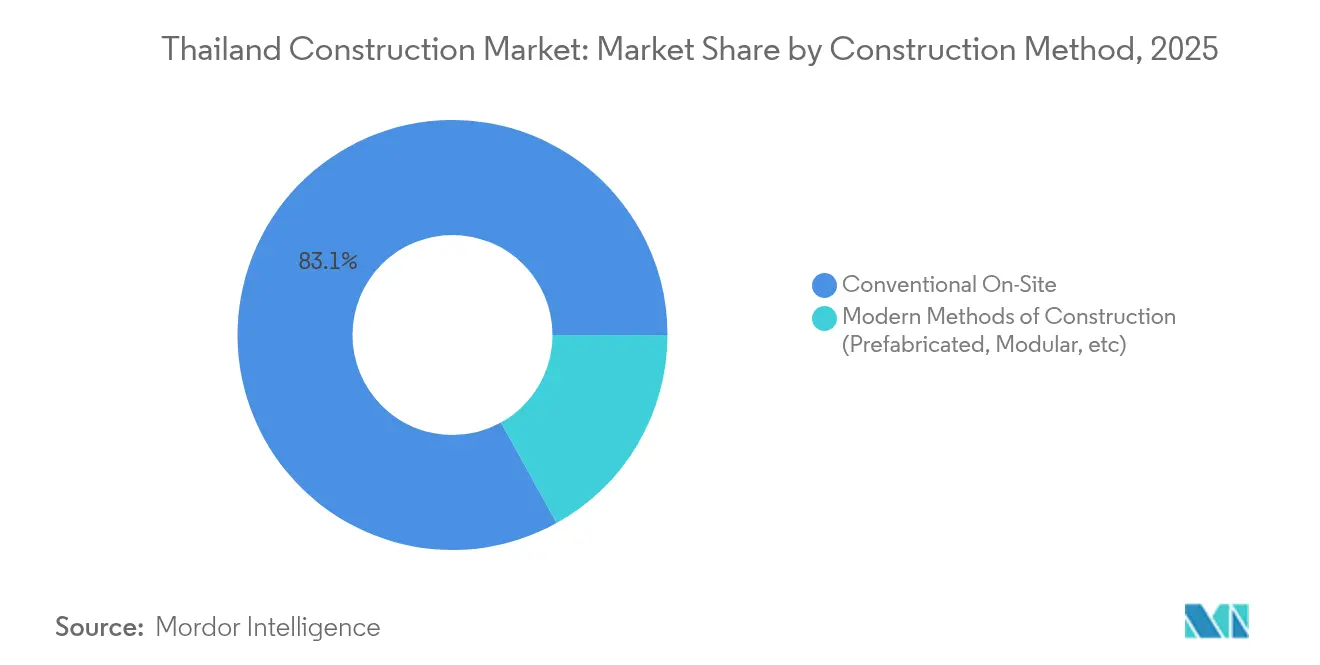
- By construction method, conventional on-site techniques commanded 83.05% share of Thailand construction market size in 2025, yet modern methods are forecast to grow 6.12% per year.
- By investment source, the private segment held 59.65% of Thailand construction market share in 2025 and is growing at a 6.19% CAGR.
- By city, Bangkok contributed 41.10% of Thailand construction market activity in 2025, whereas Chiang Mai registers the fastest 6.44% CAGR to 2031.
Note: Market size and forecast figures in this report are generated using Mordor Intelligence’s proprietary estimation framework, updated with the latest available data and insights as of 2026.
Thailand Construction Market Trends and Insights
Drivers Impact Analysis*
| Driver | ( ~ ) % Impact on CAGR Forecast | Geographic Relevance | Impact Timeline |
|---|---|---|---|
| Major infrastructure rollouts (rail, airports, mass transit) | +1.2% | Nationwide, focus on EEC & Bangkok | Long term (≥ 4 years) |
| Public–private partnership push in highways, bridges & ports | +0.8% | Nationwide, early gains in EEC | Medium term (2-4 years) |
| Mixed-use & transit-oriented developments | +0.6% | Bangkok, Phuket, Pattaya, Chiang Mai | Medium term (2-4 years) |
| Renewable power and grid expansion | +0.5% | Northeast & South | Long term (≥ 4 years) |
| Urban residential demand in Bangkok & secondary cities | +0.4% | BMA, Chiang Mai, Phuket | Short term (≤ 2 years) |
| Digital construction tools adoption | +0.3% | Nationwide | Medium term (2-4 years) |
| Source: Mordor Intelligence | |||
Major infrastructure rollouts drive nationwide construction surge
A record USD 3.9 billion budget covering 223 projects in 2025 anchors public spending, with rail, road and aviation schemes dominating award pipelines. The USD 9.6 billion Thai-China high-speed rail link and the USD 430 million U-Tapao runway illustrate the revenue visibility such mega-projects create for tier-one contractors while cementing Thailand’s role as an ASEAN logistics node. Long delivery schedules stretching beyond 2030 assure multi-year demand for civil works, signalling permanence in the Thailand construction market.
Public–private partnerships accelerate project delivery
A maturing PPP law has unlocked USD 30.8 billion in planned investment and already approved USD 13.3 billion of priority schemes. Laem Chabang Port Phase 3 combines 47% public and 53% private capital to lift annual container handling to 18 million TEU, showcasing risk-sharing structures that attract technology-rich foreign operators and ensure timetable discipline. This framework injects predictable cash flows into the Thailand construction market while sparing the public balance sheet[2].
Mixed-use developments transform urban landscapes
Developers are rolling out fully integrated retail-office-residential clusters that answer consumer demand for convenience and higher land productivity. Central Pattana’s USD 424 million programme across 2024-2026 and the USD 127 million Central Krabi site typify projects that spread beyond Bangkok into tourism corridors. Such schemes diversify revenue streams for builders, encourage transit-oriented planning and elevate design standards, thereby enriching the Thailand construction market.
Renewable energy construction expands grid infrastructure
The national goal of 50% renewable generation by 2037 underwrites continual demand for solar farms, wind arrays and battery storage. The Asian Development Bank’s USD 820 million loan covering 12 projects exemplifies the scale of capital flowing into clean-energy civil works. Grid extensions in rural northeast and southern provinces require sophisticated engineering, broadening opportunities for specialised EPC firms within the Thailand construction market.
Restraints Impact Analysis*
| Restraint | ( ~ ) % Impact on CAGR Forecast | Geographic Relevance | Impact Timeline |
|---|---|---|---|
| Skilled labor shortages and rising wages driving up costs and extending schedules | -0.9% | National, most acute in Bangkok and EEC regions | Short term (≤ 2 years) |
| Weak apartment sales in Bangkok causing cancellations and slower launches | -0.7% | Bangkok Metropolitan Area, with spillover to secondary cities | Medium term (2-4 years) |
| Land acquisition and environmental reviews delaying permission processes | -0.5% | National, particularly affecting infrastructure and industrial projects | Medium term (2-4 years) |
| Rising global material prices and logistics challenges squeezing contractor margins | -0.4% | National, with higher impact on import-dependent projects | Short term (≤ 2 years) |
| Source: Mordor Intelligence | |||
Skilled labour shortages constrain project execution
Tight domestic talent pools and rising wages have pushed contractors to source foreign workers, yet permit approvals still lag demand, stretching schedules and eroding margins. Larger firms mitigate the crunch through in-house training and mechanisation, while smaller builders struggle to meet timetable guarantees, dampening the Thailand construction market’s near-term pace.
Bangkok apartment oversupply dampens residential construction
An inventory of 235,000 unsold condominiums forces developers to curb new launches, shifting focus from high-rise towers to landed housing formats. Earthquake-related safety concerns and elevated household debt cap new mortgage uptake, prolonging absorption cycles and muting residential starts inside the core Bangkok market.
*Our forecasts treat driver/restraint impacts as directional, not additive. The impact forecasts reflect baseline growth, mix effects, and variable interactions.
Segment Analysis
By Sector: Infrastructure Leads Growth Despite Residential Dominance
The residential segment captured 35.25% of Thailand's construction market share in 2025, fuelled by urban population gains and lifestyle shifts. Yet infrastructure is the outright growth engine, forecast at 5.86% CAGR through 2031 as Thailand chases regional logistics leadership. Passenger rail corridors, airport runways, and expressways dominate award lists, reflecting a clear policy pivot toward connectivity. Illustrative is the Thai-China high-speed rail second phase, budgeted at USD 9.6 billion, and the three-airport high-speed link that ties Don Mueang, Suvarnabhumi, and U-Tapao for tourism flows. These corridors promise long-term revenue to civil contractors and unlock new catchment areas for property developers.
Commercial construction rebounds on tourism and mixed-use initiatives. Central Pattana’s USD 424 million multi-city programme underlines retail-hospitality resurgence, while emerging co-working and life-science labs diversify demand. Industrial facilities tied to the Eastern Economic Corridor benefit from electronics, automotive, and advanced biotech tenants, reinforcing infrastructure-induced spill-overs inside the Thailand construction market.
Infrastructure’s momentum rests on guaranteed public funding and the PPP pipeline that has already approved USD 13.3 billion of port, highway and rail packages. Renewable power plants and grid upgrades complement transport schemes, broadening contractor scopes and smoothing cyclicality. Consequently, infrastructure’s rising slice of Thailand construction market size is poised to outstrip residential by the decade’s close.

By Construction Type: Renovation Gains Momentum Amid New Construction Dominance
New construction accounted for 73.50% of Thailand's construction market size in 2025, mirroring the country’s continuing build-out of transport links and greenfield real estate. Landmark examples include the USD 14.1 billion first phase of the Land Bridge and the USD 429 million second runway at U-Tapao International Airport. Greenfield projects create immediate bulk demand for structural steel, cement, and heavy equipment, locking in volume for material suppliers.
Renovation, although smaller, is the fastest-growing slice at a 6.01% CAGR to 2031. Bangkok’s ageing office towers, 1990s-era condominiums, and provincial hotels are moving into their first major refurbishment cycle. Corporate ESG targets and higher utility tariffs spur energy-efficiency retrofits that rely on insulated façades, LED upgrades, and smart-building controls. SCG’s 63% share of low-carbon cement output positions the company to capitalise on this wave, giving renovation a strategic environmental overlay within the Thailand construction market.
Property owners value renovation for speed to market and lower regulatory hurdles, especially in dense central locations where land is scarce. As renovation share rises, design consultants and specialised contractors stand to benefit from steady workflow, while material makers pivot portfolios toward green certifications to defend pricing power.
By Construction Method: Modern Methods Challenge Conventional Dominance
Conventional on-site techniques held an 83.05% command of Thailand construction market size in 2025, enabled by historically ample labour pools and entrenched supply chains. Cast-in-place concrete retains popularity for mid-rise buildings and infrastructure pilings. However, wage pressure and labour scarcity lend urgency to mechanised solutions. Contractors now deploy precast segmental bridges—pioneered in Sakhon Nakhon Province—to compress timelines by up to 30%.
Modern Methods of Construction, paced to grow 6.12% yearly, encompass volumetric modular hotel rooms for Phuket resorts and factory-made wall panels for affordable housing on Bangkok’s outskirts. CPAC 3D-printed structural elements help reduce material waste and speed site assembly, suggesting the traditional-to-modern shift will accelerate post-2026. Government infrastructure tenders increasingly specify BIM coordination, nudging even late adopters to digitise, thereby raising baseline productivity across the Thailand construction market.
By Investment Source: Private Sector Drives Growth
The private segment captured 59.65% of Thailand construction market share in 2025 and is projected to advance 6.19% CAGR through 2031. Industrial estate operator WHA Corporation reported 61% revenue growth on robust land sales, reinforcing investor appetite within the Eastern Economic Corridor. Mixed-use developers and hotel chains leverage REITs and corporate bonds for capital, ensuring a broad funding base that keeps shovels moving even when public budgets tighten.
Public investment remains the strategic backbone, underwriting megaprojects like the USD 75.7 billion transport masterplan. The PPP framework blends both sources, delivering predictable returns to sponsors and de-risking state balance sheets. High-profile awards such as Laem Chabang Port Phase 3 attest to the model’s success and cement Thailand’s reputation as an investment-friendly hub. As private balance sheets scale, funding diversity further insulates the Thailand construction market from cyclical shocks.
Geography Analysis
Bangkok continues to anchor the Thailand construction market with a 41.10% share in 2025, reflecting ongoing mass-transit expansion, premium office refurbishments, and landmark retail projects. Average house prices climbed 22% year-on-year as land scarcity and higher build standards lifted development costs, even while unsold condominium inventory tempered new high-rise launches. Contractors focus on transit-adjacent plots, green retrofits, and public works that reinforce the city’s role as an administrative and commercial nerve centre.
Chiang Mai is the standout growth pocket, registering a 6.44% CAGR through 2031 on the back of secondary-city empowerment policies. The new U.S. Consulate complex showcases international confidence, while local authorities prioritise smart-city infrastructure, sustainability codes, and heritage preservation. This balanced approach attracts lifestyle-seekers, universities, and light-manufacturing investors, broadening construction demand beyond tourism.
Phuket, Pattaya, and the rest of Thailand contribute meaningful upside through resort rebuilds, industrial estate rollouts, and renewable-energy plants. Central Pattana’s USD 127 million Central Krabi complex demonstrates mixed-use momentum in tourist corridors, whereas the Saeng Thai Phalangngan solar array in Udon Thani signals how clean-energy investment spreads civil-works contracts into rural provinces. Collectively these regions reduce economic concentration risk and ensure a multi-node growth model for the Thailand construction market.
Regulatory Landscape
Thailand's construction activity is governed primarily by the Building Control Act B.E. 2522, which sets permit requirements for construction, modification, demolition, and relocation of buildings, with approvals administered largely through Local Administration Organizations. Energy performance has become a direct permitting consideration through mandatory Building Energy Code (BEC) compliance for defined new-building categories under the Building Control Act framework, with energy conservation documentation and certification increasingly embedded in the design-to-permit workflow.
Technical requirements continue to tighten through updates to structural design and material property standards, including Ministerial Regulation B.E. 2566 (2023), which influences recent engineering design baselines and compliance checks. On implementation, the Department of Alternative Energy Development and Efficiency (DEDE) uses digital pathways that support BEC-related submissions and inspections, illustrated by recorded energy-efficiency design inspection completions for public facilities as recently as March 2026, reinforcing that energy compliance is being enforced alongside local building control approvals.
Value Chain Analysis
Thailand’s construction value chain runs from landowners and developers (public agencies for infrastructure and utilities, and private developers for residential and mixed-use) to architects/engineers, main contractors and specialist subcontractors, then to building materials, equipment rental, logistics, and site services. The public pipeline is increasingly structured around PPP delivery, with a nationally visible project slate led by transport and logistics programs such as the Land Bridge and rail corridors, which concentrates demand into large consortium-led packages and pushes tier-one contractors to coordinate deep supply networks for civil works, MEP, and systems integration.
Downstream procurement and fulfillment are becoming more organized for fragmented contractor bases through platform-led distribution and industrialized components. Examples include SCG Distribution (Rakmao) partnering with Homepaint to launch the Rakmao STATION model at five Bangkok-area locations (March 2026), aimed at bundling materials procurement and job-site delivery for smaller contractors, and Sansiri’s rollout of a B2B precast roadmap supported by six manufacturing plants in Pathum Thani (April 2026). Governance risk is also moving upstream into prequalification and compliance management for state work as the Cabinet approved in principle a draft ministerial regulation in July 2026 to add work abandonment under the Public Procurement and Supplies Administration Act B.E. 2560 (2017), increasing the need for quality assurance, defect controls, and documentation across contractors and their subcontractor tiers.
Competitive Landscape
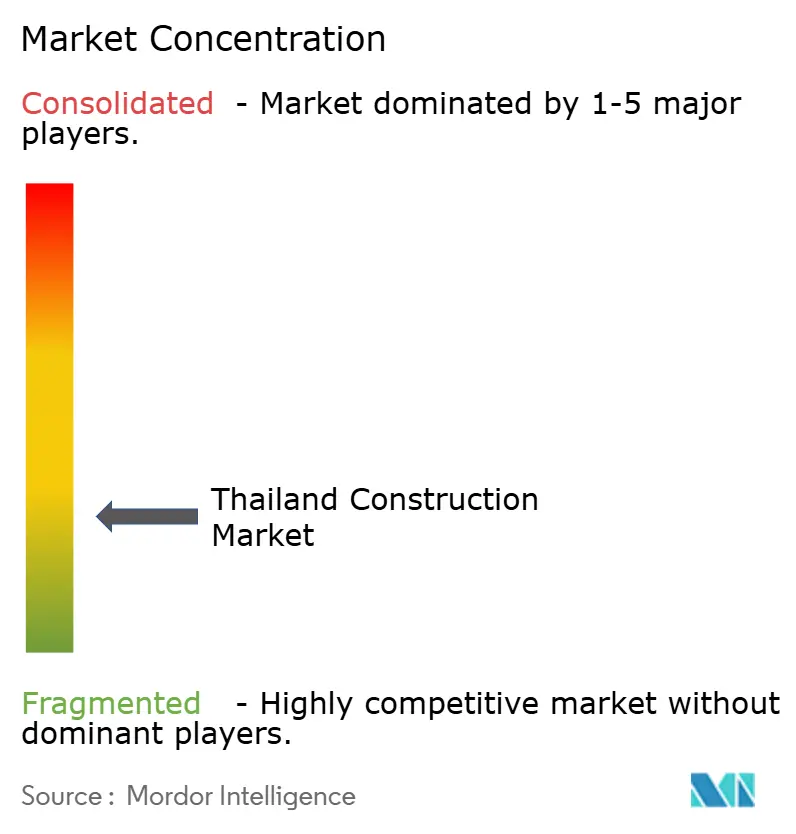
The Thailand Construction Market is moderately fragmented, with no player holding more than a low-double-digit share and the top five unlikely to exceed 35% combined revenue. Domestic majors—Italian-Thai Development, Ch. Karnchang and Sino-Thai Engineering—leverage long agency ties and multi-disciplinary capability to secure complex rail and airport packages. Heightened scrutiny on foreign contractors after a 2025 project collapse is expected to tighten qualification rules, rewarding firms with proven local safety records.
Strategic moves revolve around technology and sustainability. SCG has lifted low-carbon cement to 63% of output and advanced 3D-printing applications, signalling a portfolio shift towards green materials. WHA Corporation nearly doubled Q1 2024 land transfers to ride electronics reshoring, while Central Pattana launched a multi-city USD 424 million programme to capture tourism recovery and retail densification. Such investments create avenues for subcontractors in façade engineering, smart-building systems and green-certified interiors across the Thailand construction market.
Geographic diversification becomes a common hedge. Contractors court provincial opportunities in Chiang Mai, Khon Kaen and coastal logistics corridors, where competition is thinner and municipal planners offer incentives. Renewable EPC specialists and prefab start-ups enter the market, targeting solar farms and hotel pods that require rapid deployment. Traditional builders respond with alliances, digital site monitoring and integrated design-build packages to remain competitive.
Thailand Construction Industry Leaders
-
Italian-Thai Development PCL
-
Sino-Thai Engineering & Construction PCL
-
Ch. Karnchang PCL
-
Unique Engineering & Construction PCL
-
TTCL Public Company Limited
- *Disclaimer: Major Players sorted in no particular order
Market Opportunities and Future Outlook
The most visible opportunity set is PPP-led transport and logistics works and the contractor ecosystems that support them, spanning civil construction, systems packages, and long-run maintenance. The Ministry of Transport has identified 20 major projects valued at over THB 1.38 trillion with PPP models emphasized, and it has also referenced acceleration of six major infrastructure projects with total investment of THB 1.96 trillion, including the Land Bridge and the Nakhon Ratchasima-Nong Khai high-speed rail section. These programs create whitespace for firms that can assemble compliant consortium structures, deliver complex interfaces (rail, airports, ports), and manage schedule and quality under heightened scrutiny.
Industrial and high-spec commercial builds also present a capability-led opportunity, particularly where international tenants require rigorous MEP, digital project controls, and commissioning standards. A concrete marker is the April 2026 Notice to Proceed for the THB 290 billion U-Tapao Airport and Eastern Aviation City project issued to U-Tapao International Aviation Co., Ltd., which elevates demand for airport-adjacent construction scopes and supporting infrastructure. In buildings, the mandatory Building Energy Code (BEC) continues to pull demand toward energy-efficient design, compliant materials, and measurement-led delivery, benefiting contractors, consultants, and suppliers that can standardize energy documentation from design through permitting and handover.
Recent Industry Developments
- July 2026: The Cabinet approved in principle a draft ministerial regulation to classify work abandonment under the Public Procurement and Supplies Administration Act B.E. 2560 (2017). The move introduces potential exclusion periods of 2 to 10 years from state projects for serious defects. It also increases the value of contractors with documented safety and quality systems when bidding for PPP and budget-funded projects.
- April 2026: Sansiri launched a B2B precast business roadmap, leveraging six manufacturing plants in Pathum Thani to industrialize component supply for construction customers. Expanding precast availability supports schedule compression and labor productivity on projects facing tight workforce conditions. The shift also strengthens demand for standardized design coordination between developers, engineers, and component manufacturers.
- January 2026: Italian-Thai Development PCL signed a construction contract for the BMA General Hospital expansion, covering demolition, a 21-storey multi-purpose building, and equipment procurement. The award reinforces the role of public-sector clients in sustaining healthcare facilities and signals ongoing bidding opportunities in health and public-service facilities that require integrated construction and procurement capability.
Research Methodology Framework and Report Scope
Market Definition and Coverage
For this study, the Thailand construction market is defined as the value of construction work executed within Thailand across public and private projects, counted at current prices in USD for the year of activity.
Scope exclusions: land values, standalone real estate transactions, and purely financial fees that are not tied to physical construction work are excluded.
Segmentation Overview
- By Sector
- Residential
- Apartments/Condominiums
- Villas/Landed Houses
- Commercial
- Office
- Retail
- Industrial and Logistics
- Others
- Infrastructure
- Transportation Infrastructure (Roadways, Railways, Airways, others)
- Energy & Utilities
- Others
- Residential
- By Construction Type
- New Construction
- Renovation
- By Construction Method
- Conventional On-Site
- Modern Methods of Construction (Prefabricated, Modular, etc)
- By Investment Source
- Public
- Private
- By Major Cities
- Bangkok
- Phuket
- Pattaya
- Chiang Mai
- Rest of Thailand
Data Sources, Market Sizing, and Validation
Desk Research
Desk research was used to set a reliable base for project volumes, funding direction, and cost movement that shape Thailand construction spending. We referenced public statistics and policy releases such as Thailand National Statistical Office publications, Bank of Thailand sector notes, Ministry of Transport updates, State Railway of Thailand transport program notes, and Comptroller General Department budget and disbursement information.
To keep pricing and activity signals grounded, we also used sources such as the Thai Department of Public Works and Town and Country Planning guidance, trade data from Thai Customs for key imported materials and equipment, and peer reviewed papers on construction productivity and cost escalation in Thailand. Company filings and investor presentations were used to understand backlog trend lines and exposure by project type, and paid database subscriptions for company financials and shipment level import and export checks were used selectively. The sources listed here are illustrative, and many other public documents and datasets were reviewed for data collection, validation, and clarification.
Primary Interviews and Surveys
Primary work focused on validating how project awards translate into on-ground spending, and how pricing is being passed through across public and private jobs. We spoke with EPC and general contractors, specialist subcontractors, consultants, and material distributors, covering major hubs and investment corridors across Thailand so assumptions could be tightened where desk sources were silent.
Distribution of primary research fieldwork respondents
| Company type | Respondent position |
|---|---|
| Top tier: 31% | CXOs: 15% |
| Mid tier: 53% | Functional/Unit leaders: 41% |
| Smaller Players: 16% | Managers: 44% |
Market-Sizing & Forecasting
Sizing starts with a top-down reconstruction of Thailand construction demand using public capex and budget direction, project pipeline conversion into annual spend, and construction cost movement. The market total is then cross-checked through selective bottom-up approximations, such as sampled project values multiplied by execution timelines, plus channel checks on material intensity and typical cost splits. This helps us adjust when project data is incomplete.
Key model inputs include public infrastructure outlay and the pace of disbursement, private investment signals by sector, construction material price indices and wage trends, permitting and approvals direction, and announced versus awarded project value conversion. Because Thailand construction is sensitive to timing (rain season workability and procurement delays), we factor execution lags so spend lands in the correct year. Forecasts were built using scenario analysis around budget release timing, private construction sentiment, and cost inflation, and then refined with expert consensus on which drivers are likely to stay sticky versus normalize.
Data Validation & Update Cycle
Outputs are validated through cross-checks against independent signals, including changes in public disbursement, large project award tracking, and observed movement in key input prices. Where variances look high, assumptions are re-tested, and follow-up calls are triggered to confirm whether the change reflects reality or timing, reporting, or currency effects.
Before sign-off, the model is reviewed in multiple steps by another analyst who challenges scope, year alignment, and arithmetic consistency. Reports are refreshed annually, and interim updates are made when major policy, budget, or project award events materially shift the outlook. Right before delivery, a final pass is completed so clients receive the latest updated view.
Mordor Intelligence's Thailand Construction Market Size Compared Against Other Published Estimates
Published numbers for Thailand construction do not always match because the scope boundary, the year counted, and the way local currency is converted into USD can vary between publishers. Differences also show up when some studies lean more on announced pipelines, while others use realized spending signals.
A common driver is refresh timing, where a model that rolls forward FX averages and construction cost inflation closer to the publication date will land on a different USD value than a model using older averages or a single point exchange rate. Another gap comes from ASP logic and what is counted as construction value, since some sources fold in broader real estate linked items or treat public and private totals differently. These checks are why the refresh cadence and currency timing used in the validation loop matter in this study, and they are applied consistently in the Thailand model by Mordor Intelligence.
Benchmark comparison
| Source | Market Size | Gaps in Research Methodology |
|---|---|---|
| Mordor Intelligence | USD 31.55 B (2026) | |
| Trade Program Report A | USD 38.30 B (2024) | Uses a 2024 construction value snapshot that splits public and private totals and can reflect budget expectations and mega project planning, which may not align to executed spend timing used in annual market sizing. |
| Industry Research Publisher B | USD 42.50 B (2024) | Uses a 2024 valuation base with broader segmentation and scenario framing, and the higher number can be influenced by scope breadth and USD conversion assumptions that are not always tied back to year-specific execution and cost pass-through checks. |
Taken together, the spread is mainly explained by which year is treated as the current point, whether values are based on planned versus realized activity, and how USD conversion is handled. By keeping the scope tied to construction work executed in-year and re-checking inflation and FX timing during updates, our estimate stays traceable to clear drivers and can be re-run with the same steps when new inputs arrive.
Key Questions Answered in the Report
What is the current value of the Thailand construction market?
The market is valued at USD 31.55 billion in 2026 and is projected to reach USD 41.19 billion by 2031.
Which sector holds the largest share of Thailand’s construction activity?
Residential construction leads with 35.25% of total market value in 2025, driven by ongoing urbanization and housing demand in Bangkok and secondary cities.
What is the fastest-growing segment within the market?
Infrastructure construction is expanding at a 5.86% CAGR through 2031, supported by high-speed rail, airport, and port projects.
How significant is private investment in Thailand’s construction industry?
Private capital accounts for 59.65% of construction activity and is forecast to grow at a 6.19% CAGR, reflecting strong business confidence and a mature PPP framework.
Which geographic area is registering the quickest construction growth?
Chiang Mai shows the highest growth pace, with a 6.44% CAGR projected between 2026 and 2031, as secondary-city development gains momentum.
What share of projects still rely on conventional on-site construction?
Conventional on-site methods represent 83.05% of current activity, although modern, prefabricated techniques are gaining ground at a 6.12% CAGR.