
El Salvador Construction Market Size and Share
Market Overview
| Study Period | 2020 - 2031 |
|---|---|
| Forecast Data Period | 2026 - 2031 |
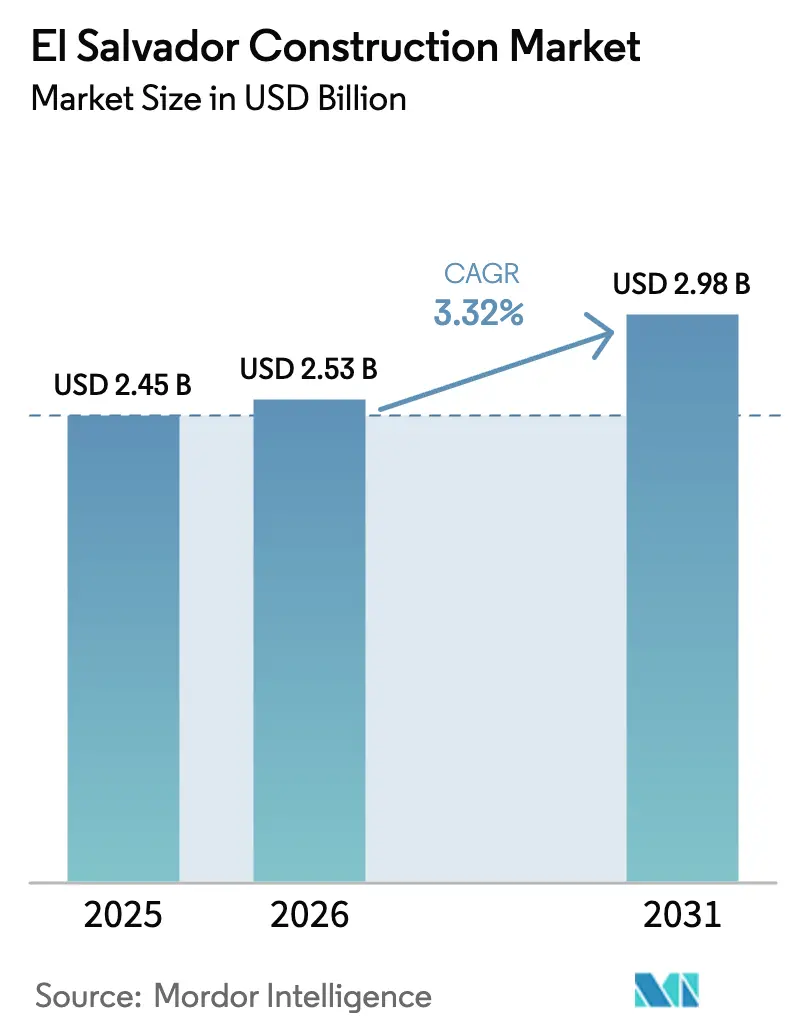
| Base Year Market Size (2025) | USD 2.45 Billion |
| Market Size (2026) | USD 2.53 Billion |
| Market Size (2031) | USD 2.98 Billion |
| Growth Rate (2026 - 2031) | 3.32 % |
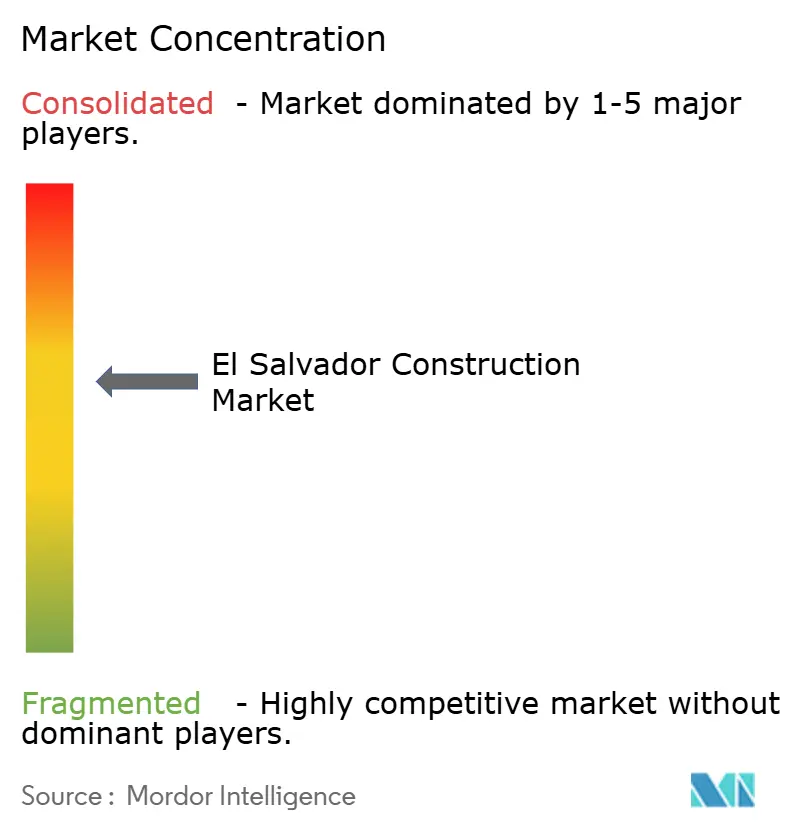
| Market Concentration | Medium |
Major Players *Disclaimer: Major Players sorted in no particular order Image © Mordor Intelligence. Reuse requires attribution under CC BY 4.0. | |
El Salvador Construction Market Analysis by Mordor Intelligence
The El Salvador Construction Market size is expected to grow from USD 2.45 billion in 2025 to USD 2.53 billion in 2026 and is forecast to reach USD 2.98 billion by 2031 at 3.32% CAGR over 2026-2031. Residential buildings, bolstered by remittances, dominate current spending, yet infrastructure programs under Plan Control Territorial are reshaping long-term demand. Public-sector capital, multilateral funding, and early private-public-partnership (PPP) successes are improving project pipelines and diversifying risk. Rising tourism, a USD 3 billion clean-energy commitment, and Bitcoin-related foreign direct investment (FDI) add new workstreams that lift margins for contractors able to meet tougher seismic and environmental codes. Volatile import prices and a shallow skilled-labor pool temper upside, but the adoption of modular systems, local material substitutions, and digital site controls is starting to offset these constraints and enhance the competitiveness of the El Salvador construction market.
Key Report Takeaways
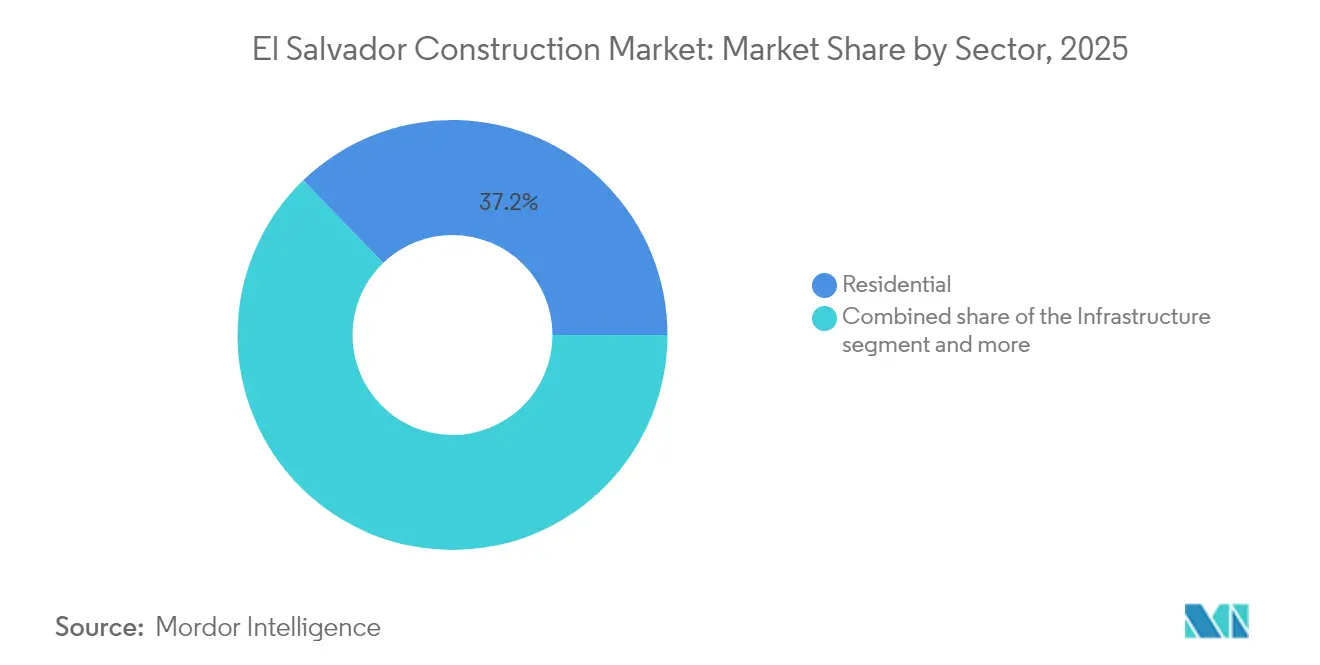
- By sector, residential led with 37.22% of the El Salvador construction market share in 2025, while infrastructure is advancing at a 5.71% CAGR through 2031.
- By construction type, new construction accounted for 68.63% share of the El Salvador construction market size in 2025, and renovation is growing at a 2.65% CAGR to 2031.
- By investment source, public outlays held a 64.98% share in 2025, while private capital is recording the highest projected CAGR at 6.44% through 2031.
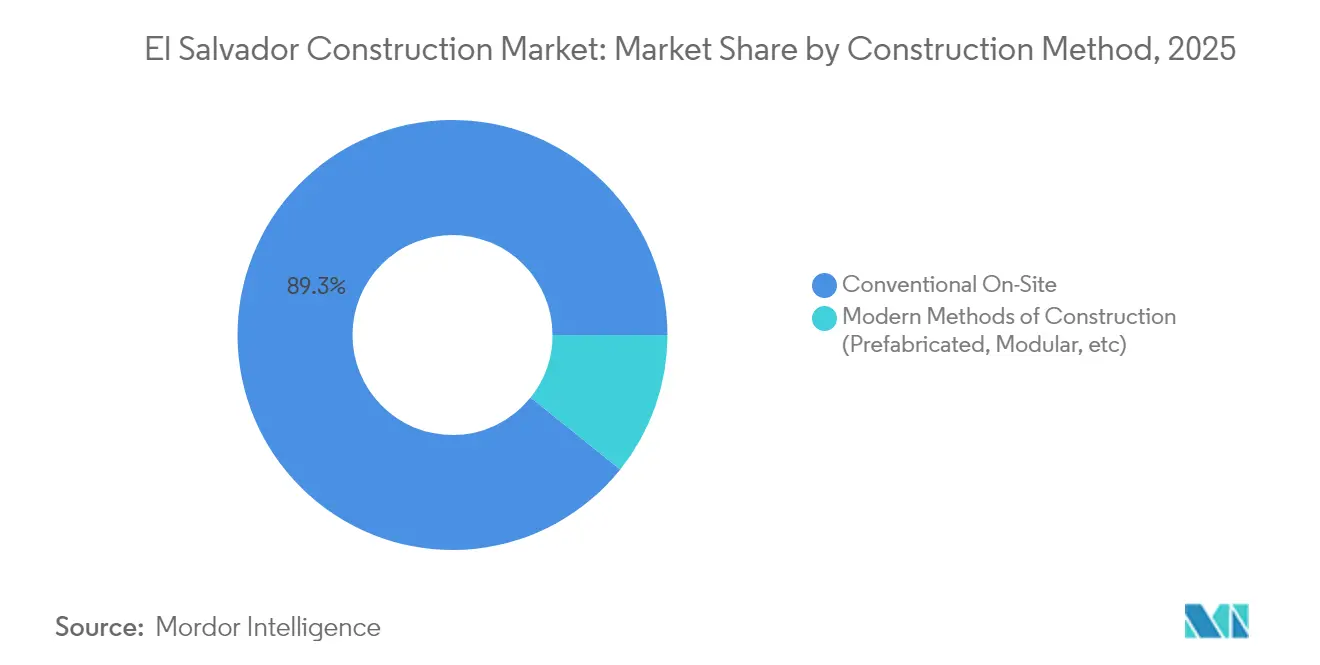
- By construction method, on-site techniques retained 89.25% share in 2025; modern methods of construction (MMC) are set to grow at 8.32% CAGR through 2031.
- By geography, San Salvador captured 45.83% of spending in 2025; La Libertad is forecast to expand at a 4.63% CAGR on the back of Surf City and port upgrades.
Note: Market size and forecast figures in this report are generated using Mordor Intelligence’s proprietary estimation framework, updated with the latest available data and insights as of 2026.
El Salvador Construction Market Trends and Insights
Drivers Impact Analysis*
| Driver | (≈) % Impact on CAGR Forecast | Geographic Relevance | Impact Timeline |
|---|---|---|---|
| Government infrastructure outlays | +1.2% | National; San Salvador & La Libertad focus | Medium term (2-4 years) |
| Surging remittance-fueled housing demand | +0.8% | Nationwide; urban clusters | Long term (≥ 4 years) |
| Utility-scale renewable energy build-out | +0.7% | Nationwide; geothermal corridors | Long term (≥ 4 years) |
| Tourism push | +0.5% | Coastal; La Libertad core | Medium term (2-4 years) |
| Bitcoin-linked FDI | +0.3% | San Salvador metro & select coasts | Long term (≥ 4 years) |
| Climate-resilient design mandates | +0.2% | Nationwide; seismic zones | Long term (≥ 4 years) |
| Source: Mordor Intelligence | |||
Government Infrastructure Outlays Drive Systematic Capacity Building
Plan Control Territorial has shifted the public works agenda from isolated roadwork to integrated territorial development. The USD 200 million Local Economic Resilience Project funds both municipal capacity and hard assets, while the newly formed National Directorate of Municipal Works streamlines procurement. Feasibility studies for the Pacific Train and a diversified financing mix—USD 71.8 million from Deutsche Bank and USD 100 million from CAF—reduce reliance on traditional lenders and smooth the flow of contracts for the El Salvador construction market[1]José A. Lopez, “Local Economic Resilience Project Appraisal Document,” World Bank, worldbank.org.
Surging Remittance-Fueled Housing Demand
Stable inflows from the diaspora underpin mortgage approvals, keeping housing starts resilient despite external shocks. Between 2017-2023, the metropolitan planning authority approved 2,249 permits—70.2% for residential projects—while a USD 2 billion pipeline in 2023 alone signaled ongoing investor confidence. Developers are responding with innovative low-carbon wall systems that meet seismic codes and cut embodied emissions by 36%, a trend that strengthens the sustainability narrative of the El Salvador construction market[2]Rodrigo Larios, “Assessing the Environmental Impact of Composite Bamboo Shear Wall Systems,” Sustainability, mdpi.com.
Utility-Scale Renewable Energy Build-Out
A USD 3 billion deployment through 2029 covers geothermal, wind, and biogas assets. Flagship ventures such as the USD 1 billion, 378 MW Energía del Pacífico plant created 2,000 construction jobs, revealing the sector’s capacity to absorb large civil and mechanical work packages. Regulatory tweaks now allow greater private participation, widening the scope for EPC firms that can scale specialized capabilities and reinforcing upside for the El Salvador construction market.
Tourism Push Transforms Coastal Construction Dynamics
Surf City 2.0 bundles road widening, wastewater facilities, and hospitality sites. The USD 113.9 million CABEI loan for CA-02 highway upgrades and a USD 328 million airport expansion will accommodate more than 4 million visitors in 2025, multiplying demand for hotels, retail, and supporting infrastructure. These projects raise environmental compliance thresholds, favoring contractors with strong ESG track records in the El Salvador construction market[3]Central American Bank for Economic Integration Staff, “Resolution No. 17/2024 Approving Surf City Highway Financing,” CABEI, cabei.org.
Restraints Impact Analysis*
| Restraint | (≈) % Impact on CAGR Forecast | Geographic Relevance | Impact Timeline |
|---|---|---|---|
| Imported material cost volatility | -0.9% | Nationwide; urban centers | Short term (≤ 2 years) |
| Skilled-labor shortage & wage escalation | -0.6% | Nationwide; San Salvador acute | Medium term (2-4 years) |
| Permit & land-titling delays | -0.4% | Nationwide | Medium term (2-4 years) |
| Seismic-zone compliance costs | -0.3% | Nationwide; fault lines | Long term (≥ 4 years) |
| Source: Mordor Intelligence | |||
Imported Material Cost Volatility Pressures Project Economics
An 11.2% spike in global steel prices during 2024, compounded by customs bottlenecks, squeezed contractor margins in a fully dollarized economy that lacks currency-hedging levers. Although the National Trade Facilitation Committee is digitizing clearances, divergent rules across cement, rebar, and glass slow gains. Builders are testing locally sourced bamboo-composite panels to trim reliance on volatile imports, a shift that could reshape the cost curve inside the El Salvador construction market.
Skilled-Labor Shortage and Wage Escalation
Median daily wages of USD 25.16 for skilled crews outpace regional peers. Recent minimum-wage hikes and stricter labor-rights enforcement raise compliance costs, while talent remains clustered in the capital. Firms are investing in on-site training and modular systems that cut labor hours, but shortages still cap the growth potential of the El Salvador construction industry.
*Our forecasts treat driver/restraint impacts as directional, not additive. The impact forecasts reflect baseline growth, mix effects, and variable interactions.
Segment Analysis
By Sector: Infrastructure acceleration challenges residential dominance
Infrastructure generated a 5.71% CAGR that is gradually eroding residential’s 37.22% hold on the El Salvador construction market. Large-scale roads, rail feasibility, and water projects financed by CAF and Deutsche Bank now move from planning into procurement. Residential pipelines stay healthy thanks to remittances, but permit data hint at saturation in mid-tier urban tracts.
Despite cyclical headwinds, developers continue to build single-family homes, apartments, and mixed-use towers linked to diaspora purchasers. Commercial assets benefit from tourism and Bitcoin enterprise offices, yet oversupply in legacy retail strips restrains rents. Industrial builds tied to near-shoring and free-trade zones have absorbed new capacity in Santa Ana and San Miguel, confirming a broader diversification in the El Salvador construction market.



By Construction Type: Renovation gains momentum amid new-build dominance
New-build activity commanded 68.63% of the El Salvador construction market share in 2025, but renovation’s 2.65% CAGR signals a pivot toward asset optimization. Urban renewal incentives and a new tariff grid for San Salvador’s historic center are steering capital toward adaptive reuse and seismic retrofits. These works often feature envelope upgrades that slice operational costs, aligning with World Bank energy-efficiency benchmarks for the El Salvador construction market.
New-build projects still dominate due to infrastructure deficits, yet environmental impact studies are lengthening timelines. Renovation enjoys streamlined approvals in designated zones and qualifies for green-bond financing, narrowing the yield gap versus green-field ventures. Together, the two streams broaden revenue stability for contractors navigating the El Salvador construction market size cycles.
By Construction Method: Technology adoption accelerates despite traditional dominance
Conventional on-site work held an 89.25% stake in 2025, mirroring an entrenched craft culture. However, MMC’s 8.32% CAGR reflects rising wage bills and tighter schedules. COPRESA’s move into prefabricated photovoltaic plants showcases how incumbents recalibrate portfolios, driving the El Salvador construction market toward higher productivity.
Prefabricated housing now serves tourism hot-spots where quick turnover matters. A 36% lower global-warming profile for bamboo shear-wall panels is winning clients focused on ESG. Earthquake-resistant standards, codified by the technical regulator, are further standardizing modular elements, signaling a structural shift that will lift the El Salvador construction market share of MMC over the forecast horizon.
By Investment Source: Private-sector momentum builds on public foundation
Public funding supplied 64.98% of overall spending in 2025, sustaining the project base through budget reform that earmarked USD 5.4 million for transport and USD 4.6 million for planning. Yet private capital’s 6.44% CAGR underscores confidence in security gains and streamlined permits. Tax incentives for 35-plus-story towers and PPP frameworks for the ring road demonstrate policy traction.
Industrial parks such as Orion II secured USD 50 million from IDB Invest, illustrating the appetite for dollar-denominated returns in the El Salvador construction market. Multilateral-backed PPPs distribute risk and accelerate delivery, ensuring that private money complements rather than displaces state projects. This blended model enlarges the El Salvador construction market size for firms that can navigate both procurement channels.
Geography Analysis
San Salvador’s 45.83% share defines it as the epicenter of the El Salvador construction market, drawing on dense supply chains and concentrated talent. Rising land prices and congested permitting, however, slow green-field starts, nudging developers toward vertical builds and renovation plays. The capital’s mix of public offices, commercial centers, and premium residential towers underpins demand stability, but regulatory scrutiny remains intense.
La Libertad, expanding at a 4.63% CAGR, is the standout growth zone, thanks to Surf City road upgrades and resort pipelines that multiply hospitality and retail footprints. Port refurbishments tied to a USD 1.6 billion JV with Yilport will lift logistics activity, reinforcing La Libertad’s role as a coastal gateway. Tourism arrivals above 4 million in 2025 translate into sustained hotel construction that diversifies the El Salvador construction market across regions.
Secondary hubs Santa Ana and San Miguel capture spillovers from national infrastructure like the planned Pacific Train, providing lower-cost staging grounds for industrial sheds and agro-processing plants. Rural corridors absorb renewable energy projects where land is ample and community acceptance remains high. This geographic spread reduces concentration risk and underscores how integrated transport corridors will redefine the El Salvador construction market over the long term.
Regulatory Landscape
El Salvador has been centralizing construction and land-use permitting under the Direccion de Ordenamiento Territorial y Construccion (DOT), created by Legislative Decree No. 122 in October 2024. DOT serves as the autonomous authority for authorizing construction, urbanization, and lotification projects, and it administers the national system used to manage and issue construction permits, replacing a more fragmented, multi-institution process.
In May 2025, DOT opened a mandatory online Registro de Profesionales y Prestadores de Servicios de Urbanizacion y Construccion. Architects, engineers, and other providers must register to legally design, execute, or evaluate urban development works. The Ministry of Housing continues to provide regional urbanism and construction services through its Occidente, Centro, and Oriente offices, including feasibility-related procedures such as Calificacion de Lugar and Linea de Construccion. DOT remains the exclusive authority for defined permit prerequisites and authorizations, which raises compliance expectations for contractors and project sponsors.
Value Chain Analysis
The construction value chain in El Salvador runs from land acquisition and project concept design through engineering, permitting, procurement, construction execution, commissioning, and post-sale operations. The permitting and authorization phase is increasingly centralized under DOT, which also supports professional services through its mandatory registry, influencing how developers and contractors assemble compliant design, supervision, and execution teams.
Developers such as Grupo Roble and Agrisal operate as integrated sponsors across the lifecycle, combining development, construction management, commercialization, and ongoing administration or rental management. Materials and equipment supply remains a key dependency for delivery economics, while financing links end-users and project sponsors to the pipeline. On the labor side, large developments show a mix of direct and indirect workforces, for example Paseo Las Flores cited 300 direct and 900 indirect jobs and Vistas Soyapango cited roughly 500 jobs during construction, underscoring the role of workforce availability and subcontractor depth.
Competitive Landscape
The El Salvador construction market is moderately fragmented. Top local players Salazar Romero, Inversiones Roble, and COPRESA leverage deep governmental ties to secure road, housing, and energy contracts. Their combined dominance is tempered by a lively tier of regional specialists tackling mid-scale hotels and mixed-use sites. International EPC firms appear mainly on megaprojects demanding tunneling, port dredging, or utility-scale renewables.
Strategic moves in 2024-2025 illustrate repositioning. COPRESA expanded its prefabrication line and digital enterprise-resource-planning system, trimming project overruns. American Industrial Park unlocked USD 50 million in green finance to extend warehouse clusters, integrating rooftop solar and smart-logistics software. Meanwhile, Yilport’s port investment brings foreign know-how in dredging and container-yard automation.
Competitive edges now rest on regulatory navigation, ESG compliance, and seismic-design credentials rather than price alone. Rising MMC adoption empowers early movers, while supply-risk hedging through local material substitutes differentiates bidders on cost. The result is a market where scale, technology depth, and risk-management acumen converge to set the pace of the El Salvador construction market.
El Salvador Construction Industry Leaders
Salazar Romero S.A. de C.V.
Inversiones Roble S.A. de C.V.
Agrisal Grupo
Construcciones Nabla S.A. de C.V.
Grupo Q Infraestructura
- *Disclaimer: Major Players sorted in no particular order

Market Opportunities and Future Outlook
Vertical residential and mixed-use densification in the San Salvador metro area creates a concrete whitespace for contractors and suppliers that can deliver compliant, high-throughput delivery under tighter permitting oversight. Developer actions support this direction: Agrisal is advancing Vistas Soyapango (USD 30 million, 288 apartments across three nine-story towers) and reported 70% unit placement as of March 2026. The project is also tied to property management and rental services, which broadens demand for renovation, fit-out, and building-operations upgrades.
On the developer-led pipeline, multi-asset portfolios are expanding the addressable workstream beyond core housing into hotels, retail expansion, and supporting infrastructure in growth corridors such as La Libertad. Grupo Roble has communicated a USD 730 million investment portfolio spanning commercial, residential, and hotel developments, including a USD 70 million Paseo Las Flores project in Lourdes (912 units), Multiplaza expansion, and a JW Marriott hotel. These packaged programs create clearer entry points for EPC providers, specialist trades, and materials suppliers that can meet seismic and environmental compliance requirements while working through DOT-administered permitting.
Recent Industry Developments
- March 2026: Agrisal's Vistas Soyapango residential project reaches 43% construction progress and 70% apartment placement with a US$30 million investment. The update points to a rising pipeline of high-density housing in the San Salvador area. It also shows demand and scale for vertical residential projects in the market.
- January 2026: Government suspends construction and parceling permits for Salazar Romero S.A. de C.V. and allied firms over project deficiencies at Ciudad Marsella. This regulatory intervention increases oversight and could reframe project risk in the sector. While it may slow near-term residential activity, it also signals tighter governance for master-planned developments.
- August 2025: Cementos Progreso acquires Cemex's El Salvador assets to expand capacity. The consolidation tightens cement supply in El Salvador and strengthens the construction industry's capacity to meet project demand. It supports market expansion by easing supply constraints and integrating operations.


Research Methodology Framework and Report Scope
Market Definition and Coverage
For this report, the market covers the total value of construction activity carried out within El Salvador, captured as revenues tied to building and civil works delivered during the year.
Scope exclusions: It excludes real estate buying and selling, property leasing, and standalone design or consulting fees when they are not part of a construction contract.
Segmentation Overview
- By Sector
- Residential
- Apartments/Condominiums
- Villas/Landed Houses
- Commercial
- Office
- Retail
- Industrial and Logistics
- Others
- Infrastructure
- Transportation Infrastructure (Roadways, Railways, Airways, others)
- Energy & Utilities
- Others
- Residential
- By Construction Type
- New Construction
- Renovation
- By Construction Method
- Conventional On-Site
- Modern Methods of Construction (Prefabricated, Modular, etc)
- By Investment Source
- Public
- Private
- By Geography
- San Salvador
- Santa Ana
- San Miguel
- La Libertad
- Rest of El-Salvador
Data Sources, Market Sizing, and Validation
Desk Research
Desk research was used to set the macro frame and to keep our assumptions realistic for El Salvador. We referenced national accounts and sector output series from official statistics, and then aligned these with public infrastructure plans and budget disclosures to understand what is likely to be executed.
Common inputs were pulled from sources such as the Central Reserve Bank of El Salvador statistics portal, national procurement and tender publications, multilateral development bank project pages, and customs trade data for construction-linked materials. We also reviewed company annual reports, investor decks, and reputable press coverage to cross-check timing of large projects, along with paid subscriptions for company financials, news and financials, and shipment-level import and export signals where needed. These examples are not exhaustive, and many other public and paid sources were also used for data collection, validation, and clarification.
Primary Interviews and Surveys
We speak with contractors, developers, material distributors, public project specialists, and consultants active in El Salvador. Interviews and surveys test project pipelines, tender timing, utilization, price changes, renovation activity, and missing private work, helping us adjust secondary inputs and reconcile the final El Salvador model.
Distribution of primary research fieldwork respondents
| Company type | Respondent position |
|---|---|
| Top tier: 30% | CXOs: 15% |
| Mid tier: 45% | Functional/Unit leaders: 30% |
| Smaller Players: 25% | Managers: 55% |
Market-Sizing & Forecasting
Sizing starts from a top-down reconstruction of construction output in El Salvador using official production and value-added series, which are then translated into a market value view using price and execution indicators. To keep the result grounded, it is corroborated with selective bottom-up checks, such as sampled project value builds, contractor revenue spot checks, and rough volume times average price tests for key materials.
Key inputs that shape the model include public capital budgets and project pipelines, construction GDP and activity indexes, building permit or approvals signals where available, import trends for cement and steel-linked items, and observed shifts in labor and material costs that move contract values. Where data is missing for smaller projects, gaps are handled by using conservative participation factors informed by interviews, followed by sensitivity checks.
For forecasting, we use scenario analysis supported by short-run smoothing on the core activity series, and then adjust the path with expected public spending execution, private investment sentiment from interviews, and cost inflation expectations shared by market participants.
Data Validation & Update Cycle
Outputs are checked in layers so the totals do not drift away from real-world signals. We compare modeled values against independent indicators like construction value-added direction, major tender awards, and import trends for construction inputs, and then review outliers before sign-off.
If variances are large, follow-up calls are triggered and assumptions are reworked, especially around price escalation and project timing. Reports are refreshed annually, with interim updates when a material policy change or project announcement shifts the demand outlook. Before delivery, a final analyst pass is completed so clients receive the latest updated view.
Mordor Intelligence's El Salvador Construction Market Size Measured Against Other Published Estimates
Published market values for construction in El Salvador can vary even when they look like they describe the same space, because each publisher uses its own measurement point and inclusion rules. Differences are usually tied to what is counted as construction activity, the year of pricing used, and how public project execution is treated versus announcements.
The table shows a visible spread across reported values, and in Mordor Intelligence's model the market counts on-the-ground construction revenues generated within El Salvador, with real estate transactions and standalone professional services excluded unless they are embedded in a construction contract.
Benchmark comparison
| Source | Market Size | Gaps in Research Methodology |
|---|---|---|
| Mordor Intelligence | USD 2.45 B (2025) | |
| Industry Association A | USD 2.70 B (2025) | May include a wider set of real estate-linked works and informal renovation activity, and it can also use gross output style totals that keep more pass-through costs inside the market value. |
| Regional Consultancy B | USD 2.20 B (2026) | Often applies conservative execution rates on public plans and may hold price assumptions flatter, which can understate value when contract escalation is more active. |
Looking across the three figures, the main drivers are scope boundaries, execution assumptions for public projects, and how prices are updated into the stated year. Our approach stays repeatable by tying the estimate to observable output signals and then pressure-testing it with interview-led checks on what is being delivered and priced in-market.


Key Questions Answered in the Report
How large is the El Salvador construction market in 2026?
The El Salvador construction market size is USD 2.53 billion, with a forecast value of USD 2.98 billion by 2031.
Which segment grows fastest in coming years?
Infrastructure construction is projected to grow at 5.71% CAGR, outpacing other segments.
Why is La Libertad attracting developers?
Surf City tourism projects, port expansion, and coastal highway upgrades give La Libertad the highest regional CAGR at 4.63%.
What challenges do builders face with materials?
Steel and cement imports are exposed to global price swings and customs delays that can erase project margins.
Are modern construction methods gaining ground?
Yes, modular and prefabricated techniques are expanding at an 8.32% CAGR as firms offset labor shortages and meet seismic codes.
Page last updated on:




