
Dominican Republic Construction Market Size and Share
Market Overview
| Study Period | 2020 - 2031 |
|---|---|
| Forecast Data Period | 2026 - 2031 |
| Base Year Market Size (2025) | USD 18.55 Billion |
| Market Size (2026) | USD 19.74 Billion |
| Market Size (2031) | USD 27.71 Billion |
| Growth Rate (2026 - 2031) | 7.02 % |
| Market Concentration | Low |
Major Players *Disclaimer: Major Players sorted in no particular order Image © Mordor Intelligence. Reuse requires attribution under CC BY 4.0. | |
Dominican Republic Construction Market Analysis by Mordor Intelligence
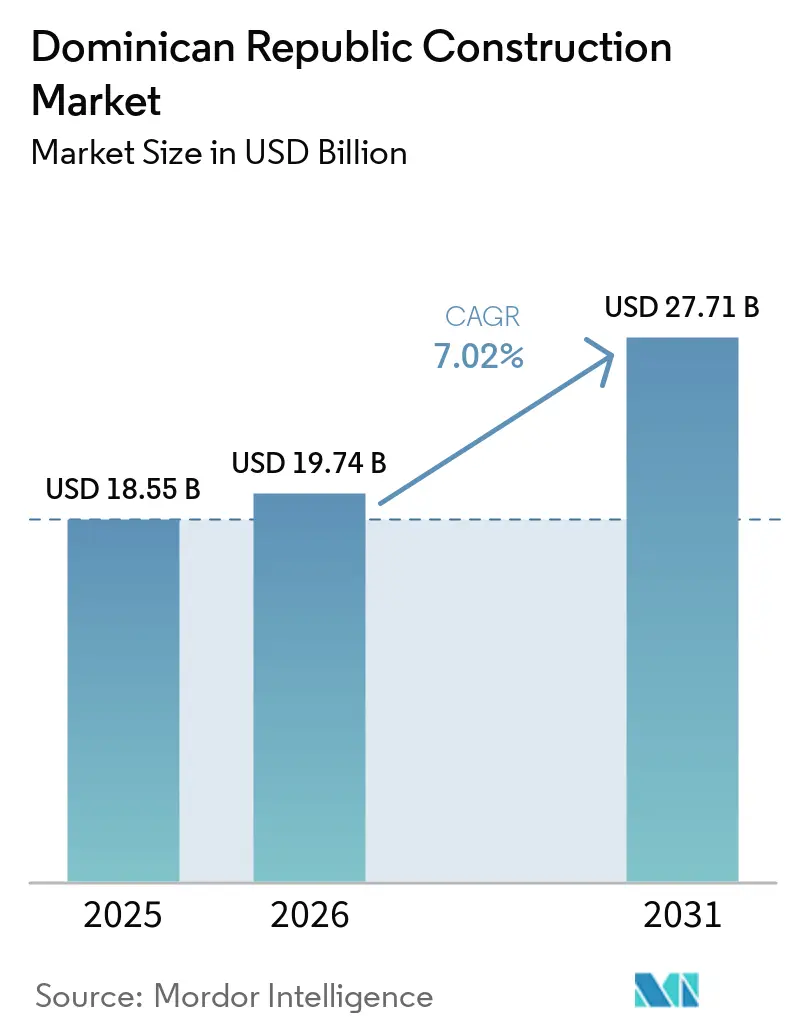
The Dominican Republic Construction Market size is projected to expand from USD 18.55 billion in 2025 and USD 19.74 billion in 2026 to USD 27.71 billion by 2031, registering a CAGR of 7.02% between 2026 and 2031.
Rising infrastructure allocations under Vision 2030, strong near-shoring inflows, and buoyant tourism demand together keep order backlogs full across civil, commercial, and utility-scale projects. Public-private-partnership (PPP) Law 47-20 has widened access to long-term capital, lowering early-stage risk and bringing global contractors into highway, airport, and renewable-energy tenders. On the private side, a steady stream of remittances, USD 10 billion in 2024, continues to underwrite mid-market housing, while free-trade-zone (FTZ) expansions trigger a new round of industrial work. Despite material-cost volatility and a persistent skills gap, project pipelines remain resilient because multilateral lenders such as CABEI and IDB Invest routinely co-finance priority transport and energy schemes.
Key Report Takeaways
- By sector, commercial construction accounted for 40.11% of the Dominican Republic construction market in 2025 and is projected to remain the fastest-growing sector, registering a 7.51% CAGR through 2031.
- By construction type, new construction held 86.79% of the Dominican Republic construction market size in 2025; renovation is advancing at a 13.21% CAGR to 2031.
- By construction method, conventional on-site techniques accounted for 92.61% share in 2025, whereas modern methods of construction led growth at a 9.73% CAGR over the same horizon.
- By investment source, the public segment accounted for 53.72% of the Dominican Republic construction market in 2025, while the private segment is projected to register the fastest growth, at a 7.62% CAGR, through 2031.
Note: Market size and forecast figures in this report are generated using Mordor Intelligence’s proprietary estimation framework, updated with the latest available data and insights as of 2026.
Dominican Republic Construction Market Trends and Insights
Drivers Impact Analysis*
| Driver | (~) % Impact on CAGR Forecast | Geographic Relevance | Impact Timeline |
|---|---|---|---|
| National infrastructure build-out under Vision 2030 | +1.8% | National, with concentration in Santo Domingo, Santiago, Puerto Plata corridors | Long term (≥ 4 years) |
| Tourism-led boom in hospitality & mixed-use projects | +1.5% | Coastal regions, Punta Cana, Puerto Plata, Miches development zones | Medium term (2-4 years) |
| Rising housing demand fuelled by remittances & urban middle-class growth | +1.2% | Greater Santo Domingo, Santiago, secondary urban centers | Medium term (2-4 years) |
| Near-shoring & Free-Trade-Zone expansions spurring industrial facilities | +0.9% | Free trade zones, Santiago, San Pedro de Macorís industrial corridors | Long term (≥ 4 years) |
| Utility-scale renewable-energy pipeline (solar, wind) | +0.8% | National grid integration points, rural solar development areas | Long term (≥ 4 years) |
| Public-Private-Partnership Law 47-20 unlocking long-tenor financing | +0.6% | National infrastructure projects, transportation networks | Long term (≥ 4 years) |
| Source: Mordor Intelligence | |||


National Infrastructure Build-Out Under Vision 2030
The Vision 2030 roadmap has ushered in the country’s largest public works program, covering highways, urban rail, and energy links. Flagship schemes such as the USD 421 million PLANACOVIAL road package and the USD 250 million Santo Domingo Metro Line 2C are already under execution. Faster permit processing, cut from 206 days to as few as 60, removes a chronic bottleneck and lets contractors move quickly from design to ground-breaking. New mobility assets also feed into climate goals because upgraded rail and cable-propelled transit cut urban emissions. Together, these factors make infrastructure the single biggest pull-factor for the Dominican Republic construction market over the decade[1]Banco Centroamericano de Integración Económica, “PLANACOVIAL Loan Document,” bcie.org.
Tourism-led Boom in Hospitality & Mixed-Use Projects
Global chains see the Dominican coast as a safe, high-yield bet, prompting a wave of resort and branded residential builds. Miches alone hosts confirmed developments by Wyndham, Marriott, Hilton, and Hyatt, alongside a Four Seasons slated for 2026. Complementary assets, notably the USD 67.5 million Cabo Rojo Airport runway, ensure visitor capacity keeps pace with room supply. Public agencies support the boom via USD 5.3 million highway upgrades that shorten travel times from airports to beaches. Construction work, therefore, spans hotels, retail promenades, and supporting utilities, multiplying spend across the value chain.
Rising Housing Demand Fueled by Remittances & Urban Middle-Class Growth
Continuous inflows from the Dominican diaspora allow families to self-finance homebuilding, explaining why residential still tops market share. Over 200 active projects were logged in the two largest metros in 2024. Government social-housing programs add a second vector, with the Ministry of Housing completing multiple health and education facilities that anchor new neighborhoods. Private developers chase the upper-mid tier, where buyers seek gated communities, better finishes, and energy-efficient designs. Innovative deals such as Eco Buildings Group’s letter of intent for 10,000 modular units signal that off-site methods could narrow the affordability gap while lifting productivity.
Near-Shoring & Free-Trade-Zone Expansions
Tighter North American supply-chain rules have vaulted the Dominican Republic onto corporate site-selection shortlists. The country now hosts 87 FTZ parks, and medical-device majors lead a pipeline of clean-room factories that require strict HVAC and utilities. Eaton’s USD 150 million fuse-assembly plant in Santiago typifies investor confidence and adds a high-spec industrial reference for local builders. Tax waivers under CAFTA-DR keep operating costs competitive, reinforcing the structural demand for production halls, logistics hubs, and back-office campuses.
Restraints Impact Analysis*
| Restraint | (~) % Impact on CAGR Forecast | Geographic Relevance | Impact Timeline |
|---|---|---|---|
| Elevated interest-rate environment inflating borrowing costs | -1.1% | National, affecting private sector projects disproportionately | Short term (≤ 2 years) |
| Skilled-labour shortages due to emigration & informal sector pull | -0.9% | National, concentrated in technical specializations | Medium term (2-4 years) |
| Volatile import prices for steel, cement & fuels | -0.8% | National, with greater impact on large infrastructure projects | Medium term (2-4 years) |
| Protracted land-titling & cadastral disputes delaying projects | -0.6% | Rural areas, peri-urban development zones | Long term (≥ 4 years) |
| Source: Mordor Intelligence | |||
Elevated Interest-Rate Environment is Inflating Borrowing Costs
High policy rates translate directly into costlier construction loans, especially for small and midsize homebuilders that rely on bank credit. Developers are postponing projects or scaling down floor-area ratios to protect margins. Although PPP structures soften this headwind for public works, commercial malls, and middle-income housing remain exposed until monetary easing resumes. The squeeze also discourages first-time buyers, curbing presales that normally fund early construction stages.
Skilled-Labor Shortages Due to Emigration & Informal-Sector Pull
By 2025, the construction sector will need 378,503 workers, rising to 387,019 in 2026. However, the supply of skilled trades is declining as many craftworkers seek better opportunities abroad. Copymecon notes that despite daily pay for general labor ranging from DOP 800 to DOP 1,200 (USD 14–21), vacancies remain high as experienced masons, carpenters, and electricians leave. Contractors often rely on Haitian crews, but many lack proper immigration status, limiting formal hiring and worsening shortages. The informal economy further complicates the issue by attracting workers with cash wages and flexible hours, making it harder for compliant firms to compete. Business associations are collaborating with immigration authorities to address labor gaps and simplify permits, but progress is slow due to procedural hurdles and public concerns. The shortage is most critical in technical roles like electrical wiring, plumbing, and heavy-equipment operation, where limited training capacity delays projects and affects quality.
*Our forecasts treat driver/restraint impacts as directional, not additive. The impact forecasts reflect baseline growth, mix effects, and variable interactions.
Segment Analysis
By Sector: Commercial Leads Market Share and Growth
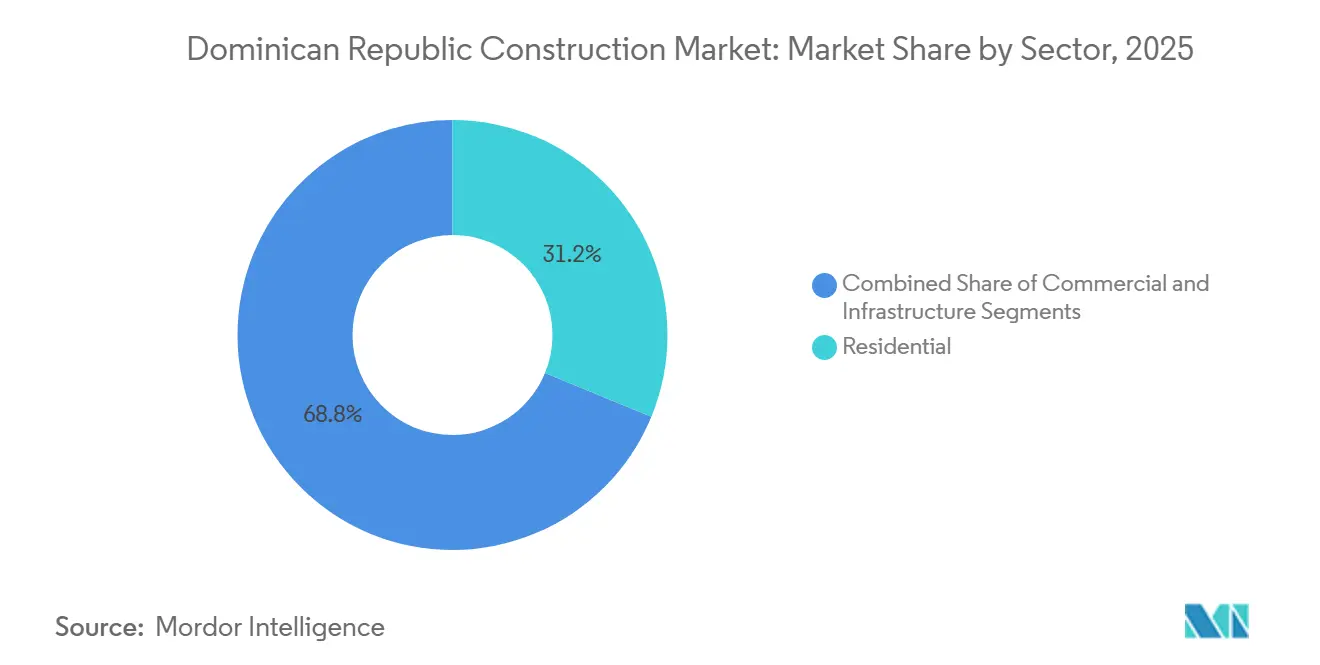
Commercial construction captured 40.11% of the Dominican Republic's construction market share in 2025, making it the largest sector, supported by continued investment in tourism, retail, hospitality, logistics, and commercial real estate across major economic centers. The expansion of tourism infrastructure, mixed-use developments, and business facilities is sustaining demand for new commercial projects, particularly in Santo Domingo and key tourism destinations. Rising private-sector investment in hotels, retail spaces, office facilities, and supporting infrastructure is also broadening the scope of commercial construction activity.
The commercial segment is projected to register the fastest growth at a 7.51% CAGR through 2031, driven by ongoing tourism-related development, expansion of commercial and logistics facilities, and continued investment in large-scale mixed-use projects. Hotel and resort developments are increasingly incorporating retail, entertainment, dining, and branded residential components, increasing construction requirements and project values. At the same time, expanding trade and free-zone activity are supporting demand for warehouses, industrial facilities, and other commercial structures, reinforcing commercial construction as the key growth segment in the Dominican Republic construction market through 2031.


By Construction Type: New Builds Dominate but Renovation Gains Traction
New construction accounted for 86.79% of the Dominican Republic construction market size in 2025, reflecting the strong contribution of greenfield residential, commercial, and infrastructure projects across the country. Ongoing development of housing, tourism facilities, commercial properties, transportation assets, and other new-build projects continues to generate substantial construction expenditure. Large-scale developments and expanding private-sector investment further support demand for new construction, keeping it firmly dominant within the market.
Renovation is projected to advance at a 13.21% CAGR through 2031, supported by the refurbishment and modernization of existing residential, commercial, and hospitality properties. Demand is increasing as property owners upgrade aging buildings, improve functionality, and align existing assets with evolving tenant, customer, and regulatory requirements. The faster growth of renovation activity is expected to gradually increase its contribution to the Dominican Republic construction market, although new construction will continue to represent the larger share through 2031.
By Construction Method: Conventional Construction Dominates While Modern Methods Gain Momentum
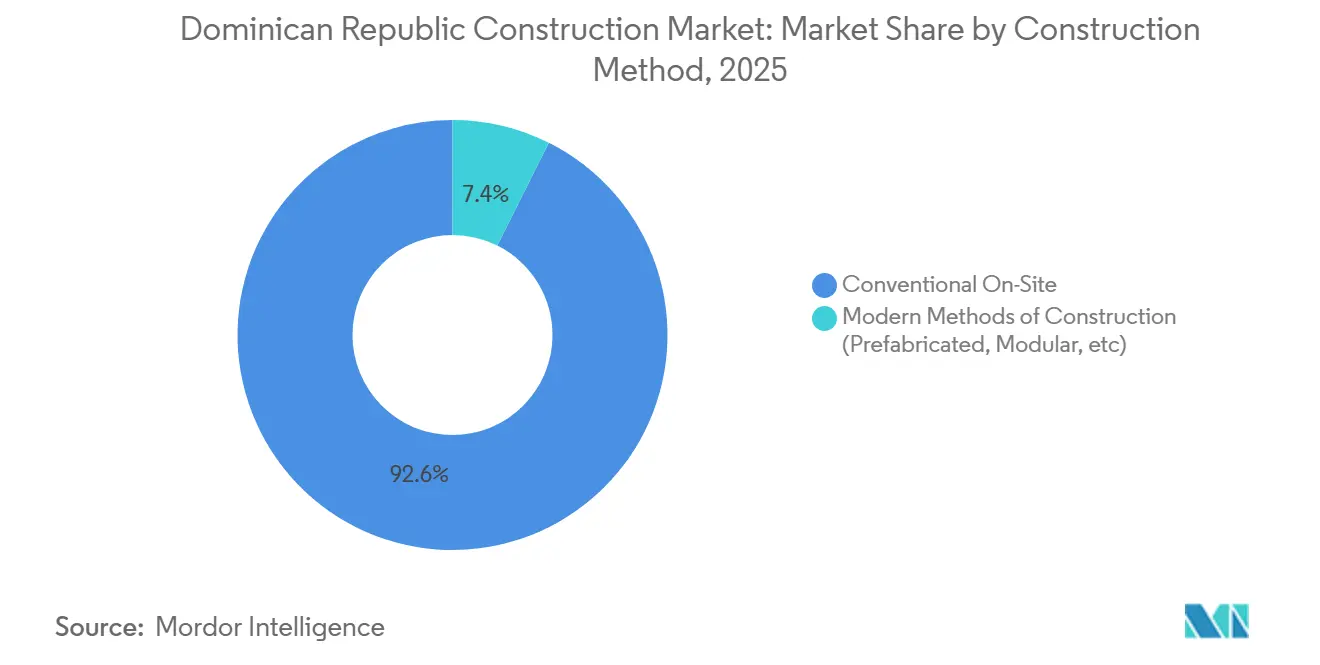
Conventional on-site construction accounted for 92.61% of the Dominican Republic construction market in 2025, reflecting the widespread use of established site-based building practices across residential, commercial, and infrastructure projects. The availability of conventional materials, established contractor networks, and familiarity with traditional construction techniques continue to support their dominance, particularly among local developers and contractors.
Modern methods of construction are projected to register a 9.73% CAGR through 2031, driven by increasing demand for faster project completion, improved construction efficiency, and greater cost and quality predictability. Modular construction, prefabricated components, and panelized systems are gaining attention as developers seek to reduce on-site construction time and address labor and productivity constraints. As adoption expands and supporting manufacturing capacity improves, modern methods are expected to gradually increase their contribution to the Dominican Republic construction market.
By Investment Source: Public Funding Leads While Private Investment Accelerates
Public investment accounted for 53.72% of the Dominican Republic construction market in 2025, supported by government spending on transportation, infrastructure, energy, and other public development projects. Continued investment in essential infrastructure and public facilities is sustaining the contribution of government-funded construction activity and reinforcing the public segment's leading position.
Private investment is projected to register the fastest growth at a 7.62% CAGR through 2031, driven by expanding activity across tourism, hospitality, residential, commercial, and industrial developments. Increasing private-sector participation in large-scale projects, together with growing demand for new properties and supporting facilities, is expected to strengthen private construction spending over the forecast period.
Geography Analysis
Greater Santo Domingo remains the single largest regional market, absorbing 37.45% of nationwide spend in 2025 and projected to advance at a 8.04% CAGR. Transit megaprojects, the USD 250 million Metro Line 2C extension and a USD 250 million urban cable car anchor civil-works demand while unlocking adjacent residential plots. A dense service economy draws corporate developers into mixed-use towers, further amplifying crane counts across the skyline.
Santiago holds the second-largest share, propelled by the monorail slated for 2025 commissioning and the Eaton fuse-assembly plant that sets a new benchmark for industrial fit-outs. Free-trade-zone growth around San Pedro de Macorís and La Romana spreads activity along the country’s main logistics spine, connecting ports with inland distribution hubs. Contractors competent in ISO-cleanroom specifications capture repeat work as medical-device exporters consolidate production under near-shoring strategies.
Coastal provinces, notably Punta Cana, Miches, and Puerto Plata, post the fastest aggregate growth at 8.36% through 2031. The USD 2.25 billion Pedernales master plan and early-work packages at Cabo Rojo Airport unlock a large pipeline of hospitality, water-treatment, and power-distribution contracts. Public highway upgrades USD 5.3 million shorten airport-hotel transfer times, making secondary beaches viable for integrated resort clusters. Renewable-energy developers dot rural hinterlands with solar arrays, requiring grid expansions that spread civil-works orders beyond the tourist belt.
Regulatory Landscape
Construction activity is governed by General Law 687, supported by a set of technical regulations administered through national entities. Oversight of building and permitting is centered on the Ministry of Housing, Habitat, and Buildings (MIVHED), while the Ministry of Public Works and Communications supports implementation through its technical regulation framework, including licensing and compliance instruments used for project approvals.
A key near-term compliance anchor is the rollout of the Construction Code of the Dominican Republic (CDCRD). On May 14, 2026, MIVHED established a one-year transition period for CDCRD implementation under Resolution No. 007-2026, running to April 10, 2027. In parallel, mandatory supervision and inspection requirements apply to both public and private works through established regulations, including R-004 (supervision and inspection) and R-021 (licensing), shaping documentation, QA/QC practices, and contractor obligations across the market.
Value Chain Analysis
The Dominican Republic construction value chain runs from land assembly and project financing through design, permitting, procurement, construction execution, and handover or operations. Developers and asset owners (residential, tourism, and industrial) engage local and international EPC and general contractors for delivery, while project permitting and document submission increasingly route through the Ventanilla Unica de Construccion. Engineering, architecture, and specialist consultants interface early with regulators and inspection bodies to align designs with technical rules and supervision requirements.
On the execution side, contractors differentiate through equipment access, logistics, and specialized trade depth. Constructora Rizek y Asociados SRL operates with in-house heavy machinery capacity for large infrastructure works, while Contratistas Civiles y Mecanicos SA (CCM) supports industrial and commercial delivery with engineering and construction management capabilities and demonstrated reliance on imported machinery components. Materials and systems suppliers (cement, steel, chemicals, and MEP equipment) feed site and off-site workflows, and growing visibility of modular solutions adds fabrication and transport coordination for residential and mixed-use programs. Property registration and land-titling disputes can also delay development timelines, creating downstream friction for contractors, suppliers, and financiers through rescheduling and claim exposure.
Competitive Landscape
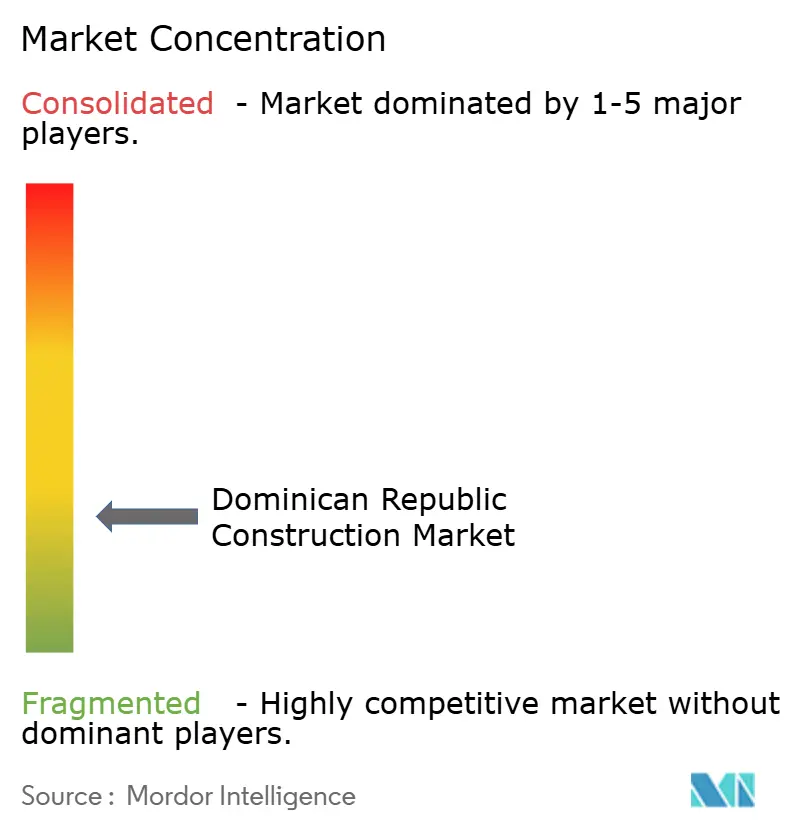
Local firms such as Constructora Rizek, Noval, and Cocime hold sway in small-to-midscale housing and commercial builds, leveraging community ties and familiarity with municipal approval processes. Their collective share keeps overall market concentration moderate, encouraging price competition yet making large projects contingent on joint-venture formations.
International majors, including ACCIONA, Dominion, and Sacyr, win transportation and renewable-energy concessions where performance guarantees and specialized equipment are prerequisites. These players usually partner with local subcontractors for earthworks and finishing trades, injecting global project-management standards while preserving domestic labor content.
M&A activity underscores strategic repositioning. Sika’s 2024 purchase of Vinaldom deepens its chemicals portfolio and expands local distribution, enhancing value-engineering options on waterproofing and admixtures. Conversely, CEMEX’s USD 950 million exit signals portfolio rotation toward core U.S. assets, opening market space for new entrants or local producers seeking backward integration. Contractors increasingly deploy BIM and drone-based progress tracking to boost productivity; however, adoption skews toward tier-one firms, leaving an innovation gap among small enterprises.
Dominican Republic Construction Industry Leaders
Constructora Rizek y Asociados SRL
Noval SRL
Contratistas Civiles y Mecanicos SA
Metro Country Club SA
Paredes y Asociados Constructora, C. por A.
- *Disclaimer: Major Players sorted in no particular order

Market Opportunities and Future Outlook
Code and permitting modernization creates near-term opportunities for compliance-led services and differentiated delivery models. The one-year transition for implementing the Construction Code of the Dominican Republic (CDCRD), set by MIVHED on May 14, 2026 (transition through April 10, 2027), increases demand for code-aligned design updates, supervision and inspection services, and contractor QA/QC systems that can document conformity under regulations such as R-004 and licensing requirements such as R-021. Firms that package design-to-permit support through the Ventanilla Unica de Construccion and build inspection-ready processes into delivery gain traction as owners prioritize schedule certainty.
Mixed-use, high-density urban projects and tourism-linked developments are widening the need for high-rise structural work, MEP packages, elevators, life-safety systems, and convention and hospitality fit-outs. In July 2026, Noval Properties presented Coralia in Santo Domingo Este, a large mixed-use concept including multiple high-rise residential towers, a hotel tower, and a convention center for 6,000 people, reflecting the scale and complexity of private-led programs moving through the pipeline. In parallel, energy and transport megaproject awards and preparations (such as hydro and airport works) keep demand active for civil contractors, heavy equipment providers, and specialized subcontractors, while labor constraints and materials volatility lift the value of modularization, productivity tools, and procurement planning.
Recent Industry Developments
- July 2026: Consorcio Autopista del Ambar, S.R.L. has been awarded the design and construction contract for Autopista del Ambar, toll road project connecting Santiago with Puerto Plata. The project expands cross-island transport infrastructure and demonstrates PPP-like collaboration on large-scale concessions. The award points to strengthened private sector involvement in national connectivity.
- June 2026: Department of Airports conducted final phase inspection and readiness checks for El Granero del Sur Domestic Airport construction. The checks advance capacity expansion and operational readiness, supporting regional air mobility. The development aligns with expectations for higher travel demand and improved regional connectivity.
- May 2026: Consorcio A and La Gina led by Acciona was awarded the La Gina multipurpose hydro project contract for Peravia province, valued at USD 108 million. The contract advances renewable energy infrastructure and hydro construction, and foreign-led execution indicates international participation in Dominican energy projects.


Research Methodology Framework and Report Scope
Market Definition and Coverage
For this report, the market refers to the annual value of construction activity delivered in the Dominican Republic, measured in current USD across the main building and infrastructure works that are executed and paid for within the country.
Scope exclusions: we exclude informal self-build work that is not captured in official statistics, and purely financial land transactions that do not translate into construction activity.
Segmentation Overview
- By Sector
- Residential
- Apartments/Condominiums
- Villas/Landed Houses
- Commercial
- Office
- Retail
- Industrial and Logistics
- Others
- Infrastructure
- Transportation Infrastructure (Roadways, Railways, Airways, others)
- Energy & Utilities
- Others
- Residential
- By Construction Type
- New Construction
- Renovation
- By Construction Method
- Conventional On-Site
- Modern Methods of Construction (Prefabricated, Modular, etc)
- By Investment Source
- Public
- Private
Data Sources, Market Sizing, and Validation
Desk Research
Desk research is used to build the first view of the country construction demand pool and to set consistent definitions for what counts as construction value. We mainly rely on public national accounts and construction activity indicators, which help anchor the model to what is actually being built and funded in the Dominican Republic.
Key public sources reviewed include statistics and releases from the Central Bank of the Dominican Republic, the Oficina Nacional de Estadistica (ONE), and relevant ministries that publish infrastructure plans and budget execution. We also review multilateral project disclosures, such as the World Bank and the IDB, and we scan for project start timing, delays, and pricing pressure. To cross-check assumptions on delivery and cost behavior, we review company annual reports, audited financial statements, investor presentations, and reputable press coverage. Where needed, we supplement with paid subscriptions for company financial intelligence, shipment-level import and export data for construction material flows, and a patent database to sanity check technology adoption signals. These desk research sources are not exhaustive, and we also used other public documents for data collection, validation, and clarification.
Primary Interviews and Surveys
We use interviews and surveys with public agencies, developers, contractors, distributors, lenders, and consultants active within the Americas scope, with emphasis on Dominican Republic activity. Respondents help clarify project timing, informal work, material pricing, private starts, and assumptions that public records do not fully capture. Analysts use these findings to close gaps and triangulate the final estimate.
Distribution of primary research fieldwork respondents
| Company type | Respondent position |
|---|---|
| Top tier: 29% | CXOs: 18% |
| Mid tier: 46% | Functional/Unit leaders: 31% |
| Smaller Players: 25% | Managers: 51% |
Market-Sizing & Forecasting
The sizing model starts from a top-down reconstruction of construction value using national accounts signals and public investment pipelines, which are then translated into an annual USD market value for the Dominican Republic. To keep the totals realistic, we also run selective bottom-up checks using sampled project values, contractor revenue mixes, and rough unit cost times volume logic for common work types, and then adjust for gaps where coverage is uneven.
The inputs that matter most include public capital spending and execution timing, private real estate starts and completions (where visible through permits and developer commentary), cement and other core material import and production trends, labor availability signals, and observed cost inflation that moves contract prices over time. Because construction value can jump when a few large projects move phases, forecasting is done using scenario analysis supported by trend smoothing on the historical series. We also stress test the scenarios with primary feedback on pipeline confidence and likely funding constraints. When bottom-up approximations are missing for smaller project types, we fill the gap through share-based allocation from the top-down totals and then recheck the implied average project values for reasonableness.
Data Validation & Update Cycle
Before results are finalized, multiple checks are run so outliers are spotted early, such as sudden jumps that do not match budget execution, import signals, or visible project milestones. Assumptions are reviewed step by step, first within the analyst model, then through an internal review where logic, conversions, and growth drivers are re-tested, and then through re-contacts when a key input moves outside a normal range.
Reports are refreshed annually, and interim updates are made when material events occur, such as major policy shifts, large project awards, or sharp currency movement that changes USD reporting. Right before delivery, the latest public releases are rechecked so the model reflects the most current view available.
Mordor Intelligence's Dominican Republic Construction Market Sizing Compared With Other Published Estimates
Published market values for construction in the Dominican Republic can differ because each estimate may time currency conversion differently, apply its own cost escalation path, and decide whether to count contract awards, work executed, or broader real estate related spending. The gaps become larger when inputs are not refreshed after major price swings in materials and labor, which can change the USD value even if physical activity stays steady.
In this study, repeatable update checks are applied, including re-benchmarking USD conversion timing and re-testing average value per square meter assumptions against current contractor quotes and project pipeline updates. That is why the 2025 figure from Mordor Intelligence can land away from sources that rely on older price baselines or less frequent refresh cycles.
Benchmark comparison
| Source | Market Size | Gaps in Research Methodology |
|---|---|---|
| Mordor Intelligence | USD 38.95 B (2025) | |
| Industry Association A | USD 36.10 B (2025) | This estimate appears to lean more on reported construction value added and public program reporting, which can undercount private commercial works and can lag when cost escalation is fast. |
| Global Consultancy B | USD 43.70 B (2025) | This estimate likely includes a wider spend boundary that can fold in adjacent real estate related costs, and it may apply a more aggressive price uplift path when converting local costs into USD. |
The table shows that most of the spread comes from timing and scope choices, not from a dispute that construction is expanding. By keeping the price and currency steps visible, and by tying the totals back to execution signals and practical unit cost checks, the resulting market size stays traceable and easier to replicate year to year.


Key Questions Answered in the Report
Which sector leads the Dominican Republic construction market?
Commercial construction leads with a 40.11% share of the Dominican Republic construction market in 2025, while the commercial segment is projected to register the fastest growth at a 7.51% CAGR through 2031.
Which construction type dominates the Dominican Republic construction market?
New construction accounted for an 86.79% share of the Dominican Republic construction market in 2025, while renovation is projected to grow at a 13.21% CAGR through 2031.
Which construction method dominates the Dominican Republic construction market?
Conventional on-site construction held a 92.61% share of the Dominican Republic construction market in 2025, while modern methods of construction are projected to grow at a 9.73% CAGR through 2031.
Which investment source leads the Dominican Republic construction market?
Public investment accounted for a 53.72% share of the Dominican Republic construction market in 2025, while private investment is projected to register the fastest growth at a 7.62% CAGR through 2031.
Page last updated on:




