
Veterinary Telehealth Market Size and Share
Market Overview
| Study Period | 2020 - 2031 |
|---|---|
| Market Size (2026) | USD 335.73 Million |
| Market Size (2031) | USD 802.53 Million |
| Growth Rate (2026 - 2031) | 19.04 % |
| Fastest Growing Market | Asia-Pacific |
| Largest Market | North America |
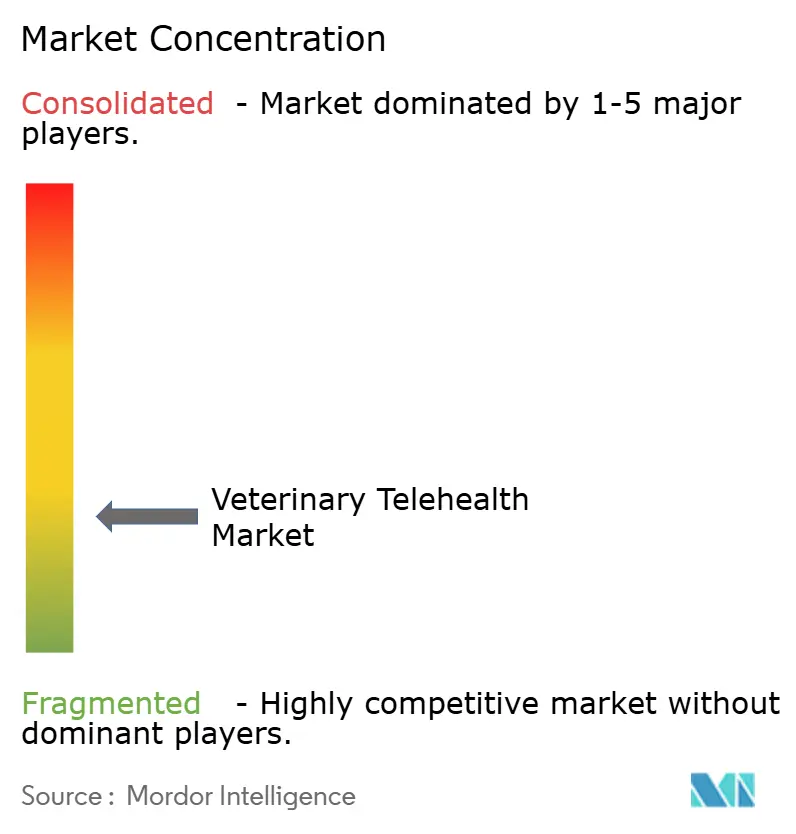
| Market Concentration | Low |
Major Players *Disclaimer: Major Players sorted in no particular order Image © Mordor Intelligence. Reuse requires attribution under CC BY 4.0. | |
Veterinary Telehealth Market Analysis by Mordor Intelligence
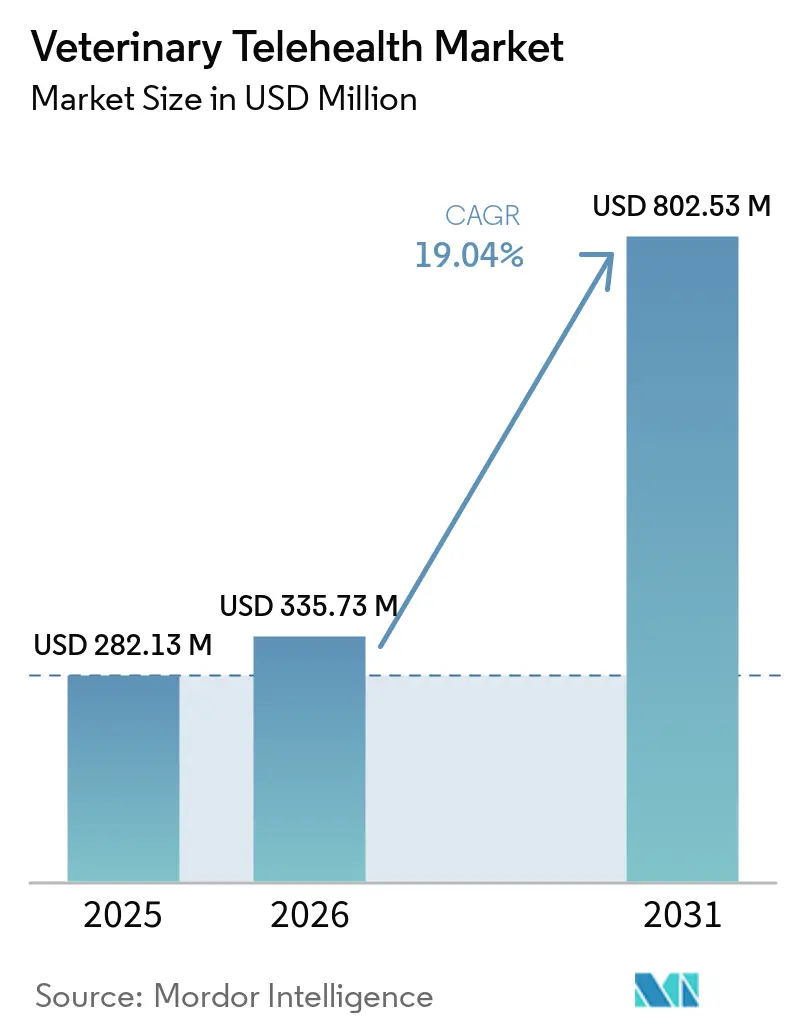
The Veterinary Telehealth Market size is projected to be USD 282.13 million in 2025, USD 335.73 million in 2026, and reach USD 802.53 million by 2031, growing at a CAGR of 19.04% from 2026 to 2031.
Robust pet-humanization, post-pandemic regulatory flexibility, and AI-enabled wearables are jointly redefining access models and cementing virtual care as a frontline service. North America continues to anchor revenues, yet the Asia-Pacific growth curve is steeper as fast-rising pet ownership collides with a shortage of brick-and-mortar clinics. Continuous remote monitoring is outpacing synchronous video visits because insurers now bundle subscription-based telemetry into mainstream policies. Competitive rivalry intensifies around platform scale, wearable integration, and usage-based pricing, while fragmented licensing laws and uneven reimbursement blunt momentum in certain jurisdictions.
Key Report Takeaways
- By animal, companion species led with 69.32% of the veterinary telehealth market share in 2025 and is expected to register the fastest CAGR with 20.22% through 2031.
- By consultation modality, synchronous segment led with 45.61% market share in 2025, and remote patient monitoring is projected to expand at a 19.98% CAGR through 2031.
- By delivery mode, cloud and app-based platforms captured 71.23% revenue in 2025 and are expected to have a 21.22% CAGR through 2031.
- By service type, teleconsulting captured 36.88% revenue in 2025, and telemonitoring is expected to have a 19.6% CAGR through 2031.
- By end user, the veterinary clinics & hospitals led with 57.7% share in 2025, yet telehealth platform providers are forecast to register a 20.65% CAGR through 2031.
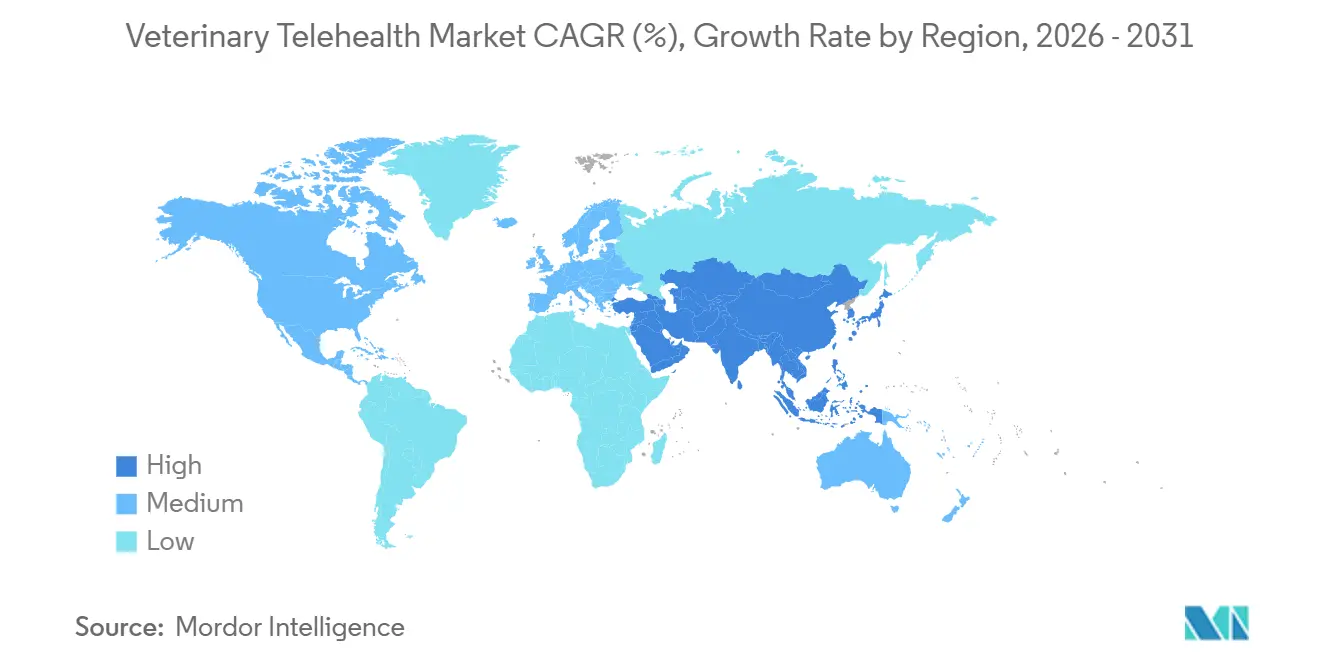
- By region, Asia-Pacific is expected to rise at a 20.99% CAGR through 2031, while North America retained 45.3% of global revenue in 2025.
Note: Market size and forecast figures in this report are generated using Mordor Intelligence’s proprietary estimation framework, updated with the latest available data and insights as of January 2026.
Market Trends and Insights
Drivers Impact Analysis of Veterinary Telehealth Market*
| Driver | (~) % Impact on CAGR Forecast | Geographic Relevance | Impact Timeline |
|---|---|---|---|
| Increasing pet ownership & humanization wave | +4.2% | Global, strongest in North America, Western Europe, and urban APAC | Medium term (2-4 years) |
| Rising veterinary healthcare spending and insurance coverage | +3.8% | North America, Europe, and emerging urban APAC | Medium term (2-4 years) |
| Regulatory flexibility post-COVID is accelerating telehealth adoption | +3.5% | United States, United Kingdom, Germany, select APAC | Short term (≤2 years) |
| The growing prevalence of zoonotic diseases is elevating remote triage demand | +2.9% | Global with APAC and Africa hot spots | Long term (≥4 years) |
| AI-enabled wearables & remote diagnostics expanding clinical use-cases | +3.1% | North America, Europe, scaling APAC | Medium term (2-4 years) |
| Usage-based pet-insurance models rewarding virtual-first care | +2.6% | North America, Western Europe, Australia pilots | Medium term (2-4 years) |
| Source: Mordor Intelligence | |||
Increasing Pet Ownership & Humanization Wave
Ninety-four million U.S. households owned a pet in 2025, an all-time peak fueled by millennial and Gen Z adoption patterns [1]. Younger cohorts treat pets as family, channel discretionary income into premium veterinary services, and favor virtual care that aligns with digital-first lifestyles. China’s 120 million pet-owning households and India’s expanding middle class multiply the addressable base for localization-ready platforms. Preventive care and chronic-disease management, well-suited to telemonitoring gain momentum as owners increasingly demand continuous oversight rather than episodic clinic visits. This demand spike sustains pricing power for platforms that pair convenience with clinically validated advice.
AI-Enabled Wearables & Remote Diagnostics Expanding Clinical Use-Cases
Smart collars capturing heart rate, respiration, and activity streams let clinicians flag anomalies before symptoms surface. PetPace’s V3.0 sensor suite, launched in 2024, applies machine-learning algorithms to alert both owner and veterinarian in real time [2]. Precision livestock farming now equips cattle and swine with telemetry tags that detect estrus or early disease, curbing on-farm morbidity and travel costs. As algorithm accuracy improves with larger datasets, veterinarian trust in remote diagnostics rises, closing a feedback loop that accelerates adoption. Subscription revenue tied to continuous monitoring lowers platform churn and deepens lifetime value.
Usage-Based Pet-Insurance Models Rewarding Virtual-First Care
Nationwide embeds unlimited telehealth visits in its flagship Whole Pet with Wellness plan, steering policyholders toward virtual triage over higher-cost in-clinic diagnostics. The National Association of Insurance Commissioners tallied 6.25 million insured U.S. pets in 2024, up from 4.8 million in 2022, and telehealth usage is growing even faster [3]. Early pilots in Australia and the United Kingdom show emergency-visit frequency falling 15-20% when insurers incentivize online consultations. Lower claim severity boosts insurer margins, encouraging broader reimbursement for remote monitoring devices and asynchronous follow-ups.
Regulatory Flexibility Post-COVID Accelerating Telehealth Adoption
Colorado HB24-1048, Texas HB3364, Ohio HB96 & SB60, and Florida HB849 abolished the mandatory in-person exam to establish a veterinarian-client-patient relationship for non-controlled substances during 2024-2025. The American Veterinary Medical Association’s December 2025 policy update now allows remote consultations in emergencies, mitigating workforce shortages that are projected to leave the United States short 15,000 veterinarians by 2030. Reduced compliance friction encourages investors to treat veterinary telehealth as infrastructure, not a pandemic stopgap.
Restraints Impact Analysis of Veterinary Telehealth Market*
| Restraint | % Impact on CAGR Forecast | Geographic Relevance | Impact Timeline |
|---|---|---|---|
| High Service Costs & Limited Reimbursement Pathways | -2.4% | Global, most acute in uninsured segments and emerging markets (Latin America, MEA, rural APAC) | Medium term (2-4 years) |
| Licensing-Law Variability Restricting Cross-Border Care | -1.8% | North America (state-by-state fragmentation), Europe (country-level barriers), APAC (nascent frameworks) | Long term (≥ 4 years) |
| Fragmented Data Interoperability Hindering AI Triage Accuracy | -1.5% | Global, with highest friction in North America and Europe due to legacy EHR systems | Medium term (2-4 years) |
| Post-Pandemic Owner Preference Swings Back To In-Clinic Exams | -2.1% | North America and Western Europe (mature markets with established clinic infrastructure) | Short term (≤ 2 years) |
| Source: Mordor Intelligence | |||
High Service Costs & Limited Reimbursement Pathways
Single teleconsultations cost USD 30-75, still steep for uninsured owners in lower-income regions. Although 6.25 million U.S. pets carried coverage in 2024, that equals under 7% of the national pet population, leaving most owners to pay out-of-pocket. Insurer policies vary on co-pays, pre-existing conditions, and device reimbursements, complicating the consumer value proposition. In markets where pet insurance penetration sits below 2%, platforms must underprice in-clinic alternatives, compress margins and slowing expansion.
Licensing-Law Variability Restricting Cross-Border Care
Veterinary licensing stays jurisdiction-specific. A California-licensed veterinarian cannot legally advise a Texas pet owner without an additional license, curbing national platform scalability. Europe mirrors the hurdle: each member state enforces distinct veterinary credentials, and GDPR health-data provisions add compliance overhead. Data silos hamper AI models that depend on diverse clinical inputs, stalling improvements in diagnostic accuracy.
*Our forecasts treat driver/restraint impacts as directional, not additive. The impact forecasts reflect baseline growth, mix effects, and variable interactions.
Veterinary Telehealth Market Segment Analysis
By Animal:
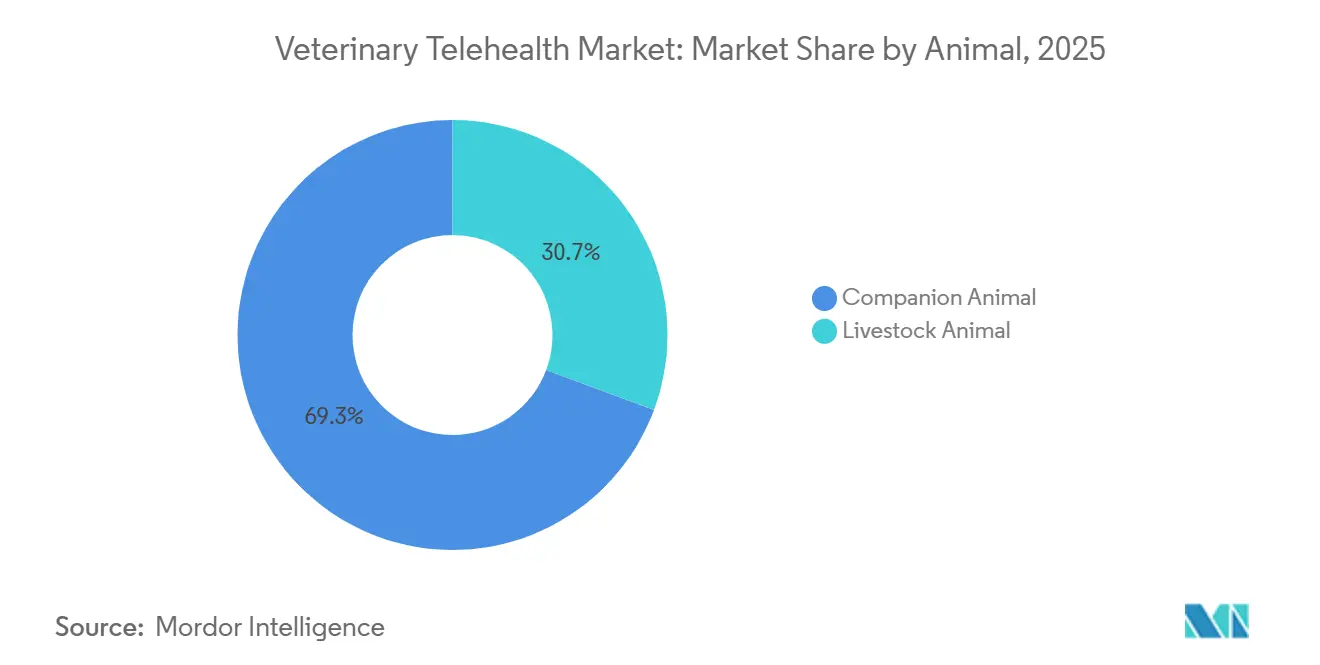
Companion Dominance Anchors Revenue, Livestock LagsCompanion species captured 69.32% of the veterinary telehealth market share in 2025, and growth is projected at 20.22% CAGR through 2031. The companion segment’s dominance reflects high household affinity for dogs and cats, which together exceed 90% of virtual-care volumes. Over the same horizon, bovine and swine deployments rise as rural broadband and sensor economics improve, but livestock still trails in revenue contribution.
Platform strategies revolve around user experience and insurance tie-ins because price competition escalates once basic connectivity hurdles fall. Equine telehealth remains niche; gait-analysis video assessments gain traction, yet tactile examinations keep many owners reliant on traditional visits. The other category—avian, reptile, exotic grows as specialty veterinarians market their expertise to dispersed clients, though its influence on the overall veterinary telehealth market size remains small.
By Delivery Mode:
Cloud Infrastructure Captures Scale EconomiesCloud and app-based systems held 71.23% of revenue in 2025 and are expected to post a 21.22% CAGR to 2031, underscoring the shift away from on-premise servers that burden clinics with IT overhead. SaaS practice-management bundles combine scheduling, EHR, billing, and teleconsultation into one interface, reducing friction for first-time adopters.
Data aggregation across multiple practices fuels algorithm training, creating predictive triage tools that strengthen platform stickiness and defend pricing. On-premise systems maintain relevance within large hospital chains, prioritizing data sovereignty, but this slice of the veterinary telehealth market is set to recede as cloud security certifications multiply and regulatory comfort rises.
By Service Type:
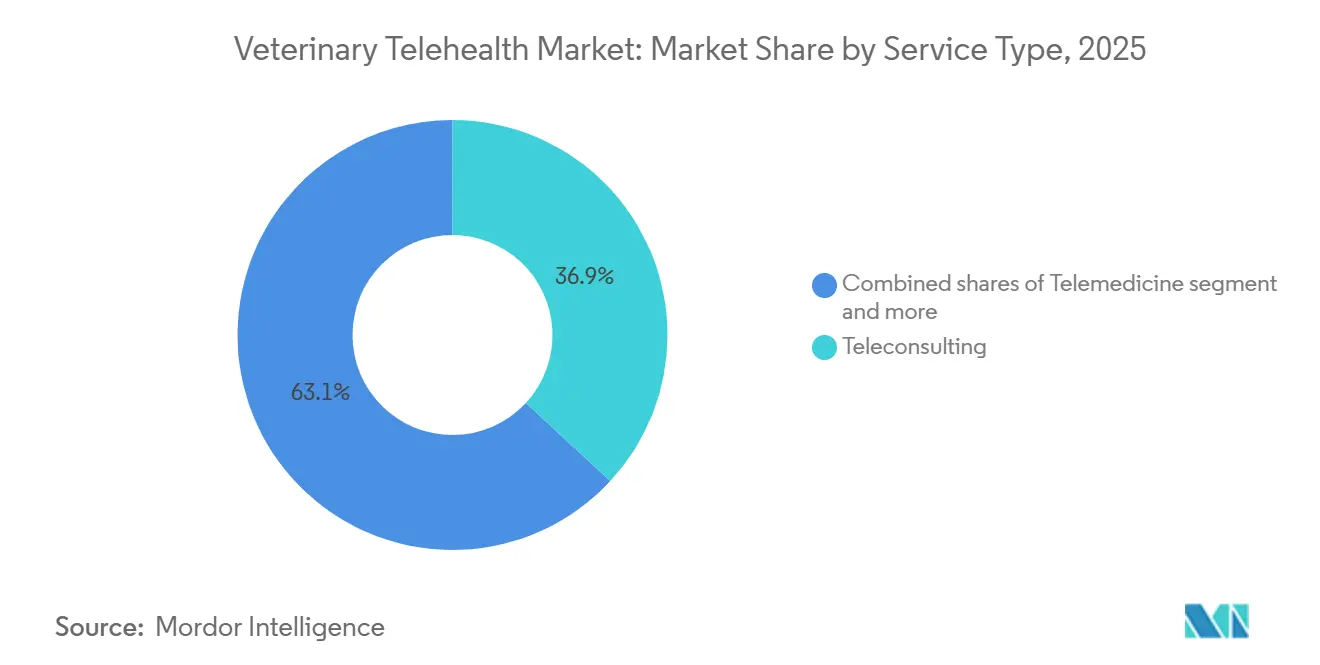
Telemonitoring Gains as Insurers Seek Cost ControlTeleconsulting remained the entry gateway with 36.88% share in 2025. Still, telemonitoring is forecast for a 19.6% CAGR to 2031 as insurers fund preventive telemetry that curbs emergency claims. The veterinary telehealth market size attached to remote monitoring is therefore expanding faster than any other service line.
Continuous health streams from glucose meters and smart collars produce longitudinal datasets that flag disease early. Platforms monetize device-linked subscriptions, swapping one-time consult fees for recurring revenue. Broadening VCPR flexibility since 2024 lets providers stitch teleconsulting and monitoring into blended care pathways, pushing utilization higher for chronic-disease cohorts.

By Consultation Modality:
Asynchronous Gains Traction, Real-Time Retains PremiumReal-time video and chat commanded 45.61% share in 2025, valued for immediate reassurance in urgent scenarios. Remote patient monitoring, however, is slated for the swiftest 19.98% CAGR, reflecting owner comfort with continuous oversight over episodic check-ins.
Asynchronous “store-and-forward” uploads cut costs for non-urgent needs. AI triage routes cases to specialty veterinarians only when needed, stretching workforce capacity and lowering owner spend. AVMA’s December 2025 emergency-consult rule change legitimizes this hybrid pathway, blending low-cost asynchronous intake with escalated synchronous care as required.
By End User:
Platform Providers Disrupt Traditional Clinic RevenueVeterinary clinics and hospitals held 57.7% share in 2025, yet platform providers are tracking a 20.65% CAGR to 2031, steadily expanding their slice of the veterinary telehealth market size. Marketplace models such as Vetster match surplus veterinary capacity with consumer demand globally, bypassing geographical barriers.
Retail alliances deepen disruption: Walmart bundled Pawp telehealth into Walmart+ subscriptions for unlimited consults, leveraging 230 million weekly shoppers. Insurance carriers, e-commerce sites, and employer wellness programs fall under “Others,” each weaving telehealth into broader ecosystems to increase stickiness and cross-sell opportunities.
Geography Analysis
North America Veterinary Telehealth Market
North America delivered 45.3% of 2025 revenue, buoyed by dense pet ownership, mature insurance, and five key state bills that eased VCPR rules between 2024 and 2025. Canada quickly aligned its provincial frameworks, letting binational platforms operate smoothly. Yet AVMA data show that veterinarian telehealth usage slid from 38% in 2023 to 29.2% in 2024 as some owners reverted to clinics once pandemic restrictions eased.
APAC Veterinary Telehealth Market
Asia-Pacific is poised for a 20.99% CAGR through 2031. China’s 120 million pet homes and India’s surging urban pet adoption catalyze mobile-first platforms backed by e-commerce titans. Japan and South Korea focus on geriatric-care telemonitoring, while Australia pilots insurance incentives for virtual-first pathways. Regulatory heterogeneity and low insurance coverage in segments of Southeast Asia temper the speed of scale.
EMEA and South America Veterinary Telehealth Market
Europe occupies a middle tier. The United Kingdom, Germany, and France lead thanks to established insurance cultures, but cross-border licensing remains a drag. GDPR raises compliance spend, prompting many platforms to limit operations to a single country. Middle East & Africa and South America represent emerging nodes; São Paulo and Dubai show pockets of high-income demand, though currency volatility and patchy broadband slow broader rollout.
Regulatory Landscape
Veterinary telehealth regulation remains jurisdiction-led, with the veterinarian-client-patient relationship (VCPR) as the main compliance gate for diagnosis and prescribing. In the United States, federal requirements still set limits for certain drug-related activities: the FDA reiterates that a valid VCPR for extralabel drug use and Veterinary Feed Directives cannot be established solely through telemedicine under 21 CFR 530.3(i). At the model-guidance level, the American Association of Veterinary State Boards (AAVSB) released updated 2026 telehealth model documents stating that member boards do not support establishing a VCPR solely by virtual means and that practitioners must be licensed where the patient is located.
At the state level, 2025-2026 actions continue to codify telemedicine rules and clarify where telehealth can maintain, but not create, a VCPR. Washington State adopted amendments to WAC 246-933-200 effective August 2025 confirming that a VCPR cannot be established solely via telehealth but may be maintained via telemedicine once established in-person. In 2026, South Carolina enacted Act No. 102 (Bill 3223) defining and setting requirements for veterinary telehealth, while Delaware proposed a new Section 18.0 (May 2026) outlining telemedicine requirements with carve-outs for tele-triage and emergency services. Rhode Island also advanced legislation in 2026 to authorize VCPR establishment via synchronous audiovisual means with documentation standards. This patchwork continues to push platforms toward state-by-state service design, VCPR verification workflows, and hybrid pathways that connect virtual care to physical exams when required.
Competitive Landscape
No single vendor exceeds a major global share, marking the veterinary telehealth market as structurally fragmented. Competition orbits three axes: veterinary-network breadth, wearable and EHR integration depth, and insurer-aligned pricing. Chewy exploited its 20 million-user e-commerce base to surpass 1 million virtual consults by March 2025, showcasing the reach advantage of incumbent retail ecosystems.
Walmart’s Pawp alliance illustrates retail’s push for ancillary revenue streams, while pure-play marketplaces Vetster and AirVet court independent veterinarians with favorable revenue splits. Technology moats widen as PetPace pairs patented AI analytics with hardware to lock in subscribers and feed continuous data loops, evidenced by a 40% rise in veterinary AI patent filings from 2023-2025.
Regulatory mastery differentiates scale aspirants from regional players: those adept at multistate licensing and EHR interoperability deliver seamless nationwide service, while single-state operators face plateauing addressable markets. Livestock telehealth remains an open frontier; platforms that secure rural connectivity partnerships could command outsized early-mover gains.
Veterinary Telehealth Industry Leaders
-
Chewy inc.
-
Vetster
-
AirVet
-
Zoetis
-
VitusVet
- *Disclaimer: Major Players sorted in no particular order
Veterinary Telehealth Market Companies Covered in this Report
- Activ4Pets
- AirVet
- BabelBark
- Chewy inc.
- FirstVet
- GuardianVets
- PetCoach
- Petriage
- Pets at Home Group Plc
- TeleVet
- VetCT
- Vetlive
- VetRad
- Vetster
- VitusVet
- whiskerDocs Llc.
- Zoetis
Market Opportunities and Future Outlook
Regulatory divergence is creating whitespace for platforms that can operationalize compliance at scale while keeping consumer access straightforward. Rhode Island signing a 2026 law to allow establishing a VCPR through synchronous audiovisual electronic means highlights a pathway for higher-acuity virtual episodes (including prescribing, where permitted) in states moving beyond the in-person prerequisite. At the same time, AAVSB's 2026 model stance reinforces that many boards still anchor VCPR formation to in-person exams. This split supports opportunity in configurable product design, including jurisdiction-aware intake, documented tele-triage that stays non-prescriptive where VCPR is absent, and referral routing into partner clinics for physical exams.
Retail and insurer distribution continues to broaden the addressable funnel for virtual-first interactions, with concrete execution visible in Canada where Vetster expanded its PetSmart-linked virtual veterinary support program to over 140 stores in July 2026. Similar embedded-channel approaches align with the reports observed on e-commerce, retail memberships, and insurance bundles, which reduce customer acquisition friction and normalize subscription-based engagement. On the clinical-use-case side, remote patient monitoring gains traction where payers or programs bundle continuous telemetry. Livestock remains an underpenetrated node, where sensor-led monitoring and standardized data backbones are still progressing through validation and deployment readiness, leaving room for vendors with durable rural connectivity, device integration, and clinician workflow tools.
Recent Industry Developments in Veterinary Telehealth Market
- July 2026: Zoetis announced an agreement to acquire VitalRADS, expanding into veterinary teleradiology services as part of its broader diagnostics portfolio. The acquisition reinforces end-to-end virtual diagnostics workflows where imaging interpretation can be delivered remotely and integrated into telemedicine pathways.
- October 2025: Healthy Paws (Chubb) partnered with AirVet to provide policyholders with telehealth access. Embedding virtual visits into an insurance benefit supports virtual-first triage and can shift utilization from one-off consult purchases toward covered, repeatable interactions.
- September 2024: Zoetis announced plans to introduce a cartridge-based AI-powered hematology analyzer. Bringing AI-assisted diagnostics closer to point-of-care supports faster remote decisioning when paired with teleconsultations and can increase the clinical depth of virtual care encounters.
Veterinary Telehealth Market Report Scope and Research Methodology
Market Definition and Coverage
For this methodology, the market covers fee-based remote clinical interactions between licensed veterinarians and animal owners or caretakers, delivered through video, voice, text, or app-based channels. It includes telehealth used for both companion and livestock animals across all regions, counted as service revenue.
Scope exclusions: We exclude one-off software license sales, diagnostic hardware, generic practice-management systems, and non-clinical pet wellness apps.
Segments Covered in This Report
- By Animal
- Companion Animals
- Livestock
- By Delivery Mode
- On Premise
- Cloud/App Based
- By Service Type
- Telemedicine
- Teleconsulting
- Telemonitoring
- Other Service Types
- By Consultation Modality
- Synchronous (Real-time Video/Chat)
- Asynchronous (Store-and-Forward)
- Remote Patient Monitoring
- By End User
- Veterinary Clinics & Hospitals
- Telehealth Platform Providers
- Others
- By Geography
- North America
- United States
- Canada
- Mexico
- Europe
- Germany
- United Kingdom
- France
- Italy
- Spain
- Rest of Europe
- Asia-Pacific
- China
- India
- Japan
- South Korea
- Australia
- Rest of Asia-Pacific
- Middle East and Africa
- GCC
- South Africa
- Rest of Middle East and Africa
- South America
- Brazil
- Argentina
- Rest of South America
- North America
Data Sources, Market Sizing, and Validation
Desk Research
Desk work starts with mapping the care setting, the legal allowance to deliver remote veterinary advice, and the likely pool of pet owners and farms that could adopt these services. For this, we rely on public sources such as USDA and Eurostat animal population and farm structure releases, the World Organisation for Animal Health (WOAH) country information, and guidance from veterinary regulator bodies and associations (for example, AVMA-style telehealth and VCPR guidance pages).
We also review company filings, investor presentations, and reputable press coverage to understand how telehealth is packaged and priced, since pricing and usage are the main levers that shape the revenue model. Where it helped close data gaps, subscriptions focused on company financials and intelligence, news and financials, patent databases, and shipment-level import and export data were used to validate directionally the commercialization pace and demand signals. The sources named above are illustrative, and we used additional public and paid references for data collection, cross-checks, and clarification.
Primary Interviews and Surveys
Primary inputs come from structured conversations and surveys with veterinary clinics and hospital leaders, practicing veterinarians, telehealth service operators, and supporting ecosystem participants such as insurers and animal health stakeholders. Coverage is balanced across APAC, EMEA, and the Americas so adoption differences tied to regulation, broadband access, and care delivery norms can be tested, and then used to confirm utilization, pricing ranges, and the share of visits that stay virtual versus convert to in-clinic follow-ups.
Distribution of primary research fieldwork respondents
| Company type | Respondent position | Region |
|---|---|---|
| Top tier: 28% | CXOs: 13% | APAC: 46% |
| Mid tier: 50% | Functional/Unit leaders: 34% | EMEA: 29% |
| Smaller Players: 22% | Managers: 53% | Americas: 25% |
Market-Sizing & Forecasting
Market sizing is built using top-down and bottom-up logic, where the top-down path reconstructs service revenue from the addressable care base and the share of interactions that are handled remotely. We start from total veterinary care activity and the reachable client base, and then apply adoption and usage factors to estimate the number of fee-based telehealth interactions.
To keep the model practical, a small set of variables is tracked closely and updated when new evidence appears, including average consult price by modality (video, phone, text), utilization per clinic (consults per month), the percentage of follow-ups that remain virtual, the mix of companion versus livestock use, and the regional split driven by VCPR and telemedicine rules. Results are then corroborated with selective bottom-up approximations such as sampled price lists and published plan pricing, channel checks with clinic groups on consult volumes, and revenue reasonableness checks against disclosed telehealth and service line commentary.
For forecasting, scenario analysis is used with a base case anchored to interview consensus on adoption pace, and then adjusted using observable drivers such as pet ownership trends, clinic capacity constraints, and the normalization of hybrid care models after spikes. When a sub-area has thin disclosure, we fill gaps using conservative ranges for adoption and pricing, and then tighten those ranges after re-contacting respondents to confirm what is realistic in their operating region.
Data Validation & Update Cycle
Validation is done through step-by-step checks that compare the modeled totals against independent signals such as expected consult counts per clinic, implied revenue per active user, and region-level adoption patterns discussed by practitioners. Any large variance triggers a review of the assumptions behind pricing, the virtual share of visits, and the timing of regulation changes, followed by a second pass by another analyst before final sign-off.
Reports are refreshed annually, and interim updates are made when material events occur, such as major regulatory shifts or clear changes in consumer usage behavior. Right before delivery, we run a fresh review pass so the final numbers and commentary reflect the latest information available at that time.
Mordor Intelligence's Global Veterinary Telehealth Market Size Compared Against Other Published Estimates
Published numbers for veterinary telehealth do not always line up, and the gaps usually come from what is counted as telehealth revenue and which parts of the care journey are included. Differences in base year timing, currency conversion windows, and whether figures reflect billed clinical services or a broader digital health bundle can also move the headline value.
The main spread comes from scope choices, especially when some estimates fold in broader veterinary software, device-enabled remote monitoring hardware, or non-clinical wellness subscriptions, which can push the total higher. Another common gap driver is how utilization is treated, since models that assume very high consult frequency per clinic without checks against real scheduling capacity will overstate revenue, and slower refresh cycles miss recent pricing and adoption resets used in Mordor Intelligence.
Benchmark comparison
| Source | Market Size | Gaps in Research Methodology |
|---|---|---|
| Mordor Intelligence | USD 282.13 M (2025) | |
| Trade Journal A | USD 306.72 M (2024) | Uses an earlier base year and often blends paid telehealth with a wider set of digital pet health services, which can include non-clinical subscriptions and inflate revenue per user assumptions. |
| Industry Publication B | USD 190.80 M (2024) | Leans toward a narrower definition that can undercount paid asynchronous consults and may apply conservative clinic adoption rates, which reduces the implied consult volume in the total. |
The comparison shows that most of the difference is explained by what is included as billable telehealth and how consult frequency is translated into revenue, rather than a disagreement about overall demand direction. By keeping the scope tied to fee-based remote clinical interactions and cross-checking price and usage with practitioner inputs, the estimate stays traceable to clear variables and repeatable steps.
Key Questions Answered in the Report
How fast is the veterinary telehealth market growing between 2026-2031?
The sector is projected to post a 19.04% CAGR, climbing from USD 335.73 million in 2026 to USD 802.53 million by 2031.
Which animal category contributes the most revenue?
Companion animals, primarily dogs and cats, held 69.32% of global revenue in 2025 and remain the principal growth engine.
What delivery mode dominates current deployments?
Cloud and app-based platforms controlled 71.23% of 2025 turnover and are widening their lead because they reduce IT overhead for clinics.
Which consultation modality is expanding the quickest?
Remote patient monitoring is forecast to advance at a 19.98% CAGR through 2031, outpacing both synchronous and asynchronous formats
Why are insurers pushing telehealth adoption?
Usage-based pet insurance models lower claim costs by directing owners to lower-priced virtual triage before authorizing in-clinic diagnostics.