
Market Overview
| Study Period | 2022 - 2031 |
|---|---|
| Forecast Data Period | 2026 - 2031 |
| Base Year Market Size (2025) | USD 3.38 Billion |
| Market Size (2026) | USD 3.63 Billion |
| Market Size (2031) | USD 5.17 Billion |
| Growth Rate (2026 - 2031) | 7.38 % |
| Market Concentration | Medium |
Major Players *Disclaimer: Major Players sorted in no particular order Image © Mordor Intelligence. Reuse requires attribution under CC BY 4.0. | |
United Kingdom Veterinary Healthcare Market Analysis by Mordor Intelligence
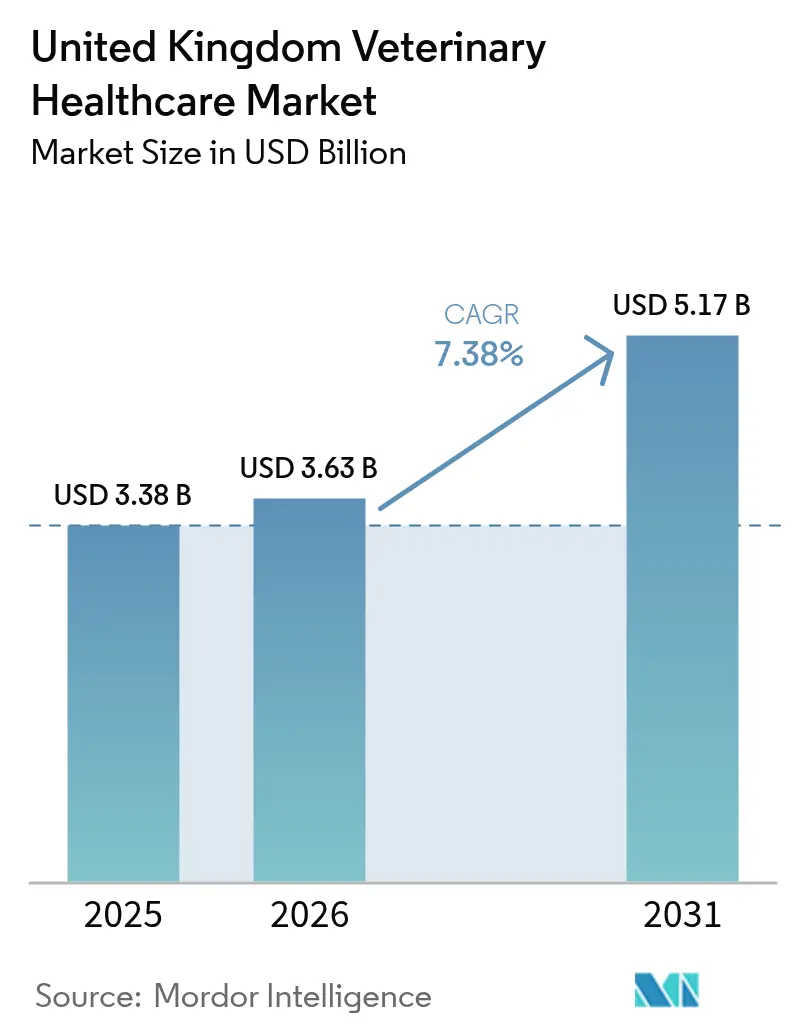
The United Kingdom veterinary healthcare market size was valued at USD 3.38 billion in 2025 and estimated to grow from USD 3.63 billion in 2026 to reach USD 5.17 billion by 2031, at a CAGR of 7.38% during the forecast period (2026-2031). Companion animal ownership has risen to 60% of households, a structural demand driver that cushions the market against Brexit-related supply realignments. Consolidation among practice groups strengthens purchasing power and accelerates technology adoption, yet it intensifies regulatory scrutiny aimed at protecting consumer choice. Rapid upgrades in point-of-care testing, artificial intelligence (AI) diagnostics and long-acting parasiticides elevate clinical standards while widening revenue streams for practices. Meanwhile, livestock operators expand biosecurity programs in response to repeated H5N1 alerts, anchoring steady volumes for vaccines and surveillance services.
Key Report Takeaways
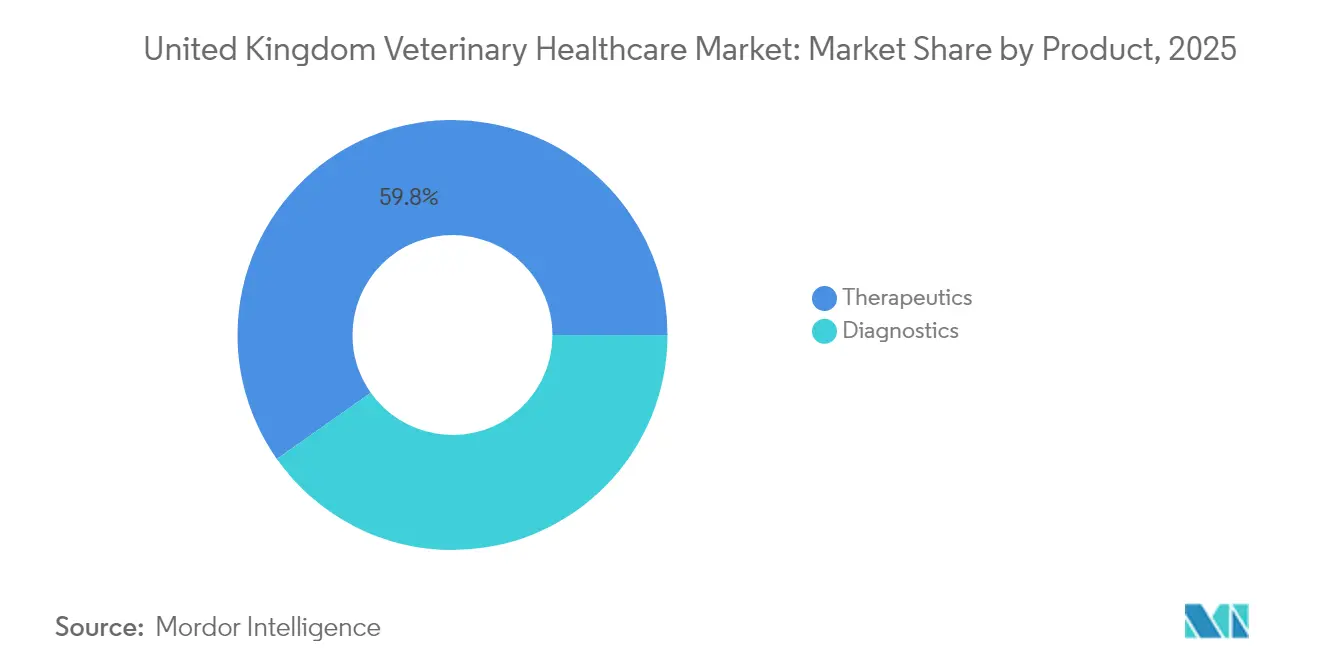
- By product, therapeutics led with 59.78% of the United Kingdom veterinary healthcare market share in 2025; diagnostics is forecast to register a 7.59% CAGR to 2031.
- By animal type, dogs and cats accounted for 44.86% of the United Kingdom veterinary healthcare market size in 2025, while poultry is advancing at an 7.93% CAGR through 2031.
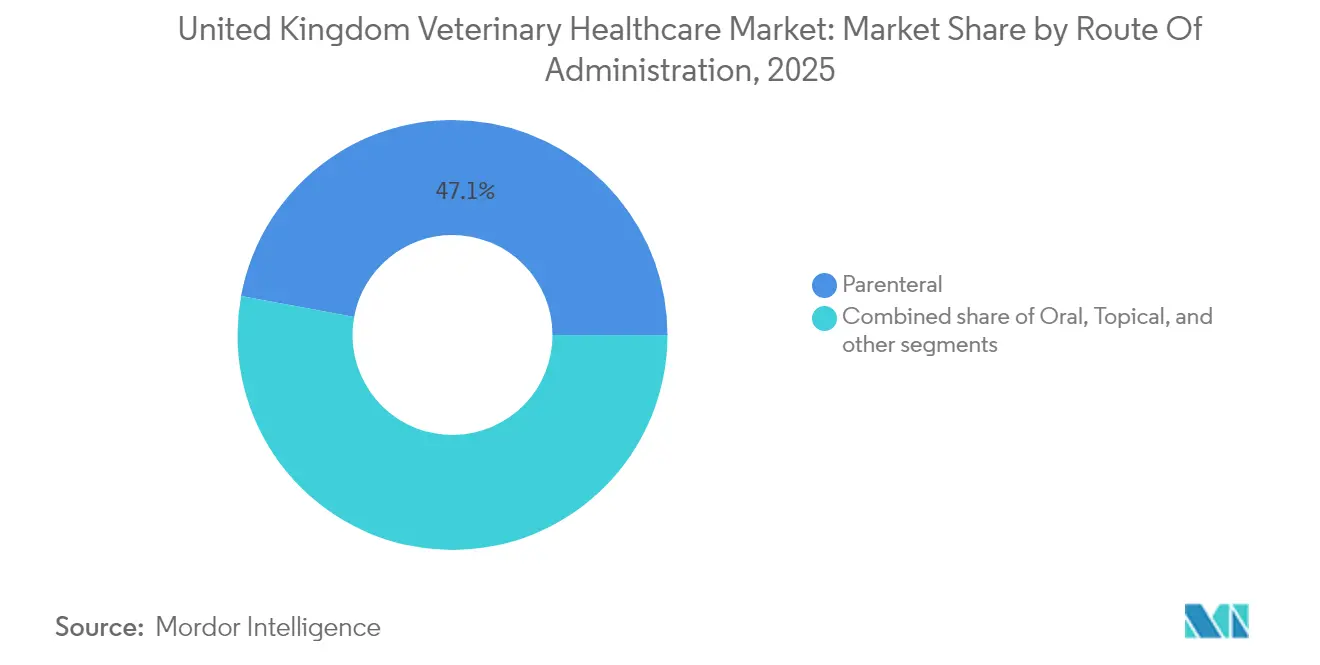
- By route of administration, parenteral delivery commanded 47.10% share of the United Kingdom veterinary healthcare market size in 2025; oral formulations are expanding at a 7.68% CAGR to 2031.
- By end user, veterinary hospitals and clinics held 55.88% revenue share in 2025, whereas point-of-care settings record the fastest projected CAGR at 8.43% to 2031.
Note: Market size and forecast figures in this report are generated using Mordor Intelligence’s proprietary estimation framework, updated with the latest available data and insights as of 2026.
United Kingdom Veterinary Healthcare Market Trends and Insights
Drivers Impact Analysis*
| Driver | % Impact on CAGR Forecast | Geographic Relevance | Impact Timeline |
|---|---|---|---|
| Technological advancements in veterinary therapeutics and diagnostics | +1.8% | UK-wide, strongest in urban hubs | Medium term (2-4 years) |
| Growing companion animal ownership and expenditure | +2.1% | UK-wide, highest in Southeast England | Long term (≥4 years) |
| Rising livestock health management needs amid zoonotic risks | +1.2% | Rural UK; Scotland, Wales focus | Short term (≤2 years) |
| Expansion of corporate veterinary practice networks | +1.5% | Major metropolitan areas nationwide | Medium term (2-4 years) |
| Increasing adoption of pet insurance and wellness plans | +1.3% | UK-wide, pronounced in London & Midlands | Medium–long term (3-5 years) |
| Government and regulatory support for One-Health initiatives | +1.0% | UK-wide, with public-sector concentration | Long term (≥4 years) |
| Source: Mordor Intelligence | |||
Technological Advancements In Veterinary Therapeutics and Diagnostics
AI-enabled platforms such as Zoetis’ Vetscan Imagyst now provide on-site cytology in minutes, freeing scarce clinicians for higher-value tasks and reducing diagnostic error rates. Portable infrared thermography and wearable sensors extend continuous monitoring for livestock, triggering early alerts that curb herd-level losses[1]UK Government, “Veterinary Medicines (Amendment etc.) Regulations 2024,” gov.uk. Integrated telemedicine portals tethered to in-clinic devices foster hybrid workflows that expand reach into rural communities. IDEXX’s inVue analyzer shows how modular chemistry, hematology and urinalysis stations compress full laboratory capability into countertop space, enabling same-visit treatment decisions. Long-acting parasiticides such as MSD’s BRAVECTO chewable extend dose intervals to 12 weeks, reinforcing owner compliance while moderating antimicrobial use.
Growing Companion Animal Ownership and Expenditure
Seventeen-point-two million UK households housed a pet in 2024, with the dog and cat population growing by 1.5 million annually. Owners treat animals as family members, elevating demand for oncology, orthopedic and behavioral services once confined to human medicine. Men now account for 27% of adult-cat adoptions versus 18% for women, shifting product and service preferences toward technology-driven convenience[2]UK Pet Food, “Pet Population Survey 2024,” ukpetfood.org. Aged pets require chronic disease management, extending lifetime spend per animal. Emotional capital forged during pandemic lockdowns sustains willingness to finance premium diagnostics, fueling revenue beyond pure volume growth.
Rising Livestock Health Management Needs Amid Zoonotic Risks
The government raised its H5N1 pandemic threat rating to Level 4 in 2024, reinforcing the strategic link between animal and public health. Farm health planning adoption jumped to 73% of holdings, and 85% of those plans were veterinarian-led, up from 65% in 2012. Tight movement controls under the Bluetongue Disease Framework require veterinary certification, increasing on-farm service frequency. Northern Ireland’s dependence on medicines registered in Great Britain compels localized supply solutions to maintain welfare standards amid Brexit-driven distribution frictions.
Expansion Of Corporate Veterinary Practice Networks
Corporate ownership grew from 10% of practices in 2013 to nearly 60% by 2024, catalyzing a Competition and Markets Authority (CMA) investigation into pricing transparency. Mars Petcare’s 2025 purchase of Linnaeus adds referral depth to its first-opinion network, illustrating multilevel integration strategies. CVS Group’s 458-site footprint delivers USD 647.3 million revenue, demonstrating the scale economies that support advanced imaging and specialized surgery investments. Centralized procurement and standard protocols boost clinical consistency, yet the CMA warns of potential consumer harm where local competition erodes.
Restraints Impact Analysis*
| Restraints Impact Analysis | (~) % Impact on CAGR Forecast | Geographic Relevance | Impact Timeline |
|---|---|---|---|
| Escalating cost of veterinary services and products | -1.4% | UK-wide, most acute in large cities | Short term (≤2 years) |
| Limited availability of skilled veterinary professionals | -1.1% | Rural UK; Northern England, Scotland | Medium term (2-4 years) |
| Prevalence of counterfeit and sub-standard medicines | -1.0% | Online and informal supply channels nationwide | Short term (≤2 years) |
| Market consolidation impacting supplier bargaining power | -0.8% | UK-wide, especially corporate practice clusters | Medium term (2-4 years) |
| Source: Mordor Intelligence | |||
Escalating Cost of Veterinary Services and Products
Average veterinary invoices have climbed 60% since 2014, amplifying affordability barriers that push some owners to postpone treatments. The Dogs Trust reports clients weighing elective care against budget constraints, signaling elastic demand that could temper overall growth. Forty percent of clinic employees say revenue targets sway clinical decisions, fueling CMA scrutiny. IDEXX noted a 2.1% dip in visit frequency in 2024 despite value gains, highlighting price sensitivity in preventive care segments.
Limited Availability of Skilled Veterinary Professionals
EU-sourced veterinarian registrations fell 68% between 2019 and 2021, tightening labor supply. The Food Standards Agency warns public safety inspections are understaffed, with only one UK national among 30 veterinarians in Food Standards Scotland[3]Food Safety Magazine, “Veterinary shortage threatens inspections,” foodsafetymagazine.com. A new school at Scotland’s Rural College will expand graduate output, yet near-term shortages force practices to cut hours or decline cases, especially in remote areas.
*Our forecasts treat driver/restraint impacts as directional, not additive. The impact forecasts reflect baseline growth, mix effects, and variable interactions.
Segment Analysis
By Product: Diagnostics Drive Innovation Despite Therapeutic Dominance
Therapeutics generated 59.78% of United Kingdom veterinary healthcare market share in 2025, reflecting entrenched demand for vaccines, parasiticides and anti-infectives. Diagnostics is growing at a 7.59% CAGR as point-of-care devices and AI analytics shorten the path from sample to therapy. Immunodiagnostics dominate revenue today, while molecular assays scale rapidly for resistance profiling. Portable ultrasound and digital radiography embed in primary care, replacing referrals and unlocking ancillary fees. Within therapeutics, vaccine uptake accelerates on heightened biosecurity awareness, whereas antimicrobial-laden feed additives face regulatory headwinds, nudging manufacturers toward precision nutrition alternatives.
Investment in diagnostics aligns with evidence-based protocols that lower drug overuse and improve outcomes, further anchoring recurring consumables revenue. AI platforms classify cytology slides in under eight minutes, enabling same-day oncology interventions. As practice groups aggregate, bulk procurement of analyzers lowers per-test costs, widening access to advanced assays even in mid-tier clinics.



By Animal Type: Companion Animals Lead While Poultry Accelerates
Dogs and cats accounted for 44.86% of United Kingdom veterinary healthcare market size in 2025, supported by 13.5 million dogs and 12.5 million cats needing routine, emergency and specialty care. Poultry is projected to expand at an 7.93% CAGR as stringent avian influenza surveillance heightens veterinary oversight across commercial flocks. Equine demand remains stable, fueled by sports and leisure riding, while ruminant health programs gain traction under climate-adaptation pressures. Swine operators adopt modern traceability, yet African swine fever vigilance keeps veterinary certification volumes high.
Pet humanization drives uptake of chemotherapy, MRI scans and behavioral therapies, elevating average spend per visit. Poultry producers embed veterinarians in biosecurity governance, reducing downtime costs from disease outbreaks. Cross-species H5N1 transmission to sheep in 2024 underlines growing need for multi-species surveillance frameworks.
By Route Of Administration: Oral Delivery Gains Despite Parenteral Leadership
Parenteral formats held 47.10% of United Kingdom veterinary healthcare market share in 2025, favored for rapid response in emergencies and mass immunizations. Oral products are progressing at a 7.68% CAGR as chewables and palatable tablets boost owner compliance. Topical innovations extend flea and tick control durations, while inhalation and implantable devices represent niches for chronic therapies. Long-duration molecules slash dosing frequency, lessening stress for pets and farm animals alike. In livestock, injectables retain primacy because uniform dosing ensures herd-wide protection during outbreaks.
Convenience-oriented owners endorse once-quarterly oral parasiticides that pair efficacy with ease, a model likely to migrate into preventive antibiotics should antimicrobial stewardship allow. Meanwhile, injectable formulations anchor large-animal procedures where precise dosing and rapid kinetics outweigh administration discomfort.
By End User: Point-Of-Care Testing Transforms Traditional Practice Models
Veterinary hospitals and clinics generated 55.88% revenue in 2025, spanning general practice, referral and emergency settings. Point-of-care facilities are forecast to clock an 8.43% CAGR, enabled by compact analyzers that slash turnaround from days to minutes. Reference laboratories keep relevance for complex assays such as PCR panels and histopathology, while academia supports evidence generation and specialist training.
In-house testing ecosystems tie hardware, reagents and cloud analytics, creating high-margin, recurring consumables streams. Corporate owners exploit volume discounts to outfit each site with integrated hematology, chemistry and urinalysis modules, standardizing protocols network-wide. Teleconsultation overlays permit specialists to review live data, widening geographic reach without physical expansion.
Geography Analysis
England, especially the Southeast, anchors companion-animal revenues, reflecting density of pet owners and strong disposable income. Scotland emphasizes livestock services; its new veterinary school addresses chronic workforce gaps and fosters research into food-animal medicine. Wales concentrates on sheep programs funded under endemic disease follow-up schemes, while Northern Ireland grapples with Brexit-linked supply risks because 85% of its animal medicines are registered in Great Britain. Rural regions nationwide face clinician shortages that constrain large-animal services despite rising demand. Urban clusters benefit from corporate consolidation, enabling MRI suites and 24-hour emergency centers, although price disparities widen between city and countryside.
The island nation’s natural sea borders aid biosecurity yet complicate logistics when outbreaks arise, necessitating swift import controls, as evidenced after Hungarian foot-and-mouth detections in 2024. Climate stresses hit southern counties first, lengthening parasite seasons and driving earlier vaccination cycles, whereas northern areas tackle respiratory issues in colder, wetter conditions.
Regulatory Landscape
Veterinary medicines regulation is led by the Veterinary Medicines Directorate (VMD), an executive agency of Defra, under the Veterinary Medicines Regulations framework. A key recent change is the Veterinary Medicines (Amendment etc.) Regulations 2024 (SI 2024/567), which came into force on 17 May 2024 and updated the 2013 Regulations for Great Britain, including time-bound transitional requirements such as VMD registration for manufacturers, importers, and distributors of active substances by 17 July 2024.
The UK operates with a dual regime due to the Windsor Framework, with EU veterinary medicines law continuing to apply in Northern Ireland while Great Britain follows the amended GB framework. This adds compliance steps for suppliers and distributors serving the full UK. Separately, Great Britain published its Multi-Annual National Control Plan (MANCP) for 2026 to 2030 (released 18 May 2026), reinforcing official-control priorities that shape surveillance and compliance activity across animal health value chains.
Competitive Landscape
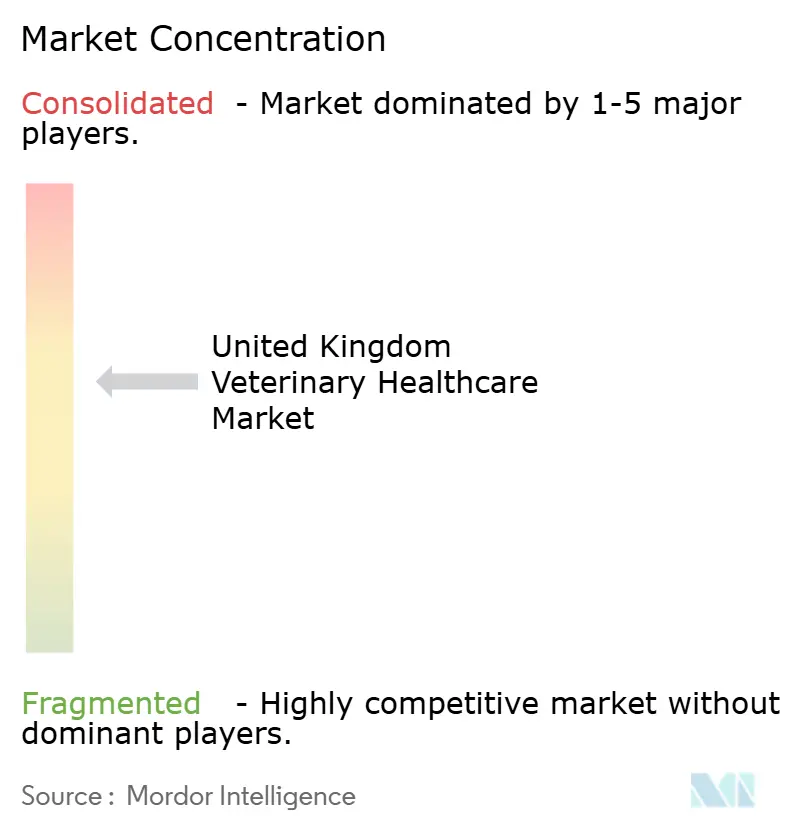
The market is moderately consolidated. CVS Group, IVC Evidensia, Pets at Home and Mars Petcare’s Linnaeus dominate corporate practice ownership, giving them leverage in procurement and tech deployment. Mars deepened its referral network in July 2025 via Linnaeus, combining oncology, neurology and cardiology specialists under one umbrella.
CVS invested in AI triage software and a home-delivery pharmacy, reinforcing seamless client experience. IVC Evidensia pilots mobile clinics to reach underserved rural zones. Diagnostic giants Zoetis and IDEXX partner with corporate chains to embed proprietary analyzers, locking in reagent revenues and data subscriptions.
Regulators intervene to keep pricing in check. The CMA’s ongoing investigation could mandate transparent fee disclosures and generic prescription options, potentially reshaping revenue models. Meanwhile, pharmaceutical players extend into services: MSD’s BRAVECTO marketing couples product with practice education, and Elanco aligns with Medgene on H5N1 vaccines poised for UK launch.
United Kingdom Veterinary Healthcare Industry Leaders
Boehringer Ingelheim
MSD Animal Health
Virbac Corporation
Ceva Santé Animale
Elanco Animal Health
- *Disclaimer: Major Players sorted in no particular order

Market Opportunities and Future Outlook
Regulatory scrutiny of veterinary services and medicine supply chains is creating near-term whitespace for solutions aimed at improving price transparency, prescribing choice, and auditable compliance workflows at practice level. The Competition and Markets Authority (CMA) published its final decision report on veterinary services in March 2026, and the resulting operating environment is pushing corporate groups and independent practices to standardize communications, invoicing, and clinical pathways. That, in turn, supports demand for practice software, pharmacy logistics, and diagnostic reporting that can withstand closer oversight.
On the production-animal side, the opportunity is strongest in turning mandatory reporting and surveillance inputs into higher-value decision support. In Scotland, the Pig Insights initiative (Scottish Pigs Ltd/ScotEID) completed an agricultural innovation project in April 2026 that applied AI and large language models to interpret veterinary notes alongside abattoir data for disease surveillance, illustrating a pathway from static compliance documentation to continuous intelligence. UK capability build-out around livestock vaccines is also advancing, including the Centre for Veterinary Vaccine Innovation and Manufacturing (CVIM) becoming operational at The Pirbright Institute, supporting innovation pathways for outbreak-driven demand in vaccines and related diagnostics.
Recent Industry Developments
- July 2026: AniVatio and Vetio UK signed an innovation partnership combining AniVatio’s oral gel delivery technology with Vetio UK’s formulation and manufacturing capabilities to develop pet supplements. The agreement expands CDMO-enabled routes to market for new companion-animal products and supports faster iteration on formats designed to improve owner compliance.
- February 2026: MSD Animal Health announced that the UK Veterinary Medicines Directorate approved NUMELVI (atinvicitinib) tablets for treating pruritus associated with allergic dermatitis in dogs. The approval widens options in specialty chronic care, where clinics differentiate through higher-value therapeutic pathways and follow-up monitoring.
- July 2025: Mars Petcare completed its acquisition of Linnaeus Group, adding referral centers and first-opinion sites to its UK network. The deal deepened vertically integrated service delivery across general practice and referral care, strengthening purchasing power and accelerating adoption of standardized diagnostics and treatment protocols across a larger footprint.


Research Methodology Framework and Report Scope
Market Definition and Coverage
This market tracks spending in the United Kingdom on veterinary therapeutics and diagnostics used to prevent, detect, and treat animal health conditions, as purchased and used through veterinary care and related channels.
Scope exclusions: We exclude human healthcare and non-UK revenue, and we also exclude general pet retail items that are not used as veterinary therapeutics or diagnostics.
Segmentation Overview
- By Product
- Therapeutics
- Vaccines
- Parasiticides
- Anti-Infectives
- Medical Feed Additives
- Other Therapeutics
- Diagnostics
- Immunodiagnostic Tests
- Molecular Diagnostics
- Diagnostic Imaging
- Clinical Chemistry
- Other Diagnostics
- Therapeutics
- By Animal Type
- Dogs & Cats
- Horses
- Ruminants
- Swine
- Poultry
- Other Animal Types
- By Route Of Administration
- Oral
- Parenteral
- Topical
- Other Route of Administrations
- By End User
- Veterinary Hospitals & Clinics
- Reference Laboratories
- Point-Of-Care / In-House Testing Settings
- Academic & Research Institutes
Data Sources, Market Sizing, and Validation
Desk Research
Desk research starts by pinning down the UK demand pool and the rules that shape it, since animal health demand is linked to regulation and clinical practice. We review public statistics and guidance from UK government animal health and veterinary medicines publications, Veterinary Medicines Directorate materials, and official trade or customs releases for imports and exports where relevant. We also use peer-reviewed veterinary journals to understand testing and treatment patterns, and association or professional-body websites to validate how care is delivered across clinics and hospitals.
To make the model practical, we add company annual reports, investor presentations, and credible press coverage to track shifts in product mix and pricing direction. When public reporting is thin, we use paid subscriptions for company financials and news intelligence, and we also reference patent databases to cross-check where diagnostics and therapeutics innovation is active. The sources listed here are illustrative only, and many other public documents and datasets are also reviewed for data collection, validation, and clarification.
Primary Interviews and Surveys
Primary work is used to pressure-test desk assumptions with people who see demand and pricing changes firsthand, and to close gaps that are hard to see in public data. We speak with a mix of manufacturers and distributors, veterinary hospitals and clinics, reference labs, and veterinary professionals across the UK, then reconcile differences in viewpoints before finalizing model inputs.
Distribution of primary research fieldwork respondents
| Company type | Respondent position |
|---|---|
| Top tier: 39% | CXOs: 13% |
| Mid tier: 44% | Functional/Unit leaders: 43% |
| Smaller Players: 17% | Managers: 44% |
Market-Sizing & Forecasting
Sizing is built using a top-down and bottom-up combination, where the top-down logic starts from the UK animal population and care utilization and then converts that demand pool into spending by applying product mix and pricing. In practice, prevalence and visit rates by major animal types are mapped to treatment intensity, and then split into therapeutics and diagnostics so each bucket can be modeled with the right drivers.
To keep the estimates grounded, we corroborate totals with selective bottom-up checks such as sampled price per test or treatment multiplied by estimated volumes, plus channel checks with clinics and labs to sanity-check year-to-year movement. Inputs include companion versus livestock mix, vaccine and parasiticide seasonality, adoption of in-house testing versus reference lab testing, procedure and visit volumes at clinics, and typical price progression for key diagnostic modalities. Where we cannot complete a bottom-up view for a sub-category, the gap is handled through penetration-rate assumptions that are validated in interviews and then aligned back to observed UK spending signals.
For forecasting, scenario analysis is used because veterinary demand and pricing can shift with cost inflation, staffing constraints, and disease events, and these factors are difficult to capture with a single fixed trend line. Variables are projected with interview-based consensus first, and then the market is rolled forward with sensitivity bands for utilization, mix, and pricing.
Data Validation & Update Cycle
Outputs are checked in multiple steps so that obvious breaks from real-world signals get caught early. We compare the model to independent indicators such as animal population trends, clinic activity signals, and the implied split between diagnostics and therapeutics, then investigate any sharp jumps before sign-off. When large variances show up by category or animal type, follow-up calls are triggered to re-check assumptions and confirm whether the change is real or a modeling artifact.
Reports are refreshed annually, and interim updates are made when material events occur, such as major regulatory changes or sudden shifts in testing and treatment demand. Before delivery, a final review pass is completed so clients receive the latest updated view of the market.
Mordor Intelligence's United Kingdom Veterinary Healthcare Market Market Size Compared With Other Published Estimates
Published market sizes for UK veterinary healthcare often do not match because groups count different buckets and they do not always start from the same demand signals. Differences show up most often around what is treated as veterinary services versus products, which animal types are fully counted, and whether values are reported in current or constant dollars.
The table shows a wide spread across published numbers, and in Mordor Intelligence's model the scope is limited to therapeutics and diagnostics used in veterinary healthcare, with totals anchored to animal-type demand and route-of-administration level mix rather than folding in broader clinic revenue. Another common gap driver is base-year choice and refresh timing, where faster updates can capture price inflation and testing uptake sooner, while slower refresh cycles may lag these shifts. Finally, some estimates apply aggressive growth paths for newer diagnostic modalities without confirming whether UK clinics have adopted them at the same pace.
Benchmark comparison
| Source | Market Size | Gaps in Research Methodology |
|---|---|---|
| Mordor Intelligence | USD 3.38 B (2025) | |
| Market Publisher A | USD 4.91 B (2024) | Uses a different base year and appears to apply a broader veterinary healthcare value pool, which can pull in adjacent service or care spending beyond therapeutics and diagnostics, thereby lifting the total. |
| Industry Research Group B | USD 1.53 B (2022) | Starts from an earlier base year and can understate later-period price and utilization changes, and the model assumptions may reflect a narrower treatment and testing intensity for the UK market. |
Taken together, the spread is mainly explained by scope boundaries, base-year timing, and how quickly pricing and testing adoption are updated. By keeping inputs traceable to animal demand signals and by validating mix and utilization with field checks, the estimate is easier to replicate and to use for planning.


Key Questions Answered in the Report
How large is the United Kingdom veterinary healthcare market in 2026?
It is valued at USD 3.63 billion, with a 7.38% CAGR projected through 2031.
Which product category is expanding fastest?
Diagnostics registers the highest growth at a 7.59% CAGR, outpacing therapeutics.
Why is poultry health spending rising quickly?
Sustained avian influenza surveillance and tighter biosecurity rules push poultry segment growth at an 7.93% CAGR.
What is driving the shift toward point-of-care testing in clinics?
Compact analyzers deliver lab-quality results in minutes, improving treatment speed and client satisfaction while generating recurring consumables revenue.
How is consolidation affecting vet service pricing?
Corporate practice ownership near 60% draws CMA scrutiny as fees rise, creating calls for greater transparency.
Page last updated on:




