
Veterinary Services Market Size and Share
Market Overview
| Study Period | 2020 - 2031 |
|---|---|
| Market Size (2026) | USD 134.96 Billion |
| Market Size (2031) | USD 170.99 Billion |
| Growth Rate (2026 - 2031) | 4.84 % |
| Fastest Growing Market | Asia Pacific |
| Largest Market | North America |
| Market Concentration | Medium |
Major Players *Disclaimer: Major Players sorted in no particular order Image © Mordor Intelligence. Reuse requires attribution under CC BY 4.0. | |
Veterinary Services Market Analysis by Mordor Intelligence
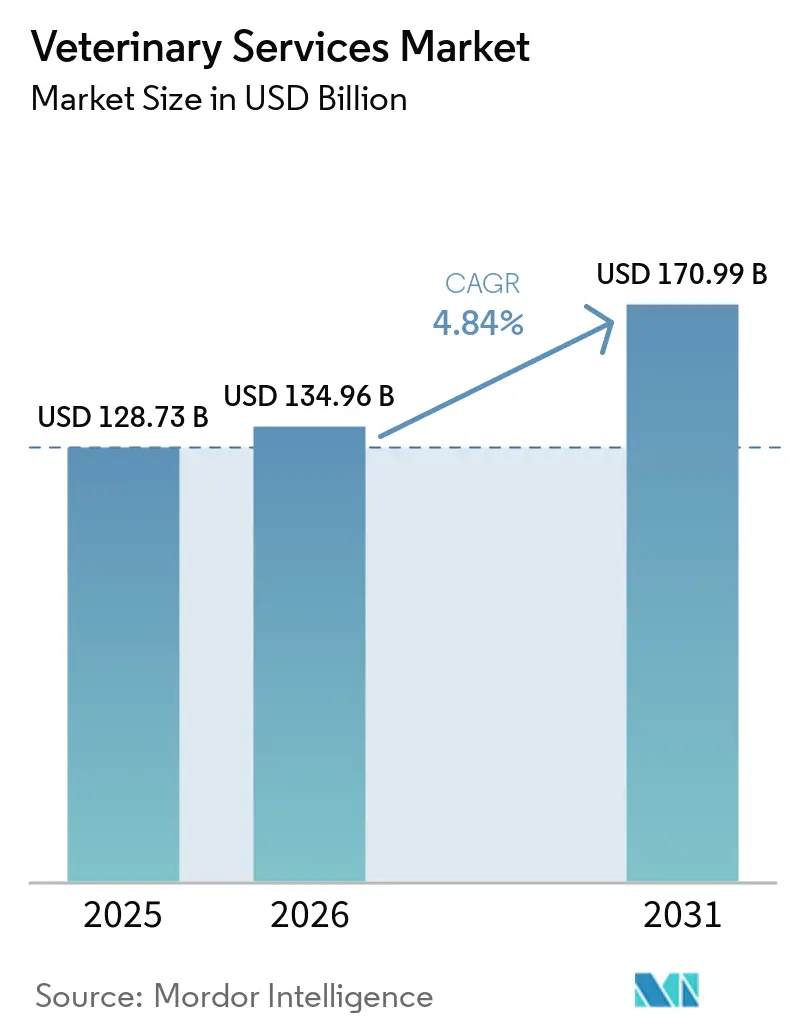
The veterinary services market size was valued at USD 128.73 billion in 2025 and estimated to grow from USD 134.96 billion in 2026 to reach USD 170.99 billion by 2031, at a CAGR of 4.84% during the forecast period (2026-2031). Healthy pet-owner spending, rapid technology adoption, and sustained corporate buy-outs keep the veterinary services market on an expansion path. Preventive medicine captures demand as households shift from episodic to continuous care, while artificial intelligence raises diagnostic throughput and supports busy clinicians. Private-equity and strategic buyers accelerate roll-up activity to secure scale economies, data assets, and talent pools. Demand also grows outside companion care: zoonotic-disease surveillance, livestock productivity mandates, and One-Health policy frameworks widen the revenue base of the veterinary services market.
Key Report Takeaways
- By service, preventive and wellness care led with 31.02% revenue share in 2025; tele-health and virtual care are projected to expand at a 6.45% CAGR through 2031.
- By animal type, companion animals accounted for 62.68% of the veterinary services market share in 2025; the same segment is set to post the fastest 6.63% CAGR by 2031.
- By provider ownership, corporate clinic chains held 40.92% of the veterinary services market in 2025, while mobile and house-call practices record the strongest 7.49% CAGR.
- By delivery mode, brick-and-mortar clinics maintained 73.58% share of the veterinary services market size in 2025; tele-consultation platforms will grow at 7.18% CAGR to 2031.
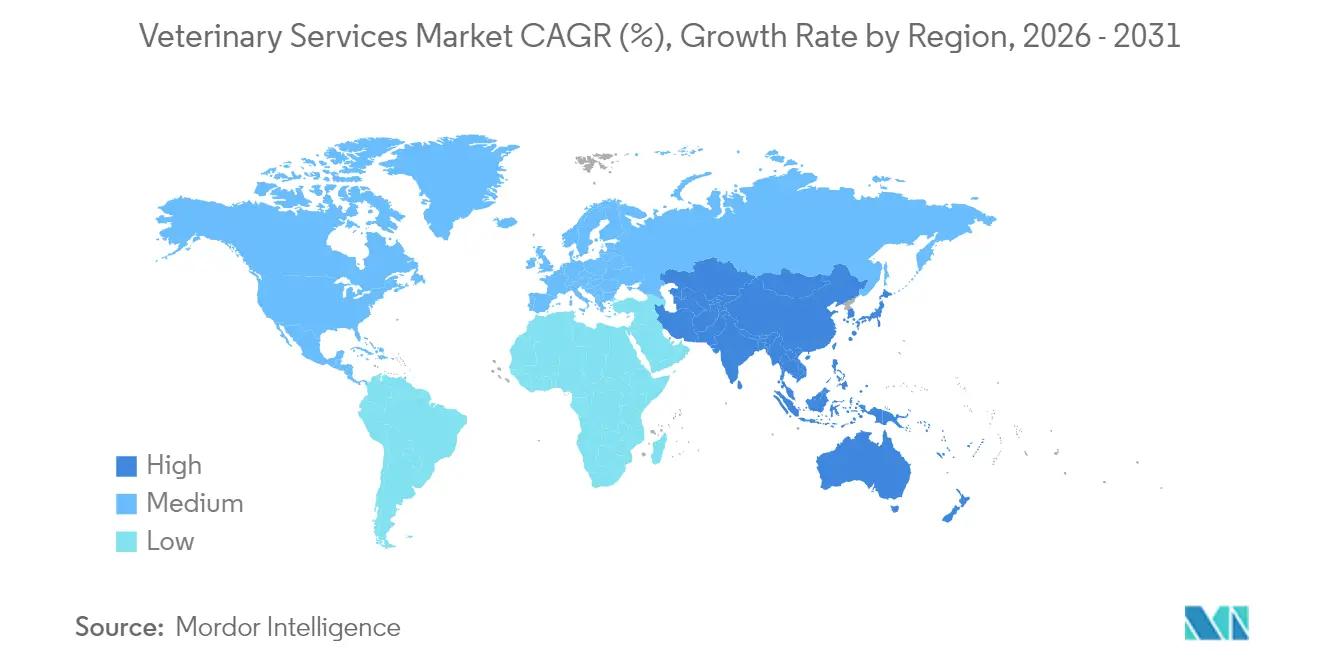
- Geographically, North America controlled 42.01% of the veterinary services market in 2025; Asia-Pacific is the fastest-growing region with a 5.57% CAGR through 2031.
Note: Market size and forecast figures in this report are generated using Mordor Intelligence’s proprietary estimation framework, updated with the latest available data and insights as of 2026.
Market Trends and Insights
Drivers Impact Analysis of Veterinary Services Market*
| Driver | % Impact on CAGR Forecast | Geographic Relevance | Impact Timeline |
|---|---|---|---|
| Rising Pet Ownership & Humanisation of Animals | +1.8% | North America & Europe (high), APAC (rising) | Long term (≥ 4 years) |
| Increasing Incidence of Zoonotic & Chronic Animal Diseases | +1.2% | Global; heightened focus in APAC & emerging markets | Medium term (2-4 years) |
| Growing Livestock Productivity & Food-Safety Requirements | +0.9% | APAC & South America agricultural hubs | Long term (≥ 4 years) |
| Expansion of Pet-Insurance Reimbursement Models | +0.6% | North America & Western Europe | Medium term (2-4 years) |
| AI-Enabled Triage & Diagnostics Boosting Clinic Capacity | +0.7% | North America & Europe initially, expanding to APAC | Short term (≤ 2 years) |
| Source: Mordor Intelligence | |||
Rising Pet Ownership & Humanisation of Animals
Pet ownership reached 94 million U.S. households in 2025, up from 56 million in 2011, and Generation Z now represents the fastest-growing cohort of new owners[1]American Pet Products Association, “2024–2025 National Pet Owners Survey,” americanpetproducts.org. This demographic expects oncology, cardiology, and behavioural therapies once reserved for human medicine. High-net-worth clients also purchase concierge plans that bundle genomic screening, nutrition counselling, and 24/7 tele-access to specialists. Such premiumisation strengthens cash-flow visibility across the veterinary services market while justifying equipment upgrades and specialist training.
Increasing Incidence of Zoonotic & Chronic Animal Diseases
The 2024 H5N1 influenza episode affected more than 800 U.S. dairy herds, with 66 confirmed human infections traced to animal exposure. Companion pets live longer, which increases chronic conditions: 73% of dogs and 64% of cats were diagnosed with dental disease in 2024. These dual pressures support sustained laboratory, imaging, and bio-security spending within the veterinary services market.
Growing Livestock Productivity & Food-Safety Requirements
USDA surveillance programs safeguard export credibility and detect antimicrobial resistance, reinforcing demand for herd-health consulting and vaccination campaigns. Low-income regions register lower vaccination rates, opening service-outsourcing opportunities for multinational providers. State-funded incentives, such as Virginia’s USD 110,000 grants for rural large-animal practice, aim to correct workforce gaps.
AI-Enabled Triage & Diagnostics Boosting Clinic Capacity
Thirty percent of veterinarians now deploy AI tools for imaging, cytology, and practice-management workflows. Solutions such as Vetscan Imagyst analyse slides in minutes, easing caseload spikes amid clinician shortages. Machine-learning models also forecast local disease outbreaks, allowing clinics to pre-position treatments, an efficiency dividend that strengthens the veterinary services market.
Restraints Impact Analysis of Veterinary Services Market*
| Restraints Impact Analysis | (~) % Impact on CAGR Forecast | Geographic Relevance | Impact Timeline |
|---|---|---|---|
| Global Shortage & Burnout of Veterinarians | -1.4% | Rural North America, APAC, parts of Europe | Medium term (2-4 years) |
| Escalating Cost of Advanced Procedures & Equipment | -0.8% | North America & Europe; urban APAC centers | Short term (≤ 2 years) |
| Regulatory Ambiguity on Cross-Border Tele-Veterinary Care | -0.5% | Europe (intra-EU), North America, APAC | Medium term (2-4 years) |
| Consumer Price-Sensitivity Causing Deferred Care | -0.4% | Global; strongest in emerging markets | Short term (≤ 2 years) |
| Source: Mordor Intelligence | |||
Global Shortage & Burnout of Veterinarians
Forecasts show a deficit of 70,092 veterinarians by 2032 versus only 52,926 graduates, a shortfall aggravated by student debt that averages USD 400,000[2]American Association of Veterinary Medical Colleges, “Workforce Demand Study 2025,” aavmc.org. Burnout exceeds 40%, and suicide risk remains elevated, pressuring clinic rosters in the veterinary services industry. Rural zones suffer most, with 243 U.S. counties classified as shortage areas in 2025.
Escalating Cost of Advanced Procedures & Equipment
Veterinary care prices climbed 7.6% between May 2023 and May 2025, far above general inflation. Capital-intensive MRI or CT units push independent practices toward corporate buyers or referral strategies. Sixty percent of owners cite affordability as the main barrier to care, curbing elective spending in parts of the veterinary services market.
*Our forecasts treat driver/restraint impacts as directional, not additive. The impact forecasts reflect baseline growth, mix effects, and variable interactions.
Veterinary Services Market Segment Analysis
By Service:
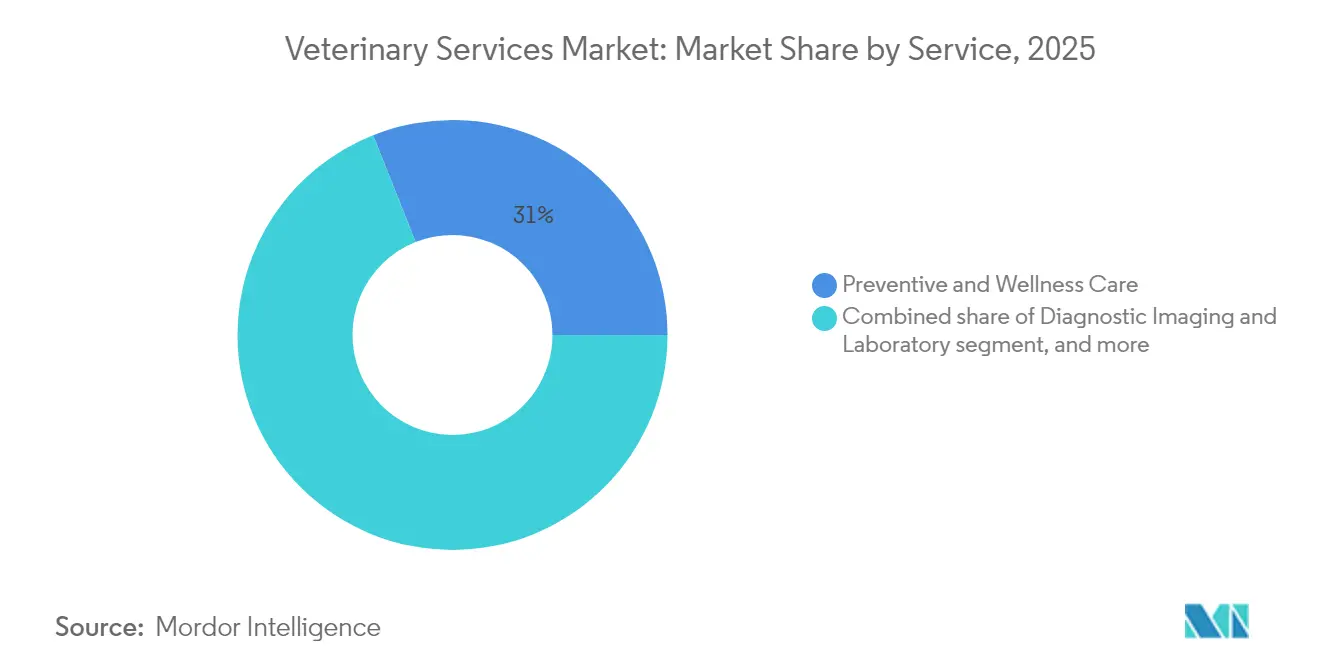
Preventive Care Dominance Drives Digital TransformationPreventive and wellness care captured 31.02% of 2025 revenue, anchoring the veterinary services market. Subscription wellness plans and annual health screens generate predictable margins, while pharmacy auto-refills deepen client stickiness. The veterinary services market size for tele-health is set to climb from USD 392.98 million in 2026 to USD 0.54 billion by 2031, a 6.45% CAGR. AI-enhanced imaging lifts throughput and supports surge capacity. Surgical demand stabilises as minimally-invasive techniques cut recovery time. Dental procedures remain lucrative, averaging USD 170-350 per case, and 73% of dogs need at least one intervention during their lifetime.
Diagnostic laboratories enjoy cross-selling with clinics, and e-prescribing platforms streamline drug compliance. Emergency and critical-care centres face labour constraints, prompting corporate groups to open 24-hour hubs linked by tele-ICU dashboards. Rehabilitation, acupuncture, and hydro-therapy gain traction as pets age, extending lifetime spending in the veterinary services market.



By Animal Type:
Companion Animals Lead Growth Amid Livestock Surveillance ExpansionCompanion animals constituted 62.68% of revenue in 2025 and will post the fastest 6.63% CAGR through 2031. Dogs continue as the largest sub-segment, with oncology and cardiology services mirroring human care protocols. Urban cat ownership rises among millennials and Generation Z, pushing demand for feline-only clinics. Equine medicine remains niche but commands high average transaction values for lameness diagnostics and sports-injury rehabilitation.
Production animals demand service integration after the H5N1 dairy-herd outbreak highlighted public-health risks. Cattle operators now purchase real-time monitoring and vaccine-compliance audits. Swine and poultry producers expand comprehensive bio-security packages, and aquaculture ventures request specialised health plans, both adding breadth to the veterinary services market. Small ruminants gain attention as consumers diversify protein sources, further widening the client base.
By Provider Ownership Structure:
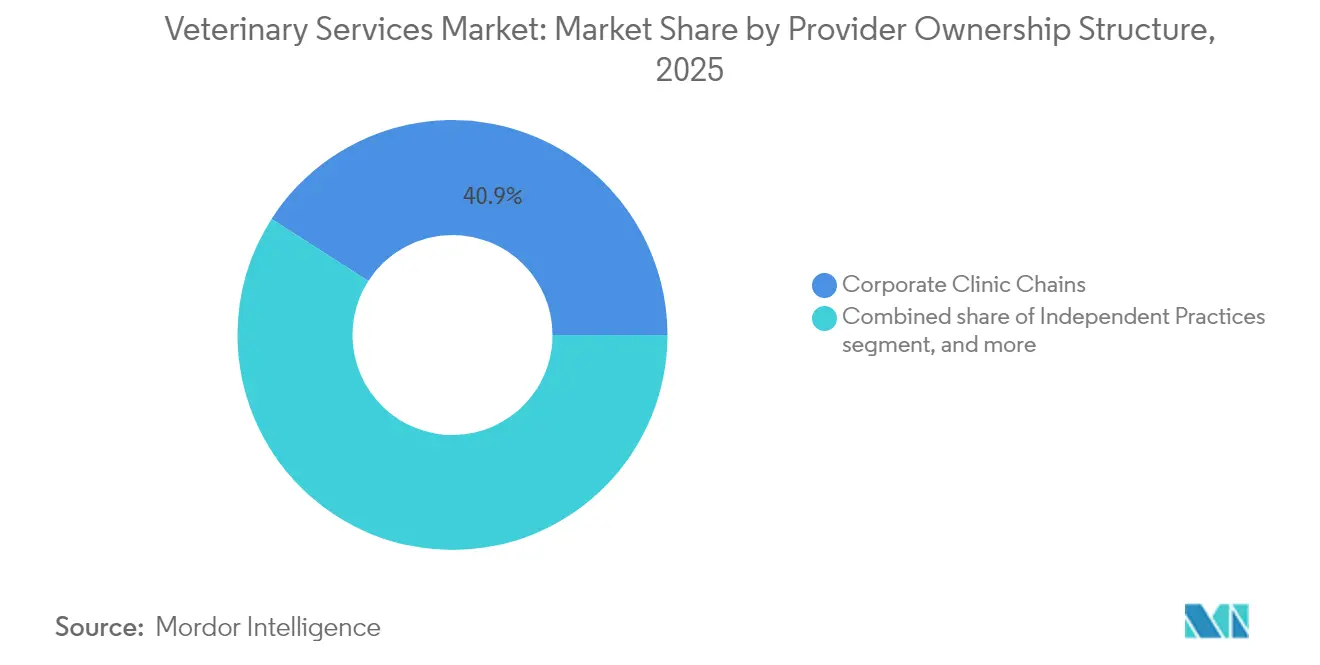
Corporate Consolidation Accelerates Amid Independent InnovationCorporate chains held 40.92% of 2025 revenue. Mars Incorporated alone operates nearly 3,000 clinics worldwide after absorbing VCA for USD 9.1 billion and later acquisitions. National Veterinary Associates split its specialty and general-practice businesses ahead of a possible IPO. Mission Veterinary Partners and Southern Veterinary Partners plan a merger covering 730 sites, a deal currently under antitrust review.
Mobile and house-call practices clock a 7.49% CAGR, appealing to time-pressed owners and clinicians seeking lifestyle balance. The Vets and BetterVet merger extended mobile reach to 30 cities, lifting the segment’s share of the veterinary services market. Universities and referral centres offer advanced modalities, such as interventional radiology, and act as talent incubators while generating premium caseloads.
By Delivery Mode:
Traditional Clinics Adapt While Digital Platforms SurgeBrick-and-mortar facilities still account for 73.58% of 2025 spending, supported by the hands-on nature of diagnosis and surgery. Yet the tele-consultation slice of the veterinary services market is growing at 7.18% CAGR. California’s Assembly Bill 1399 and similar rules in Colorado formalised virtual-care protocols and broadened technician duties, unlocking efficiencies. Wearables capture vitals, allowing remote monitoring between visits, and AI triage guides owners to in-person care when warranted.
Farm and mobile services bridge rural gaps, especially in shortage counties. Airvet raised USD 11 million to scale a virtual triage platform, seeking to mitigate an estimated 15,000 veterinarian deficit by 2030. Traditional clinics respond by extending hours, adding curbside drop-off, and embedding cloud practice-management to keep pace with the digital pivot.
Geography Analysis
North America Veterinary Services Market
North America retained 42.01% of global revenue in 2025. Mature insurance penetration, robust e-commerce pharmacy channels, and One-Health policy integration sustain premium-price elasticity. Multinational chains cluster around U.S. urban centres, and Canadian operators observe similar consolidation but tailor offerings to public-health mandates. Mexico’s rising middle class fuels double-digit pet-food growth, a signal of downstream service opportunity.
Europe Veterinary Services Market
Europe shows steady uptake. The United Kingdom’s Royal College of Veterinary Surgeons streamlines accreditation, facilitating cross-border clinician mobility. Germany and France invest in surveillance platforms that link animal and human epidemiological data. EQT’s acquisition of VetPartners indicates capital inflows aiming at clinic platform scaling across member states. Regulatory harmonisation for tele-medicine and prescription data interoperability aids clinic groups in capturing operational synergies across the veterinary services market.
APAC Veterinary Services Market
Asia-Pacific is the fastest-expanding zone at 5.57% CAGR. China’s pet-medical spend hit 1,062 billion yuan in 2024 and keeps rising despite fragmentation. India’s pet-food market is growing at 15.37% CAGR and pulls ancillary services such as dietetic consults and dermatology. Japan’s super-aging dogs spur demand for geriatric care, while South Korea pioneers AI algorithms for small-animal imaging. Australia’s clinic roll-ups attract European buyers hunting for exposure to a high-compliance market. Collectively, these dynamics enlarge the veterinary services market size for the region.

Regulatory Landscape
Regulatory landscape for veterinary services continues to be shaped by tighter animal health surveillance, governance for veterinary medicines, and rules for cross-border pet movement. In the European Union, Delegated Regulation (EU) 2026/1073, adopted March 2026, tightens rules for certain veterinary medicines and reinforces antimicrobial stewardship and biosecurity obligations.
Delegated Regulation (EU) 2026/131, effective 22 April 2026, standardised checks and recordkeeping for the non-commercial movement of pet animals. In the United States, the FDA Center for Veterinary Medicine continues operating fee-backed reviews via ADUFA and AGDUFA, with FY 2026 deadlines supporting ongoing regulatory oversight for animal drugs and generics. At the global level, WOAH advanced updates to the Terrestrial Animal Health Code during its 93rd General Session in May 2026, providing reference standards that feed into national disease-control and veterinary service frameworks.
Competitive Landscape
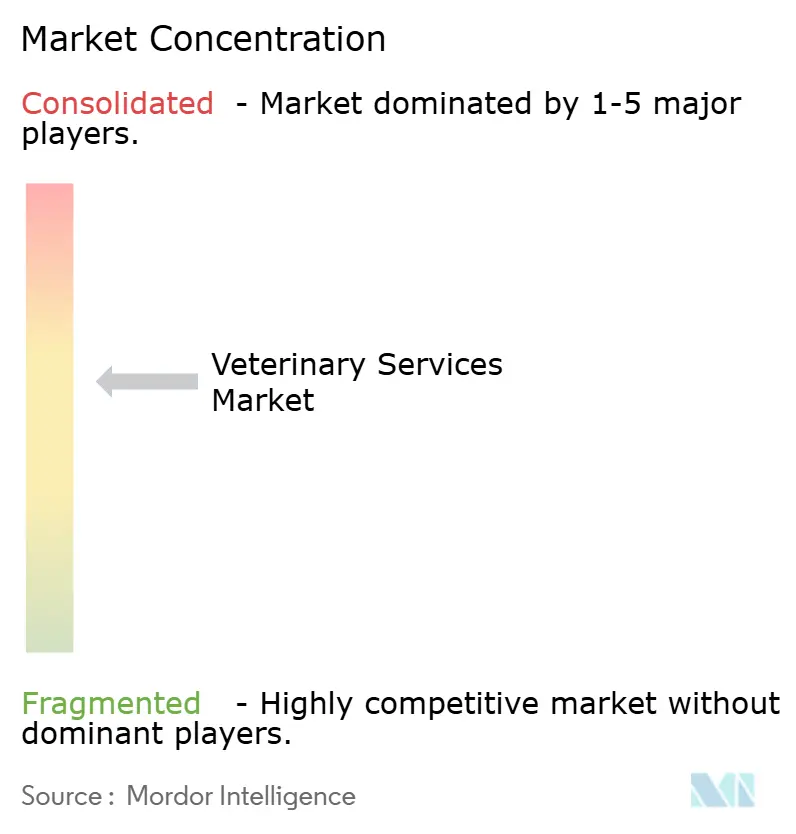
The veterinary services market shows moderate concentration and rising deal momentum. Mars Incorporated integrates pet food, diagnostics, and clinics, extracting scale benefits and data synergies. Private-equity ownership expanded from 8% of U.S. clinics in 2011 to nearly 50% by 2025, anchoring cost-of-capital advantages for serial acquirers. Covetrus was taken private for USD 4 billion, underscoring investor appetite for technology distributors. PE groups assemble regional networks, invest in AI workflow tools, and upgrade referral centres to protect margins.
White-space niches include mobile veterinary services, specialist dermatology, and rehabilitation, where smaller operators innovate without heavy fixed-asset burdens. The FDA’s Veterinary Innovation Program offers expedited pathways for software-as-a-medical-device, reducing regulatory friction. Corporate acquirers chase these assets to refresh growth and diversify against economic cycles. Despite consolidation, independent clinics still hold 51% of sites, leveraging personalised care and community ties.
The market therefore balances scale benefits with room for disruptors. AI and remote monitoring ease labour strain, but talent scarcity keeps salary inflation high. Consolidators will likely continue to pay premiums for top-tier clinics, sustaining a pipeline of exits for owner-founders and PE sponsors in the veterinary services market.
Veterinary Services Industry Leaders
Mars Inc.
National Veterinary Associates (NVA)
CVS Group PLC
IVC Evidensia
- *Disclaimer: Major Players sorted in no particular order
Veterinary Services Market Companies Covered in this Report
- Mars Inc. (VCA, Banfield, BluePearl)
- National Veterinary Associates (NVA)
- CVS Group
- IVC Evidensia
- Greencross Ltd
- Ethos Veterinary Health
- IDEXX
- Zoetis Services
- Elanco Animal Health Services
- Southern Veterinary Partners
- Thrive Pet Healthcare
- VetCor
- PetVet Care Centers
- Mission Veterinary Partners
- BlueRiver Pet Care
- FirstVet
- CityVet
- Armor Animal Health
- Kremer Veterinary Services
- I-Med Animal Referral Centers

Market Opportunities and Future Outlook
Evidence from 2026 indicates whitespace in scaling data-driven diagnostics, precision health, and capacity-building programs that target workforce and throughput constraints. Clinic demand is shifting toward continuous care models, supported by AI-enabled workflows in imaging, cytology, and practice management, with 30% of veterinarians using AI tools in imaging, cytology, and practice management.
A second opportunity is deeper integration with diagnostics, genomics, and supply-chain platforms that can make preventive care more measurable and repeatable across multi-site networks. In 2026, Zoetis announced definitive agreements to acquire Neogen's animal genomics business for USD 160 million and to acquire VitalRADS in July 2026 to strengthen diagnostic offerings, while Elanco launched Elanco Ventures with USD 25 million in June 2026 to accelerate early-stage innovation that can be commercialized through veterinary channels. Public-sector and national programs also create partnership lanes for vaccination and surveillance readiness, including Saudi Arabia's MoU in June 2026 to develop the AniVax vaccine manufacturing hub in Sudair Industrial City with Phase 1 capacity of 50 to 100 million doses annually, supporting regional biosecurity and demand for related veterinary services.
Recent Industry Developments in Veterinary Services Market
- July 2026: Zoetis announced the acquisition of VitalRADS to strengthen diagnostic offerings. The acquisition broadens Zoetis' diagnostics portfolio, supporting imaging-guided workflows across multi-site networks.
- June 2026: Elanco launches Elanco Ventures with USD 25 million multi-year commitment to accelerate early-stage innovation that can be commercialized through veterinary channels. The program lines up with ongoing investment in digital health and diagnostics across the network.
- March 2026: Zoetis announced definitive agreements to acquire Neogen's animal genomics business for USD 160 million. The deal expands Zoetis' genomics-enabled diagnostics capabilities and data-driven testing across global networks.


Veterinary Services Market Report Scope and Research Methodology
Market Definition and Coverage
For this study, the veterinary services market includes paid services delivered by licensed veterinary professionals to support animal health and welfare across companion and farm animals, covering routine visits through complex care.
Scope exclusions: Retail-only pet products and nutrition sold without a veterinary service, along with non-veterinary grooming and boarding, are treated as out of scope unless bundled and billed as part of a veterinary care visit.
Segments Covered in This Report
- By Service
- Surgery
- Diagnostic Imaging & Laboratory
- Preventive & Wellness Care
- Emergency & Critical Care
- Tele-health & Virtual Care
- Rehabilitation & Physiotherapy
- Dentistry
- Pharmacy & Prescription Management
- By Animal Type
- Companion Animals
- Dogs
- Cats
- Horses & Equine
- Production / Farm Animals
- Cattle & Buffalo
- Swine
- Poultry
- Small Ruminants
- Aquaculture Species
- Companion Animals
- By Provider Ownership Structure
- Independent Practices
- Corporate Clinic Chains
- Mobile / House-call Practices
- University & Referral Hospitals
- By Delivery Mode
- In-Clinic (Brick & Mortar)
- Mobile / On-farm
- Tele-consultation Platforms
- Geography
- North America
- United States
- Canada
- Mexico
- Europe
- Germany
- United Kingdom
- France
- Italy
- Spain
- Rest of Europe
- Asia-Pacific
- China
- Japan
- India
- Australia
- South Korea
- Rest of Asia-Pacific
- Middle East & Africa
- GCC
- South Africa
- Rest of Middle East & Africa
- South America
- Brazil
- Argentina
- Rest of South America
- North America
Data Sources, Market Sizing, and Validation
Desk Research
Desk research was used to set the fact base for animal populations, care utilization, and the operating footprint of clinics and hospitals. Public sources such as the US Bureau of Labor Statistics (employment and wage data), USDA (livestock counts and animal health programs), World Organisation for Animal Health (standards and disease reporting), and FAO (production animal indicators) helped us align demand signals with real-world animal care needs.
We also reviewed state and national veterinary association publications, peer-reviewed journals on clinical and preventive care trends, and company filings and investor presentations from service providers where available. To keep assumptions grounded, we cross-checked pricing and volume direction with reputable press coverage and a paid subscription used for company financials and news context, plus patent databases to sense diagnostic and workflow change. These examples are not exhaustive, and many other public sources were also used for data collection, validation, and clarification.
Primary Interviews and Surveys
Primary work focused on testing the service mix, visit frequency, and pricing movement across clinic types, including general practice, specialty, and emergency settings. We spoke with practice owners, hospital administrators, veterinarians, and supporting leaders across APAC, EMEA, and the Americas to confirm how preventive care adoption, staffing constraints, and diagnostics intensity are shaping revenue capture in day-to-day operations.
Distribution of primary research fieldwork respondents
| Company type | Respondent position | Region |
|---|---|---|
| Top tier: 28% | CXOs: 15% | APAC: 39% |
| Mid tier: 56% | Functional/Unit leaders: 26% | EMEA: 36% |
| Smaller Players: 16% | Managers: 59% | Americas: 25% |
Market-Sizing & Forecasting
Sizing starts with a top-down build where animal population and care utilization are translated into an addressable demand pool, which is then converted to spend using service intensity and average price points by region. In practice, the model uses a small set of repeatable inputs, such as companion and farm animal population levels, annual visit rates, share of visits that include diagnostics or surgery, typical procedure and consultation pricing, staffing availability (veterinarian and technician density), and the pace of preventive and chronic care uptake.
To make sure the totals do not drift, we corroborate the outputs with selective bottom-up approximations, such as rolling up sampled clinic revenue ranges, applying typical revenue per veterinarian, and using channel checks on price lists and service bundles. Where coverage gaps exist, like limited public visibility on independent clinics in certain countries, we apply conservative utilization and pricing proxies and then re-test them during interviews. Forecasting relies on scenario analysis, where macro factors and clinic capacity constraints are combined with expected pet ownership and livestock productivity needs, and then adjusted using what practitioners expect for pricing and case mix over the next few years.
Data Validation & Update Cycle
Validation is done through several checks so the numbers stay realistic at country and regional levels. We compare implied spend per animal, revenue per practice professional, and year over year price movement against independent signals from public statistics and what respondents report, and then we investigate outliers before final sign-off. If a key assumption changes, like sudden staffing shifts, policy updates, or a demand shock from disease events, the team triggers a re-contact loop with relevant experts to confirm the direction and size of impact.
Reports are refreshed on an annual schedule, and interim updates are made when material events meaningfully change the outlook. Before delivery, the model receives a final review pass so clients are not reading outdated estimates.
Mordor Intelligence's Veterinary Services Market Size Measured Against Other Published Estimates
Published market sizes for veterinary services often look different because each publisher draws the line around what counts as a service, which year is used as the anchor, and how prices and visit volumes are moved forward.
The benchmark table shows a noticeable spread, and in Mordor Intelligence's model the scope is tied to veterinarian-delivered services (including diagnostics, surgery, hospitalization, dentistry, and related in-clinic care) instead of folding in broader retail-only pet spending or loosely defined non-medical add-ons, which can inflate totals when mixed into the same revenue pool.
Benchmark comparison
| Source | Market Size | Gaps in Research Methodology |
|---|---|---|
| Mordor Intelligence | USD 134.96 B (2026) | |
| Industry Publisher A | USD 164.50 B (2025) | Uses an earlier base year and appears to apply a wider services boundary that can blend veterinary practice revenue with adjacent spend categories, which pushes the total upward even before forecasting assumptions are applied. |
| Industry Publisher B | USD 145.65 B (2024) | Anchors the estimate to a different year and assumes faster price and service intensity expansion, which can lift the starting value and the growth path when compared with a model that separates core clinical services from non-core spend. |
Reading the table as a whole, the gaps mostly come from year selection, what is treated as billable veterinary care, and how quickly pricing and visit intensity are assumed to rise. By keeping inputs linked to observable utilization and common procedure pricing, we can offer a clear number that is easier to trace back to practical demand drivers.


Key Questions Answered in the Report
What is the current size of the veterinary services market?
The veterinary services market is valued at USD 134.96 billion in 2026.
How fast is the veterinary services market expected to grow?
The market is projected to expand at a 4.84% CAGR, reaching USD 170.99 billion by 2031.
Which service segment holds the largest share?
Preventive and wellness care led with 31.02% of revenue in 2025.
Why is Asia-Pacific the fastest-growing region?
Urbanisation, rising disposable incomes, and shifting cultural attitudes toward companion animals drive a 5.57% CAGR in Asia-Pacific.
How is artificial intelligence influencing veterinary care?
Thirty percent of veterinarians already use AI to accelerate imaging interpretation, cytology analysis, and workflow management, improving capacity amid workforce shortages.
What challenges could slow market growth?
An acute veterinarian shortage and rising treatment costs could limit clinic capacity and suppress demand in certain demographics.
Page last updated on:


 Your data is secure and never sold or shared.


