
Sunflower Meal Market Size and Share
Sunflower Meal Market Analysis by Mordor Intelligence
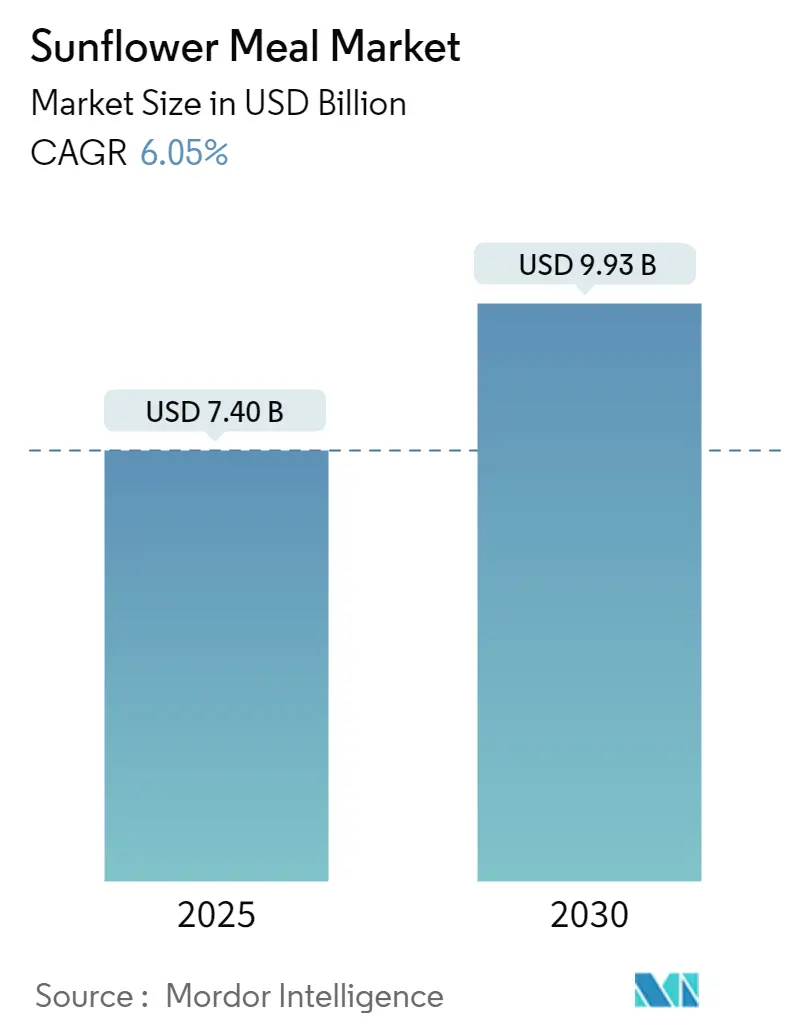
The Sunflower Meal Market size is estimated at USD 7.40 billion in 2025, and is expected to reach USD 9.93 billion by 2030, at a CAGR of 6.05% during the forecast period (2025-2030).
Sunflower meal, a byproduct of sunflower seed crushing for oil extraction, has gained significant importance in recent years due to increasing demand from the livestock, dairy, and aquaculture industries. This meal, obtained after oil extraction, contains a high protein percentage ranging from 28% for meals from hulled seeds to 42% for dehulled seed meals according to the National Institutes of Health, United States. It is primarily used in livestock and poultry feed rations. The high protein content makes sunflower meal an excellent livestock feed, particularly for ruminants. Low-fiber and higher-protein sunflower meals are also suitable for poultry and swine feeding. The widespread use of sunflower meals in various animal feeds is anticipated to drive its consumption globally. For instance, according to the US Department of Agriculture, India's consumption of sunflower seed meals increased to 265 thousand metric tons in 2022, a 44.8% increase from the previous year.
Sunflower meal is the fourth largest oilseed meal produced and consumed worldwide, following soybean, rapeseed, and cottonseed oil extraction and it is also the third largest source of protein supplement used for livestock, behind soybean and rapeseed (canola) meals, as reported by the United States Department of Agriculture. The availability and competitiveness of sunflower meals are anticipated to remain high, potentially limiting the growth in feed use of soybean meal, although soybean meal usage is still anticipated to increase. The use of sunflower meals in animal feed is driven by its cost-effectiveness. As a byproduct of oil extraction, it is often available at a lower cost compared to other protein sources such as soybean meal. This makes it an attractive option for feed manufacturers and livestock producers seeking affordable protein sources for animals.
Additionally, the global increase in animal meat consumption is raising concerns about sustainable animal feed solutions, further supporting the sunflower meal market. For instance, according to the Food and Agriculture Organization, the per capita meat consumption in Mexico increased from 14.77 kg in 2022 to 15.02 kg in 2023. Furthermore, the USDA reported that feed production in Mexico rose from 41.5 million metric tons in 2022 to 43.0 million metric tons in 2023, indicating a steady increase in feed demand. The increasing usage, low costs, and high protein content are anticipated to support the market during the forecast period.
Global Sunflower Meal Market Trends and Insights
Growing Sunflower Production and Import
Sunflower cultivation is experiencing significant growth worldwide, driven by increasing demand for various sunflower products, including sunflower meal. Sunflower’s resilience to diverse climatic conditions and high yields make it a preferred crop for farmers across Europe, North America, and parts of Asia.
Governments are actively promoting sunflower production. In India, the Indian Council of Agricultural Research (ICAR) has initiated a project on "Revival of sunflower cultivation." Sanctioned by the Department of Agriculture & Farmers Welfare, this three-year project (2022-23 to 2024-25) aims to expand cultivation area, improve productivity and profitability, and enhance capacity building in India's sunflower sector.
In Tanzania, the President directed officials in the northwestern Kagera region to allocate between 70,000 and 100,000 hectares for large-scale sunflower cultivation in June 2022. Russia and Ukraine lead global production, accounting for over 50% of sunflower seed output, according to the Food and Agriculture Organization (FAO). This dominance solidifies their position as leading exporters in the global supply chain. In the Asia-Pacific region, China, Turkey, and Kazakhstan are the top producers, with outputs of 2.93, 2.55, and 1.30 million metric tons respectively in 2022, according to FAOSTATS data.
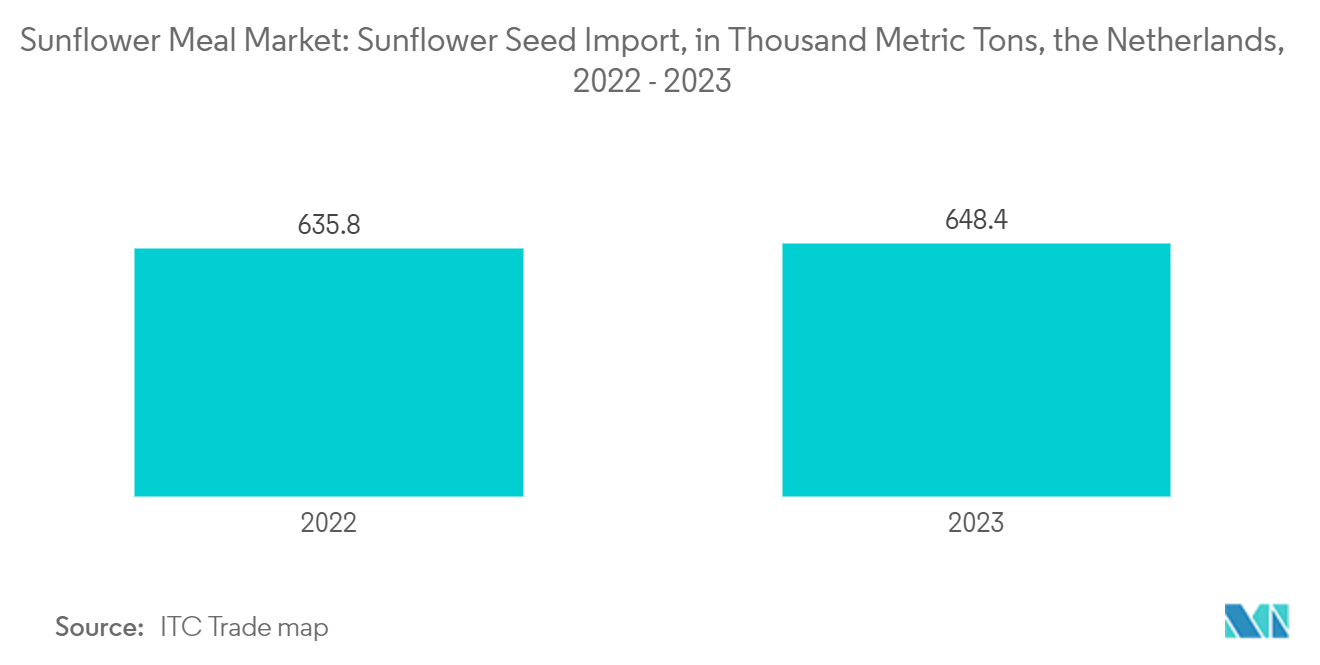
The increasing import of sunflower seeds is a significant trend driven by rising global demand for sunflower meal. Countries with limited domestic production are increasingly relying on imports to meet their consumption needs. In 2023, Turkey, the Netherlands, and Hungary were the major importers of sunflower seeds, importing 745.9, 648.4, and 357.5 thousand metric tons respectively, according to ITC Trade Map. Also, Netherlands saw a 1.9% increase in sunflower seed imports from 2022 to 2023, as per the data of the ITC Trade Map.
The growing global cultivation and import of sunflower seeds are shaping the sunflower meal market as a critical component of the animal feed sector. This trend is anticipated to drive market growth in the forecast period.


Europe Dominates the Sunflower Meal Market
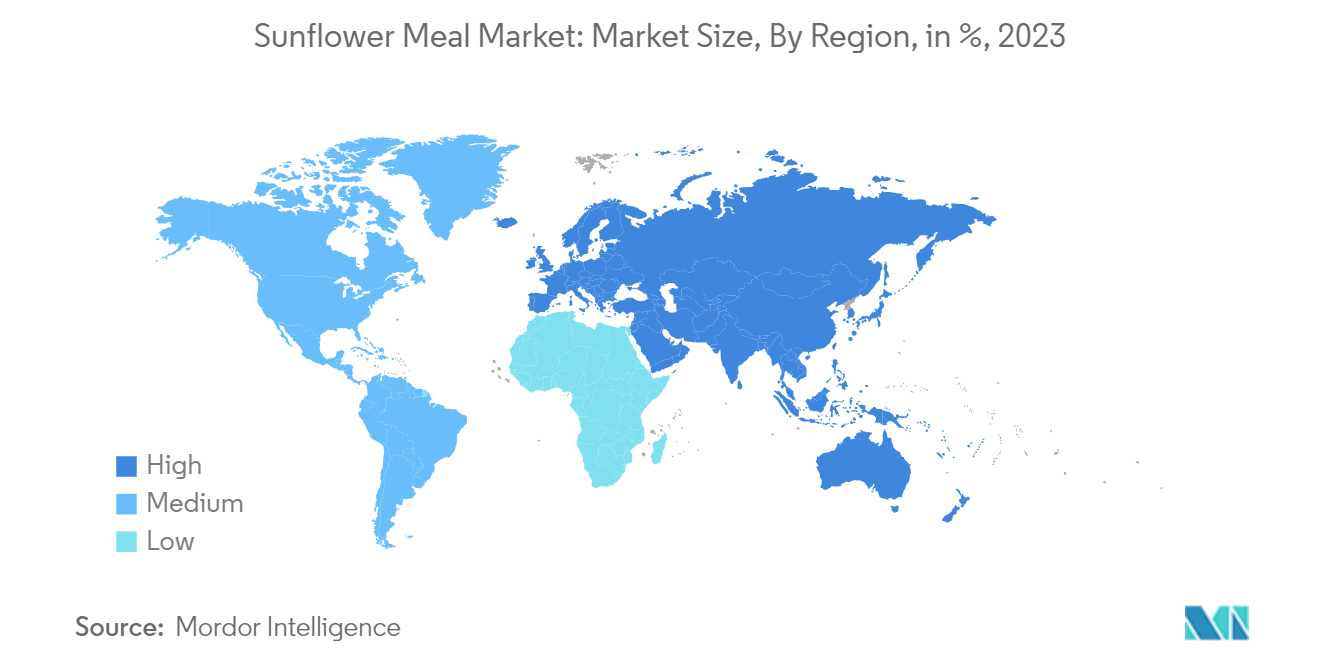
Europe stands as a major producer and consumer of sunflower meal, with the product widely used in the livestock industry as a protein source for animal feed, particularly for poultry, pigs, and cattle. Its nutritional value and cost-effectiveness compared to other protein sources make it a crucial ingredient in animal diets. The increasing meat consumption and livestock production in Europe have driven up the demand for sunflower meal. For example, the European Commission reported that per capita poultry meat consumption in Europe rose from 23.4 kilograms in 2022 to 23.7 kilograms in 2023, supporting the feed industry and contributing to market growth.
European countries such as Ukraine, Russia, France, Romania, and Bulgaria are among the leading sunflower meal producers in the region. These nations benefit from favorable climates for sunflower cultivation and well-established agricultural sectors, significantly contributing to the production and export of sunflower meal within Europe and to international markets. The USDA reported that sunflower seed production in the European Union increased from 9.39 million metric tons in 2022-2023 to 10.13 million metric tons in 2023-2024, attributed to favorable climatic conditions.
Europe's sunflower seed meal export volumes are increasing annually. According to the ITC Trade Map, Russia's sunflower meal exports grew from 1.59 million metric tons in 2022 to 1.64 million metric tons in 2023. Similarly, according to ITC Trade Map data, Ukraine's export quantity rose from 3.28 million metric tons in 2022 to 3.92 million metric tons in 2023. This export growth reinforces Europe's position as a leading region in the sunflower meal market. Additionally, the increased production in the region is supporting parallel growth in sunflower meal consumption. The US Department of Agriculture reported that sunflower seed meal consumption in Russia increased from 3.9 million metric tons in 2022 to 4.1 million metric tons in 2023. The high production, export volumes, and demand for sunflower meal in European countries are driving consumption, thus supporting market growth during the forecast period.

Recent Industry Developments
- July 2022: Black Sea grain initiative was made between, Ukraine, Russia, Turkey, and United Nations to facilitate the smooth flow of exports from other countries to Ukraine. This agreement also includes the export of 51% corn, 27% wheat, 5% sunflower, 5% sunflower meal, and 12% other ports to the Ukrainian ports until April 2023.
- June 2022: In Tanzania, the President directed officials in the northwestern Kagera region to allocate between 70,000 and 100,000 hectares for large-scale sunflower cultivation. This initiative aims to boost sunflower meal production in the country.
- May 2022: The Ministry of Agriculture and Farmers Welfare, Government of India, implemented initiatives to expand sunflower cultivation areas from 2022 to 2025. This expansion led to increased sunflower meal production, contributing to market growth.


Global Sunflower Meal Market Report Scope
Sunflower meal is the by-product obtained after the extraction of oil from sunflower seeds. They can be made from whole or decorticated seeds and can be mechanically and/or solvent-extracted. The Sunflower Meal Market is segmented by Geography (North America, Europe, Asia-Pacific, South America, and Middle East & Africa). The report includes Production Analysis (Volume), Consumption Analysis (Value and Volume), Export Analysis (Value and Volume), Import Analysis (Value and Volume), and Price Trend Analysis for all the above segments. Further, the report offers market size and forecast in terms of value in USD and volume in metric tons for all the segments.
| North America | United States | Production Analysis (Volume) |
| Consumption Analysis (Volume and Value) | ||
| Import Market Analysis (Volume and Value) | ||
| Export Market Analysis (Volume and Value) | ||
| Price Trend Analysis | ||
| Canada | Production Analysis (Volume) | |
| Consumption Analysis (Volume and Value) | ||
| Import Market Analysis (Volume and Value) | ||
| Export Market Analysis (Volume and Value) | ||
| Price Trend Analysis | ||
| Mexico | Production Analysis (Volume) | |
| Consumption Analysis (Volume and Value) | ||
| Import Market Analysis (Volume and Value) | ||
| Export Market Analysis (Volume and Value) | ||
| Price Trend Analysis | ||
| Europe | United Kingdom | Production Analysis (Volume) |
| Consumption Analysis (Volume and Value) | ||
| Import Market Analysis (Volume and Value) | ||
| Export Market Analysis (Volume and Value) | ||
| Price Trend Analysis | ||
| Russia | Production Analysis (Volume) | |
| Consumption Analysis (Volume and Value) | ||
| Import Market Analysis (Volume and Value) | ||
| Export Market Analysis (Volume and Value) | ||
| Price Trend Analysis | ||
| Ukraine | Production Analysis (Volume) | |
| Consumption Analysis (Volume and Value) | ||
| Import Market Analysis (Volume and Value) | ||
| Export Market Analysis (Volume and Value) | ||
| Price Trend Analysis | ||
| Asia-Pacific | India | Production Analysis (Volume) |
| Consumption Analysis (Volume and Value) | ||
| Import Market Analysis (Volume and Value) | ||
| Export Market Analysis (Volume and Value) | ||
| Price Trend Analysis | ||
| China | Production Analysis (Volume) | |
| Consumption Analysis (Volume and Value) | ||
| Import Market Analysis (Volume and Value) | ||
| Export Market Analysis (Volume and Value) | ||
| Price Trend Analysis | ||
| Myanmar | Production Analysis (Volume) | |
| Consumption Analysis (Volume and Value) | ||
| Import Market Analysis (Volume and Value) | ||
| Export Market Analysis (Volume and Value) | ||
| Price Trend Analysis | ||
| South America | Argentina | Production Analysis (Volume) |
| Consumption Analysis (Volume and Value) | ||
| Import Market Analysis (Volume and Value) | ||
| Export Market Analysis (Volume and Value) | ||
| Price Trend Analysis | ||
| Brazil | Production Analysis (Volume) | |
| Consumption Analysis (Volume and Value) | ||
| Import Market Analysis (Volume and Value) | ||
| Export Market Analysis (Volume and Value) | ||
| Price Trend Analysis | ||
| Middle East & Africa | South Africa | Production Analysis (Volume) |
| Consumption Analysis (Volume and Value) | ||
| Import Market Analysis (Volume and Value) | ||
| Export Market Analysis (Volume and Value) | ||
| Price Trend Analysis | ||
| Geography | North America | United States | Production Analysis (Volume) |
| Consumption Analysis (Volume and Value) | |||
| Import Market Analysis (Volume and Value) | |||
| Export Market Analysis (Volume and Value) | |||
| Price Trend Analysis | |||
| Canada | Production Analysis (Volume) | ||
| Consumption Analysis (Volume and Value) | |||
| Import Market Analysis (Volume and Value) | |||
| Export Market Analysis (Volume and Value) | |||
| Price Trend Analysis | |||
| Mexico | Production Analysis (Volume) | ||
| Consumption Analysis (Volume and Value) | |||
| Import Market Analysis (Volume and Value) | |||
| Export Market Analysis (Volume and Value) | |||
| Price Trend Analysis | |||
| Europe | United Kingdom | Production Analysis (Volume) | |
| Consumption Analysis (Volume and Value) | |||
| Import Market Analysis (Volume and Value) | |||
| Export Market Analysis (Volume and Value) | |||
| Price Trend Analysis | |||
| Russia | Production Analysis (Volume) | ||
| Consumption Analysis (Volume and Value) | |||
| Import Market Analysis (Volume and Value) | |||
| Export Market Analysis (Volume and Value) | |||
| Price Trend Analysis | |||
| Ukraine | Production Analysis (Volume) | ||
| Consumption Analysis (Volume and Value) | |||
| Import Market Analysis (Volume and Value) | |||
| Export Market Analysis (Volume and Value) | |||
| Price Trend Analysis | |||
| Asia-Pacific | India | Production Analysis (Volume) | |
| Consumption Analysis (Volume and Value) | |||
| Import Market Analysis (Volume and Value) | |||
| Export Market Analysis (Volume and Value) | |||
| Price Trend Analysis | |||
| China | Production Analysis (Volume) | ||
| Consumption Analysis (Volume and Value) | |||
| Import Market Analysis (Volume and Value) | |||
| Export Market Analysis (Volume and Value) | |||
| Price Trend Analysis | |||
| Myanmar | Production Analysis (Volume) | ||
| Consumption Analysis (Volume and Value) | |||
| Import Market Analysis (Volume and Value) | |||
| Export Market Analysis (Volume and Value) | |||
| Price Trend Analysis | |||
| South America | Argentina | Production Analysis (Volume) | |
| Consumption Analysis (Volume and Value) | |||
| Import Market Analysis (Volume and Value) | |||
| Export Market Analysis (Volume and Value) | |||
| Price Trend Analysis | |||
| Brazil | Production Analysis (Volume) | ||
| Consumption Analysis (Volume and Value) | |||
| Import Market Analysis (Volume and Value) | |||
| Export Market Analysis (Volume and Value) | |||
| Price Trend Analysis | |||
| Middle East & Africa | South Africa | Production Analysis (Volume) | |
| Consumption Analysis (Volume and Value) | |||
| Import Market Analysis (Volume and Value) | |||
| Export Market Analysis (Volume and Value) | |||
| Price Trend Analysis | |||


Key Questions Answered in the Report
How big is the Sunflower Meal Market?
The Sunflower Meal Market size is expected to reach USD 7.40 billion in 2025 and grow at a CAGR of 6.05% to reach USD 9.93 billion by 2030.
What is the current Sunflower Meal Market size?
In 2025, the Sunflower Meal Market size is expected to reach USD 7.40 billion.
Which is the fastest growing region in Sunflower Meal Market?
Europe is estimated to grow at the highest CAGR over the forecast period (2025-2030).
Which region has the biggest share in Sunflower Meal Market?
In 2025, the Asia Pacific accounts for the largest market share in Sunflower Meal Market.
What years does this Sunflower Meal Market cover, and what was the market size in 2024?
In 2024, the Sunflower Meal Market size was estimated at USD 6.95 billion. The report covers the Sunflower Meal Market historical market size for years: 2019, 2020, 2021, 2022, 2023 and 2024. The report also forecasts the Sunflower Meal Market size for years: 2025, 2026, 2027, 2028, 2029 and 2030.
Page last updated on:
Sunflower Meal Market Report
Statistics for the 2025 Sunflower Meal market share, size and revenue growth rate, created by Mordor Intelligence™ Industry Reports. Sunflower Meal analysis includes a market forecast outlook for 2025 to 2030 and historical overview. Get a sample of this industry analysis as a free report PDF download.





