
Asia-Pacific Maize Market Analysis by Mordor Intelligence
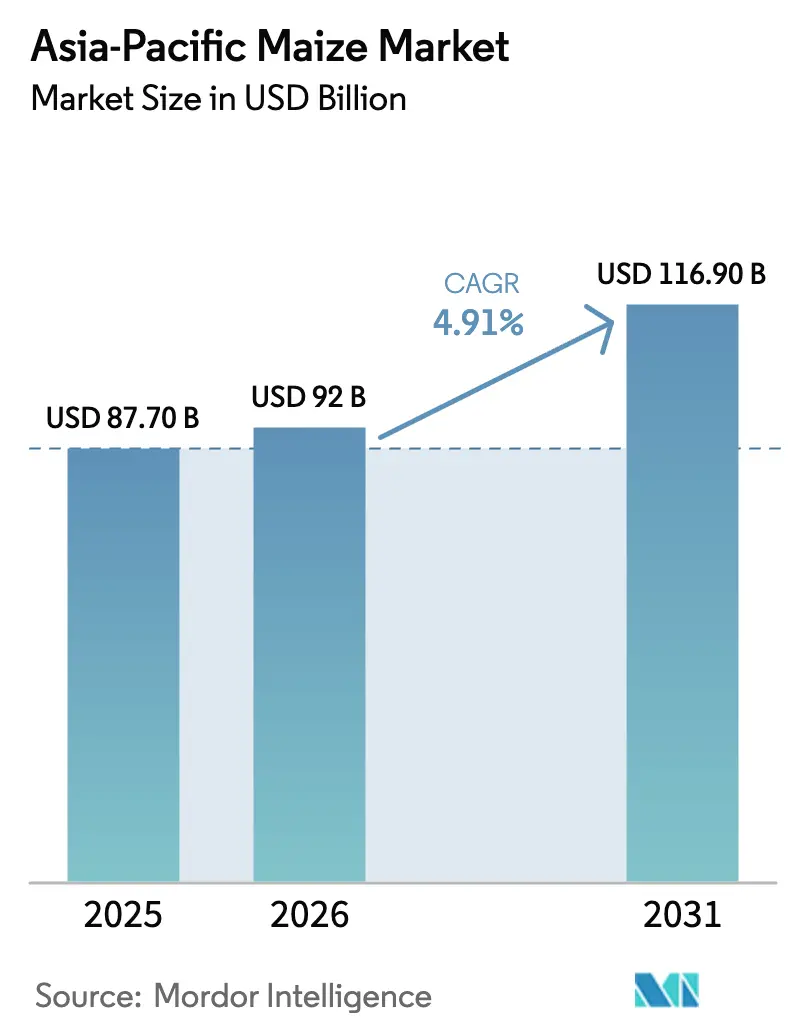
The Asia-Pacific maize market is projected to grow from USD 87.70 billion in 2025 to USD 92.00 billion in 2026, and is forecast to reach USD 116.90 billion by 2031, with a 4.91% CAGR over 2026-2031. Feed intensification across poultry and aquaculture remains the core structural driver, reinforced by deep-processing capacity additions in China and Southeast Asia that lift starch and sweetener throughput and widen downstream value pools. India’s ethanol blending policy continues to reallocate grain toward fuel in priority districts, which supports farm-gate prices, encourages acreage, and reshapes trade flows [2]. Processing enterprises are investing in higher operating rates as profitability improved in late 2025, which expands industrial demand for maize-derived starches, sweeteners, and amino acids in China [1]. Policy and regulatory signals around feed efficiency and grain-saving in large consuming markets also influence ration formulas and sustain the resilience of the Asia-Pacific maize market across cycles.
Key Report Takeaways
By geography, China accounted for 66.0% of the Asia-Pacific maize market size in 2025, while India is projected to grow at a 6.0% CAGR through 2031.
Note: Market size and forecast figures in this report are generated using Mordor Intelligence’s proprietary estimation framework, updated with the latest available data and insights as of January 2026.
Market Trends and Insights
Drivers Impact Analysis of Asia-Pacific Maize Market*
| Driver | (~) % Impact on CAGR Forecast | Geographic Relevance | Impact Timeline |
|---|---|---|---|
| Feed demand expansion from poultry, aquaculture and dairy sector | +1.8% | Global, with core growth in China, India, and Southeast Asia | Medium term (2-4 years) |
| Industrial maize deep processing capacity build-out in China and Southeast Asia | +1.2% | China (primary), Indonesia, Thailand, and Vietnam | Long term (≥ 4 years) |
| India ethanol blending policy pull for grain-based ethanol | +0.9% | National (India), with early gains in Maharashtra, Karnataka, and Uttar Pradesh | Short term (≤ 2 years) |
| Hybrid seed adoption and mechanization improving yields in South and Southeast Asia | +0.7% | India, Indonesia, and Philippines, spillover to Myanmar and Cambodia | Medium term (2-4 years) |
| Trade facilitation and tariff adjustments under RCEP benefiting maize derivatives | +0.2% | Regional Comprehensive Economic Partnership (RCEP) signatories (The Association of Southeast Asian Nations (ASEAN)), China, Japan, South Korea, Australia, and New Zealand) | Long term (≥ 4 years) |
| Diversification of feed formulations increasing corn inclusion where competitive | +0.1% | China, Vietnam, and Thailand, and secondary markets in South Asia | Short term (≤ 2 years) |
| Source: Mordor Intelligence | |||
Feed demand expansion from poultry, aquaculture and dairy sector
China’s feed maize absorption reached 193.5 million metric tons in the 2025/26 marketing year, which anchored base demand despite profit-pressure periods for breeders during late 2025. Livestock and poultry inventories remained elevated by the end of 2025, which supported steady compound feed use and sustained corn inclusion within least-cost formulations. India’s poultry and cattle segments together absorbed large maize volumes in 2024–25, with official dashboards showing sustained pull from poultry integrators and dairy ration programs in key clusters. Aquaculture feed is expanding in Vietnam as stocking densities rise in priority basins and integrators scale higher performance formulas for shrimp and finfish. Corporate feed leaders have added capacity and digital traceability in recent years, with Charoen Pokphand Foods operating significant regional feed manufacturing and maintaining verified 100% traceable corn sourcing for Thailand, which reinforces procurement standards across the Asia-Pacific maize market. Policy programs in large consuming markets promote grain-saving actions and precision nutrition, which together sustain disciplined use of maize while protecting feed efficiency targets within the Asia-Pacific maize market.
Industrial maize deep processing capacity build-out in China and Southeast Asia
China's corn-starch and deep-processing system is projected to operate with an installed capacity exceeding 125 million metric tons by 2025. Throughput and operating rates are projected to improve, supported by better margins later in the year. In 2024, China's corn starch output reached 37.99 million metric tons, representing 63.3% of the global share. Additionally, nearly two-thirds of the national output was concentrated among top processors, highlighting scale advantages in energy and water management. Demand for high-fructose corn syrup (HFCS) across the Asia-Pacific region is anticipated to grow significantly during the forecast period. This growth supports steady corn demand for starch-sugar conversion in beverage and processed food channels. Multinational companies continue to invest in integrated processing hubs to secure feedstock and serve regional customers. For instance, Cargill’s Songyuan complex in Jilin converts corn into starches, HFCS, industrial alcohols, and feed coproducts, while also piloting water and fertilizer programs with contract growers. The extensive processing ecosystem in China allows for flexible product switching across starch derivatives and amino acids, enabling adaptability to shifting demand. This flexibility strengthens the Asia-Pacific maize market during fluctuations in commodity prices. Meanwhile, Southeast Asian facilities in Indonesia and Thailand are enhancing their capabilities to cater to halal and regional buyers. These developments gradually diversify sourcing away from China while anchoring regional value addition within the Asia-Pacific maize market.
India ethanol blending policy pull for grain-based ethanol
India advanced toward higher petrol blending targets in 2025 and continued to draw grain for ethanol, which supported acreage and local procurement in maize-growing belts. Official dashboards show that domestic users have absorbed more supply, while exports moderated as feed and industrial channels expanded their pull on available grain. Policy adjustments for the 2025/26 supply year widened allowable feedstocks for ethanol, which helps balance sugar-cycle swings and provides a hedge for distilleries that also procure maize. The alignment of oil marketing company tenders, quality standards, and state-level incentives is improving procurement visibility for maize belts linked to grain-based ethanol plants, which feeds into a predictable offtake and steadier farmer realization in the Asia-Pacific maize market [3]. The ethanol corridor has emerged as a structural buffer that can smooth maize demand variability alongside feed and starch channels, which reinforces the Asia-Pacific maize market across seasons [2].
Hybrid seed adoption and mechanization improving yields in South and Southeast Asia
The ongoing adoption of hybrid seeds and a shift toward traited products, where regulations permit, are shaping the Asia-Pacific maize market. Government and industry initiatives are promoting traits such as drought tolerance, pest resistance, and improved standability, aligning with the region's increasing mechanization of planting and harvesting processes. These advancements contribute to greater yield stability for smallholders and mid-size farms. In Indonesia, the seed industry is expanding distribution and extension efforts in key provinces, supported by association-led programs that enhance access to quality seeds and agronomic guidance. Similarly, the Philippines has allocated funding for seed research and development while maintaining floor-price support mechanisms. These measures mitigate risks for growers adopting improved varieties, encouraging seasonal adoption and reducing input investment risks. The combination of hybrid seed adoption and precision services, such as optimized planting density and nutrient management, continues to close the yield gap compared to global benchmarks, strengthening the Asia-Pacific maize market in the medium term.
Restraints Impact Analysis of Asia-Pacific Maize Market*
| Restraint | (~) % Impact on CAGR Forecast | Geographic Relevance | Impact Timeline |
|---|---|---|---|
| Limited access to agricultural finance among smallholders | -0.5% | India, Indonesia, and Philippines, rural zones in Myanmar and Cambodia | Medium term (2-4 years) |
| Limited access to quality inputs (certified seed and balanced fertilizers) | -0.4% | India (eastern states), Indonesia (outer islands), and Philippines (Mindanao) | Medium term (2-4 years) |
| Sanitary and Phytosanitary (SPS) and Genetically Modified Organism (GMO) regulatory frictions limiting cross-border trade and planting | -0.3% | China (import controls), India (GM planting ban), ASEAN (varied GMO approvals) | Long term (≥ 4 years) |
| Substitution pressure from wheat, cassava and Distillers Dried Grains with Solubles (DDGS) in feed during price spreads | -0.2% | China (wheat), Southeast Asia (cassava), Vietnam and South Korea (DDGS) | Short term (≤ 2 years) |
| Source: Mordor Intelligence | |||
Limited access to quality inputs (certified seed and balanced fertilizers)
Certified seed use and balanced fertilizer application remain inconsistent across parts of South and Southeast Asia, which constrains yield gains in rain-fed zones and keeps productivity below global front-runners in several belts of the Asia-Pacific maize market. Public programs are attempting to improve input access and extension, but logistics constraints slow last-mile delivery for smallholders in outer islands and remote districts. The Philippines has rolled out funding for seed R&D and price protection schemes for growers, which support hybrid adoption and help stabilize returns during market swings. Regional variability in credit access also limits farmers’ ability to upgrade inputs and mechanize at scale, which slows the pace of agronomic gains in the Asia-Pacific maize market. Over time, better extension, seed quality assurance, and nutrient stewardship are projected to lift the input baseline and reduce yield dispersion across districts.
Substitution pressure from wheat, cassava and Distillers Dried Grains with Solubles (DDGS) in feed during price spreads
China's feed wheat consumption is projected to reach 36 million metric tons in MY2025/26 as narrowing price spreads reduce corn inclusion in feed rations during those periods. The introduction of Brazilian DDGS imports in May 2025, enabled by new phytosanitary protocols, expands protein and energy options, potentially reducing corn usage if delivered costs are competitive. In Southeast Asia, cassava chips and pellets continue to serve as energy substitutes when economically viable. Controlled trials indicate that fermented cassava byproducts can replace substantial portions of maize in duck diets without affecting performance. Vietnam's cassava supply to feed channels is projected to grow in 2026 following a weaker 2025, supporting flexible rationing in the aquaculture and livestock industries. The use of least-cost formulation tools enables feed mills to alternate between wheat, cassava, DDGS, and corn, highlighting the significance of price spreads and policy changes in influencing short-term corn demand within the Asia-Pacific maize market.
*Our forecasts treat driver/restraint impacts as directional, not additive. The impact forecasts reflect baseline growth, mix effects, and variable interactions.
Geography Analysis
China Maize Market
China is projected to maintain a dominant position in the Asia-Pacific maize market by 2025, accounting for 66.0% of the market value. The country anchors both feed and processing demand. This highlights China's significant influence on the regional maize market. Production gains have been concentrated in the Northeast, driven by increased mechanization and favorable moisture conditions, which have supported higher productivity in recent years and ensured a steady supply for feed mills and starch plants. Industrial processing activity strengthened toward the end of 2025, supported by improved profitability and higher operating rates. This led to increased production of starches, sweeteners, and fermentation outputs, further reinforcing China's influence on regional maize flows. Imports, however, declined sharply in 2024/25 and remained below 6 million metric tons in 2025/26 due to strict quota enforcement. This reflects a continued emphasis on domestic supply and a narrower import window compared to earlier in the decade. Policy measures aimed at promoting grain-saving in feed are projected to reduce maize intensity per unit of animal product by 2030. This is projected to moderate long-term demand growth and emphasize the role of co-products and alternative proteins in feed formulations within the Asia-Pacific maize market.
India Maize Market
India is the fastest-growing country in the Asia-Pacific maize market, with a CAGR of 6.0% during the forecast period of 2026–2031. This growth is driven by the expansion of the poultry sector and ethanol blending initiatives, which redirect grain flows to domestic users and help stabilize farm incomes in several regions. Between 2023–24 and 2025–26, production increased due to acreage expansion and favorable seasonal conditions in key states. Official crop updates and global production data confirm the supply growth, which supports feed mills, starch plants, and distilleries. Export shipments to neighboring countries declined as domestic demand grew, while targeted imports increased in 2024–25 to address localized requirements. This highlights how strategic trade adjustments complement the domestic supply-demand balance in the Asia-Pacific maize market. Feed and industrial sectors continue to benefit from coordinated policies and crop support measures, which promote mechanization and the adoption of improved seeds across several states in the region.
Indonesia and Philippines Maize Market
Indonesia achieved self-sufficiency in 2025, producing 16.11 million metric tons of maize, exceeding consumption by 470,000 metric tons, with carry-over stocks reaching approximately 4.5 million metric tons. This enabled a zero-import position for 2026 and allowed tentative export tenders without compromising domestic supply security in the Asia-Pacific maize market. Government-set farm-gate and warehouse floor prices have supported planting decisions and encouraged the adoption of mechanization and certified seeds in priority provinces, enhancing on-farm resilience. In contrast, the Philippines remains structurally dependent on imports, with MY2025/26 imports projected at 1.85 million metric tons to bridge the gap between production and consumption. This reliance continues to expose the country to import prices and quality standards enforced by national agencies. During the first half of 2025, maize output increased significantly. However, typhoon-related losses in parts of the Cagayan Valley later in the year highlighted the need for post-harvest investments and resilient agronomic practices in the Asia-Pacific maize market.
Regulatory Landscape
The regulatory environment for maize in Asia-Pacific is increasingly shaped by sustainability-linked trade compliance, seed and food standards updates, and country-specific biosafety rules. In 2026, Thailand tightened cross-border feed maize rules by requiring burn-free certification for imports to address PM2.5 concerns, and it expanded the 2026 feed corn import quota to 1 million tonnes at a 0% tariff. This increases the value of traceability and origin verification for regional suppliers, including Myanmar.
China continued updating standards affecting planting material and downstream food ingredients. In October 2025, SAMR implemented GB4404.1-2024 for seeds of food crops, including specific quality requirements relevant to genetically engineered maize seeds. In April 2025, SAMR implemented the GB/T 10463-2024 maize flour standard, replacing the older 2008 version. These changes operate alongside uneven GMO approvals and SPS compliance requirements across the region, which keep trade corridors segmented across Asia-Pacific despite broader tariff liberalization frameworks.
Value Chain Analysis
The Asia-Pacific maize value chain runs from input provisioning (hybrid seed and fertilizers) to farm production, where smallholders dominate across South and Southeast Asia and more mechanized systems are visible in parts of China. After aggregation through traders and cooperatives, downstream conversion includes compound feed, starch and sweeteners, and ethanol. Industrial pull is increasingly evident in India, where policy-driven ethanol demand has coincided with tighter domestic availability and a shift toward targeted imports in 2024-25, while large processors and integrated hubs such as corn wet milling and deep-processing complexes support offtake and coproduct flows into feed and food channels.
Governments and large buyers are pushing tighter coordination through direct sourcing and auditable compliance. In India, the Ministry of Agriculture approved a PPPAVCD maize value chain project with Ninjacart in April 2025 to link farmers with ethanol units in Uttar Pradesh, aiming to formalize procurement and reduce intermediation losses. Cross-border trade is also being reshaped by environmental traceability requirements, including Thailand's 2026 burn-free import conditions. That raises the importance of certification, testing, drying and storage infrastructure, and digital lot-level traceability from farmgate to feed mill.
Competitive Landscape
The Asia-Pacific maize market features a bifurcated structure where seed and deep-processing segments show moderate consolidation while feed manufacturing and farm production remain fragmented. In seeds, the combined share of leading global and regional firms is meaningful but leaves room for local champions to compete on germplasm fit and distribution reach in price-sensitive smallholder segments across the Asia-Pacific maize market. The starch industry in China displays a higher concentration among top processors, which leverage scale for energy and water efficiency and integrate into amino acids and modified starches to smooth margins across price cycles. These structures support steady throughput for corn-based derivatives that flow into food, beverage, and industrial channels in the Asia-Pacific maize market.
Global supply-chain players continue to reshape origination and logistics, which influences availability and pricing for buyers across the Asia-Pacific. The merger of Bunge and Viterra in July 2025 consolidated export and crush networks that connect South America and the Black Sea with Asia, and it came with regulatory conditions to protect supply reliability in China, confirming the strategic weight of Asian demand. Cargill’s integrated corn-processing hub in Jilin highlights a model where feedstock contracting, processing, and customer channels co-locate to reduce logistics risk and serve domestic and export markets efficiently within the Asia-Pacific maize market. These moves complement country-level policy efforts that emphasize domestic supply security while keeping trade lanes adaptable during crop shocks or policy swings in the Asia-Pacific maize market.
In feed, regional champions remain influential while the long tail of mills preserves a decentralized landscape. Charoen Pokphand Foods maintains large regional capacity and continues to invest in smart-factory upgrades and traceable sourcing that reduce contamination risk and align with emerging Environmental, Social, and Governance (ESG) requirements, which strengthens customer confidence across Southeast Asia in the Asia-Pacific maize market. National feed markets remain fragmented beyond the leading groups, which slows the adoption of software-enabled precision nutrition in certain provinces and maintains variability in corn inclusion practices. As a result, competitive strategy revolves around scale, integration, and traceability in some nodes and around localized service, credit, and input bundling in others, which together define the current dynamics of the Asia-Pacific maize market.
Market Opportunities and Future Outlook
Downstream value addition and domestic substitution remain key opportunity areas, supported by investment activity in maize processing across South Asia. In India, Regaal Resources commissioned an expansion of its maize wet-milling facility in Kishanganj, Bihar in May 2026, doubling crushing capacity from 825 TPD to 1,650 TPD. In the same month, Riddhi Siddhi Gluco Biols completed the acquisition of Cargill India's corn wet-milling plant in Davangere, Karnataka, adding 300,000 MT annual processing capacity. These steps broaden the addressable market for industrial-grade maize, starch derivatives, and fermentation-linked demand, while also tightening procurement expectations for consistent grain quality.
On the supply side, policy-led acreage diversification and more formal market linkages create room for seeds, agronomy services, storage, and traceable origination. Punjab expanded its Kharif maize diversification program to 16 districts for the 2026-27 season, targeting a shift from paddy to maize, while Nepal has been scaling CIMMYT-supported Commercial Maize Model approaches to strengthen market linkages with private participation. At the same time, sustainability-linked import requirements in Thailand, including burn-free certification, create a clearer lane for certified, mapped, and segregated supply chains in mainland Southeast Asia. That supports exporters and traders that can document compliance end-to-end.
Recent Industry Developments in Asia-Pacific Maize Market
- July 2026: Nishat Group completed the acquisition of Rafhan Maize in Pakistan. The deal consolidates a large domestic processing base under a major conglomerate, strengthening integration across maize procurement, milling, and derivative outputs in an important South Asian consuming and processing market.
- May 2026: Riddhi Siddhi Gluco Biols Ltd. completed the acquisition of Cargill India’s corn wet-milling facility in Davangere, Karnataka, with about 300,000 MT annual processing capacity. The transaction accelerates consolidation in India’s starch and derivatives segment and expands local manufacturing depth for food, pharmaceutical, and industrial customers that depend on consistent maize-based inputs.
- December 2025: China’s National Development and Reform Commission (NDRC) announced plans to expand cultivation of high-quality forage crops, including silage corn, alongside large-scale yield improvement programs for major crops. The initiative reinforces policy attention on productivity and differentiated maize use in feed systems, influencing variety choices and procurement priorities across China’s supply chain.
Asia-Pacific Maize Market Report Scope and Research Methodology
Market Definition and Coverage
For this report, the market is defined as the value of maize (corn) traded and consumed across Asia-Pacific, expressed in USD, and grounded in commodity-level supply, demand, and price behavior.
Scope exclusions: We exclude branded retail food markups, logistics margins beyond the primary commodity transaction, and pure seed-only revenue wherever it is reported separately.
Segments Covered in This Report
- By Geography
- India
- Production Analysis (Area Harvested, Yield, and Production Volume)
- Consumption Analysis (Consumption Value and Volume)
- Import Market Analysis (Import Value, Volume, and Key Supplying Markets)
- Export Market Analysis (Export Value, Volume, and Key Destination Markets)
- Wholesale Price Trend Analysis and Forecast
- Regulatory Framework
- List of Key Players
- Logistics and Infrastructure
- Seasonality Analysis
- China
- Production Analysis (Area Harvested, Yield, and Production Volume)
- Consumption Analysis (Consumption Value and Volume)
- Import Market Analysis (Import Value, Volume, and Key Supplying Markets)
- Export Market Analysis (Export Value, Volume, and Key Destination Markets)
- Wholesale Price Trend Analysis and Forecast
- Regulatory Framework
- List of Key Players
- Logistics and Infrastructure
- Seasonality Analysis
- Indonesia
- Production Analysis (Area Harvested, Yield, and Production Volume)
- Consumption Analysis (Consumption Value and Volume)
- Import Market Analysis (Import Value, Volume, and Key Supplying Markets)
- Export Market Analysis (Export Value, Volume, and Key Destination Markets)
- Wholesale Price Trend Analysis and Forecast
- Regulatory Framework
- List of Key Players
- Logistics and Infrastructure
- Seasonality Analysis
- Philippines
- Production Analysis (Area Harvested, Yield, and Production Volume)
- Consumption Analysis (Consumption Value and Volume)
- Import Market Analysis (Import Value, Volume, and Key Supplying Markets)
- Export Market Analysis (Export Value, Volume, and Key Destination Markets)
- Wholesale Price Trend Analysis and Forecast
- Regulatory Framework
- List of Key Players
- Logistics and Infrastructure
- Seasonality Analysis
- India
Data Sources, Market Sizing, and Validation
Desk Research
We first built a consistent fact base on maize area, yields, production, and trade flows across key Asia-Pacific countries, and then tied those volumes to price references to convert into market value. Public datasets help avoid mixing farm-gate, wholesale, and downstream processed values in the same total, which is a common issue in crop commodities.
Core inputs were taken from reputable open sources such as FAOSTAT, USDA PSD and GATS trade tables, UN Comtrade, national agriculture ministries and statistics offices, and customs or port releases where available. We also reviewed peer-reviewed agronomy and crop science journals for yield drivers, along with company filings and investor presentations for downstream demand cues (for example feed and starch use). In addition, we used paid subscriptions for company financial intelligence, shipment-level import and export checks, and news and financials to spot policy shifts and crop shocks. These desk sources are not exhaustive, and many other references were used to collect data, validate it, and clarify open questions.
Primary Interviews and Surveys
Primary work was used to pressure-test the desk assumptions on country pricing behavior, marketing-year timing, and how much demand is pulled by feed, food, and industrial processing. We spoke with a mix of growers or aggregators, traders, processors, and procurement leaders across major producing and importing markets in APAC, and then used follow-ups to close gaps where secondary sources were inconsistent.
Distribution of primary research fieldwork respondents
| Company type | Respondent position |
|---|---|
| Top tier: 37% | CXOs: 18% |
| Mid tier: 45% | Functional/Unit leaders: 24% |
| Smaller Players: 18% | Managers: 58% |
Market-Sizing & Forecasting
The core sizing was built using a top-down logic where production and trade data reconstruct the available supply pool, which is then mapped to consumption and pricing to express the market in USD. Once the country totals were formed, they were checked with selective bottom-up approximations such as sampled trade tonnage times observed unit values, and channel checks on bulk buying prices in key corridors, before totals were finalized.
Inputs used in the model included harvested area and yield trends, import and export volumes by key origins, stock and supply tightness signals, and the timing of the marketing year since price averages shift across harvest months. We also tracked major policy triggers like tariff moves or minimum support actions, and demand indicators such as feed requirement growth and industrial usage trends that influence pull-through. For forecasting, scenario analysis was used around yield and price outcomes, and then guided by expert views so the final path stays realistic during weather-driven years. Where trade or price series were missing for smaller markets, gaps were handled using nearest-country proxies and conservative spreads, and then revisited during validation calls.
Data Validation & Update Cycle
We validate the model by comparing outputs against independent signals such as country production balances, net trade direction, and whether implied unit values match observed wholesale price ranges. If variances are found, the driver is isolated first, and only then are assumptions adjusted, followed by a second analyst review before sign-off.
Reports are refreshed annually, and interim updates are made when material events occur, such as a major drought, a policy shock, or a sharp currency move that changes the USD value view. Before delivery, we do a fresh pass on prices, trade, and currency averages so clients receive the most up-to-date picture available at the time.
Mordor Intelligence's Asia Pacific Maize Market Sizing Compared With Other Published Estimates
Published estimates for Asia-Pacific maize can differ a lot even when they look like they cover the same topic, because the priced point in the chain and the year treatment are not always consistent. In our checks, the biggest spread typically comes from whether figures are built from grain volumes and wholesale pricing, or whether they blend in downstream corn-based products and other value add layers.
A refresh-led difference also shows up when currency timing and price averaging windows are handled differently, especially in a region where local currencies can move quickly against the USD. When the model is re-run with updated marketing-year price averages and currency conversions close to the analysis cut-off, Mordor Intelligence tends to land closer to the observable trade and wholesale signals than figures that keep older averages or mix farm-gate and retail style values.
Benchmark comparison
| Source | Market Size | Gaps in Research Methodology |
|---|---|---|
| Mordor Intelligence | USD 87.70 B (2025) | |
| Industry Data Platform A | USD 181.20 B (2024) | Uses a wholesale-price revenue construct that can be closer to a consumption value lens, and the year anchor differs, which can shift totals in volatile price cycles and during currency swings. |
| Regional Consultancy B | USD 28.40 B (2023) | Often blends maize grain with selected corn-based derivatives and a channel view, and the base year sits earlier, which can understate later price lifts or omit trade-led value in import-heavy markets. |
Looking at the table, the gap is mainly explained by what is being priced (pure maize grain versus a broader corn product bundle) and by the choice of year and conversion timing. By keeping the unit-value logic traceable to volumes, marketing-year prices, and consistent USD conversion windows, the resulting market size can be repeated and audited with clear steps.
Key Questions Answered in the Report
What is the size and growth outlook for the Asia-Pacific maize market to 2031?
The Asia-Pacific maize market size is USD 92.0 billion in 2026 and is expected to reach USD 116.9 billion by 2031 at a 4.91% CAGR.
Which country holds the largest share in the Asia-Pacific maize market?
China held 66.0% of the regional value in 2025, anchored by strong feed demand and deep-processing throughput.
Which country is the fastest growing within the Asia-Pacific maize market through 2031?
India is projected to grow at a 6.0% CAGR to 2031, supported by ethanol blending, poultry expansion, and steady rotation to domestic users.
What are the main demand pillars sustaining the Asia-Pacific maize market?
The core pillars are compound feed for poultry and aquaculture and industrial conversion into starches, sweeteners, and amino acids, with ethanol blending creating an additional buffer in India.
How are policy and trade changes affecting near-term balance in the Asia-Pacific maize market?
China's quota enforcement reduces imports, Indonesia's zero-import stance tightens local balances, and Philippine imports bridge structural gaps under strict quality controls, while Brazil-origin DDGS entry into China increases formulation flexibility.
What supply-side upgrades are improving resilience across the region?
Hybrid seed expansion, mechanization, and traceability programs in large integrators are lifting yield stability and procurement quality, which support consistent supply to feed mills and processors.