
Germany Machining Centers Market Size and Share
Market Overview
| Study Period | 2020 - 2031 |
|---|---|
| Forecast Data Period | 2026 - 2031 |
| Base Year Market Size (2025) | USD 1.38 Billion |
| Market Size (2026) | USD 1.42 Billion |
| Market Size (2031) | USD 1.65 Billion |
| Growth Rate (2026 - 2031) | 3.05% CAGR |
| Market Concentration | Medium |
Major Players
*Disclaimer: Major Players sorted in no particular order Image © Mordor Intelligence. Reuse requires attribution under CC BY 4.0. |
|
Germany Machining Centers Market Analysis by Mordor Intelligence
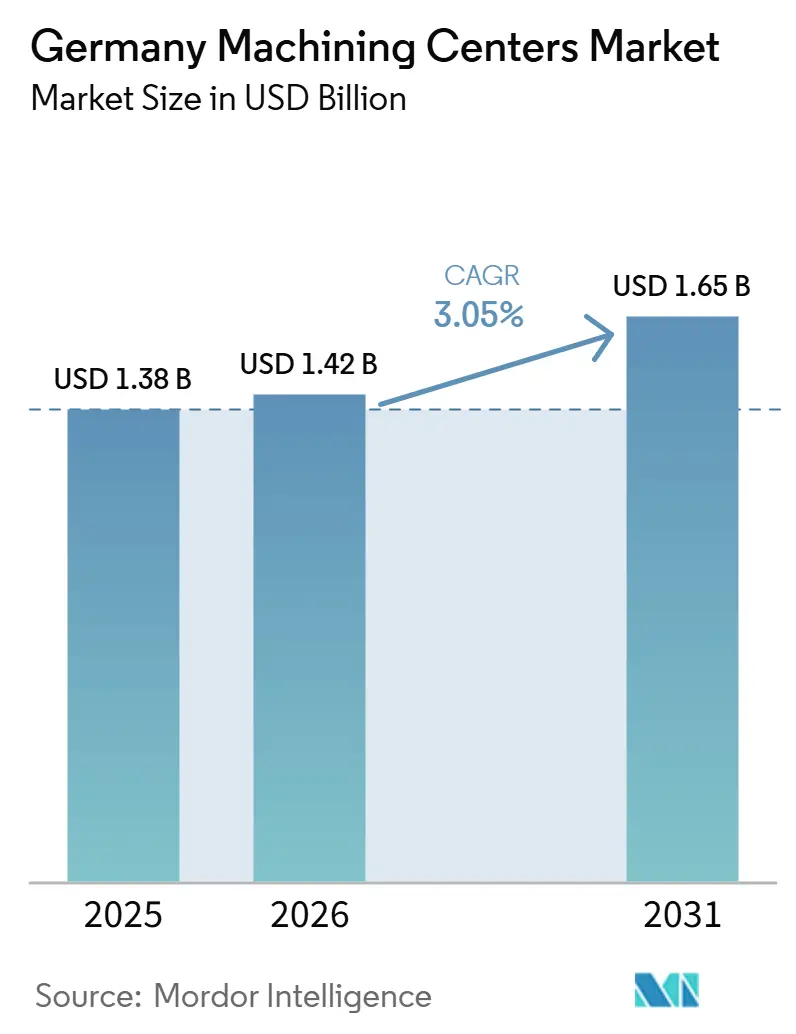
Germany Machining Centers Market size is projected to expand from USD 1.38 billion in 2025 and USD 1.42 billion in 2026 to USD 1.65 billion by 2031, registering a CAGR of 3% between 2026 and 2031. Replacements of legacy equipment, accelerating digital-factory mandates, and a sharp increase in defense procurement underpin this steady expansion despite elevated financing costs. Domestic builders keep demand anchored through local after-sales service, while AI-ready controllers shorten setup cycles and ease a nationwide shortage of skilled programmers. Concurrently, subsidies tied to the EU Net-Zero Industry Act spur investment in large-format machines for wind-turbine and hydrogen-electrolyzer components. Heightened cybersecurity rules under Manufacturing-X also steer buyers toward native IEC 62443-compliant platforms that promise lower exposure to ransomware.[1]European Commission, “The Net-Zero Industry Act,” European Commission, ec.europa.eu
Key Report Takeaways
- By machine type, vertical machining centers led with 45.40% of the Germany machining centers market share in 2025, whereas universal/5-axis machining centers are projected to post the fastest 4.80% CAGR to 2031.
- By axis configuration, 3-axis systems held 52.00% of the Germany machining centers market size in 2025, while 5-axis & above systems are forecast to expand at 5.10% CAGR through 2031.
- By spindle orientation, vertical captured 61.20% of the Germany machining centers market share in 2025, yet Multi-spindle is expected to register a 5.00% CAGR to 2031.
- By structure, column-type frames captured 41.20% of the Germany machining centers market size in 2025, yet gantry-type machines are expected to register a 4.60% CAGR to 2031 as offshore-wind suppliers embrace 6-meter work envelopes.
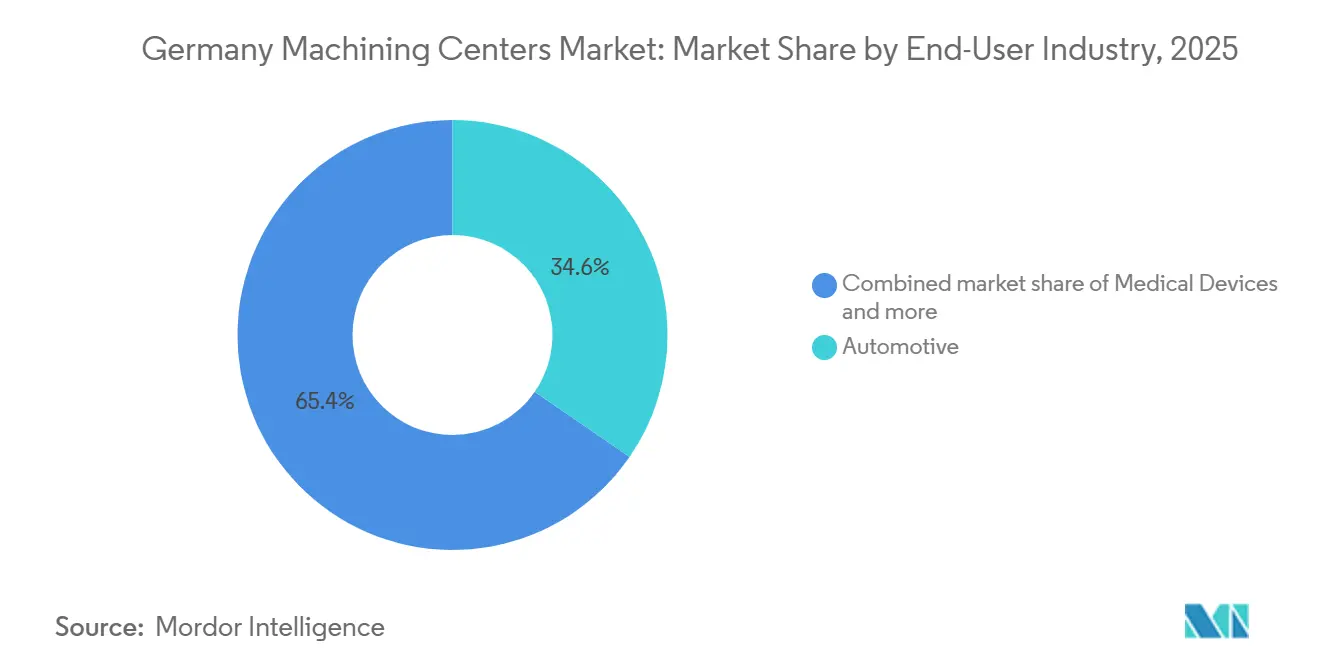
- By end-user, automotive accounted for 34.60% of the Germany machining centers market share in 2025; aerospace & defense is advancing at a 4.50% CAGR on the back of a USD 118 billion defense budget in 2026.
Note: Market size and forecast figures in this report are generated using Mordor Intelligence’s proprietary estimation framework, updated with the latest available data and insights as of January 2026.
Germany Machining Centers Market Trends and Insights
Drivers Impact Analysis*
| Drivers | (~) % Impact on CAGR Forecast | Geographic Relevance | Impact Timeline |
|---|---|---|---|
| Industry 4.0 demand accelerates adoption of connected CNC machining centers | +0.7% | National, with concentrations in Baden-Württemberg, Bavaria, North Rhine-Westphalia | Medium term (2-4 years) |
| Automotive electrification drives high-precision multi-axis machining requirements | +0.6% | National, with early gains in Stuttgart, Ingolstadt, Munich automotive clusters | Medium term (2-4 years) |
| Replacement of aging machine-tool base boosts new equipment demand across Mittelstand | +0.5% | National, strongest in small and medium enterprise (SME) manufacturing hubs | Short term (≤ 2 years) |
| EU Net-Zero Industry Act incentives increase machining for renewable energy components | +0.4% | National, with spillover to offshore wind supply chains in Bremerhaven, Cuxhaven | Long term (≥ 4 years) |
| Growing aerospace and defense machining demand strengthens advanced multi-axis machine utilization | +0.4% | National, concentrated in Bavaria, Baden-Württemberg aerospace clusters | Long term (≥ 4 years) |
| Manufacturing-X cybersecurity compliance drives adoption of AI-enabled secure CNC controllers | +0.3% | National, prioritized by Tier-1 automotive and aerospace suppliers | Medium term (2-4 years) |
| Source: Mordor Intelligence | |||
Industry 4.0 Demand Accelerates Adoption of Connected CNC Machining Centers
German facilities now specify Open Platform Communications Unified Architecture (OPC UA) and edge modules as standard so that production data stays on-premises, a core Manufacturing-X requirement. Bosch Rexroth’s ctrlX Automation platform, certified under IEC 62443-4-2, separates motion control from the human–machine interface and cuts ransomware risk by 85%. Siemens refreshed its SINUMERIK 828D line in 2025 with Run MyVirtual Machine, trimming setup times 20% through offline collision checks. Substantial federal digitalization grants are accelerating equipment modernization, empowering small- to medium-sized job shops to replace their isolated, legacy mills with fully connected, Industry 4.0-ready alternatives. As a result, machines that arrive without native OPC UA ports or digital-twin licenses face shrinking order books.
Automotive Electrification Drives High-Precision Multi-Axis Machining Requirements
Battery housings, motor stators, and inverter casings demand sub-50-micron tolerances plus surface finishes below Ra 1.6 to optimize cooling and electromagnetic shielding. ZF achieved a Ra of 0.2 microns on aluminum e-motor housings after installing Nagel precision grinders. DMG MORI’s new DMU 65 H monoBLOCK pairs a thermally stable casting with an 18,000 rpm spindle to shave 18% off battery-tray cycle time. The German Association of the Automotive Industry projects domestic EV output to hit 2.1 million units by 2028, implying the need for roughly 4,500 additional machining centers. Multi-tasking turn-mill platforms broaden appeal by combining milling, turning, and gear hobbing in a single setup, thereby reducing work-in-process inventory by 30% for Tier-1 suppliers.[2]Federal Ministry for Economic Affairs and Climate Action, "Transformation of the Automotive Industry," BMWK, bmwk.de
Replacement of Aging Machine-Tool Base Boosts New Equipment Demand Across Mittelstand
Roughly 40% of Germany’s horizontal and vertical mills predate 2009 and lack programmable pallet changers or adaptive spindle-load monitoring. While domestic orders fell 23% year over year in early 2025, renewal spending by small and midsize manufacturers is now stabilizing the queue. BERG Spanntechnik spent USD 2.7 million in 2026 on a REIDEN RX12 5-axis center that trims fixture setup by 35%. A similar modernization at Heinrich GEORG increased rolling-mill throughput by 25%. Retrofit programs from Liebherr and Kapp Niles extend service life by a decade for 40% of the cost of new equipment, letting cautious owners balance capital constraints with productivity gains.
EU Net-Zero Industry Act Incentives Increase Machining for Renewable-Energy Components
Subsidies tied to the 2024 EU Net-Zero Industry Act cover up to 20% of capital outlays for wind-turbine, hydrogen-electrolyzer, and solar-tracker machining cells, steering orders toward large-format gantry machines with 6-meter travels. The German Engineering Federation forecasts demand for 1,200 such gantry units by 2030 as offshore capacity along the North Sea coast rises. Hydrogen infrastructure worth USD 9.8 billion under construction likewise requires flatness below 10 microns on electrolyzer stacks, prompting job shops to replace 3-axis mills with multi-axis centers that halve manual re-fixturing. As a result, clean-energy suppliers are emerging as the fastest-growing new customer group in the Germany machining centers market.
Restraints Impact Analysis*
| Restraints | (~) % Impact on CAGR Forecast | Geographic Relevance | Impact Timeline |
|---|---|---|---|
| High CAPEX and rising interest rates constrain new machining center investments | -0.5% | National, most acute in capital-intensive sectors (automotive, aerospace) | Short term (≤ 2 years) |
| Shortage of skilled 5-axis programmers and operators limits advanced machine usage | -0.4% | National, with acute shortages in Bavaria, Baden-Württemberg | Medium term (2-4 years) |
| Semiconductor shortages delay machining center production and delivery timelines | -0.3% | National, with spillover effects on global supply chains | Short term (≤ 2 years) |
| Export-control regulations restrict deployment of cloud-connected CNC systems | -0.2% | National, affecting exports to non-EU markets | Long term (≥ 4 years) |
| Source: Mordor Intelligence | |||
High CAPEX and Rising Interest Rates Constrain New Machining Center Investments
The European Central Bank kept its deposit rate at 2.75% in March 2026, so seven-year equipment loans are still priced 1.5 percentage points above 2019 levels. A notable decline in manufacturing capacity utilization underscores a cautious capital expenditure environment, driven largely by operators waiting for relief from elevated borrowing costs. A 5-axis horizontal machine, often quoted at USD 1.6 million, now faces a 4-year payback period, well below the historic 6-year norm. Leasing, therefore, covers 42% of 2026 shipments, up from 31% three years earlier, while used-machine sales jumped 19% in 2025. High financing costs thus shave 0.5 percentage points off projected growth in the Germany machining centers market.
Shortage of Skilled 5-Axis Programmers and Operators Limits Advanced Machine Usage
Germany recorded 617,000 unfilled factory jobs in 2025, with CNC programmers among the most in-demand roles. A substantial portion of rated 5-axis capacity fails to run in full three-shift mode because many shops cannot source CAM-fluent talent. Wage premiums for certified programmers have climbed 18% since 2023, lifting unit operating costs. DMG MORI and Siemens now bundle AI-assisted conversational coding that halves training time, yet labor remains the bottleneck. Until vocational pipelines catch up, this labor bottleneck will continue to act as a significant drag on the potential growth of the Germany machining centers market.[3]Federal Employment Agency, "Analysis of Skilled Labour Shortages," Bundesagentur für Arbeit, arbeitsagentur.de
*Our forecasts treat driver/restraint impacts as directional, not additive. The impact forecasts reflect baseline growth, mix effects, and variable interactions.
Segment Analysis
By Machine Type: Universal/5-Axis Growth Erodes Vertical Dominance
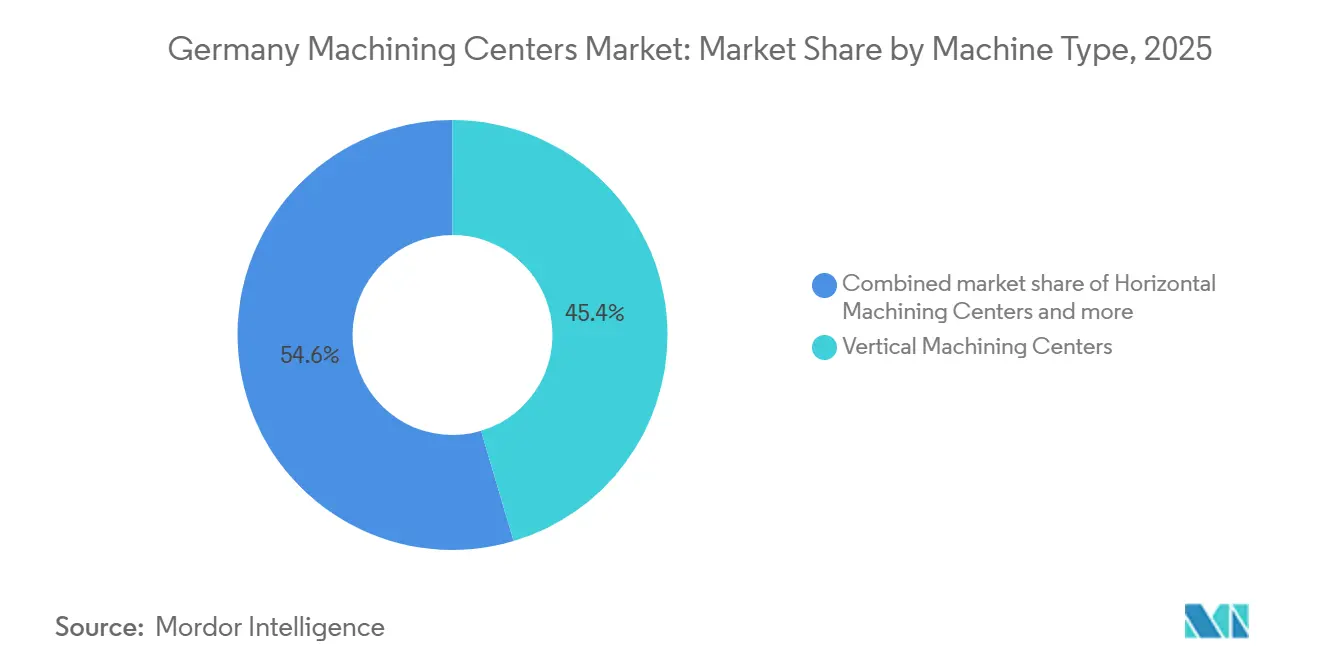
Vertical machining centers held a 45.4% of the Germany machining centers market share in 2025, thanks to their lower purchase price and wide use in automotive casting rework and mold-and-die jobs. Shops favor them for quick installation and operator familiarity, so the installed base skews heavily toward three-axis vertical mills. However, aerospace primes and medical-device subcontractors are reallocating budgets toward universal and five-axis platforms that remove secondary setups and cut cycle time by up to 22% on turbine blades and spinal implants.
Universal/five-axis machining centers are projected to register a 4.8% CAGR through 2031, the fastest among all machine types. Their growth rests on tight-tolerance programs for Future Combat Air System fuselage panels and electric-vehicle (EV) motor housings, both of which demand simultaneous multi-face milling. While gantry and bridge-style machines have historically occupied a niche segment, the heavy machining requirements of the renewable energy sector are now driving significant new demand and expanding the overall customer pool. Even so, the Germany machining centers market for vertical models will maintain a robust valuation, as Mittelstand job shops continue to view them as the ideal entry point for Industry 4.0 retrofits.



By Axis Configuration: Five-Axis Platforms Capture High-Value Jobs
Three-axis machines represented 52% of 2025 installations, cementing their role as entry-level workhorses for aluminum plate milling and steel frame fabrication. Yet defense and medical buyers are accelerating orders for five-axis and above systems, which are forecast to expand at a 5.1% CAGR to 2031. Strategic investments by major aerospace and defense contractors in advanced five-axis platforms for complex titanium machining demonstrate how heavy aerospace requirements are accelerating this pivot.
The Germany machining centers market for five-axis units reflects heightened demand for sub-10-micron repeatability. Siemens’ SINUMERIK ONE controller, which uses offline digital twin simulation, drastically accelerates the verification of collision-free toolpaths, effectively lowering the technical barrier to entry for smaller job shops. Four-axis tables hold their mid-tier niche on camshaft and crankshaft lines, but their volume growth trails the five-axis surge as EV designs phase out complex internal-combustion components.
By Spindle Orientation: Multi-Spindle Adoption Edges Up in Precision Nich
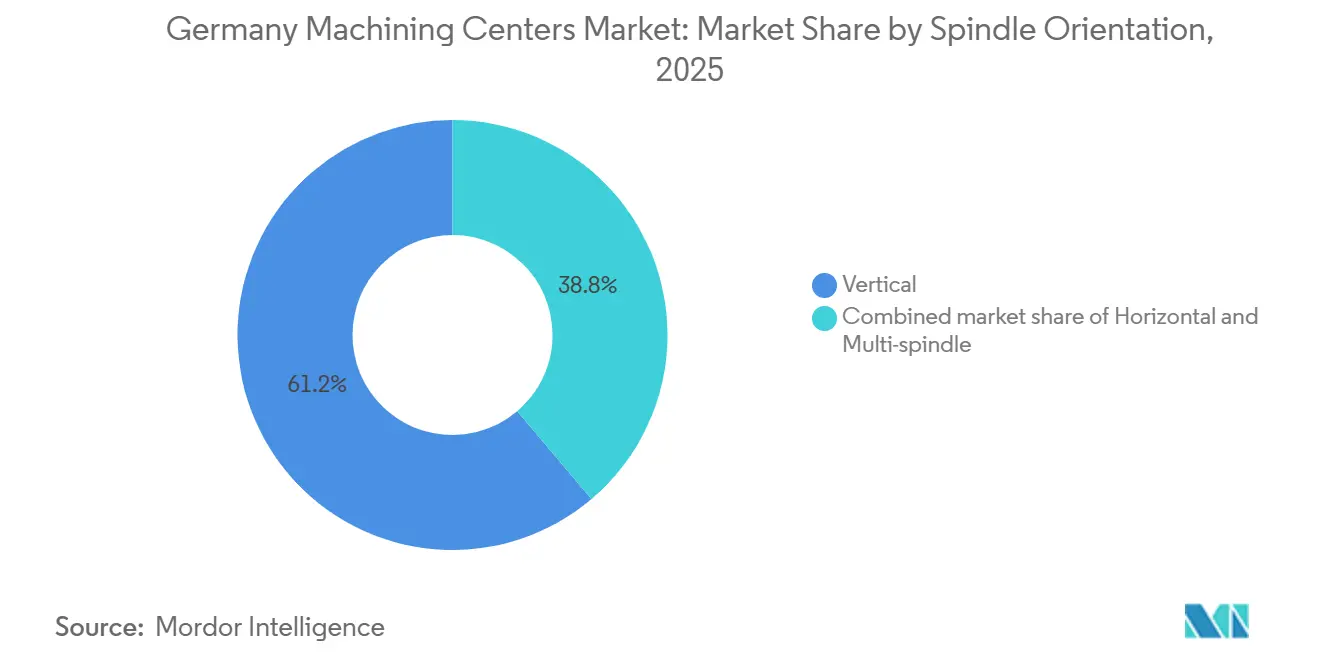
Vertical spindles captured 61.2% of 2025 revenue because chip evacuation is straightforward on aluminum and steel parts, and most legacy fixtures are built for top-down cutting. Automotive moldmakers and general machinists thus keep verticals in steady rotation. Horizontal spindles dominate high-volume automotive cases and transmission shells where gravity carries chips away, supporting 22-hour daily utilization with pallet pools.
The multi-spindle segment is the fastest-growing, expanding at a 5% CAGR from 2026 to 2031. Medical-device contractors such as Diener AG leverage twin-head platforms to execute both roughing and finishing of spinal implants in a single setup, drastically reducing subsequent polishing times while achieving superior surface quality. Aerospace turbine-disk projects apply a similar strategy, one high-torque head for hog-out passes and one high-speed head for finishing. Driven by these operational advantages, multi-spindle platforms will capture an increasingly larger share of the German machining center market over the forecast period.
By Structure Type: Gantry Frames Benefit From Renewable-Energy Orders
Column-type structures owned 41.2% of deployments in 2025 because their compact footprint and thermal rigidity suit precision mold-and-die work. Moving-table horizontals keep automotive engine-block lines running lights-out with dual pallets that chop idle time 40%.
Gantry frames, however, are on a 4.6% CAGR trajectory as the EU Net-Zero Industry Act bankrolls offshore wind nacelle machining. Heavy-duty XXL portal machines from builders like Waldrich Coburg easily accommodate massive renewable-energy workpieces with exceptional cutting power, aligning with industry association forecasts of surging demand for large-format gantry centers. As these subsidies ramp, gantry units could approach 20% of Germany machining centers market share by the end of the decade, even as columns and moving tables defend their core niches.
By End-User Industry: Aerospace & Defense Surpasses Automotive Growth
Automotive customers accounted for 34.6% of 2025 installations, as powertrain casings and die-casting molds still require high spindle hours. Yet aerospace and defense users are growing faster, at a 4.5% CAGR to 2031, lifted by a USD 118 billion German defense budget and titanium and nickel superalloy parts for Eurofighter upgrades.
Major aerospace contractors such as Airbus and MTU Aero Engines are actively expanding their advanced multi-axis machining capacity, underscoring how heavy military programs are driving demand for high-end equipment. Energy equipment builders, especially wind-turbine suppliers in Bremerhaven and Cuxhaven, rank as the next-fastest segment, aided by USD 3.3 billion in clean-energy manufacturing grants. Medical-device machining, though smaller in volume, maintains premium margins because ISO 13485 audits favor plants with coordinate-measuring machine (CMM) links to the CNC. Collectively, these high-spec segments are nudging the Germany machining centers market toward more complex configurations and away from commodity three-axis verticals.
Geography Analysis
Baden-Wurttemberg, Bavaria, and North Rhine-Westphalia collectively account for a commanding majority of the Germany machining centers market share, anchored by dense automotive, aerospace, and precision-engineering clusters in Stuttgart, Munich, Ingolstadt, and the Ruhr Valley. Baden-Wurttemberg’s automotive base drives vertical and horizontal installations, where Porsche, Mercedes-Benz, and Bosch now favor five-axis models for electric-vehicle parts, cutting setup times by 20%. Bavaria’s aerospace corridor, led by primes such as Airbus Defense and Space and MTU Aero Engines, is actively deploying advanced multi-tasking centers and large-format frames to meet critical titanium tolerances below 0.02 millimeters, a shift that pushes five-axis penetration toward 40% of local demand by 2031.
Lower Saxony and Schleswig-Holstein are fast-growing coastal hubs as offshore wind nacelle suppliers place large-format gantry orders; the VDMA expects 1,200 gantry units nationwide by 2030, with more than one-third installed at the North Sea ports of Bremerhaven and Cuxhaven. Saxony and Thuringia diversify from drivetrain machining into medical devices and hydrogen-electrolyzer plates, leveraging lower labor costs and EU structural funds that reimburse up to 20% of qualifying capital outlays.
Domestic builders are projected to ship EUR 13.7 billion (USD 16.11 billion) worth of machine tools in 2026, and with roughly 72% going abroad, replacement cycles are keeping national installations steady despite elevated interest rates; however, consistent replacement cycles continue to keep the national installed base steady despite elevated interest rates. Regional policy divergence is clear, Bavaria and Baden-Württemberg channel grants toward Industry 4.0 retrofits and cybersecurity audits, while coastal states earmark funds for renewable-energy tooling. The resulting mosaic means buyers in the south prioritize AI-ready controllers, whereas northern yards demand 6-meter travels and 400-newton-meter spindles. Together these patterns confirm that location largely dictates the machine-type mix in the Germany machining centers market.[4]Federal Ministry for Economic Affairs and Climate Action, “Regional Economic Policy,” BMWK, bmwk.de
Competitive Landscape
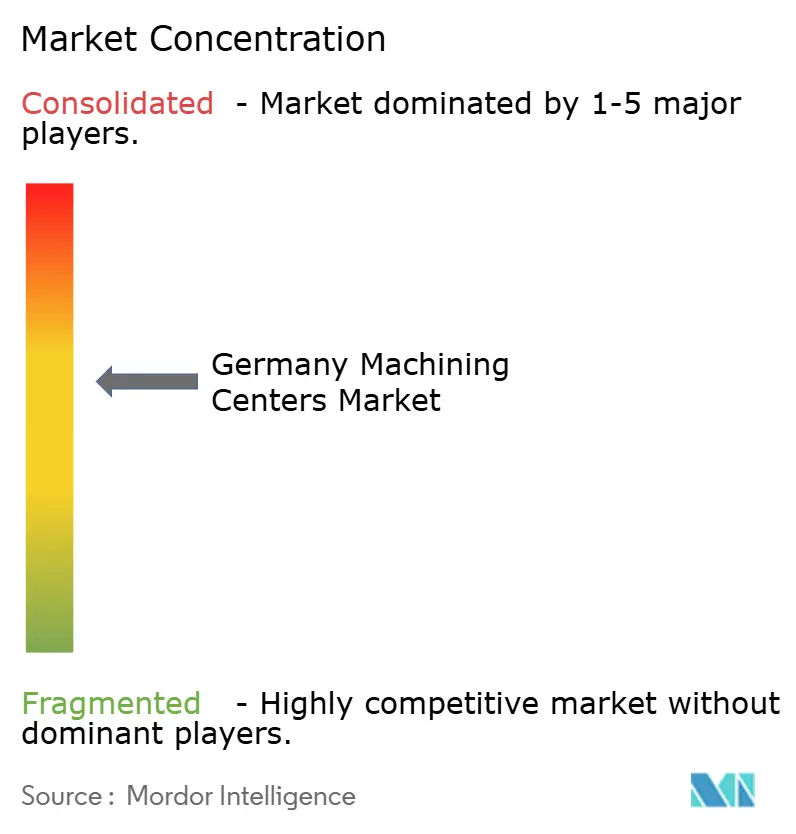
Germany's machining centers market is moderately concentrated. Domestic companies such as DMG MORI, TRUMPF, CHIRON, Hermle, EMAG, INDEX-WERKE, and GROB account for more than 55% of shipments, thanks to deep service footprints and strong ties with Siemens and Bosch Rexroth for controller integration. Asian challengers offer 20-30% price discounts on commodity three-axis verticals, yet longer parts-availability windows and limited local support restrict their uptake to small job shops. Price pressure, therefore, focuses on entry-level tiers, while the premium five-axis and gantry segments remain brand-loyal.
Strategy centers on digital-twin software and IEC 62443 cybersecurity. Siemens’ SINUMERIK 828D refresh, and Bosch Rexroth’s ctrlX platform embed anomaly detection that cuts unscheduled stops 18%, a feature DMG MORI bundles into its Machining Transformation suite launched in April 2026. TRUMPF acquired 74.9% of STOPA in late 2025 to pair machine tools with automated storage, improving material flow and shrinking lead times 25% for aerospace sheet-metal lines. CHIRON and GROB are pivoting toward the renewable energy and e-mobility sectors, unveiling highly dynamic, compact 5-axis and portal centers designed to deliver exceptional spindle torque for complex, high-precision components.
Supply risk shapes current tactics. Semiconductor shortages doubled encoder lead times to 22 weeks in 2025, so builders locked in multi-year contracts with chip foundries and pre-bought PLC lots to secure delivery windows. Export-control updates oblige dual product lines: cloud-enabled for the EU and air-gapped for sensitive markets, adding 8-12% to compliance costs but preserving access to high-margin overseas orders. With domestic production forecast to edge just 1% higher in 2026, share gains hinge on such technology bundles and supply-chain agility rather than raw volume expansion in the Germany machining centers market.
Germany Machining Centers Industry Leaders
-
DMG MORI AG
-
GROB-WERKE GmbH & Co. KG
-
Hermle AG
-
CHIRON Group SE
-
Gebr. Heller Maschinenfabrik GmbH
- *Disclaimer: Major Players sorted in no particular order

Recent Industry Developments
- April 2026: Siemens, an industrial automation and digital technology company, rolled out the Eigen Engineering Agent, an AI tool for automated PLC and HMI coding that increases engineering throughput by up to 5x.
- April 2026: DMG MORI presented its Machining Transformation program, combining digital twins and predictive upkeep to cut setup time 20%.
- March 2026: GROB-WERKE debuted the GP1350 portal mill with 6-meter X-travel and 1,350 Nm spindle for wind-energy rings.
- January 2026: DMG MORI launched the DMU 65 H monoBLOCK 2nd Gen, trimming EV battery-tray cycles 18%.


Germany Machining Centers Market Report Scope
| Horizontal Machining Centers (HMC) |
| Vertical Machining Centers (VMC) |
| Universal/5-Axis Machining Centers |
| Multi-Tasking Machining Centers (MTM) |
| Others (Gantry/Bridge-Type Centres, Turn-Mill Centers) |
| 3-Axis |
| 4-Axis |
| 5-Axis & Above |
| Horizontal |
| Vertical |
| Multi-spindle |
| Column-Type |
| Gantry-Type |
| Moving-Table |
| Automotive |
| Aerospace & Defense |
| Energy (Oil-Gas, Renewables) |
| Medical Devices |
| Mold and Die Manufacturing |
| Others (General Manufacturing, Job Shops, Electronics, etc.) |
| By Machine Type | Horizontal Machining Centers (HMC) |
| Vertical Machining Centers (VMC) | |
| Universal/5-Axis Machining Centers | |
| Multi-Tasking Machining Centers (MTM) | |
| Others (Gantry/Bridge-Type Centres, Turn-Mill Centers) | |
| By Axis Configuration | 3-Axis |
| 4-Axis | |
| 5-Axis & Above | |
| By Spindle Orientation | Horizontal |
| Vertical | |
| Multi-spindle | |
| By Structure Type | Column-Type |
| Gantry-Type | |
| Moving-Table | |
| By End-User Industry | Automotive |
| Aerospace & Defense | |
| Energy (Oil-Gas, Renewables) | |
| Medical Devices | |
| Mold and Die Manufacturing | |
| Others (General Manufacturing, Job Shops, Electronics, etc.) |


Key Questions Answered in the Report
How large is the Germany machining centers market in 2026 and how fast will it grow?
The Germany machining centers market size stands at USD 1.42 billion in 2026 and is projected to register a 3.05% CAGR to reach USD 1.65 billion by 2031.
Which machine-type dominates current demand?
Vertical machining centers remain the workhorse, holding 45.4% of 2025 revenue because they cost less and fit most automotive, mold, and general-job-shop tasks.
What is the fastest-growing configuration?
Five-axis and above platforms represent the quickest riser with a forecast 5.1% CAGR to 2031, driven by aerospace, defense, and medical-device parts that need sub-10-micron accuracy.
Why is aerospace & defense overtaking automotive as the growth engine?
A record USD 117.7 billion defense budget in 2026 funds Eurofighter and FCAS programs that require titanium and nickel-superalloy machining, pushing aerospace & defense installations up at a 4.5% CAGR.
How are EU sustainability policies shaping demand?
Subsidies under the EU Net-Zero Industry Act reimburse up to 20% of capital spent on machines for wind-turbine, hydrogen-electrolyzer, and solar-tracker parts, stimulating a 4.6% CAGR for gantry-type frames.
Does the skills shortage really restrain five-axis utilization?
Yes, Germany reported 617,000 factory vacancies in 2025; unfilled CNC-programmer roles leave five-axis machines running at only 62% of rated capacity despite AI-assisted programming modules.
Page last updated on:






