
Generative AI GPU Market Size and Share
Market Overview
| Study Period | 2020 - 2031 |
|---|---|
| Market Size (2026) | USD 101.97 Billion |
| Market Size (2031) | USD 214.22 Billion |
| Growth Rate (2026 - 2031) | 16.01 % |
| Fastest Growing Market | Asia-Pacific |
| Largest Market | North America |
| Market Concentration | High |
Major Players *Disclaimer: Major Players sorted in no particular order Image © Mordor Intelligence. Reuse requires attribution under CC BY 4.0. | |
Generative AI GPU Market Analysis by Mordor Intelligence
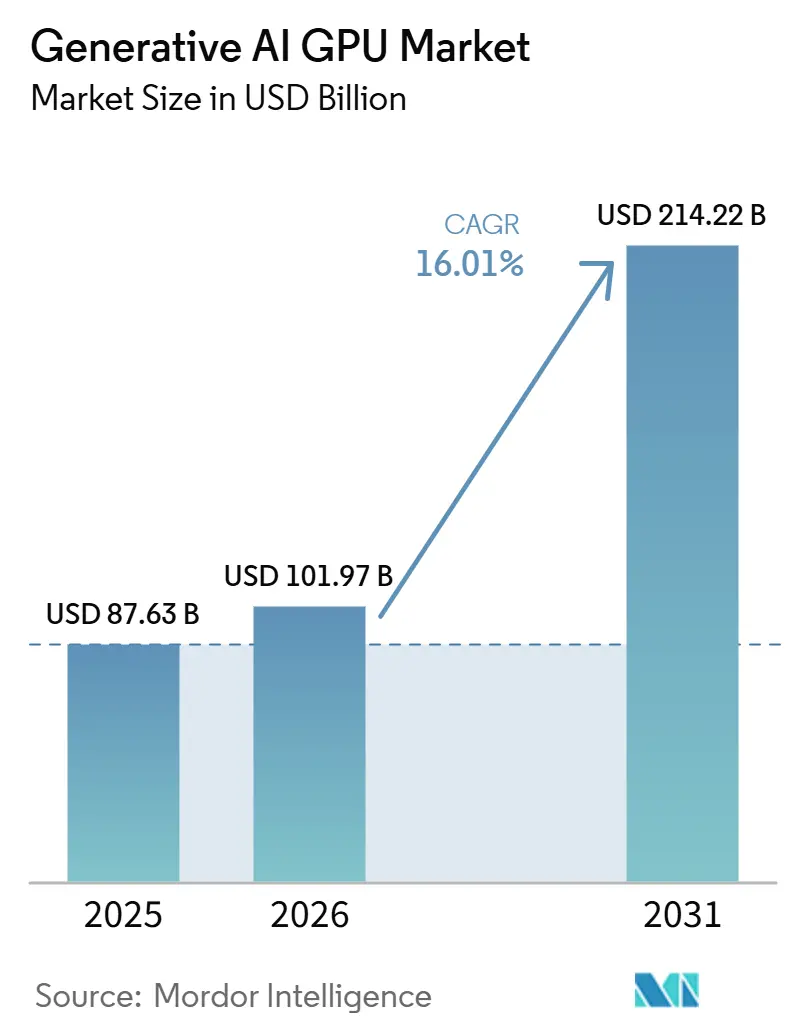
The generative AI GPU market size is projected to expand from USD 87.63 billion in 2025 and USD 101.97 billion in 2026 to USD 214.22 billion by 2031, registering a CAGR of 16.01% between 2026 to 2031. Growth is being shaped by 3 parallel buying groups, hyperscalers that are scaling AI infrastructure, governments that now view compute access as a strategic asset, and enterprises that are moving from short cloud trials to owned capacity for recurring workloads. The market is also benefiting from a clear shift in spending from model development alone to long running inference demand, which keeps GPU fleets active after training cycles end. NVIDIA remains the central competitive force because its hardware, software stack, and supply relationships still define most large-scale deployments, though the inference layer is becoming more contested as alternative accelerators gain traction. Supply conditions remain tight because advanced packaging capacity and HBM availability still limit how quickly funded demand can turn into shipped systems. This leaves room for vendors that can simplify enterprise deployment, support liquid-cooled environments, and offer dedicated infrastructure models outside the largest public clouds.
Key Report Takeaways
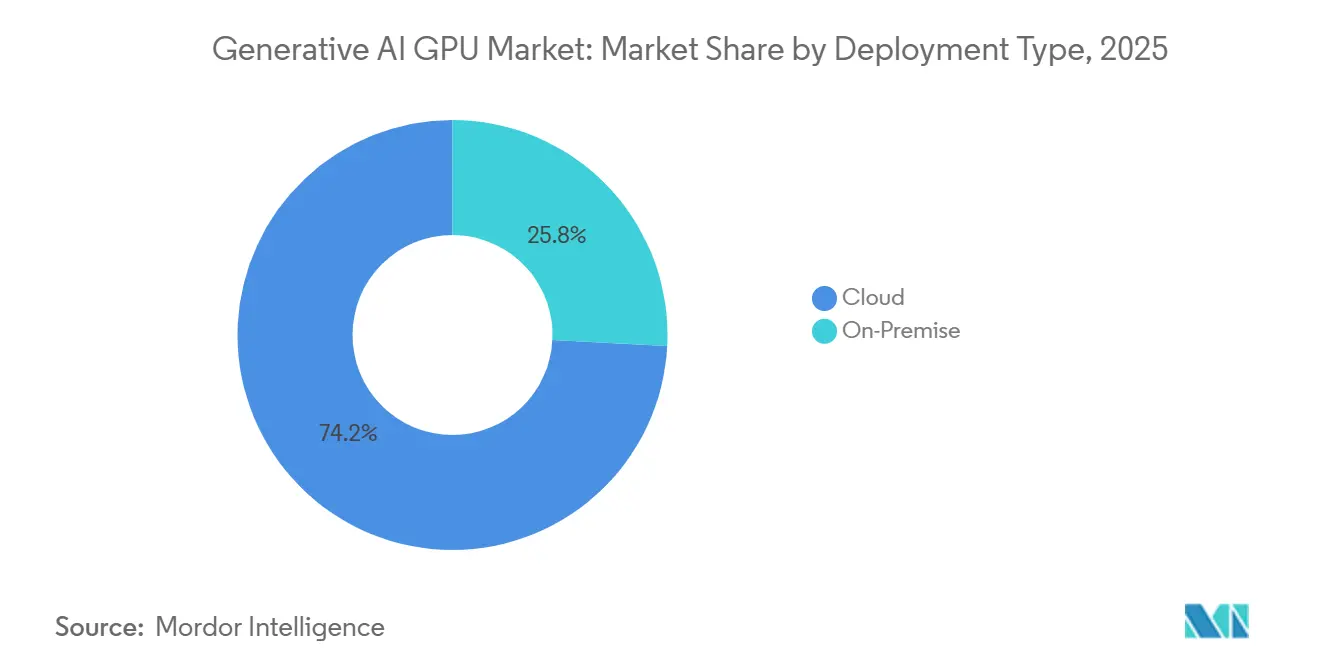
- By deployment type, cloud held 74.19% of revenue of the generative AI GPU market in 2025, while on-premise is projected to expand at a 16.38% CAGR through 2031.
- By function, training accounted for 64.88% of revenue of the generative AI GPU market in 2025, while inference is projected to grow at a 16.97% CAGR through 2031.
- By GPU type, data center training GPUs captured 62.79% of the generative AI GPU market size in 2025, while data center inference GPUs are projected to advance at a 17.11% CAGR through 2031.
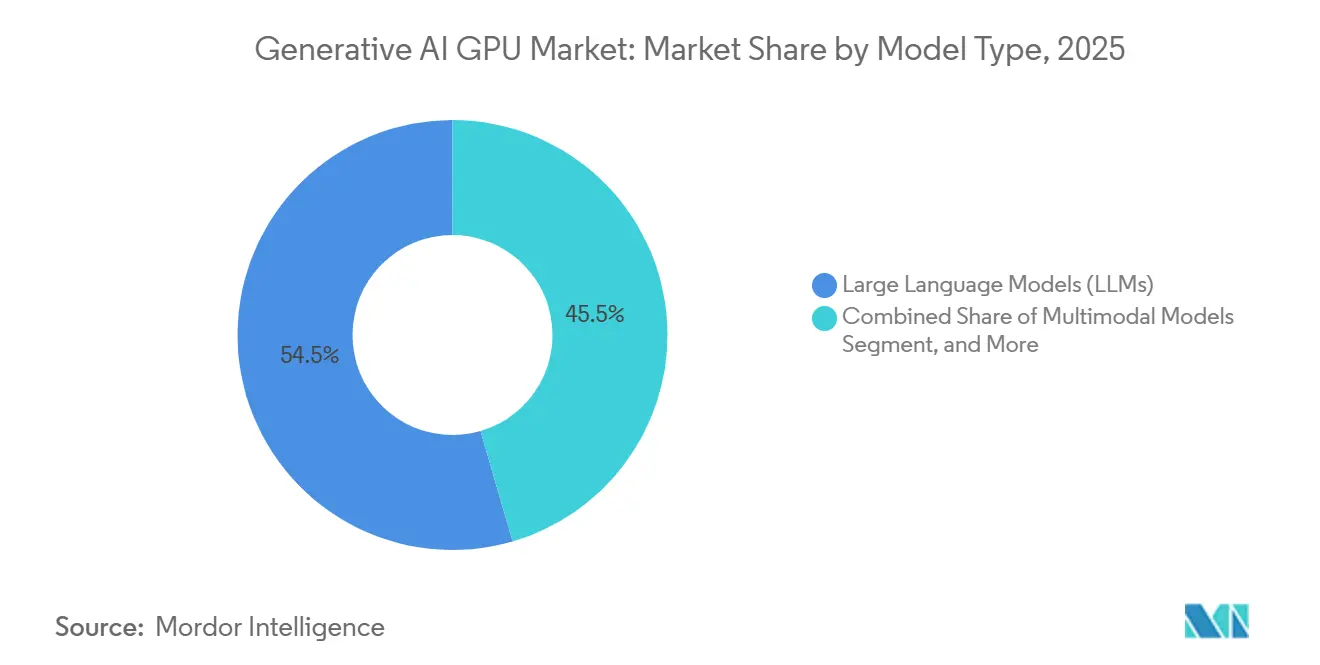
- By model type, large language models held 54.52% of revenue in 2025, while multimodal models are projected to grow at a 17.26% CAGR through 2031.
- By end user, cloud service providers held 58.66% of the generative AI GPU market share in 2025, while enterprises are projected to expand at a 17.07% CAGR through 2031.
- By geography, North America held 46.74% of revenue in 2025, while Asia-Pacific is projected to grow at a 17.36% CAGR through 2031.
Note: Market size and forecast figures in this report are generated using Mordor Intelligence’s proprietary estimation framework, updated with the latest available data and insights as of January 2026.
Market Trends and Insights
Drivers Impact Analysis of Generative AI GPU Market*
| Driver | (~) % Impact on CAGR Forecast | Geographic Relevance | Impact Timeline |
|---|---|---|---|
| Rising Enterprise Demand for Private GenAI Training Clusters | +3.5% | North America, Europe, APAC core | Medium term (2-4 years) |
| Hyperscaler Capex Expansion for Model Training and Inference Infrastructure | +3.0% | Global | Short term (≤ 2 years) |
| Rapid Shift to HBM-Heavy GPU Platforms for Large Model Training | +2.5% | Global | Short term (≤ 2 years) |
| Sovereign AI Programs Accelerating National GPU Procurement | +1.8% | APAC, Europe, North America | Medium term (2-4 years) |
| Liquid Cooling Adoption for High-TDP Generative AI Racks | +1.2% | North America, Europe, APAC core | Medium term (2-4 years) |
| GenAI Inferencing Migration From API Consumption to Owned GPU Capacity | +1.0% | North America and EU, spill-over to APAC | Long term (≥ 4 years) |
| Source: Mordor Intelligence | |||
Rising Enterprise Demand For Private GenAI Training Clusters
Private generative AI infrastructure is moving into standard enterprise capital planning, and that is giving the generative AI GPU market a demand stream that does not depend only on hyperscaler spending. Buyers are focusing on data control, compliance, cost visibility, and the ability to fine tune proprietary models inside controlled environments rather than through third-party processing layers. This shift matters because the generative AI GPU market is now pulling demand from organizations that intend to run continuous internal workloads instead of short experimental projects. The economics also improve as utilization rises, which makes dedicated capacity easier to justify for stable inference and fine-tuning programs.[1] As more vendors package managed private AI systems behind the customer firewall, the generative AI GPU market is likely to see broader enterprise participation without requiring every buyer to build deep in-house infrastructure teams.
Hyperscaler Capex Expansion For Model Training And Inference Infrastructure
The generative AI GPU market remains closely tied to hyperscaler capital spending because the largest training and serving environments still sit inside cloud platforms. These companies are committing capital across multi-generation roadmaps rather than short replacement cycles, which gives the generative AI GPU market stronger demand visibility than a normal semiconductor upgrade pattern. That pattern now extends beyond the GPU itself because large deployments also require networking fabrics, power systems, and data center expansion, which makes each compute order part of a larger infrastructure build. NVIDIA’s fiscal 2026 results show how tightly AI compute and adjacent infrastructure are now linked, with data center revenue reaching USD 193.7 billion and data center networking revenue rising 263% year over year in Q4.[2] The commitment by AWS, Google Cloud, Microsoft Azure, and Oracle Cloud Infrastructure to deploy the Vera Rubin platform shows that the generative AI GPU market is being supported by forward capacity plans rather than one product cycle at a time.
Rapid Shift To HBM-Heavy GPU Platforms For Large Model Training
The generative AI GPU market is being pushed higher by the move to platforms that carry much more HBM per chip than prior generations. Larger context windows, bigger parameter counts, and multimodal model training all increase the value of memory-rich systems, so the generative AI GPU market is not just scaling by unit count; it is also scaling by content per accelerator. NVIDIA states that Blackwell Ultra B300 carries 288 GB of HBM3e per GPU, compared with 80 GB in the H100 generation, which shows how quickly memory intensity has risen. That change strengthens the position of vendors that can secure memory and packaging supply because lower-memory alternatives become less practical for frontier training. It also means the generative AI GPU market will continue to favor premium architectures when buyers need to train more capable models without splitting workloads across less efficient clusters.
Sovereign AI Programs Accelerating National GPU Procurement
Government demand is becoming a more durable part of the generative AI GPU market because national AI programs increasingly treat compute access as strategic infrastructure. Public funding creates a buyer group that is less sensitive to short-term price changes, and that gives the generative AI GPU market another source of multi-year procurement beyond commercial cloud platforms. Canada has committed up to CAD 1.3 billion to public supercomputing infrastructure and an access fund for domestic innovators, which shows that sovereign compute programs now include both hardware buildout and subsidized usage pathways. The UK AI Hardware Plan also allocates dedicated funding for specialized chip procurement within a broader national research resource, reinforcing the policy shift toward domestic compute capability.[3] Once these installations enter service, the generative AI GPU market will likely benefit again when current-generation systems move into scheduled refresh cycles later in the decade.
Restraints Impact Analysis of Generative AI GPU Market*
| Restraint | (~) % Impact on CAGR Forecast | Geographic Relevance | Impact Timeline |
|---|---|---|---|
| Advanced Packaging and HBM Supply Constraints | -2.5% | Global | Short term (≤ 2 years) |
| High Power Density, Cooling, and Facility Upgrade Costs | -1.8% | North America, Europe, APAC core | Medium term (2-4 years) |
| Export Controls and Geopolitical Procurement Restrictions | -1.5% | China, Country Group D:5 entities globally | Short term (≤ 2 years) |
| Custom ASIC Substitution Risk in Inference Workloads | -1.2% | North America and EU, spill-over to APAC | Long term (≥ 4 years) |
| Source: Mordor Intelligence | |||
Advanced Packaging And HBM Supply Constraints
The main supply ceiling for the generative AI GPU market is no longer limited to chip design demand; it is now limited to packaging throughput and memory availability. Even when budgets are approved, orders can still face delays because the generative AI GPU market depends on a narrow set of suppliers for advanced memory and packaging steps that cannot be expanded overnight. NVIDIA’s multiyear memory partnership with SK Hynix reflects how central HBM access has become to future platform rollouts. Planned capacity additions from major memory suppliers target later production windows, which means short-term tightness is still likely to shape availability through the current forecast period. As a result, the generative AI GPU market can show strong order demand while still converting that demand into revenue more slowly than buyers intend.
High Power Density, Cooling, And Facility Upgrade Costs
The generative AI GPU market also faces a deployment bottleneck because next-generation racks require more power and more advanced thermal management than many existing sites can support. This is especially important for the generative AI GPU market because the move from air-cooled rooms to liquid-cooled AI environments adds spending that sits outside the server itself. NVIDIA highlights liquid cooling as a practical requirement for the largest AI systems, and its Rubin generation removes fans entirely, which signals that advanced cooling is becoming part of the standard deployment baseline rather than a niche option. Facility upgrades take time, and they can delay go-live schedules even when compute hardware has already been secured. That creates a second pacing factor for the generative AI GPU market, where demand may exist immediately, but usable capacity comes online only after site retrofits are completed.
*Our forecasts treat driver/restraint impacts as directional, not additive. The impact forecasts reflect baseline growth, mix effects, and variable interactions.
Generative AI GPU Market Segment Analysis
By Deployment Type:
Cloud Revenue Leads While On-Premise Economics StrengthenCloud deployments accounted for 74.19% of the generative AI GPU market in 2025, which kept this model well ahead of on-premise installations by revenue. That lead reflects a long infrastructure advantage built by hyperscalers through earlier GPU data center investment and closer ties to the largest model developers. The cloud model also remains attractive because it lets buyers provision capacity quickly without carrying the full upfront cost of hardware, facility work, and operations. For many organizations, especially those still testing workload patterns, the generative AI GPU market is easiest to access through elastic cloud infrastructure. That access advantage continues to support cloud leadership even as cost discipline becomes a bigger factor in 2026.
On-premise deployments are the fastest-growing segment at 16.38% CAGR through 2026-2031, which shows where the next wave of buyer behavior is shifting. Enterprises that have moved past pilot programs now have better visibility into usage intensity, latency needs, and data handling requirements, so the case for owned capacity is becoming more concrete. Lenovo’s 2026 analysis shows that on-premise systems can reach cost parity with cloud rental at 75% GPU utilization across fleets of more than 50 GPUs, which supports the move toward dedicated infrastructure for stable workloads. The generative AI GPU market is also benefiting from managed private AI platforms, colocation-backed clusters, and subscription-style offers that reduce the operational burden on enterprise buyers. This gives the generative AI GPU industry a broader path into regulated and data-sensitive environments where public cloud dependency is harder to justify over time.
By Function:
Training Revenue Anchors The Market, Inference Redefines Its Growth CurveTraining commanded 64.88% of the generative AI GPU market size in 2025, which shows how much spending is still centered on building frontier models. That share came from the exceptional compute intensity of pre-training large language, vision, and multimodal systems, where each run can consume very large GPU-hour volumes. The early commercial phase of the generative AI GPU market was therefore built on a training-heavy spending mix because the first priority was model creation and capability expansion. Large clusters, premium hardware, and concentrated cloud buying all reinforced that pattern. Training still anchors revenue because the most advanced models continue to require the highest-performance systems available.
Inference is the fastest-growing function at 16.97% CAGR through 2026-2031, and that growth is changing the operating profile of the generative AI GPU market. Once models enter production, they serve users continuously, which means inference demand can last far longer than the original training cycle. Enterprises are also shifting from per-token API spending toward owned or dedicated inference nodes when usage becomes frequent enough to make hardware amortization more attractive. This matters for the generative AI GPU market because inference demand is more geographically distributed than the concentrated training spend inside a small number of hyperscaler campuses. The result is a growth curve that broadens the buyer base while keeping total compute demand elevated after the training phase has already passed.
By GPU Type:
Training Chips Lead By Revenue, Inference GPUs Drive The Fastest GrowthData center training GPUs held 62.79% of the generative AI GPU market revenue in 2025, and that lead came from their role in the largest commercial and research workloads. Frontier training programs still require the highest-end accelerators, and those systems continue to capture the biggest budgets inside hyperscalers and top AI labs. This keeps the generative AI GPU market centered on premium data center platforms even as other compute tiers begin to expand. NVIDIA’s platform roadmap and customer deployment commitments show that buyers continue to prioritize top-end training architectures for state-of-the-art model development. Revenue concentration therefore remains strongest in the training chip category, where capability gaps between generations have direct commercial value.
Data center inference GPUs are the fastest-growing type at 17.11% CAGR through 2026-2031, and this reflects the scale-up of production serving across enterprise and cloud environments. As more models move into active use, the generative AI GPU market is adding demand for systems that are optimized for sustained throughput, lower latency, and better cost per token in serving tasks. NVIDIA’s fiscal 2026 data center networking revenue reached USD 11 billion in Q4, rising 263% year over year, which points to the wider infrastructure stack that high-throughput inference requires. Edge and enterprise AI GPUs remain smaller by revenue, but new workstation-scale offerings are opening a lower-tier access point for teams that want local inference capacity. NVIDIA’s June 2026 rollout of RTX Spark and DGX Station for Windows extends Blackwell-class compute into deskside and edge environments, which supports broader deployment outside the core data center floor.
By Model Type:
LLMs Anchor Current Revenue As Multimodal Models Advance RapidlyLarge language models held 54.52% of the generative AI GPU market in 2025, which reflects their role in the first major wave of commercial deployment. Chatbots, coding assistants, internal knowledge tools, and productivity software drove much of the early spending, and these applications depended heavily on text-generation and reasoning models. That pattern helped make LLM training and tuning the largest revenue pool inside the generative AI GPU market during the first commercialization cycle. Buyers also had clearer deployment paths for LLM use cases than for newer multimodal systems, which supported faster budget approval. As a result, LLMs remained the core revenue anchor even while other model classes gained traction.
Multimodal models are the fastest-growing type at 17.26% CAGR through 2026-2031, and they are increasing the compute intensity of the generative AI GPU market. Unified models that handle text, image, video, audio, and structured data within one architecture require more training work per parameter because they must align multiple data forms inside the same system. That pushes demand toward memory-rich accelerators and stronger interconnect infrastructure, which raises the value of premium hardware configurations. Image and video generation models also remain technically demanding because they involve large sequential workloads and heavy memory pressure during production inference. Speech and audio models stay smaller by total consumption, but their role in contact centers, accessibility tools, and translation services still broadens the generative AI GPU industry across additional real-time use cases.

By End User:
Cloud Providers Dominate Revenue, Enterprises Lead GrowthCloud service providers commanded 58.66% of the generative AI GPU market share in 2025, which reflects their dual role as infrastructure builders and major AI service operators. This vertical position concentrates spending in a limited set of buyers that can deploy at extraordinary scale across training and inference. The generative AI GPU market therefore still depends heavily on the procurement behavior of the largest cloud platforms. Their spending is reinforced by long-term customer demand, direct access to power and data center footprints, and closer relationships with top chip suppliers. That combination kept cloud providers as the largest end-user group by a wide margin in 2025.
Enterprises are the fastest-growing end-user segment at 17.07% CAGR through 2026-2031, and this growth reflects the move from experimentation to production use in sectors such as financial services, healthcare, manufacturing, and retail. The shift is driven by recurring workloads, proprietary datasets, and a stronger preference for predictable latency and compliance control once AI services become business critical. Government and research institutions are also adding demand through sovereign compute initiatives and public research infrastructure programs, including Canada’s national compute strategy and the UK’s dedicated hardware plan. AI model developers and dedicated labs remain smaller in absolute revenue, but they still influence the generative AI GPU market because their benchmark results and early platform adoption help shape hardware roadmaps. This gives the generative AI GPU industry a demand profile where a few very large buyers dominate current spend, while a wider mix of enterprise and public sector users drives the next phase of expansion.
Geography Analysis
North America Generative AI GPU Market
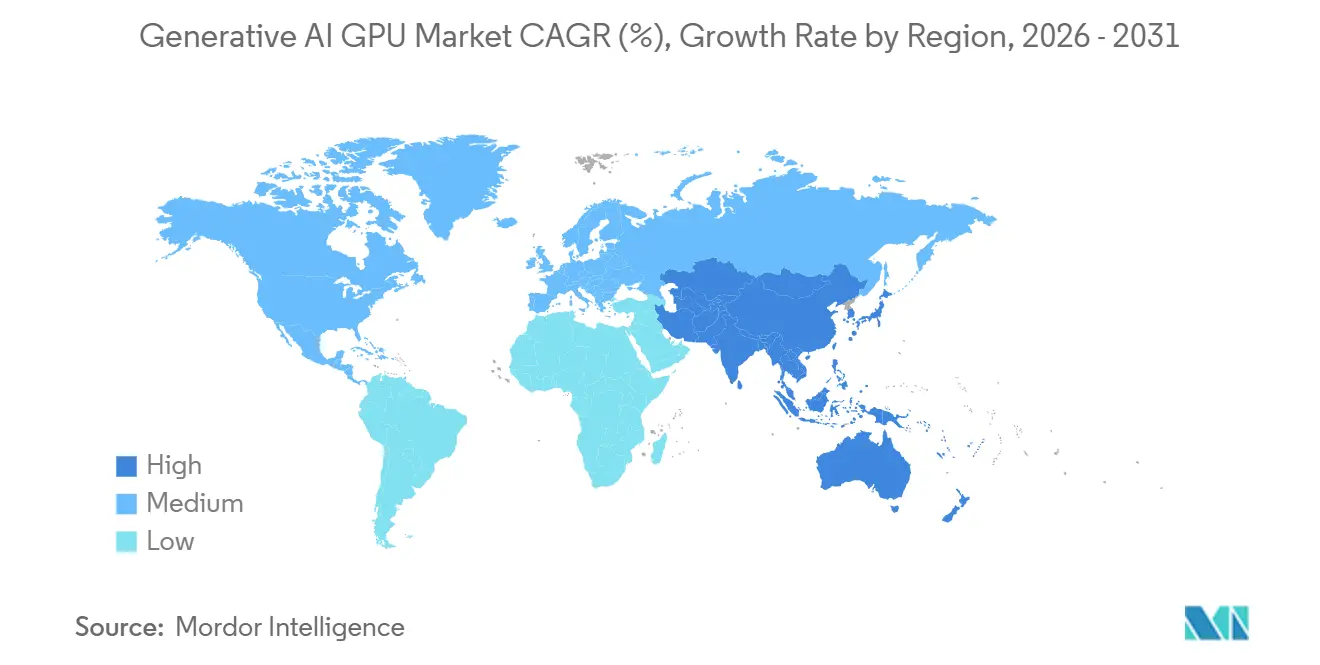
North America held 46.74% of the generative AI GPU market in 2025, which kept it as the clear revenue leader by region. The region benefits from the concentration of hyperscaler headquarters, frontier AI labs, and GPU-optimized data center capacity within the United States. That combination gives the generative AI GPU market its deepest commercial base in North America because procurement, software development, and infrastructure deployment are closely linked there. Large cloud platforms also continue to secure a major share of next-generation allocation, which supports the region’s lead in both training and production inference environments. Canada adds a public compute layer through its sovereign AI compute strategy, which complements the commercial strength of the broader regional market.
Europe Generative AI GPU Market
Europe remains important to the generative AI GPU market because demand is shaped by both public investment and regulatory pressure around data handling and model oversight. Compliance requirements under the EU AI Act support interest in domestic and on-premise deployments, especially among regulated sectors that prefer tighter control over where processing occurs. France has made one of the region’s largest national AI infrastructure commitments, which is expected to support future data center buildout and GPU procurement. The UK also formalized its hardware plan with funding for specialized chip procurement inside its broader AI research resource, showing that national compute capability is now an explicit policy target.
APAC, South America and MEA Generative AI GPU Market
Asia-Pacific is the fastest-growing regional segment at 17.36% CAGR through 2026-2031, and this gives it the most rapid expansion path within the generative AI GPU market size over the forecast period. Growth is being supported by sovereign AI programs, local hyperscaler investment, and rising interest in domestic alternatives where export restrictions affect access to leading U.S. hardware. The generative AI GPU market in China is developing under a different policy setting because U.S. export controls continue to shape procurement routes and encourage local accelerator development. That divergence matters because it creates separate competitive tracks within Asia-Pacific, one centered on imported premium systems and another centered on domestic substitutes. South America and the Middle East and Africa remain earlier-stage regions in the generative AI GPU market, though sovereign investment and local data center expansion could support stronger procurement volumes later in the forecast period.
Competitive Landscape
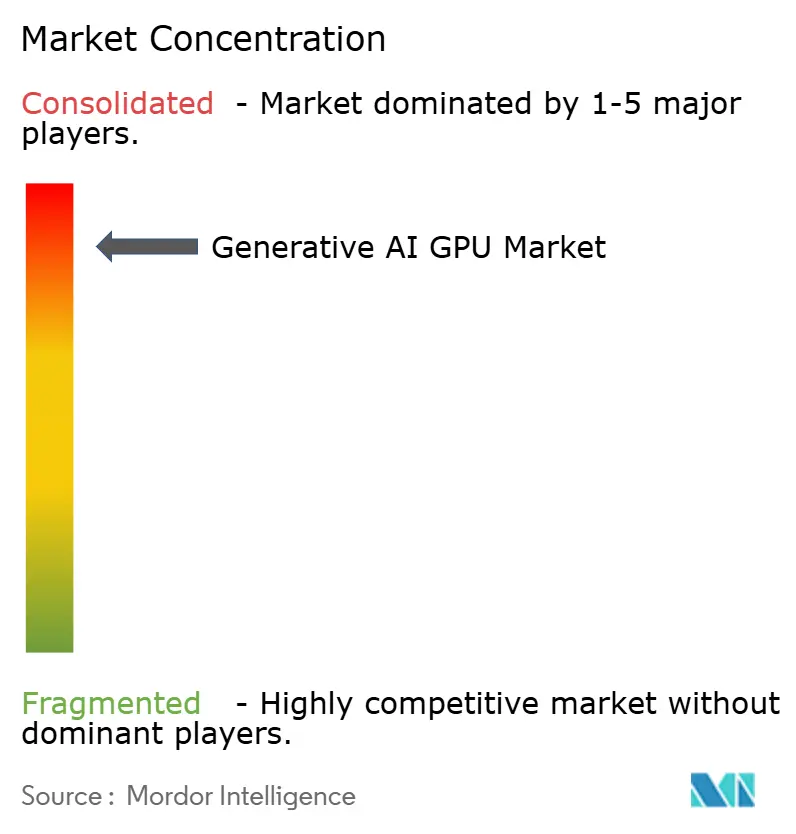
The generative AI GPU market remains highly concentrated at the chip design layer, with NVIDIA still defining the performance standard, software environment, and much of the supply structure for large deployments. The company held approximately 92% of the discrete data center AI accelerator market in 2025, and its fiscal 2026 data center revenue reached USD 193.7 billion, which underscores how strongly current demand is centered on its platform. NVIDIA’s advantage comes from more than silicon alone because CUDA, NVLink, networking, and supplier alignment all reinforce adoption inside the generative AI GPU market. Its March 2026 Vera Rubin launch also showed broad customer support from AWS, Google Cloud, Microsoft Azure, Oracle Cloud Infrastructure, and major AI labs, which extends that position into the next platform cycle. This makes the generative AI GPU market hard to dislodge at the training tier, where ecosystem dependence is still strongest.
AMD remains the most credible direct challenger in the generative AI GPU market because it is securing large-scale commitments from major AI buyers. Its October 2025 partnership with OpenAI to deploy 6 gigawatts of AMD GPUs showed that a frontier AI lab is willing to commit meaningful capacity to a non-NVIDIA roadmap. At the same time, the inference side of the generative AI GPU market is attracting more custom silicon efforts from Google, Amazon, Microsoft, and Meta, where workload specialization can matter more than full CUDA compatibility. NVIDIA’s NVLink Fusion approach, previewed at Microsoft Build, is strategically important because it creates a way for custom ASICs to interoperate with NVIDIA-centered infrastructure instead of forcing full replacement. That matters because the generative AI GPU market is likely to diversify first in inference, where buyers can prioritize cost per token and specific serving patterns more than training flexibility.
Specialized cloud GPU providers are also gaining relevance in the generative AI GPU market by serving buyers that cannot secure enough allocation through the largest hyperscalers. CoreWeave’s January 2026 expansion with NVIDIA, targeting more than 5 gigawatts of AI factory capacity by 2030, shows how dedicated providers are turning infrastructure access into a competitive product in its own right. CoreWeave then became the first AI cloud provider to bring up the Vera Rubin NVL72 platform, supported by its own cooling and rack control innovations, which signals that service differentiation in the generative AI GPU market now includes facility engineering as well as hardware access. At the same time, memory suppliers such as Samsung, SK Hynix, and Micron remain essential to the supply chain but are not direct end-market competitors, while Graphcore no longer stands as an independent force after its acquisition. More relevant secondary challengers include inference-focused accelerator designers and major GPU-consuming AI labs, because these groups are shaping where the generative AI GPU market could fragment first. The clearest white space remains enterprise inference services that combine hardware, cooling, cluster software, and long-term support into one managed offer.
Generative AI GPU Industry Leaders
-
NVIDIA Corporation
-
Advanced Micro Devices, Inc.
-
Intel Corporation
-
Google LLC
-
Amazon Web Services, Inc.
- *Disclaimer: Major Players sorted in no particular order
Generative AI GPU Market Companies Covered in this Report
- NVIDIA Corporation
- Advanced Micro Devices, Inc.
- Intel Corporation
- Google LLC
- Amazon Web Services, Inc.
- Microsoft Corporation
- Huawei Technologies Co., Ltd.
- Baidu, Inc.
- Groq, Inc.
- xAI Corp.
- Marvell Technology, Inc.
- Cerebras Systems, Inc.
- Tenstorrent Inc.
- Mistral AI
- Qualcomm Incorporated
- IBM Corporation
- CoreWeave, Inc.
- Oracle Corporation
- Alibaba Group Holding Limited
- Tencent Holdings Limited
- Lambda, Inc.
Recent Industry Developments in Generative AI GPU Market
- June 2026: CoreWeave set a record in MLPerf Training v6.0, training the DeepSeek-V3 671B model in approximately 2.02 minutes on 8,192 NVIDIA GB300 NVL72 GPUs, the largest GB300 cluster submitted in the round, demonstrating the frontier performance ceiling of current-generation GPU cluster infrastructure and validating the GB300 platform for the most computationally demanding publicly benchmarked models.
- June 2026: NVIDIA and Microsoft announced a unified stack partnership for agentic AI deployment at Microsoft Build, spanning Windows devices, Azure cloud, and enterprise edge hardware, the partnership includes NVIDIA RTX Spark, DGX Station for Windows, NVIDIA-accelerated Microsoft Fabric, and Azure validation of the Vera Rubin platform, positioning GPU-accelerated compute as the baseline for enterprise AI agent infrastructure.
- May 2026: CoreWeave launched its unified agentic AI platform on May 28, 2026, creating a closed training-to-inference feedback loop for autonomous agent improvement, the platform enables enterprises to systematically improve agent reliability and capability over time using reinforcement learning and production inference within a unified GPU infrastructure environment.
- May 2026: CoreWeave completed the industry-first bring-up and validation of the NVIDIA Vera Rubin NVL72 as the first AI cloud provider to operationalize the rack-scale platform, deploying a patent-pending Valvey cooling system and a unified Racky rack controller as proprietary innovations enabling customer-accessible Vera Rubin deployments at production scale.
Global Generative AI GPU Market Report Scope
The Generative AI GPU Market refers to the market for GPUs used to train, fine-tune, and run generative AI models that create text, images, audio, video, and code. It includes high-performance accelerator hardware, memory, and supporting software stacks optimized for large model training and inference.
The Generative AI GPU Market Report is Segmented by Deployment Type (Cloud, and On-Premise), Function (Training, and Inference), GPU Type (Data Center Training, Inference, and Edge and Enterprise AI GPUs), Model Type (LLMs, Multimodal, Image/Video, and Speech and Audio Models), End User (Cloud Service Providers, Enterprises, Government and Research Institutions, and AI Model Developers and AI Labs), and Geography (North America, Europe, Asia-Pacific, South America, MEA). The Market Forecasts are Provided in Terms of Value (USD).
Segmentation Overview
| Cloud |
| On-Premise |
| Training |
| Inference |
| Data Center Training GPUs |
| Data Center Inference GPUs |
| Edge and Enterprise AI GPUs |
| Large Language Models (LLMs) |
| Multimodal Models |
| Image and Video Generation Models |
| Speech and Audio Models |
| Cloud Service Providers |
| Enterprises |
| Government and Research Institutions |
| AI Model Developers and AI Labs |
| North America | United States |
| Canada | |
| Mexico | |
| Europe | Germany |
| United Kingdom | |
| France | |
| Italy | |
| Rest of Europe | |
| Asia-Pacific | China |
| Japan | |
| South Korea | |
| India | |
| Southeast Asia | |
| Rest of Asia-Pacific | |
| South America | |
| Middle East and Africa |
| By Deployment Type | Cloud | |
| On-Premise | ||
| By Function | Training | |
| Inference | ||
| By GPU Type | Data Center Training GPUs | |
| Data Center Inference GPUs | ||
| Edge and Enterprise AI GPUs | ||
| By Model Type | Large Language Models (LLMs) | |
| Multimodal Models | ||
| Image and Video Generation Models | ||
| Speech and Audio Models | ||
| By End User | Cloud Service Providers | |
| Enterprises | ||
| Government and Research Institutions | ||
| AI Model Developers and AI Labs | ||
| By Geography | North America | United States |
| Canada | ||
| Mexico | ||
| Europe | Germany | |
| United Kingdom | ||
| France | ||
| Italy | ||
| Rest of Europe | ||
| Asia-Pacific | China | |
| Japan | ||
| South Korea | ||
| India | ||
| Southeast Asia | ||
| Rest of Asia-Pacific | ||
| South America | ||
| Middle East and Africa | ||
Key Questions Answered in the Report
What is the current and forecast value of the generative AI GPU market?
The generative AI GPU market reached USD 87.63 billion in 2025, stands at USD 101.97 billion in 2026, and is forecast to reach USD 214.22 billion by 2031 at a 16.01% CAGR.
Which deployment model leads spending in generative AI GPU demand?
Cloud led with 74.19% of revenue in 2025 because hyperscalers still offer the fastest access to large GPU fleets and the deepest AI-ready infrastructure.
Why is inference becoming more important than before?
Inference is projected to grow at 16.97% CAGR through 2031 because deployed models serve users continuously, which creates durable compute demand after training cycles end.
Which model category is expanding the fastest?
Multimodal models are expected to grow at 17.26% CAGR through 2031 because they combine text, image, video, audio, and structured data, which raises compute and memory needs.
Which buyer group is growing the fastest?
Enterprises are projected to expand at 17.07% CAGR through 2031 as more organizations move from pilot projects to production workloads that favor owned or dedicated GPU capacity.
Which region is growing the fastest in GPU demand for generative AI?
Asia-Pacific is projected to grow at 17.36% CAGR through 2031, supported by sovereign compute programs, domestic hyperscaler investment, and shifting procurement patterns tied to export controls.