
GCC Labels And Release Liners Market Size and Share
Market Overview
| Study Period | 2020 - 2031 |
|---|---|
| Forecast Data Period | 2026 - 2031 |
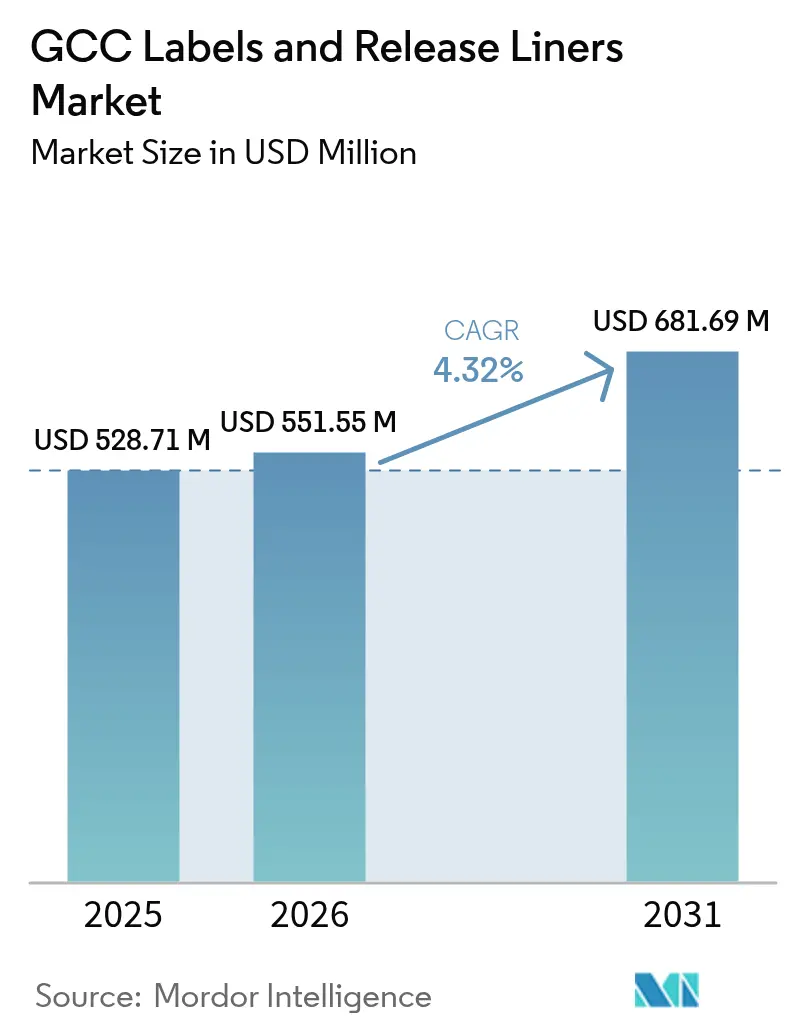
| Base Year Market Size (2025) | USD 528.71 Million |
| Market Size (2026) | USD 551.55 Million |
| Market Size (2031) | USD 681.69 Million |
| Growth Rate (2026 - 2031) | 4.32 % |
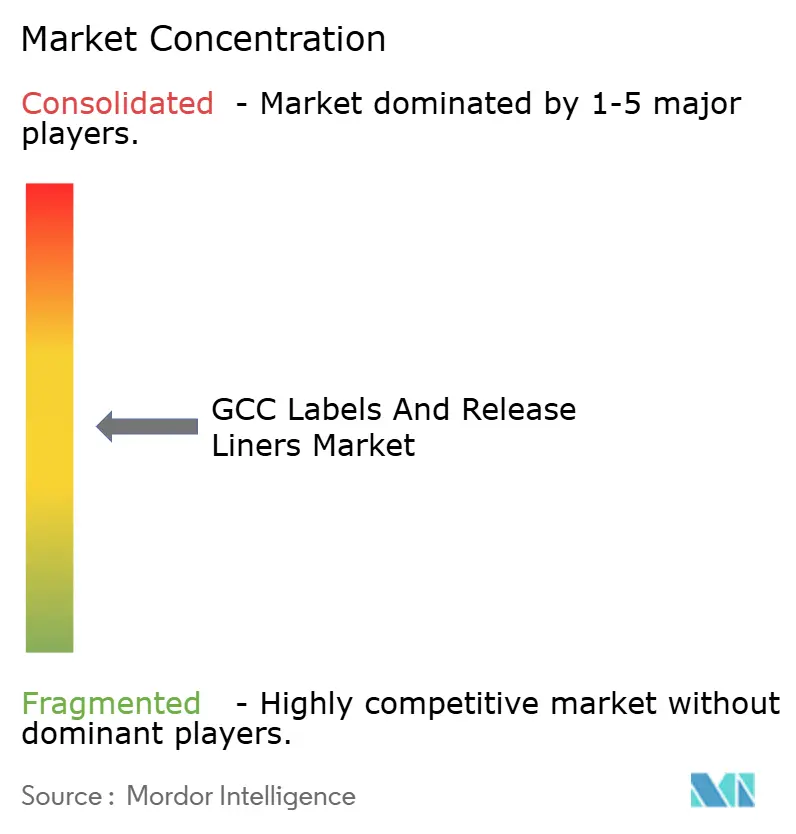
| Market Concentration | Medium |
Major Players *Disclaimer: Major Players sorted in no particular order Image © Mordor Intelligence. Reuse requires attribution under CC BY 4.0. | |
GCC Labels And Release Liners Market Analysis by Mordor Intelligence
The GCC labels and release liners market size was valued at USD 528.71 million in 2025 and estimated to grow from USD 551.55 million in 2026 to reach USD 681.69 million by 2031, at a CAGR of 4.32% during the forecast period (2026-2031). This expansion aligns with national diversification programs that channel industrial capital into food, beverage, cosmetics, and pharmaceutical lines, all of which require data-rich, multilingual labels. Demand also benefits from fast-growing e-commerce operations that need variable-data shipping labels and from petrochemical investments that secure regional film supply. Technical mandates such as the Gulf health authorities’ 2025 QR-code serialization rules add further volume by increasing the number of labels per unit dose. Against this backdrop, pressure-sensitive constructions remain dominant; however, shrink sleeves, film liners, and digitally printed short runs are posting the fastest gains as converters shift toward premium aesthetics, sustainability, and just-in-time fulfillment. Strategic opportunities, therefore, concentrate on hybrid presses, mono-material films, and turnkey e-labeling platforms that connect QR codes to regulator-hosted instructions.
Key Report Takeaways
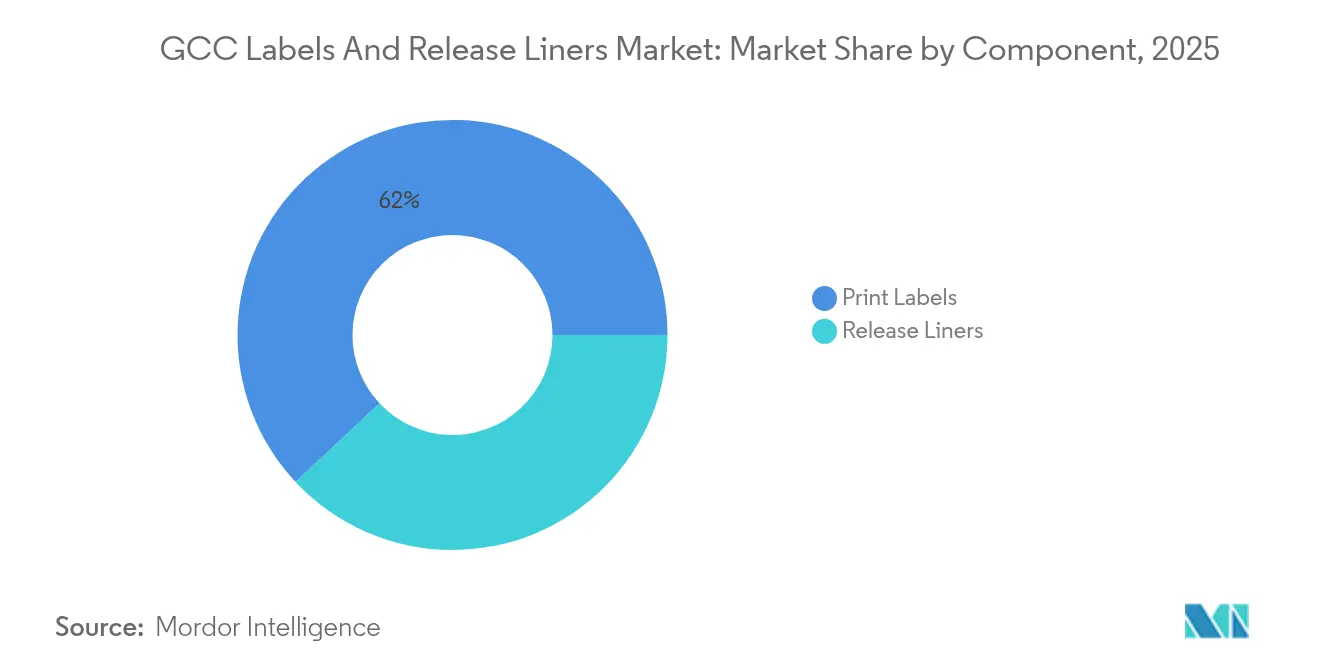
- By component, print labels held 61.98% of the GCC labels and release liners market share in 2025, while release liners are projected to advance at a 5.42% CAGR through 2031.
- By face stock material, paper accounted for 53.92% of the GCC labels and release liners market size in 2025, whereas film liners are expected to expand at a 5.86% CAGR to 2031.
- By print process, flexography led with a 35.21% revenue share in 2025; digital presses are projected to register the highest CAGR at 6.61% through 2031.
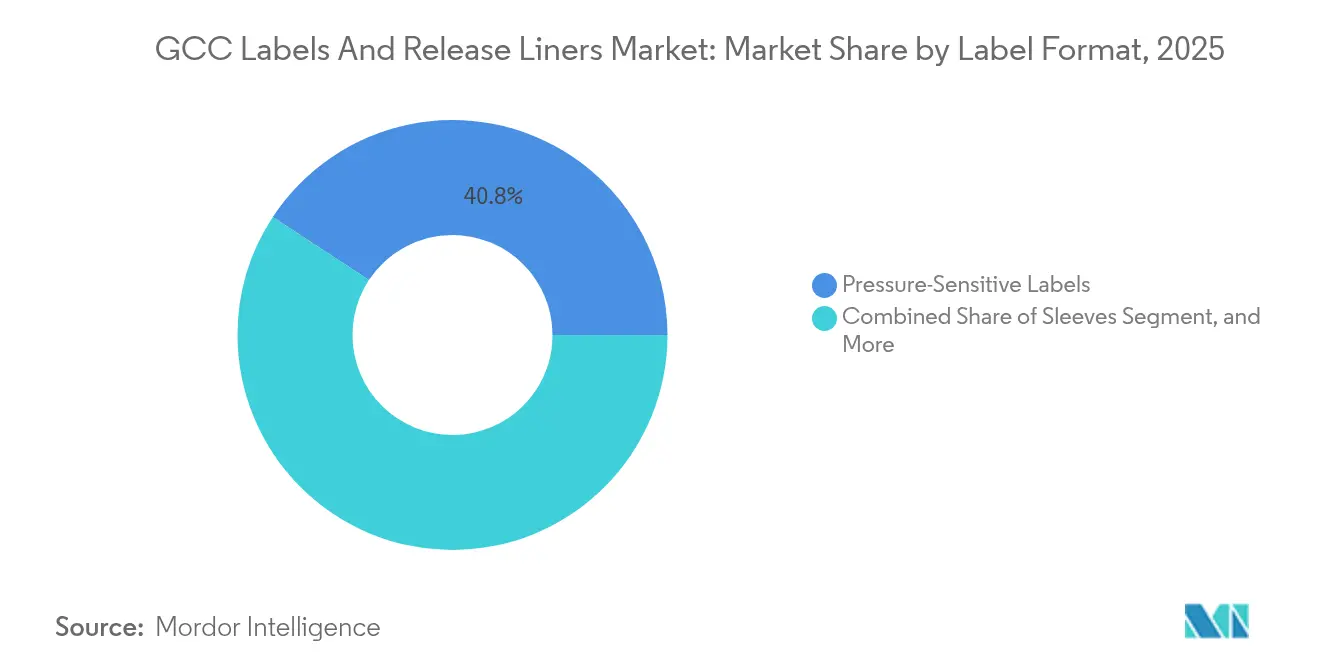
- By label format, pressure-sensitive labels commanded a 40.75% share of the GCC labels and release liners market size in 2025; shrink sleeves are projected to grow at 5.21% annually through 2031.
- By end user, food retained a 28.15% share of the GCC labels and release liners market size in 2025; whereas cosmetics is the fastest-growing segment with a 6.44% CAGR between 2026 and 2031.
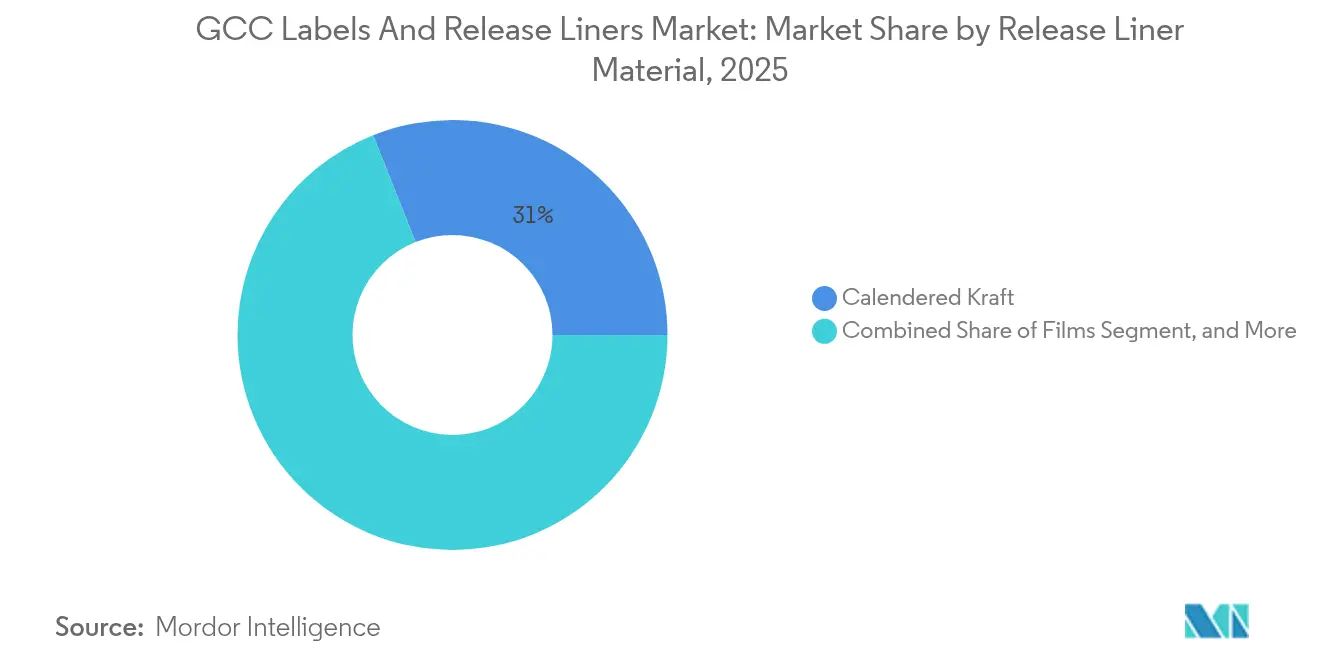
- By release liner material, calendered kraft paper captured a 31.02% share of the GCC labels and release liners market size in 2025; while films are projected to rise at a 5.61% CAGR through 2031.
- By release liner application, labels accounted for 46.21% share of the GCC labels and release liners market size in 2025; medical use cases are projected to record a 6.73% CAGR through 2031.
- By country, Saudi Arabia held 59.97% of the GCC labels and release liners market share in 2025; however, the United Arab Emirates showed the fastest pace at a 6.58% CAGR through 2031.
Note: Market size and forecast figures in this report are generated using Mordor Intelligence’s proprietary estimation framework, updated with the latest available data and insights as of 2026.
Market Trends and Insights
Drivers Impact Analysis of GCC Labels And Release Liners Market*
| Driver | (~) % Impact on CAGR Forecast | Geographic Relevance | Impact Timeline |
|---|---|---|---|
| Rapid Growth of Cosmetics, Food and Beverages Sectors | +1.2% | Saudi Arabia, United Arab Emirates, Qatar | Medium term (2-4 years) |
| Expansion of E-Commerce Packaging Demand | +0.9% | United Arab Emirates, Saudi Arabia, Qatar, Bahrain | Short term (≤ 2 years) |
| Rise of Smart Labels for Track-and-Trace | +0.8% | Saudi Arabia, United Arab Emirates | Short term (≤ 2 years) |
| Government Vision-2030 Diversification Initiatives | +1.1% | Saudi Arabia, United Arab Emirates | Long term (≥ 4 years) |
| Surge in Halal-Certified Export Labeling | +0.5% | Saudi Arabia, United Arab Emirates | Medium term (2-4 years) |
| Petrochemical Film Capacity Investments in GCC | +0.7% | Saudi Arabia, United Arab Emirates | Medium term (2-4 years) |
| Source: Mordor Intelligence | |||
Rapid Growth of Cosmetics, Food, and Beverages Sectors
Middle East and North Africa beauty sales are on track to reach USD 60 billion by 2025, up from USD 46 billion, which is expected to boost regional demand for premium sleeves, metallic foils, and halal-certified pressure-sensitive labels.[1]PwC Middle East, “MENA Beauty Report,” PWC.COM The Saudi Food and Drug Authority reduced product-registration lead times in 2024, enabling brands such as Asteri to obtain export clearance to 15 markets within six months. Parallel food investments amplify volume: Almarai allocated USD 4.8 billion for new dairy, juice, and bakery lines through 2028, and Nestlé opened a USD 72 million plant in Jeddah in 2025. Dubai Industrial City added AED 350 million (USD 95.3 million) in food-and-beverage capital during 2024, bringing 25 new tenants and millions of square feet under lease. Combined, these expansions ensure dependable throughput for the GCC labels and release liners market, as brands seek multilingual nutrition panels, tamper-evident packaging, and premium shelf appeal.
Expansion of E-Commerce Packaging Demand
Gulf online retail sales are forecast to hit USD 63 billion by 2027, with Saudi Arabia contributing USD 24 billion by 2029.[2]McKinsey and Company, “GCC E-Commerce Growth Forecast,” MCKINSEY.COM E-tailers need durable shipping labels that carry QR codes, order IDs, and personalized messages. Saudi Graphco installed Durst, Xeikon, and Gallus digital presses in 2024, promising a 24-hour turnaround for runs of less than 1,000 units. The United Arab Emirates leverages Al Maktoum International Airport, Jebel Ali Port, and Etihad Rail to consolidate fulfillment, attracting converters that bundle printing, kitting, and customs-compliant labeling under one roof. New customs rules, which expand tariff lines to 13,400 items in 2025, intensify the need for accurate duty declarations on every parcel. These dynamics steer converters toward high-speed digital workflows, reinforcing the growth of the GCC labels and release liners market.
Rise of Smart Labels for Track-and-Trace
Gulf regulators now require QR-coded electronic leaflets for drugs and devices, with the UAE’s Tatmeen platform insisting on unique identifiers for every unit dose.[3]UAE Ministry of Health and Prevention, “Tatmeen Platform,” MOHAP.GOV.AE Converters therefore invest in 2D code verification, secure short-link creation, and high-resolution printing that guarantees 600 dpi readability. RFID use is spreading beyond healthcare: The Landmark Group equipped more than 600 stores with smart tags in 2024, reducing shrinkage and inspiring similar projects in the grocery and apparel sectors. Logistics providers add NFC chips to pallet labels to automate customs clearance, aligning with Saudi Arabia’s goal to rank among the world’s top 25 logistics performers by 2030. These requirements favor film liners that tolerate wide temperature swings and resist moisture, stimulating premium revenue streams within the GCC labels and release liners market.
Government Vision-2030 Diversification Initiatives
Saudi Arabia plans to scale to 36,000 factories by 2035, backed by the USD 100 billion Alat fund for electronics, renewables, and automotive clusters. The UAE’s Make in UAE and Dubai Agenda D33 grant 10-year tax holidays and full foreign ownership, luring over 1,100 tenants to Dubai Industrial City by 2024. Every new facility needs safety labels, asset tags, and supply-chain tracking that conform to GS1 and ISO standards. The Mohammed bin Rashid School of Government noted double-digit improvements in diversification scores for Saudi Arabia and Oman between 2000 and 2022, confirming structural momentum. Converters offering design, print, and compliance services within a single workflow are well-positioned to win long-term contracts, thereby anchoring the growth of the GCC labels and release liners market.
Restraints Impact Analysis of GCC Labels And Release Liners Market*
| Restraint | (~) % Impact on CAGR Forecast | Geographic Relevance | Impact Timeline |
|---|---|---|---|
| Volatility in Crude-Based Raw Material Prices | -0.6% | Saudi Arabia, United Arab Emirates | Short term (≤ 2 years) |
| Competitive Pressure from Digital Media | -0.3% | United Arab Emirates, Saudi Arabia | Medium term (2-4 years) |
| Import Duties on Adhesives and Chemicals | -0.4% | GCC-wide | Short term (≤ 2 years) |
| Limited Skilled Workforce for Advanced Converting | -0.5% | Saudi Arabia, United Arab Emirates, Qatar | Long term (≥ 4 years) |
| Source: Mordor Intelligence | |||
Volatility in Crude-Based Raw Material Prices
Saudi Arabia raised petrochemical feedstock prices in 2024, squeezing adhesive and film margins and resulting in a 92.5% profit drop at the National Company for Manufacturing Packaging Materials. Crude oil jumped from USD 70 to USD 90 per barrel during 2024, lifting acrylic adhesive and PET resin costs by up to 20%. Red Sea shipping disruptions added roughly 60% to freight charges and extended transit times by up to 14 days, forcing converters to reassess their global sourcing strategies. Larger players with backward integration, such as Borouge, which will reach 6.6 million tonnes per annum of polymer capacity by 2028, can buffer volatility, but small converters remain exposed. Although anti-dumping duties on Asian film imports may stabilize prices, relief is unlikely before existing inventories clear.
Competitive Pressure from Digital Media
Domino Printing Sciences unveiled a bottle-closure printer in July 2024 that etches QR codes directly onto caps at a rate of 44,000 units per hour, potentially displacing external labels in beverage categories. Consumer electronics brands are embedding NFC chips in cartons to deliver manuals and recycling guides, thereby reducing the need for paper labels. Gulf Print and Pack 2024 showcased AI workflows and direct-to-substrate presses capable of decorating corrugated, metal, and glass substrates, thereby eroding volumes for commodity wet-glue labels. Converters are responding with tamper-evident holograms, temperature-reactive inks, and augmented-reality triggers, but margin pressure persists as some brand owners test labelless packaging.
*Our forecasts treat driver/restraint impacts as directional, not additive. The impact forecasts reflect baseline growth, mix effects, and variable interactions.
GCC Labels And Release Liners Market Segment Analysis
By Component:
Release Liners Gain as Medical Serialization AcceleratesRelease liners garnered incremental attention in 2025 as pharmaceutical and medical device producers prepared for unit-level serialization. Although print labels represented 61.98% of revenue, liner consumption grew faster because every tamper-evident pharmaceutical label includes a silicone-coated backing. Saudi Arabia’s serialization rules have added millions of blister packs, vials, and syringes to the annual output, each requiring high-grade release liners that can tolerate clean-room handling. Converters with ISO 13485 certification now process 10-15 tonnes of liner per new packaging line, driving steady uptake within the GCC labels and release liners market.
Looking ahead, the shift toward thinner liners and recyclable polypropylene films is set to favor integrated suppliers that control silicone coating, slitting, and die-cutting under one roof. Smaller printers may continue to focus on high-volume food and beverage labels, but margins will lag as commodity prices fluctuate. Strategic investment, therefore, tends to focus on specialty coatings and medical clean-room facilities, where entry barriers are steep, and contract durations are long.



By Face Stock Material:
Films Ride Sustainability and Durability TrendsPaper retained a 53.92% share in 2025 due to its printability and cost advantage, while film liners achieved a 5.86% CAGR, driven by their strength in moisture resistance, transparency, and recyclability. SABIC’s TRUCIRCLE resins and Taghleef’s BOPP with recycled content help brand owners meet emerging extended producer responsibility mandates in export markets. Mono-material laminates from Borealis simplify mechanical recycling, a feature prized by the beverage and cosmetics industries seeking circular credentials.
Future demand centers on shrink sleeves, in-mold labels, and logistics tags that are exposed to temperature swings and condensation. Polyethylene films conform to complex bottle shapes in shrink tunnels, while PET films deliver dimensional stability for high-speed die-cutting. The GCC labels and release liners market, therefore, shows a gradual shift away from paper, although paper will remain entrenched in ambient-storage groceries, where tactile appeal and compostable options still resonate with consumers.
By Print Process:
Digital Presses Capture Short-Run and Variable-Data DemandFlexography led with 35.21% revenue in 2025, yet digital presses posted a 6.61% CAGR, propelled by e-commerce, personalization, and mandated QR codes. Saudi Graphco’s Durst and Xeikon lines now turn around orders under 24 hours, shrinking lead times that once discouraged regional fulfillment centers. The latest digital engines run at nearly 40 meters per minute with inline inspection, making them cost-competitive for batches up to 5,000 linear meters.
Gravure holds a niche status for ultra-long shrink-sleeve runs, while offset supports luxury cosmetics that require metallic inks and fine screens. Screen and hot-foil processes serve under 5% of demand, positioning hybrid presses analog color with digital variable heads as the middle-volume solution. As variable-data requirements expand, the digital share of the GCC labels and release liners market is set to climb even faster after 2027.
By Label Format:
Sleeves Gain Premium Shelf PresencePressure-sensitive formats controlled 40.75% of the value in 2025, due to their application speed and compatibility with legacy filling lines. Shrink sleeves, however, are registering a 5.21% CAGR because beverages and cosmetics value 360-degree graphics and built-in tamper evidence. Pure Ice Cream’s forthcoming Dubai facility highlights this shift, allocating new lines to premium tubs wrapped in full-body sleeves. Wet-glue labels remain the low-cost choice for mass-produced water bottles, but their edge is narrowing as PS adhesives now run at comparable line speeds.
In-mold labeling enables seamless recycling by embedding graphics during the molding process. SABIC has pioneered PP resins that enable the entire container and label to be reintroduced into the polyolefin waste stream, a distinct advantage in the face of looming plastic taxes. Looking forward, converters that master multi-format portfolios will capture growth as brands mix PS, sleeve, and IML solutions across SKU ranges within the GCC labels and release liners market.
By End User Industry:
Cosmetics Outpace Food as Fastest-Growing SegmentFood held a 28.15% share in 2025 and continues to produce the largest square-meter volume of labels. Cosmetics, however, is expanding at a rate of 6.44% per year, benefiting from regional beauty spending, export ambitions, and halal certification rules. New cosmetic lines often demand high-definition imagery, tactile varnish, and metallic accents that command premiums over commodity labels. Beverage packaging is enjoying demographic tailwinds, particularly for flavored water and energy drinks that utilize shrink sleeves to stand out on crowded shelves.
Healthcare labels grow steadily thanks to serialization mandates. Avalon Pharma, Acino, and other producers now specify tamper-evident constructions with UV-fluorescent ink and microtext, elevating technical complexity. Industrial end uses such as lubricants, building chemicals, and logistics require solvent-resistant adhesives and durable films, providing a hedge against economic fluctuations in consumer categories.
By Release Liner Material:
Films Advance on Silicone-Coating EfficiencyCalendered kraft paper secured a 31.02% share in 2025 due to its low cost and acceptable stiffness in food labels. Film liners, although smaller today, exhibit a 5.61% CAGR as converters utilize thinner gauges that reduce waste and increase press speeds. PET and PP films maintain dimensional stability, enabling precise die-cutting at 200 meters per minute, a must for high-output pharmaceutical lines. Borouge’s agreement to supply 100% recycled polypropylene underscores momentum toward circular alternatives that satisfy multinational sustainability scorecards.
Specialty papers with fluoropolymer coatings or antistatic treatments serve electronics and medical niches where release force tolerance is critical. The investment hurdle for silicone coating on thin films tends to screen out smaller players, intensifying consolidation. As more healthcare and electronics plants start up, films are expected to gain share within the GCC labels and release liners market.
By Release Liner Application:
Medical Serialization Drives Fastest GrowthLabels accounted for 46.21% of release-liner tonnage in 2025, reflecting their pervasive use across consumer and industrial products. Medical applications, however, exhibit the fastest growth, at 6.73%, driven by Gulf serialization rules that require the addition of unique identifiers to every blister and vial. Each sterile package often requires a multi-layer label with overt and covert security features, pushing up liner demand.
Tapes find stable demand in construction, automotive, and electronics assembly, where double-sided adhesives bond plastics, metals, and composites. Industrial protective films safeguard glass, metals, and composite panels during fabrication and shipping, a segment likely to grow as new factories emerge under Vision 2030. Graphic films round out demand with vehicle wraps and retail signage that leverage cast-vinyl liners for conformability over complex curves.
Geography Analysis
Saudi Arabia Labels and Release Liners Market
Saudi Arabia generated 59.97% of GCC labels and release liners revenue in 2025, underpinned by large food and beverage projects and by the National Industrial Development and Logistics Program. Streamlined SFDA approvals help homegrown brands accelerate export, further increasing local print runs. Zahra Al-Waha’s new packaging plant began operations in March 2025, adding domestic capacity even as feedstock price hikes pressure small converters. Logistics corridors at King Abdullah Economic City and the Jeddah land bridge position the Kingdom as a relabeling hub for shipments into Africa and South Asia.
United Arab Emirates Labels and Release Liners Market
The United Arab Emirates is projected to grow at the fastest rate of 6.58% through 2031. Dubai Industrial City added AED 350 million (USD 95.3 million) of food investments in 2024 and now hosts over 1,100 industrial tenants. Borouge’s polymer expansion to 6.6 million tonnes per annum by 2028 anchors local resin supply, while the Tatmeen platform compels pharmaceutical printers to install verification hardware. Proximity to deep-water ports and freight railroads allows for seamless multimodal logistics, attracting e-commerce packaging clients seeking 24-hour service.
GCC Labels and Release Liners Market
Qatar, Bahrain, Oman, and Kuwait form the remaining slice of market value. Qatar leverages tourism and event-driven demand, while Oman’s Madayn network supports flexible packaging ventures, and Bahrain plans to introduce QR-coded e-PILs by 2025. The region’s new 12-digit customs codes add complexity, benefiting converters who bundle duty declarations with printed packaging. Collectively, smaller Gulf states create niche opportunities focused on halal certification, specialty exports, and cold-chain logistics, all of which rely on compliant labeling.
Regulatory Landscape
GCC label converters work within a mix of product-labeling mandates and packaging conformity schemes that determine required on-pack information and what substrates can be marketed. In Saudi Arabia, SASO technical regulation for packaging (notified through the WTO TBT process, including G/TBT/N/SAU/1257) covers packaging across materials such as plastics and paper, linking market access to documented conformity assessment and referenced standards (including SASO-ISO 18602 on packaging optimization and SASO guidance linked to self-adhesive label information). Alongside this, healthcare track-and-trace and QR-driven e-leaflet requirements referenced in the report context (including the UAE Tatmeen platform) increase the share of variable-data content and verification requirements for pharmaceutical labels.
In the UAE, the Ministry of Industry and Advanced Technology (MoIAT) updated national conformity marks and efficiency labels in April 2025, with 12-month transition windows for locally produced products and 6 months for imported products. That update required packaging and label artwork changes across multiple categories. MoIAT also administers regulated-product conformity certificate pathways and maintains workstreams related to permitting recycled plastic in food packaging under Federal Law Decree No. 20 of 2015, reinforcing the need for documented compliance in food-contact labeling and packaging structures used by FMCG and healthcare brand owners.
Value Chain Analysis
The GCC labels and release liners value chain starts with upstream feedstocks and specialty inputs, including paper, polymer films (BOPP, PET, PE), pressure-sensitive adhesives, silicone release coatings, inks, and security or smart components (2D codes, RFID/NFC inlays). Regional polymer producers and resin platforms referenced in the report context (including Borouge expansion plans and SABIC circular-resin programs) support film-based labelstocks and liner films, while converters and coaters provide silicone coating, slitting/rewinding, die-cutting, and finishing. Printing and converting then cover flexography and growing digital and hybrid workflows, followed by inspection and verification steps that increasingly support serialization and QR-code readability in healthcare.
Downstream, labels and linered constructions go to FMCG, cosmetics, healthcare, industrial, and logistics users, with distribution shaped by duty labeling needs and cross-border trade rules. The GCC Integrated Customs Tariff changes (12-digit codes and expanded tariff lines implemented in 2025) raise the volume of variable-data shipping and compliance labels, tightening turnaround requirements for converters serving e-commerce and relabeling hubs around major ports and free zones. Key friction points include skilled labor for advanced converting, access to compliant materials and testing for regulated packaging, and uptime on digital fleets, leading equipment OEMs and regional service partners to expand local support to reduce downtime and support just-in-time fulfillment.
Competitive Landscape
Multinationals, including Avery Dennison, CCL Industries, UPM Raflatac, 3M, and Brady, anchor the supply chain with adhesives, films, and label stock. Regional converters, such as Sigma Middle East Labels, RAK Labels, and Lawaseq, complement the ecosystem with short lead-time production. PwC logged 475 Middle East mergers and acquisitions in 2024, including five deals above USD 1 billion, signaling a persistent appetite for scale despite the global slowdown. Borouge’s backward integration exemplifies a vertical strategy that secures polymer feedstock and establishes a cost baseline.
Equipment manufacturers are also expanding their regional presence. Rotocon appointed ITM as its GCC distributor in March 2025, and press OEMs opened service hubs in Dubai and Riyadh to cut downtime for digital fleets. Digital disruptors like Saudi Graphco leverage late-stage investments to promise one-day delivery, pulling share from traditional flexo shops. Meanwhile, Domino’s cap printer threatens label volumes in beverages if Gulf bottlers adopt labelless designs.
Quality and compliance now separate leaders from followers. Fewer than 30% of converters hold both ISO 14001 and FSSC 22000 certifications, an opening for well-capitalized entrants. Niche providers that master hybrid printing, recyclable mono-material films, and e-labeling ecosystems can capture high-margin orders, while commodity players face continuous price pressure as resin volatility and labelless technologies converge.
GCC Labels And Release Liners Industry Leaders
Avery Dennison Corporation
Taghleef Industries LLC
3M Company
UPM Raflatac Oy
Brady Corporation
- *Disclaimer: Major Players sorted in no particular order
GCC Labels And Release Liners Market Companies Covered in this Report
- Avery Dennison Corporation
- CCL Industries Inc. (Pacman CCL)
- Taghleef Industries LLC
- 3M Company
- UPM Raflatac Oy
- Brady Corporation
- Sigma Middle East Labels Industries LLC
- Sticker Products Company (Lawaseq)
- Print Pack LLC
- Labels UAE (Mustansir Labels LLC)
- Label Tech UAE LLC
- SoluWise Labels LLC
- Ravenwood Packaging Ltd.
- Fuji Seal International Inc.
- Interlabels Gulf LLC
- Al-Mal Polymer Ltd.
- RAK Labels FZC
- Gulf Printing and Packaging Company
- Saudi Print and Pack Company
- Skanem AS

Market Opportunities and Future Outlook
Opportunities concentrate where compliance requirements and localization programs increase label complexity per unit and pull more packaging activity into GCC industrial zones. In healthcare, unit-level identification and QR-linked e-leaflets (including the UAE Tatmeen platform noted in the report context) expand demand for high-resolution variable-data printing, inline inspection, and secure link management. This supports investment in hybrid presses and verification hardware. In trade and logistics, the 2025 GCC Integrated Customs Tariff expansion to 13,400 tariff lines increases the need for accurate, duty-specific variable data on parcels and cases, creating whitespace for converters that combine labeling with kitting and customs-ready data workflows.
Material innovation and local feedstock projects also support film-based labels, shrink sleeves, and release liner films. In May 2026, TA’ZIZ and Alpha Dhabi Holding announced an estimated USD 10 billion collaboration for industrial chemicals production in Abu Dhabi, including packaging-related resins and coatings, which strengthens the case for locally sourced film structures and coating chemistry. May 2026 MoUs and supply initiatives involving Borouge (for example, an Al Ain Farms Group MoU to increase locally produced HDPE resin supply) and multiple packaging manufacturing proposals in Abu Dhabi also indicate deeper localization of packaging supply chains, typically lifting demand for compliant labelstocks, liners, and smart/track-and-trace solutions that can be deployed closer to filling lines. As sustainability scorecards and recyclability approvals become procurement gates for multinational brand owners, detachable and floatable label technologies and PFAS-free film solutions support premiumization in shrink sleeves and in-mold and pressure-sensitive formats.
Recent Industry Developments in GCC Labels And Release Liners Market
- July 2026: Avery Dennison received RecyClass Technology Approval for its AD CleanFlake RFID tags, supporting PET bottle recyclability by enabling label component removal during mechanical recycling. This strengthens the commercial case for RFID-enabled smart labels in FMCG while aligning with recyclability-driven packaging procurement requirements.
- February 2026: Avery Dennison expanded its NFC Connect portfolio through mass-scale integration of Pragmatic Semiconductor flexible integrated circuits for intelligent packaging. The move lowers barriers for converters and brand owners to deploy connected labels that link to digital content, authentication, and track-and-trace functions without changing primary packaging formats.
- September 2025: Taghleef Industries launched a detachable in-mold label film technology designed to separate cleanly during mechanical recycling of rigid polypropylene containers. This provides brand owners and molders a pathway to maintain premium decoration while reducing contamination in recycling streams, increasing the appeal of advanced label films in circular packaging programs.


GCC Labels And Release Liners Market Report Scope and Research Methodology
Market Definition and Coverage
This market covers the value of labels and release liners used across GCC countries, counted from the point these products are sold into end-use and converting demand, and captured in USD for a consistent view.
Scope exclusions: It does not include packaging substrates without labeling function, printing machinery, inks, or adhesives sold as standalone inputs.
Segments Covered in This Report
- By Component
- Print Labels
- Release Liners
- By Face Stock Material
- Paper
- Film liner
- Biaxially Oriented Polyethylene Terephthalate (BOPP)
- Polyethylene Terephthalate (PET)
- Polyethylene (PE)
- Other Face Stock Materials
- By Print Process
- Offset Lithography
- Gravure
- Flexography
- Digital
- Other Print Processes
- By Label Format
- Wet-Glue Labels
- Pressure-Sensitive Labels
- In-Mold Labels
- Sleeves
- Other Label Formats
- By End User Industry
- Food
- Beverage
- Healthcare
- Cosmetics
- Household
- Industrial
- Other End User Industries
- By Release Liner Material
- Calendered Kraft
- Clay-Coated Paper
- Polyolefin-Coated Paper
- Films
- Other Release Liner Materials
- By Release Liner Application
- Labels
- Tapes
- Medical
- Industrial
- Graphic Films/Signage
- Other Release Liner Application
- By Country
- United Arab Emirates
- Saudi Arabia
- Qatar
- Rest of GCC
Data Sources, Market Sizing, and Validation
Desk Research
Desk research was used to build the basic demand map for GCC labeling and liner use, and to set realistic ranges for consumption growth by end-use industries. We referenced public trade and production indicators where available, and then tied them back to packaging intensity and labeling requirements that show up in government and association publications.
Typical sources included official statistics and trade portals such as national statistics authorities in GCC, UN Comtrade for customs flows of relevant paper and film items, World Bank macro series, and standards or regulatory references that influence labeling compliance. We also reviewed company annual reports, investor presentations, and reputable press coverage to understand capacity additions, pricing pressure, and technology shifts (for example, digital print adoption and film usage). In a few areas, paid subscriptions were used only for company financials and patent screening to cross-check directionally. These sources are illustrative, and many other public and paid references were also used to collect data, validate it, and clarify open questions.
Primary Interviews and Surveys
Primary work focused on validating how labels and release liners are bought, priced, and specified in the GCC, since published statistics rarely separate these product buckets cleanly. We spoke with converters, material distributors, and end-use procurement and packaging teams across the GCC to confirm volume movement, typical contract terms, and where price changes were actually realized over the year.
Distribution of primary research fieldwork respondents
| Company type | Respondent position |
|---|---|
| Top tier: 33% | CXOs: 12% |
| Mid tier: 53% | Functional/Unit leaders: 43% |
| Smaller Players: 14% | Managers: 45% |
Market-Sizing & Forecasting
Sizing started with a top-down build where packaging output and key end-use activity were translated into label and liner demand pools, and then filtered through adoption rates for pressure-sensitive formats, wet-glue formats, and liner-based constructions. Once that demand pool was established, we corroborated totals using selective bottom-up checks such as sampled converter revenue ranges, channel feedback on import-heavy categories, and typical price bands by material and format, which helped adjust for under-covered pockets.
Inputs used in the model included label format mix shifts (pressure-sensitive versus wet-glue and sleeves), face stock split between paper and film, release liner material mix (kraft and coated papers versus films), printing process adoption (flexography and digital in particular), and end-use demand signals from food, beverage, healthcare, and industrial activity. Where direct volume data was missing, gaps were handled through proxy indicators such as trade movement, capacity announcements, and normalized consumption per unit of packaged output, and then stress-tested in interviews.
Forecasting relied mainly on scenario analysis, because pricing and material substitution can move faster than volumes in this market. Assumptions for growth, price pass-through, and mix change were set in ranges and then narrowed based on what respondents considered achievable under current procurement cycles and regulations.
Data Validation & Update Cycle
Outputs were checked through triangulation across independent signals, including trade direction, end-use production trends, and the implied per-unit labeling intensity by sector. Variances that exceeded expected ranges triggered a second review of the driver assumptions, followed by targeted re-contacts to confirm whether the gap was caused by pricing timing, mix movement, or a scope boundary issue.
Before sign-off, the model is reviewed in multiple steps so that arithmetic, unit conversions, and country aggregation are consistent. Reports are refreshed annually, and interim updates are made when material events occur, such as sharp raw material price swings or major capacity changes. Right before delivery, we run a fresh pass to make sure the latest public indicators are reflected in the final view.
Mordor Intelligence's Gcc Labels and Release Liners Market Size Compared With Other Published Estimates
Published market sizes for GCC labels and release liners can look far apart, even when the title sounds identical, because the boundaries and timing choices are not uniform. In practice, differences usually come from what is counted as a label versus a packaging print job, whether liners are limited to label-related uses, and how pricing is converted into USD across the year.
Key gap drivers here are refresh cadence and currency timing, plus how average selling prices are stepped through the year when paper and film inputs move quickly. For that reason, the 2025 value was rechecked against year-specific pricing reality and trade signals before being finalized in Mordor Intelligence.
Benchmark comparison
| Source | Market Size | Gaps in Research Methodology |
|---|---|---|
| Mordor Intelligence | USD 528.71 M (2025) | |
| Industry Portal A | USD 1500.00 M (2023) | Uses a broader label and liner definition and appears to blend in non-GCC or non-comparable demand, and it is not clear how label formats and liner-only uses were separated or converted to a consistent USD timing. |
| Market Bulletin B | USD 21200.00 M (2025) | The figure is likely not limited to labels and release liners as products, and may be capturing a wider packaging or printing spend pool, which inflates totals versus a model tied to label and liner demand drivers. |
The table shows that the spread is mainly explained by scope control and by whether price and currency are anchored to the same year. When we keep the count tied to clear product boundaries and cross-check it with independent demand and pricing signals, the resulting number stays traceable to repeatable inputs instead of a broad spend bucket.


Key Questions Answered in the Report
What is the current value of the GCC labels and release liners market?
The market is valued at USD 551.55 million in 2026 and is forecast to reach USD 681.69 million by 2031.
Which segment shows the fastest growth in label formats?
Shrink sleeves grow at 5.21% annually as beverage and cosmetics brands seek 360-degree graphics and tamper evidence.
Why are digital printing presses gaining share in the GCC?
E-commerce and serialization mandates require short runs and variable data, enabling digital presses to achieve 6.61% CAGR through 2031.
How does Saudi Arabia influence regional demand?
Saudi Arabia holds 59.97% of revenue, driven by large food, beverage, and industrial investments under Vision 2030.
What material trend supports sustainability goals?
Film liners made from recyclable polypropylene and PET are expanding at 5.86% CAGR, helped by local resin supply from Borouge and SABIC.
Which driver most boosts market expansion?
Diversification initiatives under Saudi Vision 2030 and the UAE’s Make in UAE program add factories that need compliant industrial and consumer labels.
Page last updated on:





