
Automotive Alternative Fuel Vehicle Market Size and Share
Market Overview
| Study Period | 2019 - 2031 |
|---|---|
| Market Size (2026) | USD 0.93 Trillion |
| Market Size (2031) | USD 1.9 Trillion |
| Growth Rate (2026 - 2031) | 15.29 % |
| Fastest Growing Market | Middle East and Africa |
| Largest Market | Asia Pacific |
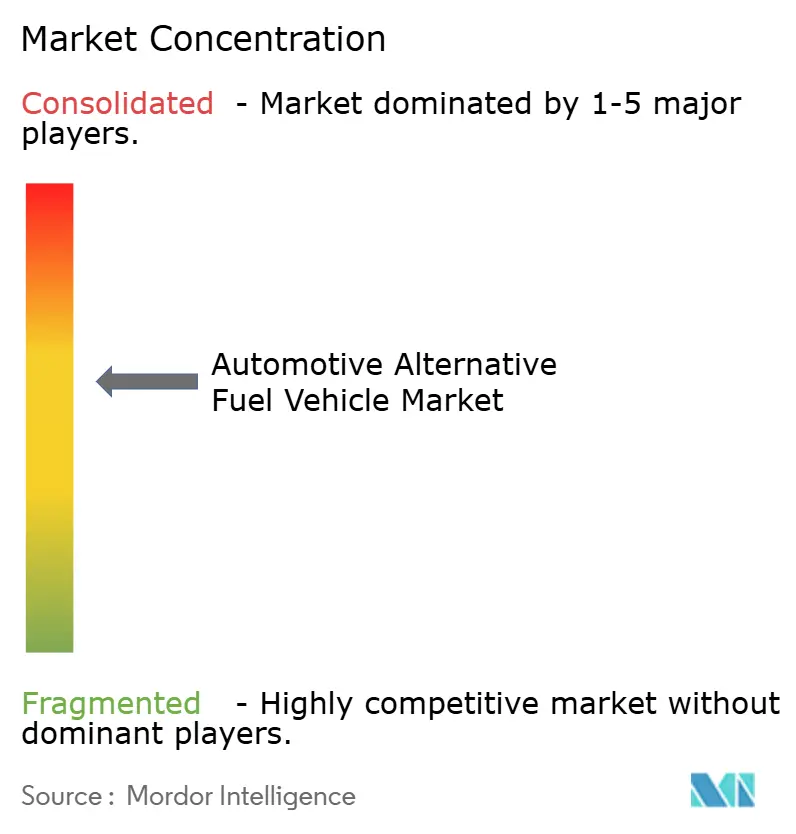
| Market Concentration | Medium |
Major Players *Disclaimer: Major Players sorted in no particular order Image © Mordor Intelligence. Reuse requires attribution under CC BY 4.0. | |
Automotive Alternative Fuel Vehicle Market Analysis by Mordor Intelligence
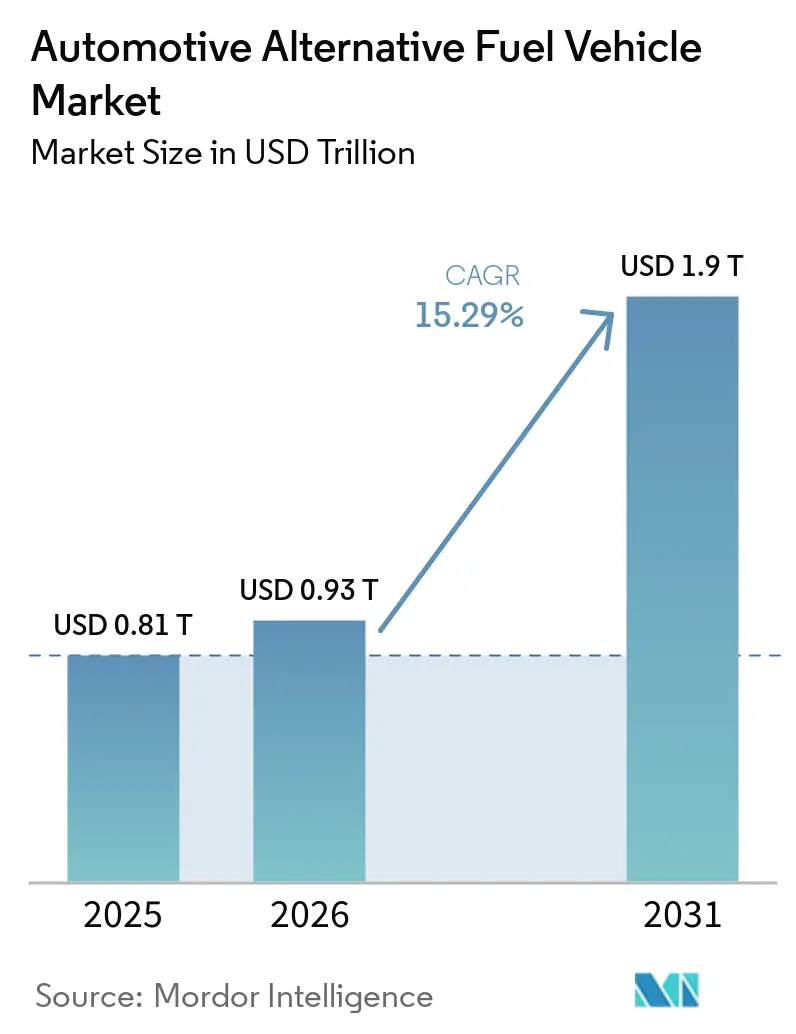
The automotive alternative fuel vehicle market size was valued at USD 0.81 trillion in 2025 and is estimated at USD 0.93 trillion in 2026, and is projected to reach USD 1.90 trillion by 2031 at a 15.29% CAGR over 2026-2031. Intensifying decarbonization mandates in the United States, the European Union, China, India, and Japan are compressing the economic window for new internal-combustion launches, nudging buyers toward battery-electric, hydrogen, and gaseous-fuel platforms. Falling battery-pack prices in 2025, alongside hydrogen-tank costs sliding to USD 12 per kilowatt-hour, and fast-charging corridors scaling in three continents together neutralize historical range-anxiety and refueling-time objections. Fleet operators are accelerating purchases to meet Scope 3 reporting obligations, and logistics majors increasingly treat alternative drivetrains as a hedge against diesel-price volatility. Meanwhile, automakers are racing to localize battery supply chains to comply with the United States domestic-content rules and to sidestep the European Union’s 2035 combustion-engine sunset clause.
Key Report Takeaways
- By fuel type, electric vehicles led with 60.12% revenue share in 2025, while hydrogen platforms are projected to expand at a 24.01% CAGR through 2031.
- By vehicle type, passenger cars accounted for 56.33% of global volume in 2025; medium and heavy-duty trucks exhibit the highest forecast growth at a 19.23% CAGR through 2031.
- By propulsion technology, battery-electric architectures commanded 58.24% of the automotive alternative fuel vehicle market share in 2025, yet fuel-cell electric propulsion will grow at a 24.55% CAGR through 2031.
- By end-user, private customers represented 61.35% of demand in 2025, whereas fleet adoption is advancing at a 22.31% CAGR through 2031 as centralized refueling shortens payback periods.
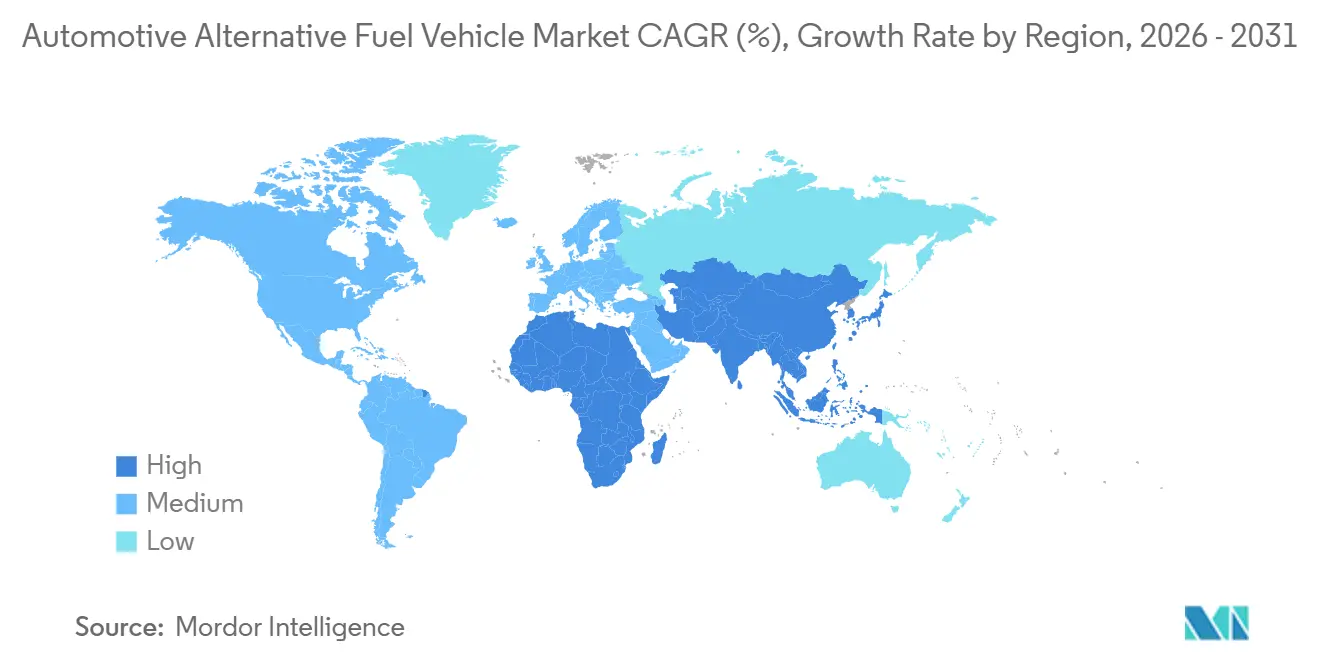
- By geography, Asia-Pacific captured 38.12% of deliveries in 2025, while the Middle East and Africa region is poised for the fastest expansion at 17.24% CAGR through 2031.
Note: Market size and forecast figures in this report are generated using Mordor Intelligence’s proprietary estimation framework, updated with the latest available data and insights as of January 2026.
Market Trends and Insights
Drivers Impact Analysis of Automotive Alternative Fuel Vehicle Market*
| Driver | (~) % Impact on CAGR Forecast | Geographic Relevance | Impact Timeline |
|---|---|---|---|
| Decarbonization Mandates and Purchase Incentives | +4.2% | North America, Europe, China, India | Medium term (2-4 years) |
| Battery and Hydrogen-Tank Cost Decline | +3.8% | Asia-Pacific manufacturing hubs with global spillover | Short term (≤ 2 years) |
| EV-Charging / H₂-CNG Refueling | +2.9% | North America, EU, parts of Asia-Pacific | Medium term (2-4 years) |
| Fleet-Electrification Commitments | +2.1% | Global, concentrated in developed logistics markets | Short term (≤ 2 years) |
| Pilots of Synthetic Drop-in E-Fuels | +1.3% | EU and Middle East early movers with South America spill-over | Long term (≥ 4 years) |
| Second-Life Battery Adoption | +0.9% | Asia-Pacific core with North America and EU grid-integration | Medium term (2-4 years) |
| Source: Mordor Intelligence | |||
Government Decarbonization Mandates and Purchase Incentives
Zero-emission regulations are compressing automaker product-cycle latitude. The United States Inflation Reduction Act extends credits through 2032 and introduces an incentive for used EVs while tightening local-content thresholds. The European Union’s fleet-average CO₂ target dropped to 93.6 g/km in 2025, with penalties of EUR 95 (~USD 112) per excess gram, which can accumulate to over EUR 1 billion (~USD 1 billion) per carmaker [1]“CO₂ Emission Performance of Light-Duty Vehicles,” European Environment Agency, eea.europa.eu. China’s dual-credit scheme awards significant tradable points per battery-electric sale, effectively cross-subsidizing manufacturers that outpace quotas. India’s PLI plan channels USD 3.5 billion into cell manufacturing and widens eligibility to fuel-cell two-wheelers. Japan’s Green Growth Strategy covers 50% of the incremental cost of fuel-cell cars and ties subsidies to buyers subscribing to certified hydrogen stations.
Rapid Decline in Battery‐Pack and H₂-Tank Costs
By 2025, advancements in lithium-iron-phosphate chemistry, cell-to-pack integration, and sodium-ion technology significantly reduced battery-pack costs compared to 2022. CATL’s Shenxing Plus cells now offer extended range with rapid charging, matching the refueling time of gasoline vehicles. Composite type-IV hydrogen cylinders, being lighter than their metal-lined counterparts, have lowered system costs, enabling adoption in class-8 trucks. BYD has extended warranties to cover longer distances, alleviating concerns about residual values for secondary-market purchasers. Meanwhile, Toyota's early-stage solid-state prototypes have achieved notable energy density improvements, though they're still limited by the scale of electrolyte production.
Expansion of EV-Charging / H₂-CNG Refueling Corridors
The United States National Electric Vehicle Infrastructure program funded several fast chargers and brought a significant number of public ports online by the end of 2025 [2]“National Electric Vehicle Infrastructure Program,” U.S. Department of Transportation, transportation.gov. Tesla opened 12,000 Supercharger stalls to non-Tesla models, creating a quasi-public backbone that speeds payback for infrastructure investors. The EU’s Alternative Fuels Infrastructure Regulation requires a 150 kW charger every 60 km on core corridors from 2025, an objective already exceeded in Germany and France. By 2025, China significantly expanded its public charging infrastructure and introduced dynamic tariffs during off-peak hours. Globally, hydrogen station development advanced, with Japan leading efforts supported by long-term government supply guarantees.
Fleet-Electrification Commitments by Logistics and E-Commerce Majors
Amazon deployed over 30,000 Rivian vans across North America by 2025, cutting last-mile delivery energy costs by 12% and signaling OEMs that large fleet orders de-risk platform tooling[3]“2025 Sustainability Report,” Amazon, amazon.com. DHL operates electric vehicles and aims for significant last-mile electrification by 2030. FedEx has allocated resources for chargers and vehicles, focusing on infrastructure in California and New York. UPS has incorporated several Arrival vans, using depot-charging to nearly eliminate range anxiety. Maersk is testing hydrogen drayage trucks at its Los Angeles and Rotterdam terminals, achieving refueling times that meet port turnaround standards.
Restraints Impact Analysis of Automotive Alternative Fuel Vehicle Market*
| Restraint | (~) % Impact on CAGR Forecast | Geographic Relevance | Impact Timeline |
|---|---|---|---|
| Price Gap vs. ICE Parity | -2.8% | Emerging markets worldwide | Medium term (2-4 years) |
| Limits on High-Power Charging | -2.4% | Southeast Asia, South America, Sub-Saharan Africa | Short term (≤2 years) |
| H₂ and Advanced-Biofuel Supply Chain | -2.1% | Rural regions and developing economies | Long term (≥4 years) |
| Volatility in Mineral Supply Chains | -1.9% | Global, especially in developing economies | Medium term (2-4 years) |
| Source: Mordor Intelligence | |||
High Upfront Price Gap vs. ICE Parity Across Several Alt-Fuel Lines
In 2025, compact battery-electric sedans were priced higher than their gasoline counterparts. This price difference stemmed from enhanced infotainment and safety packages added to the electric models to safeguard profit margins. Meanwhile, fuel-cell sedans remained expensive, primarily due to the use of platinum in each stack. However, industry roadmaps aim to reduce platinum usage by 2028. While fleets covering significant distances annually achieved total-cost-of-ownership parity, private owners driving shorter distances faced extended payback periods. In India, entry-level EV batteries constituted a substantial portion of the vehicle's MSRP. This high percentage is attributed to limited small-pack volumes, which hinder economies of scale, and import restrictions that drive up component prices.
Grid-Stability Limits on High-Power Charging in Emerging Markets
Fast chargers, boasting ratings above 350 kW, exert sharp, short-duration loads on distribution networks. These networks were designed for a steady baseload, not for such episodic spikes. In India, utilities in certain regions impose high demand charges once draws exceed specific thresholds. This policy discourages private investors from establishing public fast-charging plazas. Southeast Asian grids, already operating near their evening peak capacity, compel station developers to invest in additional infrastructure. This addition significantly raises each charger’s capital cost. Eskom, South Africa’s state-owned power utility, cautions that clustered urban fast chargers could exacerbate load-shedding issues. This concern is contingent on timely upgrades to parallel substations, presenting a financing challenge for potential operators.
*Our forecasts treat driver/restraint impacts as directional, not additive. The impact forecasts reflect baseline growth, mix effects, and variable interactions.
Automotive Alternative Fuel Vehicle Market Segment Analysis
By Fuel Type:
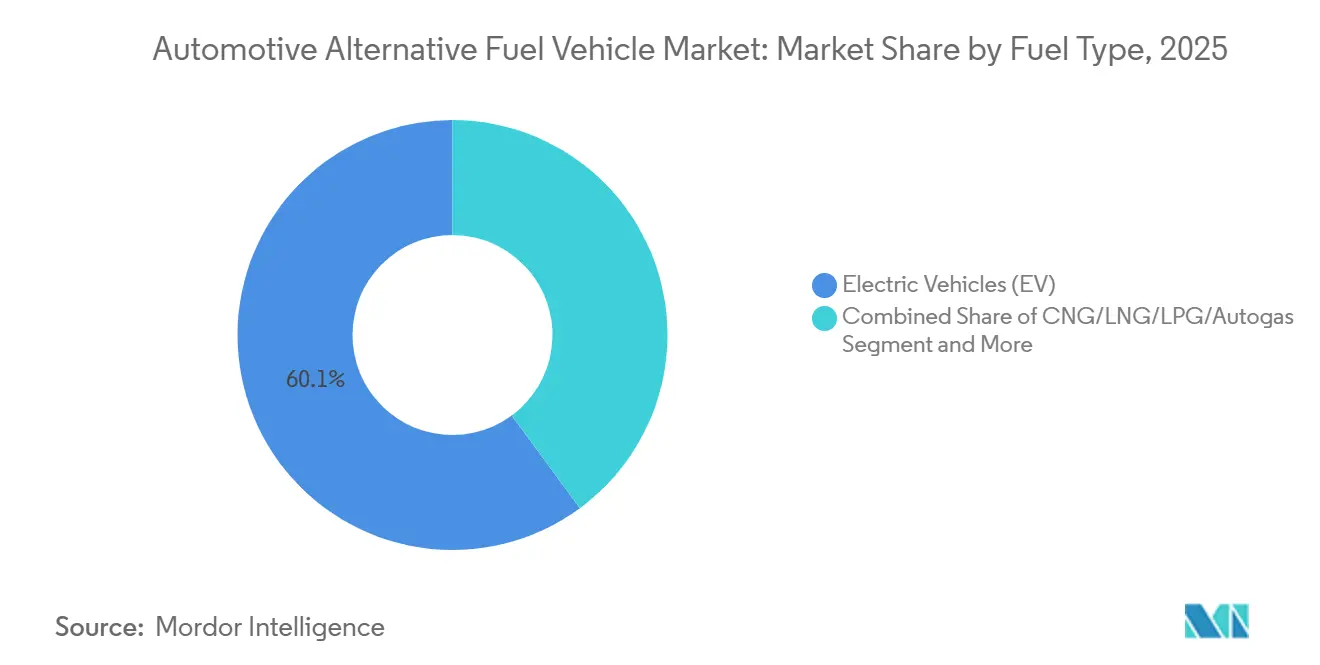
Hydrogen Platforms Outpace EV GrowthElectric vehicles accounted for the largest share of the automotive alternative fuel vehicle market, with 60.12% of revenue in 2025. Cost declines in lithium-iron-phosphate cells, fast-charging corridors, and widespread dealer familiarity anchor near-term dominance. Yet growth moderates as early-adopter consumer pools saturate and subsidies are scaled back in several large economies.
Hydrogen platforms, though accounting for only a nominal share of 2025 volume, are forecast to compound at 24.01% annually to 2031 as refueling density improves along major freight corridors and as platinum-loading reductions shave the stack cost by 2028. Long-haul trucking, municipal buses, and port-handling equipment value the 15-minute refuel window, retaining asset utilization that bulky batteries would otherwise curtail. CNG, LNG, and LPG retain a niche share, buoyed by 40% pump-price discounts versus diesel in markets with domestic gas production. Meanwhile, mandated ethanol blends keep biofuels at a steady share, supplying a transition solution for regions with vast existing combustion fleets.



By Vehicle Type:
Commercial Segments AcceleratePassenger cars dominated revenue in 2025, representing 56.33% of the automotive alternative fuel vehicle market share. Growth, however, flattens as fiscal incentives taper and middle-income households delay purchases pending further price parity. Medium and heavy-duty trucks grow the fastest at a 19.23% CAGR through 2031, underpinned by contractual purchase agreements by retailers and 3PL operators eager to insulate freight rates from diesel volatility.
Dedicated depots allow megawatt chargers or 700-bar hydrogen pumps, compressing payback periods below three years in high-mileage lanes. Two-wheelers and three-wheelers capture outsized unit volumes in India and Southeast Asia, where battery-swap networks sidestep home-charging hurdles. Light commercial vans further illustrate that regenerative braking plus stop-start duty cycles slash energy costs, enticing parcel couriers to commit to electrification roadmaps.
By Propulsion Technology:
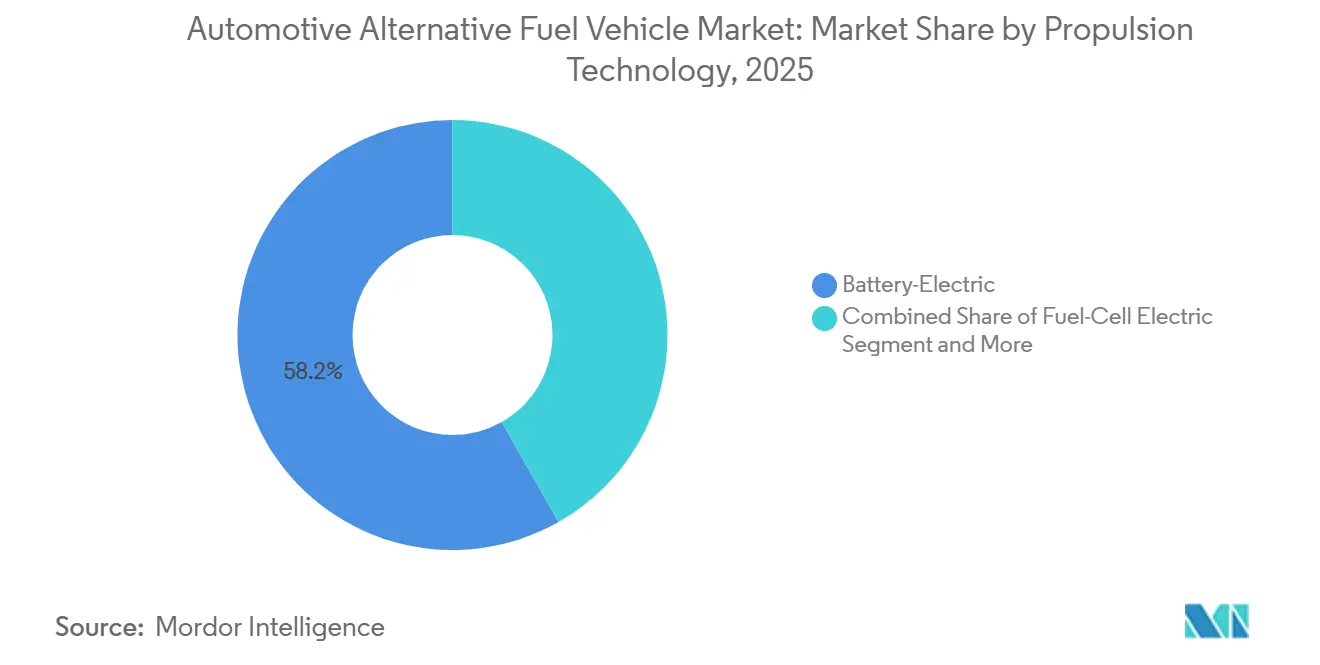
Fuel-Cell Architectures Gain ShareBattery-electric platforms commanded 58.24% of the 2025 automotive alternative fuel vehicle market size. Plug-in hybrids linger as a bridge option but face policy headwinds as regulators redefine “zero-emission” to exclude them from incentives after 2027.
Fuel-cell electric drivetrains accelerate at 24.55% CAGR to 2031 as OEMs prove durability parity with diesel in class-8 trucks and city buses. Falling catalyst loadings, modular stack designs, and green-hydrogen cost curves below USD 3/kg converge to enhance total-cost-of-ownership appeal. Dual-fuel CNG-gasoline systems will persist where gas prices remain structurally low and where fleets prize fuel flexibility. In parallel, solid-state research milestones signal another leap in 2030-plus product planning, although commercial volumes will hinge on solid-electrolyte scaling.
By End-User:
Fleet Adoption Outpaces Private BuyersPrivate households still accounted for 61.35% of 2025 demand, yet the CAGR moderates as subsidy cliffs approach and real-world range needs are already satisfied by existing second-generation models. Smartphone-like depreciation curves also encourage many prospective buyers to lease rather than own.
Fleet operators, from parcel couriers to ride-hailing platforms, expand purchases at 22.31% CAGR through 2031, driven by centralized refueling, mandated sustainability disclosures, and the ability to amortize assets over known duty cycles. Government and municipal procurements add ballast, especially where zero-emission bus mandates eliminate diesel tendering. Corporate fleets in California, Britain, and parts of China face statutory zero-emission purchase quotas, guaranteeing a minimum replacement rhythm that further stabilizes residual values.
Geography Analysis
APAC Automotive Alternative Fuel Vehicle Market
Asia-Pacific generated the largest regional turnover in 2025, equal to 38.12% of deliveries, propelled by China’s 16.49 million new-energy-vehicle registrations and India’s rapidly electrifying two-wheeler segment. Beijing’s dual-credit policy obliges automakers to achieve a significant NEV output in 2026, forcing joint ventures either to ramp proprietary platforms or buy credits, a pressure that effectively subsidizes domestic battery specialists. India’s Production-Linked Incentive scheme disburses USD 3.5 billion to localize cell factories, while several states top up purchase grants, enabling electric scooters to underprice gasoline rivals in total cost per kilometer. Japan’s hydrogen roadmap underwrites both station roll-outs and 50% of the incremental price gap per fuel-cell car, yet registrations still trail headline targets. South Korea aligns its policy by linking purchase rebates to specific price range vehicles, nurturing domestic brands Hyundai and Kia.
MEA Automotive Alternative Fuel Vehicle Market
The Middle East and Africa region, although a small base, is forecast to advance at 17.24% CAGR through 2031. Saudi Arabia’s Public Investment Fund finances the Ceer brand’s assembly complex, targeting 500,000 annual units by 2030. The United Arab Emirates earmarks a significant number of public chargers by 2030 and permits free parking for zero-emission cars, stimulating premium-segment uptake. South Africa’s platinum endowment fosters hydrogen pilot fleets in mining operations, where eliminating diesel ventilates underground shafts more cheaply than fans. Egypt and Turkey leverage tariff exemptions to attract Chinese partnerships that deliver affordable EVs and expand local supplier ecosystems. North African coastal wind and solar resources also underpin green-hydrogen projects aimed at EU synthetic-fuel markets.
The Americas and Europe Automotive Alternative Fuel Vehicle Market
North America and Europe each captured a notable share of 2025 revenue. The United States recorded a significant number of EV sales, lifted by the Inflation Reduction Act’s generous consumer credits, albeit conditioned on localized battery content. Canada mirrors tax incentives and accelerates East-to-West charging corridor build-outs. Europe posted notable registrations, with Norway uniquely above 90% due to VAT exemptions. Germany’s Fit-for-55 policy forces OEMs such as Volkswagen to pledge a significant investment toward electrification, whereas BMW and Mercedes hedge with higher-margin hybrids until infrastructure certainties improve [4]“Fit for 55 legislative package,” European Commission, ec.europa.eu . Brazil continues to exemplify liquid-biofuel leadership, operating flex-fuel cars and blending ethanol at 27%, though EV take-up remains low due to import tariffs on battery packs and charger scarcity.

Competitive Landscape
In 2025, the top manufacturers dominated the market, resulting in a moderate market concentration. New entrants from China, including BYD, NIO, XPeng, and Li Auto, are making aggressive inroads into Europe and Southeast Asia. Their moves are not only eroding the market shares of established players but also driving prices down. While Tesla continues to lead in brand recognition, it's grappling with challenges in scaling up its cell yields. In a bid to bolster its position, Tesla is diversifying into cathode production to gain a foothold in raw materials. Meanwhile, BYD's integration of blade-battery technology has allowed it to achieve lower cost structures. This positions BYD for swift export growth, contingent on overcoming homologation challenges.
Established automakers are forging strategic partnerships to navigate the evolving landscape. Stellantis has teamed up with Leapmotor, targeting platforms produced in Changsha, China. This collaboration significantly reduces variable costs in Europe. General Motors, banking on its Ultium program, has lined up vehicle launches. However, the program has faced setbacks, with joint-venture plants in Ohio and Tennessee ramping up slower than anticipated. This delay has hindered the clearing of the Cadillac Lyriq backlog. Ford's Model e division reported significant operating losses for 2025. The division's struggles stem from the F-150 Lightning, which won't see positive margins until production scales further. In the realm of intellectual property, a surge in patent filings related to solid-state chemistry is evident. Notably, Toyota and Samsung SDI collectively submitted claims in 2025, signaling that positioning for post-2028 chemistries is already shaping current R&D investments.
Emerging players in the automotive sector are grappling with financial challenges. Rivian, despite achieving notable output, burned through cash, leading to a necessary raise through convertible notes. Lucid is exploring a technology-licensing avenue, collaborating with facilities backed by Saudi Arabia’s PIF. However, Lucid still lags in scale compared to its larger counterparts. Compliance with ISO 15118 vehicle-to-grid protocols is becoming a key product differentiator. Notably, Volkswagen’s ID-series, Hyundai’s Ioniq 5, and GM’s Silverado EV have integrated bidirectional charging. This feature enables fleet operators to capitalize on ancillary grid services.
Automotive Alternative Fuel Vehicle Industry Leaders
Tesla Inc.
BYD Co. Ltd.
SAIC Motor Corp.
Volkswagen AG
Hyundai Motor Company
- *Disclaimer: Major Players sorted in no particular order
Automotive Alternative Fuel Vehicle Market Companies Covered in this Report
- Tesla Inc.
- BYD Co. Ltd.
- Toyota Motor Corporation
- Volkswagen AG
- Hyundai Motor Company
- BMW AG
- Mercedes-Benz Group AG
- Ford Motor Company
- General Motors Company
- Honda Motor Co., Ltd.
- Nissan Motor Co., Ltd.
- Kia Corporation
- SAIC Motor Corp.
- Stellantis N.V.
- Volvo Group
- Tata Motors Ltd.
- Audi AG
- Maruti Suzuki Ltd.
Read Analysis of Automotive Alternative Fuel Vehicle Companies

Recent Industry Developments in Automotive Alternative Fuel Vehicle Market
- August 2026: Euler Motors plans to invest Rs. 100 crore (approximately USD 12 million) to expand its Palwal plant in Haryana. The dedicated commercial vehicle facility, spanning 40 acres, will increase annual production capacity to 24,000 units and manufacture the Turbo EV 1000 and Storm EV. The expansion includes the commissioning of a dedicated production line for the company’s four-wheeler cargo vehicle portfolio.
- May 2026: Stellantis will unveil its EUR 60 billion (USD 65 billion) FaSTLAne 2030 plan to drive growth and profitability. By 2030, it will launch over 60 vehicles and 50 refreshes, including 29 battery-electric, 15 plug-in hybrid/range-extended electric, 24 hybrid, and 39 ICE/mild-hybrid vehicles across its brands worldwide.
- October 2025: Tata Motors signed an MoU with THINK Gas to expand LNG refueling infrastructure for long-haul trucking corridors across India.
- December 2025: India launched a pilot using Toyota’s Mirai fuel-cell electric vehicle under real-world conditions through the National Institute of Solar Energy, with insights feeding future hydrogen-mobility policy.
- October 2025: Hyundai announced plans to double its compressed-natural-gas portfolio in India to six models by 2030, aiming for 20% CNG sales penetration.


Global Automotive Alternative Fuel Vehicle Market Report Scope
The scope includes segmentation by fuel type (CNG/LNG/LPG/autogas, electric vehicles, hydrogen fuel-cell, and biofuels), vehicle type (two-wheelers, three-wheelers, passenger cars, light commercial vehicles, medium and heavy-duty trucks, buses and coaches, and off-highway/construction and agri equipment), propulsion technology (hybrid, battery-electric, fuel-cell electric, and dual-fuel), and end-user (private users, fleet operators, government and municipal transport, and others). The analysis also covers regional-level segmentation, including North America, South America, Europe, Asia-Pacific, the Middle East, and Africa. Market size and growth forecasts are presented by value in USD and by volume in units.
| CNG / LNG / LPG / Autogas |
| Electric Vehicles (EV) |
| Hydrogen Fuel-Cell (FCEV) |
| Biofuels (Ethanol, Biodiesel) |
| Two-Wheelers |
| Three-Wheelers |
| Passenger Cars |
| Light Commercial Vehicles |
| Medium and Heavy-Duty Trucks |
| Buses and Coaches |
| Off-Highway / Construction and Agri Equipment |
| Hybrid | Series Hybrid |
| Parallel Hybrid | |
| Battery-Electric | |
| Fuel-Cell Electric | |
| Dual-Fuel (CNG-Gasoline / LPG-Gasoline) |
| Private Users |
| Fleet Operators |
| Government and Municipal Transport |
| Others |
| North America | United States |
| Canada | |
| Rest of North America | |
| South America | Brazil |
| Argentina | |
| Rest of South America | |
| Europe | Germany |
| United Kingdom | |
| France | |
| Italy | |
| Spain | |
| Russia | |
| Rest of Europe | |
| Asia-Pacific | China |
| Japan | |
| India | |
| South Korea | |
| Rest of Asia-Pacific | |
| Middle East and Africa | Saudi Arabia |
| United Arab Emirates | |
| Egypt | |
| Turkey | |
| South Africa | |
| Rest of the Middle East and Africa |
| By Fuel Type | CNG / LNG / LPG / Autogas | |
| Electric Vehicles (EV) | ||
| Hydrogen Fuel-Cell (FCEV) | ||
| Biofuels (Ethanol, Biodiesel) | ||
| By Vehicle Type | Two-Wheelers | |
| Three-Wheelers | ||
| Passenger Cars | ||
| Light Commercial Vehicles | ||
| Medium and Heavy-Duty Trucks | ||
| Buses and Coaches | ||
| Off-Highway / Construction and Agri Equipment | ||
| By Propulsion Technology | Hybrid | Series Hybrid |
| Parallel Hybrid | ||
| Battery-Electric | ||
| Fuel-Cell Electric | ||
| Dual-Fuel (CNG-Gasoline / LPG-Gasoline) | ||
| By End-User | Private Users | |
| Fleet Operators | ||
| Government and Municipal Transport | ||
| Others | ||
| By Geography | North America | United States |
| Canada | ||
| Rest of North America | ||
| South America | Brazil | |
| Argentina | ||
| Rest of South America | ||
| Europe | Germany | |
| United Kingdom | ||
| France | ||
| Italy | ||
| Spain | ||
| Russia | ||
| Rest of Europe | ||
| Asia-Pacific | China | |
| Japan | ||
| India | ||
| South Korea | ||
| Rest of Asia-Pacific | ||
| Middle East and Africa | Saudi Arabia | |
| United Arab Emirates | ||
| Egypt | ||
| Turkey | ||
| South Africa | ||
| Rest of the Middle East and Africa | ||


Key Questions Answered in the Report
What is the projected global value of the automotive alternative fuel vehicle market in 2031?
It is forecast to reach USD 1.90 trillion by 2031.
Which region currently leads in sales of alternative fuel vehicles?
Asia-Pacific, accounting for 38.12% of 2025 deliveries.
Which drivetrain technology is expected to expand the fastest through 2031?
Hydrogen fuel-cell electric platforms, with a 24.01% CAGR.
Which segment holds the largest 2025 market share by propulsion technology?
Battery-electric architectures with 58.24% share.
Page last updated on:





