
Automotive Fuel Injection Pump Market Size and Share
Market Overview
| Study Period | 2019 - 2031 |
|---|---|
| Market Size (2026) | USD 10.68 Billion |
| Market Size (2031) | USD 12.28 Billion |
| Growth Rate (2026 - 2031) | 2.82 % |
| Fastest Growing Market | Asia-Pacific |
| Largest Market | Asia-Pacific |
| Market Concentration | Medium |
Major Players
*Disclaimer: Major Players sorted in no particular order Image © Mordor Intelligence. Reuse requires attribution under CC BY 4.0. |
|
Automotive Fuel Injection Pump Market Analysis by Mordor Intelligence
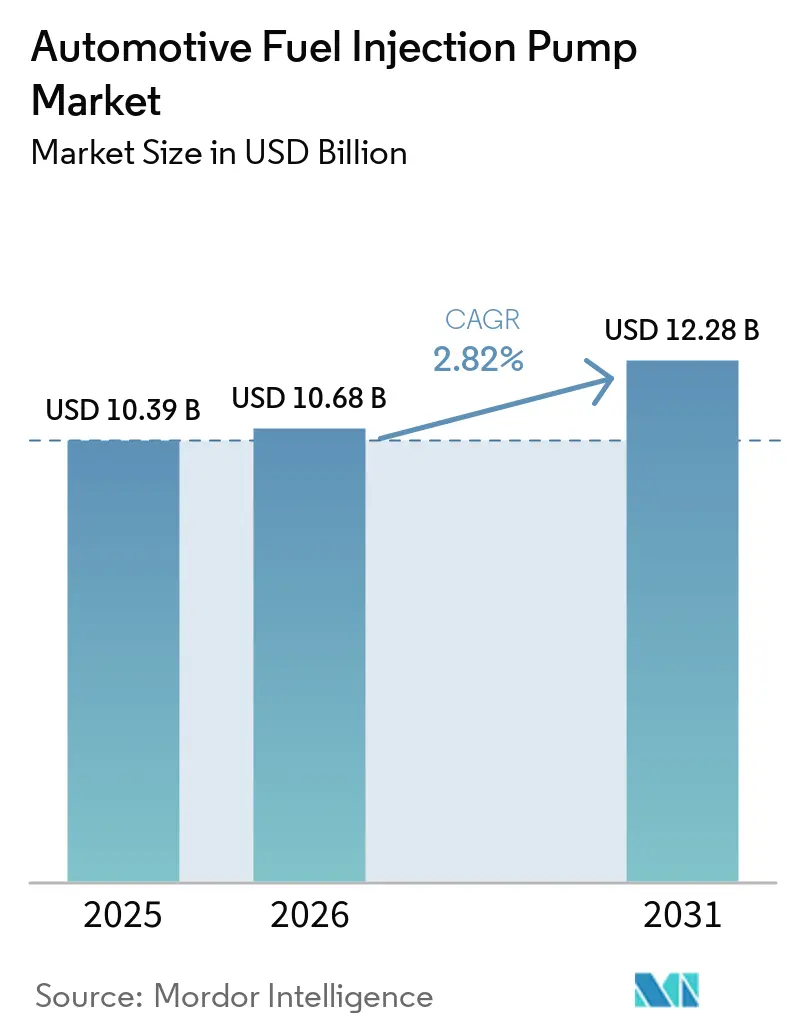
The automotive fuel injection pump market size was valued at USD 10.39 billion in 2025 and is projected to expand from USD 10.68 billion in 2026 to USD 12.28 billion by 2031, registering a CAGR of 2.82% between 2026 and 2031. Consistent legislative pressure on tailpipe emissions, the rebound of hybrid powertrains, and the need for precise real-driving-emissions control keep the internal-combustion supply chain relevant even as electric-vehicle volumes accelerate. Euro 7, China VI-B, and India’s forthcoming Bharat Stage VII collectively tighten particulate-number ceilings[1] Himanshu Arora, "Bharat Stage 7 (BS7): Everything You Need To Know in Detail," GoMechanic, gomechanic. in and lengthen warranty obligations, steering OEM procurement toward durable, high-pressure common-rail and gasoline direct-injection solutions. At the same time, OEM hybrid strategies call for pumps that withstand frequent start–stop cycles without compromising rail-pressure stability. The competitive landscape remains moderately concentrated, with five global suppliers dominating new-vehicle awards, while numerous regional brands thrive in the replacement channel.
Key Report Takeaways
- By pump type, the common-rail fuel injection pump captured 57.33% of the automotive fuel injection pump market share in 2025, while the same segment is forecast to post the fastest CAGR of 3.91% through 2031.
- By pressure type, high-pressure pumps commanded a 66.11% share of the automotive fuel injection pump market in 2025, and that category is also projected to record the highest CAGR of 3.81% to 2031.
- By application, direct-injection systems held a 71.33% share of the automotive fuel injection pump market in 2025, advancing at the fastest CAGR of 4.76% through 2031.
- By fuel type, diesel led with 56.13% market share in 2025, while gasoline variants are expected to grow at a 3.41% CAGR through 2031.
- By vehicle type, passenger cars accounted for 60.84% of the automotive fuel injection pump market share in 2025 and are anticipated to expand at a leading 3.19% CAGR through 2031.
- By distribution channel, OEM lines accounted for 73.15% of the automotive fuel injection pump market share in 2025, while the aftermarket is set to record the highest CAGR at 3.31% through 2031.
- By geography, Asia-Pacific held a 46.25% share of the automotive fuel injection pump market in 2025 and is projected to continue growing at the fastest rate, at 3.22%, by 2031.
Note: Market size and forecast figures in this report are generated using Mordor Intelligence’s proprietary estimation framework, updated with the latest available data and insights as of January 2026.
Market Trends and Insights
Drivers Impact Analysis of Automotive Fuel Injection Pump Market*
| Driver | (~) % Impact on CAGR Forecast | Geographic Relevance | Impact Timeline |
|---|---|---|---|
| Stringent Global Emission Regulations | +0.8% | EU, North America, Asia-Pacific | Medium term (2-4 years) |
| Rising GDI Passenger-Car Production | +0.6% | Asia-Pacific | Short term (≤ 2 years) |
| Demand for Downsized Turbo Engines | +0.5% | Europe, North America, Asia-Pacific | Short term (≤ 2 years) |
| Hybrid-Vehicle Electrified Pumps Demand | +0.4% | Global | Medium term (2-4 years) |
| Hydrogen-Ready High-Pressure Pump R&D | +0.3% | Europe, Asia-Pacific | Long term (≥ 4 years) |
| AI-Enabled Fleet Predictive Maintenance | +0.2% | North America, Europe | Long term (≥ 4 years) |
| Source: Mordor Intelligence | |||
Stringent Global Emission Regulations
Euro 7 became law in 2025 and adds real-driving-emissions checks that demand consistent rail pressure across altitude and temperature bands. China VI-B, fully enforced in 2026, mirrors those stringencies and requires durability proof beyond 30,000km for ICE vehicles[2]Mark Rainford, "China mandates longer testing periods for new vehicles," Inside China Auto, insidechinaauto.com. India’s Bharat Stage VII framework, due in 2027, will align with the ammonia-slip and onboard-monitoring clauses. Together, the three regions force suppliers to adopt advanced materials and tighter machining tolerances. Certification audits increasingly emphasize real-world data over laboratory prototypes, rewarding vendors that integrate hardware with self-diagnostics.
Rising GDI Passenger-Car Production in Asia
China aims for a corporate average fuel consumption ceiling of 3.3 L/100 km by 2030, and provincial regulators encourage flex-fuel compatibility, thereby pushing GDI penetration upward [3]"China to enforce stricter fuel efficiency standards for vehicles in 2026," www.gov.cn, English.www.gov.cn. Indian passenger-car makers likewise pivot toward GDI to meet BS-VII. Local tier-ones ramp capacity and introduce ethanol-compatible seals, while multinational suppliers underscore modular designs to balance cost and compliance. The trend accelerates platform homogenization, enabling economies of scale across mid-range models.
Demand for Downsized Turbo-Turbo Engines
Smaller displacement paired with a big boost remains the quickest way for automakers to satisfy efficiency rules without sacrificing drivability. Because turbo lag and transient load spikes stress fuel delivery, pumps must maintain pulse-to-pulse accuracy under rapid pressure swings. Suppliers respond with coated plungers and low-inertia cam profiles. In commercial fleets, high-bar common-rail systems marry turbocharging with exhaust-gas recirculation to reach future NOx thresholds, keeping mechanical pumps indispensable.
Hybrid-Vehicle Electrified Pumps Demand
Toyota’s 2026 Camry Hybrid achieves 5.0 liters per 100 kilometers by using low-flow metering during battery-assist phases, proving that precisely controlled electronically driven pumps can trim parasitic losses without sacrificing responsiveness. Suppliers adapt by integrating brushless DC motors and smart controllers that synchronize with battery-management systems, ensuring stable rail pressure after extended idle periods. Mikuni has publicly stated that more than 70% of its 2030 revenue target will come from electrified powertrain components, underscoring a strategic pivot from legacy mechanical pumps toward compact, software-defined units. These developments underscore the importance of collaboration between automotive pump engineers and hybrid-system architects to ensure fuel delivery aligns with regenerative braking and engine-off coasting.
Restraints Impact Analysis of Automotive Fuel Injection Pump Market*
| Restraint | (~) % Impact on CAGR Forecast | Geographic Relevance | Impact Timeline |
|---|---|---|---|
| Accelerating EV Penetration | –2.8% | Europe, China, Global | Short term (≤ 2 years) |
| High Cost And Complexity Of HP Pumps | –0.6% | Global | Medium term (2-4 years) |
| Precision Component Supply-Chain Risks | –0.4% | Global | Short term (≤ 2 years) |
| Shortage Of Skilled Pump Technicians | –0.3% | North America, Europe | Long term (≥ 4 years) |
| Source: Mordor Intelligence | |||
Accelerating EV Penetration
Pure battery-electric models now outsell diesel cars in several European member states, and North American OEMs are allocating the majority of future capital expenditure to electrified platforms. This shift is reducing incremental combustion engine development budgets and compressing pump volumes in light-duty segments. Suppliers are feeling the pressure and responding by divesting legacy assets, pursuing hydrogen-ready programs, or expanding aftermarket lines that support aging fleets. For many traditional suppliers, the transition is less a choice and more a matter of survival.
High Cost and Complexity of HP Pumps
Rail pressures exceeding 2,500 bar require precise tolerances, vacuum-furnace metallurgy, and rigorous end-of-line flow checks. These requirements increase unit prices and raise barriers for new entrants. Smaller manufacturers face real challenges with tooling amortization and yield losses, limiting high-pressure designs to a small group of tier-one specialists. Breaking into this space is not straightforward, as the capital and expertise required are substantial. OEMs, aware of this dynamic, offset cost premiums by negotiating system-level warranties and stricter field-failure metrics, which further compress supplier margins.
*Our forecasts treat driver/restraint impacts as directional, not additive. The impact forecasts reflect baseline growth, mix effects, and variable interactions.
Automotive Fuel Injection Pump Market Segment Analysis
By Pump Type:
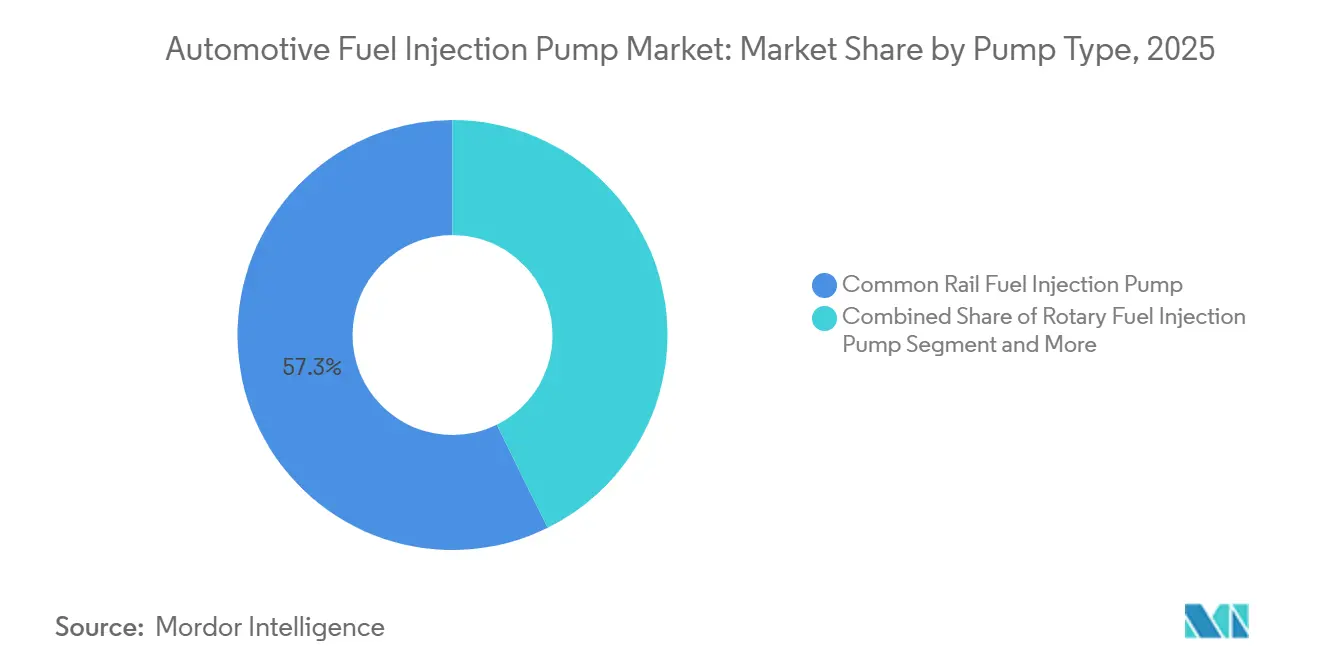
Common-Rail Dominance Anchors GrowthCommon-rail fuel injection pumps captured 57.33% of the automotive fuel injection pump market share in 2025. Their decoupled-pressure design lets engineers tune multiple injection events in ways rotary and in-cylinder formats struggle to match. OEM calibration teams value that flexibility when navigating ever-tighter emissions files and hybrid cycles. The architecture also lends itself to modular software updates that keep hardware viable as combustion strategies evolve. Suppliers therefore bundle common-rail hardware with advanced analytics, reinforcing a lock-in effect around this platform.
The same sub-segment is forecast to post the fastest CAGR of 3.91% over the period. Continuous material upgrades, smarter solenoids, and tighter machining tolerances underpin that growth projection. New entrants tend to license baseline patents rather than build competing designs from scratch, reducing direct rivalry and sustaining margins. Fleets migrating to synthetic diesel blends also find common-rail pumps easier to certify under durability audits. Taken together, these factors cement the technology as the default choice for future internal-combustion programs.



By Pressure Type:
High-Pressure Systems Capture Premium SegmentsHigh-pressure pumps commanded 66.11% of the automotive fuel injection pump market share in 2025. Their ability to finely atomize fuel makes them indispensable for controlling particulate counts. Automakers integrate them with closed-loop sensors so the rail adjusts instantly to altitude, temperature, and load transients. Development partners focus on seal chemistry and shaft coatings that extend life without adding bulk. As regulations spread, the high-pressure format has become synonymous with clean combustion across passenger and commercial platforms.
This category is also expected to deliver the quickest 3.81% CAGR. Growth hinges on the move toward direct-injection gasoline and low-carbon diesel substitutes, both of which demand higher spray energy. Collaborative R&D projects between pump makers and steel suppliers aim to reduce core weight while holding pressure stability, a combination that broadens vehicle fitment. Hybrid vehicles further reinforce demand because frequent restarts benefit from the immediate pressure readiness that high-bar systems provide. Consequently, investment pipelines remain heavily skewed toward this pressure class.
By Application:
Direct Injection Systems Lead Efficiency PushDirect-injection platforms accounted for 71.33% of the automotive fuel injection pump market share in 2025. Engineers favor in-cylinder delivery because it improves thermal efficiency and enables stratified charge modes. That same trait helps fleets cut fuel use during urban duty cycles without hardware retrofits. Suppliers now ship pumps as part of turnkey kits that include matched sensors and controllers, simplifying line-side installation. The resulting time savings resonate strongly with contract manufacturers under cost-down pressure.
Direct-injection also records the sharpest 4.76% CAGR across applications. Expansion is driven by increasingly stringent fleet-average efficiency targets, leaving little headroom for multi-point systems. Pump vendors capitalize on software updates that refine pulse timing rather than change mechanical layouts, thereby extending asset life for automakers. Aftermarket specialists see a parallel tailwind as early-generation GDI cars exit warranty, lifting replacement demand. All told, the segment’s twin pull from OEM and service channels cements its growth premium.
By Fuel Type:
Gasoline Gains as Diesel MaturesDiesel pumps retained 56.13% of the automotive fuel-injection pump market share in 2025, reflecting their continued dominance in the freight and heavy-duty sectors. Fleet operators rely on diesel’s torque profile for long-haul payloads, keeping base demand steady. Suppliers, however, confront tightening tailpipe rules that push hardware toward higher precision and better self-diagnostics. Progressive regions also test renewable diesel blends, forcing validation loops but ultimately supporting pump longevity. Against that backdrop, the diesel segment remains the anchor that funds wider product portfolios.
Gasoline pumps, by contrast, are projected to rise at a 3.41% CAGR, the fastest in this grouping. Passenger-car makers are pivoting toward gasoline direct-injection layouts that pair well with turbo-downsizing strategies. Pump designers focus on ethanol-resistant seals and compact housings suited to smaller engine bays. Marketing teams emphasize quiet operation and swift priming to differentiate from commodity offerings. These attributes resonate with consumers seeking refined driveability, giving the gasoline sub-segment a clear upward trajectory.
By Vehicle Type:
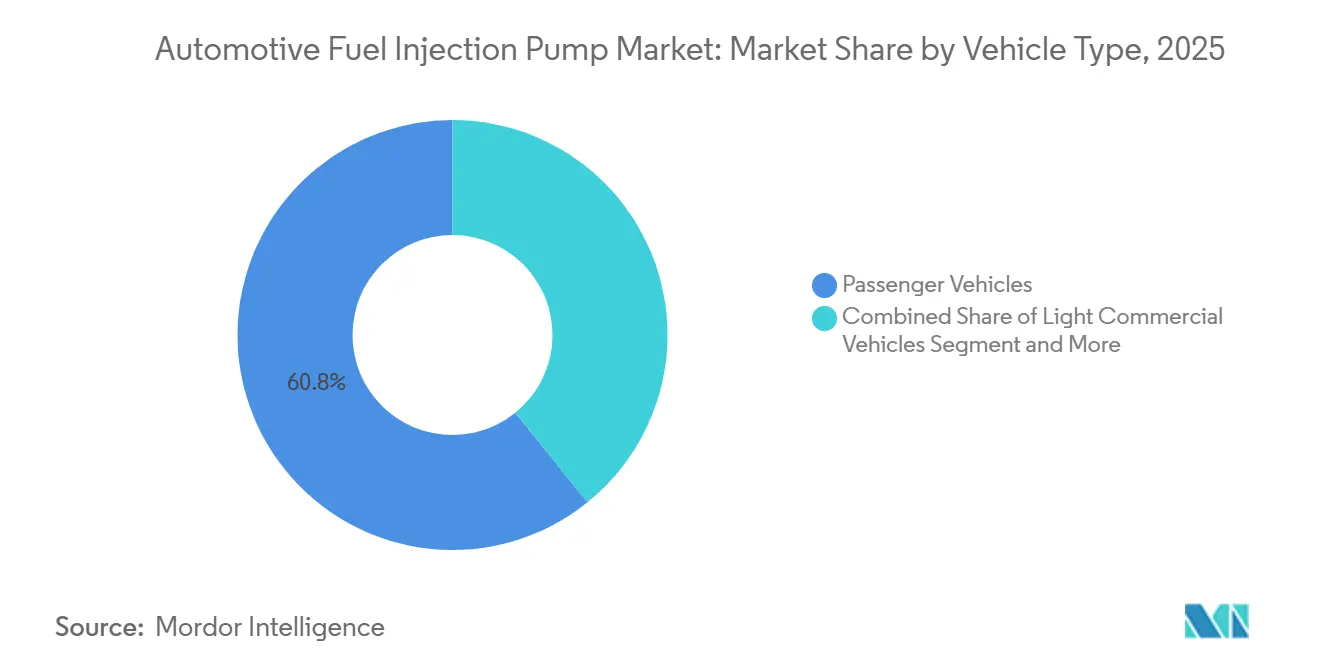
Passenger Vehicles Sustain Core DemandPassenger cars accounted for 60.84% of the automotive fuel-injection pump market share in 2025, underscoring their pivotal role in shaping design roadmaps. Hybrid layouts in sedans and crossovers keep combustion components relevant even as electric adoption rises. Pump integration must balance space, noise, and start-stop durability, leading vendors to miniaturize housings and refine control logic. Automakers also appreciate pumps that update over-the-air, allowing calibration tweaks without dealership visits. These soft advantages reinforce the passenger-car segment’s scale edge.
The same category is anticipated to post a leading 3.19% CAGR over the horizon. Growth rests on strong demand for compact SUVs and plug-in hybrids, both of which still need fuel systems for extended range. Suppliers leverage modular tooling so that a single core architecture spans multiple nameplates, reducing unit costs. Ride-hailing fleets extend vehicle lifecycles, creating a secondary lift for replacement pumps tailored for high-cycle duty. Together, these influences keep passenger vehicles at the forefront of market expansion.
By Distribution Channel:
OEM Lines Dominate, Aftermarket AcceleratesOEM supply routes held 73.15% of the automotive fuel injection pump market share in 2025, reflecting automakers’ preference for bundled pump-and-controller modules installed on the main assembly line. Close engineering collaboration ensures component tolerances align with engine management software from day one. Long-term agreements lock in volumes, giving tier-one vendors predictable cash flows. These contracts often include shared warranty pools that incentivize continual quality improvement. The net effect is a high barrier to entry for newcomers targeting factory fit.
Even so, the aftermarket is projected to record the highest CAGR at 3.31%. Rising average vehicle age pushes owners toward repair rather than replacement, elevating demand for standalone pumps. Independent garages favor brands that provide clear installation guides and robust technical hotlines, turning serviceability into a selling point. E-commerce platforms broaden geographic reach, allowing niche suppliers to tap rural markets that brick-and-mortar channels overlook. As digital ordering and predictive maintenance apps mature, the aftermarket’s growth arc looks firmly upward.
Geography Analysis
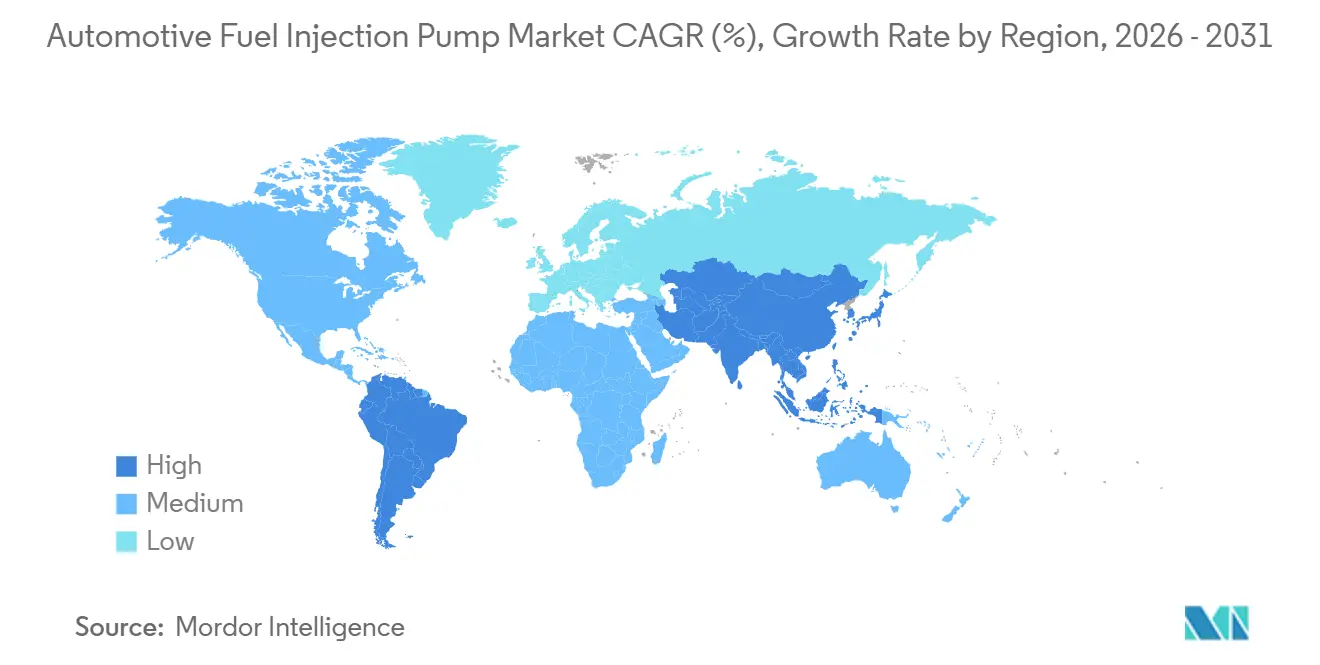
Asia-Pacific accounted for 46.25% of 2025 revenue in the automotive fuel injection pump market and is projected to extend that lead at a 3.22% CAGR. China’s VI-B enforcement mandates durability of over 30,000km and low particulate counts for ICEs, spurring local OEMs to award high-pressure common-rail contracts to domestic and joint-venture suppliers. India’s Bharat Stage VII roadmap confirms similar thresholds and real-time ammonia-slip monitoring. Japanese hybrid dominance sustains steady order books for precision low-flow gasoline pumps, buffering the region from near-term EV cannibalization.
Europe navigates the twin pressures of the introduction of Euro 7 and the accelerated adoption of battery-electric vehicles. While passenger-car diesel volumes contract, premium makers still rely on high-bar fuel systems for range-extended hybrids and performance gasoline models. Supplier plants in Germany, France, and the Czech Republic recalibrate lines to juggle combustion and e-drive sub-assemblies, keeping capacity utilization stable. Hydrogen bus prototypes funded under the European Green Deal create a new niche for pump specialists, requiring the adaptation of sealing materials to dry fuels.
North America balances state-level zero-emission mandates with market loyalty to large pickups and SUVs. Full-size hybrid trucks and ethanol-flex models preserve pump demand even as coastal states push stricter sales targets for zero-tail-pipe vehicles. Regional tier-twos in Mexico diversify toward aftermarket exports, offsetting lower OEM call-offs. The United States also acts as a testbed for renewable diesel in long-haul freight, giving high-pressure diesel pumps a multi-year runway.

Competitive Landscape
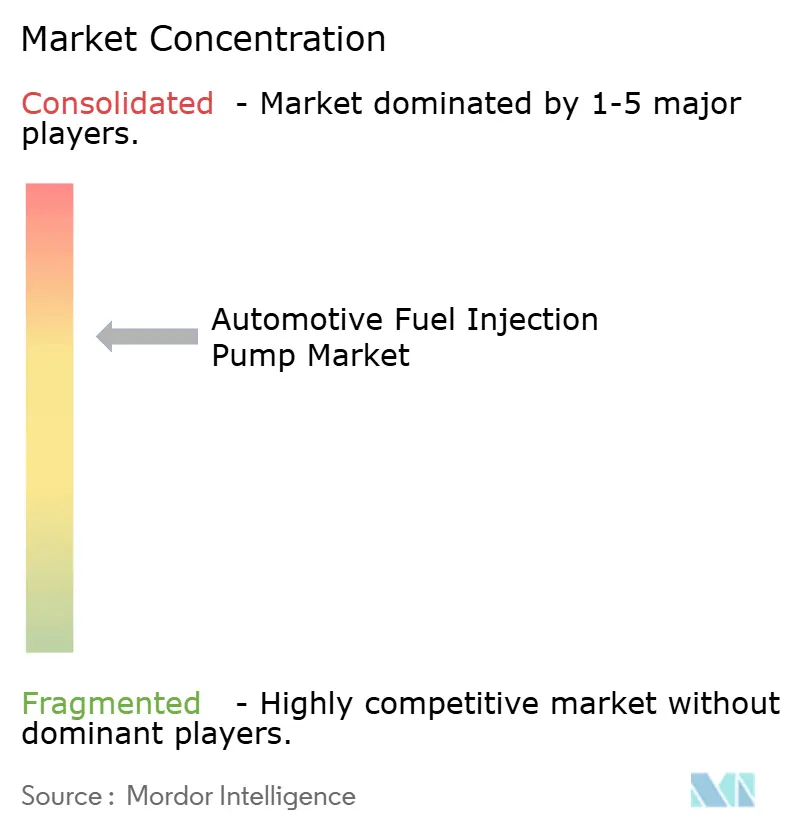
The automotive fuel injection pump market shows moderate concentration: Bosch, Denso, Continental, BorgWarner-spinoff PHINIA, and Hitachi Astemo control most new-model nominations. PHINIA’s 2025 acquisition of a Swedish ignition specialist, Swedish Electromagnet Invest AB (SEM), boosts its hydrogen and natural-gas portfolio, positioning it for fleet pilots in Europe and Asia. Denso capitalizes on smart-factory rollouts that pair pump assembly with edge-cloud analytics, shrinking lead times and flagging quality drifts in real time.
Hitachi Astemo, now majority-owned by Honda, co-designs integrated pump-ECU suites that optimize duty cycles in hybrid sedans. Continental extends its aftermarket range to provide independent garages with dealer-level compatibility, cementing its channel share. Meanwhile, Chinese brands backed by local funding refine automated gear-train assembly for common-rail units, narrowing cost and technology gaps with global peers.
Niche innovators cluster around alternative fuels. One European supplier developed low-pressure methanol pumps that feed off-road machinery in ports and mines, looking to slash carbon intensity. A U.S. start-up is testing brushless DC micro-pumps for range-extender drones and eVTOLs, hinting at cross-industry diversification. Collectively, these moves underscore a landscape in which incumbents fortify their scale advantages while challengers carve out niche corners.
Automotive Fuel Injection Pump Industry Leaders
-
Robert Bosch GmbH
-
Denso Corporation
-
Continental AG
-
BorgWarner Inc. (Phinia Inc.)
-
Hitachi Astemo Ltd.
- *Disclaimer: Major Players sorted in no particular order
Automotive Fuel Injection Pump Market Companies Covered in this Report
- Robert Bosch GmbH
- Denso Corporation
- Continental AG
- Hitachi Astemo Ltd.
- Aisin Corporation
- Stanadyne LLC
- Cummins Inc.
- Woodward Inc.
- Weifu Group
- BorgWarner Inc. (Phinia Inc.)
- Magna International Inc.
- Mikuni Corporation
- SHW AG
- Marelli Holdings

Recent Industry Developments in Automotive Fuel Injection Pump Market
- May 2026: Standard Motor Products, Inc. expanded its Standard Gasoline Fuel Injection program, adding over 1,100 all-new GDI, MFI, and TBI injectors, pumps, sensors, regulators, and service kits.
- April 2026: Renault developed a new 1.2-liter turbo-petrol engine for the Bridger. The engine features a simplified multi-point fuel injection (MPFi) system designed to support CNG compatibility, enabling the vehicle to operate on both petrol and compressed natural gas.


Global Automotive Fuel Injection Pump Market Report Scope
The Automotive Fuel Injection Pump market is segmented across pump type, pressure type, application, fuel type, vehicle type, distribution channel, and geography. By Pump Type, the market includes Common Rail Fuel Injection Pumps, Distributor/Rotary Pumps, inline pumps, and Unit Injector Pumps. By Pressure Type, systems are categorized as low-pressure or high-pressure. By Application, the market is segmented into Direct Injection Systems and Multi-Point Fuel Injection. By Fuel Type, segments include Diesel, Gasoline/Petrol, and Alternative Fuels (Biofuels/Ethanol). By Vehicle Type, it encompasses Passenger Cars, Light Commercial Vehicles (LCVs), and Heavy Commercial Vehicles (HCVs). By Distribution Channel, the market operates through OEMs (Original Equipment Manufacturers) and the Aftermarket. By Geography, the market is analyzed across North America (US, Canada, Rest of North America), South America (Brazil, Argentina, Rest of South America), Europe (UK, Germany, France, Italy, Spain, Russia, Rest of Europe), Asia-Pacific (China, India, Japan, South Korea, Rest of Asia-Pacific), and the Middle East and Africa (UAE, Saudi Arabia, Turkey, Egypt, South Africa, Rest of MEA).
Market Forecasts are Provided in Terms of Value (USD) and Volume (Units).
Segmentation Overview
| Common Rail Fuel Injection Pump |
| Rotary Fuel Injection Pump |
| In-Cylinder Pump |
| Outside-Cylinder Pump |
| Low Pressure |
| High Pressure |
| Direct Injection System |
| Multi-Point Fuel Injection System |
| Gasoline |
| Diesel |
| Alternative Fuels |
| Passenger Vehicles |
| Light Commercial Vehicles |
| Medium and Heavy Commercial Vehicles |
| Original Equipment Manufacturer (OEM) |
| Aftermarket |
| North America | United States |
| Canada | |
| Rest of North America | |
| South America | Brazil |
| Argentina | |
| Rest of South America | |
| Europe | United Kingdom |
| Germany | |
| Spain | |
| Italy | |
| France | |
| Russia | |
| Rest of Europe | |
| Asia-Pacific | India |
| China | |
| Japan | |
| South Korea | |
| Rest of Asia-Pacific | |
| Middle East and Africa | United Arab Emirates |
| Saudi Arabia | |
| Turkey | |
| Egypt | |
| South Africa | |
| Rest of Middle-East and Africa |
| By Pump Type | Common Rail Fuel Injection Pump | |
| Rotary Fuel Injection Pump | ||
| In-Cylinder Pump | ||
| Outside-Cylinder Pump | ||
| By Pressure Type | Low Pressure | |
| High Pressure | ||
| By Application | Direct Injection System | |
| Multi-Point Fuel Injection System | ||
| By Fuel Type | Gasoline | |
| Diesel | ||
| Alternative Fuels | ||
| By Vehicle Type | Passenger Vehicles | |
| Light Commercial Vehicles | ||
| Medium and Heavy Commercial Vehicles | ||
| By Distribution Channel | Original Equipment Manufacturer (OEM) | |
| Aftermarket | ||
| By Geography | North America | United States |
| Canada | ||
| Rest of North America | ||
| South America | Brazil | |
| Argentina | ||
| Rest of South America | ||
| Europe | United Kingdom | |
| Germany | ||
| Spain | ||
| Italy | ||
| France | ||
| Russia | ||
| Rest of Europe | ||
| Asia-Pacific | India | |
| China | ||
| Japan | ||
| South Korea | ||
| Rest of Asia-Pacific | ||
| Middle East and Africa | United Arab Emirates | |
| Saudi Arabia | ||
| Turkey | ||
| Egypt | ||
| South Africa | ||
| Rest of Middle-East and Africa | ||


Key Questions Answered in the Report
What is the current size of the automotive fuel injection pump market?
The automotive fuel injection pump market size was valued at USD 10.39 billion in 2025 and is projected to expand from USD 10.68 billion in 2026 to USD 12.28 billion by 2031, registering a CAGR of 2.82% between 2026 and 2031.
Which pump type leads global share?
Common-rail pumps held the largest 57.33% share of worldwide revenue in 2025, reflecting their suitability for new emission standards.
Which application grows the fastest through 2031?
Direct-injection systems are expected to post the quickest 4.76% CAGR through 2031, supported by tighter fuel-economy targets in major regions.
Why does Asia-Pacific dominate demand?
China’s VI-B rollout, India’s forthcoming Bharat Stage VII norms, and Japan’s hybrid leadership collectively enlarge the regional installed base for high-precision pumps.
Page last updated on:


 Your data is secure and never sold or shared.


