
Gambling Market Size and Share
Market Overview
| Study Period | 2021 - 2031 |
|---|---|
| Market Size (2025) | USD 0.81 Trillion |
| Market Size (2030) | USD 1.23 Trillion |
| Growth Rate (2026 - 2031) | 8.71 % |
| Fastest Growing Market | Asia-Pacific |
| Largest Market | Asia-Pacific |
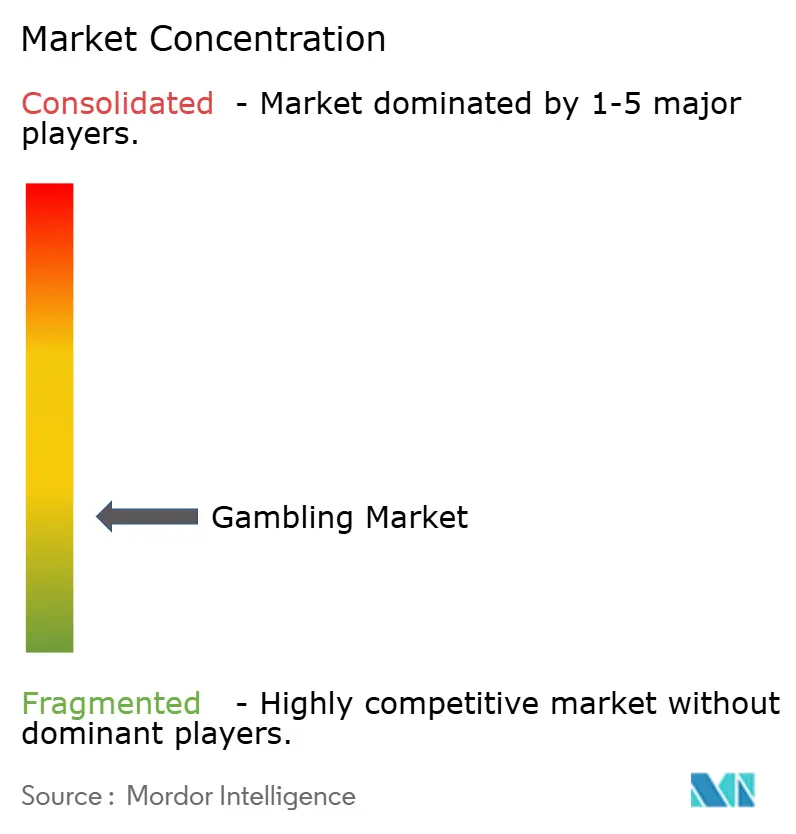
| Market Concentration | Low |
Major Players *Disclaimer: Major Players sorted in no particular order Image © Mordor Intelligence. Reuse requires attribution under CC BY 4.0. | |
Gambling Market Analysis by Mordor Intelligence
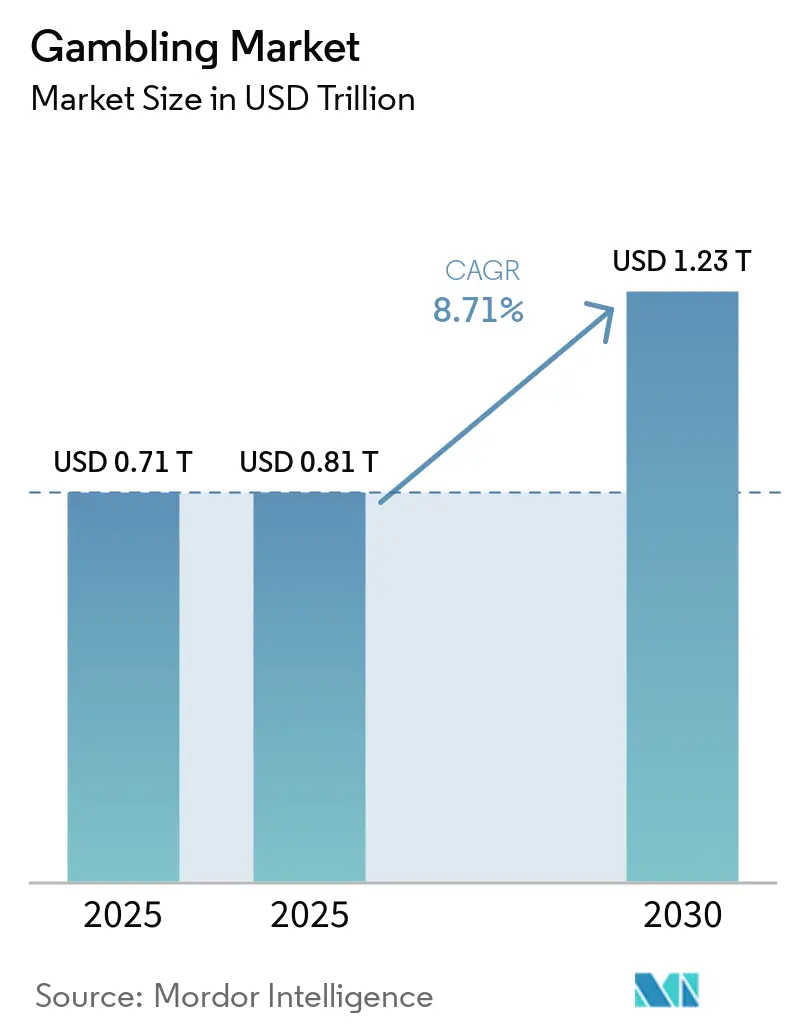
The gambling market size is expected to grow from USD 0.71 trillion in 2025 to USD 0.81 trillion in 2026 and is forecast to reach USD 1.23 trillion by 2031 at 8.71% CAGR over 2026-2031. Digital wagering is becoming a larger part of customer activity, while regulated openings in Brazil and other markets are broadening the addressable base. Sports betting is gaining visibility through live wagering and closer links with sports media, which favors operators with strong mobile products. Regulation is also shaping outcomes because tax rates, licensing rules, and player protection requirements can change the economics of each jurisdiction. Large operators are using acquisitions, platform investment, and local partnerships to enter regulated markets before smaller rivals can build comparable scale. These conditions leave room for technology suppliers as operators seek content, payments, compliance, and customer engagement capabilities across multiple countries.
Key Report Takeaways
- By type, casino games held 35.61% of global revenue in 2025, while sports betting is forecast to grow at a 9.45% CAGR through 2031.
- By platform, offline held 64.45% of global revenue in 2025, while online is forecast to grow at a 10.06% CAGR through 2031.
- By age group, 35–44 years held 30.22% of global revenue in 2025, while 25–34 years is forecast to grow at a 9.81% CAGR through 2031.
- By geography, Asia-Pacific held 34.25% of global revenue in 2025 and is forecast to grow at a 9.74% CAGR through 2031.
Note: Market size and forecast figures in this report are generated using Mordor Intelligence’s proprietary estimation framework, updated with the latest available data and insights as of January 2026.
Global Gambling Market Trends and Insights
Drivers Impact Analysis*
| Driver | (~) % Impact on CAGR Forecast | Geographic Relevance | Impact Timeline |
|---|---|---|---|
| Expansion of Online Gambling Platforms | +2.5% | Global, concentrated in Europe, North America, and Asia-Pacific | Short term (≤ 2 years) |
| Growing Popularity of Sports Betting | +2.0% | North America, Europe, and South America | Medium term (2-4 years) |
| Legalization and Regulation of Gambling markets | +1.3% | South America, Asia-Pacific, and parts of the Middle East and Africa | Medium term (2-4 years) |
| Integration of Live Dealer and Interactive Gaming | +0.9% | Global, with high adoption in Europe and Asia-Pacific | Medium term (2-4 years) |
| Growth of Digital Payments and Payment Infrastructure | +0.6% | Global, with faster adoption in emerging markets | Medium term (2-4 years) |
| Marketing, Sponsorships, and Promotional Activities | +0.4% | North America, Europe, and South America | Short term (≤ 2 years) |
| Source: Mordor Intelligence | |||
Expansion of Online Gambling Platforms
The expansion of online gambling platforms is a key driver of the global gambling market, supported by increasing internet penetration, smartphone adoption, and digital payment accessibility. According to the International Telecommunication Union (ITU), approximately 6 billion people, representing 74% of the global population, were using the internet in 2025, expanding the potential audience for digital gambling services[1]. Online platforms enable users to access sports betting, casino games, and other gambling activities without visiting physical establishments. Mobile applications, live betting features, and real-time gaming experiences further improve convenience and user engagement. In addition, secure digital payment options and personalized promotions are helping operators attract and retain customers.
Growing Popularity of Sports Betting
Sports betting is expanding in the Gambling market as legal markets mature and customers place more wagers through digital channels. According to the American Gaming Association, U.S. sports betting revenue reached USD 16.96 billion in 2025, increasing by 22.8% compared with 2024, while the total amount wagered reached USD 166.94 billion[2]. The popularity of sports such as football, basketball, cricket, and tennis encourages participation among sports enthusiasts. Mobile betting applications and live, in-play wagering allow users to place bets before and during sporting events, improving accessibility and engagement. In addition, partnerships between betting operators, sports leagues, and teams help increase brand visibility and customer reach. The expansion of regulated sports betting markets and improvements in digital payment systems are further supporting participation, contributing to the growth of the global gambling market.
Legalization and Regulation of Gambling Markets
New legal frameworks can turn existing demand into Gambling market revenue into licensed revenue, but the design of those frameworks remains important. Flutter completed its acquisition of a 56% stake in NSX Group, the owner of the Betnacional brand, for USD 350 million in May 2025 after Brazil opened its regulated online market. Japan’s Osaka integrated resort is expected to attract more than 10 million international visitors each year, according to the Ministry of Land, Infrastructure, Transport, and Tourism[3]. These developments show why operators enter early when large markets become accessible. Licensing systems also encourage investment in local compliance, payment tools, and customer protection systems. Where rules are clear and workable, Gambling market operators can plan product launches with greater confidence.
Integration of Live Dealer and Interactive Gaming
Live dealer products give Gambling market operators a way to provide a more interactive casino experience. Great Britain’s Gambling Survey found that 38% of adults participated in online gambling in 2025, creating a large audience for differentiated digital formats. The format helps operators extend casino play beyond physical properties and can support longer customer sessions. It also increases the importance of content suppliers, studio reliability, and customer data safeguards. Evolution, a major live dealer supplier, illustrates how concentrated this layer of the value chain can become. Gambling market operators are responding through supplier diversification and, in some cases, their own studio investments, which raises the capital advantage of larger businesses.
Restraints Impact Analysis*
| Restraint | (~) % Impact on CAGR Forecast | Geographic Relevance | Impact Timeline |
|---|---|---|---|
| Stringent and Fragmented Gambling Regulations | -1.2% | Europe and parts of Asia-Pacific | Medium term (2-4 years) |
| High Taxation and Licensing Costs | -0.8% | North America and Europe | Medium term (2-4 years) |
| Risk of Gambling Addiction and Social Harm | -0.5% | Global, with higher exposure in mature markets | Long term (≥ 4 years) |
| Cybersecurity Threats and Data Privacy Risks | -0.3% | Global, concentrated in online markets | Short term (≤ 2 years) |
| Source: Mordor Intelligence | |||
Stringent and Fragmented Gambling Regulations
Regulatory fragmentation raises operating costs across the Gambling market because a multi-country operator must meet separate licensing, reporting, affordability, and advertising requirements. The United Kingdom introduced a statutory gambling levy in April 2025, adding a new requirement for licensed operators. The Gambling Act amendments also introduced conditions covering affordability checks and online slot stake limits. In the United States, different state rules on taxes, promotions, and licensing make a single national operating model difficult to run. Such variation can favor operators with strong legal, technology, and responsible gambling teams. It also places more pressure on smaller firms that must fund compliance while attracting customers against larger Gambling market brands.
High Taxation and Licensing Costs
Higher taxes and licensing costs can reduce investment across the Gambling market the money available for product development, promotions, and market entry. The Betting and Gaming Council reported that Western European markets with tax increases recorded a 6% gross gaming revenue CAGR between 2019 and 2024, compared with 17% in markets with stable or lower rates. High costs can therefore reinforce market concentration by making expansion harder for smaller license holders. They can also push customers toward unlicensed sites if legal operators cannot offer competitive prices or products. Responsible gambling requirements and cyber controls add necessary protections, but they also require continuing investment.
*Our forecasts treat driver/restraint impacts as directional, not additive. The impact forecasts reflect baseline growth, mix effects, and variable interactions.
Segment Analysis
By Type: Casino Games Lead While Sports Betting Leads Growth
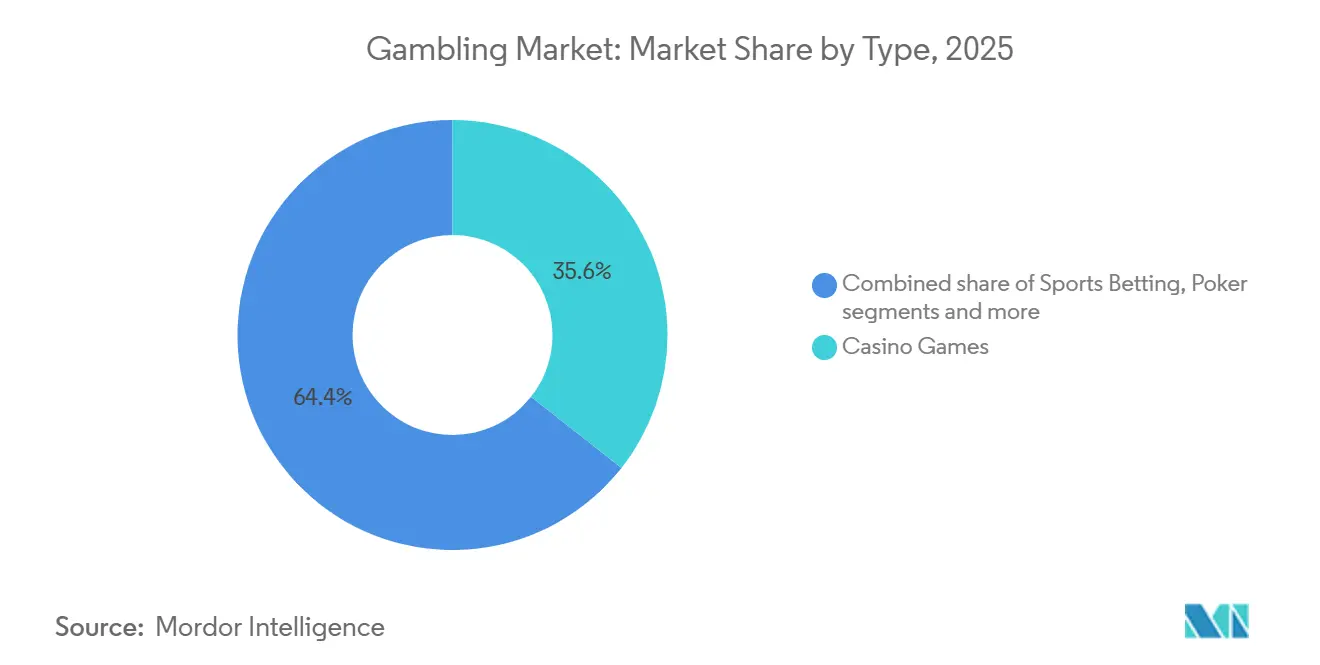
Casino games accounted for 35.61% of the global gambling market revenue in 2025, making them the largest segment by type. The segment's leading position is supported by the wide availability of games such as slots, poker, roulette, blackjack, and baccarat across land-based casinos and online gambling platforms. The variety of gaming formats attracts participants with different preferences and levels of experience. Online casino platforms have further expanded accessibility by allowing users to participate through smartphones, computers, and other digital devices. In addition, live dealer games and interactive gaming features have enhanced the digital gambling experience by replicating aspects of traditional casino environments.
Sports betting is projected to register the fastest growth among gambling types, with a CAGR of 9.45% through 2031. The segment's growth is supported by the increasing adoption of online betting platforms, which enable users to place wagers through mobile applications and websites. The expansion of regulated sports betting markets across various jurisdictions is also creating opportunities for operators to reach a wider customer base. Furthermore, the popularity of major sporting events, including football, basketball, cricket, and tennis, continues to generate betting activity among sports enthusiasts. The growing availability of live and in-play betting allows users to place wagers during matches, increasing engagement throughout sporting events.

By Platform: Offline Revenue Base and Online Expansion
The offline platform accounted for 64.45% of the global gambling market revenue in 2025, making it the largest segment by platform. Its leading position is supported by the continued presence of land-based casinos, betting shops, gaming establishments, and other physical gambling venues across established and emerging markets. These venues provide in-person gaming experiences and direct interaction with dealers, staff, and other participants. Many consumers continue to prefer offline gambling because of the physical environment, social interaction, and established gaming experiences offered by traditional venues. Furthermore, established operators benefit from physical infrastructure, recognizable brands, and customer loyalty built through long-standing operations.
The online platform is projected to register the fastest growth in the global gambling market, with a CAGR of 10.06% through 2031. The segment's expansion is supported by the increasing use of smartphones, high-speed internet connectivity, and mobile applications that enable users to access gambling services remotely. Online platforms offer greater convenience by allowing users to participate without visiting physical gambling establishments. The integration of digital payment methods and streamlined account management features is further improving the accessibility of online gambling services.
By Age Group: Established Customers Support Revenue and Younger Adults Shape Demand
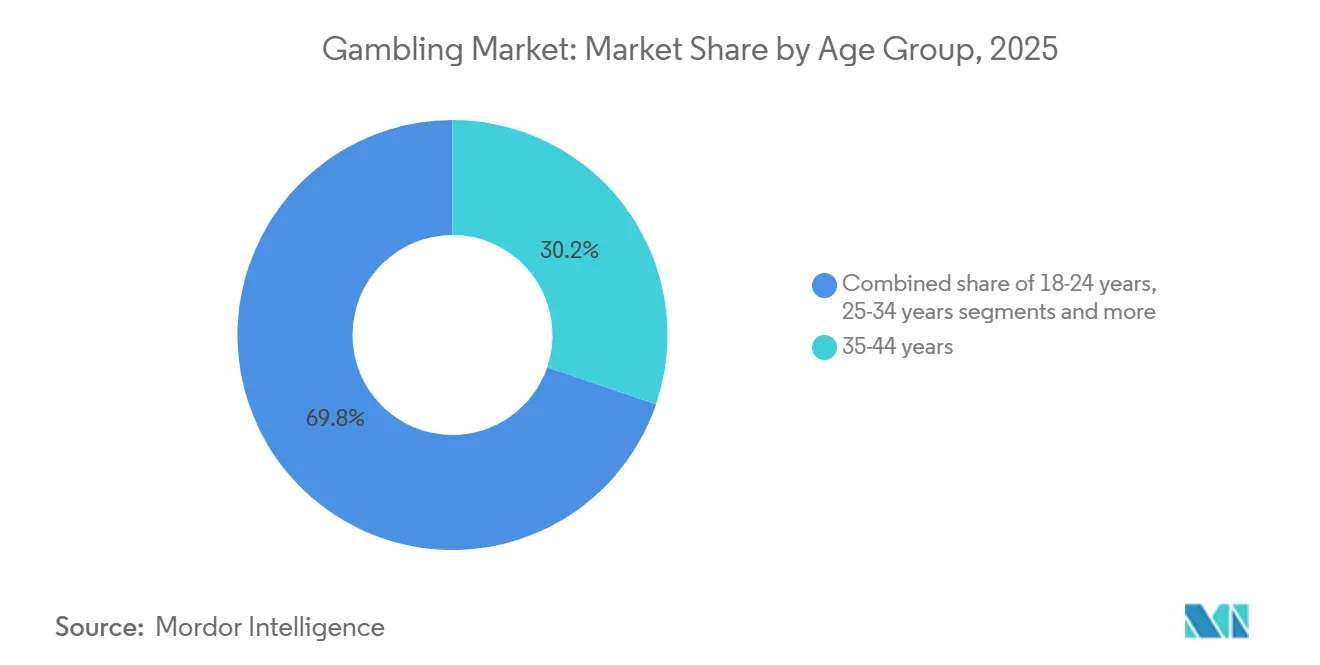
The 35–44 years group held 30.22% of global revenue in 2025, making it the largest age segment. This group supports casino games, established sportsbook products, and visits to physical gaming venues. Higher disposable income and familiarity with major brands help explain its central role in operator revenue. The 45–54 Years and 55+ Years groups remain relevant to lottery and land-based products. Their movement to digital channels is more gradual, which limits their contribution to online platform growth. Customer protection measures remain important across all age groups because participation patterns differ by product and channel.
The 25–34 years group is projected to grow at a 9.81% CAGR through 2031. This group uses mobile devices heavily and shows interest in live betting, social media content, and interactive formats. The 18–24 Years group has a smaller share, but its interest in esports, prediction markets, and social casino formats can influence future product design. Prediction markets are expanding the set of interactive formats available to younger adults. These products extend wagering beyond conventional sports events into finance, culture, and entertainment. Brands that build trust with younger adults may benefit as these customers move into the higher-spending 35–44 Years group.
Geography Analysis
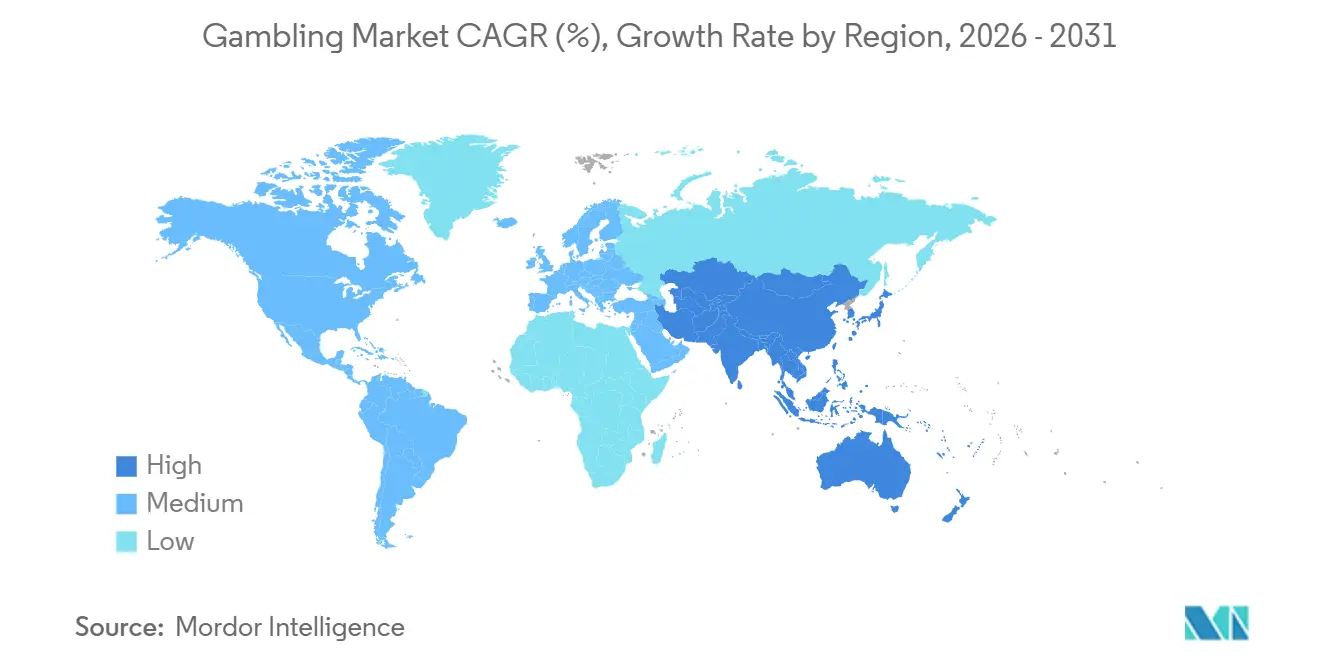
Asia-Pacific accounted for 34.25% of the global gambling market revenue in 2025 and is projected to grow at a CAGR of 9.74% through 2031, making it both the largest and fastest-growing regional market. The region's leading position is supported by its large population base, growing digital connectivity, and increasing adoption of online gaming and betting platforms. Countries such as China, India, Japan, and Australia have diverse gambling landscapes shaped by varying regulatory frameworks and consumer preferences. The growing popularity of sports, particularly cricket, football, and basketball, is supporting betting activity across selected markets. Furthermore, rising smartphone penetration and improvements in digital payment infrastructure are expanding access to online gambling services.
North America and Europe represent established gambling markets, supported by the presence of major casino operators, regulated betting platforms, and developed gaming infrastructure. In North America, the expansion of legal sports betting across selected US states and the growth of online casino services in permitted jurisdictions are creating additional opportunities for market participants. Mobile betting applications, live wagering, and partnerships between operators and sports organizations are further strengthening consumer engagement. Europe benefits from a mature gambling ecosystem, widespread sports betting participation, and established land-based and online casino operations.
The Middle East and Africa region presents a diverse gambling landscape, with market development shaped by differences in regulation, cultural considerations, and the availability of licensed gambling services. South Africa represents an important market within the region, supported by an established betting industry, licensed bookmakers, and consumer participation in sports betting and horse racing. The growth of mobile connectivity and online betting platforms is improving access to regulated services in markets where such activities are legally permitted. In the Middle East, gambling opportunities remain restricted in many countries, limiting the development of conventional casino and betting operations.
Competitive Landscape
The global gambling market is highly fragmented, characterized by the presence of international operators, regional specialists, and country-specific gambling companies competing across online and offline channels. The competitive landscape includes companies with diversified portfolios spanning sports betting, online casino games, poker, and land-based gambling operations. Flutter Entertainment plc, Entain plc, DraftKings Inc., bet365, and BetMGM compete at the upper end of the market, leveraging established brands, extensive gaming portfolios, digital platforms, and customer acquisition strategies. Market participants compete on brand recognition, platform accessibility, product variety, promotional offerings, and user experience to attract and retain customers.
Technology and digital platform development are important competitive factors, particularly as operators expand their online presence and mobile betting capabilities. Companies are investing in platform functionality, personalized user experiences, live betting features, digital payment integration, and data analytics to improve customer engagement and operational efficiency. Sports sponsorships, strategic partnerships, loyalty programs, and promotional campaigns also support brand visibility and customer acquisition. In addition, operators seek to strengthen their market positions by expanding product offerings and entering new jurisdictions where gambling activities are legally permitted.
Regional specialists continue to retain strong positions in selected countries by leveraging local brand recognition, established distribution networks, market-specific product offerings, and familiarity with domestic regulatory requirements. Their localized strategies enable them to compete with larger international operators, particularly in markets with distinct consumer preferences and regulatory barriers to entry. Meanwhile, major gambling companies seek to strengthen their competitive positions through geographic expansion, acquisitions, technology investments, and partnerships with sports organizations and entertainment providers.
Gambling Industry Leaders
-
MGM Resorts International
-
Flutter Entertainment plc
-
Entain plc
-
DraftKings Inc.
-
Bet365 Group Ltd
- *Disclaimer: Major Players sorted in no particular order
Recent Industry Developments
- June 2026: Playtech announced the integration of its iPoker offering into a new FanDuel poker product. The development supports the expansion of online poker services in North America and demonstrates the importance of technology-provider and operator partnerships in extending regulated online gaming offerings.
- March 2026: bet365 and UFC announced a multiyear partnership naming bet365 the official sports betting partner of UFC in the United States and Canada. The agreement includes broadcast integrations, fighter odds, same-game parlays, and live-event activations.
- January 2026: Playtech launched its second bespoke game exclusively for Novibet. The development reflects continued investment in exclusive digital gaming content and operator-specific experiences, supporting differentiation in the competitive online casino market.
Global Gambling Market Report Scope
Gambling involves wagering money or valuable items on uncertain events, primarily aiming to win more money or goods. The gambling market is segmented by type, platform, age group and geography. Based on type, the market is segmented into casino games, lotteries, sports betting, poker, bingo and other types. Based on platform, the market is segmented into offline and online channels. Based on age group, the market is segmented into 18-24 years, 25-34 years, 35-44 years, 45-54 years and 55+ years. The market is also segmented based on geography as North America, Europe, Asia-Pacific, South America, and the Middle East & Africa. The market sizing has been done in value terms in USD for all the above mentioned segments.
| Sports Betting |
| Casino Games |
| Lottery |
| Poker |
| Bingo |
| Other Types |
| Online |
| Offline |
| 18-24 Years |
| 25-34 Years |
| 35-44 Years |
| 45-54 Years |
| 55+ Years |
| North America | United States |
| Canada | |
| Mexico | |
| Rest of North America | |
| Europe | United Kingdom |
| Germany | |
| Spain | |
| France | |
| Italy | |
| Sweden | |
| Ireland | |
| Austria | |
| Rest of Europe | |
| Asia-Pacific | China |
| Japan | |
| South Korea | |
| New Zealand | |
| Australia | |
| Rest of Asia-Pacific | |
| South America | Brazil |
| Argentina | |
| Rest of South America | |
| Middle East and Africa | United Arab Emirates |
| South Africa | |
| Rest of Middle East and Africa |
| By Type | Sports Betting | |
| Casino Games | ||
| Lottery | ||
| Poker | ||
| Bingo | ||
| Other Types | ||
| By Platform | Online | |
| Offline | ||
| By Age Group | 18-24 Years | |
| 25-34 Years | ||
| 35-44 Years | ||
| 45-54 Years | ||
| 55+ Years | ||
| By Geography | North America | United States |
| Canada | ||
| Mexico | ||
| Rest of North America | ||
| Europe | United Kingdom | |
| Germany | ||
| Spain | ||
| France | ||
| Italy | ||
| Sweden | ||
| Ireland | ||
| Austria | ||
| Rest of Europe | ||
| Asia-Pacific | China | |
| Japan | ||
| South Korea | ||
| New Zealand | ||
| Australia | ||
| Rest of Asia-Pacific | ||
| South America | Brazil | |
| Argentina | ||
| Rest of South America | ||
| Middle East and Africa | United Arab Emirates | |
| South Africa | ||
| Rest of Middle East and Africa | ||
Key Questions Answered in the Report
What is the forecast growth rate for gambling through 2031?
The sector is projected to grow at an 8.71% CAGR from 2027 to 2031, reaching USD 1.23 trillion by 2031.
Which gambling type is growing fastest?
Sports Betting is the fastest-growing type, with a projected 9.45% CAGR through 2031.
Why is online gambling growing faster than offline play?
Online play is projected to grow at a 10.06% CAGR because mobile access, product breadth, payment tools, and personalized offers support customer use.
Which region leads global gambling revenue?
Asia-Pacific leads with 34.25% share in 2026 and is projected to grow at a 9.74% CAGR through 2031.
Which customer age group has the largest share?
Adults aged 35–44 Years hold the largest share at 30.22% in 2025, supported by established product use and brand loyalty.