
Furniture For The Aging Population Market Size and Share
Market Overview
| Study Period | 2020 - 2031 |
|---|---|
| Market Size (2026) | USD 16.62 Billion |
| Market Size (2031) | USD 23.48 Billion |
| Growth Rate (2026 - 2031) | 7.16 % |
| Fastest Growing Market | Asia-Pacific |
| Largest Market | North America |
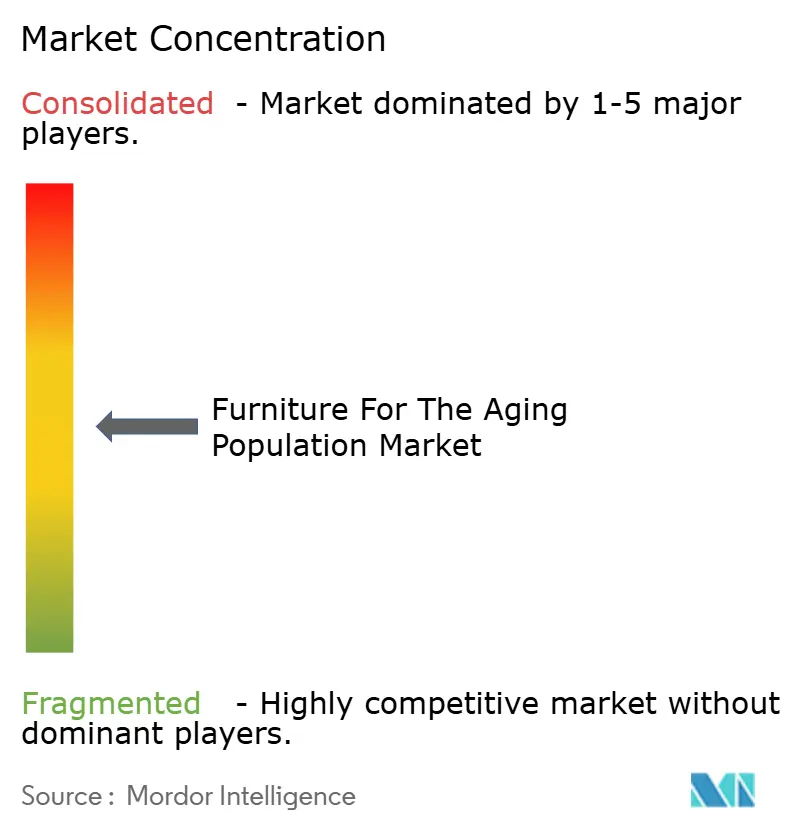
| Market Concentration | Medium |
Major Players *Disclaimer: Major Players sorted in no particular order Image © Mordor Intelligence. Reuse requires attribution under CC BY 4.0. | |
Furniture For The Aging Population Market Analysis by Mordor Intelligence
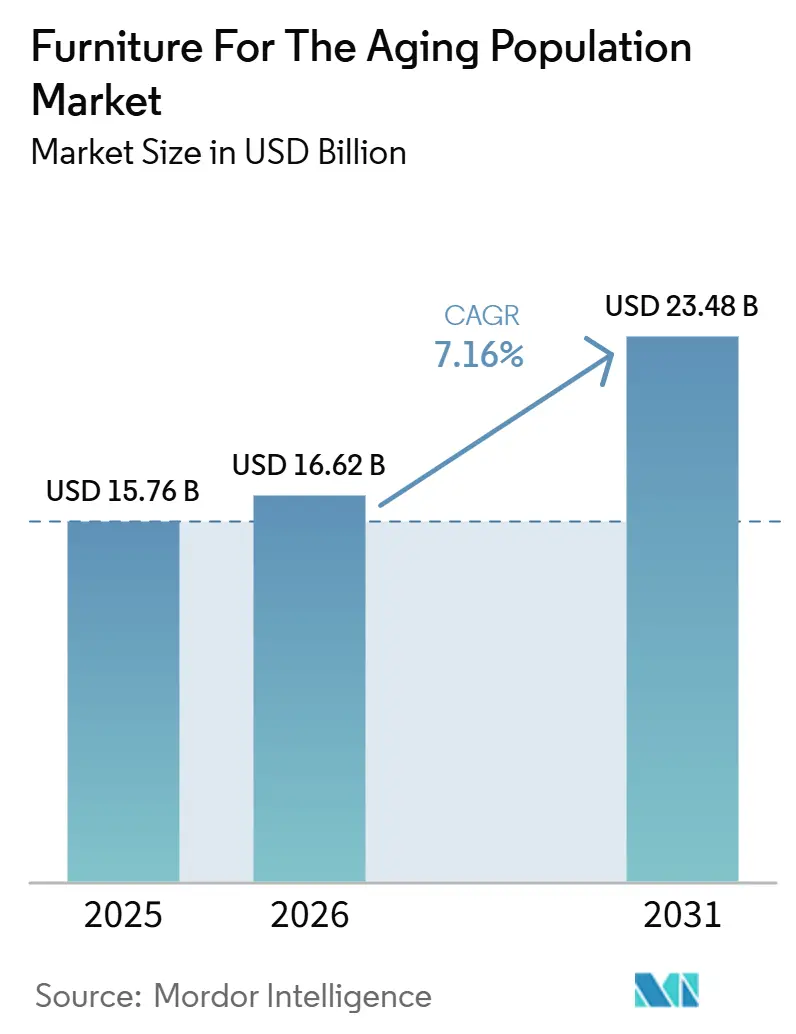
The furniture market for the aging population is projected to be USD 15.76 billion in 2025, USD 16.62 billion in 2026, and USD 23.48 billion by 2031, growing at a CAGR of 7.16% from 2026 to 2031. The furniture market for the aging population is being supported by a steady rise in the older population, with the United States Census Bureau reporting 61.2 million people aged 65 and older in the United States in 2024, while the WHO Europe states that adults aged 65 and above have now surpassed children and adolescents in the region[1]. Demand is also being reinforced by the mismatch between housing design and aging needs, as the Census Bureau states that only 10% of United States homes are adequately designed for older residents, which keeps retrofitting and replacement demand active across the furniture for the aging population market. Institutional demand remains firm as well, with NIC reporting senior housing occupancy at 89.5% in Q1 2026, marking the 19th straight quarter of increase and pushing operators to upgrade resident environments through better beds, seating, and common-area furniture[2]. The furniture for the aging population market is also moving beyond clinical utility alone, as universal design is becoming more visible in mainstream housing and furnishings, while connected monitoring and pressure-relief features are shaping new procurement decisions in care settings and home use. Competition in the furniture for the aging population market therefore rests on product reliability, clinical value, service capability, and channel reach, with room for further consolidation as suppliers try to serve both institutional buyers and households with more tailored offers.
Key Report Takeaways
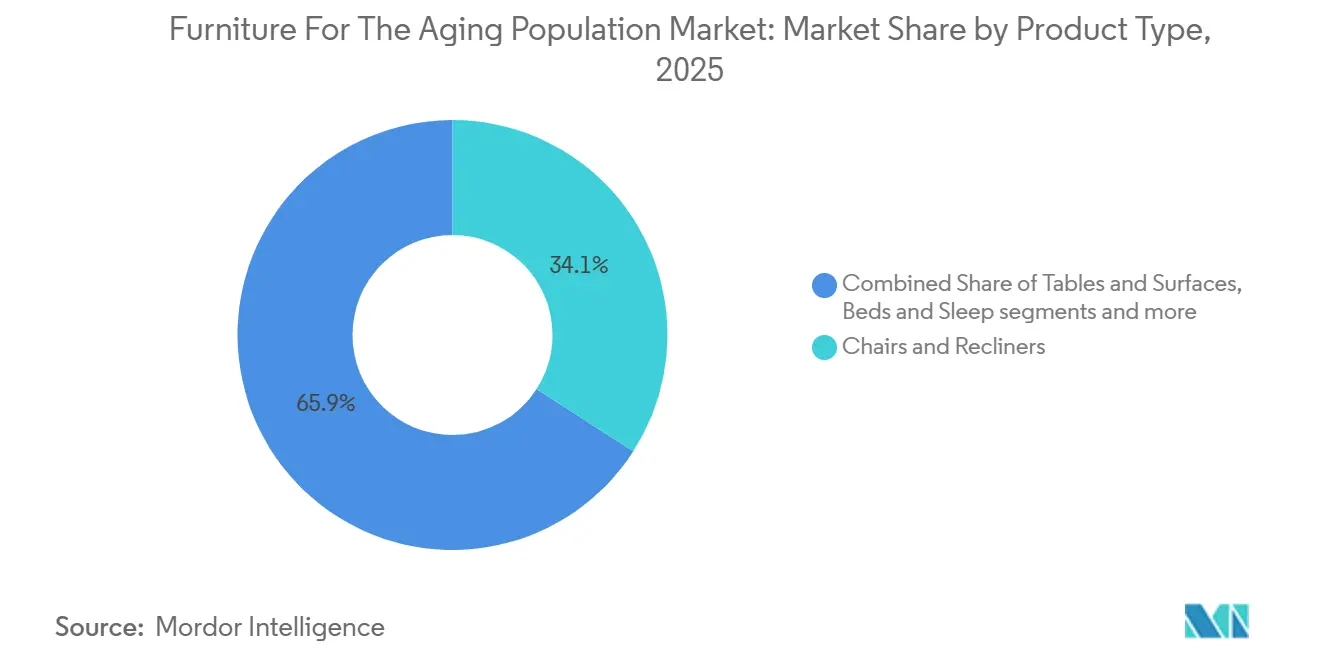
- By product type, chairs and recliners led with 34.15% of the market share for furniture for the aging population in 2025, while beds and sleep support systems are projected to expand at a 7.75% CAGR through 2031.
- By end user, residential households held a 65.45% of the market share for furniture for the aging population in 2025, while senior living communities recorded the highest projected CAGR of 7.48% through 2031.
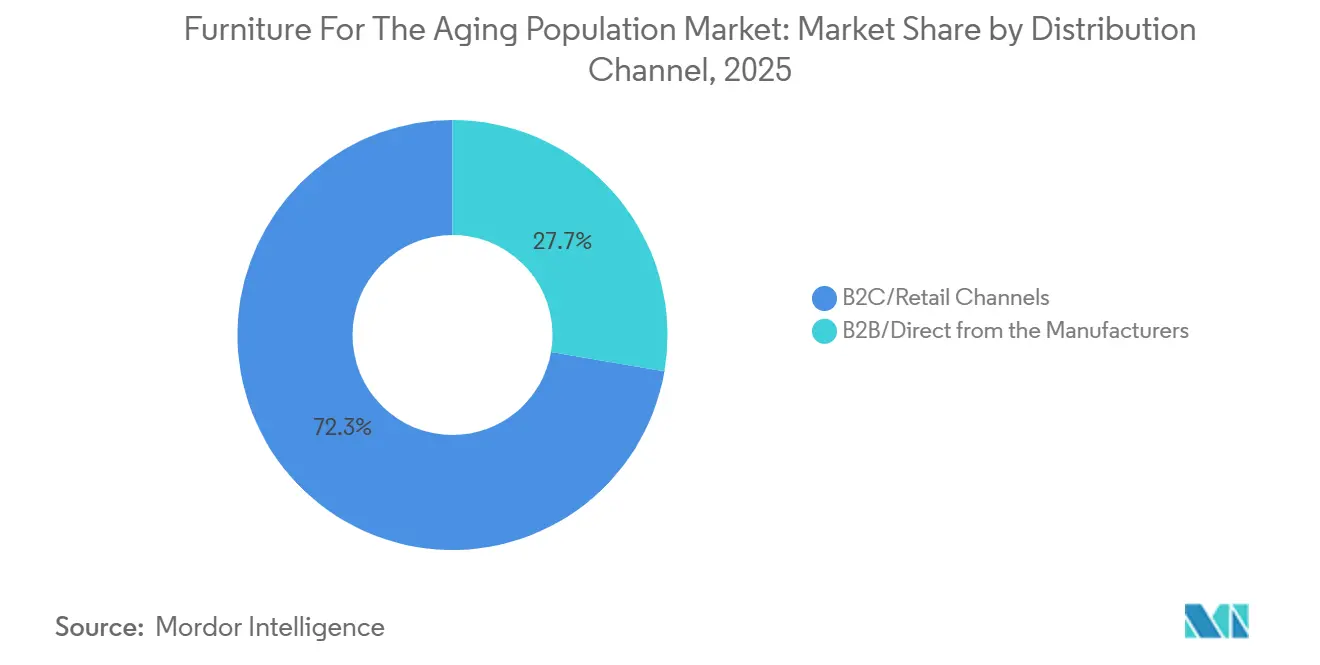
- By distribution channel, B2C and retail accounted for 72.35% of the market share for furniture for the aging population in 2025, and this channel is forecast to grow at a 7.31% CAGR through 2031.
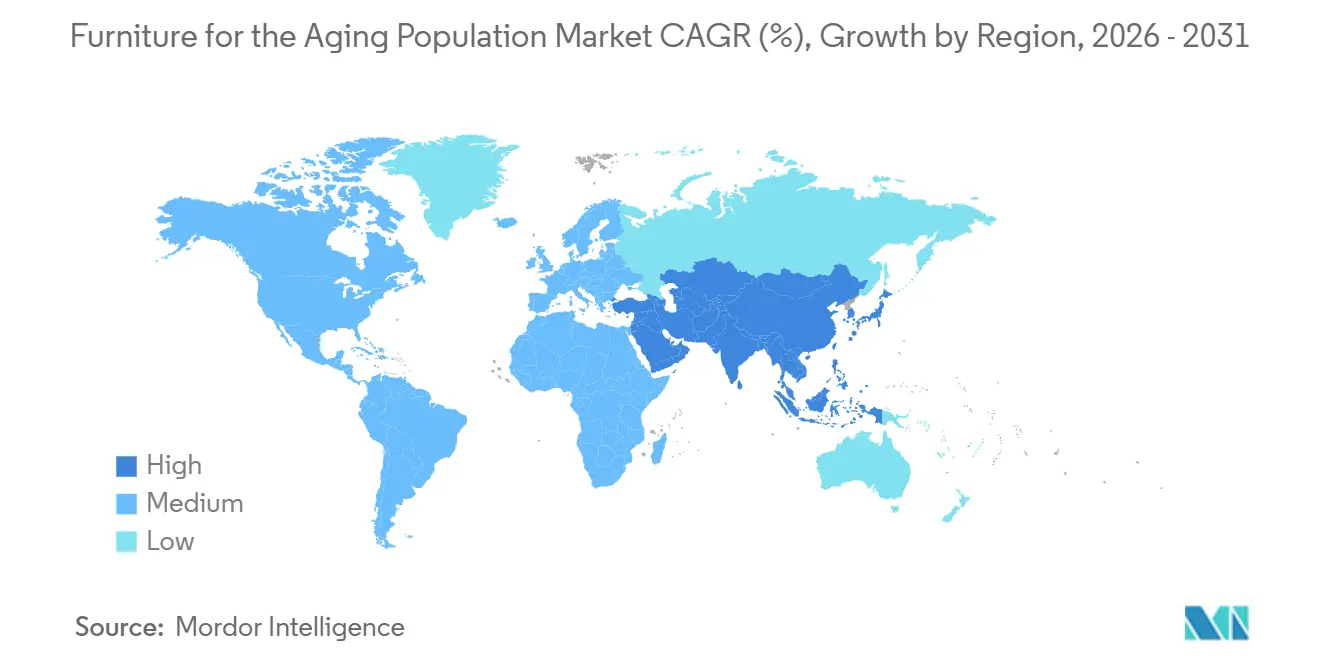
- By geography, North America held 35.15% share in 2025, while Asia-Pacific is forecast to expand at a 7.82% CAGR through 2031.
Note: Market size and forecast figures in this report are generated using Mordor Intelligence’s proprietary estimation framework, updated with the latest available data and insights as of January 2026.
Market Trends and Insights
Drivers Impact Analysis of Furniture For The Aging Population Market*
| Driver | (~) % Impact on CAGR Forecast | Geographic Relevance | Impact Timeline |
|---|---|---|---|
| Rising Aging-In-Place Renovation Demand | 2.00% | Global, concentrated in North America and Europe | Medium term (2-4 years) |
| Growth of Assisted Living and Long-Term Care Capacity | 1.70% | North America and Europe, Asia-Pacific emerging | Medium term (2-4 years) |
| Hospital-To-Home Care Shift for Mobility-Supportive Furniture | 1.20% | North America, Europe | Short term (≤ 2 years) |
| Universal Design Adoption in Mainstream Home Furnishings | 0.90% | Global | Long term (≥ 4 years) |
| Rising Demand for Pressure-Relief and Fall-Prevention Features | 1.10% | Global | Short term (≤ 2 years), Medium term (2-4 years) |
| Smart Monitoring Integration in Senior Living Furniture | 0.80% | North America, Europe, core Asia-Pacific | Long term (≥ 4 years) |
| Source: Mordor Intelligence | |||
Rising Aging-In-Place Renovation Demand
The furniture for the aging population market is seeing strong support from aging-in-place preferences, as households prefer to stay in familiar settings rather than move into institutions. AARP states that 87% of adults aged 65 and older prefer to remain in their current homes as they age, which keeps accessibility upgrades close to the center of purchase decisions for the furniture for the aging population market[3]. That preference would matter less if homes were already prepared, yet the United States Census Bureau states that only 10% of U.S. homes are adequately designed for aging populations, leaving a large retrofit gap that continues to feed demand for supportive seating, adjustable beds, and bathroom safety items. The result is that furniture for the aging population market is not tied solely to medical needs; it also aligns with renovation cycles, caregiver planning, and discharge preparation. This widens the buyer base beyond older residents and brings family members, therapists, and housing professionals into the same decision-making chain, which changes how suppliers position products and manage channels.
Growth of Assisted Living and Long-Term Care Capacity
The furniture market for the aging population is also being boosted by operating pressure in assisted living and long-term care properties, where high occupancy is pushing owners to improve resident spaces rather than delay upgrades. NIC reports that senior housing occupancy reached 89.5% in Q1 2026 and that units under construction fell to 16,400, or only 2.3% of existing inventory, underscoring why the furniture for the aging population market is benefiting from supply tightness and demographic growth[4]. NIC also states that occupied assisted living and memory care inventory in tracked markets grew 21% between Q3 2021 and Q3 2025, while assisted living asking rent increased 7.2% year over year in March 2026, giving operators more room to invest in furnishings that support recruitment and retention. In this setting, the furniture for the aging population market is shaped less by low-cost replacement and more by value, since operators can justify spending when better beds, chairs, and common areas strengthen the resident experience. Suppliers that can link furniture choices to comfort, staff safety, and care outcomes are therefore better positioned as institutional tenders become more selective.
Hospital-To-Home Care Shift for Mobility-Supportive Furniture
The furniture market for the aging population is gaining another demand path from the movement of post-acute recovery into the home, where patients need equipment and furniture that support safe transfers, rest, and mobility. Research published in BMC Geriatrics in 2025 shows that hospital-to-home transitions for older adults depend heavily on how well care and the home setting support daily functioning, making appropriate furniture a key component of practical discharge success rather than an optional add-on. A 2025 systematic review in Healthcare also found that home modifications, including furniture adaptations, were associated with reduced falls, fewer emergency hospitalizations, and greater functional independence when consistently implemented. That shift favors adjustable beds, transfer-assistance products, and supportive seating in the furniture for the aging population market, as these items now move into residential delivery channels rather than remaining within hospital purchasing systems. It also raises the value of services such as installation, instruction, and post-delivery support, which gives specialist suppliers an advantage over general furniture sellers.
Universal Design Adoption in Mainstream Home Furnishings
The furniture for the aging population market is also expanding as universal design becomes easier to discuss in mainstream housing terms rather than solely in clinical language. AARP states that 68% of Americans aged 50 and older view universal design features as important, and 59% believe such features should be standard in newly built homes, which supports broader acceptance of age-friendly furniture across the furniture market for the aging population. Standardization is moving in the same direction, with ISO/TS 25558:2026 providing guidance on smart home safety and usability for older persons, indicating that accessible living products are increasingly being incorporated into formal design frameworks. This matters for the furniture for the aging population market because products with stable bases, easy-grip surfaces, and adjustable heights can appeal to multigenerational households, people recovering from illness or injury, and older adults. As a result, manufacturers that reduce clinical styling and present accessibility as everyday comfort are better placed to move into broader retail settings.
Restraints Impact Analysis of Furniture For The Aging Population Market*
| Restraint | (~) % Impact on CAGR Forecast | Geographic Relevance | Impact Timeline |
|---|---|---|---|
| Higher Cost Versus Conventional Furniture | -0.70% | Global, acute in Asia-Pacific and Middle East and Africa | Medium term (2-4 years) |
| Limited Awareness of Age-Friendly Design Benefits | -0.40% | Asia-Pacific, Middle East and Africa, South America | Long term (≥ 4 years) |
| Fragmented Standards Across Care and Residential Channels | -0.30% | Global, moderating in Europe after MDR implementation | Short term (≤ 2 years), Medium term (2-4 years) |
| Customization Complexity for Different Mobility Needs | -0.30% | Global | Medium term (2-4 years), Long term (≥ 4 years) |
| Source: Mordor Intelligence | |||
Higher Cost Versus Conventional Furniture
The furniture for the aging population market still faces a clear pricing barrier because purpose-built products entail engineering, testing, and material requirements that ordinary household furniture does not. Compliance benchmarks are also becoming more demanding, with standards such as EN ISO 20342-4:2026 raising expectations for durability testing of tissue-integrity products, which can add development and validation costs for suppliers across the furniture market serving the aging population. This cost pressure is harder to absorb in residential settings and in price-sensitive regions, where specialized furniture often competes against cheaper conventional substitutes that appear acceptable at first purchase. The furniture market for the aging population is somewhat protected in settings where reimbursement or formal care programs support procurement, but coverage gaps remain when products fall between consumer furniture and regulated medical equipment. That keeps adoption uneven and stretches replacement cycles in parts of the market that would otherwise expand more quickly.
Limited Awareness of Age-Friendly Design Benefits
The furniture for the aging population market also grows more slowly when buyers do not connect furniture design with safety, comfort, and care outcomes. A 2025 systematic review in Healthcare found that 65% of the studies it examined confirmed the value of home modifications, including furniture adaptations, in reducing falls, improving independence, and lowering emergency hospitalizations, yet this evidence does not always reach households or frontline referral channels in a clear form. When awareness stays low, families often choose on price or appearance first, which can delay upgrades to products that would better support mobility, rest, and safer transfers. This leaves part of the furniture for the aging population market underpenetrated, even in places where demographic need is already visible. Stronger education through care pathways, discharge planning, and consumer-facing communication would likely improve adoption, especially in emerging markets where specialized products are still seen as optional rather than preventive.
*Our forecasts treat driver/restraint impacts as directional, not additive. The impact forecasts reflect baseline growth, mix effects, and variable interactions.
Furniture For The Aging Population Market Segment Analysis
By Product Type:
Beds Lead Clinical Innovation, Chairs Anchor VolumeChairs and recliners accounted for 34.15% of the furniture market share for the aging population in 2025, maintaining their leading position because they are widely used in both homes and care settings. Lift recliners, ergonomic armchairs, and mobility-support seating remain the most familiar entry point for many buyers, since they address comfort, transfer support, and everyday usability without requiring a full room redesign. The segment also benefits from channel flexibility, because products that once moved mainly through medical supply distributors are now sold through specialist retailers and e-commerce platforms at several price points. Mobility-support chairs and ergonomic armchairs compete on durability, weight capacity, cleanability, and upholstery options. At the same time, compliance with non-domestic seating standards matters more in institutional purchases than in ordinary household replacements.
The furniture market for the aging population, including beds and sleep support systems, is projected to expand at a 7.75% CAGR from 2026 to 2031, making this the fastest-growing product group. Growth is being supported by pressure mapping, fall-detection functions, and sensor-enabled monitoring that are making beds more central to both resident care and caregiver workflow. EN ISO 20342-4:2026 is also raising the technical bar for tissue-integrity products such as mattresses and overlays, which supports replacement demand for newer systems with stronger validation and durability claims. Adjustable beds and transfer-assistance beds are gaining traction because providers want products that reduce fall risk and caregiver strain simultaneously. Pressure-relief mattresses add another layer of growth, as they tie clinical performance to automation and can now be moved more easily from hospitals into home recovery settings.

By End-User:
Residential Scale Meets Senior Living UrgencyResidential households accounted for 65.45% of the furniture for the aging population market in 2025, underscoring how much of the market is still shaped by aging-in-place behavior rather than institutional residency alone. This share reflects the scale of household demand, where buyers often start with seating, bedroom support, and bathroom safety products that fit into existing homes with limited disruption. The residential segment is closely tied to accessibility gaps in the housing stock, and that link keeps supportive furniture relevant even when the initial purchase is framed as comfort or convenience rather than medical need. The segment also depends heavily on B2C routes, because families compare products across specialty stores, home improvement outlets, and online platforms before committing to higher-value items.
Senior living communities are forecast to grow at a 7.48% CAGR from 2026 to 2031, making them the fastest-expanding end-user segment in the furniture market for the aging population. NIC occupancy data supports this direction, as operators are working within a market where occupancy has climbed for 19 consecutive quarters, and new supply has remained constrained. That environment pushes operators to improve room quality and common areas so they can justify rent growth and remain attractive to incoming residents. Drive Medical’s May 2026 launch of common room and dining room collections for long-term care facilities shows how suppliers are widening their offers beyond patient rooms to capture more of each facility’s furnishing spend. The result is a broader revenue pool across the elderly care furniture industry, where premium and value product lines can both find demand depending on the operator’s occupancy position and asset strategy.
By Distribution Channel:
B2C Dominance Signals a Structural Market ShiftB2C and retail channels accounted for 72.35% of the furniture for the aging population market in 2025 and are projected to post a 7.31% CAGR through 2031, indicating the market is becoming more consumer-facing than in earlier years. This channel mix shows that households are not waiting for institutional referrals alone; they are actively researching and buying products through specialist furniture stores, medical supply stores, home improvement chains, and digital storefronts. Online routes are gaining relevance as buyers compare features from home, especially when family caregivers are involved in selection and when direct delivery can remove logistical friction. Even so, store-based formats still matter for lift recliners and adjustable beds, where product trial, advice, and reassurance remain important parts of the purchase process.
B2B and direct manufacturer channels accounted for the remaining 27.65% of the furniture market for the aging population in 2025, and they continue to matter because institutional orders carry higher ticket values and more formal specification requirements. Hospitals, nursing homes, rehabilitation centers, and assisted living operators buy on performance, service agreements, and compliance rather than on convenience alone, which keeps this route structurally different from consumer retail. That split creates operating complexity in the elderly care furniture industry, since companies that grew up serving tenders and contracts now need consumer marketing, digital tools, and last-mile installation if they want more residential exposure. At the same time, online procurement is starting to shape institutional purchasing as well, which narrows the gap between traditional B2B selling and digital commerce. The companies that manage both models well should be better placed as the furniture for the aging population market continues to blur old boundaries between clinical procurement and household buying.
Geography Analysis
North America Furniture for the Aging Population Market
North America held 35.15% of the furniture market share for the aging population in 2025, making it the leading regional market. The region benefits from a large older population, stronger reimbursement support in parts of the care delivery system, and an active aging-in-place environment that keeps home adaptation relevant across multiple income tiers. The U.S. Census Bureau stated in April 2026 that all baby boomers had reached ages 61 to 79 in 2025, which supports a large wave of first-time and follow-on purchase activity tied to mobility, comfort, and home safety needs. North America also gains from the link between healthcare discharge planning and residential recovery needs, which supports more cross-channel movement of beds, supportive seating, and transfer-focused furniture.
Europe and South America Furniture for the Aging Population Market
Europe remains a mature region in the furniture for the aging population market, with institutional procurement, regulatory discipline, and an aging population providing a stable demand base. WHO Europe states that adults aged 65 and above have now outnumbered children and adolescents in the region, and it also notes that the share of people aged 60 and older is expected to reach 32.2% by 2050, which supports a long demand runway for furniture for the aging population market. This environment favors suppliers that are strong in care beds, transfer systems, and pressure-relief products, especially when tender processes reward durability and documented performance. South America is still a smaller part of the furniture for the aging population market, yet the draft indicates that Brazil is leading regional development as formal retail and institutional channels continue to take shape.
APAC and MEA Furniture for the Aging Population Market
The furniture for the aging population market size in Asia-Pacific is projected to grow at a 7.82% CAGR from 2026 to 2031, making it the fastest-growing regional segment. The region combines demographic pressure in mature aging economies with large-volume opportunity in China and India, while Southeast Asia is adding capacity through hospital and eldercare expansion. The furniture for the aging population market in Asia-Pacific is also drawing more localization activity, shown by Wellell’s April 2025 distribution partnership with idsMED Group in Thailand and Linet’s February 2026 delivery of premium electric beds to Bach Mai Hospital Campus 2 in Vietnam through idsMED Vietnam. The Middle East and Africa region remains smaller in share, but healthcare investment and policy adoption are widening the long-term base for supportive care products. WHO reported in June 2026 that Iran adopted the Integrated Care for Older People framework, which points to a broader policy shift that can strengthen future care infrastructure and product demand across parts of the region.
Competitive Landscape
The furniture for the aging population market is moderately concentrated in institutional procurement and far more fragmented in the residential segment, so competitive structure changes noticeably by channel and product complexity. Large clinical suppliers such as Arjo, Linet, Stryker, Getinge, and Hillrom, now part of Baxter International, remain the main reference points in hospital and long-term care settings because they compete on product depth, service, and care workflow support rather than on price alone. In contrast, the residential side of the furniture for the aging population market is split across regional specialists, mobility product suppliers, and broader furniture retailers that offer selected age-friendly lines. This mixed structure keeps the furniture for the aging population market open to both consolidation and niche specialization.
One of the clearest structural moves in the furniture for the aging population market was the formation of DHCare in 2026 through the combination of Invacare Europe and Asia-Pacific with Direct Healthcare Group, followed by the June 2026 agreement to acquire Ottobock’s Human Mobility division. That sequence shows that scale is becoming more valuable where mobility support, post-acute care, and specialist furnishing demand increasingly overlap across care settings. Another visible move came from Drive Medical in May 2026, when it expanded from patient-room products into common room and dining room collections for long-term care facilities, which signals a push to capture a larger share of facility-wide spending. Competitive direction is also being shaped by standards, with ISO and related testing frameworks pushing product durability, usability, and connected-home readiness higher on procurement agendas.
The furniture for the aging population market still leaves meaningful room for regional players because customization, local distribution, and after-sales support remain hard to standardize across countries and care systems. This is especially true where institutional products are moving into homes, since delivery, setup, and user training can matter as much as product design in the final purchase decision. The furniture for the aging population market also has open space where mainstream consumer channels meet clinical credibility, which means companies that can bridge those two worlds may gain share without needing to dominate every category. Partnerships such as the Wellell and idsMED arrangement in Thailand show how market access can still be built through distribution strength rather than through full-scale manufacturing expansion alone.
Furniture For The Aging Population Industry Leaders
-
Stryker Corporation
-
Baxter International Inc.
-
Getinge AB
-
Arjo AB
-
Paramount Bed Co. Ltd
- *Disclaimer: Major Players sorted in no particular order
Furniture For The Aging Population Market Companies Covered in this Report
- Stryker
- Getinge AB
- Invacare Corporation
- Drive DeVilbiss Healthcare
- Hillrom, now part of Baxter International Inc.
- Arjo
- Joerns Healthcare LLC
- GF Health Products, Inc.
- Paramount Bed Co., Ltd.
- Linet spol. s r.o.
- Stiegelmeyer GmbH and Co. KG
- Direct Healthcare Group
- Permobil AB
- K Care Healthcare Equipment
- Medline Industries, LP
- CHEROKEE FURNITURE LTD
- Wellell Inc.
- Merivaara Corp.
- BraunAbility
- Invicta Health and Social Care Products Ltd.
Recent Industry Developments in Furniture For The Aging Population Market
- May 2026: Drive Medical announced a major expansion of its long-term care furniture portfolio with the launch of Common Room and Dining Room furniture collections, moving beyond patient-room offerings to provide full-facility furnishing solutions.
- November 2025: Linet Group officially launched hospital bed manufacturing and assembly operations in Indonesia, marking a significant step in its Asia-Pacific expansion.
- April 2025: Arjo launched the Maxi Move 5 patient floor lift—its second major product launch in 2025 after Symblis- in the United States, Germany, France, and the Netherlands, with a global rollout to approximately 40 countries planned by year-end.
- February 2025: Stryker launched the PROceed hospital bed across the Europe, Middle East, and Africa region, featuring an ultra-low height of 28 cm to reduce fall injury risk, integrated Safe Exit and Safe Bed staff alerts, an onboard patient weight scale, and a smart-ready design for integration into hospital digital ecosystems.
Global Furniture For The Aging Population Market Report Scope
Segmentation Overview
| Beds and Sleep Support Systems | Adjustable Beds |
| Hospital-Grade Beds | |
| Pressure-Relief Mattresses | |
| Transfer and Rise Assistance Beds | |
| Chairs and Recliners | Lift Recliners |
| Ergonomic Armchairs | |
| Mobility-Support Chairs | |
| Tables and Surfaces | Adjustable Overbed Tables |
| Height-Adjustable Dining Tables | |
| Bedside Tables | |
| Storage and Support Furniture | Accessible Wardrobes |
| Grab-Aid Furniture Units | |
| Low-Threshold Storage Units | |
| Bathroom Safety Furniture | Shower Chairs |
| Raised Toilet Support Systems | |
| Bathroom Transfer Aids |
| Residential Households |
| Assisted Living Facilities |
| Nursing Homes |
| Hospitals and Rehabilitation Centers |
| Senior Living Communities |
| B2C/Retail Channels | Specialty Furniture Stores |
| Medical Supply Stores | |
| Home Improvement Stores | |
| Online | |
| Other Distribution Channels | |
| B2B/Direct from the Manufacturers |
| North America | Canada |
| United States | |
| Mexico | |
| South America | Brazil |
| Peru | |
| Chile | |
| Argentina | |
| Rest of South America | |
| Europe | United Kingdom |
| Germany | |
| France | |
| Spain | |
| Italy | |
| BENELUX (Belgium, Netherlands, and Luxembourg) | |
| NORDICS (Denmark, Finland, Iceland, Norway, and Sweden) | |
| Rest of Europe | |
| Asia-Pacific | India |
| China | |
| Japan | |
| Australia | |
| South Korea | |
| South East Asia (Singapore, Malaysia, Thailand, Indonesia, Vietnam, and the Philippines) | |
| Rest of Asia-Pacific | |
| Middle East and Africa | United Arab Emirates |
| Saudi Arabia | |
| South Africa | |
| Nigeria | |
| Rest of the Middle East and Africa |
| By Product Type | Beds and Sleep Support Systems | Adjustable Beds |
| Hospital-Grade Beds | ||
| Pressure-Relief Mattresses | ||
| Transfer and Rise Assistance Beds | ||
| Chairs and Recliners | Lift Recliners | |
| Ergonomic Armchairs | ||
| Mobility-Support Chairs | ||
| Tables and Surfaces | Adjustable Overbed Tables | |
| Height-Adjustable Dining Tables | ||
| Bedside Tables | ||
| Storage and Support Furniture | Accessible Wardrobes | |
| Grab-Aid Furniture Units | ||
| Low-Threshold Storage Units | ||
| Bathroom Safety Furniture | Shower Chairs | |
| Raised Toilet Support Systems | ||
| Bathroom Transfer Aids | ||
| By End-User | Residential Households | |
| Assisted Living Facilities | ||
| Nursing Homes | ||
| Hospitals and Rehabilitation Centers | ||
| Senior Living Communities | ||
| By Distribution Channel | B2C/Retail Channels | Specialty Furniture Stores |
| Medical Supply Stores | ||
| Home Improvement Stores | ||
| Online | ||
| Other Distribution Channels | ||
| B2B/Direct from the Manufacturers | ||
| By Geography | North America | Canada |
| United States | ||
| Mexico | ||
| South America | Brazil | |
| Peru | ||
| Chile | ||
| Argentina | ||
| Rest of South America | ||
| Europe | United Kingdom | |
| Germany | ||
| France | ||
| Spain | ||
| Italy | ||
| BENELUX (Belgium, Netherlands, and Luxembourg) | ||
| NORDICS (Denmark, Finland, Iceland, Norway, and Sweden) | ||
| Rest of Europe | ||
| Asia-Pacific | India | |
| China | ||
| Japan | ||
| Australia | ||
| South Korea | ||
| South East Asia (Singapore, Malaysia, Thailand, Indonesia, Vietnam, and the Philippines) | ||
| Rest of Asia-Pacific | ||
| Middle East and Africa | United Arab Emirates | |
| Saudi Arabia | ||
| South Africa | ||
| Nigeria | ||
| Rest of the Middle East and Africa | ||
Key Questions Answered in the Report
What is the 2031 value forecast for elderly care furniture?
The furniture for the aging population market is forecast to reach USD 23.48 billion by 2031, up from USD 16.62 billion in 2026.
What is driving growth in elderly care furniture through 2031?
Growth is being supported by aging-in-place demand, rising senior housing occupancy, hospital-to-home care shifts, and wider acceptance of universal design.
Which product group leads revenue in elderly care furniture?
Chairs and recliners held the largest share at 34.15% in 2025, reflecting broad residential and institutional use.
Which product group is growing the fastest in this space?
Beds and sleep support systems are projected to grow at a 7.75% CAGR from 2026 to 2031, supported by pressure-relief and monitoring features.
Which end-user group offers the strongest growth outlook?
Senior living communities are forecast to expand at a 7.48% CAGR through 2031 as occupancy pressure drives facility upgrades.
Which region has the best near-term growth outlook?
Asia-Pacific is projected to record the fastest regional growth at a 7.82% CAGR through 2031, supported by healthcare expansion and supplier localization.