
Built-in Furniture Systems Market Size and Share
Market Overview
| Study Period | 2021 - 2031 |
|---|---|
| Market Size (2026) | USD 133.33 Billion |
| Market Size (2031) | USD 181.31 Billion |
| Growth Rate (2026 - 2031) | 6.34 % |
| Fastest Growing Market | Asia-Pacific |
| Largest Market | Europe |
| Market Concentration | Low |
Major Players *Disclaimer: Major Players sorted in no particular order Image © Mordor Intelligence. Reuse requires attribution under CC BY 4.0. | |
Built-in Furniture Systems Market Analysis by Mordor Intelligence
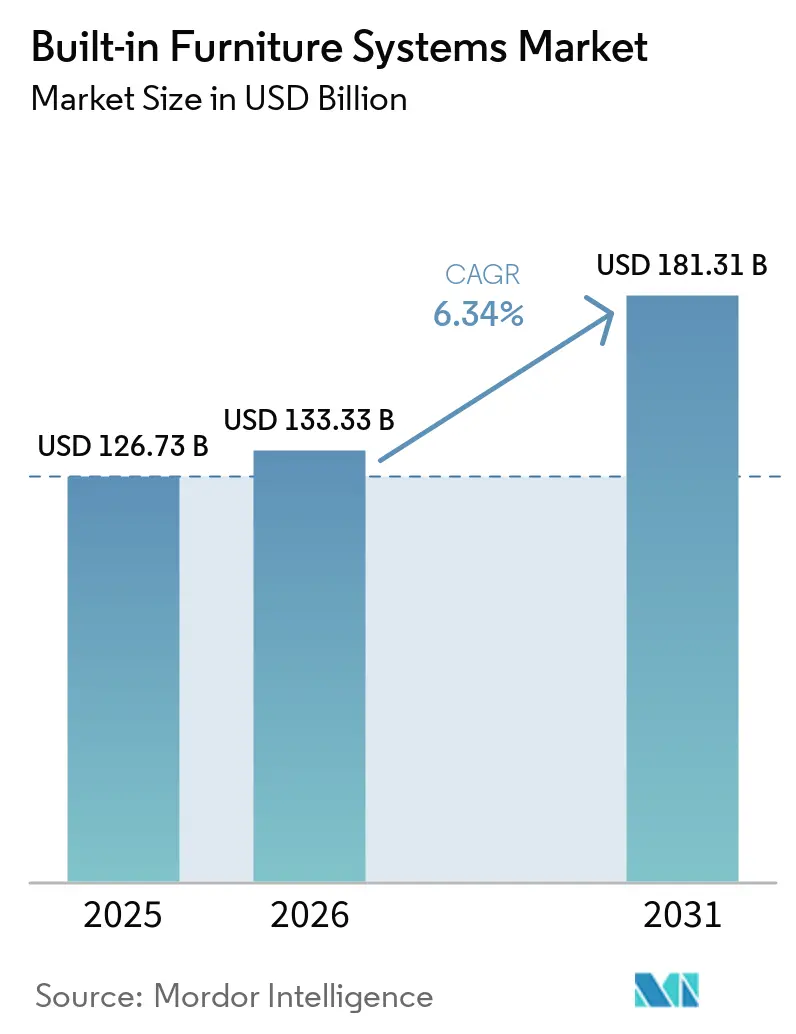
The built-in furniture market size is expected to grow from USD 126.73 billion in 2025 to USD 133.33 billion in 2026, and is forecast to reach USD 181.31 billion by 2031, at a 6.34% CAGR over 2026-2031. The built-in furniture market is being supported by smaller home layouts in dense cities, where vertical storage and fitted designs help households use limited floor area more effectively. The built-in furniture market is also gaining from the lasting shift to hybrid work, as a steady share of working adults continues to split time between home and office and therefore needs more permanent home office setups. Digital design tools, direct-to-installer buying, and repeat procurement from developers are making the built-in furniture market easier to access and easier to scale across residential and project orders[1]. At the same time, the built-in furniture market is seeing tighter competition as large companies use mergers, showroom expansions, and scale to expand reach and reduce costs. The main limits remain installer shortages, affordability pressure, and compliance requirements for wood-based products. Still, these same factors continue to create room for modular systems, low-emission materials, and standardized project packages.
Key Report Takeaways
- By product type, built-in cabinets held 33.21% of the built-in furniture market share in 2025, while built-in office furniture systems recorded the highest projected CAGR at 7.88% through 2031.
- By material type, wood accounted for 44.58% of the built-in furniture market share in 2025, while plastic and polymer are forecast to expand at an 8.13% CAGR through 2031.
- By application, residential captured 83.46% of the built-in furniture market size in 2025, while commercial is advancing at a 7.92% CAGR through 2031.
- By distribution channel, business-to-consumer and retail held 85.62% share in 2025, while business-to-business and project is projected to grow at an 8.26% CAGR through 2031.
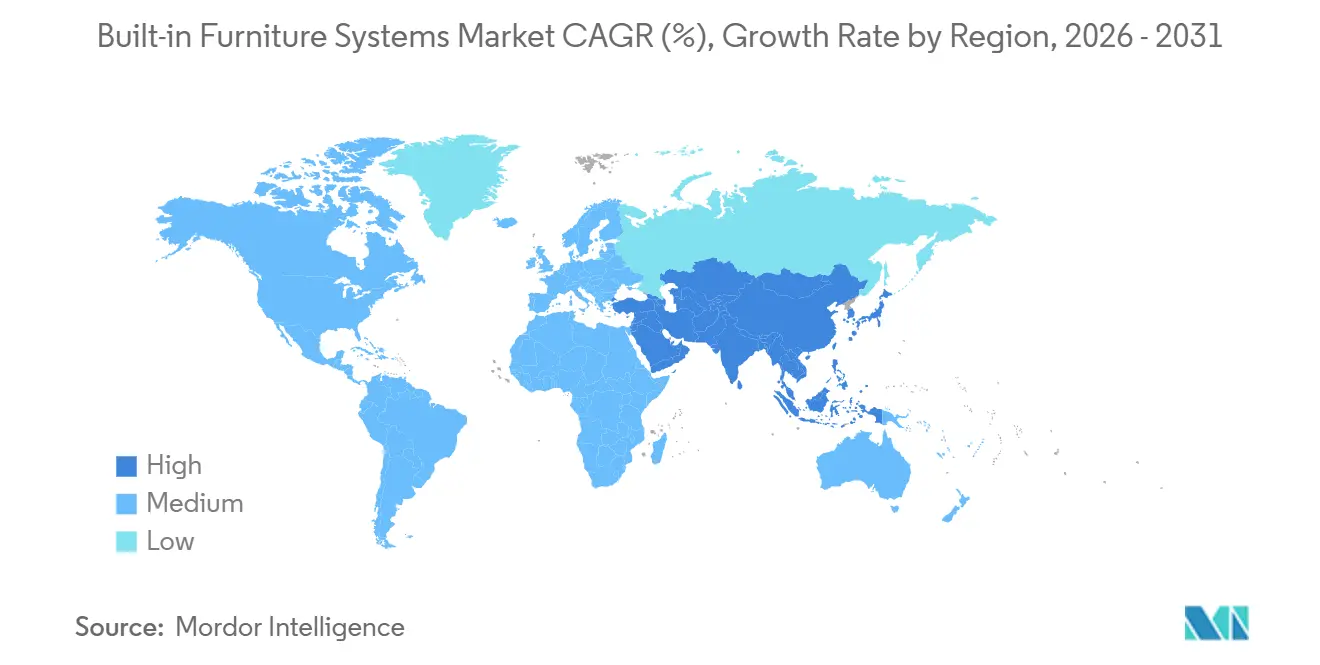
- By geography, Europe led with 38.41% share in 2025, while Asia-Pacific is forecast to expand at an 8.34% CAGR through 2031.
Note: Market size and forecast figures in this report are generated using Mordor Intelligence’s proprietary estimation framework, updated with the latest available data and insights as of January 2026.
Market Trends and Insights
Drivers Impact Analysis of Built-in Furniture Systems Market*
| Driver | (~) % Impact on CAGR Forecast | Geographic Relevance | Impact Timeline |
|---|---|---|---|
| Small-Space Living And Vertical Storage Density | 1.50% | Global, highest impact in Asia-Pacific and Western Europe | Long term (≥ 4 years) |
| Hybrid Work And Home Office Reconfiguration | 1.20% | Global, with highest concentration in North America and Europe | Long term (≥ 4 years) |
| Digital Configurators And Direct-To-Installer Buying | 0.90% | Global, led by North America, Europe, and Asia-Pacific e-commerce markets | Medium term (2-4 years) |
| Sustainability And Low-Volatile Organic Compound Specification Demand | 0.70% | North America and European Union primary, Asia-Pacific spillover | Medium term (2-4 years) |
| Same-Day Modular Installation Demand | 0.50% | Global, with highest impact in urban residential markets | Short term (≤ 2 years) |
| Developer-Led Standardization In Multi-Unit Housing | 0.80% | Global, strongest in North America, Europe, and Asia-Pacific high-density urban markets | Long term (≥ 4 years) |
| Source: Mordor Intelligence | |||
Small-Space Living And Vertical Storage Density
The built-in furniture market is benefiting from a clear reduction in usable living space across major cities, making fitted storage more practical than freestanding pieces. In Singapore, the average floor area for non-landed private residences fell from 118 sq m in 1995 to 83 sq m by 2025, while single-person households accounted for 16% of resident households, indicating that space pressure is becoming more common. Tokyo shows the same pressure, with 9 sq m single-occupancy units leasing before completion and average rents for single-occupancy units in the city’s 23 wards moving above JPY 110,000 per month (USD 740)[2]. This shift changes buying behavior in the built-in furniture market, as households start to value storage yield per square meter more than the flexibility of loose furniture. The effect should remain durable in places where minimum unit sizes are regulated, because developers cannot easily respond by expanding apartment layouts
Hybrid Work And Home Office Reconfiguration
Hybrid work, initially adopted as a temporary measure, has now become a permanent aspect of modern work culture, significantly influencing the built-in furniture market. This shift has driven demand for more functional and aesthetically pleasing home office setups. The market is transitioning from basic desks to advanced wall units that integrate multiple features, including work surfaces, storage, lighting, and cable management, creating cohesive, efficient workspaces. This evolution is fueled by hybrid work policies and equipment stipends, which make premium home office solutions more accessible while simultaneously raising consumer expectations for quality, durability, and functionality. As a result, the built-in furniture market is increasingly catering to the need for well-designed, integrated home office environments that align with the demands of a hybrid workforce.
Digital Configurators And Direct-To-Installer Buying
Digital planning tools are shortening the path from product search to order placement in the built-in furniture market. EGGER and Julius Blum both show how configurators now help cabinetmakers, retailers, and installers move from design to ordering through connected planning systems. VividWorks reported that clients using 3D configurators saw 20% to 30% faster sales cycles and up to 30% higher website conversion rates, suggesting better lead quality rather than just traffic growth[3]. This changes channel economics in the built-in furniture market by enabling consumers to arrive with clearer specifications, reducing design time but increasing order readiness. The same shift supports the expansion of direct-to-installer buying and helps explain why the Business-to-Business and Project channel is forecast to grow at 8.26% during 2026-2031.
Sustainability And Low-Volatile Organic Compound Specification Demand
The built-in furniture market is under greater pressure to meet low-emission, sustainable-material standards, especially in North America and Europe. The United States Environmental Protection Agency, the Toxic Substances Control Act Title VI, and the California Air Resources Board's Airborne Toxic Control Measure rules set formaldehyde emission limits for hardwood plywood, particleboard, and medium-density fiberboard used in finished furniture, which increase documentation and testing requirements across the supply chain. The effect in the built-in furniture market is that larger manufacturers are better able to absorb the costs of certification, chain of custody, and labeling than smaller, import-reliant fabricators. Driven by the advantages of moisture resistance and reduced volatile organic compound emissions, bio-based and recycled formulations are propelling the growth forecast for plastics and polymers for 2026-2031, particularly in kitchen and bathroom applications.
Restraints Impact Analysis of Built-in Furniture Systems Market*
| Restraint | (~) % Impact on CAGR Forecast | Geographic Relevance | Impact Timeline |
|---|---|---|---|
| High Upfront Cost Versus Conventional Furniture | -0.90% | Global, highest in price-sensitive emerging markets and first-time buyer segments | Long term (≥ 4 years) |
| Skilled Installer Shortage And Extended Lead Times | -0.80% | North America and Europe most acute, extending to Asia-Pacific urban markets | Medium term (2-4 years) |
| Material Compliance Burden Across Markets | -0.50% | North America and European Union primary, affecting import-reliant fabricators globally | Medium term (2-4 years) |
| Custom Fit Complexity In Legacy Housing Stock | -0.40% | Europe and North America, particularly in pre-1980 housing stock | Long term (≥ 4 years) |
| Source: Mordor Intelligence | |||
High Upfront Cost Versus Conventional Furniture
The built-in furniture market continues to face affordability challenges, as fitted solutions entail significantly higher upfront costs than mass-market freestanding alternatives. As of June 2026, an analysis of 90,632 live apartment listings indicated that nearly 50% of renters in the United States spent more than 30% of their household income on rent. This financial burden makes the cost of fully fitted kitchens or wardrobe systems, typically 2 to 4 times higher than freestanding options- a deterrent for many first-time buyers and renters, leading to delayed purchases. Similarly, in build-to-rent projects, landlords often prioritize lower-specification fit-outs to minimize immediate capital expenditures. Despite these challenges, the built-in furniture market mitigates some of the pressure by driving project-channel growth, enabling developers to spread specification costs across larger, standardized orders.
Skilled Installer Shortage And Extended Lead Times
The built-in furniture market is also being limited by a shortage of skilled installers, especially in North America and Europe. The 2025 craft workforce survey from the Associated General Contractors of America and the National Center for Construction Education and Research found that 92% of construction companies had difficulty hiring for open positions, with carpenters among the hardest roles to fill. The National Association of Home Builders and the Home Builders Institute reported that 90% of builders faced shortages of rough carpenters in January 2025, while the National Kitchen and Bath Association found that 58% of firms were experiencing moderate or severe skilled labor shortages in 2025[4]. This matters because longer lead times weaken conversion in renovation projects and raise the total installed cost for buyers. It also pushes the built-in furniture market toward prefabricated, prefinished modules that reduce on-site labor requirements and provide a stronger competitive advantage for faster installation.
*Our forecasts treat driver/restraint impacts as directional, not additive. The impact forecasts reflect baseline growth, mix effects, and variable interactions.
Built-in Furniture Systems Market Segment Analysis
By Product Type:
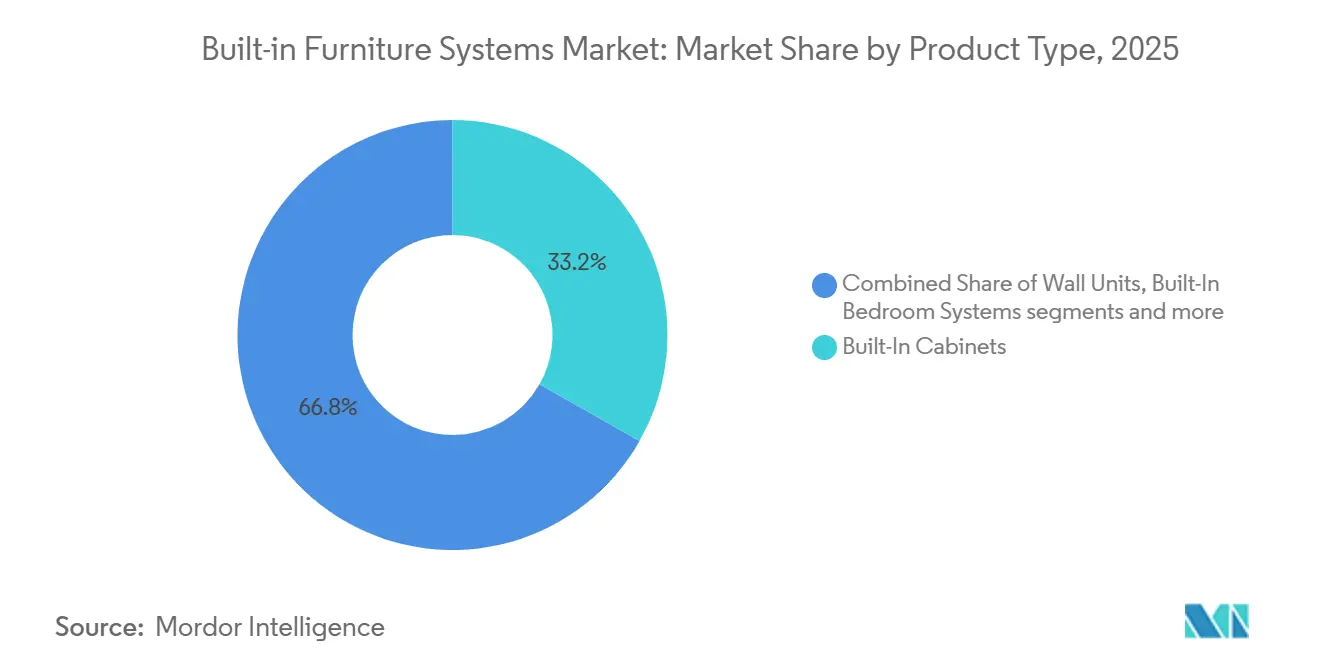
Cabinets Lead While Office Systems Shift Growth Toward Permanent Home Work AreasBuilt-In Cabinets held 33.21% of the built-in furniture market share in 2025, which made them the largest product category across kitchen, bathroom, utility, and living room uses. Their lead reflects the fact that cabinets are among the first fit-out elements standardized in multi-unit housing projects, and they also benefit from a steady renovation cycle in existing homes. Built-In Wardrobes and Closets and Built-In Kitchen Storage Systems followed as the next largest groups, supported by demand for full-room fitted layouts and easier digital specification. Built-In Wall Units and Built-In Bedroom Systems remained more exposed to housing completions and new-build activity than the more established kitchen and storage categories.
Built-In Office Furniture Systems is the fastest-growing product group, with the built-in furniture market size for this sub-segment projected to expand at a 7.88% CAGR during 2026-2031. Growth is being driven by a shift from simple desks toward integrated storage, cable management, lighting, and acoustic features in spaces that now function as fixed work zones. MillerKnoll, through its Knoll brand, launched the Konzert system in May 2026, featuring configurable panels, shelving, tables, and storage, demonstrating how residential and contract office formats are starting to overlap at the premium end. The Others category includes modular mudroom systems, built-in media walls, and laundry room cabinetry, which are gaining attention in North America and Northern Europe as households invest more in finish quality in utility spaces.

By Material Type:
Wood Holds The Largest Base While Polymers Benefit From Compliance And Moisture PerformanceWood accounted for 44.58% of the built-in furniture market share in 2025, maintaining its position as the leading material across most residential applications. Engineered wood products, such as medium-density fiberboard, particleboard, and hardwood plywood, account for most of the volume, while solid wood remains more common in premium custom work. This position is supported by buyer preference for natural finishes and by a mature supply chain across Europe and Asia. At the same time, compliance rules on composite wood emissions are increasing interest in no-added-formaldehyde and ultra-low-emitting formaldehyde resin systems.
Plastics and polymers are the fastest-growing material categories, with the built-in furniture market for this segment projected to grow at an 8.13% CAGR during 2026-2031. The growth driver is not low-cost plastic, but newer bio-based and high post-consumer recycled formulations that offer good moisture resistance, color stability, and lower compliance risk in wet areas. The European Union Circular Economy Action Plan and the United States recycled content procurement framework are also helping create pull for these materials in public-sector purchasing. LIXIL’s refreshed kitchen cabinet lines in Japan, supported by new-generation worktop materials and a more furniture-like finish direction, demonstrate how advanced surfaces are being used to enhance design value without relying solely on wood.
By Application:
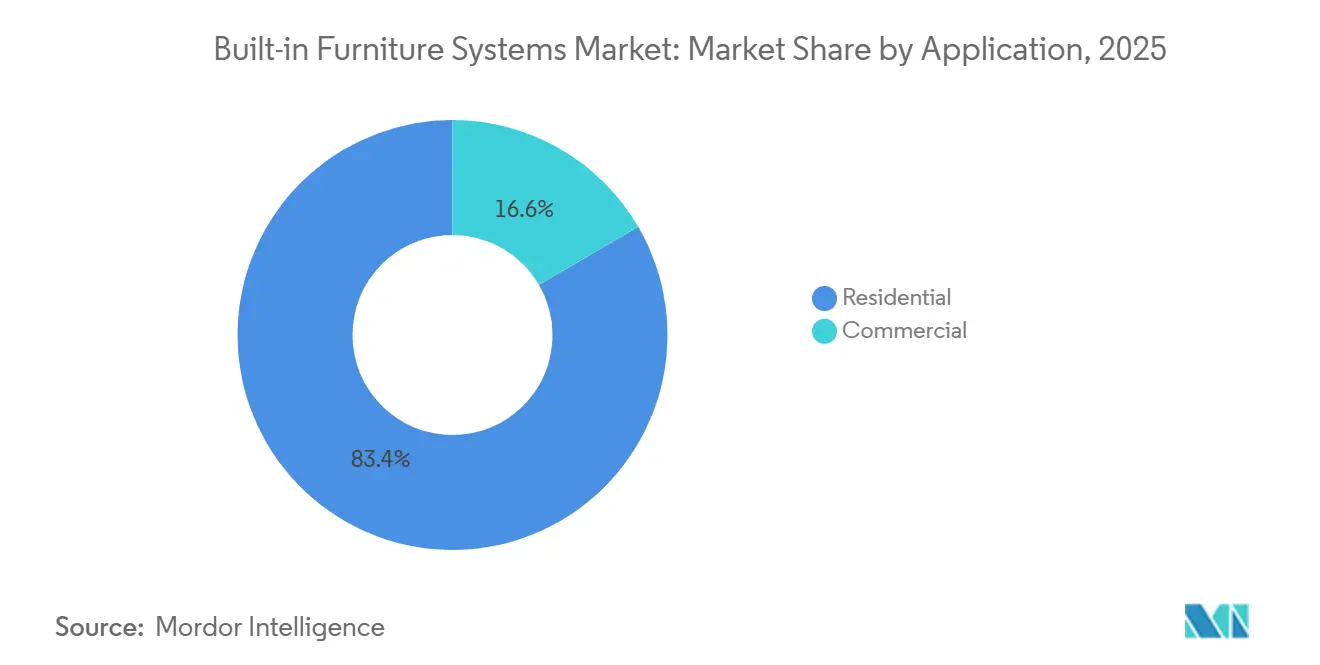
Residential Keeps The Largest Revenue Base While Commercial Posts Faster GrowthResidential applications accounted for 83.46% of the market in 2025, making housing the main demand base for the built-in furniture industry. The built-in furniture market in residential use remained strong because fitted kitchens, wardrobes, and storage systems are standard features of both new housing and renovation projects. The Harvard Joint Center for Housing Studies reported that 354,000 multifamily units were started in the United States in 2024, which helped preserve a large pipeline for primary fit-outs. The build-to-rent segment is becoming increasingly important in residential demand because developers increasingly want repeatable furniture packages that simplify procurement, warranty management, and later replacement cycles.
The commercial application is the fastest-growing category, with a 7.92% CAGR during 2026-2031. Demand is concentrated in office refurbishment and hospitality renovation, where operators are using interior quality and integrated storage to enhance space utilization and the user experience. Project furniture, fixtures, and equipment work across 462 modular studio apartments in the United Kingdom also shows how factory-fitted installations are moving beyond one-off custom work into more repeatable programs. HNI Corporation’s completion of its USD 2.2 billion acquisition of Steelcase in December 2025 further bolstered confidence in commercial demand, as the company cited accelerating in-office work trends in explaining the deal.
By Distribution Channel:
Retail Remains The Main Route While Project Supply Builds ScaleBusiness-to-Consumer and Retail accounted for 85.62% of the market in 2025, maintaining its dominance as the dominant route to end buyers. This channel includes home centers, specialty kitchen and furniture stores, online platforms, and local workshops, with higher-value transactions still concentrated in formats that provide design consultation and measurement support. Online ordering is gaining share because configurator tools make it easier to specify fitted furniture without repeated showroom visits. IKEA United States expanded this access model through 14 new locations in fiscal year 2025 and plans for additional openings in 2026, including smaller Plan and Order Points focused on kitchens and storage.
Business-to-Business and Project is the fastest-growing channel, with a 8.26% CAGR during 2026-2031. The channel operates on a different logic from retail, as repeat procurement, standard specifications, and installation efficiency matter more than full design customization. Oppein Home Group, with more than 8,700 showrooms globally and an annual output capacity of over 9 million cabinets, is well-positioned to meet both consumer demand and large-volume developer orders. The Container Store overhaul launched after Bed Bath and Beyond’s USD 150 million acquisition also points to broader retail integration of closet and built-in storage products into larger home improvement ecosystems.
Geography Analysis
Europe and Nordics Built-in Furniture Systems Market
Europe held 38.41% of the built-in furniture market share in 2025, which kept it as the largest regional market. The built-in furniture market has a strong base in Europe because fitted kitchens and wardrobes are already treated as standard parts of residential property in many countries, not optional upgrades. Germany remains the main value anchor, while renovation activity and established cabinetry culture continue to support demand across the region. The Nordics, which include Denmark, Finland, Iceland, Norway, and Sweden, remain important for built-in kitchen systems because they combine mature consumer demand with efficient production networks. Nobia AB’s consolidation of Scandinavian manufacturing into the Nobia Park facility in Jönköping, together with expected annual savings of SEK 80 million from the third quarter of 2026, shows how automation and scale are becoming more important in the regional supply base.
APAC Built-in Furniture Systems Market
Asia-Pacific is the fastest-growing regional block, with the built-in furniture market size in the region projected to advance at an 8.34% CAGR during 2026-2031. Growth is being driven by urban residential construction, rising middle-class income, and the spread of organized fitted furniture retail in countries that were historically served by local carpenters. Japan shows a premium direction through LIXIL’s 2026 launch of refreshed Nokto and Sierra kitchen lines and its plan for a high-end kitchen offer aimed at luxury Tokyo properties. India is another major growth engine, with Godrej Interio reporting fiscal year 2026 revenue of INR 4,000 crore, equivalent in the source text to USD 480 million, a 12% increase, wider installation coverage, and plans to add 102 stores in fiscal year 2027.
The Americas and MEA Built-in Furniture Systems Market
North America remains a mature but active part of the built-in furniture market, supported by renovation demand, a strong home center channel, and ongoing supplier consolidation. MasterBrand’s all-stock merger with American Woodmark, completed on May 28, 2026, created a broader cabinetry platform and targeted USD 90 million in annual run-rate cost synergies by the end of year 3. South America continues to be centered on Brazil, where urbanization and residential construction support base demand even though economic volatility can slow upgrade spending. Middle East and Africa is still emerging, but the United Arab Emirates and Saudi Arabia stand out because luxury housing and hospitality projects require large volumes of kitchens, wardrobes, and vanity units, while Sobha Furniture’s Abu Dhabi plant shows the move toward local manufacturing instead of full import dependence.
Competitive Landscape
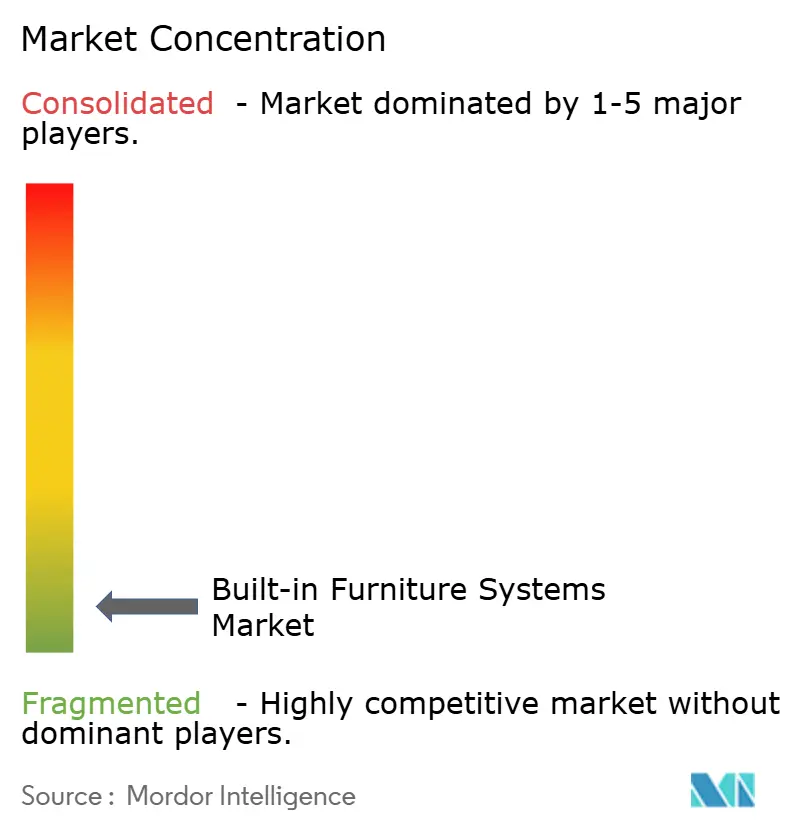
The built-in furniture market remains moderately fragmented at the global level, with no single company controlling demand across all regions and product categories. Competition in the built-in furniture market operates through global retailers with scale advantages, regional specialists with strong domestic positions, and premium design-led manufacturers that compete more on specification than on price. IKEA remains important because its manufacturing scale, flat-pack logistics, and omnichannel network let it reach a broad consumer base while also supporting fitted planning formats. Regional specialists such as Nobia in the Nordics, Oppein and Suofeiya in China, and Godrej Interio in India remain relevant because they combine local market knowledge with expanding production or distribution reach. Premium brands such as Poliform, Vitra, and Kinnarps continue to hold space in luxury residential and contract work where finish, planning quality, and brand position carry more weight than entry price.
Strategic consolidation has become more visible in the built-in furniture market during 2025 and 2026. HNI Corporation completed its USD 2.2 billion acquisition of Steelcase in December 2025, which combined two large commercial furniture platforms and reflected confidence in longer-term office demand. MasterBrand’s merger with American Woodmark in May 2026 added another major example, especially for cabinetry supply into residential construction and renovation channels. IKEA’s store expansion and smaller planning-led formats also show that retail leaders are widening access points instead of relying only on large traditional stores.
The built-in furniture market also has white space in developer-focused supply and digital order fulfillment. Companies that can provide standardized packages, single-source procurement, and warranty support to multi-unit developers are likely to gain share in the faster-growing project channel. Technology-linked ordering is another opening, because configurator-led sales connect directly with installers and manufacturing output, which cuts friction from the older showroom-led process. Hardware and fitting suppliers such as Häfele, Hettich, and Julius Blum still influence the built-in furniture market because innovations in lighting, drawers, hinges, and organization systems change what finished products can offer to end buyers.
Built-in Furniture Systems Industry Leaders
-
IKEA
-
OPPEIN Home Group
-
Suofeiya Home Collection
-
MasterBrand Cabinets, Inc.
-
American Woodmark Corporation
- *Disclaimer: Major Players sorted in no particular order
Built-in Furniture Systems Market Companies Covered in this Report
- IKEA Retail
- Oppein Home Group Inc.
- Suofeiya Home Collection Co., Ltd.
- California Closets
- Closet Factory
- The Container Store Group, Inc.
- MasterBrand, Inc.
- American Woodmark Corporation
- Nobia AB
- Häfele GmbH & Co KG
- Hettich Holding GmbH & Co. oHG
- Julius Blum GmbH
- LIXIL Corporation
- HNI Corporation
- MillerKnoll, Inc.
- Steelcase Inc.
- Haworth, Inc.
- KOKUYO Co., Ltd.
- Kinnarps AB
- Vitra International AG
- Godrej Interio
Recent Industry Developments in Built-in Furniture Systems Market
- April 2026: The Container Store launched a chainwide overhaul of its 98 United States stores, preparing for the integration of Bed Bath and Beyond products following Bed Bath and Beyond's USD 150 million acquisition.
- February 2026: Ingka Group, IKEA's largest franchisee, has opened 21 new global retail locations since January 2026 across Europe, North America, and Asia as part of its EUR 5 billion 3-year investment program.
- February 2026: LIXIL Corporation launched refreshed built-in kitchen series, the Nokto and Sierra lines, across Japan, featuring new-generation worktop materials positioned for a furniture-grade aesthetic.
- January 2026: Knoll, a MillerKnoll brand, launched the Dividends Skyline built-in workplace system, featuring new planning typologies and configurable boundary elements for open-plan and private office environments, commercially available through MillerKnoll dealers
Global Built-in Furniture Systems Market Report Scope
Segmentation Overview
| Built-In Cabinets |
| Built-In Wardrobes and Closets |
| Built-In Wall Units |
| Built-In Bedroom Systems |
| Built-In Office Furniture Systems |
| Built-In Kitchen Storage Systems |
| Others |
| Wood |
| Plastic and Polymer |
| Metal |
| Other Materials |
| Residential |
| Commercial |
| B2B/Project | |
| B2C/Retail | Home Centers |
| Specialty Furniture Stores | |
| Online | |
| Local Workshops | |
| Other Distribution Channels |
| North America | Canada |
| United States | |
| Mexico | |
| South America | Brazil |
| Peru | |
| Chile | |
| Argentina | |
| Rest of South America | |
| Europe | United Kingdom |
| Germany | |
| France | |
| Spain | |
| Italy | |
| BENELUX (Belgium, Netherlands, and Luxembourg) | |
| NORDICS (Denmark, Finland, Iceland, Norway, and Sweden) | |
| Rest of Europe | |
| Asia-Pacific | India |
| China | |
| Japan | |
| Australia | |
| South Korea | |
| South East Asia (Singapore, Malaysia, Thailand, Indonesia, Vietnam, and the Philippines) | |
| Rest of Asia-Pacific | |
| Middle East and Africa | United Arab Emirates |
| Saudi Arabia | |
| South Africa | |
| Nigeria | |
| Rest of the Middle East and Africa |
| By Product Type | Built-In Cabinets | |
| Built-In Wardrobes and Closets | ||
| Built-In Wall Units | ||
| Built-In Bedroom Systems | ||
| Built-In Office Furniture Systems | ||
| Built-In Kitchen Storage Systems | ||
| Others | ||
| By Material Type | Wood | |
| Plastic and Polymer | ||
| Metal | ||
| Other Materials | ||
| By Application | Residential | |
| Commercial | ||
| By Distribution Channel | B2B/Project | |
| B2C/Retail | Home Centers | |
| Specialty Furniture Stores | ||
| Online | ||
| Local Workshops | ||
| Other Distribution Channels | ||
| By Geography | North America | Canada |
| United States | ||
| Mexico | ||
| South America | Brazil | |
| Peru | ||
| Chile | ||
| Argentina | ||
| Rest of South America | ||
| Europe | United Kingdom | |
| Germany | ||
| France | ||
| Spain | ||
| Italy | ||
| BENELUX (Belgium, Netherlands, and Luxembourg) | ||
| NORDICS (Denmark, Finland, Iceland, Norway, and Sweden) | ||
| Rest of Europe | ||
| Asia-Pacific | India | |
| China | ||
| Japan | ||
| Australia | ||
| South Korea | ||
| South East Asia (Singapore, Malaysia, Thailand, Indonesia, Vietnam, and the Philippines) | ||
| Rest of Asia-Pacific | ||
| Middle East and Africa | United Arab Emirates | |
| Saudi Arabia | ||
| South Africa | ||
| Nigeria | ||
| Rest of the Middle East and Africa | ||
Key Questions Answered in the Report
What is the 2031 value forecast for built-in furniture?
The built-in furniture market is forecast to reach USD 181.31 billion by 2031, rising from USD 133.33 billion in 2026 at a 6.34% CAGR.
Which product category leads revenue generation?
Built-In Cabinets led revenue contribution in 2025 with a 33.21% share, making them the largest product category in the report.
Which region is expanding the fastest through 2031?
Asia-Pacific is projected to grow the fastest, with an 8.34% CAGR during 2026-2031, supported by urban housing growth and organized retail expansion.
Why are home office systems growing faster than other product groups?
Built-In Office Furniture Systems is projected to grow at 7.88% CAGR because hybrid work is pushing buyers toward permanent, integrated work zones instead of simple desks.
What is the biggest challenge for manufacturers and installers?
Skilled labor availability remains a major challenge, with 92% of construction companies reporting hiring difficulty in 2025 and 58% of kitchen and bath firms facing moderate or severe shortages.