
Space-Saving Furniture Market Size and Share
Market Overview
| Study Period | 2020 - 2031 |
|---|---|
| Market Size (2026) | USD 12.62 Billion |
| Market Size (2031) | USD 17.56 Billion |
| Growth Rate (2026 - 2031) | 6.83 % |
| Fastest Growing Market | Asia-Pacific |
| Largest Market | Asia-Pacific |
| Market Concentration | Medium |
Major Players *Disclaimer: Major Players sorted in no particular order Image © Mordor Intelligence. Reuse requires attribution under CC BY 4.0. | |
Space-Saving Furniture Market Analysis by Mordor Intelligence
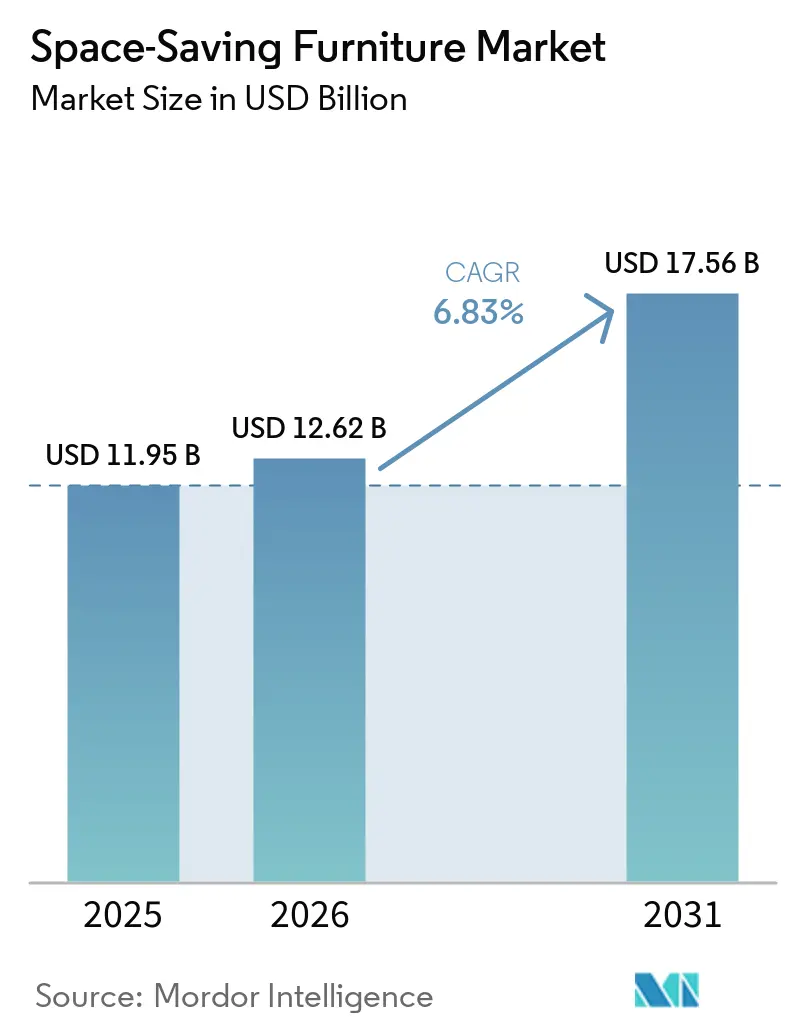
The Multifunctional furniture market size is projected to expand from USD 11.95 billion in 2025 and USD 12.62 billion in 2026 to USD 17.56 billion by 2031, registering a CAGR of 6.8% between 2026 and 2031. The multifunctional furniture market is advancing because smaller urban homes are making space efficiency a daily requirement rather than a design preference. In the United States, micro-units under 450 sq ft accounted for 66% of new housing under construction in Seattle, 56% in Boston, and 43% in New York City in May 2025, which shows that compact living is moving into the mainstream housing pipeline. Digital discovery is also driving conversion, since online channels accounted for 28% of IKEA retail sales in FY2025, and the group added 66 new sales locations worldwide to support planning, ordering, and fulfillment across formats[1]. Institutional procurement standards are becoming more important, with BIFMA strengthening material transparency tools for the furniture value chain in 2025, which is raising the quality threshold in project-led buying. The competitive landscape remains fragmented, so brands with dependable supply chains, efficient flat-pack logistics, and tighter sourcing control are better placed to capture the next phase of demand in the multifunctional furniture market.
Key Report Takeaways
- By product type, sofa beds led with 28.6% of the space-saving furniture market revenue share in 2025, while wall beds are forecast to expand at a 7.6% CAGR through 2031.
- By material type, wood accounted for 38.5% of the space-saving furniture market revenue share in 2025, while plastic and polymer materials are projected to record the highest CAGR at 7.3% through 2031.
- By end user, residential held 81.2% of the space-saving furniture market share, while commercial is forecast to grow the fastest at an 8.1% CAGR through 2031.
- By distribution channel, B2C and retail accounted for 85.5% of revenue in 2025, while B2B and project distribution is expected to grow at a 8.1% CAGR through 2031.
- By geography, Asia-Pacific accounted for 38.6% of revenue in 2025 and is forecast to expand at a 8.3% CAGR through 2031.
Note: Market size and forecast figures in this report are generated using Mordor Intelligence’s proprietary estimation framework, updated with the latest available data and insights as of January 2026.
Market Trends and Insights
Urban Micro-Housing Adoption Creating Structural Demand for Convertible Furniture
The micro-housing wave is a durable driver of the multifunctional furniture market because it operates at both the policy and household levels. Congress for the New Urbanism reported in May 2025 that micro-units accounted for 66% of new housing under construction in Seattle, 56% in Boston, 43% in New York City, and 19% in Los Angeles[2]. The same source also highlighted that Chicago micro-units averaged USD 1,263 in monthly rent, while conventional apartments averaged USD 2,420, which shows why compact formats remain commercially viable in dense urban areas. These projects create direct demand for wall beds, storage ottomans, fold-out work surfaces, and modular storage, as each room must support multiple daily uses. Since zoning reforms usually shape future housing stock for many years, this driver supports a long demand runway for the multifunctional furniture market.
Drivers Impact Analysis of Space-Saving Furniture Market*
| Driver | (~) % Impact on CAGR Forecast | Geographic Relevance | Impact Timeline |
|---|---|---|---|
| Urban Micro-Housing Adoption | 1.80% | Global, led by Asia-Pacific gateway cities and United States coastal metros | Long term (≥ 4 years) |
| Growth of Hybrid Home Office Demand | 1.40% | North America and Europe primarily, with Asia-Pacific emerging | Medium term (2-4 years) |
| Rising Preference for Multifunctional Interiors | 1.20% | Global, with early concentration in Asia-Pacific and Nordic markets | Long term (≥ 4 years) |
| E-Commerce-Assisted Product Discovery | 0.90% | Global, led by the United States, China, and Southeast Asia | Medium term (2-4 years) |
| B2B Project Demand From Hospitality and Co-Living | 0.80% | Europe, Asia-Pacific, and Middle East project-heavy markets | Medium term (2-4 years) |
| Flat-Pack Logistics Advantage | 0.60% | Global, most relevant for cross-border and emerging markets | Short term (≤ 2 years) |
| Source: Mordor Intelligence | |||
Growth of Hybrid Home Office Demand Converting Living Rooms Into Dual-Use Spaces
Hybrid work continues to reshape furniture demand, as living areas now need to switch between work, leisure, and guest use within the same footprint. This is raising demand for folding desks, nesting tables, modular shelving, and convertible seating that can be adjusted without permanent room changes. The multifunctional furniture market also benefits because many households now replace single-purpose pieces with products that support both daytime productivity and evening living. On the commercial side, employers and workspace operators are favoring layouts that can absorb variable attendance without committing to fixed desk counts in every location. This pattern supports repeat buying rather than one-time buying, which improves replacement demand across the multifunctional furniture market.
Rising Preference for Multifunctional Interiors Driving Better Realization Across Price Tiers
Buyer expectations have shifted from basic utility to products that combine function, appearance, and dependable mechanism quality. Ingka Group reported in its FY24 summary that 40% of surveyed consumers associated a tidy and organized home with personal well-being, which supports stronger demand for storage-led and space-saving formats[3]. IKEA also framed systems such as KALLAX and EKET as space-enabling products rather than simple storage units, reflecting how the category is being positioned to address broader room-planning needs. That shift matters because buyers are more willing to pay for furniture that reduces visible clutter while improving daily use of the room. Brands that combine a cleaner design language with more reliable mechanisms are therefore better protected from commoditization in the multifunctional furniture market.
E-Commerce-Assisted Product Discovery Lowering the Barrier to Adoption
Online retail remains a strong demand enabler because convertible products are easier to understand when motion, dimensions, and reconfiguration steps are shown visually. The United States Census Bureau reported that e-commerce accounted for 16.8% of total United States retail sales in Q1 2026, up 9.7% from Q1 2025, while total retail sales grew 4.0% over the same period. That shift favors the multifunctional furniture market because shoppers can evaluate room fit, mechanism use, and storage outcomes before purchase. Inter IKEA Group also reported that 28% of total IKEA retail sales came from online channels in FY2025, while the company opened 66 new sales locations globally to support a more connected digital and local fulfillment model. As digital room-planning tools improve and delivery networks become more reliable, e-commerce should continue to shorten the decision cycle for the multifunctional furniture market.
Restraints Impact Analysis of Space-Saving Furniture Market*
| Restraint | (~) % Impact on CAGR Forecast | Geographic Relevance | Impact Timeline |
|---|---|---|---|
| Premium Pricing Versus Conventional Furniture | -0.80% | Global, most acute in South Asia and Southeast Asia | Long term (≥ 4 years) |
| Durability Concerns in High-Frequency Use | -0.50% | Global, concentrated in commercial and co-living settings | Medium term (2-4 years) |
| Installation Complexity and After-Sales Dependence | -0.40% | Global, most pronounced in emerging markets with limited installer networks | Medium term (2-4 years) |
| Material and Mechanism Cost Volatility | -0.60% | Global, with higher exposure for European and South Asian manufacturers | Short term (≤ 2 years) |
| Source: Mordor Intelligence | |||
Premium Pricing Versus Conventional Furniture Narrowing the Addressable Consumer Base
The affordability gap remains a real restraint in the multifunctional furniture market, especially when households focus more on the initial ticket price than on the total space value. Wall beds with integrated cabinetry, precision sofa-bed systems, and engineered modular units usually cost more than single-purpose alternatives because they include moving parts and more complex construction. This slows first-time adoption in price-sensitive markets, even where smaller homes should support strong demand. Inter IKEA Group reported FY2025 total IKEA retail sales of EUR 44.6 billion, driven by continued price investments, demonstrating that scale can support affordability-led volume strategies more effectively than specialist makers[4]. For many smaller brands, that cost structure limits how far prices can fall without weakening margins or product quality.
Material and Mechanism Cost Volatility Compressing Flexibility in Product Pricing
Cost volatility is more difficult for convertible furniture than for conventional furniture because these products rely on both furniture materials and mechanism components. A wall bed or sofa bed typically combines engineered wood, metal frames, hinges, gas lifts, fasteners, upholstery inputs, and finishing materials in one unit. That means manufacturers face multiple cost exposures at the same time, while still being expected to keep mechanisms safe and durable. Companies with stronger sourcing discipline, more integrated production, or wider vendor networks can absorb these swings better than smaller firms. Persistent cost pressure therefore reduces pricing flexibility and slows broader reach for the multifunctional furniture market.
*Our forecasts treat driver/restraint impacts as directional, not additive. The impact forecasts reflect baseline growth, mix effects, and variable interactions.
Space-Saving Furniture Market Segment Analysis
By Product Type:
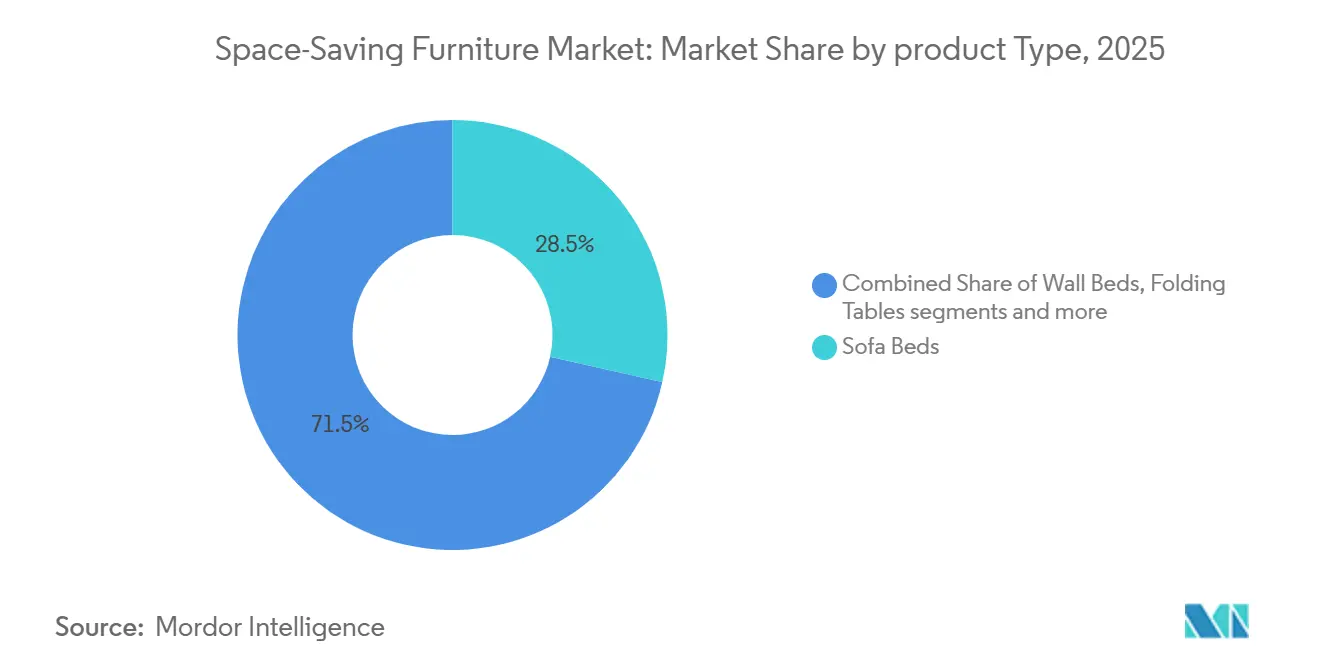
Wall Beds Scale as Compact-Living Standards Become More FormalizedSofa beds held 28.6% of the multifunctional furniture market share in 2025, making them the largest product category. Their position reflects familiar usage, easier room fit, and a lower behavioral shift for first-time buyers who want one piece to support seating and sleeping. They remain especially relevant in studio apartments, co-living rooms, guest rooms, and small family homes where an extra sleeping surface is needed without dedicating a full room. Folding and nesting tables also maintained steady demand because they support work, dining, and occasional use without locking a room into a single purpose.
Wall beds are projected to grow at a 7.6% CAGR from 2026 to 2031, which makes them the fastest-expanding product type in the multifunctional furniture market. This growth reflects stronger use in compact apartment projects, micro-hotel rooms, and space-constrained urban homes where vertical storage matters more than floor coverage. Specialist manufacturers such as Clei S.p.A. remain important in this space because wall bed performance depends heavily on the precision of the mechanisms, installation quality, and ease of daily use. Storage ottomans and convertible chairs continue to serve smaller niches, but they support the same core demand logic by adding storage or guest function without occupying permanent room space. The broad product mix shows that a single hero item does not define the multifunctional furniture market; rather, it is a family of products that address different room constraints across price bands.

By Material Type:
Polymer Adoption Rises While Wood Retains a Quality AdvantageWood accounted for 38.5% of the multifunctional furniture market in 2025, making it the leading material across premium and mid-range applications. Buyers still associate wood with durability, visual warmth, and better value retention, especially for products that remain visible in living rooms or bedrooms throughout the day. Engineered wood is especially important in mechanism-dependent products because it offers dimensional stability while allowing more controlled fabrication for integrated frames, storage compartments, and fold-out sections. Metal also remains essential in the multifunctional furniture industry, where load-bearing strength is critical, especially in wall bed frames, folding structures, and hardware-led product assemblies.
Plastic and polymer materials are projected to expand at a 7.3% CAGR through 2031, which makes them the fastest-growing material segment in the multifunctional furniture market. Their appeal comes from lighter unit weight, lower delivery cost, and greater design flexibility for molded parts and accessory components. These properties matter in flat-pack distribution because lower shipping weight improves handling and reduces pressure on last-mile costs. Polymer-based components can also improve part consistency in certain high-volume applications, which supports smoother operation in folding and expandable products. Over time, the material mix is likely to remain hybrid, with wood, metal, and polymer each serving different structural and commercial roles in the multifunctional furniture market.
By End-User:
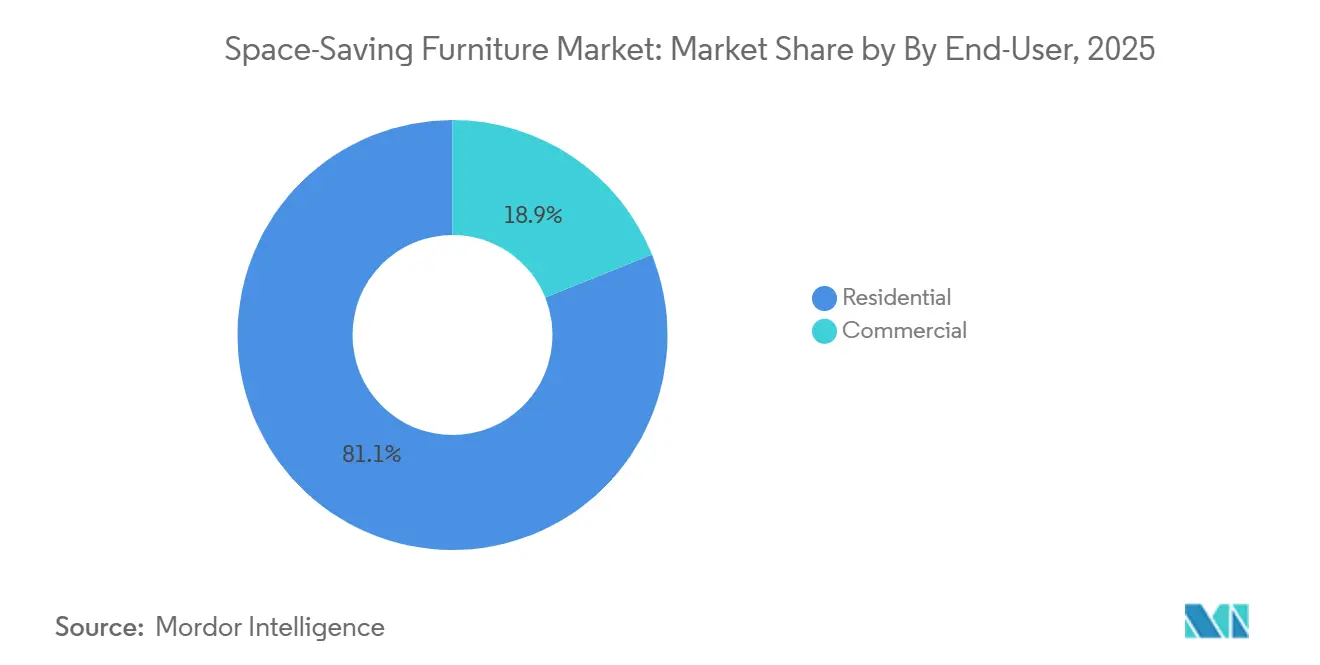
Commercial Procurement Is Rising Faster Even as Residential Demand Remains DominantResidential users accounted for 81.2% of the multifunctional furniture market in 2025, underscoring that households remain the primary driver of demand. This reflects the category’s roots in home furnishing, where compact apartments, guest-use flexibility, and storage pressure continue to shape purchase decisions. Many consumers also now view space-saving furniture as part of normal room planning rather than as a compromise product for unusually small homes. That shift supports not only first-time purchases but also replacement demand as earlier buyers move toward better mechanisms, stronger finishes, or more coordinated designs.
The commercial end-user segment is projected to grow at a 8.1% CAGR from 2026 to 2031, making it the fastest-growing end-user channel in the multifunctional furniture market. Demand is being supported by co-living operators, boutique hotels, extended-stay properties, serviced apartments, and flexible workspace operators that need to use limited square footage more efficiently. These buyers often procure room packages rather than individual components, which can increase order values and strengthen repeat business for suppliers with project execution capabilities. Commercial buyers also place greater weight on installation support, durability, and after-sales service because furniture failure affects occupancy, guest experience, or workspace usability. As institutional buyers become more organized, the multifunctional furniture market should see a greater share of value growth driven by specification-led procurement.
By Distribution Channel:
Project Buying Gains Momentum While Retail Keeps Scale LeadershipB2C and retail accounted for 85.5% of revenue in 2025, confirming that consumer channels still dominate the multifunctional furniture market. Home centers, furniture stores, and online retail platforms remain important because many buyers want to compare dimensions, finishes, and room fit before purchase. Showroom support also remains valuable for products such as wall beds or modular systems, where installation planning can affect confidence and conversion. At the same time, online discovery is becoming more effective because videos, room visualizers, and dimension tools reduce uncertainty in the purchase journey.
B2B and project distribution is projected to expand at a 8.1% CAGR from 2026 to 2031, making it the fastest-growing route to market in the multifunctional furniture market. This change reflects the formalization of procurement in hospitality, co-living, and other managed-space formats, where furniture is selected as part of a broader room-use strategy. BIFMA’s SOURCE database and broader sustainability guidance are also strengthening the role of material transparency in institutional buying decisions. Suppliers that can combine product quality with installation, service responsiveness, and documentation are more likely to gain repeat project work. The result is a distribution mix where retail keeps scale, but project-led buying is becoming more influential in how the multifunctional furniture market grows.
Geography Analysis
APAC Space-Saving Furniture Market
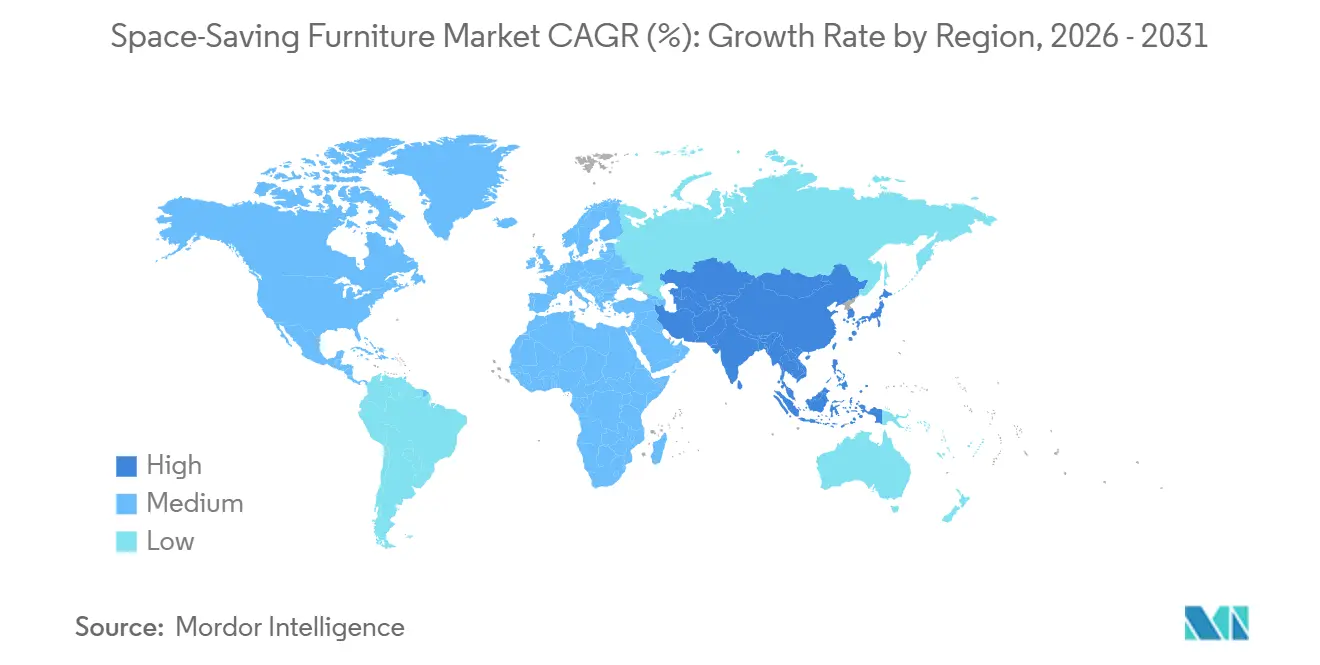
Asia-Pacific accounted for 38.6% of the multifunctional furniture market size in 2025 and is forecast to grow at an 8.3% CAGR through 2031. The region leads because compact urban housing, rising apartment living, and mobile-first commerce all support demand for space-saving products. The multifunctional furniture market is also more dynamic in Asia-Pacific because room size constraints are already part of everyday purchasing logic in many large cities. This gives the region both a large installed base and a strong pipeline for continued replacement and first-home demand. As product availability improves across both physical retail and digital channels, the Asia-Pacific region should remain the main growth engine for the multifunctional furniture market.
North America and Europe Space-Saving Furniture Market
North America and Europe together represent deep and durable demand centers for the multifunctional furniture market, although the drivers differ by region. In the United States, housing units in structures with 50 or more units rose 77.4% between 2005 and 2024 to 10.2 million, suggesting a larger stock of dense multifamily housing that supports compact furniture demand. The National Association of Home Builders reported in Q1 2026 that multifamily construction expanded across most markets, led by gains in large metro core counties, which supports continued furnishing demand in urban apartment deliveries. In England, the Ministry of Housing reported that new build dwelling completions in Q1 2025 stood 125% above the 2020 Q2 trough, which signals a meaningful recovery in newly furnished housing supply. In Ireland, the Central Statistics Office reported 36,284 new domestic dwellings in 2025, with 65% located in urban areas and 33% built as apartments, which supports the case for compact and dual-use furniture formats.
MEA and South America Space-Saving Furniture Market
South America, the Middle East, and Africa remain smaller in total value, but each contains demand pockets that matter for future regional expansion of the multifunctional furniture market. In South America, demand is tied mainly to dense city living and the gradual movement from local workshop products toward more standardized branded offerings. In the Middle East, hospitality and mixed-use project development create stronger specification-led demand, particularly for wall beds, modular storage, and flexible guest-room layouts. In Africa, long-term potential depends on urbanization, organized retail growth, and more reliable logistics that can improve access to the multifunctional furniture market.
Competitive Landscape
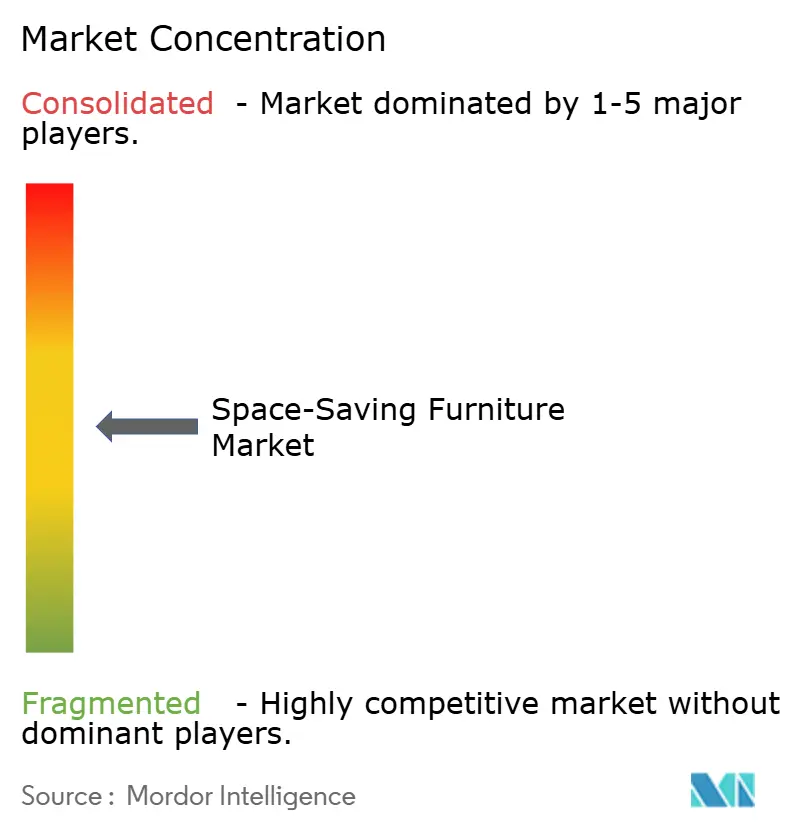
The multifunctional furniture market remains fragmented globally, with no single company dominating any product category or region. Inter IKEA Systems B.V. stands out by scale, with FY2025 IKEA retail sales of EUR 44.6 billion across 63 markets, 28% of sales through online channels, and 66 new sales locations opened during the year. Even so, IKEA’s multifunctional ranges sit within a much broader portfolio, which means its leadership comes from platform reach as much as from any single convertible category. Specialist players such as Clei S.p.A., Resource Furniture LLC, and Expand Furniture Inc. compete more on product engineering, design credibility, and installer relationships than on mass-market pricing. This creates a layered market structure in which global generalists, regional brands, and niche specialists coexist within the multifunctional furniture market.
Commercial furniture consolidation is also influencing expectations for scale, sourcing, and institutional reach. HNI Corporation reported fourth-quarter and fiscal-year 2025 results in February 2026, after completing the Steelcase transaction, demonstrating how quickly larger furnishing platforms are building broader commercial capabilities. In May 2026, HNI reported Q1 net sales of USD 1.3 billion and said expected synergies from the Steelcase acquisition should add USD 1.2 to non-GAAP diluted EPS when fully mature. La-Z-Boy also kept expanding its direct retail presence, and in November 2025 it announced its largest acquisition to date, a 15-store retail network in the Southeast United States for USD 86 million. These moves matter because larger retail and institutional footprints improve product visibility, customer data access, and route-to-market control. They also raise the standard for smaller firms that still rely heavily on third-party sellers or isolated regional distribution.
Mechanism quality, installation support, and sourcing resilience remain the most practical competitive differentiators in the multifunctional furniture market. BIFMA launched SOURCE in January 2025 to support better material transparency, and that is becoming more relevant in institutional procurement where documentation standards are tightening. Inter IKEA Group also reported that IKEA Industry AB acquired 8,000 hectares of forest land in Latvia in FY2025, which highlights the value of upstream supply control when raw material conditions are less stable. Overall, the multifunctional furniture market still offers room for regional brands and specialists, but companies with stronger sourcing discipline, better service capability, and more trusted mechanisms should be best placed to capture premium demand and project-led orders.
Space-Saving Furniture Industry Leaders
-
Inter IKEA Systems B.V.
-
Wayfair LLC
-
Ashley Furniture Industries, LLC
-
HNI Corporation
-
Resource Furniture
- *Disclaimer: Major Players sorted in no particular order
Space-Saving Furniture Market Companies Covered in this Report
- Inter IKEA Systems B.V.
- Resource Furniture LLC
- Clei S.p.A.
- Wayfair LLC
- Ashley Furniture Industries, LLC
- HNI Corporation
- MillerKnoll, Inc.
- Haworth, Inc.
- Steelcase Inc.
- La-Z-Boy Incorporated
- BoConcept A/S
- Expand Furniture Inc.
- Murphy Bed Depot Ltd.
- Godrej & Boyce Manufacturing Company Limited (Godrej Interio brand)
- Urban Ladder Home Decor Solutions Private Limited
- Nilkamal Limited
- Pepperfry Limited
- Ashley HomeStore Ltd.
- Bush Industries, Inc.
- Crate and Barrel Holdings, Inc.
Recent Industry Developments in Space-Saving Furniture Market
- February 2026: HNI Corporation completed the acquisition of Steelcase Inc., creating a combined commercial furnishings enterprise.
- November 2025: La-Z-Boy advanced the largest acquisition in company history, acquiring a 15-store retail network in the Southeast US for USD 86 million as part of its Century Vision DTC strategy
- August 2025: Inhabitr expanded its furniture financing program for hospitality clients following a successful pilot with PACIFIC 19 Kona (a 150-room boutique hotel in Hawaii), completing full guest-room furniture procurement for 122 rooms in under 5 months; the company targets over 100,000 furnished units across hospitality, multifamily, and student housing
- June 2025: Ashley Furniture Industries acquired a 705,000 sq ft distribution facility in Lakeland, Florida, and opened a flagship store and distribution center on a 20-acre parcel in Las Vegas, part of an ongoing USD 2 billion capital investment program in United States manufacturing and logistics.
Global Space-Saving Furniture Market Report Scope
Segmentation Overview
| Sofa Beds |
| Wall Beds |
| Folding Tables |
| Nesting Tables |
| Storage Ottomans |
| Convertible Chairs |
| Modular Storage Units |
| Other Product Types |
| Wood |
| Plastic & Polymer |
| Metal |
| Other Materials |
| Residential |
| Commercial |
| B2B/Project | |
| B2C/Retail | Home Centers |
| Specialty Furniture Stores | |
| Online | |
| Local Workshops | |
| Other Distribution Channels |
| North America | Canada |
| United States | |
| Mexico | |
| South America | Brazil |
| Peru | |
| Chile | |
| Argentina | |
| Rest of South America | |
| Europe | United Kingdom |
| Germany | |
| France | |
| Spain | |
| Italy | |
| BENELUX (Belgium, Netherlands, and Luxembourg) | |
| NORDICS (Denmark, Finland, Iceland, Norway, and Sweden) | |
| Rest of Europe | |
| Asia-Pacific | India |
| China | |
| Japan | |
| Australia | |
| South Korea | |
| South East Asia (Singapore, Malaysia, Thailand, Indonesia, Vietnam, and the Philippines) | |
| Rest of Asia-Pacific | |
| Middle East and Africa | United Arab Emirates |
| Saudi Arabia | |
| South Africa | |
| Nigeria | |
| Rest of the Middle East and Africa |
| By Product Type | Sofa Beds | |
| Wall Beds | ||
| Folding Tables | ||
| Nesting Tables | ||
| Storage Ottomans | ||
| Convertible Chairs | ||
| Modular Storage Units | ||
| Other Product Types | ||
| By Material Type | Wood | |
| Plastic & Polymer | ||
| Metal | ||
| Other Materials | ||
| By End-User | Residential | |
| Commercial | ||
| By Distribution Channel | B2B/Project | |
| B2C/Retail | Home Centers | |
| Specialty Furniture Stores | ||
| Online | ||
| Local Workshops | ||
| Other Distribution Channels | ||
| By Geography | North America | Canada |
| United States | ||
| Mexico | ||
| South America | Brazil | |
| Peru | ||
| Chile | ||
| Argentina | ||
| Rest of South America | ||
| Europe | United Kingdom | |
| Germany | ||
| France | ||
| Spain | ||
| Italy | ||
| BENELUX (Belgium, Netherlands, and Luxembourg) | ||
| NORDICS (Denmark, Finland, Iceland, Norway, and Sweden) | ||
| Rest of Europe | ||
| Asia-Pacific | India | |
| China | ||
| Japan | ||
| Australia | ||
| South Korea | ||
| South East Asia (Singapore, Malaysia, Thailand, Indonesia, Vietnam, and the Philippines) | ||
| Rest of Asia-Pacific | ||
| Middle East and Africa | United Arab Emirates | |
| Saudi Arabia | ||
| South Africa | ||
| Nigeria | ||
| Rest of the Middle East and Africa | ||
Key Questions Answered in the Report
What is the current size and outlook for multifunctional furniture?
The multifunctional furniture market stood at USD 12.62 billion in 2026 and is projected to reach USD 17.56 billion by 2031 at a 6.8% CAGR.
Which product category leads demand today?
Sofa beds led product demand with a 28.6% share in 2025 because they are easy for households to adopt and fit well in dual-use rooms.
Which product category is growing the fastest?
Wall beds are projected to record the fastest growth at a 7.6% CAGR through 2031, supported by compact apartment layouts and stronger vertical space use.
Why is Asia-Pacific leading revenue and growth?
Asia-Pacific held 38.6% share in 2025 and is forecast to grow at an 8.3% CAGR because dense city living and smaller homes make space-efficient furniture more necessary.
What is the main challenge limiting wider adoption?
Premium pricing remains the main barrier, since mechanism-heavy products often cost more than conventional furniture and many buyers still focus on first cost.