
Fuel Cell Powertrain Market Size and Share
Market Overview
| Study Period | 2019 - 2031 |
|---|---|
| Market Size (2026) | USD 1.55 Billion |
| Market Size (2031) | USD 6.99 Billion |
| Growth Rate (2026 - 2031) | 35.25 % |
| Fastest Growing Market | Middle East and Africa |
| Largest Market | Asia-Pacific |
| Market Concentration | Medium |
Major Players *Disclaimer: Major Players sorted in no particular order Image © Mordor Intelligence. Reuse requires attribution under CC BY 4.0. | |
Fuel Cell Powertrain Market Analysis by Mordor Intelligence
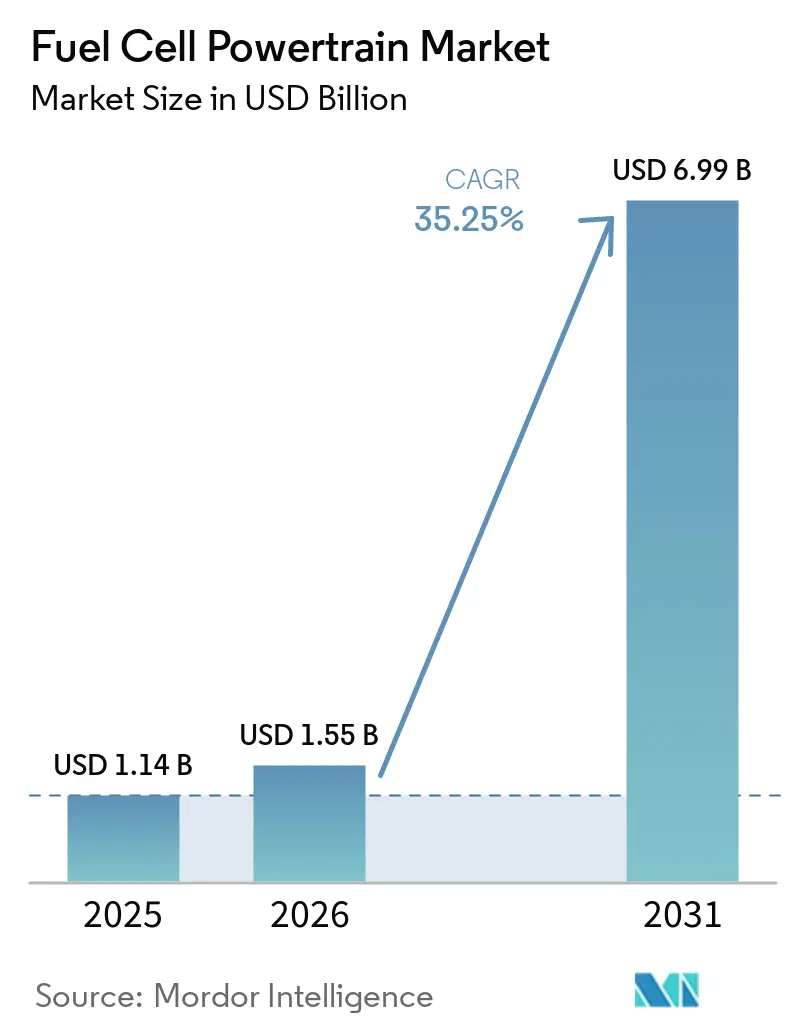
The fuel cell powertrain market size was valued at USD 1.14 billion in 2025, is expected to reach USD 1.55 billion in 2026, and to reach USD 6.99 billion by 2031, growing at a CAGR of 35.25% over 2026-2031. Heightened zero-emission mandates, rapid cost declines in proton-exchange-membrane stacks, and the emergence of long-distance hydrogen corridors are combining to push the fuel cell powertrain market into mainstream fleet planning. Commercial operators increasingly view hydrogen propulsion as the only viable option for heavy-duty duty cycles where battery-electric payload penalties and charging downtime erode productivity. Component suppliers are scaling carbon-fiber Type IV tanks that trim system mass, and silicon-carbide inverters that raise overall drivetrain efficiency, thereby reinforcing the viability of the fuel cell powertrain market for high-utilization applications. Asia-Pacific leads early adoption because of China’s purchase subsidies and Japan’s technology export push, yet the Middle East and Africa are on track to post the fastest growth thanks to sovereign green-hydrogen export strategies that seed domestic fleets. Competitive intensity is mounting as legacy OEMs pair with specialist stack developers to accelerate durability breakthroughs and share industrialization risk, signalling a maturing fuel cell powertrain market ecosystem.
Key Report Takeaways
- By component type, fuel cell systems led with 48.17% of the 2025 share, while hydrogen storage systems are forecast to expand at a 35.88% CAGR through 2031.
- By drive type, rear-wheel drive architectures held 54.22% revenue share in 2025; all-wheel drive is projected to advance at a 36.01% CAGR to 2031.
- By vehicle type, passenger cars accounted for 39.35% of the 2025 fuel cell powertrain market size, while trucks are set to record the highest CAGR at 37.04% between 2026 and 2031.
- By power output, the 150-250 kW power band commanded 49.26% revenue share in 2025, while systems above 250 kW will grow at a 36.65% CAGR over the forecast window.
- By geography, Asia-Pacific captured 40.12% of 2025 revenue, while the Middle East and Africa region is projected to rise at a 36.41% CAGR to 2031.
Note: Market size and forecast figures in this report are generated using Mordor Intelligence’s proprietary estimation framework, updated with the latest available data and insights as of January 2026.
Market Trends and Insights
Drivers Impact Analysis of Fuel Cell Powertrain Market*
| Driver | (~) % Impact on CAGR Forecast | Geographic Relevance | Impact Timeline |
|---|---|---|---|
| Mandates Accelerating Zero-Emission Adoption | +8.2% | Global, early enforcement in California, EU, China | Medium term (2-4 years) |
| Breakthroughs in Fuel-Cell Stack | +7.5% | Global, led by Japan, South Korea, Germany | Long term (≥ 4 years) |
| Hydrogen Refueling Corridor Build-Out | +6.8% | North America, Europe, APAC coastal hubs | Medium term (2-4 years) |
| Commitments to Heavy-Duty Fleets | +5.9% | North America, Europe, China | Short term (≤ 2 years) |
| Green-Ammonia-to-H₂ Cracking | +3.1% | Europe, Japan, Australia | Long term (≥ 4 years) |
| Demand for Silent Powertrains | +2.4% | United States, France, Israel | Medium term (2-4 years) |
| Source: Mordor Intelligence | |||
Government Emission Mandates Accelerating Zero-Emission Adoption
California’s Advanced Clean Cars II rule locks in 100% zero-emission light-duty sales by 2035, the EPA’s Heavy-Duty Omnibus limits NOx for 2027 trucks, and China extends purchase-tax exemptions through 2027, all compressing OEM timelines and driving fleets toward hydrogen solutions for payload-sensitive segments [1]“Advanced Clean Cars II,” California Air Resources Board, arb.ca.gov. The EU’s Alternative Fuels Infrastructure Regulation requires hydrogen stations every 200 km across TEN-T corridors by 2030, mitigating range anxiety for cross-border freight. In 2025, Germany allocated significant funding with a vision to substantially increase its public stations by 2030, bolstering domestic adoption. As a result, players in the fuel cell powertrain market discern a stronger influence from regulatory measures over technological advancements in shaping medium-term demand trends.
Breakthroughs in Fuel-Cell Stack Durability and Cost
Honda has introduced its next-generation module, delivering improved efficiency through optimized membrane-electrode assemblies. This innovation significantly reduces costs while extending the module's lifespan. Similarly, Toyota's third-generation stack has achieved a notable milestone in durability by implementing advancements in material usage. Additionally, Cellcentric's latest model enhances power density and demonstrates impressive durability. These technological developments collectively narrow the total-cost-of-ownership gap with diesel, strengthening confidence in the fuel cell powertrain market.
Rapid Build-Out of Hydrogen Refueling Corridors
Several hydrogen hubs across the U.S. are receiving federal funding to establish heavy-duty stations, with a focus on California. Element 2 has outlined plans to expand its presence across Europe by 2030, leveraging modular dispensers to accelerate construction timelines. The European Union's support for corridor stations, along with NEOM's integrated production and refueling network, highlights the importance of asset co-location in reducing early-stage offtake risks within the fuel cell powertrain sector.
OEM Commitments to Fuel-Cell Heavy-Duty Fleets
In March 2026, Ballard secured an order from New Flyer, further strengthening its position in the market with a robust operational performance. By 2024, Hyundai had delivered its trucks to Europe and outlined plans for significant production expansion by 2030. Meanwhile, Daimler Truck is set to initiate customer trials for its liquid-hydrogen tractors in 2027, highlighting the growing commercial viability of the fuel cell powertrain market.
Restraints Impact Analysis of Fuel Cell Powertrain Market*
| Restraint | (~) % Impact on CAGR Forecast | Geographic Relevance | Impact Timeline |
|---|---|---|---|
| Cost Premium Vs. BEVs | −5.3% | Global, acute in North America, Europe | Short term (≤ 2 years) |
| Hydrogen Production and Logistics | −4.7% | Global, severe areas where pipelines are lacking | Medium term (2-4 years) |
| Safety and Regulatory Hurdles | −2.9% | Global, stringent in the EU, Japan | Long term (≥ 4 years) |
| Nickel Price Volatility | −1.8% | Global, supply concentrated in Indonesia, Philippines | Medium term (2-4 years) |
| Source: Mordor Intelligence | |||
Capital Cost Premium Vs. BEVs
Tata Motors has identified a significant bus premium in India, estimating that it would take several years of service to achieve price parity with hydrogen. Meanwhile, Argonne National Laboratory suggests that purchase-price parity is possible only if certain cost reductions are achieved, which depend on large-scale production volumes. As a result, fleet managers are limiting hydrogen use to routes where the added costs of battery payloads are more significant than the premium.
Constrained Hydrogen Production and Logistics
According to the IEA, while the current electrolyzer capacity is significantly lower than the annual requirement, this gap is driving up the costs of delivered hydrogen and hindering the expansion of refueling networks. When it comes to liquid transport, there's an added challenge: boil-off losses. Additionally, for long-distance hauls, costs increase further. On the other hand, retrofitting pipelines comes with its own substantial price tag. Such challenges are moderating the growth rate of the fuel cell powertrain market.
*Our forecasts treat driver/restraint impacts as directional, not additive. The impact forecasts reflect baseline growth, mix effects, and variable interactions.
Fuel Cell Powertrain Market Segment Analysis
By Component Type:
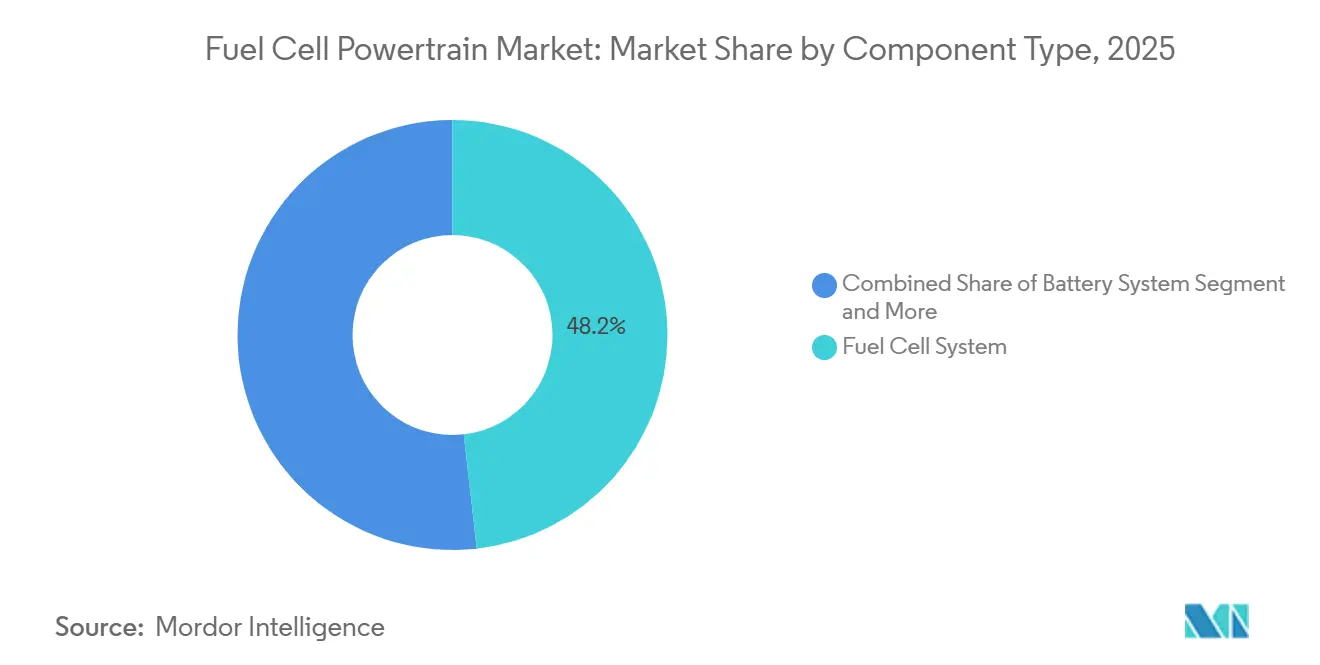
Storage Systems Drive Cost-Performance FrontierHydrogen storage systems will expand at a 35.88% CAGR, surpassing overall fuel cell powertrain market growth, as 700-bar Type IV tanks achieve 6.8 wt% gravimetric capacity and unlock higher payload margins. Fuel cell systems still captured 48.17% 2025 revenue because stacks remain the value anchor, yet modular designs from Cellcentric slash manufacturing complexity 40%, signaling imminent commoditization.
NPROXX’s conformable tanks add 18% usable hydrogen without wheelbase stretch, and silicon-carbide inverters from Bosch cut switching losses 30%, demonstrating the fertility of subsystem innovation inside the fuel cell powertrain market. Cummins’ vertical integration across electrolyzers and stacks foreshadows turnkey packages that streamline OEM sourcing and expedite warranty coverage.



By Drive Type:
All-Wheel Configurations Gain in Off-Road and Defense SegmentsRear-wheel drive dominated 2025 with 54.22% share because single-axle layouts satisfy transit and regional-haul duty cycles at the lowest cost. All-wheel drive grows 36.01% CAGR through 2031 as refuse, mining, and military vehicles demand torque vectoring for challenging terrain, widening the addressable fuel cell powertrain market.
Daimler's liquid-hydrogen tractors are testing tandem-axle 6×4 setups to ensure traction on icy slopes. Meanwhile, Volvo has identified that downtime for stuck vehicles justifies the investment in additional motors. While rear-wheel configurations will dominate line-haul fleets, there's potential for all-wheel setups to capture a significant share of the market by 2031. This shift comes as the fuel cell powertrain market begins to take on duty cycles that have historically been the domain of diesel-powered 4×4 and 6×6 chassis.
By Vehicle Type:
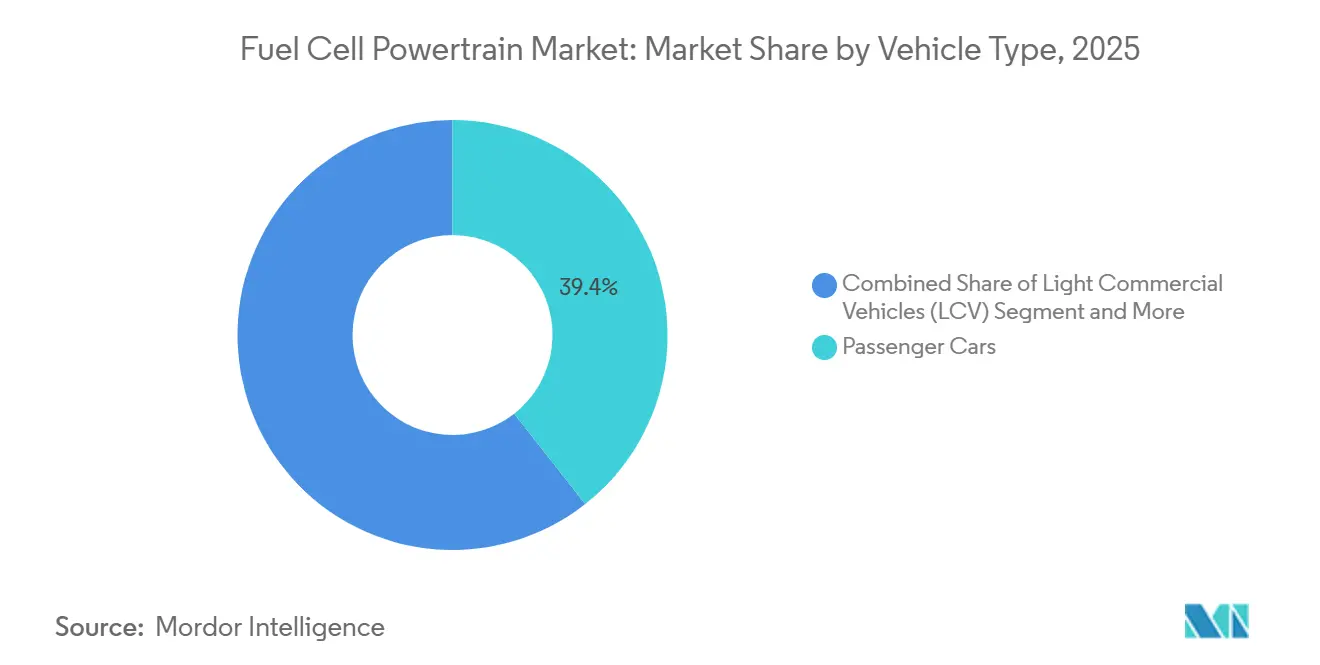
Trucks Accelerate as TCO Parity Nears for High-Mileage FleetsPassenger cars claimed 39.35% of revenue in 2025, led by the Toyota Mirai and Hyundai NEXO, yet insufficient station density slows household adoption. Trucks will rise at 37.04% CAGR because 16-18 h daily utilization amortizes capital faster, and weight-sensitive haulers cannot accept 1.5-2 t battery penalties, lifting the fuel cell powertrain market size for Class 8 tractors.
In 2024, Nikola's trucks demonstrated significant commercial progress by dispensing hydrogen across numerous refuels. Meanwhile, Wrightbus enhanced fuel efficiency with its Gen 2 Hydroliner platform, highlighting advancements in the fuel cell powertrain industry. These developments emphasize the growing momentum in the sector. While buses and light commercial vehicles continue to experience steady growth, the long-haul freight sector remains the key driver pushing the fuel cell powertrain market toward achieving scale economics.
By Power Output:
Heavy-Duty Segments Push Beyond 250 KilowattsThe 150-250 kW band led 2025 with 49.26% revenue, fitting regional buses and refuse haulers at optimized cost-performance points. Systems above 250 kW climb 36.65% CAGR, propelled by mining trucks and marine auxiliary power that demand sustained high output, marking an inflection for the fuel cell powertrain market.
Cellcentric has developed a fuel cell pack that is lightweight and efficient in hydrogen consumption. Meanwhile, Daimler's architecture is focused on achieving long-range capabilities, catering to transcontinental freight needs. While lower-capacity systems are expected to lose ground to batteries in urban fleets, higher-capacity units are anticipated to gain significant market traction by 2031. This shift is driven by advancements in scaling efforts, which are reducing costs and shaping the narrative of the fuel cell powertrain market.
Geography Analysis
APAC Fuel Cell Powertrain Market
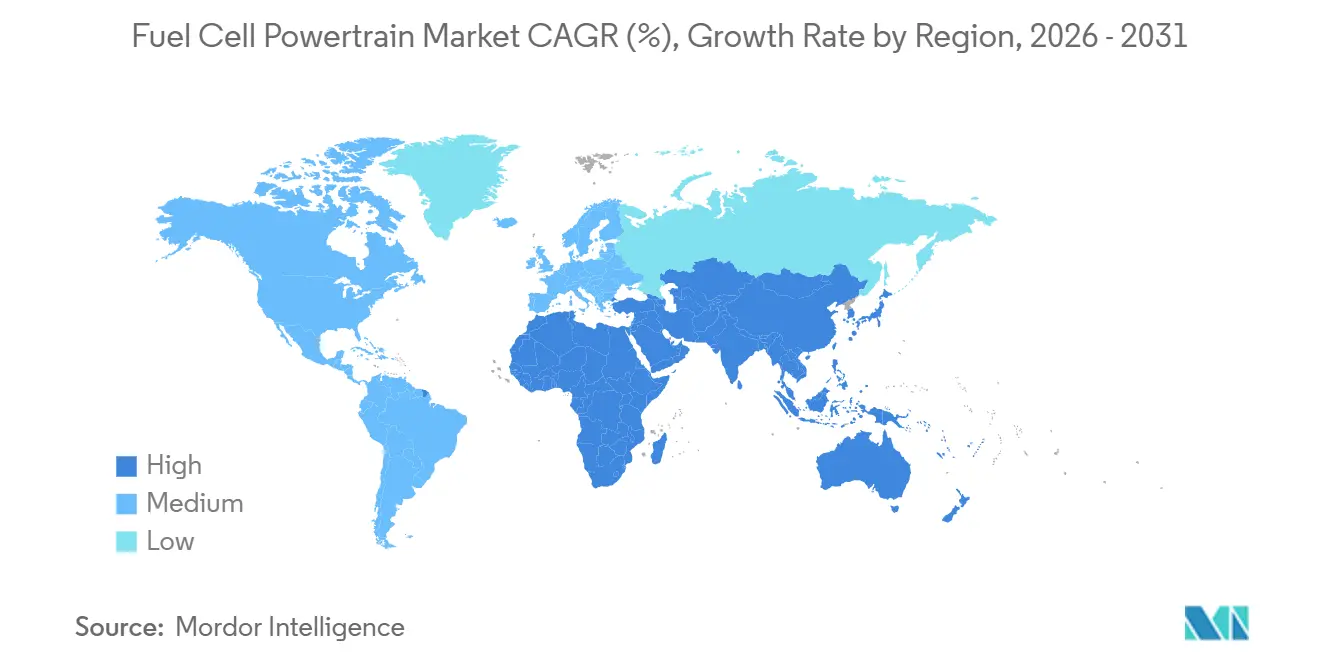
In 2025, Asia-Pacific accounted for 40.12% of global revenue, driven by government subsidies in countries like China and Japan, which supported the adoption of fuel-cell trucks and passenger cars. This support solidified Asia-Pacific's dominance in the fuel cell powertrain market. Hyundai aims for an ambitious target of commercial fuel cell electric vehicles (FCEVs) annually by 2030. Concurrently, India is backing electrolyzer localization with a significant mission fund, underscoring a concerted push across multiple nations. In China, demonstration clusters are incentivizing early fleets with operating subsidies, cementing the country's leadership in the fuel cell powertrain market.
MEA Fuel Cell Powertrain Market
Meanwhile, the Middle East and Africa are emerging as the fastest-growing regions, boasting a robust CAGR of 36.41%, as oil-rich nations pivot towards green hydrogen. NEOM's electrolyzer project is set to produce significant output by 2026, catering to both in-house construction fleets and export needs, thereby bolstering the regional fuel cell market. Countries like the UAE, Egypt, and South Africa are not just investing state funds into pilot bus projects but are also leveraging their domestic platinum reserves to ensure a steady catalyst supply, effectively bridging ecosystem gaps.
Europe and the Americas Fuel Cell Powertrain Market
Europe is reaping benefits from the Alternative Fuels Infrastructure Regulation, which mandates fuel stations at regular intervals [2]“Alternative Fuels Infrastructure Regulation,” European Commission, europa.eu. This initiative not only facilitates cross-border freight but also boosts Europe's fuel cell market. Germany is making headlines with investments aimed at significantly increasing public transport by 2030. Simultaneously, the UK's Element 2 program is set to establish a large number of sites, further densifying the network. In North America, the Department of Energy's hub grants, coupled with California's Low Carbon Fuel Standard credits, are positioning the ports of Los Angeles and Long Beach as pivotal players. While South America is still in its nascent stages, Brazil and Chile are setting ambitious targets, signaling a burgeoning potential for the fuel cell powertrain market.

Competitive Landscape
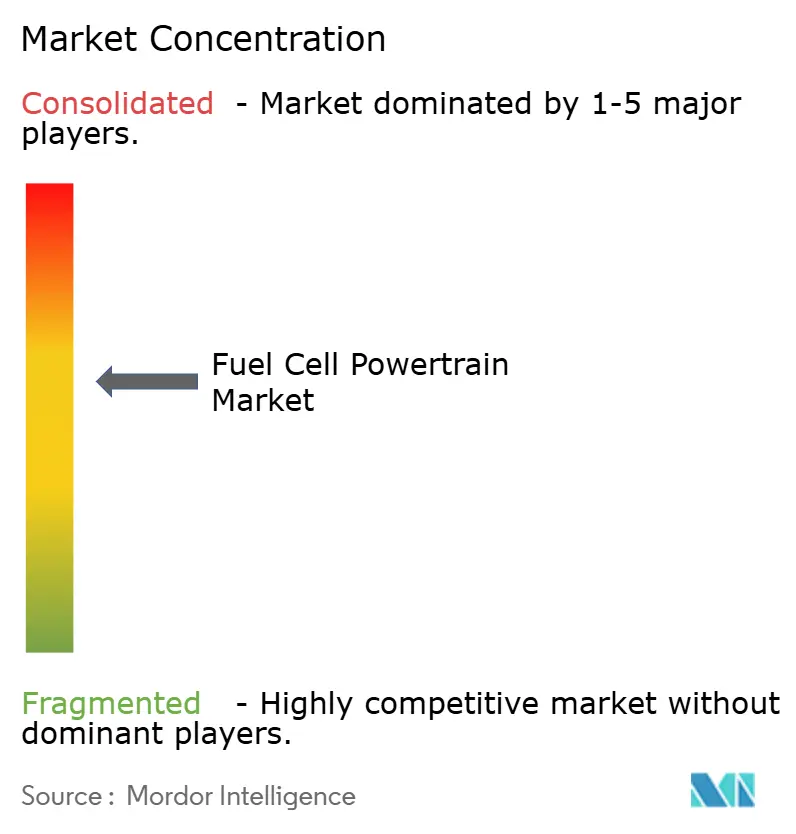
The leading suppliers in the fuel cell powertrain market, including Toyota, Hyundai, Ballard, Cummins, and Daimler Truck, collectively hold significant influence. However, the market remains moderately concentrated, with no single player dominating. Ballard's recent agreement with New Flyer demonstrates how reliability in pilot programs can lead to larger orders, while multiyear service agreements ensure consistent revenue streams [3]“New Flyer Order Press Release,” Ballard Power Systems, ballard.com. In 2025, even established players like General Motors adjusted their strategies, pausing the development of next-generation HYDROTEC systems. This shift reflects the evolving dynamics of battery economics and opens opportunities for agile companies to gain a competitive edge.
Technological advancements in the market focus on improving stack durability and hydrogen efficiency. Cellcentric has introduced innovations aimed at extending product lifespan, while Doosan is targeting niche applications such as high-temperature environments like data-center backups, where combined heat and power advantages are critical. Nikola is adopting an integrated approach by pairing its truck sales with a refueling network, creating an ecosystem that generates recurring revenue beyond hardware sales. These strategies highlight the growing importance of holistic solutions in the fuel cell powertrain industry.
Regulatory complexities, such as those associated with ISO 19881 and UN GTR 13 certifications, tend to favor established companies with existing testing infrastructure. However, emerging players like Hexagon Purus and NPROXX are lowering barriers to entry by introducing modular tank designs. These innovations are driving more frequent platform updates, fostering a dynamic and competitive environment within the market.
Fuel Cell Powertrain Industry Leaders
Toyota Motor Corporation
Hyundai Motor Company
Ballard Power Systems Inc.
Daimler Truck AG
Cummins Inc.
- *Disclaimer: Major Players sorted in no particular order
Fuel Cell Powertrain Market Companies Covered in this Report
- Toyota Motor Corporation
- Hyundai Motor Company
- Honda Motor Co., Ltd.
- Daimler Truck AG
- Ballard Power Systems Inc.
- Cummins Inc.
- General Motors Company
- Nikola Corporation
- Robert Bosch GmbH
- Plug Power Inc.
- Doosan Fuel Cell Co., Ltd.
- Horizon Fuel Cell Technologies
- Proton Motor Power Systems plc
- Tata Motors Limited
- Wrightbus

Recent Industry Developments in Fuel Cell Powertrain Market
- April 2026: Cellcentric unveiled the BZA375, a 350 kW stack weighing below 500 kg and offering 25,000-hour durability, 40% higher power density, and below 6 kg/100 km hydrogen consumption, cutting manufacturing complexity 40% through modular plate stacking.
- September 2025: Drive System Design, Intelligent Energy, and GEMS co-developed a 200 kW system under UK-funded Project Archer aimed at zero-emission heavy-duty trucks.


Global Fuel Cell Powertrain Market Report Scope
The scope includes segmentation by component type (fuel cell system, battery system, drive system, hydrogen storage system, and others), drive type (rear wheel drive, front wheel drive, and all-wheel drive), vehicle type (passenger cars, light commercial vehicles, buses, and trucks), power output (less than 150 kW, 150-250 kW, and more than 250 kW). The analysis also covers regional-level segmentation, including North America, South America, Europe, Asia-Pacific, and the Middle East and Africa. Market size and growth forecasts are presented by value in USD.
| Fuel Cell System |
| Battery System |
| Drive System |
| Hydrogen Storage System |
| Others |
| Rear Wheel Drive (RWD) |
| Front Wheel Drive (FWD) |
| All-Wheel Drive (AWD) |
| Passenger Cars |
| Light Commercial Vehicles (LCV) |
| Buses |
| Trucks |
| Less than 150 kW |
| 150-250 kW |
| More than 250 kW |
| North America | United States |
| Canada | |
| Rest of North America | |
| South America | Brazil |
| Argentina | |
| Rest of South America | |
| Europe | United Kingdom |
| Germany | |
| Spain | |
| Italy | |
| France | |
| Russia | |
| Rest of Europe | |
| Asia-Pacific | India |
| China | |
| Japan | |
| South Korea | |
| Rest of Asia-Pacific | |
| Middle East and Africa | United Arab Emirates |
| Saudi Arabia | |
| Turkey | |
| Egypt | |
| South Africa | |
| Rest of Middle East and Africa |
| By Component Type | Fuel Cell System | |
| Battery System | ||
| Drive System | ||
| Hydrogen Storage System | ||
| Others | ||
| By Drive Type | Rear Wheel Drive (RWD) | |
| Front Wheel Drive (FWD) | ||
| All-Wheel Drive (AWD) | ||
| By Vehicle Type | Passenger Cars | |
| Light Commercial Vehicles (LCV) | ||
| Buses | ||
| Trucks | ||
| By Power Output | Less than 150 kW | |
| 150-250 kW | ||
| More than 250 kW | ||
| By Geography | North America | United States |
| Canada | ||
| Rest of North America | ||
| South America | Brazil | |
| Argentina | ||
| Rest of South America | ||
| Europe | United Kingdom | |
| Germany | ||
| Spain | ||
| Italy | ||
| France | ||
| Russia | ||
| Rest of Europe | ||
| Asia-Pacific | India | |
| China | ||
| Japan | ||
| South Korea | ||
| Rest of Asia-Pacific | ||
| Middle East and Africa | United Arab Emirates | |
| Saudi Arabia | ||
| Turkey | ||
| Egypt | ||
| South Africa | ||
| Rest of Middle East and Africa | ||


Key Questions Answered in the Report
What is the projected value of the fuel cell powertrain market in 2031?
The fuel cell powertrain market is forecast to reach USD 6.99 billion by 2031, reflecting a 35.25% CAGR between 2026 and 2031.
Which region dominates current revenue?
Asia-Pacific led with 40.12% of 2025 revenue thanks to Chinese purchase subsidies and Japanese technology exports.
Which component is expanding fastest?
Hydrogen storage systems will grow at a 35.88% CAGR through 2031 as advanced Type IV composite tanks raise payload capacity.
How quickly are fuel cell trucks expected to grow?
Trucks represent the fastest-growing vehicle class, advancing at a 37.04% CAGR during 2026-2031 as high-mileage fleets reach total-cost parity.
Page last updated on:





