
Frontline Worker Technology In Retail and E-Commerce Market Size and Share
Market Overview
| Study Period | 2020 - 2031 |
|---|---|
| Market Size (2026) | USD 4.03 Billion |
| Market Size (2031) | USD 10.62 Billion |
| Growth Rate (2026 - 2031) | 21.38 % |
| Fastest Growing Market | Asia-Pacific |
| Largest Market | North America |
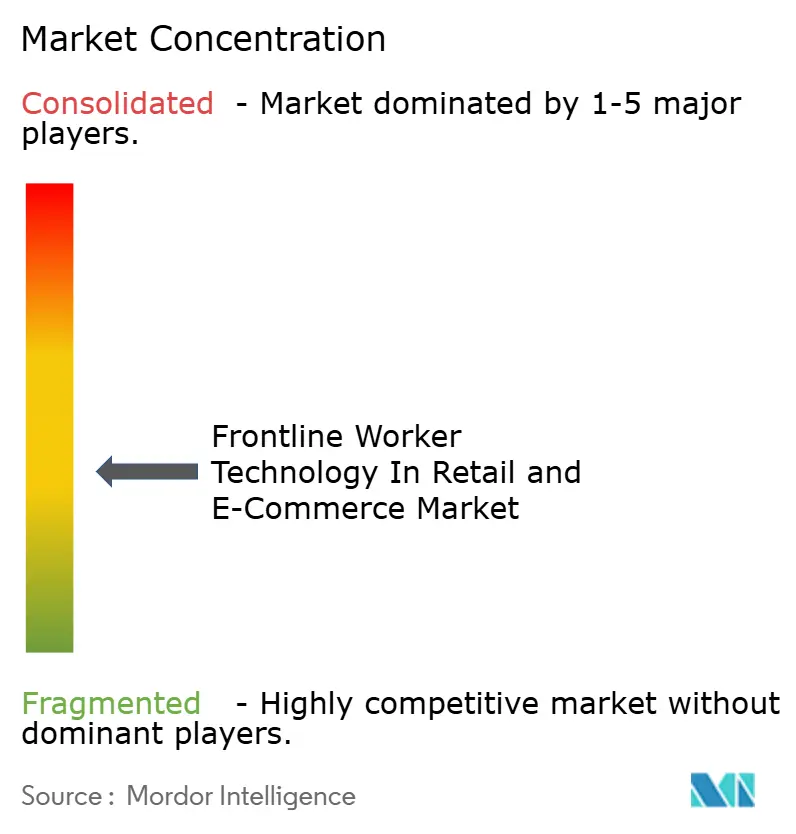
| Market Concentration | Medium |
Major Players *Disclaimer: Major Players sorted in no particular order Image © Mordor Intelligence. Reuse requires attribution under CC BY 4.0. | |

Frontline Worker Technology In Retail and E-Commerce Market Analysis by Mordor Intelligence
The frontline worker technology in retail and e-commerce market size reached USD 3.46 billion in 2025 and is forecast to reach USD 10.62 billion by 2031, growing at a CAGR of 21.38% during 2026-2031. Growth is being shaped by higher labor costs, broader use of AI in daily store operations, and the rising pressure to run physical stores and digital fulfillment through the same workforce. Retailers are no longer treating frontline platforms as stand-alone HR tools because these systems now affect scheduling, task execution, training, store compliance, and same-day order handling across the full operating model. Procurement has also moved upward inside retail organizations, with executive teams taking a more direct role because workforce technology now influences margin control, labor productivity, and execution consistency across large store networks. Software platforms continue to anchor spending, while demand for services is rising because implementation work becomes more complex when retailers connect new applications with older POS, ERP, and workforce management environments. Adoption is spreading beyond large chains as cloud-based delivery lowers entry barriers, although rollout speed still varies by infrastructure readiness, data governance maturity, and the ability of retailers to manage operational change at the store level.
Key Report Takeaways
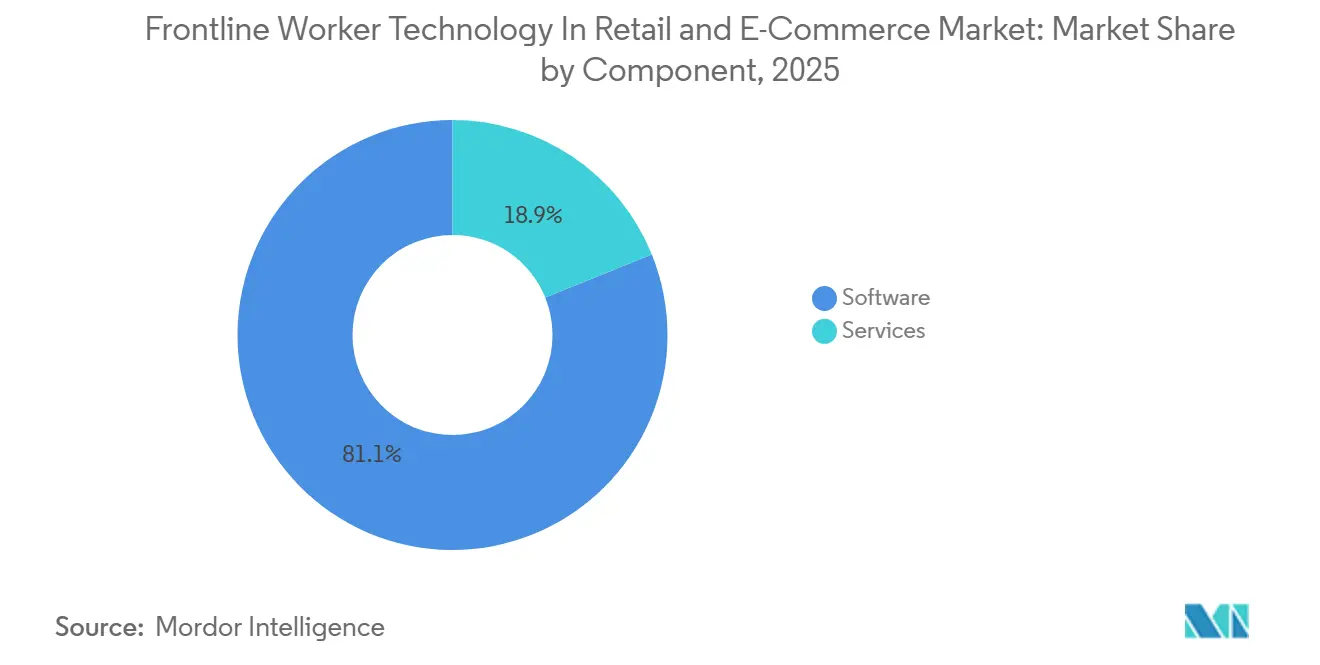
- By component, software accounted for 81.11% of revenue share of frontline worker technology in retail and e-commerce market in 2025, while services are projected to expand at a 22.41% CAGR through 2031.
- By deployment mode, cloud-based platforms accounted for 77.61% of revenue share of frontline worker technology in retail and e-commerce market in 2025 and are projected to grow at a 23.88% CAGR through 2031.
- By organization size, large enterprises captured 69.66% of revenue share of frontline worker technology in retail and e-commerce market in 2025, while SMEs are projected to advance at a 24.19% CAGR through 2031.
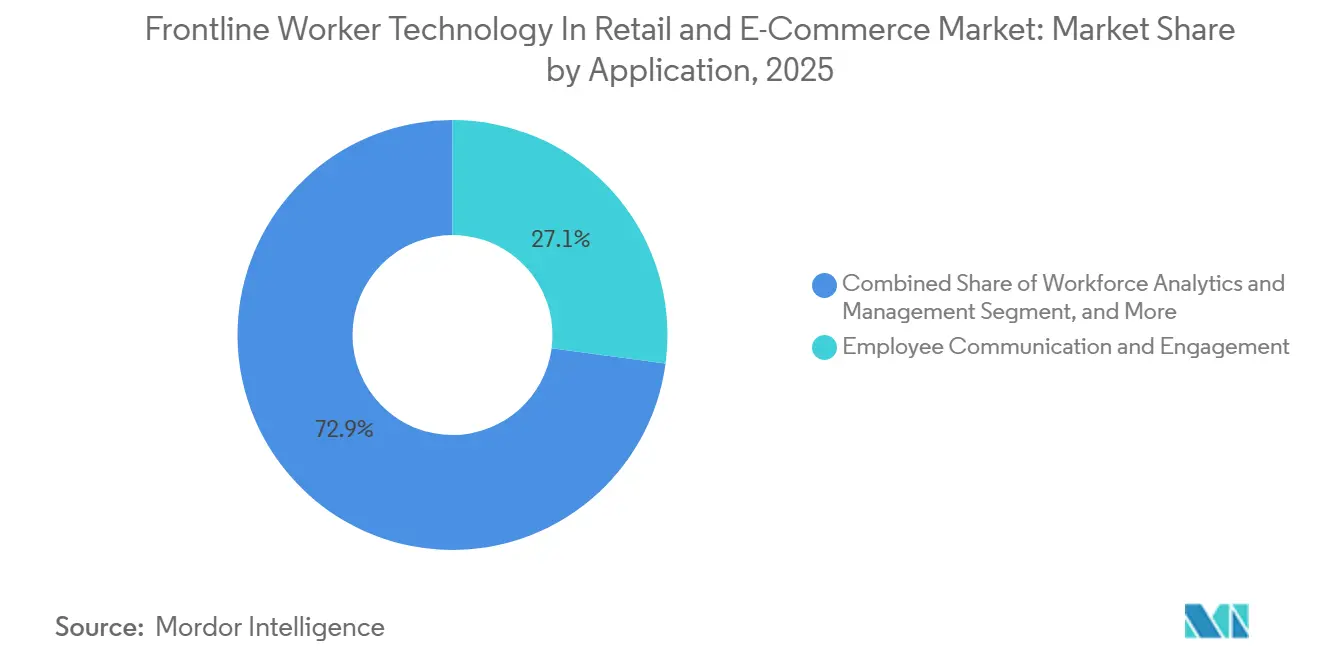
- By application, employee communication and engagement held 27.11% of revenue share of frontline worker technology in retail and e-commerce market in 2025, while workforce analytics and performance management are projected to grow at a 26.33% CAGR through 2031.
- By end user, supermarkets and hypermarkets accounted for 37.11% of revenue share of frontline worker technology in retail and e-commerce market in 2025, while convenience stores are projected to expand at a 27.33% CAGR through 2031.
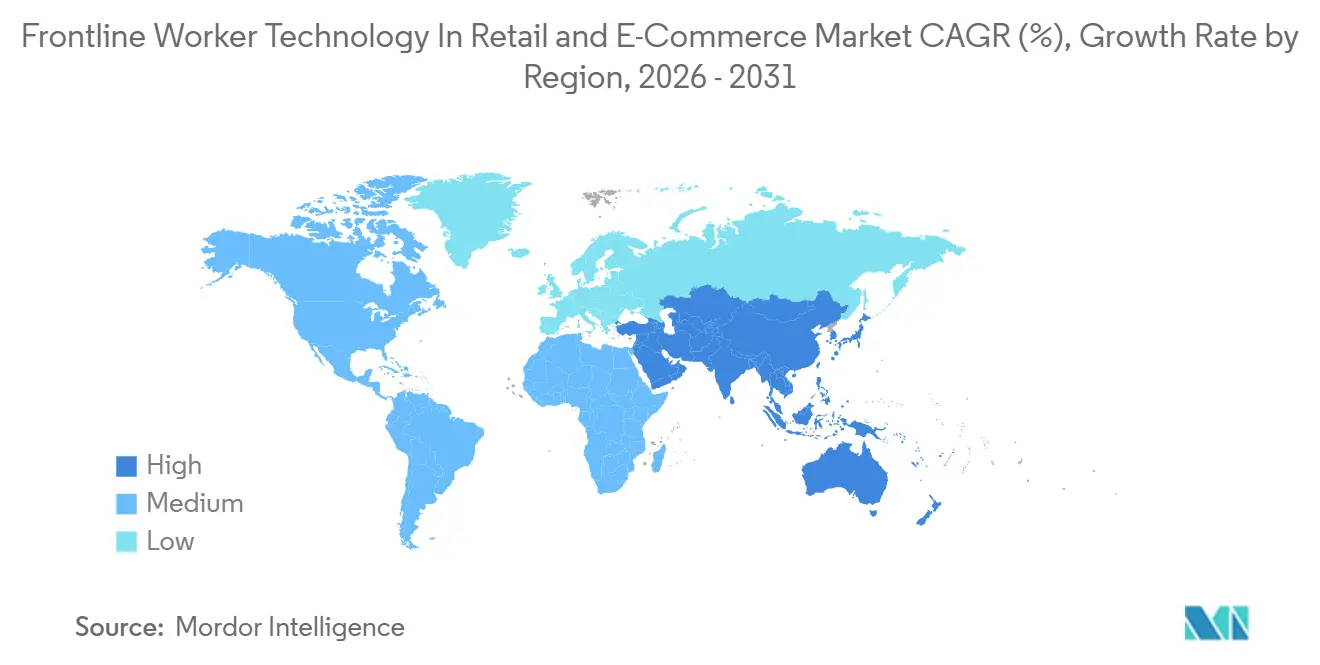
- By geography, North America held 38.11% of the frontline worker technology market share in retail and e-commerce market in 2025, while Asia-Pacific is projected to grow at a 27.44% CAGR through 2031.
Note: Market size and forecast figures in this report are generated using Mordor Intelligence’s proprietary estimation framework, updated with the latest available data and insights as of January 2026.
Market Trends and Insights
Drivers Impact Analysis of Frontline Worker Technology In Retail and E-Commerce Market*
| Driver | (~) % Impact on CAGR Forecast | Geographic Relevance | Impact Timeline |
|---|---|---|---|
| Rising Demand for Real-Time Task Orchestration Across Store Networks | +3.5% | Global, with highest intensity in North America and Europe | Medium term (2-4 years) |
| Shift Toward AI-Enabled Labor Forecasting And Scheduling | +3.2% | Global, with North America and Asia Pacific leading adoption | Medium term (2-4 years) |
| Need to Reduce Labor Waste and Improve Margin Control | +2.8% | Global, with higher urgency in high-wage markets across North America and Europe | Short term (≤ 2 years) |
| Omnichannel Fulfillment Pressure Inside Retail Stores | +2.5% | Global, with North America and Europe at earlier scale | Short term (≤ 2 years) |
| Expansion of Mobile-First Frontline Collaboration Tools | +2.2% | Global, with Asia Pacific and Middle East and Africa accelerating | Medium term (2-4 years) |
| Rising Adoption of Computer Vision for In-Aisle Execution | +1.8% | North America, Europe, and Asia Pacific | Long term (≥ 4 years) |
| Source: Mordor Intelligence | |||
Rising Demand for Real-Time Task Orchestration Across Store Networks
The frontline worker technology in retail and e-commerce market is seeing stronger demand for platforms that can assign and reprioritize work in real time across large store networks. Retailers now need systems that can respond quickly when inventory gaps appear, labor availability changes, or promotional execution falls behind plan at the store level. This has shifted frontline software from a communication layer into an operational layer that connects data inputs with immediate action on the sales floor. Zebra introduced Workcloud Integration and Orchestration in 2026, with more than 250 out-of-the-box integrations, demonstrating how vendors are building systems that tie POS, inventory, task, and labor data into a single workflow layer.[1] Zebra also reported in 2026 that 51% of retailers were piloting AI for inventory optimization and 45% for cost optimization, which supports the move toward live task orchestration across the sector. As adoption widens, the frontline worker technology in retail and e-commerce market is increasingly favoring platforms that can close the loop between store conditions, labor allocation, and execution speed without waiting for manual intervention.
Shift Toward AI-Enabled Labor Forecasting and Scheduling
The frontline worker technology in retail and e-commerce market is also being pushed by a clear shift from fixed scheduling toward more adaptive labor planning. Retailers are moving away from weekly staffing methods that relied on historical averages and manager judgment because store demand now changes more rapidly with promotions, digital order flow, and in-store service needs. AI-enabled tools are gaining ground because they can combine demand signals with labor rules to generate schedule changes that are faster and easier to apply at scale. UKG expanded in this direction in 2026 by adding an orchestration layer with real-time workforce intelligence and live schedule adjustments, reflecting how the category is moving from planning to execution within the workday.[2] Walmart also showed in 2025 that AI-directed shift planning could cut team lead planning time from 90 minutes to 30 minutes per cycle in overnight stocking pilots, reinforcing the practical value of faster labor decisions. As the frontline worker technology in retail and e-commerce market expands, vendors that improve schedule responsiveness without adding more manager workload are likely to remain in stronger demand.
Need to Reduce Labor Waste and Improve Margin Control
The frontline worker technology in retail and e-commerce market is benefiting from a stronger focus on margin discipline across retail operations. Labor efficiency is now more closely tied to store profitability because retailers are managing wage pressure, inventory losses, and the additional work required by digital fulfillment. This makes labor planning, task sequencing, and shift execution more important than they were when stores operated with less operational complexity. Walmart’s 2025 pilot showed that AI tools could reduce shift planning time from 90 minutes to 30 minutes per cycle, giving managers more time for higher-value store activities and reducing wasted effort in planning routines.[3] Kyndryl also reported in 2026 that many retailers are still not using their omnichannel systems to their full potential, suggesting that productivity gains depend not only on software purchases but also on how well the operating environment supports better labor execution. In that setting, the frontline worker technology in retail and e-commerce market is moving closer to core retail operations because labor waste now has a more direct effect on service levels and margin outcomes.
Omnichannel Fulfillment Pressure Inside Retail Stores
The frontline worker technology in retail and e-commerce market is also being lifted by the operational pressure created when stores handle both physical shopping and digital order fulfillment at the same time. Store teams are now expected to pick, stage, replenish, and serve customers without breaking service standards during the day. This adds more complexity to labor coordination because task priorities can change quickly as online order queues and store traffic move in different directions. In 2026, Kyndryl found that only 15% of retail leaders believed they were using their omnichannel systems to their full potential, underscoring how hard it remains to connect store execution with omnichannel demand in a workable way.[4] The need is no longer limited to visibility, as retailers increasingly require systems that can move associates between customer service and fulfillment work with less friction within the same shift. That pressure is widening the role of the frontline worker technology in retail and e-commerce market from workforce communication to real-time coordination of labor, inventory, and fulfillment activity.
Restraints Impact Analysis of Frontline Worker Technology In Retail and E-Commerce Market*
| Restraint | (~) % Impact on CAGR Forecast | Geographic Relevance | Impact Timeline |
|---|---|---|---|
| Integration Complexity With Legacy POS, WFM, and ERP Stacks | -3.5% | Global, most acute in North America and Europe with large legacy estates | Medium term (2-4 years) |
| Frontline Adoption Friction From Change Fatigue and Low Digital Fluency | -3.0% | Global, with severity varying by associate demographics and workforce tenure | Short term (≤ 2 years) |
| Data Privacy and Worker Surveillance Concerns | -2.2% | North America and Europe, with regulatory relevance across GDPR and U.S. state laws | Long term (≥ 4 years) |
| Fragmented Retail Estate and Uneven Connectivity Across Stores | -1.8% | Global, most acute in South America, Middle East and Africa, and secondary-tier markets in Asia Pacific | Medium term (2-4 years) |
| Source: Mordor Intelligence | |||
Integration Complexity with Legacy POS, WFM, and ERP Stacks
The frontline worker technology in retail and e-commerce market still faces a major barrier in the form of difficult integration with legacy retail systems. Many retailers operate estates where POS, HR, workforce management, inventory, and finance systems were added over time and were not designed to exchange data in a simple way. This slows deployment, raises service costs, and narrows the pool of vendors capable of delivering a workable rollout across a large store network. Kyndryl reported in 2026 that only 15% of retail leaders believed they were using omnichannel systems to full potential and that nearly one-third said mission-critical networks, storage, and servers had reached end-of-service life. Zebra’s 2026 launch of an orchestration layer with more than 250 integrations also underscores the strong demand for prebuilt connectors that reduce deployment friction. Even so, the frontline worker technology in retail and e-commerce market will continue to expand unevenly because retailers with heavier technical debt will need more time and higher implementation spending to reach the same operating capability.
Frontline Adoption Friction from Change Fatigue and Low Digital Fluency
The frontline worker technology in retail and e-commerce market also faces a practical challenge at the store level because rollout success depends on how comfortably associates can use new tools in daily work. Retail environments often introduce multiple applications for communication, tasks, training, and scheduling, and that can create confusion when interfaces and workflows are not unified. Adoption improves when platforms reduce app switching and present operational work in a way that feels simple for associates who were not hired into technology-heavy roles. Microsoft’s 2025 account of AEON Retail’s rollout showed that the company used an AI assistant to standardize operational knowledge for frontline teams and reduce the learning burden for new hires, underscoring the importance of usability in deployment success. WorkJam’s 2026 platform update also centered on embedded AI workflows, visual merchandising tools, and customizable dashboards, reflecting the vendor's continued effort to make execution tools easier to use in live-store conditions. For that reason, the frontline worker technology in retail and e-commerce market is not only a software buying story, it is also a store adoption story where simplification matters as much as functionality.
*Our forecasts treat driver/restraint impacts as directional, not additive. The impact forecasts reflect baseline growth, mix effects, and variable interactions.
Frontline Worker Technology In Retail and E-Commerce Market Segment Analysis
By Component:
Software Leads While Services Rise With Integration WorkSoftware accounted for 81.11% of revenue in 2025, which made it the leading component in the frontline worker technology in retail and e-commerce market. That dominance reflects the shift toward SaaS platforms that act as the main layer for communication, scheduling, analytics, and task execution across retail operations. Retailers are increasingly choosing broader platforms over narrow point tools because leadership teams want fewer systems, fewer logins, and better visibility into store activity. This pushes software spending higher because the value now resides in the application layer, which organizes work, captures data, and connects frontline workers to store priorities. The frontline worker technology in retail and e-commerce market has therefore become more platform-led, with software carrying the main share of value creation as retailers modernize operating processes.
Services are projected to grow at a 22.41% CAGR during 2026-2031, which shows that rollout complexity is rising alongside platform adoption. Implementation work is becoming increasingly important because retailers often need integration support, configuration, change management, and ongoing training after the software contract is signed. Kyndryl’s 2026 findings on underused omnichannel systems and aging infrastructure support this pattern, as they point to the amount of work still needed at the application layer before retailers can fully use new tools. Zebra’s expansion of its integration and orchestration stack in 2026 also signals that vendors see deployment services as a lasting part of the revenue mix, not a temporary add-on. In practice, the frontline worker technology in retail and e-commerce market size for software remains larger, while the services layer is gaining importance because execution quality now determines how quickly retailers convert licenses into operating gains.
By Deployment Mode:
Cloud-Based Platforms Extend Their LeadCloud-based deployment held 77.61% of revenue in 2025 and remained the largest deployment model in the frontline worker technology in retail and e-commerce market. Retailers prefer cloud delivery because stores and fulfillment workflows now require fast data exchange between task systems, labor tools, and order environments that change throughout the day. Cloud platforms also make updates easier because vendors can release new functions without the long upgrade cycles associated with on-premises systems. This supports faster rollout of AI features, scheduling changes, compliance settings, and mobile workflows across large store networks. As a result, cloud-based platforms now define the standard buying model for most new deployments in the frontline worker technology in retail and e-commerce market.
Cloud-based deployment is also projected to expand at a 23.88% CAGR during 2026-2031, indicating that this segment is still growing from active adoption rather than saturation. UKG’s 2026 addition of real-time workforce intelligence and live schedule adjustment features to its cloud platform underscores why retailers continue to favor cloud environments for operational decisions that cannot wait for batch updates. Cloud delivery is especially valuable when retailers want one operational view across stores, labor pools, and digital order flows without managing separate local environments at each location. Hybrid and on-premises models remain relevant when data residency or internal IT policy requires tighter local control, but they no longer set the pace of product development. In that sense, the frontline worker technology in retail and e-commerce market share remains firmly tilted toward cloud because it matches the need for speed, scale, and continuous product improvement.
By Organization Size:
Large Enterprises Set The Base While SMEs Add MomentumLarge enterprises accounted for 69.66% of revenue in 2025, making them the biggest buyer group in the frontline worker technology in retail and e-commerce market. Their lead comes from store scale, broader IT budgets, and the fact that labor inefficiencies become more visible when operations stretch across hundreds or thousands of sites. These retailers also tend to have dedicated technology, HR, and operations teams that can support enterprise deployment and ongoing optimization. Because the business case is clearer at scale, large chains have remained the main source of current revenue for the category. That keeps the revenue base of the frontline worker technology in retail and e-commerce market concentrated in retailers that can justify broad operational transformation programs.
SMEs are projected to grow at a 24.19% CAGR during 2026-2031, which shows that the demand base is widening. Smaller retailers are gaining access to more capable cloud-native tools that no longer require the same implementation burden that once limited advanced workforce technology to larger chains. They are also under pressure to improve labor productivity and store consistency as larger competitors raise operating standards across scheduling, fulfillment, and in-store execution. Vendors are responding by packaging more functions into mobile-first platforms that combine communication, scheduling, and task management into a single experience, rather than asking smaller retailers to stitch together several systems. This makes frontline worker technology in the retail and e-commerce industries more accessible to regional and mid-sized operators who want enterprise-grade capability without enterprise-grade complexity.
By Application:
Communication Holds The Lead While Analytics Gains SpeedEmployee communication and engagement held 27.11% of revenue in 2025 and remained the largest application area in the frontline worker technology in retail and e-commerce market. This segment leads because communication sits at the center of day-to-day store execution, from policy updates and shift notices to training content and task alignment. Retailers have learned that operational consistency becomes harder to sustain when frontline teams receive instructions through fragmented channels or delayed manager handoffs. Mobile communication platforms help bridge that gap by delivering updates directly to associates in a faster, more trackable format. That is why communication has become the entry point for many deployments in the frontline worker technology in retail and e-commerce market.
Workforce analytics and performance management are projected to grow at a 26.33% CAGR during 2026-2031, making this the fastest-growing application area. Retailers now want more than visibility because they are starting to expect systems that can show which labor patterns, task sequences, and training responses drive better store outcomes. UKG’s 2026 move toward real-time intelligence and dynamic workforce operations reflects this shift from reporting toward live operational guidance. Zebra’s 2026 expansion of AI-enabled workcloud tools points in the same direction by linking operational signals with action at the frontline. The frontline worker technology in retail and e-commerce market size for analytics remains smaller than communication today, but its growth rate shows that retailers increasingly want systems that can improve decisions, not only distribute information.

By End User:
Supermarkets And Hypermarkets Lead While Convenience Stores Grow FasterSupermarkets and hypermarkets accounted for 37.11% of revenue in 2025 and represented the largest end-user group in the frontline worker technology in retail and e-commerce market. Their lead is tied to high employee counts, multi-department operations, and the need to coordinate replenishment, compliance, promotions, and customer service within the same store environment. These formats also face daily execution pressure because food, fresh categories, and high traffic volumes leave little room for labor inefficiency. As a result, the operational value of workforce communication, scheduling, and task management is easier to prove in grocery-led formats than in many smaller retail models. This keeps supermarkets and hypermarkets at the center of current demand in the frontline worker technology in retail and e-commerce market.
Convenience stores are projected to expand at a 27.33% CAGR during 2026-2031, suggesting a faster next wave of adoption. The growth case is linked to labor shortages, extended operating hours, and the need to maintain service and compliance with lean staffing models. In these environments, even small gains in scheduling accuracy or task prioritization can have a noticeable impact on store performance, as staffing buffers are limited. The category also benefits from mobile-first tools that align with fast operational rhythms and reduce the need for additional management layers. That pattern suggests the frontline worker technology in retail and e-commerce market will continue broadening across retail formats as retailers with smaller labor pools seek more disciplined execution.
Geography Analysis
North America Frontline Worker Technology in Retail and E-Commerce Market
North America held 38.11% of revenue in 2025 and remained the largest regional segment in the frontline worker technology in retail and e-commerce market. The region benefits from a high concentration of large retail chains that can fund enterprise deployments across wide store networks and connect those systems with established digital operations. The United States continues to set the pace because major retailers are moving workforce technology deeper into daily operations rather than leaving it at the level of communication or scheduling alone. Walmart’s 2025 deployment of AI-powered tools to 1.5 million associates, including a shift-planning application that cut planning time in pilots, illustrates the scale at which large U.S. retailers are now operationalizing frontline AI. California’s 2025-2026 legislative activity on workplace surveillance and worker data also shows that governance is becoming a live design issue for vendors and buyers in the region. That mix of strong demand and growing compliance scrutiny keeps North America central to both the current size and future design direction of the frontline worker technology in retail and e-commerce market.
Europe Frontline Worker Technology in Retail and E-Commerce Market
Europe remains an important regional pillar in the frontline worker technology in retail and e-commerce market because retailers in the region have continued to invest in labor productivity, store execution, and compliance-oriented digital tools. Large grocery, department store, and fashion chains in the United Kingdom, Germany, and France have supported adoption by seeking tighter control over scheduling, communication, and store-level consistency. The region also places greater weight on data handling and labor rules, which shape how platforms are configured and how AI features are introduced into operational workflows. That makes Europe a market where functionality alone is rarely enough, because deployment design must also reflect local governance expectations. In practical terms, the frontline worker technology in retail and e-commerce market in Europe remains attractive for vendors that can combine operational depth with stronger compliance discipline.
APAC, South America and MEA Frontline Worker Technology in Retail and E-Commerce Market
Asia-Pacific is projected to grow at a 27.44% CAGR during 2026-2031, making it the fastest-growing region in the frontline worker technology in retail and e-commerce market. Growth is being driven by a mix of advanced deployments in Japan, fast digital retail expansion in China, and a broader push across the region to standardize frontline execution as store and fulfillment models become more complex. AEON Retail in Japan deployed an AI assistant across nearly 390 stores by June 2025 and equipped 10,000 associates with AI-capable devices in the initial phase, with a plan to reach 50,000 devices by fiscal year-end 2026. That rollout focused on standardizing operational knowledge and reducing the learning burden for new hires, which is directly relevant to the role of frontline platforms in large retail environments. South America and Middle East and Africa remain earlier-stage opportunities, but the frontline worker technology in retail and e-commerce market in those regions is expected to strengthen as modern trade, mobile workflows, and distributed store management needs continue to expand.
Competitive Landscape
The frontline worker technology in retail and e-commerce market remains moderately concentrated at the top, with a limited group of enterprise software and operational technology vendors holding the strongest positions in large retail accounts. Competition is being shaped by a mix of enterprise suites, workforce specialists, and store-operations platforms that are all moving toward broader operational coverage. The lines between communication, scheduling, analytics, and task management are becoming less distinct because retailers increasingly prefer integrated platforms over isolated tools. This has pushed the frontline worker technology in retail and e-commerce market toward consolidation in product scope even when the vendor base remains diverse.
Strategic product moves in 2026 show how vendors are competing for that broader role. UKG added an orchestration layer to its Workforce Operating Platform in June 2026, which moved the company further from traditional workforce management and deeper into real-time execution and operational intelligence. Zebra introduced Workcloud BI, Workcloud IO, and Zebra Nucleus in January 2026, with Workcloud IO positioned as an enterprise orchestration layer that connects frontline task management with POS and core business systems. Honeywell also launched an AI-enabled smart shopping platform with Google Cloud in January 2026, demonstrating that device and automation players are also building greater software-led relevance in frontline retail environments. These moves indicate that the frontline worker technology in retail and e-commerce market is increasingly being contested through platform breadth, integration depth, and live execution capability.
Competitive differentiation is now shifting away from basic feature checklists and toward the quality of integration, workflow usability, and governance readiness. Retail buyers want systems that fit into existing operations, reduce manager workload, and support AI use without creating new risks around worker data or opaque decision-making. California’s worker data and surveillance legislation makes that issue more visible because vendors will need to explain how operational data is collected, processed, and used in AI-supported environments. At the same time, Microsoft’s account of AEON Retail’s AI assistant deployment suggests that buyers are also paying close attention to the practical value of standardizing frontline knowledge and reducing onboarding friction. This keeps room open for both large enterprise vendors and more focused specialists, but the frontline worker technology in retail and e-commerce market is likely to reward vendors that can connect store execution, labor visibility, and operational simplicity within one coherent platform.
Frontline Worker Technology In Retail and E-Commerce Industry Leaders
-
Zebra Technologies Corporation
-
Honeywell International Inc.
-
UKG Inc.
-
WorkJam Inc.
-
YOOBIC SAS
- *Disclaimer: Major Players sorted in no particular order
Frontline Worker Technology In Retail and E-Commerce Market Companies Covered in this Report
- Zebra Technologies Corporation
- Honeywell International Inc.
- UKG Inc.
- WorkJam Inc.
- YOOBIC SAS
- Logile, Inc.
- Reflexis Systems, Inc.
- Task Management Group, Inc.
- Movista, Inc.
- Quinyx AB
- Legion Technologies
- PTC Inc.
- Microsoft Corporation
- Salesforce, Inc.
- Oracle Corporation
- SAP SE
- ServiceNow, Inc.
- Shopworks, Inc.
- Peak Technologies, Inc.
- Fujitsu Limited
Recent Industry Developments in Frontline Worker Technology In Retail and E-Commerce Market
- June 2026: UKG introduced an agentic orchestration layer to its Workforce Operating Platform, including the Workforce Intelligence Hub and Dynamic Workforce Operations, designed to surface real-time labor intelligence and enable live schedule adjustments, marking a structural shift in how the company positions its platform from planning to real-time execution.
- January 2026: UKG introduced an agentic orchestration layer to its Workforce Operating Platform, including the Workforce Intelligence Hub and Dynamic Workforce Operations, designed to surface real-time labor intelligence and enable live schedule adjustments, marking a structural shift in how the company positions its platform from planning to real-time execution.
- January 2026: Honeywell launched its AI-enabled Smart Shopping Platform in collaboration with Google Cloud at NRF 2026, designed to bring e-commerce-style search, personalized recommendations, and store navigation capabilities to physical store operations via Honeywell mobile devices, with general availability from February 2026.
- January 2026: WorkJam released a major platform update featuring embedded AI workflows, planned agent-to-agent orchestration, visual merchandising tools with image annotation, and custom KPI dashboard widgets, the platform added HIPAA compliance to its existing ISO 27001, SOC II Type 2, and CSA Star certifications.
Global Frontline Worker Technology In Retail and E-Commerce Market Report Scope
The frontline worker technology in retail and e-commerce market refers to the specialized ecosystem of software and services designed to empower non-desk employees operating within physical retail environments and e-commerce fulfillment centers. This includes tools tailored for store associates, warehouse staff, and logistics personnel to facilitate communication, task execution, shift scheduling, knowledge sharing, and performance tracking. The market encompasses cloud-based, on-premises, and hybrid solutions deployed by organizations of various sizes to address sector-specific challenges such as inventory management, in-store customer assistance, and rapid order fulfillment. Ultimately, these technologies aim to bridge the communication gap between corporate management and on-the-ground staff, thereby improving operational efficiency, ensuring safety and compliance, and enhancing the overall consumer experience.
The Frontline Worker Technology In Retail and E-Commerce Market Report is Segmented by Component (Software, and Services), Deployment (Cloud-Based, Hybrid, and On-Premises), Organization Size (Large Enterprises, and Small and Medium Enterprises), Application (Employee Communication and Engagement, Workforce Execution and Task Management, Workforce Scheduling and Coordination, Learning and Knowledge Enablement, Workforce Analytics and Performance Management, Safety and Compliance Management, and Other Applications), End User (Supermarkets and Hypermarkets, Specialty Stores, Department Stores, Convenience Stores, and E-Commerce Fulfillment Operations), and Geography (North America, South America, Europe, Asia-Pacific, and Middle East and Africa). The Market Forecasts are Provided in Terms of Value (USD).
Segmentation Overview
| Software |
| Services |
| Cloud-Based |
| Hybrid |
| On-Premises |
| Large Enterprises |
| Small and Medium Enterprises |
| Employee Communication and Engagement |
| Workforce Execution and Task Management |
| Workforce Scheduling and Coordination |
| Learning and Knowledge Enablement |
| Workforce Analytics and Performance Management |
| Safety and Compliance Management |
| Other Applications |
| Supermarkets and Hypermarkets |
| Specialty Stores |
| Department Stores |
| Convenience Stores |
| E-Commerce Fulfillment Operations |
| North America | United States | |
| Canada | ||
| Mexico | ||
| South America | Brazil | |
| Argentina | ||
| Rest of South America | ||
| Europe | Germany | |
| United Kingdom | ||
| France | ||
| Italy | ||
| Spain | ||
| Russia | ||
| Rest of Europe | ||
| Asia-Pacific | China | |
| India | ||
| Japan | ||
| South Korea | ||
| Australia | ||
| Rest of Asia-Pacific | ||
| Middle East and Africa | Middle East | Saudi Arabia |
| United Arab Emirates | ||
| Rest of Middle East | ||
| Africa | South Africa | |
| Nigeria | ||
| Rest of Africa | ||
| By Component | Software | ||
| Services | |||
| By Deployment | Cloud-Based | ||
| Hybrid | |||
| On-Premises | |||
| By Organization Size | Large Enterprises | ||
| Small and Medium Enterprises | |||
| By Application | Employee Communication and Engagement | ||
| Workforce Execution and Task Management | |||
| Workforce Scheduling and Coordination | |||
| Learning and Knowledge Enablement | |||
| Workforce Analytics and Performance Management | |||
| Safety and Compliance Management | |||
| Other Applications | |||
| By End User | Supermarkets and Hypermarkets | ||
| Specialty Stores | |||
| Department Stores | |||
| Convenience Stores | |||
| E-Commerce Fulfillment Operations | |||
| By Geography | North America | United States | |
| Canada | |||
| Mexico | |||
| South America | Brazil | ||
| Argentina | |||
| Rest of South America | |||
| Europe | Germany | ||
| United Kingdom | |||
| France | |||
| Italy | |||
| Spain | |||
| Russia | |||
| Rest of Europe | |||
| Asia-Pacific | China | ||
| India | |||
| Japan | |||
| South Korea | |||
| Australia | |||
| Rest of Asia-Pacific | |||
| Middle East and Africa | Middle East | Saudi Arabia | |
| United Arab Emirates | |||
| Rest of Middle East | |||
| Africa | South Africa | ||
| Nigeria | |||
| Rest of Africa | |||
Key Questions Answered in the Report
What is the current and projected size of the frontline worker technology in retail and e-commerce space?
The frontline worker technology in retail and e-commerce market reached USD 3.46 billion in 2025 and is forecast to reach USD 10.62 billion by 2031 at a 21.38% CAGR during 2026-2031.
Which component generates the most revenue in this space?
Software led with 81.11% of revenue in 2025 because retailers are prioritizing platform-based tools for communication, scheduling, analytics, and task execution.
Why are cloud deployments gaining so much traction among retailers?
Cloud-based platforms held 77.61% of revenue in 2025 and are projected to grow at a 23.88% CAGR because they support real-time updates, faster rollout, and easier integration across stores and digital operations.
Which application area is growing the fastest across frontline tools?
Workforce analytics and performance management are projected to grow at a 26.33% CAGR through 2031 as retailers move from basic reporting toward live operational guidance and performance improvement.
Which retail format is creating the strongest demand today?
Supermarkets and hypermarkets led with 37.11% of revenue in 2025 because they face higher staffing complexity, multi-department execution needs, and constant operational pressure.
Which region is expected to expand the fastest through 2031?
Asia-Pacific is projected to grow at a 27.44% CAGR through 2031, supported by large-scale deployments in markets such as Japan and broader digital retail expansion across the region.