
Frontline Worker Technology In Construction Market Size and Share
Market Overview
| Study Period | 2020 - 2031 |
|---|---|
| Market Size (2026) | USD 1.23 Billion |
| Market Size (2031) | USD 3.74 Billion |
| Growth Rate (2026 - 2031) | 24.91 % |
| Fastest Growing Market | Asia-Pacific |
| Largest Market | North America |
| Market Concentration | Medium |
Major Players *Disclaimer: Major Players sorted in no particular order Image © Mordor Intelligence. Reuse requires attribution under CC BY 4.0. | |
Frontline Worker Technology In Construction Market Analysis by Mordor Intelligence
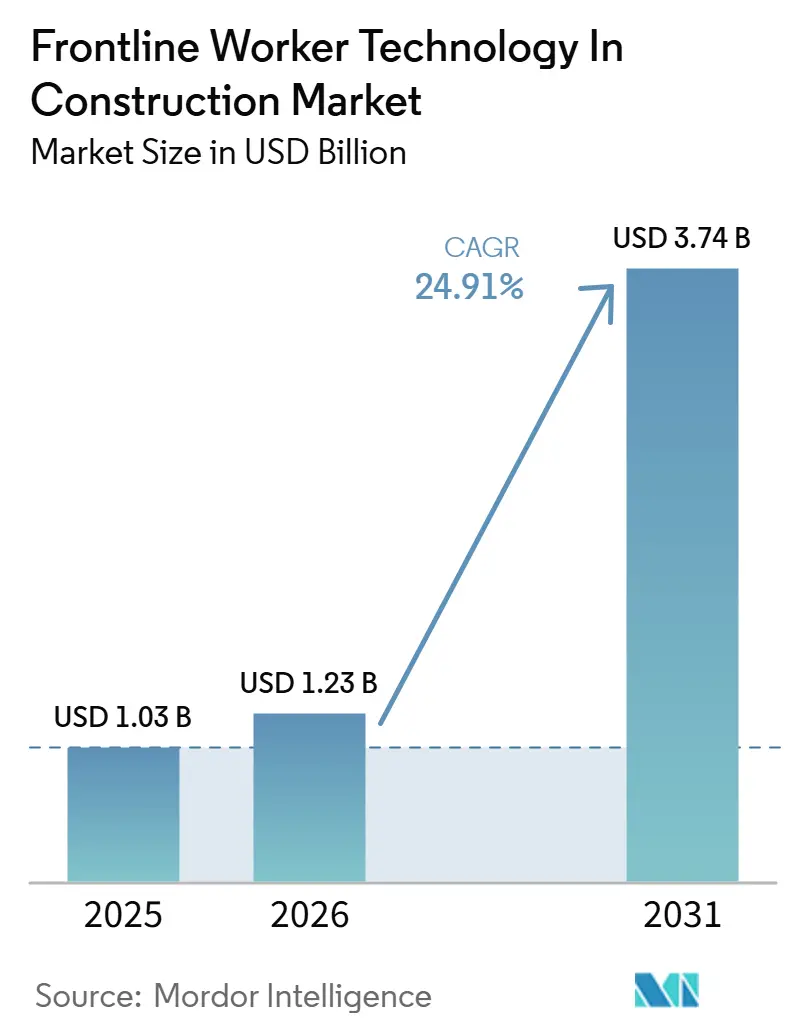
The frontline worker technology in construction market size is expected to increase from USD 1.03 billion in 2025 to USD 1.23 billion in 2026 and reach USD 3.74 billion by 2031, growing at a CAGR of 24.91% over 2026-2031. The market is moving quickly as construction firms invest more in digital tools that enhance field visibility, worker safety, and site-level coordination. Skilled labor shortages, stricter documentation needs, and the wider availability of AI-enabled monitoring tools are pushing contractors to replace manual oversight with connected systems that support faster decisions. Construction teams are also shifting from post-incident reporting to continuous risk monitoring, which is changing how buyers evaluate technology across active jobsites. This is broadening demand beyond large contractors and into mid-sized builders and regional subcontractors that need simple deployment models and measurable operating value. Competition is therefore moving toward platform integration, recurring services, and easier adoption, creating room for vendors that can connect software, wearables, analytics, and site workflows into a single usable system.
Key Report Takeaways
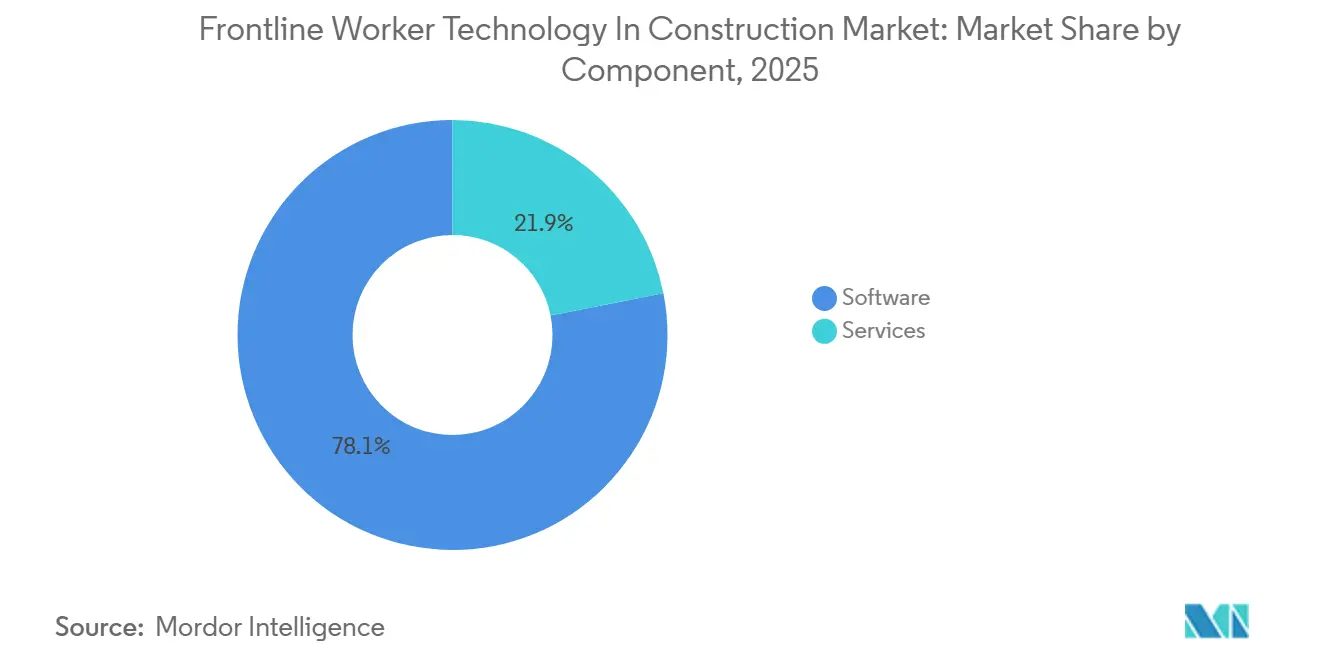
- By component, software held 78.11% of revenue in 2025, while services are projected to expand at a 25.91% CAGR through 2031 in the frontline worker technology in construction market.
- By deployment, cloud-based platforms accounted for 72.61% of the market share in 2025, and cloud-based deployment is also expected to record the highest CAGR of 26.18% through 2031.
- By organization size, large enterprises captured 66.61% of revenue in 2025, while small and medium enterprises are projected to grow at a 27.33% CAGR through 2031.
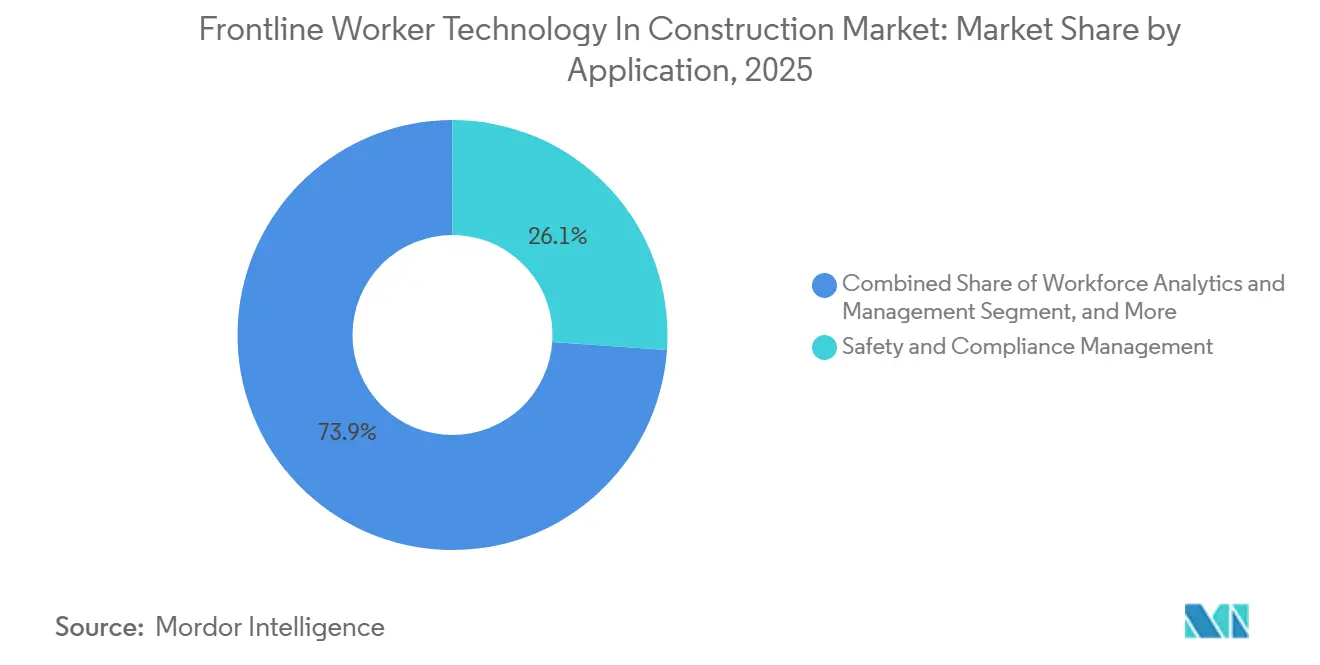
- By application, safety and compliance management accounted for 26.11% of the market share in 2025, while workforce analytics and performance management are projected to expand at a 28.44% CAGR through 2031.
- By end user, residential construction led with 36.11% revenue share in 2025, while industrial and utility construction is expected to advance at a 27.44% CAGR through 2031.
- By geography, North America held 36.11% share in 2025, while the Asia-Pacific is projected to grow at a 29.66% CAGR through 2031.
Note: Market size and forecast figures in this report are generated using Mordor Intelligence’s proprietary estimation framework, updated with the latest available data and insights as of January 2026.
Market Trends and Insights
Drivers Impact Analysis of Frontline Worker Technology In Construction Market*
| Driver | (~) % Impact on CAGR Forecast | Geographic Relevance | Impact Timeline |
|---|---|---|---|
| Rising Demand for Real-Time Worker Visibility on Complex Jobsites | +6.5% | Global | Short term (≤ 2 years) |
| Rising Safety Compliance Pressure Across Construction Sites | +5.5% | Global | Short term (≤ 2 years) |
| Growing Use of AI-Powered Hazard Detection and Predictive Safety Analytics | +4.8% | North America and Europe | Medium term (2-4 years) |
| Increasing Adoption of Connected PPE and Smart Wearables | +4.2% | North America and Asia-Pacific | Short term (≤ 2 years) |
| Labor Shortages Accelerating Automation of Attendance, Compliance, and Productivity Tracking | +3.5% | North America and Europe | Medium term (2-4 years) |
| Rising Demand for Digital Worker Credentialing and Site Access Control | +2.8% | Global | Medium term (2-4 years) |
| Source: Mordor Intelligence | |||
Rising Demand for Real-Time Worker Visibility on Complex Jobsites
The frontline worker technology in construction market is gaining momentum because complex projects now involve multiple subcontractors, overlapping trade schedules, and wider site footprints that are difficult to manage manually. Contractors are using ultra-wideband sensors, Bluetooth low-energy beacons, and GPS-linked systems to feed live location data into workforce planning tools and emergency response dashboards. This allows supervisors to verify zone occupancy, locate workers, and respond to incidents faster than radio-based coordination and manual headcounts allow. The same visibility layer is also becoming more valuable when location data is combined with behavior-based analytics that flag elevated risk conditions before an incident is reported. Large infrastructure programs are increasingly extending these requirements to subcontractors, helping frontline worker technology in the construction market reach deeper into the contractor chain without relying solely on direct software sales.
Rising Safety Compliance Pressure Across Construction Sites
The frontline worker technology in construction market is also being supported by stronger safety enforcement and stricter reporting expectations across major construction regions. OSHA’s electronic injury-reporting requirements increased the need for digital recordkeeping and real-time field documentation, which made compliance modules more important in contractor buying decisions.[1] This has shortened sales cycles for platforms that combine incident reporting, certification tracking, inspections, and digital safety records in one environment. National and regional compliance frameworks are pushing firms toward traceable, system-based safety management rather than paper-based processes that are harder to audit and scale. As a result, the frontline worker technology in the construction market is benefiting from compliance-driven demand that remains active even as contractors are cautious about discretionary technology spending.
Growing Use of AI-Powered Hazard Detection and Predictive Safety Analytics
The frontline worker technology in construction market is moving beyond simple monitoring because buyers now want systems that can identify risk patterns before work begins. Oracle’s Construction and Engineering Advisor for Safety, which reached general availability in March 2026, reflects this shift by using historical incident data and field observations to forecast project-level safety exposure before crews mobilize.[2] The ConstructAI deployment documented in the AAAI 2026 proceedings showed that PPE compliance detection accuracy improved from 2.3% to 75.8% when wearable cameras, fixed CCTV, and drone imagery were combined into a single edge-cloud pipeline. That performance gap shows why multi-modal AI is becoming more attractive than stand-alone sensor systems, even when infrastructure costs are higher. The frontline worker technology in construction market is therefore seeing demand move from detection-only tools toward predictive analytics platforms that can support planning, supervision, and preventive action on the same site.
Increasing Adoption of Connected PPE and Smart Wearables
The frontline worker technology in construction market is also being shaped by connected PPE that turns helmets, vests, armbands, and heavy-equipment safety systems into continuous data sources. Epicore Biosystems expanded its Series B funding to USD 32 million in May 2025 to support broader deployment of its sweat-sensing wearable technology, which tracks hydration, skin temperature, and activity levels in demanding field environments. Hexagon launched the Leica Xsight360 in North America in February 2026, adding six-camera edge AI detection and real-time alerts around heavy equipment while also transmitting cloud-based safety dashboards and incident heatmaps.[3] Peer-reviewed research in 2025 also showed that biometric vests using sensor fusion and edge computing can simultaneously detect heat-stress risk, structural instability exposure, and cardiovascular strain. This is widening the role of wearables in the frontline worker technology in construction market from passive protection to active workforce data collection and immediate intervention support.[4]
Restraints Impact Analysis of Frontline Worker Technology In Construction Market*
| Restraint | (~) % Impact on CAGR Forecast | Geographic Relevance | Impact Timeline |
|---|---|---|---|
| High Upfront Cost Of Hardware, Software, and Site Integration | -3.8% | Global | Short term (≤ 2 years) |
| Privacy, Labor Relations, and Worker Acceptance Challenges | -2.5% | North America and Europe | Short term (≤ 2 years) |
| Poor Interoperability with Legacy Construction Systems | -1.8% | Global | Medium term (2-4 years) |
| Battery Life, Durability, and Connectivity Limitations in Harsh Site Conditions | -0.9% | Asia-Pacific, Middle East and Africa, and South America | Medium term (2-4 years) |
| Source: Mordor Intelligence | |||
High Upfront Cost of Hardware, Software, and Site Integration
Frontline worker technology in the construction market continues to face cost pressures, as full-scale deployment typically entails hardware, software, connectivity infrastructure, and integration work. Unlike conventional office software, these solutions often require site-specific device configuration, network setup, and model calibration. A Safety Management SmartMarket report from CPWR and Dodge found that only a limited proportion of surveyed contractors used predictive analytics tools and wearables, suggesting that tight budgets and uncertain payback periods continue to constrain adoption. Mid-sized contractors also face a disconnect between annual capital budgets and project-based spending cycles, which makes long-term platform investments more difficult to justify. Although vendors are introducing subscription-based pricing and hardware-as-a-service models, the initial cost burden continues to limit expansion in the frontline worker technology in the construction market.
Privacy, Labor Relations, and Worker Acceptance Challenges
The frontline worker technology in the construction market faces resistance, as biometric tracking, real-time location monitoring, and behavioral analytics may be viewed as surveillance rather than safety tools. A 2025 National Science Foundation-supported study found that older construction workers had greater privacy concerns than younger workers, particularly regarding the collection of physiological and mental health data. This is significant because experienced workers make up a large share of the construction workforce and can influence site-level adoption. Wearable IoT systems collect substantial personal health data, and there is no unified international standard governing their management across organizations and jurisdictions. Therefore, successful implementation depends on technical capabilities, transparent communication, robust data governance, and worker trust.
*Our forecasts treat driver/restraint impacts as directional, not additive. The impact forecasts reflect baseline growth, mix effects, and variable interactions.
Frontline Worker Technology In Construction Market Segment Analysis
By Component:
Software Leadership Supports Revenue While Services Expand The Operating ModelSoftware held 78.11% of the frontline worker technology in construction market share in 2025, which kept it well ahead of services within the component mix. This lead shows that buyers in the frontline worker technology in construction industry usually start with the platform layer, then add compatible devices and integrations around it. Contractors want systems that can combine wearable inputs, sensor feeds, incident records, and field observations in one environment that managers can use across multiple projects. That preference continues to support software demand because cloud updates, workflow changes, and analytics improvements can be rolled out faster than new hardware cycles.
Services are projected to grow at a 25.91% CAGR through 2031, indicating that deployment complexity is now generating a larger recurring revenue stream around the core platform. Implementation work now includes site connectivity design, AI model tuning, workflow alignment, and managed analytics support, rather than just basic onboarding. That is important in the frontline worker technology in construction market because vendors with a durable services layer can improve retention and raise switching costs after the initial software sale. Miter’s June 2026 launch of Miter Performance, which unified attendance, certifications, job history, and performance reviews, shows how workforce software is widening into a more complete operating layer for construction firms
By Deployment:
Cloud Leads Adoption While Hybrid Stays Relevant In Select Site ConditionsCloud-based deployment accounted for 72.61% of the frontline worker technology in construction market size in 2025, and it is also projected to grow at a 26.18% CAGR through 2031. This dual lead shows that the architecture debate has largely shifted in favor of cloud systems for connected frontline workflows. Construction sites vary by project, location, and crew mix, so platforms that depend on fixed infrastructure are harder to scale across changing job sites. Cloud systems are better suited to continuous data ingestion from mobile devices, wearables, and remote sensors spread across active field locations.
Hybrid deployment still matters in environments where data residency rules, internal governance standards, or unstable site connectivity make a fully cloud model difficult to run. That is especially relevant for remote programs and sensitive project categories where partial local control remains necessary for operations. On-premises systems continue to serve a narrow base of users that cannot move field data outside tightly controlled environments, but they are no longer the preferred path for most new rollouts. The frontline worker technology in construction market is therefore moving toward cloud-first design, while hybrid models remain a practical bridge for buyers that need flexibility without sacrificing compliance or uptime.
By Organization Size:
Large Enterprises Anchor Spending While SMEs Open The Next Growth LayerLarge enterprises held 66.61% of revenue in 2025, which shows that the frontline worker technology in construction market still depends heavily on contractors with stronger procurement budgets and deeper internal IT capacity. These firms are more likely to run complex projects where a safety event, documentation gap, or productivity delay can have direct financial and reputational consequences. They also have the integration teams, governance structures, and change management resources needed to support multi-month deployments across business units and sites. That has kept large organizations at the center of early adoption and scaled implementation.
Small and medium enterprises are projected to grow at a 27.33% CAGR through 2031, indicating a broader expansion path for the frontline worker technology in the construction market. Mobile-first workflows, easier configuration, and lower deployment friction are reducing the barriers that once made these tools feel enterprise-only. The shift matters for the frontline worker technology in construction industry because many regional contractors and specialty firms now have access to digital workforce tools without building large in-house support teams. Vendors using per-project and per-worker pricing are gaining greater traction with SMEs because these models better match the variable revenue patterns of construction businesses than large annual licenses.
By Application:
Compliance Buying Leads Today While Analytics Drives The Next WaveSafety and compliance management held the largest application share at 26.11% of revenue in 2025, indicating that external reporting and documented site safety continue to drive the first technology purchase in many accounts. Contractors often begin with certification tracking, inspection workflows, incident records, and subcontractor qualification tools because these needs are harder to delay under active compliance pressure. OSHA’s digital reporting guidance has also reinforced the value of platforms that can organize field safety information in a traceable, audit-ready format. This keeps compliance-oriented modules at the front of many buying decisions, even when broader productivity features are available.
Workforce analytics and performance management is projected to grow at a 28.44% CAGR through 2031, which shows that the frontline worker technology in construction market is expanding from recordkeeping into labor intelligence. Contractors want systems that can reduce rework, improve crew allocation, track performance patterns, and support retention decisions across active projects. Bridgit’s 2026 Construction Workforce Benchmark Report found an average attrition rate of 20.7% across data from 233 contractors and more than 114,000 professionals, which helps explain why workforce analytics is moving closer to core operating priorities. Other application groups, including communication, task execution, scheduling, and learning, continue to gain importance because disconnected point tools weaken the broader value of the analytics layer.

By End User:
Residential Spending Leads While Industrial And Utility Projects Lift GrowthResidential construction accounted for 36.11% of revenue in 2025, making it the largest end-user segment in the frontline worker technology in construction market. This position reflects the high volume of residential work and the need to manage subcontractor compliance across multiple developments simultaneously. Mid-sized homebuilders and residential contractors are also adopting digital workforce tools to improve site visibility without building heavy internal systems. Commercial and infrastructure projects remain important adjacent users because multi-crew coordination and contract-level compliance both create steady demand for connected worker platforms.
Industrial and utility construction is projected to grow at a 27.44% CAGR through 2031, making it the fastest-growing end-user group. Energy transition programs, grid upgrades, data centers, renewable projects, and other complex builds require tighter workforce oversight and stronger multi-contractor coordination than conventional building work. Bridgit reported that industrial and manufacturing project starts surged 68.1% year over year in 2025, which supports the view that spending and activity are rising together in this end-user group. That combination is shifting attention within the frontline worker technology in construction market toward project types with both high compliance intensity and operational complexity.
Geography Analysis
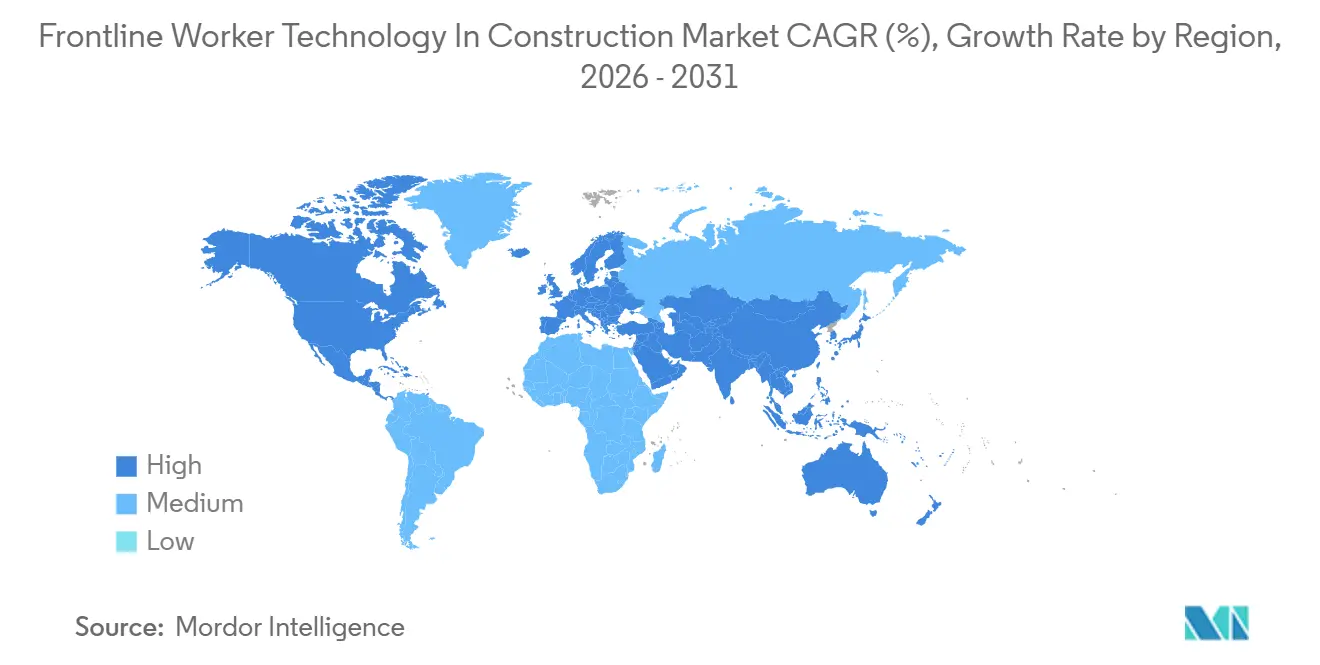
North America Frontline Worker Technology in Construction Market
North America held 36.11% of the frontline worker technology in construction market share in 2025, which kept it as the largest regional contributor. The United States remains the main revenue base because digital injury reporting and safety documentation requirements have pushed contractors toward platforms that support real-time records and monitoring. Canada is also building momentum through digital identity and workforce credentialing tools, including Credivera’s government-validated credential exchange, highlighted by the Digital Identity and Authentication Council of Canada in 2026. Labor shortages, enterprise contractor presence, and stronger insurance awareness continue to support adoption across the frontline worker technology in construction market in North America.
APAC Frontline Worker Technology in Construction Market
Asia-Pacific is projected to grow at a 29.66% CAGR through 2031, giving it the fastest regional expansion in the frontline worker technology in construction market size outlook. India is adding demand through large infrastructure pipelines that require multi-site workforce coordination and subcontractor oversight across transport, housing, and urban projects. China is also pushing adoption as experienced workers retire and contractors seek AI-based tools to improve labor allocation and site supervision. Japan and South Korea are moving through productivity-focused adoption paths, while Australia is supporting demand for offline-capable tools that can work in remote and low-connectivity construction settings. The scale of project activity across Asia-Pacific is therefore turning workforce compliance and field visibility into core operating needs rather than optional digital upgrades.
EMEA and South America Frontline Worker Technology in Construction Market
Europe, the Middle East and Africa, and South America show different maturity levels, but each remains relevant to the frontline worker technology in construction market. In Europe, countries such as Germany, the United Kingdom, and France are shaping demand by driving tighter privacy expectations and greater interest in platforms that can balance worker protection with data control. In the Middle East and Africa, Saudi Arabia and the United Arab Emirates are supporting growth through large construction programs that require better oversight of multinational workforces across wide, remote sites. South America remains earlier in the adoption cycle, but rising attention to formal safety management and workforce monitoring is creating a clearer path for future technology uptake.
Competitive Landscape
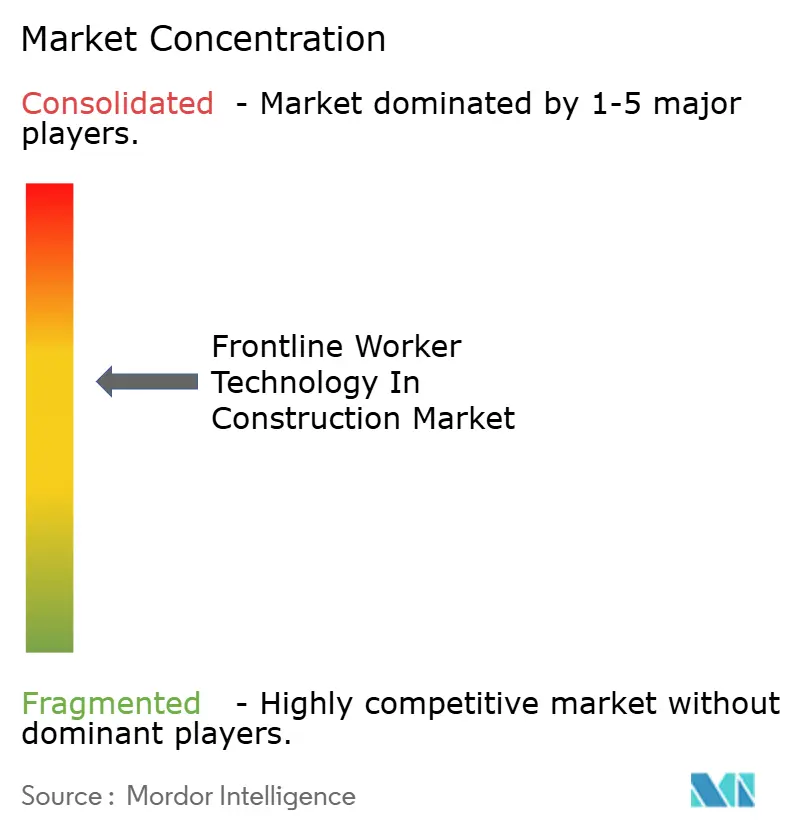
The frontline worker technology in construction market remains moderately fragmented, with broad enterprise platforms and specialized wearable vendors competing across different parts of the value chain. Microsoft Corporation, Siemens AG, Trimble Inc., and Hexagon AB are leveraging existing software and construction relationships to expand their positions in the frontline worker technology market through integration-led offerings. Specialist providers such as Epicore Biosystems Inc. and MākuSafe Inc. are instead focusing on physiological monitoring, fatigue, hydration, and worker-level risk detection where hardware precision matters more than software breadth. Microsoft’s February 2025 release of spatial annotations in Dynamics 365 Field Service and Teams widened access to mixed-reality collaboration for frontline workers without requiring dedicated HoloLens hardware.
Competition in the frontline worker technology in construction market is moving toward AI orchestration, connected workflows, and cross-platform data flow rather than stand-alone features. Procore’s January 2026 acquisition of Datagrid clearly demonstrated this, as the company used the deal to strengthen AI implementation and remove data silos across contractor workflows. Augmentir’s February 2026 launch of out-of-the-box AI agents for frontline operations also reflected the same direction, with tools built to support root cause review and operational data analysis across field environments. Hexagon’s May 2026 launch of Multivista Hub further emphasized unified construction intelligence by bringing together capture, creation, and analysis services into a single system. Siemens also launched the Intelligence Center X in June 2026 to support hybrid human and AI workflows, demonstrating that larger industrial technology players are actively building broader orchestration layers around frontline data.
The frontline worker technology in construction market still has a clear opening at the integration layer because many contractors already use ERP, project management, and field execution systems that do not exchange data smoothly. Vendors that can connect connected worker tools with those incumbent systems are in a stronger position to win larger enterprise budgets and longer contracts. This is one reason why acquisitions, partnerships, and platform bundling are becoming more visible across the frontline worker technology in construction market. The current structure still supports several viable competitive models, but scale is likely to favor vendors that combine usable analytics, field-ready hardware compatibility, and low-friction integration.b
Frontline Worker Technology In Construction Industry Leaders
-
Honeywell International Inc.
-
Trimble Inc.
-
RealWear Inc.
-
Hexagon AB
-
Microsoft Corporation
- *Disclaimer: Major Players sorted in no particular order
Frontline Worker Technology In Construction Market Companies Covered in this Report
- 36Zero Group Ltd.
- Aatmunn, Inc.
- Aetheer, Inc.
- Augmentir, Inc.
- Epicore Biosystems, Inc.
- Garmin Ltd.
- Hexagon AB
- Honeywell International Inc.
- Karam Safety Private Limited
- Librestream Technologies Inc.
- MākuSafe, Inc.
- Microsoft Corporation
- PTC Inc.
- ProGlove GmbH
- RealWear Inc.
- RedZone, Inc.
- Siemens AG
- SlateSafety, Inc.
- Trimble Inc.
- Vuzix Corporation
Recent Industry Developments in Frontline Worker Technology In Construction Market
- June 2026: Epicore Biosystems launched major new features to Connected Hydration, including the first Hydration Readiness Score and a reusable wearable armband engineered for daily deployment at scale, reducing per-worker physiological monitoring costs in industrial construction environments where heat-related incidents represent a persistent and underreported risk category.
- June 2026: Siemens AG launched Intelligence Center X, an industrial AI orchestration platform designed to create hybrid workforces where human workers and AI agents share context, workflows, and lifecycle intelligence across engineering, manufacturing, and construction site operations, directly addressing the challenge of scaling AI deployments from isolated pilots to enterprise-wide impact.
- May 2026: Procore Technologies launched an expanded AI experience powered by embedded Datagrid intelligence, introducing AI agents capable of autonomously executing submittal reviews, drafting RFIs, and coordinating workflows across construction projects, the offering entered private beta with broader commercial availability expected in summer 2026.
- May 2026: Hexagon AB launched Hexagon Multivista Hub, unifying its Capture, Create, and Analyze services into a single integrated construction intelligence hub, enabling project teams to access and act on data across the full project lifecycle without switching platforms or managing multiple authentication environments.
Global Frontline Worker Technology In Construction Market Report Scope
The frontline worker technology in construction market refers to the specialized ecosystem of software and services designed to empower non-desk employees operating on job sites and in related field environments. This includes tools tailored for site workers, supervisors, and contractors to facilitate communication, task execution, shift scheduling, safety and compliance management, and knowledge sharing. The market encompasses cloud-based, on-premises, and hybrid solutions deployed by construction firms of varying sizes across residential, commercial, infrastructure, and industrial projects. Ultimately, these technologies aim to bridge the communication gap between back-office project managers and on-site personnel, mitigating safety risks, streamlining project workflows, reducing downtime, and improving overall operational efficiency.
The Frontline Worker Technology in Construction Market Report is Segmented by Component (Software and Services), Deployment (Cloud-Based, Hybrid, and On-Premises), Organization Size (Large Enterprises and Small and Medium Enterprises), Application (Employee Communication and Engagement, Workforce Execution and Task Management, Workforce Scheduling and Coordination, Learning and Knowledge Enablement, Workforce Analytics and Performance Management, Safety and Compliance Management, and Other Applications), End User (Residential Construction, Commercial Construction, Infrastructure Construction, and Industrial and Utility Construction), and Geography (North America, South America, Europe, Asia-Pacific, and Middle East and Africa). The Market Forecasts are Provided in Terms of Value (USD).
Segmentation Overview
| Software |
| Services |
| Cloud-Based |
| Hybrid |
| On-Premises |
| Large Enterprises |
| Small and Medium Enterprises |
| Employee Communication and Engagement |
| Workforce Execution and Task Management |
| Workforce Scheduling and Coordination |
| Learning and Knowledge Enablement |
| Workforce Analytics and Performance Management |
| Safety and Compliance Management |
| Other Applications |
| Residential Construction |
| Commercial Construction |
| Infrastructure Construction |
| Industrial and Utility Construction |
| North America | United States | |
| Canada | ||
| Mexico | ||
| South America | Brazil | |
| Argentina | ||
| Rest of South America | ||
| Europe | Germany | |
| United Kingdom | ||
| France | ||
| Italy | ||
| Spain | ||
| Russia | ||
| Rest of Europe | ||
| Asia-Pacific | China | |
| India | ||
| Japan | ||
| South Korea | ||
| Australia | ||
| Rest of Asia-Pacific | ||
| Middle East and Africa | Middle East | Saudi Arabia |
| United Arab Emirates | ||
| Rest of Middle East | ||
| Africa | South Africa | |
| Nigeria | ||
| Rest of Africa | ||
| By Component | Software | ||
| Services | |||
| By Deployment | Cloud-Based | ||
| Hybrid | |||
| On-Premises | |||
| By Organization Size | Large Enterprises | ||
| Small and Medium Enterprises | |||
| By Application | Employee Communication and Engagement | ||
| Workforce Execution and Task Management | |||
| Workforce Scheduling and Coordination | |||
| Learning and Knowledge Enablement | |||
| Workforce Analytics and Performance Management | |||
| Safety and Compliance Management | |||
| Other Applications | |||
| By End User | Residential Construction | ||
| Commercial Construction | |||
| Infrastructure Construction | |||
| Industrial and Utility Construction | |||
| By Geography | North America | United States | |
| Canada | |||
| Mexico | |||
| South America | Brazil | ||
| Argentina | |||
| Rest of South America | |||
| Europe | Germany | ||
| United Kingdom | |||
| France | |||
| Italy | |||
| Spain | |||
| Russia | |||
| Rest of Europe | |||
| Asia-Pacific | China | ||
| India | |||
| Japan | |||
| South Korea | |||
| Australia | |||
| Rest of Asia-Pacific | |||
| Middle East and Africa | Middle East | Saudi Arabia | |
| United Arab Emirates | |||
| Rest of Middle East | |||
| Africa | South Africa | ||
| Nigeria | |||
| Rest of Africa | |||
Key Questions Answered in the Report
What is the current and forecast size of the frontline worker technology in construction space?
The frontline worker technology in construction market size stood at USD 1.03 billion in 2025, reached USD 1.23 billion in 2026, and is forecast to reach USD 3.74 billion by 2031 at a 24.91% CAGR.
Which application area currently leads adoption in construction frontline technology?
Safety and compliance management led in 2025 with a 26.11% share because many contractors first buy these tools to meet reporting, inspection, and documentation needs.
Which application is growing the fastest through 2031?
Workforce analytics and performance management is projected to grow the fastest at a 28.44% CAGR as contractors use workforce data for labor allocation, retention, and productivity improvement.
Why is cloud deployment leading in this space?
Cloud-based deployment held 72.61% share in 2025 and is also the fastest-growing model at 26.18% CAGR because construction firms need flexible systems that can support moving sites, field devices, and remote access.
Which end-user group offers the strongest growth opportunity?
Industrial and utility construction is expected to record the fastest growth at a 27.44% CAGR as energy, grid, data center, and renewable projects require tighter workforce compliance and coordination.
Which region is growing the fastest for connected frontline solutions in construction?
Asia-Pacific is projected to grow the fastest at a 29.66% CAGR through 2031, supported by large infrastructure pipelines, labor transition needs, and demand for multi-site workforce visibility.