
Frankfurt Data Center Market Size and Share
Market Overview
| Study Period | 2020 - 2031 |
|---|---|
| Forecast Data Period | 2026 - 2031 |
| Base Year Market Size (2025) | 1.39 Thousand megawatt |
| Market Volume (2026) | 1.47 Thousand megawatt |
| Market Volume (2031) | 2.03 Thousand megawatt |
| Growth Rate (2026 - 2031) | 6.77 % |
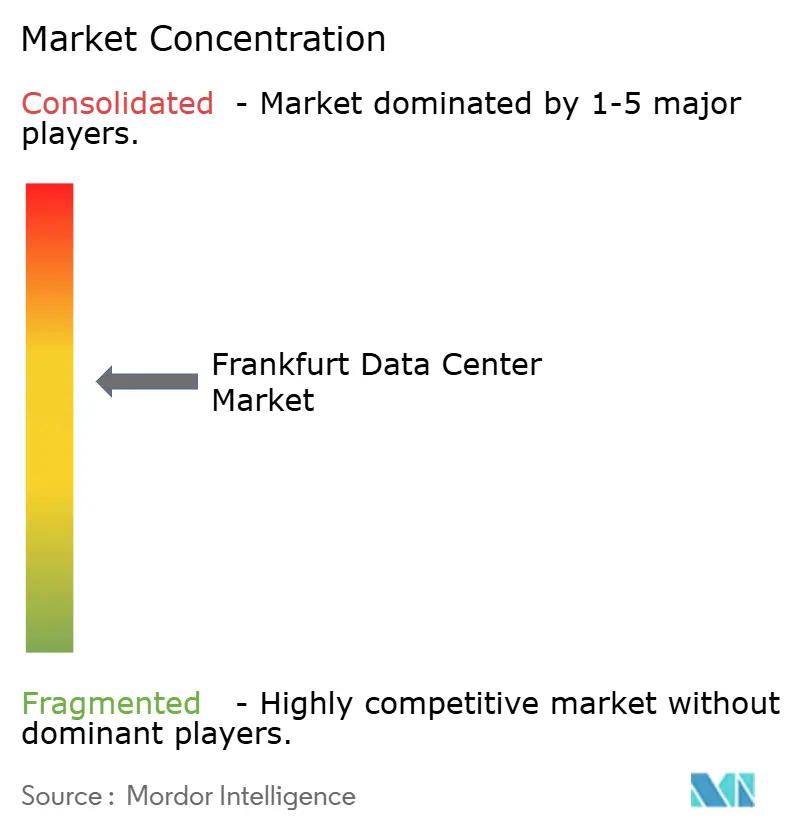
| Market Concentration | Medium |
Major Players *Disclaimer: Major Players sorted in no particular order Image © Mordor Intelligence. Reuse requires attribution under CC BY 4.0. | |
Frankfurt Data Center Market Analysis by Mordor Intelligence
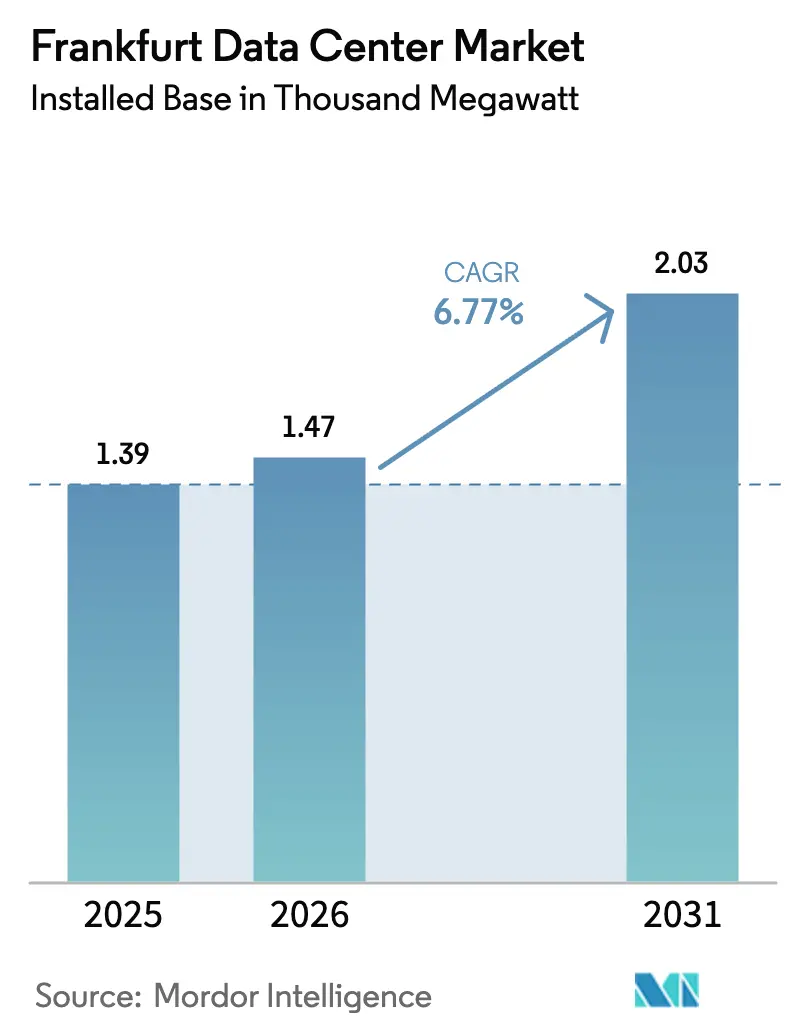
The Frankfurt Data Center Market size in terms of installed base is projected to expand from 1.39 thousand megawatt in 2025 and 1.47 thousand megawatt in 2026 to 2.03 thousand megawatt by 2031, registering a CAGR of 6.77% between 2026 to 2031. Capital continues to pour into Germany’s digital capital as hyperscalers accelerate sovereign-cloud builds, yet grid queues of three to five years push new capacity into adjacent towns, lifting land values and nudging operators toward behind-the-meter generation. Colocation providers that secured power reservations before 2024 now command premium prices, while newcomers shoulder 15-25% higher upfront costs for liquid-cooling retrofits. Demand for 150-240 kW racks tied to AI inference drives early adoption of direct-to-chip cooling, and regulatory pressure to reuse waste heat converts thermal output into a secondary revenue stream. Competitive intensity rises as Data4, CyrusOne, Vantage, and STACK Infrastructure collectively announce 663 MW of greenfield builds, compressing wholesale rates in outer-ring sub-markets.
Key Report Takeaways
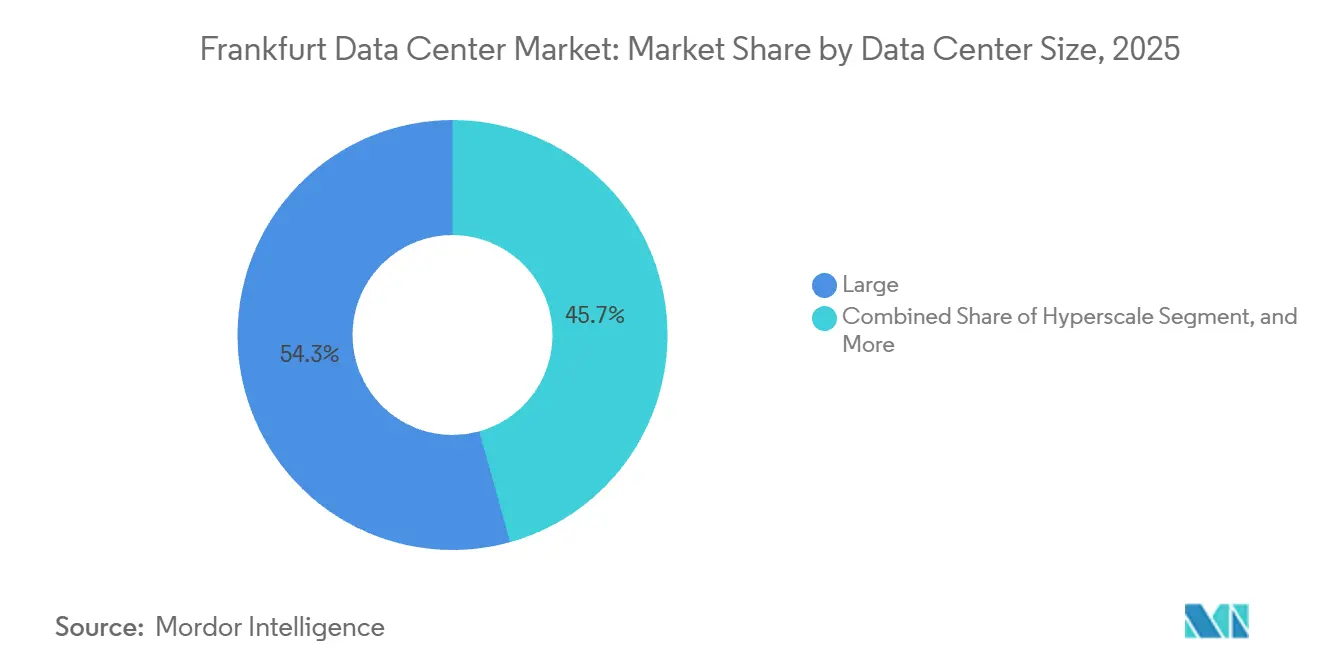
- By data center size, large facilities held 54.32% of 2025 installed capacity, while hyperscale campuses are projected to expand at a 7.41% CAGR through 2031.
- By tier, tier 3 captured 64.86% of 2025 deployments, whereas tier 4 builds are set to grow at 7.24% as financial institutions migrate to higher-resilience halls.
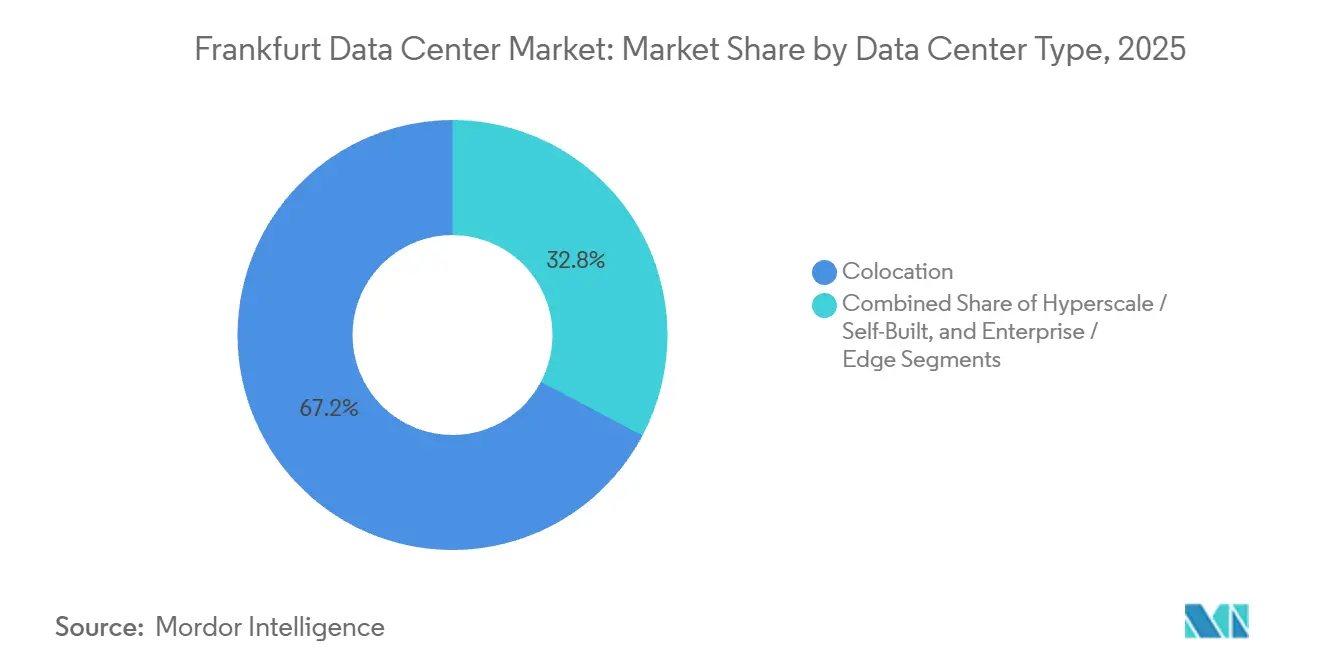
- By data center type, colocation represented 67.25% of 2025 installed capacity, yet hyperscale and self-build capacity will expand at 7.62% annually as major cloud providers internalize operations.
- By end user, IT and ITES accounted for 27.86% of 2025 installed capacity, but BFSI workloads will accelerate by 8.59% due to real-time payment mandates.
Note: Market size and forecast figures in this report are generated using Mordor Intelligence’s proprietary estimation framework, updated with the latest available data and insights as of 2026.
Frankfurt Data Center Market Trends and Insights
Drivers Impact Analysis*
| Driver | (~) % Impact on CAGR Forecast | Geographic Relevance | Impact Timeline |
|---|---|---|---|
| Hyperscale Cloud Expansion by US Tech Majors | +1.8% | Frankfurt metro, spill-over to Hanau, Dietzenbach, Offenbach | Medium term (2-4 years) |
| AI Clusters Driving High-Density Liquid-Cooling Demand | +1.5% | Global, concentrated in Frankfurt core and Hanau edge zones | Short term (≤ 2 years) |
| Sovereign-AI Initiatives of German Federal Agencies | +1.2% | National, with early deployments in Frankfurt, Berlin, Munich | Long term (≥ 4 years) |
| Strategic FLAPD Network-Latency Advantage | +0.9% | Frankfurt metro, competitive with Amsterdam, Paris, London, Dublin | Medium term (2-4 years) |
| New Submarine Cable Landings Boost Bandwidth | +0.6% | Frankfurt metro, extending to Prague, Vienna corridors | Long term (≥ 4 years) |
| Grid-Decarbonisation Commitments Lure Green Tenants | +0.5% | Frankfurt metro, Hesse state, broader Germany | Long term (≥ 4 years) |
| Source: Mordor Intelligence | |||
Hyperscale Cloud Expansion By US Tech Majors
Amazon Web Services earmarked EUR 8.8 billion for capacity adds through 2026, Google pledged EUR 5.5 billion between 2026 and 2029, and Microsoft is expanding Azure regions, all targeting purpose-built campuses that support 150 kW-plus racks and liquid cooling. The shift pulls development toward Hanau and Dietzenbach, locations offering faster power approvals and room for 100-MW blocks. Established colocation operators respond by acquiring peripheral land or accepting margin compression as tenants migrate. CyrusOne’s tie-up with E.ON delivers 61 MW of on-site generation, signalling that utility partnerships become a prerequisite for projects over 50 MW.[1]CyrusOne Press Team, “CyrusOne and E.ON Announce Strategic Partnership to Overcome Data Center Grid Capacity Constraints,” CyrusOne, cyrusone.comOverall, hyperscale spending lifts construction pipelines but also intensifies the battle for scarce power allocations.
AI Clusters Driving High-Density Liquid-Cooling Demand
Rack densities in the latest Frankfurt builds now range from 132 kW to 240 kW, quadruple the 30-40 kW standard that was prevalent only three years ago. Digital Realty’s FRA18 debuted in March 2025 with direct-to-chip cooling, supporting NVIDIA H100 clusters at 150 kW per rack without throttling. Hyperscalers pay a 20-30% capex premium, while mid-market enterprises stick with traditional air-cooled floors. Liquid cooling simultaneously unlocks 50-60 °C waste heat suitable for district heating, helping operators meet Germany’s Energy Efficiency Act, which requires heat reuse above 30% for new halls. Early movers monetize both AI demand and thermal by-products, whereas laggards face stranded assets when tenants chase denser footprints.
Sovereign-AI Initiatives of German Federal Agencies
DataHub Europe and allied projects mandate that sensitive models and datasets stay on German soil, reserving 10-15% of Frankfurt’s addressable load for providers with German operational control. Procurement cycles shorten to three to four months under framework agreements, rewarding operators already vetted for security. Data4’s Hanau campus offers air-gapped zones and on-premises key management to meet federal standards.[2]Data4 Group, “Data4 Lays the Foundations on Its First Mega Campus in Germany,” Data4, data4group.comOnce a ministry lands a workload, migration costs lock demand for five-seven years, providing durable revenue. Providers lacking sovereign credentials risk exclusion from a high-margin, low-churn segment projected at EUR 400-600 million annually by 2029.
Strategic FLAPD Network-Latency Advantage
Frankfurt anchors the FLAPD cluster and hosts DE-CIX, which introduced 800G optics in November 2025 and an AI-IX service two months earlier.[3]DE-CIX Media, “DE-CIX Launches AI-IX,” DE-CIX, de-cix.netRound-trip latency under two milliseconds remains critical for algorithmic trading between Xetra and London’s LSE. As hyperscalers expand into outer-ring towns, the city’s interconnection density helps maintain premium retail pricing for latency-sensitive workloads. Operators bundling direct cross-connects to DE-CIX and sub-one-millisecond paths to cloud on-ramps capture BFSI demand that values speed over cost.
Restraints Impact Analysis*
| Restraint | (~) % Impact on CAGR Forecast | Geographic Relevance | Impact Timeline |
|---|---|---|---|
| Grid-Connection Moratorium and Power-Availability Limits | -1.4% | Frankfurt core, moderate impact in Hanau, Dietzenbach, Offenbach | Short term (≤ 2 years) |
| Rising Electricity Costs from EU Carbon Pricing | -0.9% | Frankfurt metro, broader Germany and EU | Medium term (2-4 years) |
| Community Opposition over Water-Consumption Spikes | -0.5% | Hanau, Griesheim, Dietzenbach municipalities | Medium term (2-4 years) |
| Specialised-Talent Shortage in Frankfurt DC Operations | -0.4% | Frankfurt metro, broader Germany | Long term (≥ 4 years) |
| Source: Mordor Intelligence | |||
Grid-Connection Moratorium and Power-Availability Limits
Mainova and Amprion extended lead times for new power links to as long as five years, forcing newcomers to seek brownfield sites or finance behind-the-meter generation. CyrusOne’s FRA7 illustrates the workaround, with 61 MW of on-site gas generators that raise capex but shave up to 2 years off delivery. Scarcity inflates land within 500 m of substations by 40-60%, spawning a land-banking strategy for investors awaiting Amprion’s EUR 1.2 billion transmission upgrade due in 2029. Operators without power reservations face high entry barriers, pushing the market toward consolidation.
Rising Electricity Costs from EU Carbon Pricing
EU ETS allowances averaged EUR 85 per tonne CO₂ in 2025 and are forecast to top EUR 100 by 2028, adding roughly 18% to gas-peaker backup costs. Deutsche Telekom covered 50% of its data-center load with renewable PPAs by end-2025, locking in rates 15-20% below spot. Google’s 24/7 carbon-free arrangement with Engie and Ørsted lifts its German portfolio to 85% carbon-free energy in 2026. Operators without multi-country scale struggle to sign sub-50 MW PPAs, leaving them exposed to rising carbon pass-throughs and squeezing already tight wholesale margins.
*Our forecasts treat driver/restraint impacts as directional, not additive. The impact forecasts reflect baseline growth, mix effects, and variable interactions.
Segment Analysis
By Data Center Size: Hyperscale Campuses Capture AI Workload Surge
Hyperscale campuses delivered the fastest trajectory, rising from a modest base toward a projected 7.41% CAGR through 2031, underpinned by cloud providers internalizing 150-240 kW racks. Large sites accounted for 54.32% of installed load in 2025, yet their share erodes as AWS, Google, and Microsoft favor 100-MW blocks outside the grid-constrained core. Medium facilities anchor enterprise cages within five milliseconds of DE-CIX, supporting stable but slower 5.8% growth. Small edge nodes tied to 5G standalone networks maintain relevance in telecom deployments across 12 German metros. The Frankfurt data center market for hyperscale campuses is on track to outpace all other segments, while large halls remain the bulk of near-term revenue.
Hyperscale operators spread cooling and fiber backhaul across mega-campuses, cutting per-kW capex by up to 35% compared with modular builds. Compliance with Germany’s Energy Efficiency Act raises capital intensity but creates a moat for well-financed projects such as NTT’s 482 MW Nierstein campus, slated for commissioning in 2029. Hyperscale-ready white space in Hanau and Dietzenbach underpins a bifurcated Frankfurt data center market where latency-sensitive loads stay downtown and large AI workloads flock outward.



By Tier Type: Tier 4 Builds Accelerate Under Financial-Sector Mandates
Tier 3 halls commanded 64.86% of 2025 capacity, but Tier 4 rooms accelerate at 7.24% CAGR after BaFin’s January 2026 resilience update that obliges systemically important banks to migrate core stacks into 2N+1 redundant environments. The Frankfurt data center market share of Tier 4 facilities inches up each year as Commerzbank and Deutsche Bank move their payment rails and trading engines to higher-redundancy zones. Operators such as Equinix and Digital Realty leverage multi-tenant footprints to amortize the 35-45% capex premium required for Tier 4 builds.
CyrusOne’s FRA7 targets a PUE below 1.3 while reusing up to 40 MW of heat for the Westside district network, marrying Tier 4 uptime to BREEAM “Very Good” certification. Operators unable to retrofit older Tier 2 halls face occupancy declines as tenants recontract to compliant sites, reinforcing a consolidation trend in the Frankfurt data center market.
By Data Center Type: Colocation Dominance Erodes as Hyperscalers Internalize
Colocation captured 67.25% of installed load in 2025, yet hyperscale self-builds will post 7.62% CAGR, the quickest among all facility types. Retail colocation maintains pricing of EUR 180-220 per kW by bundling meet-me-room access to DE-CIX, which is critical for BFSI and manufacturing workloads. Wholesale colocation anchors cost-sensitive enterprise tenants at EUR 120-150 per kW, expanding at a mid-6% pace. The Frankfurt data center market for self-built hyperscale capacity is projected to surpass wholesale revenue by 2031 as pre-leasing absorbs remaining inventory.
Digital Realty’s hybrid FRA18 template reserves one-fifth of space for retail cages within an otherwise hyperscale-oriented hall, hedging against demand swings. Vacancy across the Frankfurt data center market fell to 4.8% by mid-2025, tightening to a forecast 3.4% in 2026, suggesting higher price elasticity for operators with ready-to-fit halls.
By End User: BFSI Leads Growth on Real-Time Payment Mandates
BFSI workloads are set to climb at an 8.59% CAGR through 2031 as EU instant payment rules cap transaction windows at 10 seconds, forcing banks to locate compute within 2-millisecond round-trips to Xetra. IT and ITES remain the largest slice, accounting for 27.86% of installed load and expanding at the market’s average pace. E-commerce, manufacturing, and government clusters deliver steady mid-6% gains, while media and telecom edge nodes fragment workloads across multiple metros. Tier 4 space within ten kilometers of downtown Frankfurt wins the lion’s share of BFSI expansion, underscoring the value of low latency.
Commerzbank and Lufthansa’s 2025 migration to Google’s Hanau site illustrates the swivel toward resilient, sovereign facilities that meet both BaFin and CSRD benchmarks. This momentum bolsters the Frankfurt data center market share of Tier 4 halls, even as outer-ring hyperscale builds capture less latency-sensitive AI training clusters.
Geography Analysis
Frankfurt commands roughly 60% of Germany’s upcoming power capacity and hosted between 831 MW and 1,020 MW of live IT load in mid-2025. DE-CIX handled 79 exabytes of traffic in 2025, a 16% lift that underscores the city’s interconnection gravity. Yet protracted power queues reroute expansion to Hanau, Dietzenbach, and Nierstein, which collectively logged 742 MW of announced builds. Core sites preserve premium retail colocation prices, whereas outer-ring halls trade performance for faster grid access and cheaper land.
Secondary German hubs, chiefly Berlin and Munich, house 80-120 MW apiece, but their smaller internet exchanges limit appeal for ultra-low-latency applications. Hesse’s tax incentives for sub-1.2 PUE builds drew Colt DCS’s 63 MW Frankfurt 4 and 5 projects, reinforcing regional clustering. Frankfurt’s eastern vantage offers under-10 millisecond paths to Prague and Vienna, drawing Central European cloud tenants seeking EU residency without western rates.
Network upgrades bolster the hub-and-spoke pattern. Eurofiber’s Frankfurt-Vienna route and GlobalNet’s DWDM rings trimmed latency, enabling banks to comply with DORA’s geographic dispersion mandates. While grid scarcity pushes capacity outward, interconnection density assures Frankfurt’s status as the focal point of the German and Central European digital economy.
Regulatory Landscape
Germany's regulatory framework for data centers in the Frankfurt (Rhine-Main) cluster is shaped by national energy-efficiency obligations and local planning controls. The Energieeffizienzgesetz (EnEfG) sets efficiency and waste-heat utilization expectations for new facilities, and since January 2026, energy management system requirements apply from 300 kW non-redundant nominal load, with validation and certification obligations tightening for 1 MW-plus facilities. In April 2026, a draft amendment to EnEfG was discussed to ease PUE-related requirements for new and existing facilities in response to implementation cost and practicality concerns, keeping compliance design choices central to project feasibility and retrofit economics.
Alongside federal rules, municipal policy influences where capacity can be added. The City of Frankfurt master planning approach restricts data center development to specified neighborhoods (including Sossenheim, Rodelheim, Griesheim, Gallus, Ostend, Fechenheim, and Seckbach), reinforcing the shift of larger hyperscale builds toward outer-ring municipalities when core siting becomes constrained. At the national level, the Federal Government's Data Centre Strategy announced on 18 March 2026 signals an intent to accelerate planning and grid-connection procedures, creating a policy backdrop for operators and utilities (such as Mainova and transmission partners) to structure grid access and waste-heat offtake in parallel with permitting.
Value Chain Analysis
The Frankfurt data center value chain starts with site origination and permitting (municipal planning and environmental constraints), followed by power procurement and connection (local utility and transmission and distribution operators), and then design and build (general contractors, MEP integrators, and cooling and electrical OEMs). Grid availability and connection lead times remain a binding upstream input, pushing developers to secure substation-adjacent land early or arrange alternative power solutions, while compliance needs under EnEfG elevate demand for heat-reuse systems and energy monitoring. This, in turn, pulls district-heating stakeholders into project design earlier than in prior build cycles.
On the demand and monetization side, interconnection and network ecosystem density around DE-CIX Frankfurt underpin a large share of retail colocation value, while hyperscalers and large enterprises transact through wholesale colocation, build-to-suit, and self-build models. Operators such as Digital Realty, Equinix, NTT Global Data Centers, CyrusOne, and Vantage sit at the center of the chain, bundling powered shell, cooling capability (including liquid-cooling readiness for higher rack densities), and cross-connect services. Downstream, waste-heat offtake into district heating converts a compliance requirement into an operating interface with municipal heat networks, and ongoing operations depend on specialized facilities teams and service partners for maintenance, security, and energy-performance reporting.
Competitive Landscape
The market is moderately concentrated, with players such as NTT Global Data Centers, Digital Realty, Equinix, and others. Wholesale prices in Griesheim, Offenbach, and Hanau slid 8-12% as new capacity hit the market. Incumbents differentiate on cooling maturity, renewable PPAs, and DE-CIX cross-connect density rather than raw scale.
Digital Realty introduced 150 kW liquid-cooled racks at FRA18, while CyrusOne’s E.ON alliance eliminates grid dependency for FRA7. Municipal utilities such as Mainova leverage substation access to bundle power and colocation, undercutting private peers on electricity by up to 15%. Antin bought NorthC’s 140 MW platform in December 2025; STACK acquired Wortmann's assets; and Iron Mountain picked up three EWE halls, signaling that private equity views regulatory complexity as an entry hurdle favoring larger portfolios.
Certification and sustainability emerge as table stakes. Germany’s 2024 Energy Efficiency Act enforces PUE below 1.2 and 30% heat reuse on new halls, nudging smaller operators toward sale or shutdown. The Frankfurt data center market thus inches toward an oligopoly where capital depth, energy partnerships, and sovereign-cloud credentials dictate share gains.
Frankfurt Data Center Industry Leaders
Digital Realty Trust Inc.
Equinix Inc.
NTT Global Data Centers
CyrusOne Inc.
Vantage Data Centers
- *Disclaimer: Major Players sorted in no particular order

Market Opportunities and Future Outlook
A primary whitespace in Frankfurt sits at the intersection of power access, compliance-ready sustainability features, and AI-grade density. The Federal Government's Data Centre Strategy (18 March 2026) sets a clear national direction to expand data center and AI/HPC capacity and includes proposals that address grid-connection procedure and prioritization. This creates room for projects that can pair firm power pathways with measurable efficiency and heat-reuse outcomes. In parallel, the EnEfG framework and the January 2026 step-up in energy-management system obligations make compliance tooling and heat-reuse engineering a differentiator rather than an add-on, supporting opportunities for operators and partners that can productize energy monitoring, reporting, and district-heating integration.
Within the Frankfurt metro, opportunities concentrate in three lanes: (1) outer-ring capacity in municipalities where large power blocks can be secured sooner than in the core, (2) premium, latency-sensitive colocation tied to DE-CIX Frankfurt where interconnection density supports higher-value workloads, and (3) retrofit and brownfield upgrades that raise rack density and cooling capability without waiting for greenfield grid timelines. Recent operator actions in the region underscore the investable themes: high-density capable new halls (for example, Digital Realty's FRA18 template referenced in the report context) and behind-the-meter or utility partnerships (such as the CyrusOne and E.ON on-site generation approach cited in the report) align directly with long grid queues and tightening energy-efficiency expectations. The municipal master planning approach in Frankfurt also opens a practical lane for land-banked, zoning-aligned development in designated neighborhoods, while spillover locations around Rhine-Main capture the next wave of campus-style builds.
Recent Industry Developments
- July 2026: Equinix completed the FR13 data center (7.75MW) within the Frankfurt North-East campus. The completion expands Frankfurt FRA capacity and strengthens Equinix footprint and low-latency capacity in Frankfurt.
- July 2026: Digital Realty launched the FRA18 data center at the Digital Park Fechenheim campus (8,200 m2, 6.4MW initial capacity). The opening adds new capacity in FRA Fechenheim and enhances Digital Realty's FRA campus presence and heat-reuse potential.
- July 2026: Digital Realty commenced construction on the FRA20 data center at the Digital Park Fechenheim campus (16MW). The development expands the FRA development pipeline and increases future capacity and competitive pressure in Frankfurt.


Research Methodology Framework and Report Scope
Market Definition and Coverage
For this methodology, the Frankfurt data center market is defined as operational and planned data center IT load capacity located in the Frankfurt metropolitan cluster, expressed in megawatts, and tied to usable compute and storage deployment in facilities.
Scope exclusions: We exclude telecom tower sites, small server rooms inside offices, and non-data-center power infrastructure that does not translate into IT load.
Segmentation Overview
- By Data Center Size
- Small
- Medium
- Large
- Hyperscale
- By Tier Type
- Tier 1 and 2
- Tier 3
- Tier 4
- By Data Center Type
- Hyperscale / Self-Built
- Enterprise / Edge
- Colocation
- Non-Utilized
- Utilized
- Retail Colocation
- Wholesale Colocation
- By End User
- BFSI
- IT and ITES
- E-Commerce
- Government
- Manufacturing
- Media and Entertainment
- Telecom
- Other End Users
Data Sources, Market Sizing, and Validation
Desk Research
Desk research starts with public signals on how much capacity can realistically be built and absorbed in Frankfurt. We typically review official and non-paywalled sources such as Germany and EU energy statistics, German federal and state digital and energy policy publications, the Bundesnetzagentur grid and energy reporting, and trade bodies focused on data centers and energy efficiency in Germany.
We also use public company filings and investor presentations to understand campus additions and commissioning timelines, and to compare how operators describe contracted versus available capacity. For supporting checks, we may use paid subscriptions for company financials, patent databases for cooling and power innovations, and shipment-level import and export data for major electrical and mechanical equipment categories used in data centers. The desk sources listed above are illustrative, and we also consulted other public documents and datasets during validation and clarification.
Primary Interviews and Surveys
We interview and survey data center operators, developers, service providers, power specialists, and enterprise users active in Germany. Respondents help clarify rack demand, take-up, commissioning timing, pricing direction, and how grid access affects planned capacity in the Frankfurt market. Their input is used to address undisclosed project details and compare the secondary model with operating conditions before the estimate is finalized.
Distribution of primary research fieldwork respondents
| Company type | Respondent position |
|---|---|
| Top tier: 27% | CXOs: 18% |
| Mid tier: 48% | Functional/Unit leaders: 27% |
| Smaller Players: 25% | Managers: 55% |
Market-Sizing & Forecasting
The core sizing logic is built from a top-down reconstruction of Frankfurt IT load capacity by tracking live capacity, committed build pipelines, and realistic energization timing based on grid and commissioning milestones, then converting those totals into year-by-year installed base totals. Those totals are corroborated with selective bottom-up approximations, such as sampled campus MW additions, a small roll-up of publicly visible expansions, and checks on implied MW-to-floor space and MW-to-rack density ranges to keep outputs grounded.
Inputs used in the model include installed IT load (MW), under-construction and planned capacity (MW), expected commissioning and energization timelines, typical rack density progression (kW per rack) influenced by AI-ready deployments, and constraints such as power availability and permitting lead times that move supply into later years. We also test sensitivity to utilization and absorption patterns because Frankfurt often shows strong pre-leasing when new power is secured.
For forecasting, we primarily use scenario analysis. Grid connection timing and large campus delivery schedules can create step changes that do not behave like smooth time series. Assumptions are tightened when multiple interviewees align on the same lead-time ranges, and gaps in bottom-up visibility are handled by applying conservative build-status probabilities to pipeline capacity before it is counted as installed.
Data Validation & Update Cycle
Validation is done through triangulation between the model output and independent market signals, followed by targeted variance checks when totals move faster than power, land, or construction realities would allow. Outliers are reviewed in more than one step, and the model is challenged against alternative views such as commissioning cadence, pipeline conversion rates, and implied utilization patterns before sign-off.
The report is refreshed annually, with interim updates triggered if a material event changes deliverable capacity, such as a major power allocation shift, a large campus delay, or a change in energy efficiency requirements. Before delivery, we complete a final pass so the published view reflects the latest public announcements and confirmed expert feedback.
Mordor Intelligence's Frankfurt Data Center Market Size Versus Other Published Estimates
Published figures for Frankfurt often differ because not all sources count the same scope, even when labels appear similar. Some sources talk about revenue in euros, others focus on installed IT load in megawatts, and a few mix in broader Germany metrics that do not isolate the Frankfurt cluster.
DE-CIX-driven connectivity density and grid-queue timing are used as evidence checks that tie Mordor Intelligence's estimate to energizable IT load, not just announced projects. This approach reduces double counting when planned capacity is repeatedly reported before it is deliverable.
Benchmark comparison
| Source | Market Size | Gaps in Research Methodology |
|---|---|---|
| Mordor Intelligence | USD 1.39 B (2025) | |
| Trade Journal A | USD 2.15 B (2024) | This figure is presented as a euro-denominated market value and is commonly discussed alongside broader commercial activity, which can blend colocation revenue and related services rather than isolating installed IT load capacity. |
| Industry Association B | USD 0.83 B (2024) | This estimate is capacity-focused but is scoped to colocation and enterprise sites above a stated threshold, which can undercount smaller facilities and may not align to the same installed base definition used in broader market sizing. |
The spread across sources mainly comes from differences in value versus capacity units, and from how strictly pipeline MW is filtered into installed base by year. By keeping the unit consistent and stress-testing delivery timing against real constraints, the final number remains traceable to clear inputs and can be repeated when new project and power signals emerge.


Key Questions Answered in the Report
How fast is the Frankfurt data center market expected to grow?
Capacity is projected to rise from 1.47 thousand MW in 2026 to 2.03 thousand MW by 2031 at a 6.77% CAGR.
Which customer segment shows the strongest demand momentum?
BFSI workloads expand at 8.59% per year as instant payment regulations drive ultra-low-latency requirements.
Why are hyperscalers building outside Frankfurt’s city limits?
Three-to-five-year grid queues in the core push hyperscalers to Hanau, Dietzenbach, and Nierstein where power can be secured sooner and land is cheaper.
What cooling technology is gaining traction in new Frankfurt halls?
Direct-to-chip liquid cooling enabling 150-240 kW racks is standard in 2025-2026 openings, supporting AI inference clusters.
How do German regulations influence future builds?
The 2024 Energy Efficiency Act demands PUE below 1.2 and at least 30% waste-heat reuse, increasing capex but creating a barrier to entry for smaller operators.
Which operators currently dominate capacity?
NTT Global Data Centers, Digital Realty, and Equinix together control roughly 45% of installed load, though new entrants are rapidly adding supply.
Page last updated on:
- Data Center Construction Market Construction worldwide, split by tier, facility size and facility type.
- Data Center Server Market Servers across the global market, covering tier, facility size and facility type.
- Artificial Intelligence (AI) Data Center Market AI facilities across the global market, covering facility type, component and tier.
- Europe Data Center Physical Security Market Europe physical security, split by component, data-center tier and facility type.
- Germany Data Center Cooling Market Cooling demand across Germany, covering cooling technology, type and end-user industry.
- Poland Data Center Power Market Power systems demand across Poland, covering component, facility type and facility size.
- US Data Center Rack Market Racks in the US, split by rack size and end-user.


 Your data is secure and never sold or shared.


