
Foam Tape Market Size and Share
Market Overview
| Study Period | 2020 - 2031 |
|---|---|
| Market Size (2026) | USD 10.82 Billion |
| Market Size (2031) | USD 14.37 Billion |
| Growth Rate (2026 - 2031) | 5.86 % |
| Fastest Growing Market | Asia Pacific |
| Largest Market | Asia Pacific |
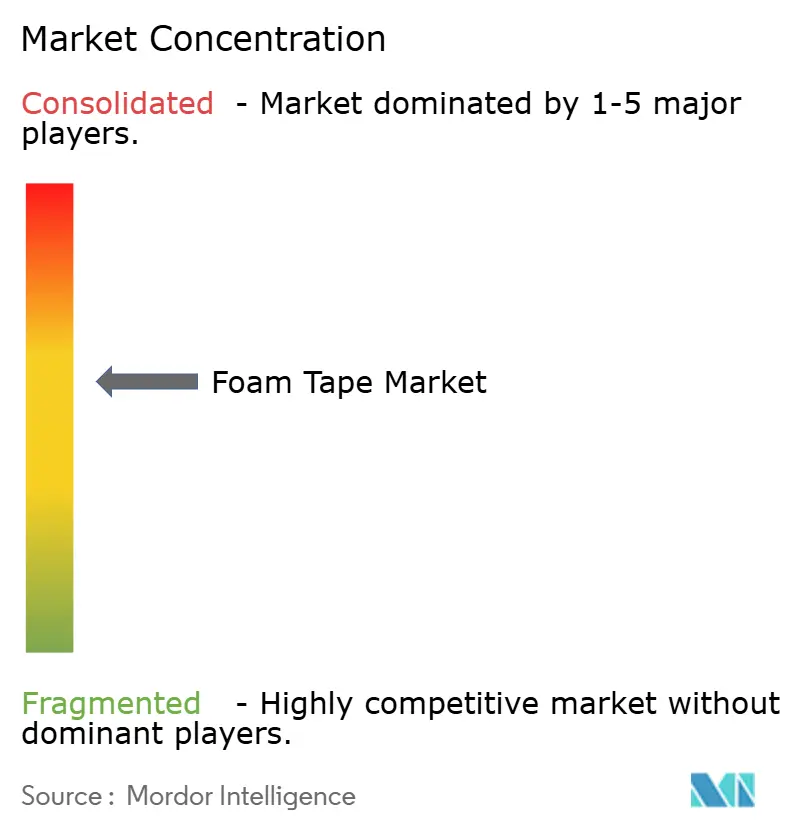
| Market Concentration | Medium |
Major Players *Disclaimer: Major Players sorted in no particular order Image © Mordor Intelligence. Reuse requires attribution under CC BY 4.0. | |
Foam Tape Market Analysis by Mordor Intelligence
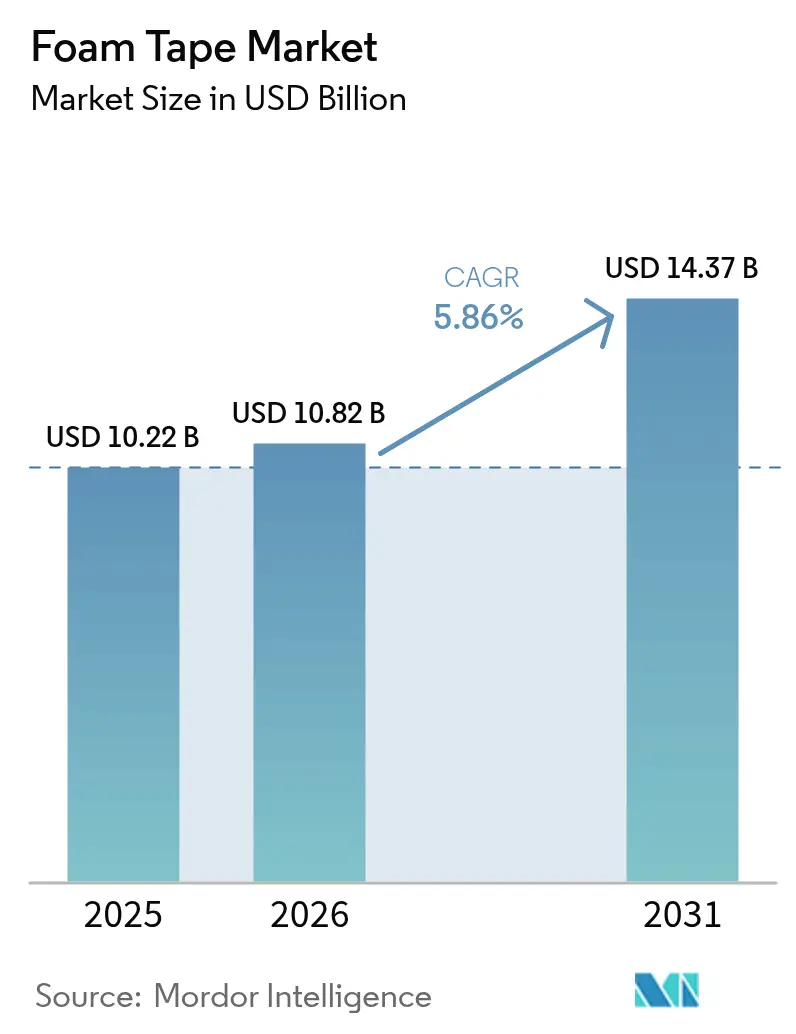
The Foam Tape Market size was valued at USD 10.22 billion in 2025 and estimated to grow from USD 10.82 billion in 2026 to reach USD 14.37 billion by 2031, at a CAGR of 5.86% during the forecast period (2026-2031). Electrification in automotive systems, rapid expansion of e-commerce fulfillment centers, and stricter construction codes are raising demand as foam tapes deliver sealing, insulation, and bonding in one material. Asia-Pacific leads with manufacturing scale and local demand, while Europe and North America pull demand upward through retrofit incentives and stringent fire-safety rules. Product design trends now favor hot-melt and solvent-free chemistries to meet low-VOC mandates, and bio-based foams move from niche to growth engines. Competitive focus is shifting from volume to value, with suppliers investing in debondable adhesives, EV battery solutions, and recyclable architectures that support circularity.
Key Report Takeaways
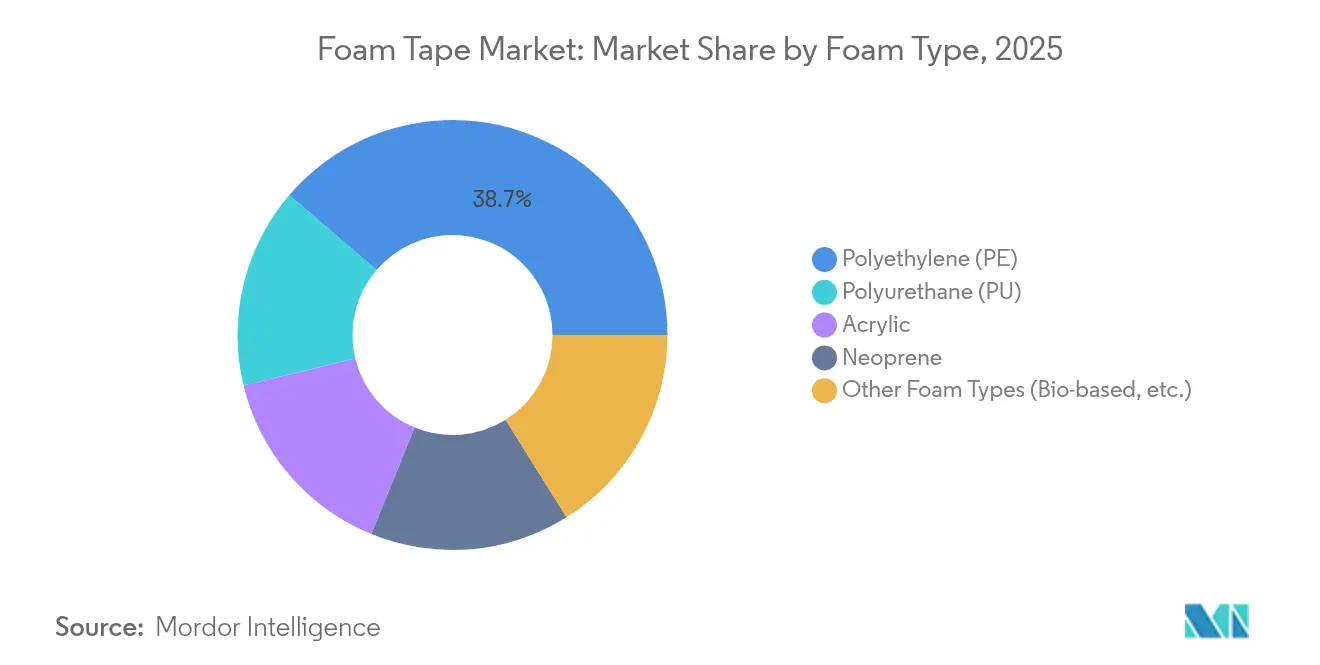
- By foam type, polyethylene retained 38.72% of the foam tapes market share in 2025; Other foam types are projected to expand at a 6.83% CAGR through 2031
- By tape type, single-sided accounted for 61.68% share of the foam tapes market size in 2025; double-sided products are forecast to grow at 7.02% CAGR between 2026-2031.
- By resin, acrylic led with 43.02% revenue share in 2025; silicone resins register the fastest 7.08% CAGR through 2031.
- By technology, solvent-based lines held 47.65% share in 2025; hot-melt solutions rise at 6.64% CAGR to 2031.
- By end-user industry, construction captured 35.05% of the foam tapes market share in 2025; electronics is advancing at a 7.18% CAGR through 2031.
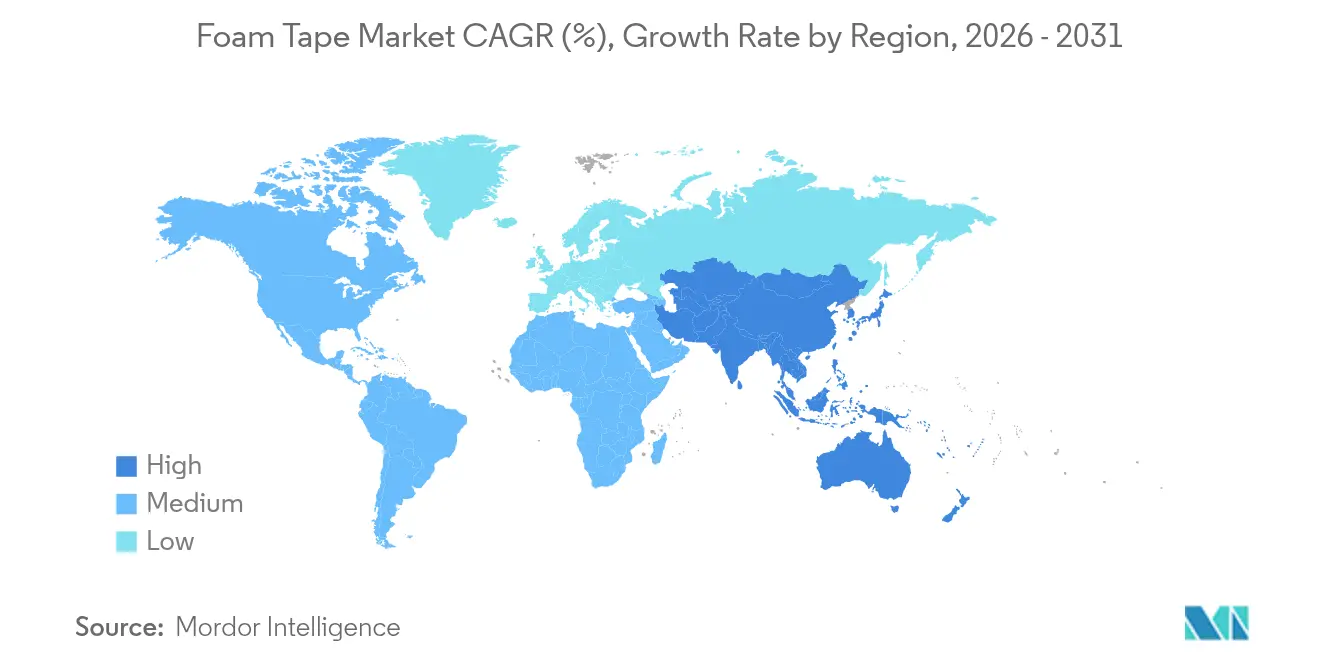
- By region, Asia-Pacific accounted for the largest share of 41.63% in 2025, and is projected to grow at the fastest CAGR of 6.72% through 2031.
Note: Market size and forecast figures in this report are generated using Mordor Intelligence’s proprietary estimation framework, updated with the latest available data and insights as of 2026.
Market Trends and Insights
Drivers Impact Analysis of Foam Tape Market*
| Driver | (~) % Impact on CAGR Forecast | Geographic Relevance | Impact Timeline |
|---|---|---|---|
| Booming retrofit construction demand | +1.8% | Global, with concentration in North America & EU | Medium term (2-4 years) |
| Rapid e-commerce packaging shift to foam tape | +1.2% | Global, led by Asia-Pacific and North America | Short term (≤ 2 years) |
| Lightweighting push in EV battery pack assembly | +1.5% | Global, with early adoption in China, EU, and North America | Medium term (2-4 years) |
| High-speed automated die-cutting adoption | +0.9% | APAC core, spill-over to MEA | Long term (≥ 4 years) |
| Building-code fire-safety upgrades for façades | +1.1% | North America & EU, expanding to APAC | Long term (≥ 4 years) |
| Source: Mordor Intelligence | |||
Booming Retrofit Construction Demand
Retrofit programs aim for a 73% emission cut in US buildings over twenty years, and foam tapes help close thermal bridges without adding structural load. The Inflation Reduction Act allocates USD 9 billion to low-income retrofit projects, broadening the customer base beyond commercial segments[1]US Department of Energy, “Inflation Reduction Act Building Provisions,” energy.gov. Updated 2024 International Building Code provisions require façade materials to meet tougher flame-spread indices, lifting demand for fire-rated foam tapes. Similar direction in the EU Packaging and Packaging Waste Regulation promotes recyclable insulation systems that enable clean separation during deconstruction[2]European Commission, “Packaging and Packaging Waste Regulation,” europa.eu. The combined policy push positions retrofit as a fast-growing avenue where energy savings, safety, and circularity converge.
Rapid E-commerce Packaging Shift to Foam Tape
Automated fulfillment centers run at high line speeds that reward adhesive solutions over mechanical closures. The global sealing and strapping tapes market reached USD 25.36 billion in 2024, and foam tapes capture share by lowering damage rates in parcel networks. Ahlstrom’s recyclable backings answer retailer mandates for curb-side-recyclable packaging. Superior cushioning versus air-filled dunnage keeps goods secure across temperature swings, a decisive factor while logistics disruptions elevate service-level penalties. The shift is amplified as brands adopt packaging reliability as a hedge against supply chain unpredictability, driving steady uptake of premium foam tapes.
Lightweighting Push in EV Battery Pack Assembly
EV battery packs need thermal, structural, and EMI functions simultaneously, and specialized foam tapes deliver each. Rogers’ ProCell EV Firewall ranges block thermal propagation while trimming weight. tesa’s EV battery tapes remove drilling steps, cutting module assembly time and shaving up to 30% weight. Avery Dennison offers UL 94-rated flame-retardant tapes that mitigate thermal runaway hazards. Vehicle electrification mandates in China and Europe ensure multi-year volume growth, making battery applications a pivotal long-term revenue pillar for the foam tapes market.
High-speed Automated Die-cutting Adoption
Next-generation converting lines apply AI to optimize cutting paths and reduce waste, which requires tapes with tight caliper control and lint-free edges. Dow expanded specialty adhesive capacity to meet these automation-ready specs. Asian converters pair labor-cost advantages with robotics, creating export-competitive production clusters that prefer dimensionally stable foams. Suppliers able to deliver consistent roll-to-roll uniformity win procurement contracts that lock in multi-year volumes, supporting predictable capacity utilization.
Restraints Impact Analysis of Foam Tape Market*
| Restraint | (~) % Impact on CAGR Forecast | Geographic Relevance | Impact Timeline |
|---|---|---|---|
| Volatile isocyanate & petro-feedstock prices | -1.4% | Global, with acute impact in regions dependent on imports | Short term (≤ 2 years) |
| Stringent VOC emissions limits on solvent lines | -0.8% | EU and North America, expanding to APAC | Medium term (2-4 years) |
| Recycling-unfriendly multi-layer foam composites | -0.6% | EU leading, with global adoption of circular economy principles | Long term (≥ 4 years) |
| Source: Mordor Intelligence | |||
Volatile Isocyanate & Petro-feedstock Prices
MDI and TDI costs spiked in early 2024, pushing polyurethane resin prices higher and eroding margins for tape converters reliant on spot purchasing. Automotive demand dropped 25% the same quarter, magnifying margin strain as raw material surcharges met falling volumes. Smaller converters without long-term supply contracts faced cash-flow stress, triggering acquisitions by larger players seeking scale economies. Alliances with feedstock suppliers and R&D into non-isocyanate polyurethanes are under way, but these solutions need multi-year validation, keeping volatility a near-term concern.
Stringent VOC Emissions Limits on Solvent Lines
REACH Annex XVII adds a formaldehyde cap in 2026 that forces re-formulation of solvent acrylics. China’s low-VOC mandates for car interiors create a global compliance bar that all exporters must clear, prompting tesa and peers to launch ultra-low-emission lines. Converting from solvent to water-based or hot-melt chemistries calls for new ovens, chillers, and coaters, lifting capex and production downtime. Large multinationals absorb the cost, but smaller companies may exit commodity niches rather than reinvest, raising market entry barriers.
*Our forecasts treat driver/restraint impacts as directional, not additive. The impact forecasts reflect baseline growth, mix effects, and variable interactions.
Foam Tape Market Segment Analysis
By Foam Type:
Bio-based Innovation Challenges PE DominancePolyethylene led the segment with 38.72% share in 2025 thanks to mature supply chains and low cost that satisfy construction and packaging demand. The foam tapes market size for polyethylene equates to USD 3.96 billion in 2025, but growth moderates as regulations drive users toward greener chemistries. Other foam types that include bio-based and specialty formulations expand at a 6.83% CAGR, the highest in the segment mix. Polyurethane variants face headwinds from EU diisocyanate training rules, and this constraint diverts volume into acrylic and silicone options that offer inherently lower hazard profiles.
Bio-based polyurethane derived from corn and castor oil delivers 30-50% lower carbon footprints, and Wanhua’s polyether polyols now meet automotive standards for compression set and shear. Fraunhofer’s FOIM technology, where thin polyurethane foil puffs into foam during lamination, removes isocyanate exposure during production while cutting shipping volume. Academic labs in Minnesota are scaling cashew-shell triblock copolymers that match adhesion strength yet degrade under mild composting conditions. These breakthroughs signal an impending shift, although scale-up economics still favor conventional PE in cost-sensitive jobs.



By Tape Type:
Double-sided Applications Drive Premium GrowthSingle-sided tapes commanded 61.68% revenue in 2025 relying on their versatility for gasketing, gap filling, and weather stripping. The foam tapes market share for single-sided stands resilient as contractors and OEMs value familiar installation and broad supplier choice. Double-sided tapes, while smaller, post 7.02% CAGR through 2031 on the strength of EV battery modules, façade panels, and electronic bezel bonding where two-way adhesion cuts assembly steps.
Avery Dennison has positioned its EVB tapes to replace rivets in structural attachments, winning design-ins that add USD 5-10 per vehicle. tesa’s Debonding on Demand series allows device repair by releasing with low-heat tools, meeting circular-design guidelines in consumer electronics. Commodity single-sided products remain a price-driven arena, but OEM qualification cycles provide stickiness for premium double-sided lines, offsetting lower absolute volumes with healthier contribution margins.
By Resin Type:
Silicone Surge Driven by Thermal ApplicationsAcrylic resins topped with 43.02% share in 2025 due to balanced adhesion, UV tolerance, and price. Silicone resins accelerate at 7.08% CAGR given their unrivaled heat resistance, which is vital in EV battery packs and power semiconductors operating above 150 °C. Rubber-based adhesives retain a foothold where flexibility and cold-flow properties matter more than high-temperature survival.
DowSil’s TC-3080 curable gel exemplifies silicone’s expansion by combining low viscosity for automated dispensing with 3 W/m·K conductivity. Non-isocyanate polyurethane examines toxicity concerns yet must match acrylic clarity and cost. Hence, resin choice is pivoting from one-size-fits-all toward application-tailored chemistry, reinforcing supplier specialization trends.
By Technology:
Hot-melt Gains Momentum from Automation TrendsSolvent-based lines held 47.65% revenue in 2025 backed by entrenched assets and strong bond strength. The foam tapes market size contribution from solvent lines will slip as low-VOC laws bite. Hot-melt CAGR stands at 6.64% through 2031 because 100% solids systems bypass drying ovens and run at higher web speeds. Water-based coatings serve interior applications where odor and VOC thresholds are tight, yet their slower drying limits high-speed lamination.
H.B. Fuller promotes hot-melt grades that cut energy use by 30% and lower freight costs due to solids content. Henkel paired hot-melt with UV-curing, marrying line speed with elevated heat resistance for high-temperature masking tapes. Converters weigh capex versus long-term compliance, yet many retrofit solvent assets with modular hot-melt heads to hedge regulatory risk while preserving sunk investments.
By End-User Industry:
Electronics Surge Challenges Construction LeadershipConstruction recorded 35.05% share in 2025 as retrofits, façades, and HVAC sealing rely on foam tapes for thermal bridges and fire blocking. Electrical and electronics lines outpace the pack with a 7.18% CAGR, propelled by semiconductor packaging that needs new thermal interface materials and EMI shielding functions. Automotive remains vital due to the metal-to-plastic shift and lightweighting, while aerospace and medical device niches deliver high margin but lower tonnage.
The IC packaging and testing sector will double to USD 137.10 billion by 2034, pulling high-temp tapes into flip-chip and wafer-level encapsulation. UFP Technologies supplies 25 of the top 30 medical device firms with foam components that meet ISO 10993 biocompatibility standards. Biomimetic octopus-suction tapes open new wound-closure avenues, merging medical and industrial know-how into future growth lanes. The downstream mix thus skews toward electronics without eroding construction’s base volume.

Geography Analysis
APAC Foam Tape Market
Asia-Pacific dominated with 41.63% revenue share in 2025 and leads at a 6.72% CAGR to 2031. China accounts for the largest slice through its EV and consumer electronics production hubs, while India supplies double-digit electronics growth supported by the Production Linked Incentive scheme. South Korea and Japan push premium demand in semiconductors and advanced materials. VOC rules in Chinese car interiors accelerated adoption of ultra-low-emission tapes, and these standards ripple into export markets, compelling global suppliers to certify to Chinese thresholds first.
North America Foam Tape Market
North America shows steady growth underpinned by USD 9 billion in retrofit funding tied to the Inflation Reduction Act. Foam tapes fit window flashing, façade joints, and HVAC ducting upgrades, enabling fast project cycles without heavy gear. Sonoco invests USD 30 million to scale adhesive packaging capacity in Orlando, signaling confidence in regional demand. Near-shoring pushes Mexico to become the fourth-largest polyurethane consumer, offering short-haul supply for US automotive plants. The continent rewards suppliers with UL and NFPA approvals that speed municipal permitting.
Europe Foam Tape Market
Europe balances strict environmental compliance with materials innovation. The diisocyanate training regulation effective in 2023 nudged users toward acrylic and silicone systems. Saint-Gobain’s USD 1.025 billion FOSROC acquisition illustrates consolidation aimed at strengthening construction chemistry portfolios. Germany’s OEMs specify flame-retardant adhesives in lightweight body panels, while France’s aerospace sector demands FST-rated foams for cabin interiors. EU circularity policies enforce recyclability, prompting R&D into mono-material architectures. Export of these sustainable solutions to other continents supports revenue diversification for European headquarters.

Value Chain Analysis
The foam tape value chain starts with feedstocks and additives (polyolefin and polyurethane precursors, acrylic and silicone chemistries, blowing agents, tackifiers, fillers, and fire-retardant packages) that supply foam producers and adhesive formulators. These materials flow into foam making and adhesive coating operations, followed by curing (including UV in selected systems), slitting, and converting into application-specific formats such as die-cuts and laminated stacks. Qualification requirements, particularly in automotive, electronics, and power applications, extend procurement cycles and increase the need for consistent caliper control and repeatable adhesion performance for approved suppliers.
Downstream, specialized converters and tape manufacturers sell through a mix of direct OEM programs (common for high-volume, custom parts) and industrial distribution for MRO and smaller-batch demand, with expanding e-commerce channels supporting replenishment purchases. Lead times in complex OEM programs can stretch due to certification checks and shipment processing, which pushes some buyers toward vendor-managed inventory and local warehousing strategies to protect production schedules. End users span construction (sealing and insulation), packaging (cushioning and closure), and electronics/EV assembly (thermal, EMI, and fire-barrier functions), where solvent-free and low-emission product architectures are increasingly tied to compliance and automation requirements.
Competitive Landscape
The foam tapes market is moderately fragmented. 3M led with USD 24.6 billion total sales in 2024 and invests in debondable acrylic platforms for consumer electronics. Avery Dennison generated USD 8.8 billion and directs its Materials Group toward intelligent labels and EV battery tapes that carry higher margins. tesa files over 50 patents around reversible adhesion to serve repairable smartphones and circular design. Rogers, Nitto Denko, and Saint-Gobain build moats in thermal and fire-safe foams, while regional players specialize in contract converting.
Raw material cost swings trigger vertical integration moves. Dow extends silicone gel capacity, pairing polymer supply with direct tape coating services. Meanwhile Berry Global divested certain specialty tape units to refocus on core films, opening niches for mid-size converters to gain share. Innovation races center on bio-based foams, hot-melt UV chemistries, and in-process fire-barrier additives. Suppliers with global sites hedge geopolitical risk and win multinational sourcing contracts.
M&A is expected to climb as small converters lack capital for VOC-compliant upgrades. Saint-Gobain’s FOSROC deal sets the tone, and private equity interest rises where automation investments can double EBITDA in three years. Winners will align product lines with EV, electronics, and high-rise retrofit cycles, leveraging digital supply-chain tools to guarantee on-time delivery that OEMs now treat as critical to avoid production stoppages.
Foam Tape Industry Leaders
3M
NITTO DENKO CORPORATION
tesa Tapes (India) Private Limited
IPG (Intertape Polymer Group)
AVERY DENNISON CORPORATION
- *Disclaimer: Major Players sorted in no particular order
Foam Tape Market Companies Covered in this Report
- 3F GmbH Klebe- & Kaschiertechnik.
- 3M
- AVERY DENNISON CORPORATION
- Berry Global Inc.
- CCL Design
- HALCO
- IPG (Intertape Polymer Group)
- LAMATEK, Inc.
- LINTEC Corporation.
- Lohmann
- Lynvale Ltd
- Nitto Denko Corporation.
- Rogers Corporation
- RPM International Inc
- Saint-Gobain
- Shurtape Technologies, LLC
- Teraoka Seisakusho co.,Ltd.
- tesa Tapes (India) Private Limited
- Wuxi Canaan Adhesive Technology Co., Ltd

Market Opportunities and Future Outlook
White space is emerging where compliance, repairability, and multi-functionality intersect. The shift away from solvent-based systems, alongside low-VOC requirements in interiors and higher fire-safety scrutiny in buildings and batteries, is tightening demand for hot-melt, waterborne, and UV-curable PSA platforms that can deliver strong bonds with lower emissions and faster processing. Bostik points to ongoing development across hot-melt and waterborne acrylic, UV-cure, and moisture-cure tape adhesive technologies, supporting an opportunity for suppliers that can pair performance (thermal range, bond integrity) with more sustainable raw material backbones.
Regional capacity and portfolio repositioning also open room for foam tape producers and converters that can localize supply and tailor products for automotive and electronics. In May 2026, tesa marked a topping-out ceremony for a 4,500-square-meter expansion at its Offenburg plant, adding adhesive compound manufacturing and coating lines for industrial demand, with production scheduled to begin in 2027. In July 2026, Zotefoams completed a USD 13.8 million expansion in Kentucky to increase North American foam production capacity, supporting broader foam-based component and tape demand for more reliable local feedstock and converting capability.
Recent Industry Developments in Foam Tape Market
- May 2026: Nitto Denko Corporation agreed with INOAC CORPORATION to transfer a portion of its EPDM rubber foam sealing material business (NITTO EPTSEALER), effective May 22, 2026. The transfer includes manufacturing equipment for closed-cell and semi-closed cell structures, technical know-how, and trademark rights. The deal reshapes sourcing options for EPDM foam sealing materials while Nitto Denko refocuses on its prioritized industrial tape and materials portfolio.
- January 2026: 3M launched the VHB Tape Max Series, an acrylic foam tape positioned for transportation, appliance assembly, and construction applications. The product is marketed as delivering at least twice the strength of standard VHB tapes, reinforcing the replacement trend of mechanical fasteners in assembly lines. This launch raises performance benchmarks in premium acrylic foam tapes and supports higher-value design-in opportunities.
- July 2024: Avery Dennison unveiled a new range of functional tapes for bonding foam and fiber materials in vehicles. The range targets in-cabin noise, VOC-related odor control, and OEM compliance requirements. It expands the companys addressable automotive content in applications where low-emission and comfort-focused materials specifications are tightening.


Foam Tape Market Report Scope and Research Methodology
Market Definition and Coverage
For this study, the market covers the value of foam tapes sold for bonding, sealing, cushioning, insulation, vibration control, and gap filling, across common end uses such as automotive, construction, electronics, packaging, and industrial assembly.
Scope exclusions: It does not count liquid adhesives, non-foam adhesive tapes, or uncoated foam sheets that are not sold as tape products.
Segments Covered in This Report
- By Foam Type
- Polyethylene (PE)
- Polyurethane (PU)
- Acrylic
- Neoprene
- Other Foam Types (Bio-based, etc.)
- By Tape Type
- Single-Sided
- Double-Sided
- By Resin Type
- Acrylic
- Rubber
- Silicone
- Ethyl Vinyl Acetate (EVA)
- Other Resin Types (Epoxy, Bio-based, etc,)
- By Technology
- Solvent-Based
- Water-Based
- Hot-Melt
- By End-User Industry
- Construction
- Automotive
- Electrical and Electronics
- Aerospace
- Packaging
- Other End-user Industries (Food and Beverage, etc.)
- By Geography
- Asia-Pacific
- China
- Japan
- India
- South Korea
- ASEAN Countries
- Rest of Asia-Pacific
- North America
- United States
- Canada
- Mexico
- Europe
- Germany
- United Kingdom
- France
- Italy
- Spain
- Russia
- NORDIC Countries
- Rest of Europe
- South America
- Brazil
- Argentina
- Rest of South America
- Middle East and Africa
- Saudi Arabia
- South Africa
- Rest of Middle East and Africa
- Asia-Pacific
Data Sources, Market Sizing, and Validation
Desk Research
Desk work starts with building a clean picture of demand and supply drivers that influence foam tape consumption by region. We rely on public datasets such as national statistics offices for manufacturing output, trade data portals for polymer and adhesive-related imports and exports, and customs-based classification notes to avoid mixing in non-tape foam products.
We also reference sources such as building and construction permit databases, automotive production releases from industry bodies, electronics shipment indicators, and peer-reviewed polymer and adhesive journals for trend signals on materials and performance requirements. Company annual reports, investor presentations, and reputable press are used to map product positioning and regional exposure, and a paid subscription for company financials plus a patent database helps validate capacity moves and innovation focus. These examples are not exhaustive, and many other public sources were also reviewed for data collection, cross-checking, and clarification.
Primary Interviews and Surveys
Primary work is used to pressure-test the desk assumptions with people who see pricing, mix, and demand shifts firsthand, including manufacturers, converters, distributors, and large end users in assembly-heavy industries. For a global market like foam tape, inputs were balanced across APAC, EMEA, and the Americas so regional material preferences and the application mix could be reflected in the final model.
Distribution of primary research fieldwork respondents
| Company type | Respondent position | Region |
|---|---|---|
| Top tier: 27% | CXOs: 13% | APAC: 44% |
| Mid tier: 55% | Functional/Unit leaders: 41% | EMEA: 37% |
| Smaller Players: 18% | Managers: 46% | Americas: 19% |
Market-Sizing & Forecasting
Sizing is built using a top-down model where production, end-use output indicators, and trade-linked availability are used to reconstruct a realistic demand pool for foam tape by region, and then it is translated into value using observed price bands. To keep totals practical, we corroborate the results with selective bottom-up approximations, such as sampled supplier roll-ups, distributor channel checks, and a volume times ASP approach for a few high-visibility applications.
Key inputs used in the model include automotive build volumes and lightweighting trends, construction activity indicators tied to insulation and sealing use cases, electronics manufacturing output as a proxy for precision bonding, raw material and adhesive feedstock price movements that influence tape ASPs, and shifts in single-sided versus double-sided usage for assembly processes. Where bottom-up reads are incomplete, for example with smaller local converters, we fill gaps by applying conservative coverage factors that are reviewed during interviews.
For forecasting, scenario analysis is used, since end-use cycles and raw material costs can move in different directions across regions. Assumptions on application mix, price progression, and substitution intensity are refined using expert feedback, and then the forecast is carried forward with year-by-year checks to avoid unrealistic step changes.
Data Validation & Update Cycle
Validation is done through several checks that aim to catch scope drift and outliers before numbers are finalized. Model outputs are compared against independent signals such as regional manufacturing growth, construction activity, and observed price movement in relevant foam and adhesive inputs, followed by variance checks across regions and end-use intensity.
When a mismatch is seen, the assumptions are revisited, and targeted re-contacts are made to confirm whether the change is real or caused by timing, currency, or product-mix effects. The report is refreshed annually, and interim updates are made when material events occur, such as sharp input cost swings or major capacity changes. Before delivery, an analyst performs a fresh review pass so clients receive the latest updated view.
Mordor Intelligence's Foam Tape Market Sizing Compared With Other Published Estimates
Market size numbers for foam tape can look different across sources because each publisher sets its own product boundary, time period, and pricing logic, and those choices influence the final value.
The benchmark table shows a spread that mainly comes from what is counted as foam tape versus adjacent adhesive tape categories, along with differences in base year selection and how ASPs are moved forward with raw material cycles. The table also reflects that some estimates use broader assumptions on application penetration without enough cross-checks against end-use output signals and trade-linked availability.
Benchmark comparison
| Source | Market Size | Gaps in Research Methodology |
|---|---|---|
| Mordor Intelligence | USD 10.82 B (2026) | |
| Industry Research Publisher A | USD 10.56 B (2024) | Uses an earlier base year and a different forecast window, and scope appears to be organized around adhesive type and applications, which can pull in adjacent tape categories if the foam tape definition is not tightly separated from specialty tapes. |
| Market Research Publisher B | USD 10.48 B (2024) | Provides limited public detail on inclusion and exclusion rules, and the value can shift if thickness, foam sheet conversions, or non-PSA products are blended into the count, which is hard to validate from the published summary alone. |
The table points to timing and scope as the biggest drivers, and in Mordor Intelligence's model the total is anchored to pressure-sensitive adhesive coated foam tapes used for bonding, sealing, insulation, dampening, and gap filling, and it is then checked against end-use activity and realistic price bands. By keeping the steps traceable, the final number stays practical for planning and easier to reproduce when conditions change.


Key Questions Answered in the Report
What is the current value of the foam tapes market and its expected growth?
The foam tapes market stands at USD 10.82 billion in 2026 and is forecast to reach USD 14.37 billion by 2031, advancing at a 5.86% CAGR.
Which region generates the highest demand for foam tapes?
Asia-Pacific accounts for 41.63% of global revenue in 2025 and is also the fastest-growing region at a 6.72% CAGR through 2031.
Which end-user segment is expanding the fastest?
Electrical and electronics applications lead growth with a 7.18% CAGR as EV battery packs and semiconductor packaging lift demand for high-temperature, precision bonding solutions.
How are environmental regulations influencing product development?
Stricter VOC limits and diisocyanate restrictions are accelerating shifts from solvent-based to hot-melt chemistries and boosting interest in bio-based and recyclable foam formulations.
Page last updated on:


 Your data is secure and never sold or shared.


