
Double-sided Tape Market Size and Share
Market Overview
| Study Period | 2020 - 2031 |
|---|---|
| Market Size (2026) | USD 15.4 Billion |
| Market Size (2031) | USD 20.4 Billion |
| Growth Rate (2026 - 2031) | 5.78 % |
| Fastest Growing Market | Asia Pacific |
| Largest Market | Asia Pacific |
| Market Concentration | Medium |
Major Players *Disclaimer: Major Players sorted in no particular order Image © Mordor Intelligence. Reuse requires attribution under CC BY 4.0. | |
Double-sided Tape Market Analysis by Mordor Intelligence
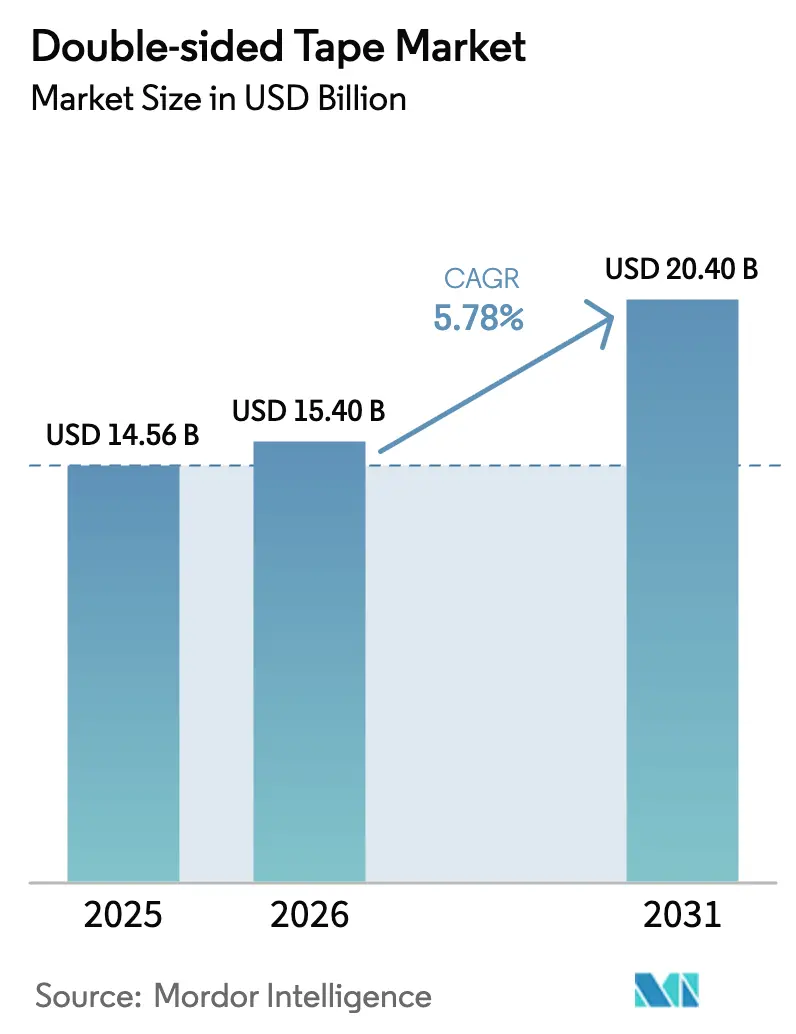
Double-sided Tape market size in 2026 is estimated at USD 15.4 billion, growing from 2025 value of USD 14.56 billion with 2031 projections showing USD 20.4 billion, growing at 5.78% CAGR over 2026-2031. Strong substitution of screws, rivets, and liquid adhesives in favor of pressure-sensitive bonding drives this expansion, while rapid automation in manufacturing lines heightens demand for clean, fast, and design-flexible attachment methods. Growing adoption of electric vehicles (EVs), the miniaturization of consumer electronics, and the shift toward modular construction intensify the need for tapes that combine mechanical strength with thermal, optical, and reworkable properties. Regulatory pressure on volatile organic compound (VOC) emissions spurs reformulation toward low-VOC chemistries, particularly acrylics, and stimulates premium pricing for high-performance grades. The competitive field remains moderately fragmented as global leaders scale R&D around multi-functional tapes and regional players concentrate on localized service, keeping price tension alive in commoditized SKUs.
Key Report Takeaways
- By adhesive chemistry, acrylic tapes accounted for 51.20% of the double-sided tape market share in 2025, whereas butyl and EVA formulations are projected to post the fastest 6.92% CAGR through 2031.
- By backing material, foam held 29.74% revenue share of the double-sided tape market in 2025 and is forecast to extend at a 6.95% CAGR to 2031.
- By tape thickness, the 100–200 µm range commanded 47.20% share of the double-sided tape market size in 2025, while the below-100 µm segment is on track for the highest 6.55% CAGR to 2031.
- By end-user industry, construction captured 41.05% revenue share in 2025 and is set to expand at a leading 7.02% CAGR over the forecast horizon.
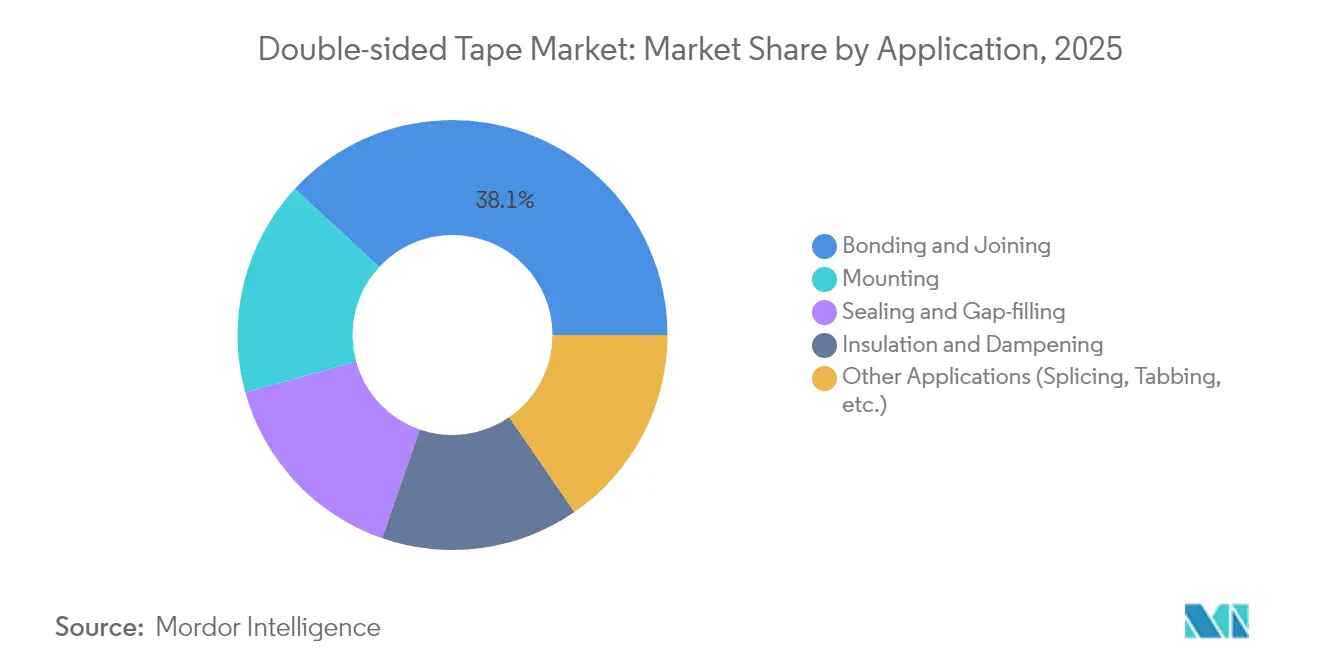
- By application, bonding and joining retained 38.10% of the double-sided tape market size in 2025, whereas mounting shows the quickest 6.96% CAGR through 2031.
- By geography, Asia-Pacific dominated with a 41.80% double-sided tape market share in 2025 and is anticipated to record the strongest 7.01% CAGR up to 2031.
Note: Market size and forecast figures in this report are generated using Mordor Intelligence’s proprietary estimation framework, updated with the latest available data and insights as of 2026.
Global Double-sided Tape Market Trends and Insights
Drivers Impact Analysis*
| Driver | (~) % Impact on CAGR Forecast | Geographic Relevance | Impact Timeline |
|---|---|---|---|
| Increasing applications in indoor and outdoor construction | +1.50% | Global, with strongest impact in Asia-Pacific and North America | Medium term (2-4 years) |
| Automotive lightweighting requirements | +1.20% | Global, led by Europe and North America regulatory mandates | Long term (≥ 4 years) |
| Miniaturisation in consumer electronics assembly | +0.80% | Asia-Pacific core, spill-over to North America | Short term (≤ 2 years) |
| Expansion of prefabricated/ modular buildings | +1.40% | North America & EU, expanding to Asia-Pacific | Medium term (2-4 years) |
| EV battery cell bonding and thermal-gap filling | +1.10% | Global, with early gains in China, Germany, United States | Long term (≥ 4 years) |
| Source: Mordor Intelligence | |||
Increasing Applications in Indoor and Outdoor Construction
Construction professionals replace screws and nails with pressure-sensitive tapes to avoid substrate damage and accelerate installation. Waterproof acrylic foam variants anchor façades and interior panels while meeting stringent building codes. Modular builders favor factory-applied tapes that assure consistent bond-line control and reduce on-site labor. Bio-based adhesives enter premium green projects that target lower embodied carbon. Foam-core formats accommodate uneven walls common in retrofits, boosting demand in Asia-Pacific’s urban renovation boom. Together, these trends lift construction-related orders for the double-sided tape market.
Automotive Lightweighting Requirements
Vehicle makers pursue adhesive bonding to remove rivets that add mass and cause galvanic corrosion. High-shear acrylic tapes bond aluminum roof panels to carbon-fiber frames in EVs, raising energy efficiency. In battery packs, thermally conductive tapes dissipate heat while isolating cells, aligning with strict interior VOC limits in China[1]tesa, “China tightens emission requirements for automotive interiors,” tesa.com . Growth accelerates in Europe where CO₂ mandates tighten, pushing OEMs toward lighter assemblies. Low-VOC chemistries secure interior cabin compliance without sacrificing peel strength. These dynamics underpin rising automotive intake in the double-sided tape market.
Miniaturisation in Consumer Electronics Assembly
Smartphones and wearables demand tape thicknesses down to 5 µm that still deliver shock absorption and optical clarity. Manufacturers integrate thermal or EMI shielding layers into the same ultra-thin construction to save space. Optically clear acrylics dominate flexible display laminations, keeping pixels bright even under repeated bending. Debond-on-demand designs simplify repair and recycling, supporting circular economy policies. Asia-Pacific’s dense electronics supply chain ensures rapid scale-up, raising regional consumption of premium micro-tapes.
EV Battery Cell Bonding and Thermal Gap-Filling
Next-generation battery packs require tapes that conduct heat away from cells without permitting current leakage. Silicone-acrylic hybrids meet these dual needs, securing foils while maintaining dielectric integrity. Leading EV assemblers in China and Germany integrate gap-fill tapes that shorten production cycles. OEM qualification protocols prioritize low outgassing to protect sensitive chemistries. Premium pricing follows the critical safety role these products play. As global EV volumes scale, thermal tapes emerge as a multibillion-dollar niche within the broader double-sided tape market.
Restraints Impact Analysis*
| Restraint | (~) % Impact on CAGR Forecast | Geographic Relevance | Impact Timeline |
|---|---|---|---|
| Limited high-temperature resistance of rubber-based tapes | -0.90% | Global, particularly affecting automotive and industrial applications | Medium term (2-4 years) |
| Petrochemical feed-stock price volatility | -0.70% | Global, with strongest impact on cost-sensitive applications | Short term (≤ 2 years) |
| Stricter VOC limits on solvent-based adhesive lines | -1.10% | North America & EU leading, expanding to Asia-Pacific | Long term (≥ 4 years) |
| Source: Mordor Intelligence | |||
Limited High-temperature Resistance of Rubber-based Tapes
Standard rubber adhesives lose cohesion beyond 150 °C, restricting deployment near engines or industrial ovens. OEMs must shift to higher-priced silicone or acrylic versions, adding system cost. Battery makers require tapes that stay stable across wide thermal cycles, making rubber grades unsuitable. Research into hybrid polymers shows promise but remains expensive. As a result, cost-driven buyers hesitate to convert from mechanical fasteners where peak temperatures exceed limits, tempering overall uptake in the double-sided tape market.
Petrochemical Feed-stock Price Volatility
Ethylene, propylene, and VAM price swings squeeze tape producers who rely on these monomers. Raw-material surges cannot always be passed through to fixed annual contracts, compressing margins. Manufacturers hedge via long-term supply pacts and dual sourcing, yet still face inventory carrying costs. Recent carbon black hikes announced by Cabot Corporation illustrate the exposure of adhesive formulators to input inflation. Such volatility impedes capital budgeting and may slow expansion in the double-sided tape market.
*Our forecasts treat driver/restraint impacts as directional, not additive. The impact forecasts reflect baseline growth, mix effects, and variable interactions.
Segment Analysis
By Adhesive Chemistry: Acrylic Dominance Faces Specialty Challenge
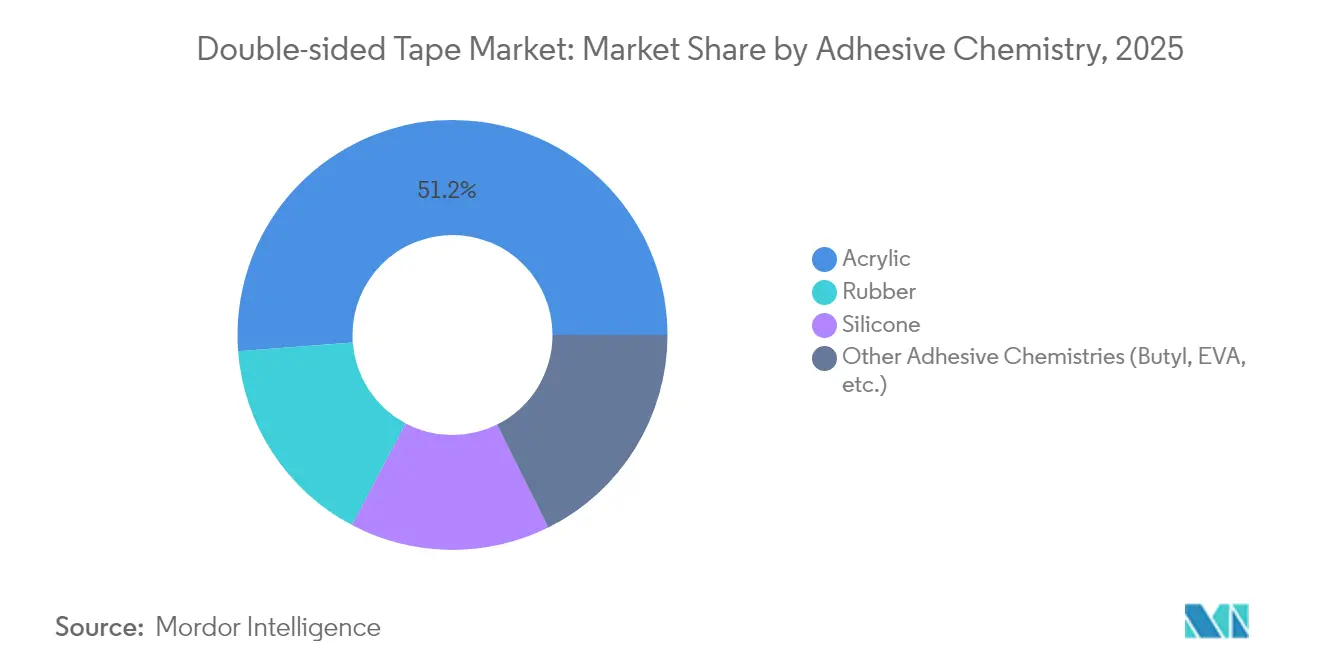
Acrylics held 51.20% of the double-sided tape market in 2025 thanks to broad compatibility with metals, plastics, and glass. Superior UV stability and optical clarity underpin leadership in consumer electronics and exterior automotive trims. Rubber grades retain share in budget packaging, while silicone excels in engine-bay and medical uses. Specialty butyl and EVA tapes are forecast for a 6.92% CAGR, propelled by EV battery encapsulation and high-temperature industrial lines. Modified acrylate systems that wet low-surface-energy polyolefins extend acrylic reach, preserving its anchor role.
Acrylic innovations target faster wet-out at low pressure, enabling high-speed robotic application. Suppliers also lower residual monomers to meet sub-70 g/L VOC caps in California. Hybrid silicone-acrylic platforms blend initial tack with 200 °C resistance to address electronic power modules. These improvements reinforce acrylic’s strategic edge even as niche chemistries capture emerging performance gaps within the double-sided tape market.



By Backing Material: Foam Leadership Drives Innovation
Foam substrates contributed 29.74% revenue in 2025 and are projected for the fastest 6.95% CAGR. Micro-cellular PE and acrylic foams equalize stress, fill gaps, and damp vibration, ideal for façade panels and EV battery housings. Film backings follow for camera module assembly, where dimensional stability prevails. Paper remains a low-cost liner in stationery and graphic arts, though it cedes ground to recyclable PET options.
Sustainability gains traction as Shurtape’s launch of 90% post-consumer recycled PET tape signals growing demand for circular backings. Foam suppliers lower density without sacrificing cohesion, trimming material use. Metal foil backings niche into EMI shielding of 5G antennas. Collectively, these advances widen addressable use-cases, reinforcing foam’s position in the double-sided tape market.
By Tape Thickness: Miniaturization Drives Thin Film Demand
The 100–200 µm range captured 47.20% share in 2025 by balancing handling ease with bond integrity across automotive and construction jobs. Less than 100 µm products are poised for a 6.55% CAGR as smartphones, foldable displays, and compact sensors shrink component stacks. Producers now extrude five-layer tapes down to 5 µm that still carry thermal fillers for heat spread.
Over-200 µm constructions persist where gap-fill and vibration-damping outweigh thickness constraints, such as HVAC duct bonding. Process engineers deploy vision systems that align thin tapes within ±25 µm, unlocking automated placement. This spectrum of thickness solutions ensures the double-sided tape market services both legacy and next-gen assembly lines.
By End-user Industry: Construction Leads Multi-sector Growth
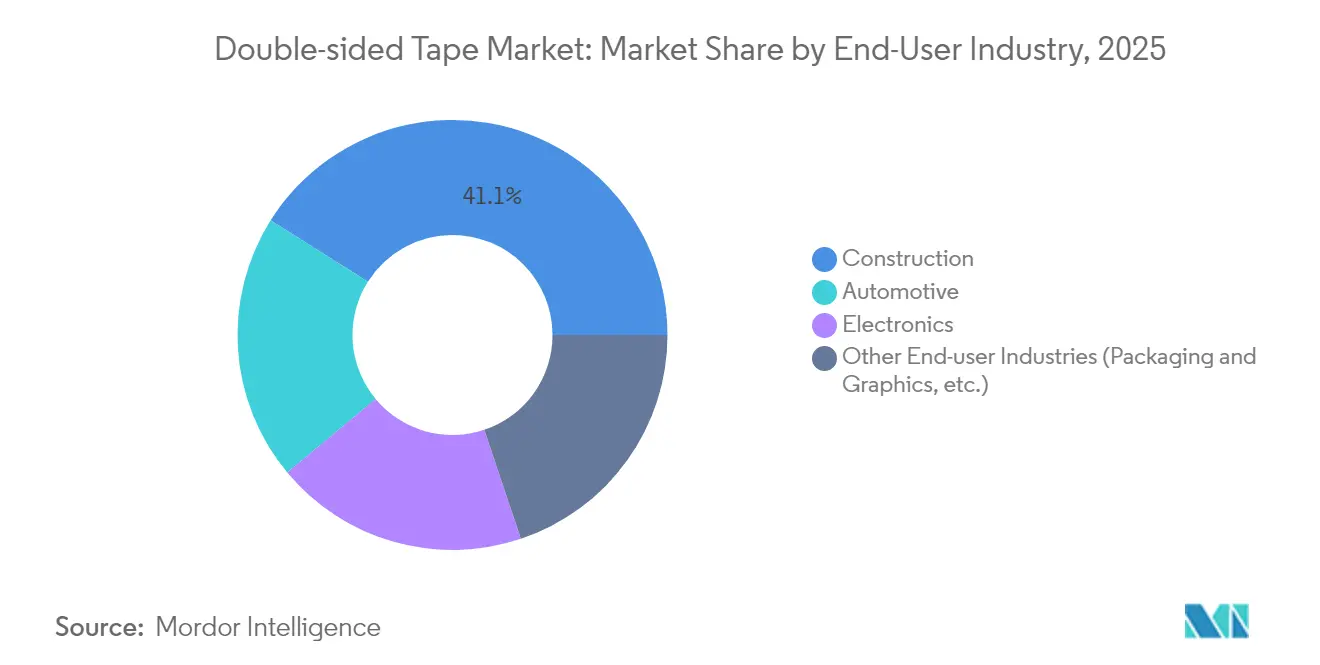
Construction owned 41.05% share in 2025 and heads for a 7.02% CAGR, fueled by façade panels, flooring trims, and sanitary ware fixtures that favor invisible fasteners. Residential refurbishment in Asia and North America boosts sales of tape-based mounting kits. Automotive remains the second pillar as structural bonding and battery thermal interfaces multiply tape touchpoints. Electronics delivers high margins through specialty optical and EMI tapes embedded in cameras and foldable displays.
Packaging and graphics keep steady demand, though sustainable mandates shift volume toward waterborne acrylics. Across industries, ESG scrutiny speeds the transition from solventborne to low-VOC platforms, safeguarding growth momentum for the double-sided tape market.
By Application: Mounting Overtakes Traditional Bonding
Bonding and joining represented 38.10% of sales in 2025, yet mounting shows the fastest 6.96% CAGR. Manufacturers want reversible attachments that simplify upgrades and recycling. Optically clear mounting tapes fix display cover glass while permitting service disassembly. Reclosable fasteners appear on modular furniture and auto interior trims, reinforcing the circular economy thrust.
Gap-filling seals thrive on foam technology that cushions differential expansion in façade joints. Thermal interface mounting widens scope in power electronics, blending insulation with heat transfer. The surge of multifunctional solutions broadens the functional map for the double-sided tape market.
Geography Analysis
Asia-Pacific accounted for 41.80% of global revenue in 2025 and is forecast for a 7.01% CAGR through 2031. Expanding EV production, intensive electronics outsourcing, and urban infrastructure projects underpin this dual leadership. China’s output of adhesive-intensive battery packs and the proliferation of Japanese smart-device lines sustain high-volume uptake. tesa reinforced its regional presence by opening Mumbai and Bengaluru hubs to bolster automotive and electronics support.
North America follows with construction stimulus and the reshoring of electronics assembly. 3M’s USD 67 million upgrade in Nebraska adds industrial tape capacity that addresses regional supply resilience. Growing EV battery factories across the United States expand demand for high-heat tapes.
Europe emphasizes sustainability, pushing suppliers toward solvent-free lines aligned with the EU Green Deal. Germany’s adhesive market, valued near EUR 2 billion in 2024, benefits from booming DIY refurbishment and packaging activity.
South America, the Middle East, and Africa remain early in adoption but gain traction through infrastructure expansion and growing automotive assembly. Government incentives for local electronics manufacturing in Brazil and the United Arab Emirates open incremental channels for the double-sided tape market.


Value Chain Analysis
The double-sided tape value chain starts upstream with petrochemical-derived monomers and polymers (for acrylic, rubber, and silicone PSAs), tackifiers, fillers, and additives, alongside backing and liner materials such as films, foams, papers/nonwovens, and release coatings. Tape producers formulate pressure-sensitive adhesive systems, coat onto release liners, laminate to backings (or build transfer tapes), and convert into rolls and die-cuts for end uses spanning construction, automotive, and electronics.
Midstream economics depend on coating and converting capabilities, including precision coating for thin-gauge electronics tapes, foam/film lamination, and specialty liners. Downstream routes include direct supply to OEMs and tier suppliers, sales through converters for custom formats, and industrial distribution for MRO and construction trades. Key friction points include petrochemical feedstock volatility and reliance on concentrated film/foam substrate supply hubs, which can affect lead times for just-in-time manufacturing programs and increase the value of dual sourcing and localized converting support.
Competitive Landscape
The double-sided tape market is moderately fragmented. 3M, tesa, and Avery Dennison anchor global supply, leveraging patent portfolios and multi-continent plants. 3M highlights material-science breakthroughs in its 2023 annual report that anticipate faster-curing and higher-temperature grades. tesa focuses on debond-on-demand technologies that aid recyclability. Avery Dennison broadened its Core Series in 2023 with new double-sided constructions tailored to converter workflows.
Regional challengers sharpen competitive pressure. Nitto is investing in a USD 8 billion Kentucky facility to scale advanced materials for the United States market. Henkel inaugurated a Loctite production plant in India in July 2024 to localize automotive supply. M&A activity continues, shown by Ellsworth’s acquisition of TapeCase to extend converting capabilities.
Technology race themes include hybrid silicone-acrylic matrices, bio-based polymers, and multi-function tapes that merge bonding with thermal or EMI performance. Top players collectively hold under 40% revenue share, indicating space for niche specialists to thrive in customized substrates.
Double-sided Tape Industry Leaders
3M
AVERY DENNISON CORPORATION
Lohmann
Nitto Denko Corporation
tesa SE
- *Disclaimer: Major Players sorted in no particular order


Market Opportunities and Future Outlook
High-performance construction and mobility applications continue to create whitespace for double-sided tape suppliers that can combine bonding strength with compliance and processability. Construction, which led demand with a 41.05% share in 2025, is driving more purpose-designed portfolios for building envelope workflows as tape makers expand product sets for flashing, seaming, and waterproofing tasks, supporting adoption in modular and retrofit projects where fast, clean attachment reduces labor steps.
Thermal management and specialty materials remain an investment lane tied to EV batteries, power electronics, and dense assemblies that need low outgassing and consistent bond-lines. Henkel expanded its Brandon, South Dakota site in September 2025 (doubling to 70,000 square feet) to increase production of thermal management materials and adhesives for EV batteries and electronics, while Avery Dennison started production at a 32,000-square-foot expansion of its Painesville, Ohio Performance Tapes facility in 2024 for specialty pressure-sensitive tapes serving automotive, construction, and packaging. On supply resilience, Avery Dennison Yongle Tape opened a manufacturing facility in Selangor, Malaysia in 2026 to add capacity outside China, reflecting customer procurement moves toward dual sourcing for tape-based components and converted parts.
Recent Industry Developments
- April 2026: Avery Dennison Yongle Tape opened a manufacturing facility in Selangor, Malaysia, its first plant outside China. The site adds another source for pressure-sensitive tape production and supports supply chain resilience for global customers that require continuity across regions.
- April 2025: Avery Dennison introduced a Flashing and Seaming Portfolio of pressure-sensitive adhesive tapes for building envelope materials, including the FT 0088 single-coated waterproof flashing tape. The launch expands fit-for-purpose options for construction applications where faster installation and moisture control accelerate conversion from mechanical fastening and liquid-applied systems.
- July 2024: Avery Dennison launched a multifunctional automotive foam and fiber bonding tape solutions portfolio targeting noise, vibration, and harshness (NVH) needs, including electric vehicles. This broadens the use of double-sided tapes in lightweighting and component attachment where damping, gap-fill, and reliable bonding are required in automated assembly.


Research Methodology Framework and Report Scope
Market Definition and Coverage
For this study, the double-sided tape market is defined as revenue earned from tapes that have adhesive on both sides and are used for bonding, mounting, joining, splicing, and temporary fixing across industrial and consumer uses.
Scope exclusions: We exclude single-sided tapes, liquid adhesives, and mechanical fasteners, even when they serve similar joining needs.
Segmentation Overview
- By Adhesive Chemistry
- Acrylic
- Rubber
- Silicone
- Other Adhesive Chemistries (Butyl, EVA, etc.)
- By Backing Material
- Foam
- Film
- Paper
- Cloth
- Metal Foil and Others
- By Tape Thickness
- Less than 100 µm
- 100 – 200 µm
- Greater than 200 µm
- By End-user Industry
- Automotive
- Construction
- Electronics
- Other End-user Industries (Packaging and Graphics, etc.)
- By Application
- Mounting
- Bonding and Joining
- Sealing and Gap-filling
- Insulation and Dampening
- Other Applications (Splicing, Tabbing, etc.)
- By Geography
- Asia-Pacific
- China
- Japan
- India
- South Korea
- ASEAN Countries
- Rest of Asia-Pacific
- North America
- United States
- Canada
- Mexico
- Europe
- Germany
- United Kingdom
- France
- Italy
- Spain
- Russia
- NORDIC Countries
- Rest of Europe
- South America
- Brazil
- Argentina
- Rest of South America
- Middle East and Africa
- Saudi Arabia
- South Africa
- Rest of Middle East and Africa
- Asia-Pacific
Data Sources, Market Sizing, and Validation
Desk Research
Desk work starts with pinning down the demand pool and supply footprint for pressure-sensitive adhesive tapes that are commonly converted into double-sided formats. We reviewed public statistics and references such as the US Census Bureau manufacturing and trade series, UN Comtrade import export data, Eurostat production and trade tables, national customs portals in key tape trading countries, and standards and guidance documents from ISO.
To make the model usable by region and end use, we also relied on company annual reports, 10-K style filings, investor presentations, and trade publication articles that discuss capacity additions, raw material price moves, and downstream production trends. In a few places, paid subscriptions for company financials and intelligence, patent databases, and shipment-level import export records were used to cross-check supplier presence and product positioning. The sources listed here are illustrative, and many other public references were also used to collect, validate, and clarify data points.
Primary Interviews and Surveys
Primary work was used to confirm how double-sided tapes are specified and bought, and to ground assumptions like typical thickness mix, backing shifts, and application-driven price bands. We spoke with manufacturers, converters, distributors, and large end users across APAC, EMEA, and the Americas, so gaps from desk findings could be filled and key assumptions could be tested before totals were finalized.
Distribution of primary research fieldwork respondents
| Company type | Respondent position | Region |
|---|---|---|
| Top tier: 31% | CXOs: 17% | APAC: 46% |
| Mid tier: 49% | Functional/Unit leaders: 36% | EMEA: 30% |
| Smaller Players: 20% | Managers: 47% | Americas: 24% |
Market-Sizing & Forecasting
Sizing starts with a top-down build where production and trade data reconstruct the tape supply pool by major regions, then the pool is filtered to double-sided formats using application level usage patterns gathered from interviews. To keep the math practical, we convert volumes into value using blended average selling prices that reflect backing choice and performance grade, and then we normalize the outputs for currency and inflation timing.
A few variables materially move the model, including electronics and appliance output trends, light vehicle and EV build rates, construction finishing activity, packaging and converting runs, and resin and tackifier price direction, since these flows influence tape pricing. Where direct data is thin, the gaps are handled by using proxy indicators such as import intensity, converting capacity commentary, and observed price bands from distributor quotes, and then the assumption is re-tested with primary feedback.
For forecasting, scenario analysis is used around end market growth and price progression, because the market responds differently when raw material costs rise quickly and when demand shifts to higher bond acrylic and foam-backed products. Bottom-up checks are applied selectively through sampled supplier revenue references and channel checks (ASP times estimated roll usage) so totals can be adjusted if the top-down path looks too high or too low.
Data Validation & Update Cycle
Validation is done in steps so unusual results get caught early and corrected. We compare the model output against independent signals such as regional tape trade flows, manufacturing output trends in key end-use industries, and visible changes in capacity or product mix, and then a second analyst reviews the logic and assumptions before sign-off.
If a large variance appears by region, application, or price band, the assumptions are rechecked and selected experts are re-contacted to confirm what changed and whether it is temporary or structural. The report is refreshed annually, and interim updates are made when material events occur, such as major plant additions, sharp resin price swings, or policy changes that affect manufacturing activity. Before delivery, a fresh pass is completed so clients receive the most current view.
Mordor Intelligence's Double Sided Tape Market Estimate Compared With Other Published Estimates
It is normal to see different market sizes for double-sided tape, even when the topic label looks the same. The biggest reasons are usually how each publisher draws the boundary around product forms, which year and FX timing they anchor to, and whether pricing is treated as a stable average or allowed to move with raw material cycles.
Trade flow patterns for adhesive tape materials, cross-checked with end-market output signals like electronics and automotive production, are used to keep Mordor Intelligence's 2025 estimate tied to a defined global demand pool for double-sided tape rather than a broader tape basket. Differences also show up when some estimates fold in adjacent categories like wider specialty tape formats, or when they use aggressive price escalation assumptions without re-validating typical selling prices by backing and performance grade during the same base year.
Benchmark comparison
| Source | Market Size | Gaps in Research Methodology |
|---|---|---|
| Mordor Intelligence | USD 14.56 B (2025) | |
| Global Consultancy A | USD 13.08 B (2025) | Often reflects a narrower counted scope in practice, where some foam-backed and high-bond construction mounting formats are partially excluded, and regional conversions are simplified into fewer price bands. |
| Industry Publisher B | USD 14.46 B (2025) | Can differ due to a different base-year pricing approach and quicker carry-forward of ASP growth into the base year, with limited cross-checking against trade and manufacturing signals by region. |
Across the three figures, the spread is mainly explained by scope edges and how pricing is normalized in the base year, not by a disagreement that demand exists. When the counted tape formats and the FX and price timing are aligned, the values converge, and the final number becomes easier to trace back to clear variables and repeatable steps.


Key Questions Answered in the Report
What is the current value of the double-sided tape market?
The double-sided tape market size is USD 15.4 billion in 2026.
Which region leads the market?
Asia-Pacific holds 41.80% share and shows the fastest 7.01% CAGR through 2031.
Which end-user sector generates the most demand?rowing region in Double-sided Tape Market?
Construction leads with 41.05% revenue share and a 7.02% growth rate.
Why are acrylic adhesives dominant?
Acrylics balance adhesion, weatherability, and low VOCs, securing 51.20% market share in 2025.
What application segment is growing quickest?
Mounting solutions post the highest 6.96% CAGR as industries prioritize reversible assemblies.
Page last updated on:


 Your data is secure and never sold or shared.


