
Flexible Paper Packaging Market Size and Share
Market Overview
| Study Period | 2020 - 2031 |
|---|---|
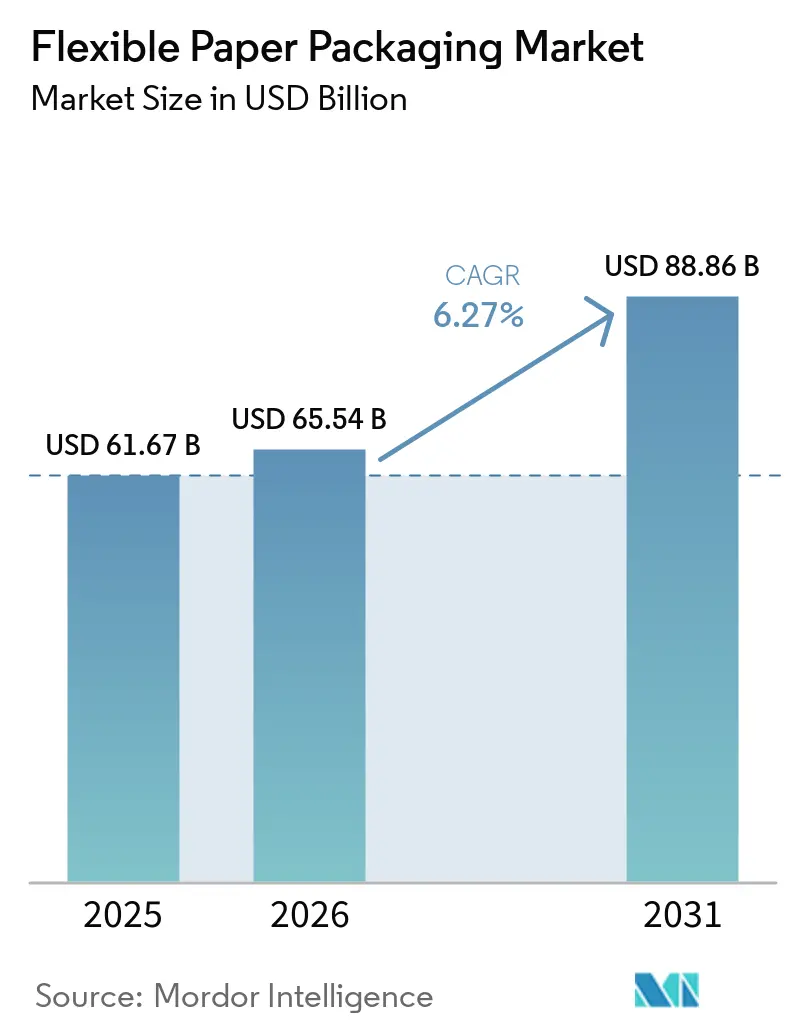
| Market Size (2026) | USD 65.54 Billion |
| Market Size (2031) | USD 88.86 Billion |
| Growth Rate (2026 - 2031) | 6.27 % |
| Fastest Growing Market | Middle East and Africa |
| Largest Market | Asia Pacific |
| Market Concentration | Medium |
Major Players *Disclaimer: Major Players sorted in no particular order Image © Mordor Intelligence. Reuse requires attribution under CC BY 4.0. | |
Flexible Paper Packaging Market Analysis by Mordor Intelligence
The flexible paper packaging market size is expected to grow from USD 61.67 billion in 2025 to USD 65.54 billion in 2026 and is forecast to reach USD 88.86 billion by 2031 at 6.27% CAGR over 2026-2031. The expansion is anchored in regulatory mandates limiting single-use plastics, corporate net-zero targets, and rapid innovation in barrier coatings that let paper substitute plastic in direct-food and e-commerce channels. Converters are modernizing assets with high-speed digital presses and aqueous or bio-polymer coatings that support short runs, variable data printing, and mono-material designs, thereby compressing lead times for brand launches. Large integrated mills leverage pulp backward integration to hedge raw-material volatility, while independent converters differentiate through specialty grease-resistant wraps and meal-kit pouches. Investor appetite remains strong as acquirers pursue scale to negotiate pulp contracts and fund R&D pipelines, with regulatory clarity in the European Union (EU) and Asia-Pacific (APAC) accelerating deal flow.
Key Report Takeaways
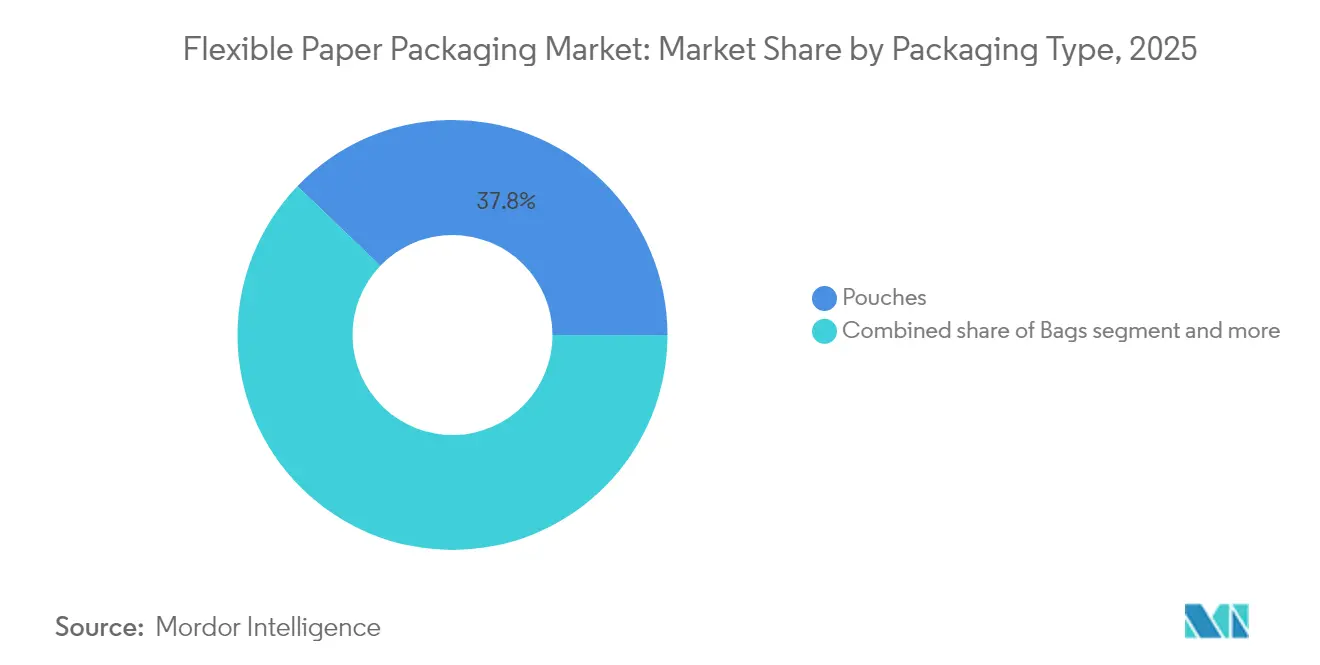
- By packaging type, pouches led with 37.83% of flexible paper packaging market share in 2025; wraps are projected to grow at a 8.78% CAGR through 2031.
- By printing technology, flexography captured 35.02% of revenue in 2025, whereas digital printing exhibit the highest 7.74% CAGR to 2031.
- By paper grade, kraft paper accounted for 44.68% of the flexible paper packaging market size in 2025; laminated paper is expanding at 7.71% CAGR during 2026-2031.
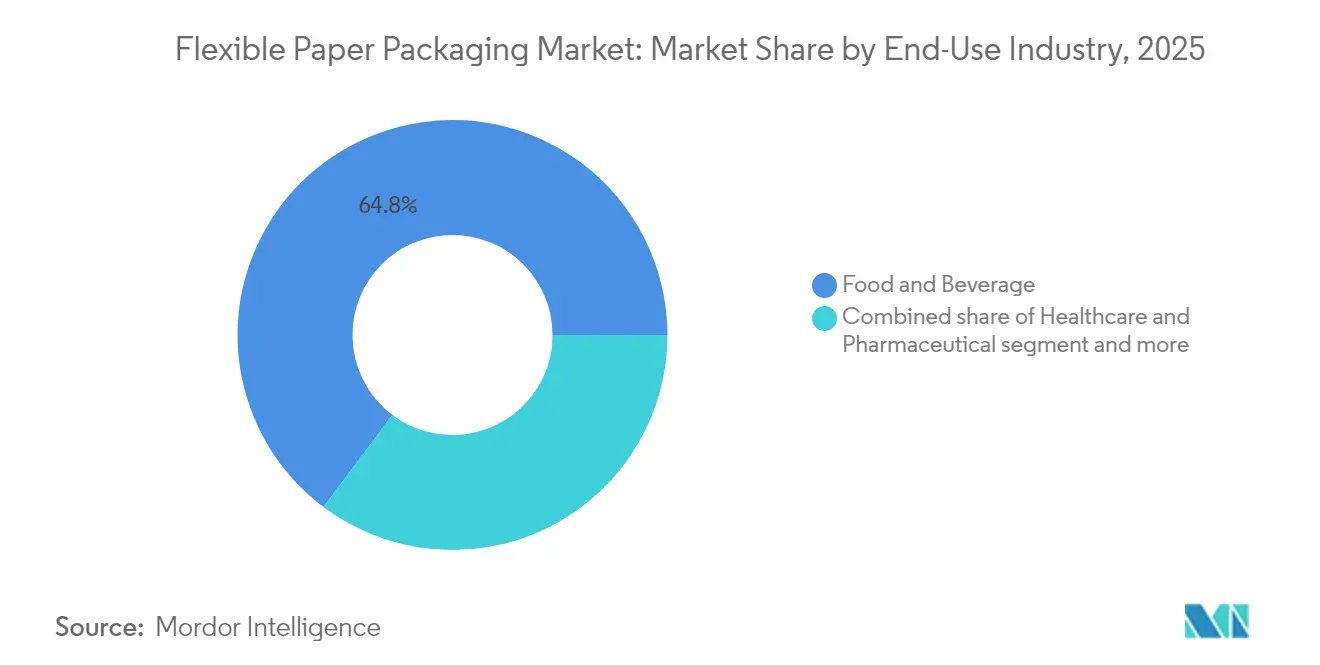
- By end-use industry, food and beverage captured 64.75% of revenue in 2025, whereas healthcare and pharmaceuticals exhibit the highest 8.89% CAGR to 2031.
- By geography, Asia-Pacific commanded 44.56% revenue share in 2025, while the Middle East & Africa region is poised for the fastest 8.92% CAGR to 2031.
Note: Market size and forecast figures in this report are generated using Mordor Intelligence’s proprietary estimation framework, updated with the latest available data and insights as of 2026.
Global Flexible Paper Packaging Market Trends and Insights
Drivers Impact Analysis*
| Driver | (~) % Impact on CAGR Forecast | Geographic Relevance | Impact Timeline |
|---|---|---|---|
| Regulatory bans on single-use plastics | +1.8% | EU core, spill-over to APAC & North America | Medium term (2-4 years) |
| High-barrier paper for e-commerce meal-kits | +1.2% | North America, expanding to Europe | Short term (≤ 2 years) |
| High-speed digital printing for DTC brands | +0.9% | Europe & North America | Medium term (2-4 years) |
| Grease-resistant pouches for refrigerated Asian foods | +1.1% | APAC core, emerging in MEA | Short term (≤ 2 years) |
| Brand-owner 2025 recyclability commitments in cosmetics packaging | +0.7% | Global, concentrated in developed markets | Long term (≥ 4 years) |
| Expansion of aqueous/biopolymer coatings for snack wraps | +0.8% | Latin America, expanding globally | Medium term (2-4 years) |
| Source: Mordor Intelligence | |||
Regulatory bans on single-use plastics
The EU’s Packaging & Packaging Waste Regulation sets a mandatory 65% recycling rate for paper packs by 2025, forcing global FMCG suppliers to redesign multilayer laminates around mono-paper substrates. China’s updated food-contact standard GB 4806 now lists bio-origin coatings, nudging takeaway chains toward fluorine-free wraps. Thailand and Japan adopted similar positive-list schemes in 2024, creating cross-regional scale for compliant grades. Brand owners embed paper-substitution milestones in supplier scorecards, triggering multi-year offtake commitments that underpin capacity expansions by Amcor and Mondi.
High-barrier paper for e-commerce meal-kits
Cold-chain meal-kit vendors require oxygen- and moisture-barrier integrity over 48-hour transit. Solenis teamed with Heidelberg to commercialise aqueous coatings that withstand condensation without polymer lamination, cutting pack weight 18% and maintaining curbside recyclability. [1]Source: Solenis, “Barrier Coatings for Food and Beverage Packaging,” solenis.com Amcor’s AmFiber platform now ships mono-paper mailers rated for −20 °C storage while meeting FDA migration limits. US meal-kit operators report 12% repeat-purchase lifts after switching from PE films to paper mailers that carry “widely recyclable” How2Recycle labels.
High-speed digital printing for DTC brands
European converters deploy industrial inkjet presses capable of 500-unit profit runs, unlocking mass-customised packaging with serialized QR codes, variable loyalty offers, and geo-targeted graphics. New pigment sets bond to grease-resistant and barrier-coated papers without corona treatments, expanding substrate freedom while reducing VOC emissions under Germany’s TA Luft limits. Digital workflows trim plate waste and eliminate chemical wash-ups, aligning with Scope-1 emissions targets published by Huhtamaki.
Grease-resistant pouches for refrigerated Asian foods
Fluorine-free dispersion coatings allow paper pouches to pack oily dim sum, sushi, and noodle bowls for refrigerated shelves. Vietnam’s paper-pack industry, worth USD 2.60 billion in 2025, is forecast to grow 9.73% annually through 2033 as wet-market operators shift from LDPE bags to paper pouches mandated by Decree 45/2024. Nestlé Thailand replaced multi-layer PP pouches with FC-approved kraft, cutting plastic tonnage 28% in its ready-meal range. [2]Source: Nestlé Thailand, “Nestlé Thailand Eliminates Plastic in Ready Meal Lines,” nestle.co.th
Restraints Impact Analysis*
| Restraint | (~) % Impact on CAGR Forecast | Geographic Relevance | Impact Timeline |
|---|---|---|---|
| Barrier limits in dairy & beverage applications | −1.4% | Global, especially developed markets | Long term (≥ 4 years) |
| Virgin pulp price volatility | −1.1% | Global, acute in North America & Europe | Short term (≤ 2 years) |
| Weak collection infrastructure for paper-laminates | −0.8% | Emerging markets in Africa & LatAm | Medium term (2-4 years) |
| High capex to retrofit plastic-flexible lines | −0.9% | North America & Europe | Medium term (2-4 years) |
| Source: Mordor Intelligence | |||
Barrier limits in dairy & beverage applications
Paper’s porosity still compromises flavour and carbonation retention in milk and soft drinks beyond 72 hours, according to controlled storage trials that recorded a 0.2 log CFU microbial uptick in skim-milk cartons after refrigerated hold. Nano-cellulose and biodegradable EVOH replacements remain commercially nascent; Stora Enso targets pilot-scale output only by 2028. As a result, PET and aseptic cartons continue to dominate liquid dairy aisles, capping flexible paper packaging market penetration.
Virgin pulp price volatility compressing converter margins
Benchmark NBSK pulp averaged USD 1,350/tonne in 2024, 15% higher year-over-year after storm damage cut Canadian fiber supply. [3]Source: Forest Products Association Canada, “2024 Market Pulp Outlook,” fpac.ca Currency swings amplify strain; euro-denominated converters paid an effective 19% surcharge due to dollar strength. Integrated majors offset shocks via captive forests and long-term stumpage leases; independents instead blend higher recycled furnish, but tensile loss elevates reject rates 4% and drags OEE metrics.
*Our forecasts treat driver/restraint impacts as directional, not additive. The impact forecasts reflect baseline growth, mix effects, and variable interactions.
Segment Analysis
By Packaging Type: Pouches Consolidate Leadership
Pouches accounted for 37.83% of flexible paper packaging market share in 2025, reflecting cross-category acceptance in snacks, nutraceuticals, and condiments. Bleached kraft accounted for 46.12% of 2024 revenues within the base paper for flexible packaging market and remains the print-quality benchmark for branded consumer packs. Their flattened geometry cuts freight emissions by up to 30% versus rigid cans, aligning with retailer scope-3 carbon targets. Brand owners appreciate front-panel real estate that supports storytelling and QR-enabled traceability. Bags persist in industrial seed and pet-food channels where drop-test performance trumps aesthetics. Wraps, although holding a smaller base, post a 8.78% CAGR through 2031 as e-commerce apparel and confectionery shippers pivot from PE mailers to tear-resistant paper wraps that meet mailbox-friendly sizing.
The flexible paper packaging market size is projected to reach USD 88.86 billion by 2031, and wraps could command a doubled share if e-tailers scale mono-material pilots nationwide. Sachets and stick-packs remain niche but vital for powdered electrolytes and cosmetic samplers that exploit new micro-valve fitments compatible with paper laminates. Integrated mills deploy modular pouching lines enabling quick tool changes between stand-up and flat variants, enhancing asset utilisation. Customisable zipper seals, now made from cellulose-based films, advance the circularity narrative without compromising barrier metrics.



By Paper Grade: Kraft Paper Retains Strength Premium
Kraft paper delivered 44.68% of revenue in 2025 due to high tear resistance and excellent machinability on existing form-fill-seal lines. Mills expand bleached and natural kraft SKUs tailored for premium pet-food and organic snack brands seeking earthy aesthetics. Laminated paper, forecast at 7.71% CAGR, exploits water-based adhesive systems that bond thin barrier layers yet allow same-stream repulping. White-top kraft grades gain traction where photo-realistic printing is crucial, bridging the gap between cost and printability.
The flexible paper packaging market size for kraft grades alone translates to USD 27.55 billion in 2025, underscoring their strategic importance to converters. Recycled-content options climb in popularity after consumer-goods companies pledged 30% post-consumer fiber by 2028. Specialty grease-resistant coated papers serve Asian frozen meals, using fluorine-free chemistry validated under FDA and EU food-contact protocols. Research into nano-clay and chitosan coatings promises moisture-barrier lifts without plastic, broadening kraft applicability to bakery and salty snack corridors.
By End-Use Industry: Food & Beverage Drive Volume
Food and beverage relied on paper for 64.75% of sectoral uptake in 2025 as quick-service restaurants replaced waxed boards with PE-free wraps. Shelf-stable cereal brands moved to micro-perforated paper sachets that balance moisture egress and crunch retention. The healthcare vertical, rising at 8.89% CAGR, pilots blister-lidding composites using thin aluminium-oxide coated paper, anticipating EU pharmaceutical EPR enactment in 2026. Personal-care sachets leverage the tactile warmth of paper to signal natural formulations, with line extensions in shampoo bars and serums.
The flexible paper packaging industry taps e-grocery alliances for scale, supplying high-barrier pouch liners that withstand freezer burn for plant-based entrées. Home-care detergents adopt paper refill pods scored for easy tearing, cutting rigid-plastic bottle demand. Pet-food brands trial oxygen-scavenger functional inks printed on kraft, prolonging kibble freshness without multilayer films. Across verticals, universal design for recyclability checklists guide substrate qualification and accelerate cross-segment knowledge transfer.
By Printing Technology: Digital Accelerates Personalisation
Flexography held 35.02% share in 2025, buoyed by continuous-duty reliability on wide-web kraft lines. LED-UV curing lowers energy draw and curbs VOC emissions, helping fleets meet ESG audits. Yet digital inkjet exhibits an 7.74% CAGR as DTC marketing budgets pivot toward limited-edition drops and influencer collaborations. Cloud-native prepress platforms streamline artwork approvals, enabling 72-hour turnaround from file receipt to shipment.
The flexible paper packaging market size allocated to digitally printed formats is expected to surpass USD 11.07 billion by 2031. Hybrid presses merge flexo bases with digital units, allowing cost-optimal versioning within the same pass. Rotogravure remains the choice for premium confectionery wraps needing metallic effects, although solvent-recovery mandates add capex burdens. Offset litho occupies a niche in folded cartons and insert sleeves but informs colour-management protocols adopted by flexo and inkjet workflows, promoting visual consistency across mixed substrates.
Geography Analysis
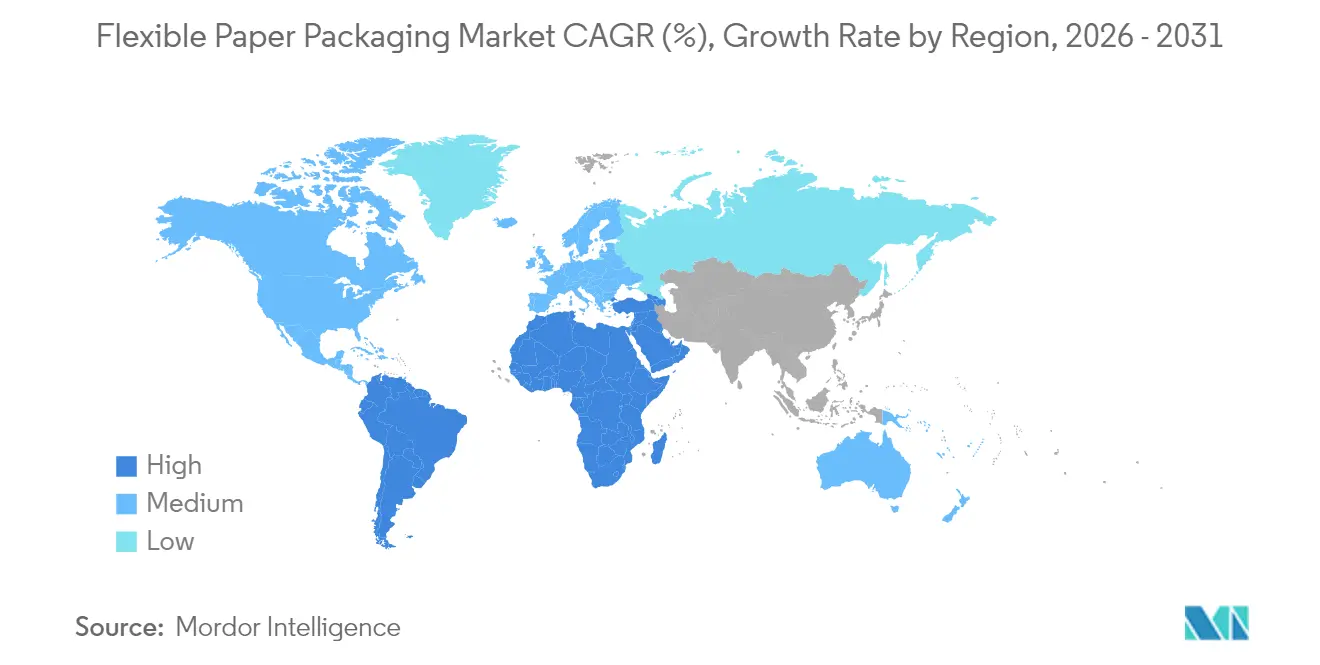
Asia-Pacific led the flexible paper packaging market with 44.56% revenue share in 2025, supported by competitive fiber sourcing, integrated mill networks, and rising middle-class consumption. China’s updated positive list for food-contact coatings expedites commercial rollout of bio-polymer barriers, shortening regulatory lead times. Vietnam, valued at USD 2.60 billion in 2025, represents a template for export-ready meal-kit pouches that align with European recyclability standards. Japanese converters benefit from government subsidies that offset capital costs for high-speed digital presses, accelerating innovation diffusion. The flexible paper packaging market size is set to expand steadily in the region as cold-chain infrastructure spreads into tier-3 cities, unlocking applications for grease-resistant freezer pouches.
The Middle East & Africa region records the fastest 8.92% CAGR, underpinned by plastic-tax legislation in the Gulf Cooperation Council and infrastructure investments in corrugated and flexible converting. Saudi Arabia’s Vision 2030 allocates land for integrated pulp-to-packaging complexes that reduce import dependency. In Africa, pan-regional supermarket chains mandate recyclable mono-paper wraps for private-label baked goods, triggering capacity additions in Kenya and Nigeria. International brand owners negotiate local sourcing agreements to bypass high freight costs and mitigate currency risk, embedding circular-economy clauses that require in-country recycling audits.
North America and Europe together represent mature, high-value nodes where brand owners demand advanced barrier performance and precision print quality. US e-commerce meal-kit operators adopt porch-friendly pouch formats that maintain freshness through ambient swings, driving R&D in condensation-resistant coatings. In the EU, PPWR recyclability targets continue to pull forward capital expenditure on repulpable laminates. South America leverages abundant plantation forestry in Brazil and Chile to export uncoated kraft reels, while domestic converters in Argentina focus on snack-wrap demand amid rising convenience-food sales. Regional trade pacts streamline movement of jumbo reels, fostering cross-border cooperation among mill and print converters.

Regulatory Landscape
Regulation-driven redesign remains the main compliance lever for flexible paper packaging, and the European Union provides the clearest timeline. Regulation (EU) 2025/40 (Packaging and Packaging Waste Regulation, PPWR) entered into force on 11 February 2025 and applies from 12 August 2026. From that point, brand owners and converters will need to demonstrate recyclability performance, packaging-format requirements, and labeling alignment through harmonized rules and implementing acts.
Technical standardization is beginning to translate these requirements into testable grading criteria. The EN 18120 series, published April 2026, sets technical requirements that are used to assess packaging recyclability, reinforcing the move away from non-recyclable multilayer structures toward mono-paper designs and repulpable barrier solutions. Chemical and food-contact constraints are also shaping substrate and coating choices, especially for direct-food and grease-resistant applications. Under PPWR-linked implementation, new PFAS limits take effect from 12 August 2026, which is pushing wider adoption of fluorine-free barrier and grease-resistant chemistries in paper wraps and pouches. In Asia-Pacific, food-contact compliance is tightening through positive-list approaches, including China’s GB 4806 updates that recognize bio-origin coatings and support scale-up of compliant high-barrier paper grades across supply chains serving food, confectionery, and e-commerce shipments.
Competitive Landscape
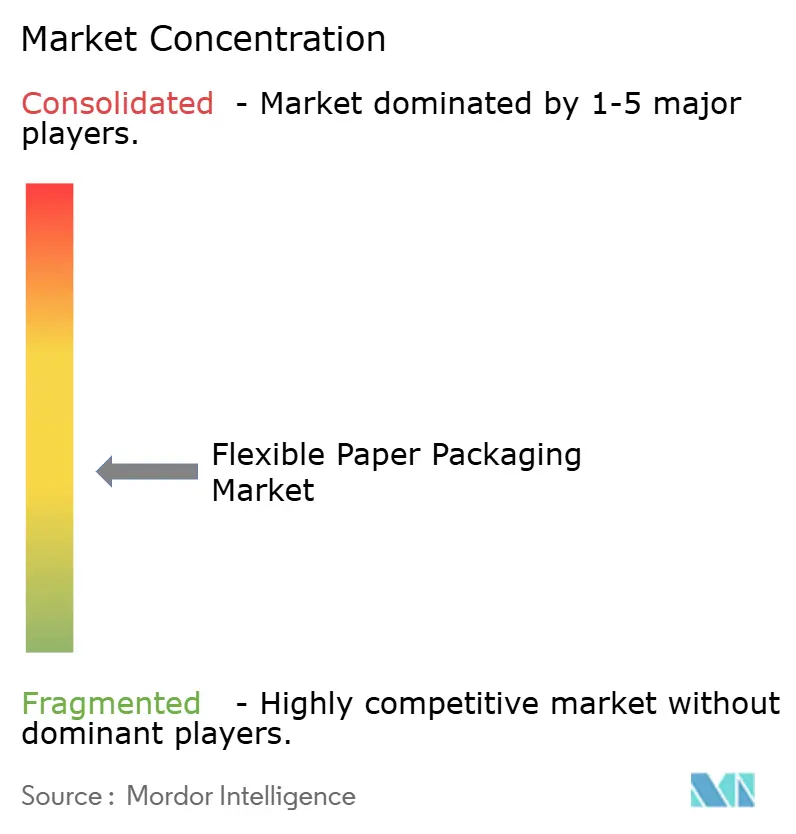
The flexible paper packaging market remains moderately fragmented, yet consolidation momentum accelerates as players pursue synergies in pulp procurement, R&D, and cross-selling. International Paper’s USD 7.2 billion acquisition of DS Smith in January 2025 created the world’s largest paper-centric packaging entity, integrating corrugated and flexible portfolios under one sourcing umbrella. Amcor’s merger with Berry Global in February 2025 solidifies a North America-Europe axis that combines polymer know-how with emerging mono-paper lines, while Smurfit Westrock’s USD 34 billion tie-up amplifies bargaining power with supermarket chains.
Strategic emphasis rests on proprietary barrier chemistries that enable mono-material designs. Huhtamaki scales fiber lid output in Northern Ireland, pairing lids with in-house produced grease-resistant pouches for QSR chains. UPM pilots nano-fibrillated cellulose coatings that elevate water vapour barrier without plastic, positioning mills for entry into dairy powdered drink mixes. Integrated players lock pulp supply through sustainable forestry certifications, insulating against raw-material spikes that continue to pressure stand-alone converters.
Mid-cap specialists differentiate via digital-printing agility, offering cosmetic and nutraceutical brands batch sizes as low as 300 units with serialized graphics. Start-ups commercialize chitosan-based barrier dispersions sourced from shrimp-shell waste, attracting venture capital for scale-up reactors. Private-label retailers expand direct sourcing offices in Asia to co-create sustainable paper packs, bypassing legacy procurement intermediaries and compressing time-to-market. Competitive intensity therefore hinges on technical IP, scale advantages, and the capacity to navigate converging global regulations.
Flexible Paper Packaging Industry Leaders
Amcor Plc
Mondi Plc
Smurfit Westrock
Huhtamaki Oyj
International Paper Company
- *Disclaimer: Major Players sorted in no particular order

Market Opportunities and Future Outlook
The most actionable near-term opportunity is converting hard-to-recycle flexible structures into fiber-based formats that can score against PPWR-aligned recyclability grading and adapt to upcoming PFAS-related constraints, particularly in confectionery and on-the-go food where paper can replace plastic laminates. Evidence of commercial momentum is visible in barrier and coating work focused on performance without conventional polymer layers. For example, Amcor partnered with UK-based Kelpi in June 2026 to evaluate seaweed-based barrier coatings for fiber packaging, with attention to scalability and compatibility with paper recycling streams.
There is also a more practical opportunity around integrated, equipment-compatible paper systems that reduce switching friction for packers and brand owners. Amcor, Metsa Group, and G. Mondini pointed to this direction through an integrated fiber-based tray system development in April 2026, connecting molded fiber (Metsa Muoto) and tray sealing technology (G. Mondini Trave) for protein and ready-meal use cases where performance, line efficiency, and compliance documentation matter. With Extended Producer Responsibility (EPR) fees entering total cost of ownership calculations in regulated markets, converters that can provide verifiable recyclability grades, labeling readiness aligned to harmonized rules, and drop-in machinability for existing converting and packing lines have a clearer path to commercialize paper pouches, wraps, and lidding materials.
Recent Industry Developments
- July 2026: Lappi Labels and Flexible Packaging acquired Portuguese flexible packaging provider Alempack to increase industrial capacity in doypack and flowpack formats and expand its Iberian footprint. The expansion of Iberian regional platform strengthens regional capabilities and scale in Iberia, enabling faster time-to-market for mono-material and flowpack/doypack formats.
- July 2026: APPLIED Adhesives entered into an exclusive U.S. distribution partnership with Henkel’s Packaging Adhesives business to supply adhesive and coating technologies for flexible packaging converters. Expands market reach and accelerates adoption of Henkel technologies in the U.S. flexible-packaging segment.
- July 2026: LyondellBasell partnered with Mondelez International, Amcor, and Taghleef Industries to launch a flexible packaging solution for Marabou chocolate bars using 75% recycled content, processed via ISCC PLUS-certified mass balance approach. Demonstrates cross-value-chain collaboration to enable high post-consumer recycled content in mono-material formats.


Research Methodology Framework and Report Scope
Market Definition and Coverage
For this study, we define flexible paper packaging as paper based packaging formats that bend and fold during use, and that are sold as pouches, bags, wraps, and similar flexible packs used by end users across consumer and industrial needs.
Scope exclusions: We exclude rigid paper formats (such as corrugated boxes and folding cartons) and paper used only for labels or printing without a packaging function.
Segmentation Overview
- By Packaging Type
- Pouches
- Bags
- Wraps
- Other Packaging Types
- By Paper Grade
- Coated Papers
- Laminated Pape
- Kraft Paper
- Other Paper Grades
- By End-Use Industry
- Food and Beverage
- Healthcare and Pharmaceutical
- Beauty and Personal Care
- Home Care and Laundry
- Pet Food
- Other End Use Industry
- By Printing Technology
- Flexography
- Rotogravure
- Digital Printing
- Offset
- Other Printing Technology
- By Geography
- North America
- United States
- Canada
- Mexico
- Europe
- Germany
- United Kingdom
- France
- Italy
- Spain
- Russia
- Rest of Europe
- Asia-Pacific
- China
- India
- Japan
- South Korea
- Australia and New Zealand
- Rest of Asia-Pacific
- Middle East and Africa
- Middle East
- United Arab Emirates
- Saudi Arabia
- Turkey
- Rest of Middle East
- Africa
- South Africa
- Nigeria
- Egypt
- Rest of Africa
- Middle East
- South America
- Brazil
- Argentina
- Rest of South America
- North America
Data Sources, Market Sizing, and Validation
Desk Research
Desk research started with pinning down how much packaging paper is produced and used by geography, then narrowing it to flexible pack formats that are actually converting into pouches, bags, and wraps. We leaned on public statistics and standards sources such as the U.S. Census Bureau manufacturing data, Eurostat structural business statistics, UN Comtrade trade flows for packaging paper and converted articles, and FAO forestry and pulp and paper time series to understand supply and demand movement.
To keep the inputs practical, we also used technical and policy references that clarify what is counted as paper packaging in practice, such as ISO packaging and environment standards, and packaging waste and recycling rules published by regulators in large markets. Company annual reports, investor presentations, and reputable packaging press were used to identify capacity additions, product mix shifts, and changes in coating technology. We also used a paid subscription for company financials and news screening, and a patent database to sanity check the pace of barrier coating innovation. These desk sources are illustrative and not exhaustive, and we relied on many other public and paid references for cross checks and clarification.
Primary Interviews and Surveys
Primary work was used to convert broad paper and packaging indicators into flexible paper packaging specific shares, pricing bands, and adoption rates by use case. We spoke with converters, paper producers, packaging buyers, and channel participants to test assumptions around coating uptake, downgauging, and switching from plastic, and then adjusted inputs where the first pass did not align with on the ground conversion behavior. Since this is a global market, inputs were checked across the main demand centers, with follow ups done where numbers did not match across sources.
Distribution of primary research fieldwork respondents
| Company type | Respondent position | Region |
|---|---|---|
| Top tier: 28% | CXOs: 12% | APAC: 47% |
| Mid tier: 54% | Functional/Unit leaders: 37% | EMEA: 32% |
| Smaller Players: 18% | Managers: 51% | Americas: 21% |
Market-Sizing & Forecasting
Sizing was built using a top-down and bottom-up combination, where packaging paper output, conversion intensity, and end use demand pools were reconstructed first, then checked using selective roll ups from supplier and converter indicators. For the top-down build, we mapped packaging paper availability and trade to flexible conversion, and then applied format mix factors so pouches, bags, wraps, and other flexible formats were not overstated.
Key inputs in the model included kraft and coated paper usage trends, barrier coating and lamination penetration (because it changes where paper can replace plastic), average selling price ranges by format, end use growth for food and beverage and personal care packs, and regional policy timing for single use plastic restrictions that pull demand toward fiber. Where bottom-up visibility was incomplete, gaps were handled using capacity utilization ranges and conversion yield assumptions that were validated in interviews.
For forecasting, we used scenario analysis supported by short series trend checks, since switching to paper depends on regulation timing and on barrier performance improvements that do not move in a straight line. The forward view was stress tested by adjusting pulp and paper price cycles and by checking whether implied per capita flexible packaging use stays realistic by region.
Data Validation & Update Cycle
Outputs were checked against multiple independent signals, including trade movement for relevant paper grades, announced paper and converting capacity changes, and observed price bands for common flexible paper formats. When the model produced a jump that did not match these signals, we revisited the drivers and, where needed, re contacted sources to confirm whether the change was real or a modeling artifact.
Before sign off, the market model goes through a stepwise review where assumptions, unit logic, and currency conversions are rechecked, followed by a final variance scan across regions and end uses. Reports are refreshed annually, and interim updates are made when material events occur, such as major capacity additions, regulatory shifts, or a sharp raw material price change. Right before delivery, we do a fresh review pass so clients receive an updated view consistent with the latest public information.
Mordor Intelligence's Flexible Paper Packaging Market Size Compared With Other Published Estimates
Published market sizes for flexible paper packaging can look far apart because each publisher draws the line differently around what counts as flexible paper, then uses different pricing logic and growth scenarios. Differences also show up when one study reports a shipment value view while another reports consumption value, which can shift totals due to trade and converter margin treatment.
The biggest gap drivers for this market usually come from whether laminated paper structures are counted as paper packaging, how barrier coated paper is treated when it competes with plastic, and whether paper used as an input to other packaging is mistakenly included. Currency conversion timing matters as well, since pulp linked input costs can move prices quickly, and some estimates are not refreshed after large pricing swings.
Benchmark comparison
| Source | Market Size | Gaps in Research Methodology |
|---|---|---|
| Mordor Intelligence | USD 65.54 B (2026) | |
| Industry Association A | USD 46.60 B (2024) | Uses a flexible packaging paper lens and can exclude converted flexible paper packaging formats where the pack value includes conversion, printing, and finishing, which pulls the total down versus a packaging value model. |
| Trade Journal B | USD 125.10 B (2024) | Often expands scope to adjacent paper packaging and may treat multilayer paper laminate structures as fully paper based, and then applies broad ASP progression, which can inflate the measured revenue pool. |
The table shows a wide spread that mainly comes from scope and value chain treatment, and in Mordor Intelligence's model the number reflects converted flexible paper packaging value for flexible formats like pouches, bags, and wraps rather than only base paper demand or a broader paper packaging basket. By anchoring the build on conversion mix, end use pull, and realistic price bands, we keep the total traceable to a repeatable set of market variables that can be revisited each refresh.


Key Questions Answered in the Report
What is the current size of the flexible paper packaging market?
• The flexible paper packaging market size stands at USD 65.54 billion in 2026 and is forecast to hit USD 88.86 billion by 2031.
Which region leads demand for flexible paper packaging?
• Asia-Pacific leads with 44.56% revenue share, driven by manufacturing scale, raw-material availability, and rising consumer-goods output.
Which packaging type dominates the flexible paper packaging market?
• Pouches hold 37.83% market share thanks to their convenience, barrier performance, and freight-efficiency benefits.
What is the fastest-growing end-use sector?
• Healthcare and pharmaceuticals expand at a 8.89% CAGR because of rising unit-dose formats and regulatory acceptance of paper substrates.
How are raw-material price fluctuations affecting the market?
• Virgin pulp volatility, with 15% price swings in 2024, compresses converter margins and incentivizes vertical integration and blended fiber recipes.
Why are regulators accelerating adoption of paper packaging?
• Policies such as the EU PPWR set high recyclability targets and single-use plastic bans, prompting brand owners to swap plastic films for recyclable paper alternatives.
Page last updated on:


 Your data is secure and never sold or shared.


