
Market Overview
| Study Period | 2020 - 2031 |
|---|---|
| Forecast Data Period | 2026 - 2031 |
| Base Year Market Size (2025) | USD 43.99 Billion |
| Market Size (2026) | USD 46.46 Billion |
| Market Size (2031) | USD 61.02 Billion |
| Growth Rate (2026 - 2031) | 5.61 % |
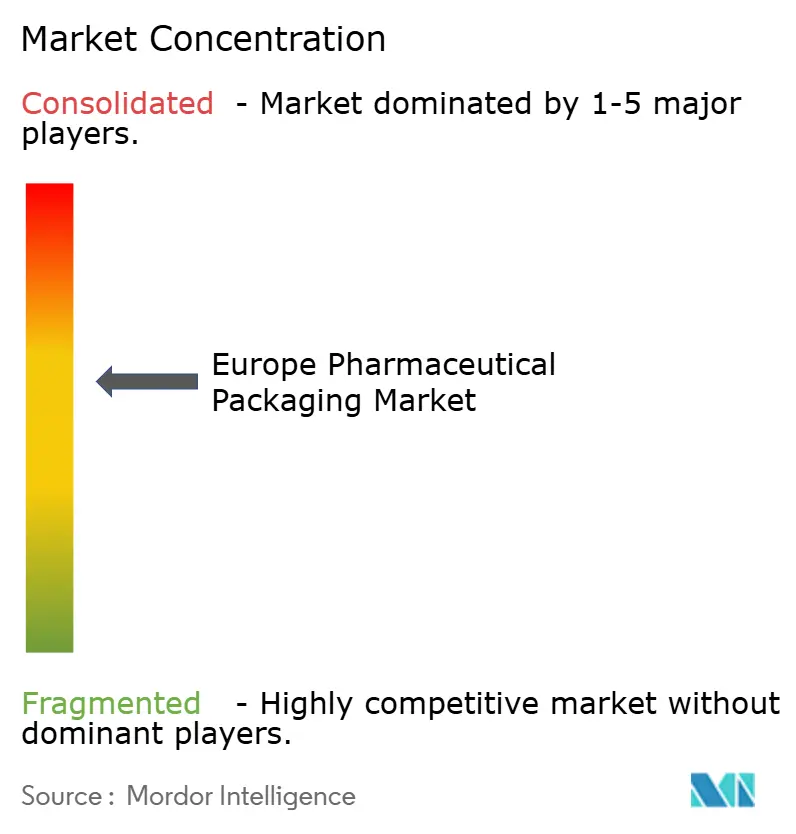
| Market Concentration | Medium |
Major Players *Disclaimer: Major Players sorted in no particular order Image © Mordor Intelligence. Reuse requires attribution under CC BY 4.0. | |
Europe Pharmaceutical Packaging Market Analysis by Mordor Intelligence
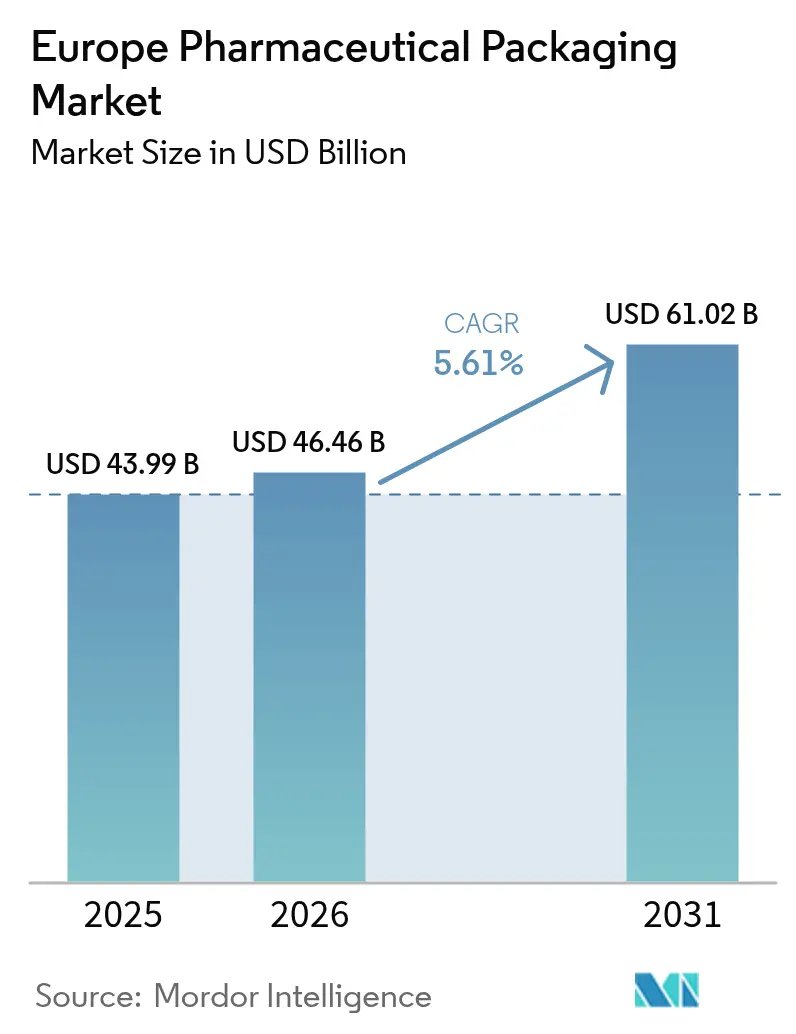
The Europe pharmaceutical packaging market size was valued at USD 43.99 billion in 2025 and estimated to grow from USD 46.46 billion in 2026 to reach USD 61.02 billion by 2031, at a CAGR of 5.61% during the forecast period (2026-2031). Demand is expanding as biologics and injectable therapies move to the commercial forefront, forcing drugmakers to favor pre-fillable syringes, ready-to-fill vials, and temperature-controlled distribution formats. Parallel to this shift, the European Commission’s Packaging and Packaging Waste Regulation (PPWR) is setting recycled-content thresholds that encourage converters to qualify medical-grade recycled polyethylene terephthalate and high-density polyethylene at scale. Logistics providers are adding GDP-compliant cold-chain hubs, while label specialists are equipping secondary packs with NFC chips to meet the requirements of the Falsified Medicines Directive. Capital intensity is high, with glass and plastics suppliers investing more than EUR 2 billion (USD 2.2 billion) in aseptic fill-finish and recycled-content extrusion lines from 2023 to 2027.
Key Report Takeaways
- By material type, plastics led with a 52.03% share of the Europe pharmaceutical packaging market in 2025, while biopolymers and composite materials are projected to expand at a 6.86% CAGR through 2031.
- By packaging type, primary formats captured 62.10% of the Europe pharmaceutical packaging market share in 2025 and are anticipated to grow at the highest CAGR of 6.58% from 2026 to 2031.
- By technology, conventional designs held 45.05% of the Europe pharmaceutical packaging market share in 2025, whereas smart and connected solutions are forecast to register the quickest 7.55% CAGR over the same horizon.
- By end user, pharmaceutical manufacturers accounted for 54.40% of the Europe pharmaceutical packaging market share in 2025, while contract manufacturing and packaging organizations are poised for a 6.36% CAGR through 2031.
- By country, Germany dominated the Europe pharmaceutical packaging market with a 22.30% share in 2025, and Poland is expected to post the fastest growth rate of 7.72% during the forecast period.
Note: Market size and forecast figures in this report are generated using Mordor Intelligence’s proprietary estimation framework, updated with the latest available data and insights as of 2026.
Market Trends and Insights
Drivers Impact Analysis of Europe Pharmaceutical Packaging Market*
| Driver | (~) % Impact on CAGR Forecast | Geographic Relevance | Impact Timeline |
|---|---|---|---|
| Growth of Biologics and Injectable Therapies | +1.2% | Germany, France, Switzerland, with spillover to Poland and Italy | Medium term (2-4 years) |
| Stringent EU Serialization Mandates | +0.9% | EU-27, UK, Switzerland | Short term (≤ 2 years) |
| Rising Demand for Patient-Friendly Drug Delivery Formats | +0.8% | Germany, France, UK, Nordics | Medium term (2-4 years) |
| Adoption of NFC-Enabled Smart Labels for Anti-Counterfeiting | +0.7% | EU-27, with early adoption in Germany, France, Italy | Short term (≤ 2 years) |
| Expansion of Temperature-Controlled Mail-Order Pharmacies | +0.6% | Germany, Netherlands, Poland, UK | Medium term (2-4 years) |
| Recycled Medical-Grade Plastics Mandate Under EU PPWR | +0.5% | EU-27 | Long term (≥ 4 years) |
| Source: Mordor Intelligence | |||
Growth of Biologics and Injectable Therapies
Biologics accounted for more than 30% of new molecular entities approved by the European Medicines Agency in 2024, elevating demand for parenteral containers with low extractables and tight dimensional tolerances. SCHOTT Pharma reported EUR 2.095 billion (USD 2.30 billion) in fiscal 2024 revenue, 78% of which came from drug containment solutions, including Type I borosilicate vials and cyclic olefin polymer cartridges.[1] West Pharmaceutical Services derived USD 1.98 billion from proprietary components, including NovaPure stoppers and Daikyo Crystal Zenith syringes in the nine months to September 2024. Stevanato Group grew its first-half 2024 revenue 11.6% year over year, driven by EZ-fill vials and the Nexa autoinjector platform. A September 2024 alliance among Gerresheimer, Stevanato, and SCHOTT Pharma is expected to harmonize ready-to-fill specifications, potentially reducing qualification timelines for biosimilars, particularly in Poland and Italy, where contract manufacturing growth is strongest.
Stringent EU Serialization Mandates
The Falsified Medicines Directive requires every prescription pack distributed in the European Union to carry a unique identifier and a tamper-evident device, generating a EUR 1.2 billion aftermarket for serialized labels, 2D barcodes, and NFC-equipped cartons through 2026.[2] Schreiner MediPharm has expanded its NFC label portfolio to support authentication and patient engagement use cases. CCL Industries reported CAD 5.1 billion (USD 3.75 billion) revenue for the first nine months of 2024, with healthcare and specialty labels benefiting from aggregation upgrades. The United Kingdom has mirrored EU serialization rules post-Brexit, compelling label converters to deliver interoperable solutions for pan-European supply chains.
Adoption of NFC-Enabled Smart Labels for Anti-Counterfeiting
Near-field communication labels embed encrypted chips that confirm product provenance, register custody transfers, and deliver patient-facing content. AptarGroup’s Pharma segment earned USD 445 million in Q3 2024, supported by connected inhalers and autoinjectors linked to cloud-based medication-adherence dashboards. German and French payers, who are piloting outcomes-based reimbursement, now request adherence data harvested via smart packs for biologics priced above EUR 500 per dose. As a result, pharmaceutical brands are integrating IoT-ready NFC tags during secondary-pack design stages rather than retrofitting late in the cycle.
Expansion of Temperature-Controlled Mail-Order Pharmacies
Direct-to-patient distribution is scaling as advanced therapy medicinal products receive EMA guidance for home administration. UPS Healthcare invested USD 500 million in GDP-certified hubs across Poland and the Netherlands during 2024, raising European cold-chain capacity by 30%. DHL Supply Chain inaugurated automated cold stores in Germany and Spain that monitor real-time temperature excursions via IoT-enabled shippers.[3] Redcare Pharmacy commissioned a 25,000-square-meter fulfillment center in Germany, capable of handling biologics and over-the-counter items at multiple temperatures. Visibility into last-mile integrity is reducing reimbursement cycles as payers track therapy outcomes in real-time.
Restraints Impact Analysis of Europe Pharmaceutical Packaging Market*
| Restraint | (~) % Impact on CAGR Forecast | Geographic Relevance | Impact Timeline |
|---|---|---|---|
| Volatility in Pharmaceutical-Grade Raw Material Prices | -0.8% | EU-27, UK, with acute impact in Germany, France, Italy | Short term (≤ 2 years) |
| Increasing Sustainability Compliance Costs | -0.5% | EU-27 | Medium term (2-4 years) |
| Capacity Bottlenecks for Pharma-Grade Molded Glass Vials | -0.6% | Germany, France, Italy, with spillover to Poland | Short term (≤ 2 years) |
| Extended CE-Mark Review Timelines for Combination Products | -0.4% | EU-27, UK, Switzerland | Medium term (2-4 years) |
| Source: Mordor Intelligence | |||
Volatility in Pharmaceutical-Grade Raw Material Prices
Borosilicate glass tubing and cyclic olefin copolymer resins climbed 18-22% in 2024 as European energy costs surged. Continuous glass furnaces require an operating temperature of 1,500 °C, anchoring producers to natural-gas inputs that remain vulnerable to geopolitical shocks. West Pharmaceutical Services now secures its supply with multi-year resin contracts to protect Daikyo Crystal Zenith components from spot-price fluctuations. Elevated input costs have accelerated material-substitution studies involving cyclic olefin polymer and polyethylene terephthalate glycol; however, these alternatives require extensive stability data before EMA approval.
Capacity Bottlenecks for Pharma-Grade Molded Glass Vials
COVID-19 vaccination campaigns and biosimilar launches are expected to stress European molded-glass capacity through mid-2024, with lead times peaking at 28 weeks before easing to 16-20 weeks in Q4 2024. SCHOTT Pharma is installing new furnaces in Hungary and Serbia, which will enable the production of 1 billion vials per year by 2026. Nonetheless, the 18-to 24-month commissioning window for ISO 15378-certified lines keeps supply tight, sustaining pricing power for incumbents. Pharmaceutical firms, therefore, prioritize ready-to-fill platforms that shorten fill-finish cycles and lower particulate risks.
*Our forecasts treat driver/restraint impacts as directional, not additive. The impact forecasts reflect baseline growth, mix effects, and variable interactions.
Europe Pharmaceutical Packaging Market Segment Analysis
By Material Type:
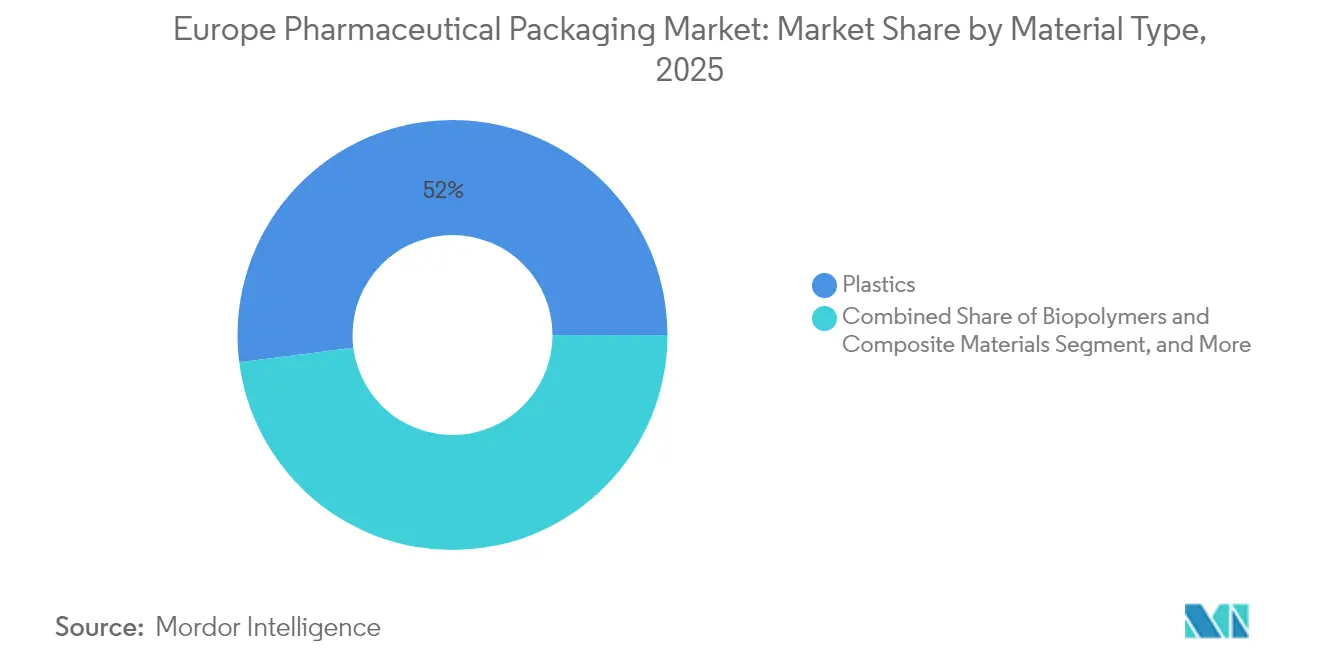
Biopolymers Gain Momentum as PPWR Deadlines NearPlastics dominated the Europe pharmaceutical packaging market with a 52.03% share in 2025, led by polyethylene terephthalate bottles and polypropylene blister films. Glass remained second in value, owing to Type I borosilicate vials and cartridges, a segment fortified by EUR 1.5 billion (USD 1.65 billion) in furnace investments from Gerresheimer, Schott Pharma, and SGD Pharma between 2023 and 2027. Biopolymers and composite materials are projected to grow at a 6.86% CAGR, driven by brand owners seeking to meet PPWR recycled-content requirements without compromising barrier properties. Amcor and Nolato are qualifying polylactic and polyhydroxyalkanoate resins for non-contact layers that still meet the ISO 15378 process validation thresholds.
Regulatory hurdles slow the uptake of biopolymers in primary containers, yet converters with scale can amortize validation costs, creating a two-tier supplier landscape. As PPWR enforcement tightens after 2028, growth in plastics for oral-solid dosage formats will moderate, while Glass and cyclic olefin polymers will retain their premium status in high-value biologics.

By Packaging Type:
Primary Containers Capture Biologics PremiumPrimary formats are expected to account for 62.10% of the Europe pharmaceutical packaging market size in 2025 and are projected to rise at a 6.58% CAGR through 2031. Bottles for tablets remain the largest sub-segment, but their growth lags as injectables and inhalables gain share. Pre-fillable syringes and cartridges underpin West Pharmaceutical Services’ USD 1.98 billion proprietary-components revenue, highlighting the margin leverage embedded in drug-delivery systems. Vials and ampules face intermittent supply constraints despite the introduction of new capacity in Hungary and Serbia.
Secondary packaging, which accounts for 30-35% of spending, grows in tandem with serialization and NFC adoption, as evidenced by CCL Industries’ healthcare-label revenue uptick. Tertiary corrugated packs hold the balance, aided by e-commerce distribution for chronic-disease therapies. The underlying shift concentrates value creation in primary packs where regulatory moats and technical complexity remain highest.
By Technology:
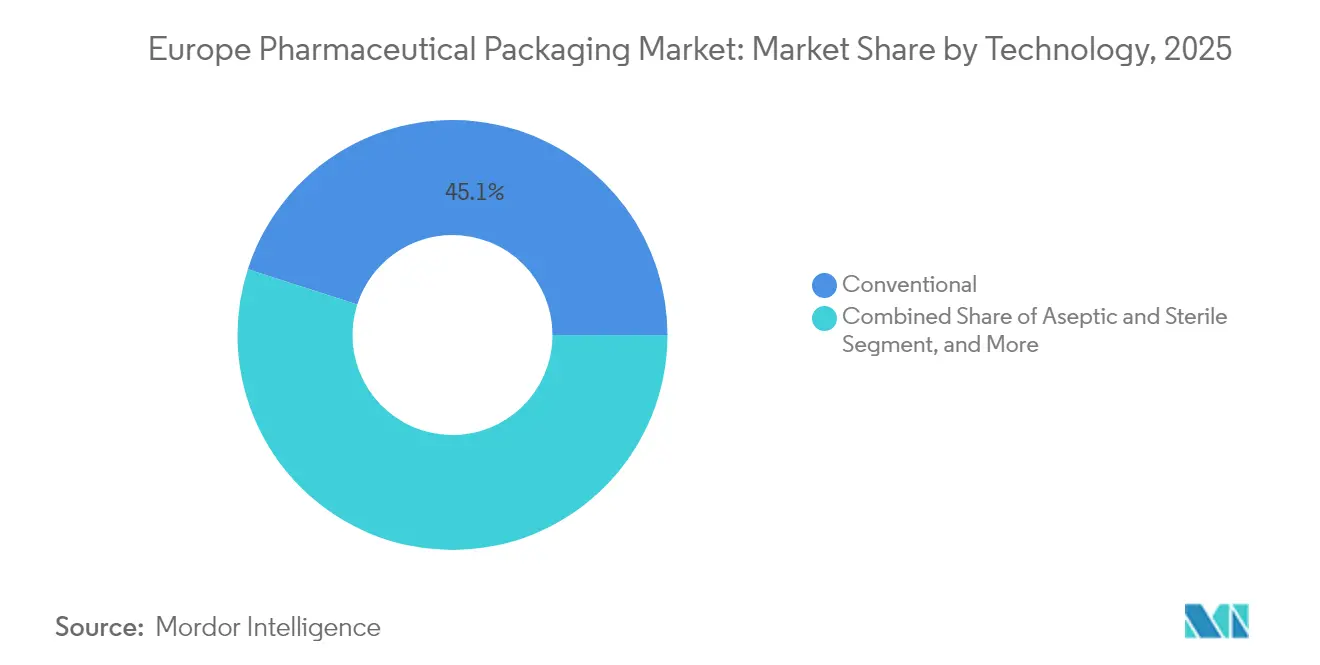
Smart Solutions Outpace Conventional FormatsConventional designs still accounted for 45.05% of 2025 revenue, but smart and connected formats are expected to compound at 7.55% through 2031 as serialization, anti-counterfeiting, and adherence monitoring converge. Schreiner MediPharm’s NFC labels, already embedded in oncology cartons, authenticate origin and push dosing reminders to smartphones.
AptarGroup’s connected inhalers stream sensor data to cloud dashboards, underpinning its USD 445 million Q3 2024 Pharma turnover. Aseptic-sterile technologies expand in lockstep with the growth of biologics, while recyclable-ready designs accelerate as PPWR milestones near.
By End User:
Outsourced Capacity Accelerates Among Mid-Tier BiotechsIn-house pharmaceutical plants accounted for 54.40% of demand in 2025. Yet, contract manufacturing organizations are attracting investment, growing at a 6.36% CAGR, as mid-sized biotechs race to market without building costly fill-finish lines. Almac Group’s GBP 65 million (USD 81.9 million) packaging hub in the United Kingdom offers serialization and cold-chain services for late-phase trials.
Sandoz’s PLN 171 million (USD 43 million) center in Poland produces 4 billion serialized blister packs annually. Hospitals and clinics, the smallest segment, increasingly order unit-dose packs to curb medication error risks. The Europe pharmaceutical packaging market, therefore, splits between vertically integrated big pharma and outsourcing-oriented biotech innovators.
Geography Analysis
Germany Pharmaceutical Packaging Market
Germany generated 22.30% of the European pharmaceutical packaging market revenue in 2025, anchored by clustered glass-vial makers such as Gerresheimer and Schott Pharma, whose combined 2024 sales surpassed USD 4 billion. Energy-price volatility elevated input costs, leading converters to favor ready-to-fill formats that reduce furnace runtime and speed customer validation.
Poland Pharmaceutical Packaging Market
Poland is poised for the fastest 7.72% CAGR through 2031, as pharmaceutical companies establish greenfield aseptic and serialization-ready facilities, supported by government R&D incentives. Sandoz, Polpharma, and GSK collectively expanded packaging or API capacity during 2024, positioning the country as Central Europe’s logistics gateway.
Broader European Markets
The United Kingdom, France, Spain, and Italy jointly contribute 35-40% of the Europe pharmaceutical packaging market. The United Kingdom will maintain EU-equivalent serialization codes post-Brexit, ensuring cross-border packaging compatibility. France tightens biologic-stability testing, which drives Type I borosilicate demand, while Italy pilots outcomes-linked payment contracts that rely on NFC-enabled adherence data to facilitate reimbursement releases. Remaining Northern and Eastern European markets grow at roughly the regional average, with generic-dominant portfolios favoring cost-effective plastic blisters.
Regulatory Landscape
Pharmaceutical packaging in Europe is primarily shaped by two EU-wide regimes: the Falsified Medicines Directive safety-features framework (implemented via Commission Delegated Regulation (EU) 2016/161) and the new Packaging and Packaging Waste Regulation (PPWR), Regulation (EU) 2025/40. PPWR entered into force on 11 February 2025 and applies from 12 August 2026, so packaging placed on the EU market after that date must meet its sustainability-related requirements, while packs placed before can remain in circulation.
Beyond material and waste requirements, compliance extends to labeling and traceability. PPWR adds harmonized labeling provisions, including material-composition sorting labels, tied to implementing acts, while the safety-features framework continues to require unique identifiers and anti-tampering devices on prescription packs. In parallel, the European Medicines Agency and EU institutions are advancing reform of EU pharmaceutical legislation, with adoption targeted in 2026 and phased implementation across 2026-2028, which adds change-management work for artwork, labeling control, and pack approval workflows.
Value Chain Analysis
The value chain begins with regulated raw materials (Type I borosilicate glass, cyclic olefin polymers, pharma-grade PET/HDPE, aluminum foils, papers, and specialty adhesives/inks), followed by conversion into primary components (vials, cartridges, prefillable systems, blisters, bottles, closures) under ISO 15378-aligned quality systems and EU-GMP expectations. Midstream activities include sterilization, ready-to-use (RTU) preparation, and assembly, while secondary and tertiary conversion (cartons, labels, inserts, corrugated) integrates serialization and tamper evidence to satisfy the safety-features requirements under Regulation (EU) 2016/161.
Downstream, contract packaging organizations, CDMOs, and logistics providers connect packaging output to fill-finish plants, wholesalers, and, increasingly, direct-to-patient channels that require GDP-compliant cold-chain performance for biologics. Recent capacity and capability moves show where value is concentrating: Sharp invested more than EUR 20 million to expand injectable packaging capacity in Belgium and the Netherlands, including cold-chain warehousing and syringe assembly, Aenova commissioned an automated tube-packaging line in Germany that raised capacity above 50 million tubes per year, and Woodberry acquired UK folding-carton suppliers Medica Packaging and F.G. Curtis. These actions reflect ongoing investment in automation, local-for-local capacity, and secondary and tertiary scale to handle serialization, aggregation, and upcoming PPWR-driven packaging changes.
Competitive Landscape
Five leading suppliers account for around 35% of the primary-pack segment, while secondary and tertiary tiers remain fragmented. GERRESHEIMER, SCHOTT Pharma, and Stevanato agreed in September 2024 to standardize ready-to-fill vials and cartridges, allowing customers to dual-source without requiring repeated validation.
West Pharmaceutical Services builds IoT sensors into NovaPure stoppers to create closed-loop adherence feedback, differentiating its offer when payers demand outcome tracking. Amcor leverages its global scale to qualify recycled PET and HDPE that meet PPWR's recycled-content levels, thereby defending its share ahead of the 2030 deadline.
White-space opportunities favor connected packaging, biopolymer secondary packs, and modular fill-finish lines. Schreiner MediPharm and CCL Industries attack incumbents by embedding NFC chips into cartons at cost points mainstream brands can afford. ISO 15378 and EU-GMP Annex 1 validation cycles remain formidable entry barriers; however, niche digital-health expertise and recycled-material know-how can carve out profitable niches.
Europe Pharmaceutical Packaging Industry Leaders
-
Amcor Plc
-
Gerresheimer AG
-
Schott AG
-
AptarGroup Inc.
-
CCL Industries Inc.
- *Disclaimer: Major Players sorted in no particular order
Europe Pharmaceutical Packaging Market Companies Covered in this Report
- Amcor Plc
- Gerresheimer AG
- Schott AG
- AptarGroup Inc.
- CCL Industries Inc.
- Stevanato Group S.p.A.
- West Pharmaceutical Services Inc.
- SGD Pharma SAS
- Nolato AB
- Ardagh Group S.A.
- Bormioli Pharma S.p.A.
- Nipro Corporation
- Origin Pharma Packaging Ltd.
- Gaplast GmbH
- DWK Life Sciences GmbH
- IntraPac International LLC
- Vetter Pharma-Fertigung GmbH and Co. KG
- Romaco Group GmbH
- APG Europe B.V.
- Piramal Pharma Solutions
Market Opportunities and Future Outlook
PPWR application from 12 August 2026 creates a clear commercialization window for packaging redesign programs that preserve medicine protection while improving recyclability, labeling harmonization, and secondary and tertiary material efficiency. Converters and material suppliers that can qualify medical-grade recycled content for non-contact layers, while maintaining ISO 15378 process validation and pharma change-control requirements, can participate in EU-wide rollouts as brand owners standardize pack formats across countries rather than managing fragmented national approaches.
The ongoing shift toward biologics, injectables, and home administration continues to move spend toward RTU and ready-to-fill primary containers and GDP-ready distribution packs, and the supply chain is already adding capacity for this mix. Sharp’s EUR 20 million expansion in Belgium and the Netherlands, focused on injectables packaging and cold-chain storage, and Adare Pharma Solutions’ 2,800 square meter packaging and warehousing expansion at Pessano (Milan), authorized by AIFA in October 2025, show how manufacturers are aligning packaging and distribution capacity. Anti-counterfeiting and patient-engagement requirements also keep pull-through demand for serialized and NFC-enabled secondary packaging, with opportunities centered on integrated solutions that combine compliant artwork management, tamper evidence, and digital authentication at scale.
Recent Industry Developments in Europe Pharmaceutical Packaging Market
- January 2026: SCHOTT Pharma announced that its TOPPAC polymer cartridge platform is compatible with SHL Medical large-volume autoinjectors. The update aligns polymer primary packaging with established device platforms, supporting combination-product supply chains that prioritize standardized, ready-to-integrate components.
- September 2025: Gerresheimer broke ground on a new 4,000 square meter production hall at its Wertheim, Germany site dedicated to ready-to-fill vials, tied to an investment of around EUR 30 million. Expanding RTF capacity strengthens European supply for high-value parenteral packaging where lead times and qualification cycles can constrain fill-finish throughput.
- September 2024: Gerresheimer, SCHOTT Pharma, and Stevanato Group announced a strategic industry alliance to standardize ready-to-use (RTU) solutions for vials and cartridges. Harmonized specifications reduce revalidation work for dual-sourcing and support broader adoption of RTU formats across biologics and biosimilars pipelines.
Europe Pharmaceutical Packaging Market Report Scope and Research Methodology
Market Definition and Coverage
For this study, the Europe pharmaceutical packaging market is defined as the value of packaging used to protect, store, and distribute pharmaceutical products across Europe, covering packaging used at primary, secondary, and tertiary levels.
Scope exclusions: The sizing excludes non-pharmaceutical packaging used only for medical devices, general consumer health goods, or purely promotional packs that do not carry or protect a drug product.
Segments Covered in This Report
- By Material Type
- Plastic
- Glass
- Paper and Paperboard
- Metal/Foil
- Biopolymers and Composite Materials
- By Packaging Type
- Primary Packaging
- Bottles
- Blister Packs
- Pre-fillable Syringes
- Vials and Ampoules
- IV Containers
- Inhalers
- Other Primary Packagings
- Secondary Packaging
- Folding Cartons
- Labels and Inserts
- Bags and Pouches
- Trays
- Other Secondary Packagings
- Tertiary Packaging
- Corrugated Shippers
- Pallets
- Other Tertiary Packagings
- Primary Packaging
- By Technology
- Conventional
- Aseptic and Sterile
- Smart and Connected (NFC/RFID)
- Anti-counterfeit / Serialisation
- Sustainable / Recyclable Solutions
- Child-Resistant and Tamper-Evident Solutions
- By End User
- Pharmaceutical Manufacturers
- Specialty/Biotech Firms
- Contract Manufacturing and Packaging Organizations
- Hospitals and Clinics
- By Country
- United Kingdom
- Germany
- France
- Spain
- Italy
- Poland
- Rest of Europe
Data Sources, Market Sizing, and Validation
Desk Research
Desk research began with a fact base on pharmaceutical output, trade, and packaging material availability across Europe, and then mapped those indicators to packaging demand signals. Public sources such as Eurostat, the European Medicines Agency, national statistics offices, and customs and trade publications were used to understand manufacturing volumes, import and export flows, and regulated product movement.
We also reviewed EU and country packaging waste rules, official pharmacopoeia and safety guidance, and peer-reviewed journals on stability and barrier requirements, since these inputs shape pack mix and replacement cycles. In parallel, company annual reports, investor presentations, and trusted industry press were reviewed for capacity moves and pricing commentary. Select paid subscriptions were used only for company financials, patent checks, and shipment-level trade visibility where public detail was not sufficient. The examples above are illustrative only, and the desk inputs are not exhaustive, because additional public sources were used for data collection, validation, and research clarification.
Primary Interviews and Surveys
We conduct expert interviews and surveys across Europe with packaging suppliers, pharmaceutical manufacturers, contract packagers, distributors, and quality or regulatory specialists. Respondents help clarify format mix, material prices, outsourcing, biologic and injectable demand, and recycled-content adoption. Their input is used to address gaps in secondary data and test assumptions before the final estimate is prepared.
Distribution of primary research fieldwork respondents
| Company type | Respondent position |
|---|---|
| Top tier: 28% | CXOs: 18% |
| Mid tier: 47% | Functional/Unit leaders: 32% |
| Smaller Players: 25% | Managers: 50% |
Market-Sizing & Forecasting
Sizing was built using a top-down and bottom-up combination, where pharma production and trade indicators were translated into packaging demand pools by pack intensity and typical bill of packaging for key dosage forms, and then value was derived using representative price ranges by material and pack format. To keep totals realistic, we corroborated results with selective bottom-up checks, such as sampled supplier revenue splits, channel checks on converter throughput, and ASP times volume sanity tests for high-volume formats.
Inputs used in the model included country-level pharmaceutical output and shipment trends, mix shift between oral solids and injectables, adoption of child-resistant and tamper-evident features, serialization and traceability compliance needs, and the balance between glass and plastic in primary containers. Where a data gap appeared for smaller countries or niche formats, we applied proxy ratios from similar markets, then adjusted them based on expert feedback.
Forecasting relied mainly on scenario analysis supported by trend-linked regression checks, where demand is tied to expected pharma production growth, biologics and injectable penetration, and sustainability-driven material changes. Assumptions on price progression were kept explicit, and local currency effects were normalized before being expressed in USD so year-to-year movement is not overstated.
Data Validation & Update Cycle
Outputs were checked against independent signals such as packaging material consumption direction, capacity announcements, and trade movement patterns, and then large variances were traced back to the exact assumption driving the difference. When results did not align with interview feedback or desk indicators, we reworked the driver and re-contacted experts to confirm the corrected logic.
Before sign-off, the model goes through more than one analyst review so arithmetic, scope alignment, and country rollups stay consistent. The report is refreshed annually, and interim adjustments are made when there are material events such as major regulatory shifts, capacity disruptions, or sharp changes in pharma output. Right before delivery, a final pass is completed so the client receives the latest view available at that time.
Mordor Intelligence's Europepharmaceutical Packaging Market Market Size Compared With Other Published Estimates
Published market numbers for Europe pharmaceutical packaging often do not match because the scope and counting logic are not the same, even when titles look identical. Differences usually come from what packaging levels are included, how pack formats are grouped, and whether the estimate is anchored to pharma output signals or to packaging industry revenue proxies.
In this market, the biggest gap drivers tend to be whether tertiary packaging and compliance add-ons (for example, anti-counterfeit and track-and-trace features) are counted as part of the core value, how average prices are progressed during the forecast years, and how currency timing is handled when multiple European countries are combined. Some sources also use longer forecast windows and faster growth scenarios that are not re-checked against short-cycle indicators like output and trade movements.
Benchmark comparison
| Source | Market Size | Gaps in Research Methodology |
|---|---|---|
| Mordor Intelligence | USD 43.99 B (2025) | |
| Trade Publisher A | USD 26.82 B (2024) | The total appears lower mainly due to base year choice and a tighter value capture approach that is not clearly tied back to country level pharma output, which can understate high-value primary packs and regulated add-on features. |
| Industry Research Portal B | USD 39.87 B (2024) | The scope looks broad, but the difference can come from how prices are escalated and how packaging format baskets are combined across countries, which can compress value for higher-spec packs when averaged early. |
The spread across the three figures is largely explained by year selection, price progression rules, and how compliance-linked packaging value is treated when rolling countries into one total. When tertiary packaging and traceability-led features are kept inside the counted value and cross-checked with production and trade signals before the annual refresh, the 2025 total stays tied to observable demand drivers, which is how it is handled in Mordor Intelligence.
Key Questions Answered in the Report
What is the 2026 revenue base for pharmaceutical packaging in Europe?
Spending stands at USD 46.46 billion in 2026.
How quickly is European pharmaceutical packaging spending projected to expand?
Expenditure is forecast to grow at a 5.61% CAGR through 2031.
Which technology area shows the fastest expansion pace?
Smart and connected formats are advancing at a 7.55% CAGR.
Which European country exhibits the strongest growth outlook?
Poland is projected to achieve an 7.72% CAGR between 2026 and 2031.
Which material currently captures the largest share of packaging spend?
Plastics command 52.03% of 2025 revenue, leading all materials.
What regulation is most influencing material selection decisions?
The EU Packaging and Packaging Waste Regulation drives adoption of recycled-content plastics and biopolymers.