
Market Overview
| Study Period | 2021 - 2032 |
|---|---|
| Forecast Data Period | 2027 - 2032 |
| Base Year Market Size (2026) | USD 13.52 Billion |
| Market Size (2027) | USD 14.51 Billion |
| Market Size (2032) | USD 20.66 Billion |
| Growth Rate (2027 - 2032) | 7.32 % |
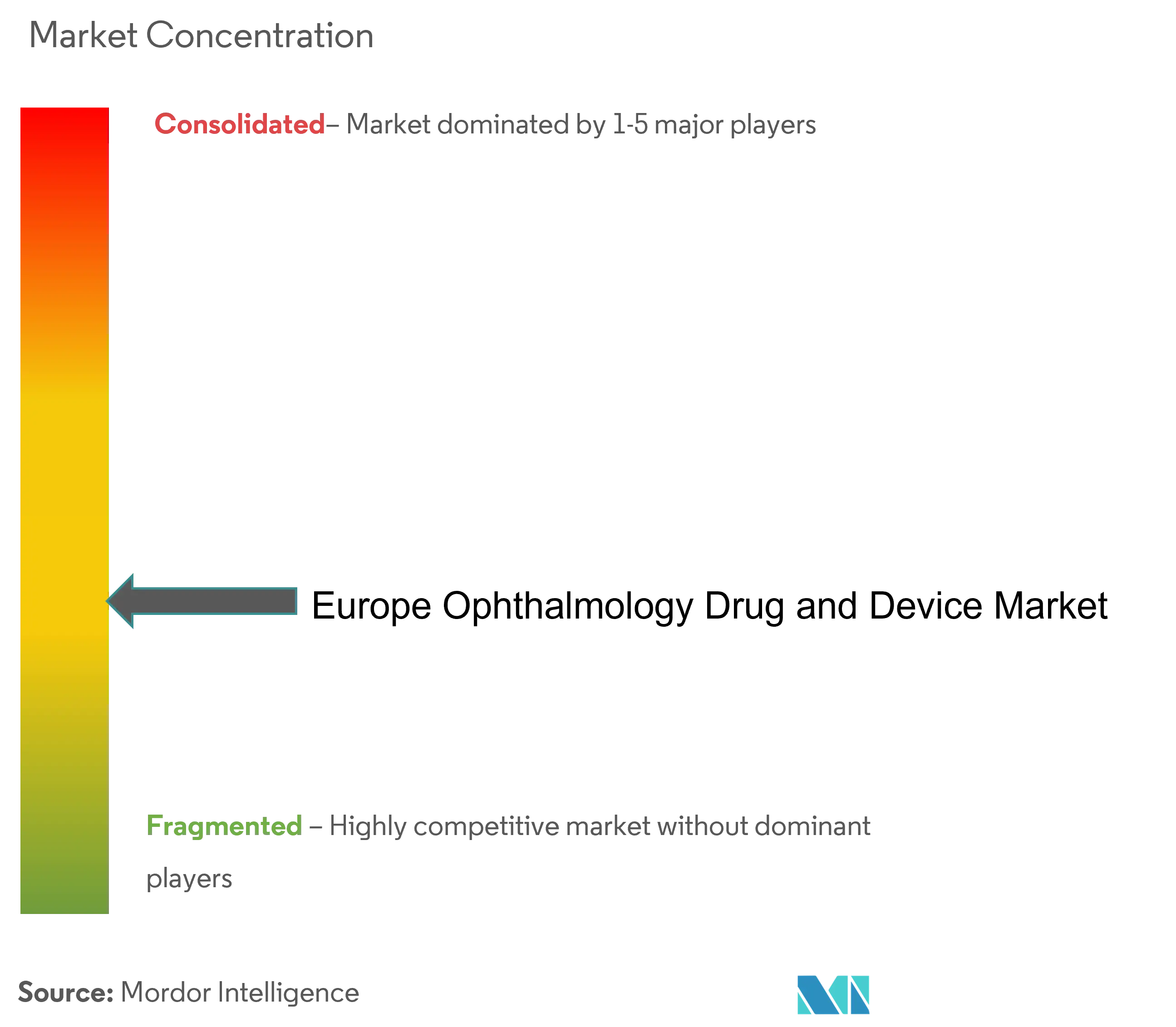
| Market Concentration | Medium |
Major Players *Disclaimer: Major Players sorted in no particular order Image © Mordor Intelligence. Reuse requires attribution under CC BY 4.0. | |
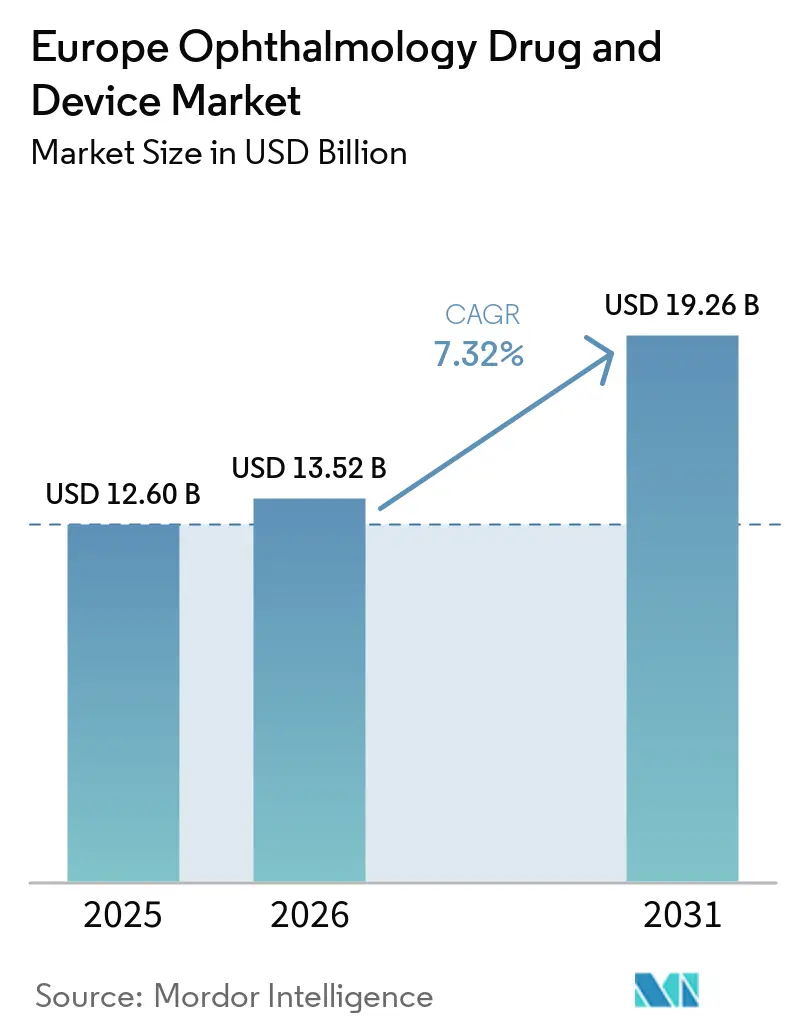
Europe Ophthalmology Drug and Device Market Analysis by Mordor Intelligence
The Europe Ophthalmology Drug And Device Market size is expected to grow from USD 13.52 billion in 2026 to USD 14.51 billion in 2027 and is forecast to reach USD 20.66 billion by 2032 at 7.32% CAGR over 2027-2032.
Demographic aging, rising incidence of chronic eye conditions, and steady migration toward minimally invasive surgery sustain this expansion. Hospitals continue to dominate procedure volumes, yet outpatient facilities are capturing the incremental growth as payers encourage cost-efficient care models. AI-enabled diagnostic platforms are improving screening throughput in Germany and the UK, while regulatory actions such as the EMA’s 2024 Durysta withdrawal are redirecting R&D toward safer sustained-release implants. Consolidation among leading manufacturers and new vertical integration moves by EssilorLuxottica underscore the sector’s shift toward end-to-end eye-care ecosystems.
Key Report Takeaways
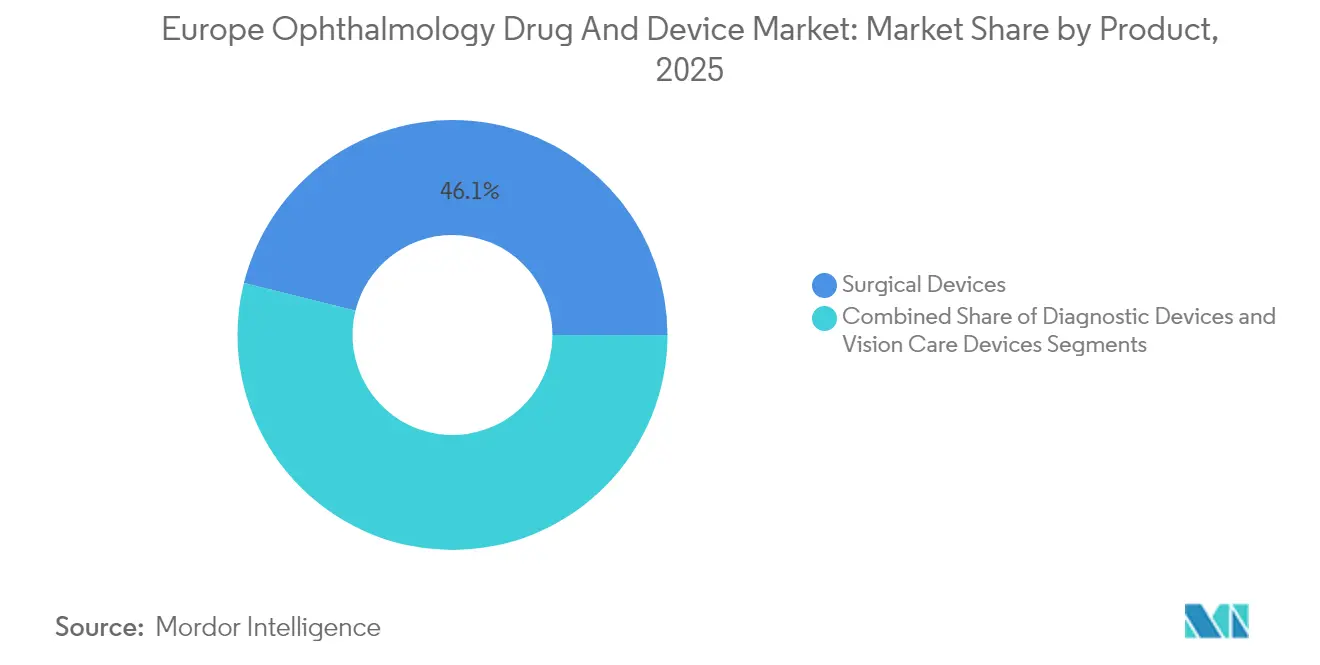
- By product, surgical devices led with 46.12% revenue share in 2026; drugs are projected to post the quickest 9.54% CAGR through 2032.
- By disease, cataract treatments captured 29.03% of Europe ophthalmic devices and drugs market share in 2026, while glaucoma therapeutics are set to grow at 9.76% CAGR to 2032.
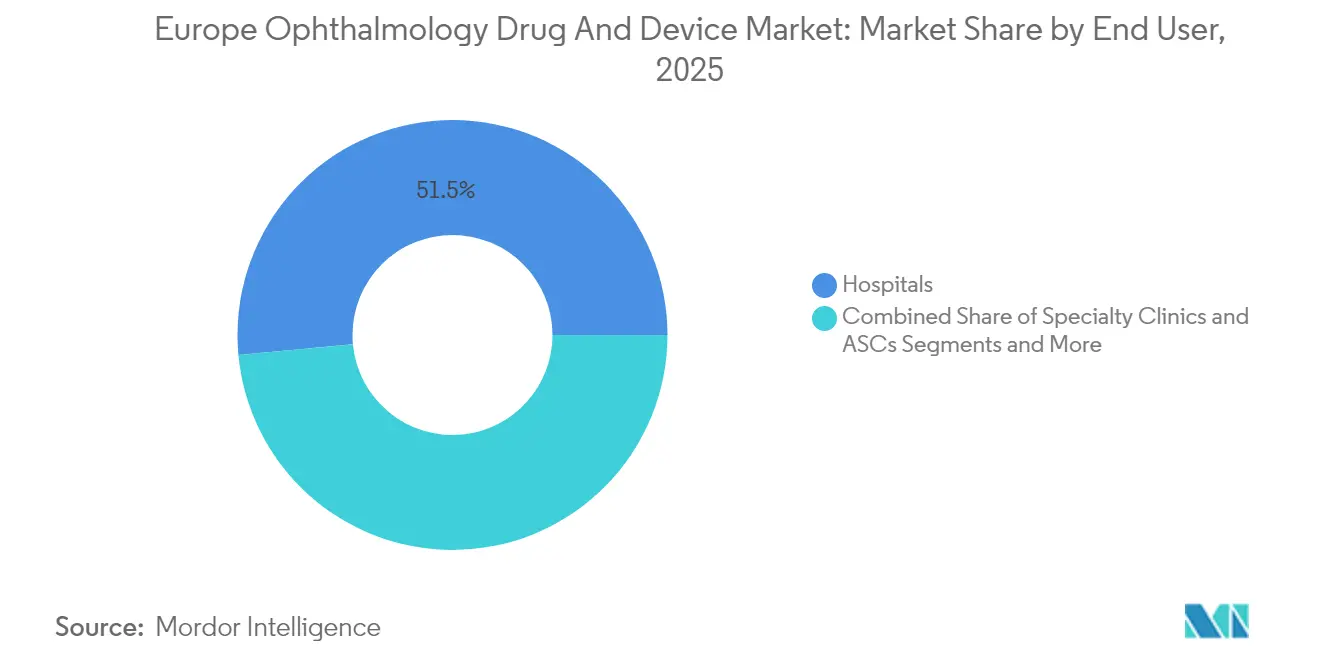
- By end user, hospitals held 51.48% of the Europe ophthalmic devices and drugs market size in 2026; ambulatory surgery centers are expanding at a 10.32% CAGR through 2032.
- By geography, Germany commanded 20.63% revenue share in 2026; the UK is forecast to be the fastest-growing market with a 8.54% CAGR to 2032.
Note: Market numbers in this report are based on Mordor Intelligence's proprietary estimation framework, which combines nine months of actuals with Q4 projections for base year 2026.
Market Trends and Insights
Drivers Impact Analysis of Europe Ophthalmology Drug and Device Market*
| Driver | (~) % Impact on CAGR Forecast | Geographic Relevance | Impact Timeline |
|---|---|---|---|
| Growing Prevalence Of Chronic Eye Diseases | +2.10% | EU-wide, concentrated in Germany, France, Italy | Long term (≥ 4 years) |
| Expanding Geriatric Population Base | +1.80% | EU-wide, particularly Northern Europe | Long term (≥ 4 years) |
| Rapid Adoption Of Minimally-Invasive Glaucoma Surgery (MIGS) | +1.50% | Germany, UK, France, Spain | Medium term (2-4 years) |
| AI-Enabled Diagnostic Imaging & Remote Screening Rollout | +1.20% | Germany, UK, Scandinavia | Short term (≤ 2 years) |
| Surge In Sustained-Release Ocular Drug-Delivery Approvals | +0.90% | EU-wide, regulatory harmonization | Medium term (2-4 years) |
| EU Funding Programs For Ophthalmic R&D And Start-Ups | +0.40% | EU-wide, concentrated in research hubs | Long term (≥ 4 years) |
| Source: Mordor Intelligence | |||
Growing Prevalence of Chronic Eye Diseases
The incidence of age-related macular degeneration and diabetic retinopathy is climbing as Europe’s population ages, generating a durable demand base for both surgical and pharmaceutical interventions.[1] Health systems are embedding ophthalmic screening into routine primary care, and German pilots using AI achieved 100% sensitivity for diabetic-retinopathy detection, catalyzing wider adoption. The economic burden of retinal disorders is estimated to hit EUR 99.8 billion by 2030, bolstering procurement budgets for advanced diagnostic equipment and sustained-release injectables.
Expanding Geriatric Population Base
Individuals aged 65 years or older constitute Europe’s fastest-growing cohort and exhibit the highest prevalence of cataract, glaucoma, and AMD. National services are tackling surgical backlogs by contracting private providers, a model that raised UK cataract procedure volumes 40% over pre-pandemic levels.[2] A larger elderly population simultaneously fuels premium IOL demand, reflecting patient preference for spectacle independence and rapid visual recovery.
Rapid Adoption of Minimally Invasive Glaucoma Surgery
German registry data show glaucoma procedures climbing 75% between 2006 and 2018, with MIGS devices now exceeding 11% of total surgeries. Devices such as the XEN Gel Stent deliver 75.9% success rates in European trials and render 55.2% of patients medication-free within six months. Combination cataract-MIGS procedures are becoming routine, creating bundled device revenue streams and shorter recovery windows.
AI-Enabled Diagnostic Imaging & Remote Screening Rollout
Validated algorithms reach sensitivities above 90% for key retinal conditions, and Aireen secured CE-MDR IIb clearance for an autonomous cloud-based system in 2024.[3] Hospitals integrate AI triage with tele-ophthalmology to stretch specialist capacity, particularly in rural Scandinavia, thereby accelerating early disease detection and reducing avoidable vision loss.
Restraints Impact Analysis of Europe Ophthalmology Drug and Device Market*
| Restraint | (~) % Impact on CAGR Forecast | Geographic Relevance | Impact Timeline |
|---|---|---|---|
| High Cost & Reimbursement Gaps For Premium Lenses/MIGS | -1.40% | Germany, France, UK, Netherlands | Medium term (2-4 years) |
| Stringent EU MDR Compliance Burden On SMEs | -0.80% | EU-wide, particularly affecting smaller companies | Short term (≤ 2 years) |
| Sub-Optimal Patient Adherence To Multi-Dose Eyedrop Regimens | -0.60% | EU-wide, elderly population focus | Long term (≥ 4 years) |
| Supply-Chain-Driven API Shortages For Sterile Ophthalmic Drugs | -0.40% | EU-wide, manufacturing concentration risk | Short term (≤ 2 years) |
| Source: Mordor Intelligence | |||
High Cost and Reimbursement Gaps for Premium Lenses/MIGS
Cataract surgery tariff disparities range from EUR 432.5 (USD 507.1) in Poland to EUR 3,411.96 (USD 4,001.21) in Portugal, causing uneven patient access to premium IOLs. Co-payment requirements depress uptake in social-insurance markets, while MIGS reimbursement remains procedure-specific, creating friction for innovators and clinicians alike. Germany’s 2025 abolition of fixed prices for visual aids illustrates the fluid reimbursement landscape.
Stringent EU MDR Compliance Burden on SMEs
Certification costs have risen to 30%, and smaller manufacturers face resource diversion from R&D to documentation and surveillance, slowing product pipelines. Master UDI-DI obligations for contact lenses from November 2025 further heighten administrative overhead, though temporary exceptions aim to prevent supply bottlenecks.
*Our forecasts treat driver/restraint impacts as directional, not additive. The impact forecasts reflect baseline growth, mix effects, and variable interactions.
Europe Ophthalmology Drug and Device Market Segment Analysis
By Product:
Surgical Devices Extend Premium LeadershipSurgical devices generated 46.12% of total 2026 revenue within the European market for ophthalmic devices and ophthalmic drugs and continue to command premium pricing due to constant innovation.. Alcon holds about 60% global share in presbyopia-correcting IOLs and has replicated similar penetration across major EU economies. Phaco platforms and femtosecond lasers secure attractive service contracts, while the fastest-expanding sub-segment is MIGS. The segment’s value proposition rises as bundled cataract-plus-MIGS procedures reduce overall care episodes.
Meanwhile, new hydrogel implants and refillable ocular reservoirs target adherence gaps. Vision-care devices retain stable revenue streams via contact-lens material upgrades and blue-light-filter spectacles. Alcon’s 2025 Clareon PanOptix Pro IOL, boasting 94% light utilization, exemplifies engineering efforts that sustain price premiums. Across all modalities, companies intensify R&D to capture an ageing demographic seeking spectacle independence and rapid recovery.

By Disease:
Cataract Dominance, Glaucoma MomentumCataract therapies contributed 29.03% of 2026 revenue, underpinning the Europe ophthalmic devices and drugs market size due to universal reimbursement and high procedure volumes. Premium IOLs drive upsell opportunities, improving manufacturer margins. Glaucoma therapeutics lead growth at a 9.76% CAGR through 2032 on the back of MIGS and polymer-based sustained-release implants that eliminate drop fatigue.
AMD, diabetic retinopathy, and uveitis remain important, with Roche re-launching Susvimo in 2024 to offer a six-month anti-VEGF interval. Gene therapies in early trials signal longer-term disruption potential. Disease-level segmentation guides product-launch prioritization and informs payer negotiation strategies across Europe’s heterogeneous health systems.
By End User:
ASC Uptake QuickensHospitals retained 51.48% revenue in 2026 thanks to installed capital equipment and complex case management. Yet ambulatory surgery centers posted a 10.32% CAGR. They will capture a growing share of the Europe ophthalmic devices and drugs market by 2032 as regulators push day-case pathways and operators expand capacity. The UK showcases the trend, with 60% of NHS cataract surgeries now performed in private clinics.
Retail optics and online pharmacies benefit from contact-lens subscriptions and dry-eye product lines. Specialty clinics leverage focused expertise to market premium vision-correction packages, while tele-ophthalmology broadens rural reach.
Geography Analysis
Germany Ophthalmology Drug and Device Market
Germany generated 20.63% of 2026 revenue, reflecting substantial insurer reimbursement and early adoption of premium technologies. Carl Zeiss Meditec reported 14.1% EMEA revenue growth in H1 2024/25, buoyed by robust German demand. The country functions as a launchpad for MIGS and AI diagnostics, with clinical evidence and pricing benchmarks that ripple across neighboring markets.
United Kingdom Ophthalmology Drug and Device Market
The United Kingdom is projected to grow at 8.54% CAGR to 2032, the fastest in Western Europe, as NHS outsourcing expanded procedure counts by 40% versus pre-pandemic baselines. Post-Brexit regulatory divergence remains limited, allowing manufacturers to expedite parallel approvals through the UK MHRA and EU MDR pathways. Investments in Moorfields Eye Hospital’s electronic records and Optometrists-Ophthalmologists shared-care schemes solidify systemic capacity.
Southern and Eastern Europe Ophthalmology Drug and Device Market
France, Italy, and Spain combine sizable populations with differing payment models. France relies heavily on ophthalmologists for primary eye care, intensifying capacity constraints. Italy’s regional financing disparities call for tailored pricing, whereas Spain harnesses medical tourism and private insurance to accelerate premium adoption. Emerging EU members in Eastern Europe are modernizing surgical theaters via cohesion funds and represent white space for mid-tier suppliers.
Broader European Markets
Collectively, these dynamics ensure that the Europe ophthalmic devices and drugs market remains anchored in its Big-5 economies while offering growth corridors in both North-Western innovation hubs and South-Eastern catch-up regions.
Regulatory Landscape
In Europe, ophthalmic drugs, devices, and integral drug-device combinations are managed through the interface between medicinal-product rules and the EU Medical Device Regulation, Regulation (EU) 2017/745 (MDR). Integral combinations are classified by principal mode of action: when the medicinal substance provides the principal action, the product follows the medicinal pathway (Directive 2001/83/EC and, where applicable, Regulation (EC) 726/2004), while the device constituent part must still meet MDR General Safety and Performance Requirements (Annex I) and interface expectations, as reflected in EMA implementation Q&A materials.
For combination products, MDR Article 117 serves as a key compliance anchor. It requires evidence of device-part conformity (such as a notified body opinion) as part of the Marketing Authorisation Application when the drug is the lead component. Coordination mechanisms including the European Medicines Agency (EMA) Combination Products Operational Group (COMBO) support alignment across national competent authorities and notified bodies, and the March 2026 EU Pharma Package compromise texts point to continued movement toward more coordinated assessment for combined studies across medicinal products and devices/IVDs.
Value Chain Analysis
The value chain covers R&D and clinical validation, where AI-enabled diagnostics and tele-ophthalmology tools are increasingly used, along with regulatory and quality activities tied to MDR Article 117 documentation for integral combinations. It also includes manufacturing of sterile ophthalmic formulations and the device constituents, including polymer components, dispensers, and implantable delivery systems, followed by distribution through hospitals, specialty clinics/ASCs, retail optical channels, and online pharmacies. Commercialization often depends on partnerships that pair formulation or platform know-how with established regional sales and market-access infrastructure, illustrated by the October 2024 Novaliq and Laboratoires Thea arrangement around Vevizye (ciclosporin 0.1% eye drops) after European Commission approval.
Manufacturing and supply are shaped by specialized inputs and compliance constraints, including aseptic fill-finish, sterile packaging, and device-component sourcing that must align with MDR-linked quality expectations. Industry sources also point to reliance on externally sourced advanced dispenser and integrated combination components. Bottlenecks such as constrained aseptic molding capacity for complex polymers and concentrated supply of medical-grade elastomers can extend lead times, which in turn supports dual-sourcing, longer-term capacity planning, and consolidation among players able to manage notified-body interactions and post-market requirements.
Competitive Landscape
Competition is moderate, with the top five vendors controlling roughly 55% of 2024 revenue. Alcon dominates cataract capital equipment and contact lenses, whereas Johnson & Johnson Vision leverages Acuvue and Tecnis franchises to retain share. EssilorLuxottica’s 2025 acquisition of Optegra clinics and Heidelberg Engineering illustrates vertical integration into diagnostics and surgical services.
Carl Zeiss Meditec amplified its vitreoretinal surgery footprint through the 2025 purchase of DORC and continues to merge optics with software to lock in workflow ecosystems. In pharmaceuticals, Novartis and Roche lead anti-VEGF therapies, while Bausch + Lomb expanded MIGS options via Elios Vision in 2024. Start-ups in AI and gene therapy are attracting EU Horizon grants and venture funding, compelling incumbents to pursue licensing and minority stakes.
Pricing power concentrates around premium IOLs, femto lasers, and sustained-release implants, yet EU tender cycles and MDR compliance costs challenge margins. Players with global supply chains are also mitigating API shortages by dual-sourcing sterile ingredients.
Europe Ophthalmology Drug and Device Industry Leaders
-
Topcon Corporation
-
Johnson & Johnson
-
Carl Zeiss Meditec AG
-
Pfizer
-
Nidek Co. Ltd
- *Disclaimer: Major Players sorted in no particular order
Europe Ophthalmology Drug and Device Market Companies Covered in this Report
- Alcon
- Carl Zeiss
- Johnson & Johnson
- Bausch + Lomb Corp.
- EssilorLuxottica
- Novartis AG (incl. Sandoz & Sandoz Vision Care)
- Roche
- Pfizer
- Glaukos Corp.
- Santen Pharmaceuticals
- Staar Surgical Co.
- Topcon Corp.
- Nidek
- HAAG-Streit
- Ziemer Group
- Canon
- Hoya Corp. / Pentax Medical
- CooperVision Inc.
- Danaher
- Abbvie
Read Analysis of Europe Ophthalmology Drug and Device Companies
Market Opportunities and Future Outlook
Opportunities are concentrated where clinical throughput, adherence, and care-site shifts intersect with capital investment and regulatory clarity. Scaling sterile ophthalmic manufacturing and improving supply resilience are near-term whitespace areas, supported by investment actions including Bausch + Lombs June 2026 announcement of a EUR 28 million expansion to double production capacity at its Macherio, Italy site (with a stated longer-term output target), as well as other capacity initiatives for ophthalmic drug production across Europe. These moves align with demand for preservative-free multi-dose formats, sustained-release delivery, and chronic-therapy portfolios that remain sensitive to aseptic capacity and packaging-component availability.
Device and surgical ecosystems offer a second expansion corridor, reinforced by investor activity and portfolio modernization in premium cataract and refractive segments. In May 2026, Groupe Bruxelles Lambert (GBL) completed the acquisition of a 45% co-controlling stake in Rayner, reflecting appetite for surgical ophthalmology platforms and premium IOL roadmaps. At the same time, the operational pathway for integral drug-device combinations under MDR Article 117, together with EMA coordination via COMBO, increases the value of end-to-end regulatory, clinical, and manufacturing capabilities, favoring companies that can integrate notified-body evidence, real-world surveillance, and service-led deployments across hospitals and outpatient settings.
Recent Industry Developments in Europe Ophthalmology Drug and Device Market
- June 2026: Bausch + Lomb announced a EUR 28 million investment to double production capacity at its Macherio site in Italy, including job creation and a longer-term plan for materially higher annual vial output. The added sterile manufacturing capacity strengthens regional supply for ophthalmic pharmaceuticals and supports scale-up of chronic-therapy portfolios where aseptic throughput is a binding constraint.
- October 2025: Carl Zeiss Meditec entered a definitive agreement to acquire a 10% stake in Ocumeda AG for EUR 10 million, with an option framework to increase the stake to up to 25%. The agreement reinforces ZEISS push into tele-ophthalmology and workflow digitization, complementing its device base with platform-driven care delivery and data-enabled services.
- April 2024: Carl Zeiss Meditec completed the acquisition of the Dutch Ophthalmic Research Center (D.O.R.C.). Bringing D.O.R.C. into the group broadened ZEISS vitreoretinal and cataract surgical offerings and strengthened its ability to provide integrated surgical workflows across European eye-care providers.
Europe Ophthalmology Drug and Device Market Report Scope and Research Methodology
Market Definition and Coverage
For this study, the Europe ophthalmology drugs and devices market is defined as revenues generated from ophthalmic therapeutic drugs and ophthalmic devices used to diagnose, monitor, or treat eye conditions across Europe.
Scope exclusions: Non-ophthalmic systemic drugs and general hospital equipment that are not used for eye care are excluded.
Segments Covered in This Report
- By Product
- Devices
- Surgical Devices
- Intra-ocular Lenses
- Ophthalmic Lasers
- Phacoemulsification Systems
- Other Surgical Devices
- Diagnostic Devices
- Optical Coherence Tomography Scanners
- Fundus Cameras
- Tonometers
- Other Diagnostic Devices
- Vision Care Devices
- Contact Lenses
- Spectacle Lenses
- Surgical Devices
- Drugs
- Glaucoma Drugs
- Retinal Disorder Drugs
- Dry-Eye Therapies
- Anti-Allergy / Anti-Inflammatory Drugs
- Anti-Infective Drugs
- Other Drugs
- Devices
- By Disease
- Glaucoma
- Cataract
- Age-related Macular Degeneration
- Diabetic Retinopathy
- Inflammatory Diseases
- Refractive Disorders
- Other Diseases
- By End User
- Hospitals
- Specialty Clinics & ASCs
- Retail Pharmacies & Optical Stores
- Online Pharmacies
- Geography
- Germany
- United Kingdom
- France
- Italy
- Spain
- Rest of Europe
Data Sources, Market Sizing, and Validation
Desk Research
Desk work was used to build the starting structure of the market and to set realistic ranges before we spoke with experts. We reviewed public sources such as European Commission and Eurostat releases, EMA and national regulator updates, WHO and OECD health statistics, and trade association publications linked to ophthalmology and medical devices.
To make the numbers usable for sizing, we also screened company annual reports, investor presentations, and product press releases to understand therapy launches, device replacement cycles, and where revenues are booked by geography. In a few places, we used paid subscriptions for company financials and patent databases only to speed up cross-checks on product footprints and innovation intensity. These desk research sources are illustrative and not exhaustive, and many other public materials were also reviewed for validation and clarification.
Primary Interviews and Surveys
We conduct expert interviews and surveys with manufacturers, distributors, healthcare providers, and reimbursement specialists in Europe. Their input helps validate secondary data, fill gaps in procedure volumes, utilization, pricing, launch timing, and channel mix. Conflicting responses are reviewed before the final market result is triangulated.
Distribution of primary research fieldwork respondents
| Company type | Respondent position |
|---|---|
| Top tier: 27% | CXOs: 18% |
| Mid tier: 49% | Functional/Unit leaders: 30% |
| Smaller Players: 24% | Managers: 52% |
Market-Sizing & Forecasting
Sizing was built using a top-down and bottom-up blended approach, where the main total is reconstructed from country demand pools and then checked against supply-side signals. In practice, we first linked the market to measurable healthcare activity such as eye disease prevalence trends, procedure volumes for cataract and other surgeries, treated patient shares for glaucoma and retinal disorders, and diagnostic testing intensity, then converted those into value using realistic price and utilization ranges.
To keep the model repeatable, we prioritized a small set of market fingerprints, including drug class mix (for example, chronic vs. acute therapies), average selling price progression by therapy type and device category, public reimbursement or access changes, and the shift of procedures toward outpatient settings. Where bottom-up detail was available, selected roll-ups were used, such as sampled supplier revenue by geography, channel markups for retail and hospital purchasing, and device unit estimates multiplied by typical ASP bands. Any gaps in bottom-up coverage were handled by using conservative penetration ranges and then re-tested in expert follow-ups.
Forecasting relied mainly on scenario analysis, because growth is driven by a few step-change variables like approvals, reimbursement timing, and procedure capacity expansion, which do not always behave like smooth time series. Each scenario was anchored to expected movement in volumes and pricing, then aligned to expert consensus on how quickly adoption and access will broaden across Europe.
Data Validation & Update Cycle
Outputs were validated through triangulation across independent signals, including implied per-capita spend checks, procedure and diagnosis trend direction, and consistency across country splits. When a country or category showed an unusual jump, we re-read the drivers, tightened assumptions, and rechecked variance before internal sign-off.
The study runs on an annual cycle, and interim reviews are triggered when material events occur, such as major approvals, safety actions, or policy changes that can shift uptake or pricing. Before delivery, we scan the latest public updates again so clients receive an up-to-date view of the market.
Mordor Intelligence's European Opthalmic Drugs Devices Market Estimate Compared With Other Published Estimates
Different published numbers for this market are common because the product basket and the measurement point can shift a lot from one study to another. In Europe, even a small difference in what is counted as a device, how distribution channels are treated, and which countries are included can move the total by several billions.
Vision testing services and routine eye examinations sit outside Mordor Intelligence's scope here, which is one key reason some broader ophthalmology totals come out much higher. Other gaps usually come from mixing consumer optical retail with clinical ophthalmology, applying aggressive price growth for specialty drugs without cross-checking access timing, or using a different base year and currency conversion window that does not match the pricing period.
Benchmark comparison
| Source | Market Size | Gaps in Research Methodology |
|---|---|---|
| Mordor Intelligence | USD 12.60 B (2025) | |
| Industry Publisher A | USD 12.40 B (2024) | Uses an earlier base year and a shorter horizon, and the split between drugs and devices is presented at a high level, which can miss country-level pricing and access timing differences. |
| Industry Publisher B | USD 22.23 B (2024) | Appears to use a wider ophthalmology definition that can include services and broader eye-exam related activity, which expands the demand pool beyond drugs and devices alone. |
Across the three figures, the spread mainly comes from what is counted in the market and how the demand pool is built, not from arithmetic differences. By keeping the scope tied to drugs and devices and then validating totals with procedure, treated-patient, and pricing checks, the final number stays traceable to inputs a buyer can review and repeat.
Key Questions Answered in the Report
What is the current Europe Ophthalmology Drug and Device Market size?
The Europe Ophthalmology Drug and Device Market is projected to register a CAGR of 7.32% during the forecast period (2027-2032)
Who are the key players in Europe Ophthalmology Drug and Device Market?
Topcon Corporation, Johnson & Johnson, Carl Zeiss Meditec AG, Pfizer and Nidek Co. Ltd are the major companies operating in the Europe Ophthalmology Drug and Device Market.
What years does this Europe Ophthalmology Drug and Device Market cover?
The report covers the Europe Ophthalmology Drug and Device Market historical market size for years: 2021, 2022, 2023, 2024, and 2025. The report also forecasts the Europe Ophthalmology Drug and Device Market size for years: 2027, 2028, 2029, 2030, 2031, and 2032.