
Europe Used Construction Machinery Market Size and Share
Market Overview
| Study Period | 2019 - 2031 |
|---|---|
| Forecast Data Period | 2026 - 2031 |
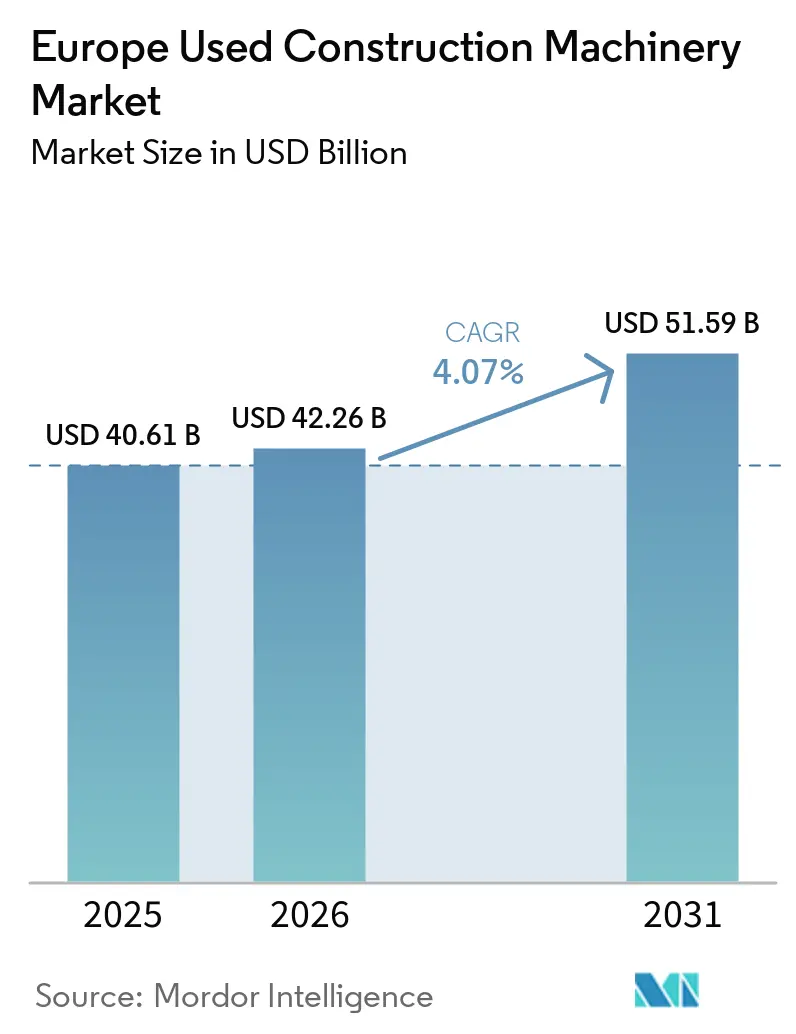
| Base Year Market Size (2025) | USD 40.61 Billion |
| Market Size (2026) | USD 42.26 Billion |
| Market Size (2031) | USD 51.59 Billion |
| Growth Rate (2026 - 2031) | 4.07 % |
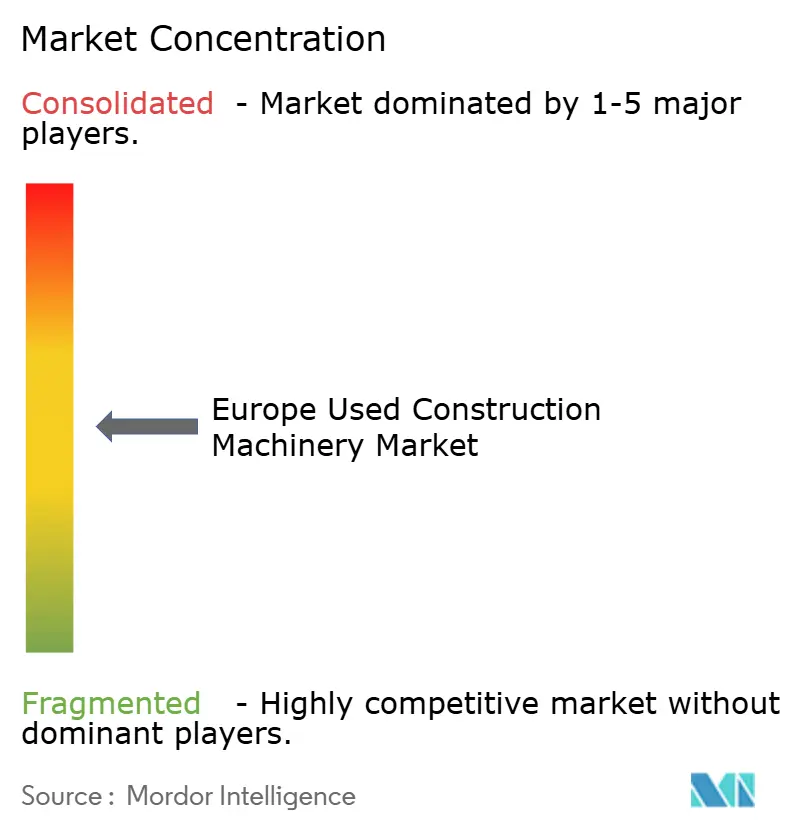
| Market Concentration | Medium |
Major Players *Disclaimer: Major Players sorted in no particular order Image © Mordor Intelligence. Reuse requires attribution under CC BY 4.0. | |
Europe Used Construction Machinery Market Analysis by Mordor Intelligence
The European used construction machinery market size was valued at USD 40.61 billion in 2025, is estimated at USD 42.26 billion in 2026, and is projected to reach USD 51.59 billion by 2031, growing at a CAGR of 4.07% from 2026 to 2031. Sustained EU infrastructure spending, the push to upgrade fleets to meet emissions standards, and liquidity from digital auction platforms that connect Northern European sellers with buyers in the Middle East and North Africa drive the expansion. While higher financing costs cast a shadow on the outlook, public-sector projects and a rental sector favoring older machines bolster transaction volumes. Articulated dump trucks and hybrid compact equipment are leading the growth, driven by infrastructure projects on challenging terrain and stringent ultra-low-emission zone regulations in major cities. As OEMs introduce certified refurbishment programs, the distinction between new and pre-owned offerings blurs, intensifying competition. Simultaneously, online marketplaces are mitigating information gaps and accelerating sales timelines.
Key Report Takeaways
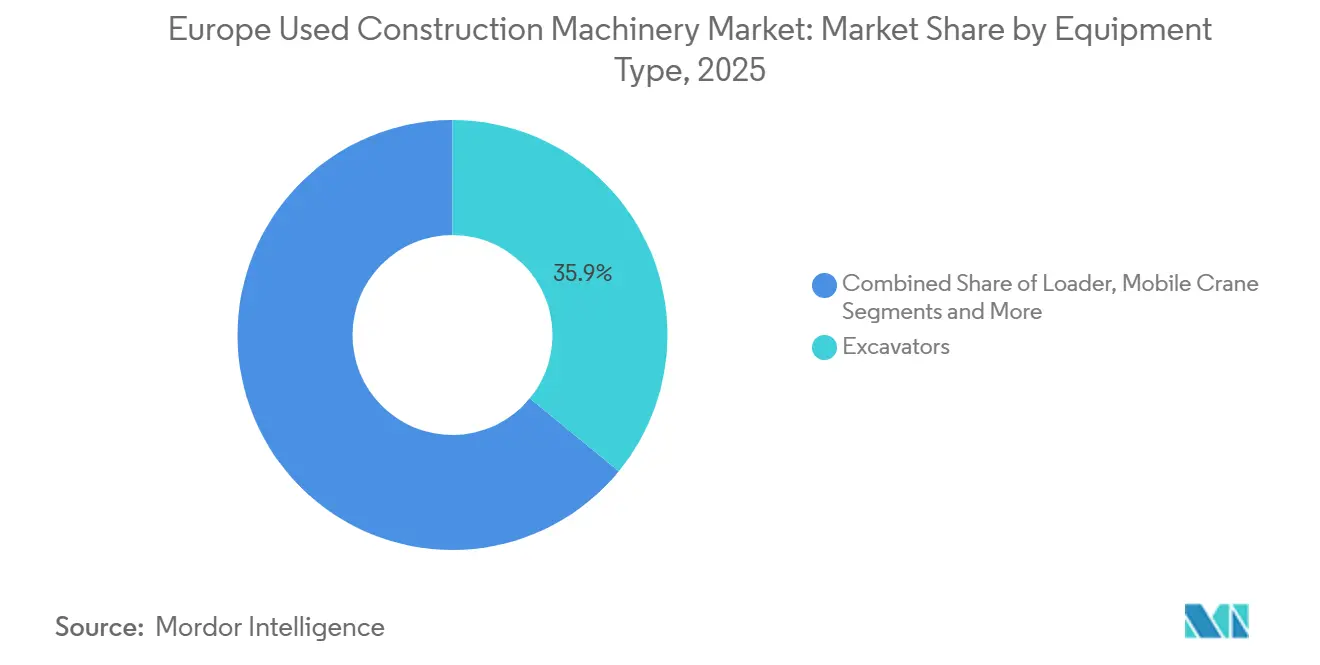
- By equipment type, excavators held 35.92% of the European used construction equipment market share in 2025, whereas dump trucks are projected to post the fastest CAGR of 4.59% through 2031.
- By propulsion, internal-combustion units commanded 89.16% of the installed base in 2025, while hybrid-and-battery models are set to expand at a 6.78% CAGR through 2031.
- By equipment size, heavy machines above 11 tonnes accounted for 46.23% of transactions in 2025; compact machines below 6 tonnes are forecast to climb at a 4.69% CAGR.
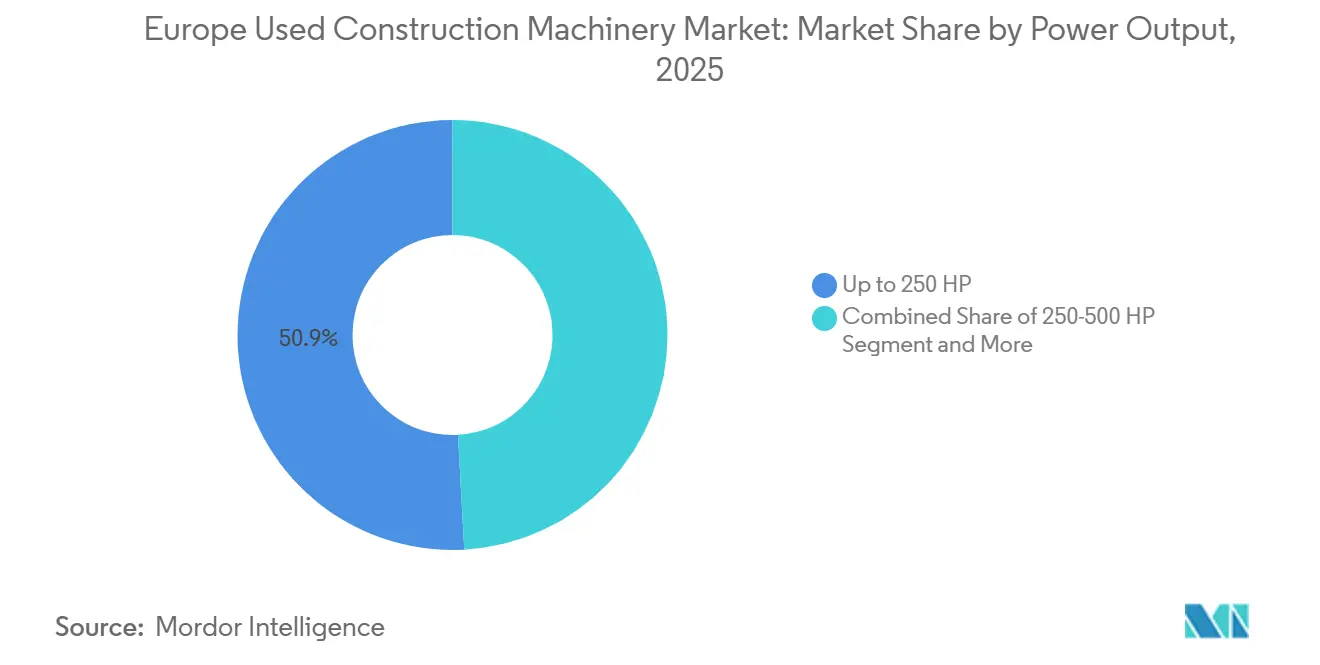
- By power output, units up to 250 horsepower represented 50.97% of volume in 2025, yet the 250–500 horsepower band is growing at 4.62% per year.
- By application, infrastructure projects accounted for 38.53% of the 2025 volume; mining and quarrying are advancing at a 4.79% CAGR as the EU seeks domestic critical-mineral capacity.
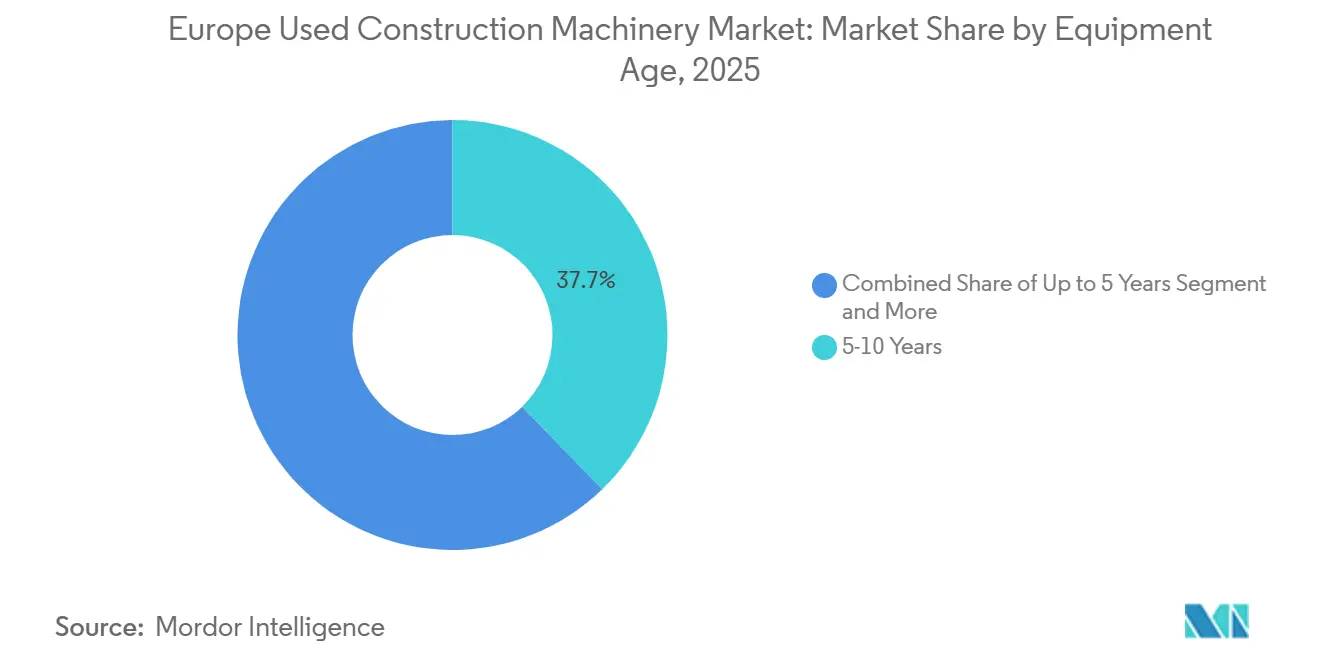
- By equipment age, 5-to-10-year machines captured 37.74% share in 2025 and are on track for a 4.84% CAGR, reflecting buyer preference for residual warranty coverage.
- By sales channel, dealer and broker networks held a 45.79% share in 2025, while online platforms will surge at a 6.23% CAGR on growing MEA demand.
- By country, Germany led with a 25.54% share in 2025, whereas Spain is set to record the quickest 4.91% CAGR as rail and port upgrades accelerate.
Note: Market size and forecast figures in this report are generated using Mordor Intelligence’s proprietary estimation framework, updated with the latest available data and insights as of January 2026.
Market Trends and Insights
Drivers Impact Analysis of Europe Used Construction Machinery Market*
| Driver | (~) % Impact on CAGR Forecast | Geographic Relevance | Impact Timeline |
|---|---|---|---|
| Accelerated EU Infrastructure Stimulus (NextGen, TEN-T) | +0.9% | Pan-European, concentrated in Poland, Spain, Italy | Medium term (2–4 years) |
| Shift to Stage V–Compliant Fleets Drives Renewal | +0.7% | Germany, France, Benelux, Nordics | Short term (≤ 2 years) |
| Digital Auction Platforms Deepen Liquidity | +0.6% | Global, with MEA and APAC buyer concentration | Medium term (2–4 years) |
| Energy-Efficient Renovation Boom (EU Green Deal) | +0.5% | Urban centers across EU-27 | Long term (≥ 4 years) |
| MEA Buyers Exploiting Weak Euro Via Online Bids | +0.4% | Germany, Sweden, Netherlands (export hubs) | Short term (≤ 2 years) |
| OEM Refurbishment + Telematics Subscriptions | +0.3% | Pan-European, led by dealer networks | Medium term (2–4 years) |
| Source: Mordor Intelligence | |||
Accelerated EU Infrastructure Stimulus
The EU’s NextGenerationEU and updated TEN-T guidelines allocate substantial funding to rail tunnels, ports, and highways, favoring high-hour excavators and articulated haulers sourced from the secondary market [1]. Poland's Recovery & Resilience Facility budget has fast-tracked contracts for the Via Carpatia highway, leading to a surge in demand for pre-owned dozers. In Spain, a railway modernization package is driving the acquisition of compact excavators for upgrades at urban stations. Public contractors, navigating procurement limits, are gravitating towards Stage IV machines. This choice not only safeguards the machines' residual value but also encourages more frequent fleet turnover. With a steady project pipeline in sight, resale prices have stabilized, motivating owners to auction off their assets sooner.
Shift to Stage V–Compliant Fleets
The enforcement of Stage V off-road regulations compelled rental firms and major contractors to phase out Tier 3 and Tier 4 interim equipment to sidestep penalties. These regulations limit particulate emissions to below a specific threshold and reduce NOx emissions for engines exceeding a certain power output. Volvo CE revealed that the majority of its deliveries were Stage V machines [2]. However, many pre-Stage V units still operate and are set for resale in the coming years. Stage V units command a significant premium at auctions, while non-compliant diesel units find their way to export markets with more lenient regulations, highlighting a distinct two-tier market. Furthermore, the push for telematics is on the rise, driven by buyers' demands for documented histories of engine hours and emission systems.
Digital Auction Platforms Deepen Liquidity
Buyers across regions can now bid in real-time on fleets through online auctions, cutting out travel expenses. Online platforms have highlighted significant growth in sales, with cross-border transactions making up a substantial portion of the total hammer value. Auctions have noted participation from bidders in multiple countries, with certain regions collectively securing a notable share of the winning bids on vehicles. Enhanced liquidity is narrowing bid-ask spreads and reducing market time, spurring more frequent fleet refresh cycles. While transparent pricing data is squeezing dealer margins, it simultaneously paves the way for added-value services like financing and logistics. Moreover, algorithmic models that factor in usage data are honing residual-value predictions, bolstering buyer confidence in the electric vehicle market.
Energy-Efficient Renovation Boom
The Green Deal's Renovation Wave targets increasing annual building renovation rates and aims to retrofit millions of units. France's MaPrimeRénov' allocated significant funding, while Germany's BEG scheme invested heavily, focusing on insulation and heat-pump upgrades. Urban projects increasingly rely on compact excavators, loaders, and telehandlers, emphasizing maneuverability in tight spaces and adherence to low-noise regulations. As a result, rental fleets are leaning towards electric and hybrid models. Notably, Wacker Neuson reported strong adoption of its zero-emission compact line—this push to renovate bolsters the residual values of battery-electric units, solidifying their emerging secondary market.
Restraints Impact Analysis of Europe Used Construction Machinery Market*
| Restraint | (~) Impact on CAGR Forecast | Geographic Relevance | Impact Timeline |
|---|---|---|---|
| Construction-Capex Volatility Amid High Rates | -0.5% | Pan-European, acute in peripheral economies | Short term (≤ 2 years) |
| Ultra-Low-Emission Zones Hurt Older Diesel Values | -0.4% | London, Paris, Milan, Madrid, Brussels | Medium term (2–4 years) |
| Export Freight-Rate Spikes Squeeze Margins | -0.3% | Germany, Netherlands, Belgium (export hubs) | Short term (≤ 2 years) |
| Influx of Low-Cost Rebuilt Chinese Equipment | -0.2% | Southern and Eastern Europe | Medium term (2–4 years) |
| Source: Mordor Intelligence | |||
Construction-Capex Volatility Amid High Rates
The European Central Bank held its deposit rate steady after significant tightening, leading mortgage rates to surpass levels seen in major markets. Eurostat highlighted a decline in eurozone construction output, driven primarily by falls in the residential sector [3]. Dealers, facing higher inventories, exert downward pressure on mid-tier residual values. Countries like Italy and Greece grapple with widening sovereign-debt spreads, postponed infrastructure tenders, and extended replacement cycles. While rental firms shifted their fleets toward logistics and warehouse projects, the change in equipment mix only partially mitigated the downturn in civil works. In the electric vehicle market, rental firms are increasingly focusing on integrating EVs into their fleets to align with sustainability goals and evolving consumer preferences.
Ultra-Low-Emission Zones Depress Older-Diesel Values
London's ULEZ expansion, along with similar initiatives in Paris, Milan, and Brussels, now levies daily charges on non-compliant machines. This move is hastening the depreciation of Tier 3 excavators. In Paris, the Zone à Faibles Émissions has outright banned diesel construction equipment with a Crit'Air 3 rating. Such regulatory fragmentation poses challenges for cross-border redeployment. For instance, a Stage IV unit might be permissible in Poland but could face penalties in Amsterdam, thereby limiting its potential buyer pool. Smaller contractors, who often lack the capital to renew their fleets, are feeling the brunt of these changes. This dynamic is further solidifying a market in which compliant machines command higher premiums.
*Our forecasts treat driver/restraint impacts as directional, not additive. The impact forecasts reflect baseline growth, mix effects, and variable interactions.
Europe Used Construction Machinery Market Segment Analysis
By Equipment Type:
Excavators Anchor Leadership While Dump Trucks AccelerateThe excavator category captured 35.92% of the European used construction equipment market in 2025, reflecting a broad installed base and versatility across civil works, demolition, and utilities. Fleet owners capitalized on excavators, achieving the highest resale liquidity. This allowed them to rotate units periodically at robust prices. Following excavators and loaders, the category of loaders captured a significant share, primarily serving quarries and material-handling tasks. Meanwhile, cranes and graders occupied mid-single-digit market positions.
Dump trucks are the fastest-growing segment, with a 4.59% CAGR to 2031, as contractors favor articulated haulers that navigate Scandinavian fjord terrain and Alpine gradients. Volvo's A45G, boasting a six-wheel drive, makes its debut on the secondary market after several rental cycles. Even with a significant discount, it still delivers notable payload productivity. As the articulated segment grows, it's reshaping residual-value curves. This change has prompted auctioneers in Germany and Belgium to launch dedicated hauler rings in their quarterly events.

By Propulsion Type:
Hybrids and Electrics Earn ShareInternal-combustion powertrains retained 89.16% market share in 2025, underscoring diesel’s superior energy density for heavy machines deployed on multi-shift quarry operations. However, the hybrid-and-battery cohort is expanding at 6.78% per year, led by compact excavators where overnight charging suffices for daily duty cycles. In European trials, Caterpillar's diesel-electric D6 XE dozer showcased significant fuel savings. However, its steeper upfront price tag has confined its adoption primarily to larger contractors with a sustainability focus.
Electric adoption is surging, particularly in mini-excavators and skid-steers. Volvo's ECR25 Electric is fetching premium prices at auctions, largely because its low-hour units allow urban contractors to sidestep emissions-related fees. While buyers typically discount electrics with higher charge cycles to account for potential battery-pack replacements, the pricing process is becoming more refined. This is largely due to the increasing standardization of telematics data disclosures, which now commonly include state-of-charge and cycle history at auctions.
By Equipment Size:
Heavy Machines Dominant, Compacts RiseHeavy units above 11 tonnes accounted for 46.23% of 2025 transactions, owing to large-scale infrastructure projects such as the Fehmarnbelt Tunnel between Germany and Denmark, while sub-6-tonne compacts will post the fastest 4.69% CAGR on urban-infill and renovation demand.
Rental companies typically refresh their compact fleets on regular cycles. This routine results in a significant influx of low-hour Takeuchi TB216 and Bobcat E10e units entering auction channels. Meanwhile, in the heavy machinery segment, Liebherr's R 980 SME mining excavator, after extended use at quarry sites, makes its debut in the secondary market. Despite trading at a discount to its new list price, the excavator continues to see robust demand, particularly from Polish and Portuguese operators seeking bucket capacities exceeding 6 m³.
By Power Output:
Mid-Range Band Gains TractionUnits up to 250 horsepower controlled 50.97% of volume in 2025, catering to residential builds, landscaping, and utilities. The 250–500 horsepower band is growing at 4.62% annually in highway rehabilitation projects that require mid-size graders and loaders. Regional contractors find the perfect balance of fuel efficiency and productivity in Caterpillar’s 140 AWD motor grader and Volvo’s L120H loader.
Machines with high horsepower are predominantly found in Scandinavian mines and Iberian quarries. While high fuel consumption and component-replacement costs narrow the buyer pool, telematics packages that highlight engine-load factors and maintenance histories are mitigating risks for funding partners. As the electric vehicle market progresses, this high-horsepower segment is expected to maintain its price floor, even as electrification advances in lighter classes.
By Application:
Infrastructure Leads, Mining AcceleratesInfrastructure accounted for 38.53% of 2025 sales, driven by TEN-T corridor upgrades and renewable-energy installations that require continuous excavator deployment. Residential and commercial projects accounted for a significant share but face headwinds from high mortgage rates, shifting the focus toward energy-efficient renovations that use compact equipment mixes.
Mining and quarrying will grow at a 4.79% CAGR as the Critical Raw Materials Act pushes domestic lithium and rare-earth extraction. Surface-mine operators often favor five- to eight-year-old machines to minimize depreciation on short project horizons, driving cross-border trade from Germany and Sweden into Portugal and Czechia.
By Equipment Age:
Mid-Life Units PreferredMachines aged five to ten years held a 37.74% share in 2025 and are forecast to advance at a 4.84% CAGR as buyers seek residual warranty coverage with fewer risks of electronic-control-unit obsolescence. Caterpillar’s Certified Rebuild program and Volvo’s Certified Used Equipment scheme underpin demand by extending warranties and adding predictive analytics subscriptions.
Lease returns and rental roll-offs frequently send newer units, accounting for a significant portion of the volume, to auction blocks. In Southern and Eastern Europe, price-sensitive buyers show a preference for older machines, but these face accelerated depreciation if emission regulations become stricter. While much older units typically end up in parts-harvesting or scrap channels, a few diesel models still fetch premium prices in North Africa.
By Sales Channel:
Dealer Networks Firm, Online Platforms SurgeDealer and broker networks retained a 45.79% share in 2025 by bundling finance, warranty, and telematics services. Online marketplaces accounted for a significant share of 2025 transactions and will grow at 6.23% per year as MEA buyers take advantage of the weak euro.
Platforms like Mascus and MachineryZone attract significant monthly visitors, and SGS remote-inspection services further reduce geographic barriers by providing video, photogrammetry, and oil-sample analysis that satisfy buyer due diligence.
Geography Analysis
Germany Used Construction Machinery Market
Germany maintained a 25.54% share in 2025, supported by Ritchie Bros.’Meppen site auctioned several units, while dealer networks like Zeppelin and Kiesel provided certified refurbishments. Being close to Poland and Austria allows for quick cross-border logistics; notably, a significant portion of domestically sold units are re-exported within a short period.
Western Europe Used Construction Machinery Market
The United Kingdom, benefiting from a strong rental-fleet churn by Sunbelt and Speedy, accounted for a notable share of the market, with low-hour compact machines predominantly moving to Ireland and Scandinavia. Meanwhile, France, Italy, and Spain accounted for a significant share of transactions. Spain will post the fastest 4.91% CAGR, driven by the Madrid-Extremadura high-speed rail link and port expansions in Barcelona and Valencia, which are boosting demand for articulated haulers and wheeled loaders.
Northern and Central Europe Used Construction Machinery Market
Sweden's forestry and mining sectors are driving demand for six-wheel articulated dump trucks designed to operate in sub-zero conditions. Poland's stimulus package is hastening the acquisition of used Stage IV machines from German fleets. Meanwhile, the Netherlands and Belgium have established themselves as re-export hubs, with Rotterdam managing a significant volume of used machines, marking a notable year-on-year increase.
Competitive Landscape
The top OEM-linked dealers and auction houses captured an estimated share of transaction value, highlighting moderate market fragmentation. Caterpillar, which processes European Certified Rebuild units, not only extended powertrain warranties but also commanded a premium over its non-certified counterparts. Meanwhile, Volvo CE's Certified Used program saw robust growth, bolstered by bundling CareTrack telematics subscriptions, ensuring a steady stream of recurring data fees.
Liebherr inaugurated a specialized refurbishment facility in Kirchdorf an der Iller, boasting an annual capacity for units. This facility, targeting excavators and cranes, offers a warranty and incorporates LiDAT telemetry. JCB, with its hydrogen combustion engine launched commercially, strategically positions itself in zero-carbon niches, especially where battery weight could compromise payload.
Online platforms are amplifying price transparency in the market. Ritchie Bros.' acquisition of Euro Auctions' digital assets significantly increased its European online hammer capacity. Listings on Mascus surged, with algorithmic pricing guiding sellers to optimal asking prices. Additionally, third-party remote inspections by SGS and Bureau Veritas bolster confidence, enabling smaller dealers to connect with cross-border buyers even without a physical yard presence.
Europe Used Construction Machinery Industry Leaders
-
Deere & Company
-
Kobelco Construction Machinery
-
Komatsu Ltd.
-
Volvo Construction Equipment
-
Caterpillar Inc.
- *Disclaimer: Major Players sorted in no particular order
Europe Used Construction Machinery Market Companies Covered in this Report
- Caterpillar Inc.
- Volvo Construction Equipment
- Liebherr-International Deutschland GmbH
- Komatsu Ltd.
- JCB Ltd.
- Hitachi Construction Machinery
- Deere & Company
- Kobelco Construction Machinery
- CNH Industrial (CASE)
- Wacker Neuson SE
- Kubota Corp.
- Doosan Infracore
- Hyundai Construction Equipment
- SANY Group
- Manitou Group
- Terex Corporation
- Yanmar CE
- Atlas GmbH
Read Analysis of Europe Used Construction Machinery Companies
Recent Industry Developments in Europe Used Construction Machinery Market
- July 2026: The EU allocated EUR 134.9 million (USD 141.65 million) in funding to 15 European infrastructure projects under the Public Sector Loan Facility, driving the adoption of used construction machinery across member states. This funding initiative supports the integration of pre-owned equipment into large-scale infrastructure developments, reducing capital expenditure while maintaining operational efficiency.
- March 2025: In 2025, the Commission introduced 47 Strategic Projects to enhance domestic capabilities in strategic raw materials, strengthen the European value chain, and diversify supply sources—key for the used construction machinery market. These projects mark progress toward the Critical Raw Material Act (CRMA) goals. By 2030, the CRMA aims for Europe to extract, process, and recycle 10%, 40%, and 25% of the EU's demand, respectively, ensuring a stable supply for industries like used construction machinery.
Europe Used Construction Machinery Market Report Scope
The Europe used construction equipment market report is segmented by equipment type (excavator, loader, mobile cranes, motor graders, bulldozers, road rollers, dump trucks, and others), propulsion type (internal combustion, hybrid/battery-electric, and hydrogen fuel-cell), equipment size (heavy, medium, and compact/mini), power output (up to 250 hp, 250–500 hp, and above 500 hp), application (infrastructure, residential and commercial construction, mining and quarrying, oil and gas/pipelines, industrial and manufacturing, and others), equipment age (below 5 years, 5-10 years, 10-15 years, and above 15 years), sales channel (dealer/broker, auction, and online platforms), and country (Germany, United Kingdom, France, Italy, Spain, Sweden, and Rest of Europe). Market forecasts are provided in terms of value (USD) and volume (units).
Segmentation Overview
| Excavator |
| Loader |
| Mobile Cranes |
| Motor Graders |
| Bulldozers |
| Road Rollers |
| Dump Trucks |
| Others |
| Internal Combustion |
| Hybrid / Battery-Electric |
| Hydrogen Fuel-Cell |
| Heavy (Above 11 t) |
| Medium (6-11 t) |
| Compact / Mini (Below 6 t) |
| Up to 250 HP |
| 250 - 500 HP |
| Above 500 HP |
| Infrastructure |
| Residential and Commercial Construction |
| Mining and Quarrying |
| Oil and Gas / Pipelines |
| Industrial and Manufacturing |
| Others |
| Below 5 Years |
| 5 - 10 Years |
| 10 - 15 Years |
| Above 15 Years |
| Dealer / Broker |
| Auction |
| Online Platforms |
| Germany |
| United Kingdom |
| France |
| Italy |
| Spain |
| Sweden |
| Rest of Europe |
| By Equipment Type | Excavator |
| Loader | |
| Mobile Cranes | |
| Motor Graders | |
| Bulldozers | |
| Road Rollers | |
| Dump Trucks | |
| Others | |
| By Propulsion Type | Internal Combustion |
| Hybrid / Battery-Electric | |
| Hydrogen Fuel-Cell | |
| By Equipment Size | Heavy (Above 11 t) |
| Medium (6-11 t) | |
| Compact / Mini (Below 6 t) | |
| By Power Output | Up to 250 HP |
| 250 - 500 HP | |
| Above 500 HP | |
| By Application | Infrastructure |
| Residential and Commercial Construction | |
| Mining and Quarrying | |
| Oil and Gas / Pipelines | |
| Industrial and Manufacturing | |
| Others | |
| By Equipment Age | Below 5 Years |
| 5 - 10 Years | |
| 10 - 15 Years | |
| Above 15 Years | |
| By Sales Channel | Dealer / Broker |
| Auction | |
| Online Platforms | |
| By Country | Germany |
| United Kingdom | |
| France | |
| Italy | |
| Spain | |
| Sweden | |
| Rest of Europe |
Key Questions Answered in the Report
How large is the Europe used construction equipment market in 2026?
The sector is valued at USD 42.26 billion in 2026 and is forecast to reach USD 51.59 billion by 2031.
Which equipment category contributes the most sales?
Excavators remain the largest category, accounting for 35.92% of 2025 transactions across the region.
Which propulsion type is growing fastest in secondary equipment sales?
Hybrid and battery-electric machines are expanding at a 6.78% CAGR, gaining share mainly in compact classes.
Which country shows the highest growth potential to 2031?
Spain is projected to deliver a 4.91% CAGR, supported by rail and port upgrades funded under its Recovery, Transformation and Resilience Plan.
How are online auction platforms influencing prices?
Digital auctions broaden the bidder base, compress bid-ask spreads, and shorten the time required to liquidate assets, encouraging more frequent fleet turnover.