
Europe SOC As A Service (SOCaaS) Market Size and Share
Market Overview
| Study Period | 2020 - 2031 |
|---|---|
| Forecast Data Period | 2026 - 2031 |
| Base Year Market Size (2025) | USD 3.54 Billion |
| Market Size (2026) | USD 4.14 Billion |
| Market Size (2031) | USD 8.18 Billion |
| Growth Rate (2026 - 2031) | 14.59 % |
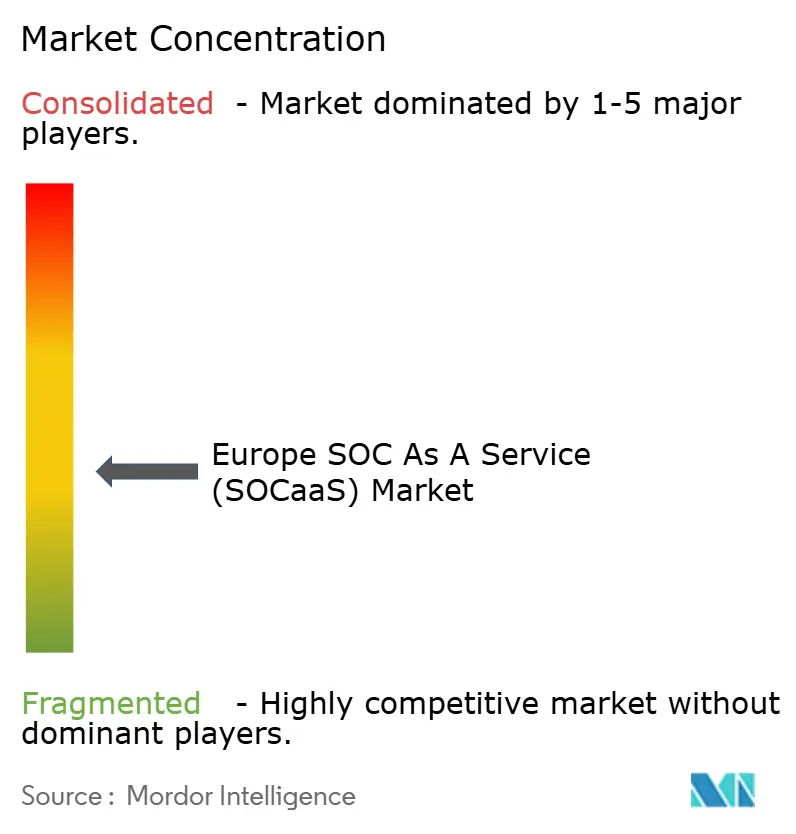
| Market Concentration | Medium |
Major Players *Disclaimer: Major Players sorted in no particular order Image © Mordor Intelligence. Reuse requires attribution under CC BY 4.0. | |
Europe SOC As A Service (SOCaaS) Market Analysis by Mordor Intelligence
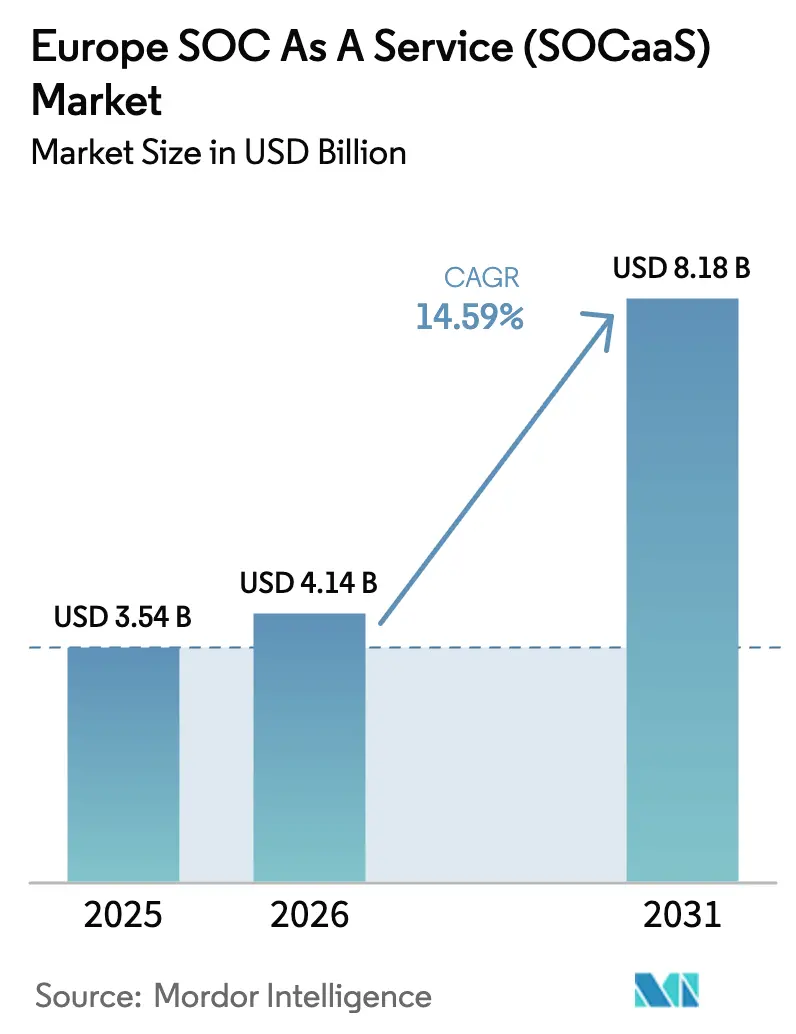
The Europe SOC As a Service market size is projected to be USD 3.54 billion in 2025, USD 4.14 billion in 2026, and reach USD 8.18 billion by 2031, growing at a CAGR of 14.59% from 2026 to 2031. Rapid adoption of consumption-based security models, the legally binding NIS2 incident reporting timelines, and the spread of generative-AI-driven detection tools are collectively reshaping budget priorities. Enterprises now view outsourced monitoring as an operating expense that scales with business activity rather than a capital project. Telcos and cloud providers bundle extended detection and response into connectivity contracts, squeezing point solution vendors but widening the addressable base of mid-market buyers. Sovereign cloud requirements in Germany and France further stimulate domestic hosting investments, tilting competitive advantage toward providers with in-region data centers. Finally, cyber-insurance underwriters now tie policy issuance to proof of 24x7 monitoring, turning SOCaaS into a prerequisite rather than an optional add-on.
Key Report Takeaways
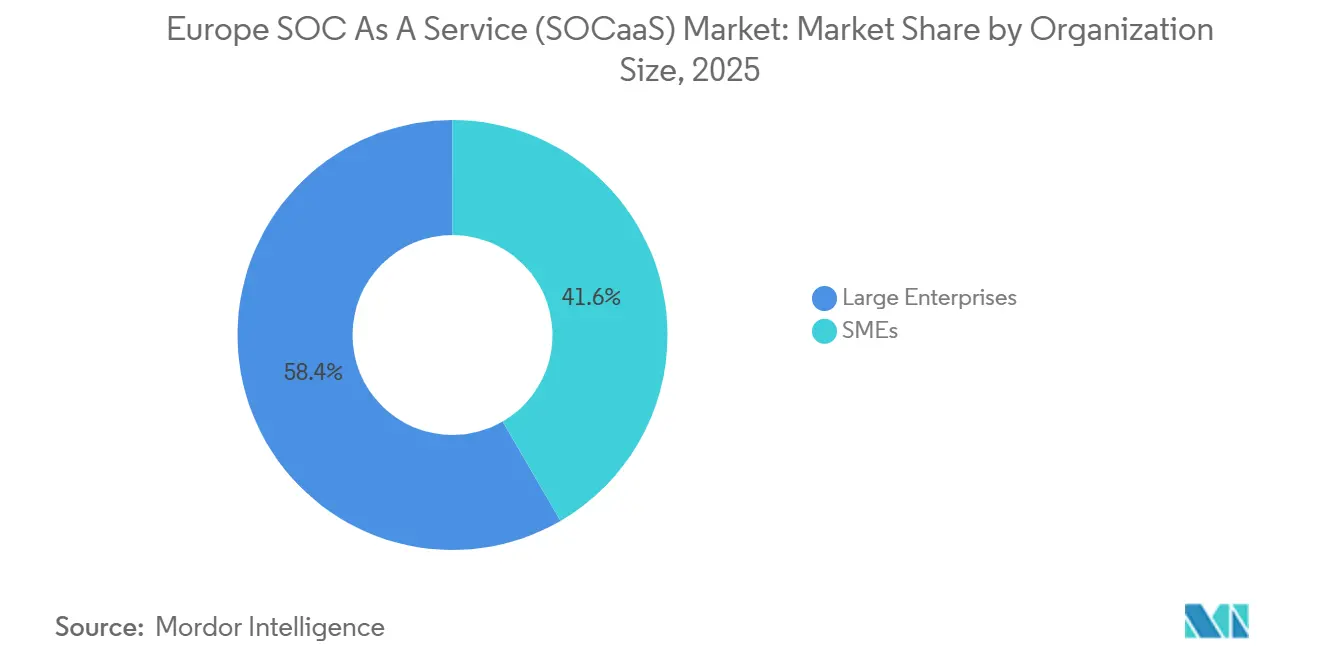
- By organization size, large enterprises led with 58.38% of Europe SOC As A Service market share in 2025, while small and medium-sized enterprises are forecast to grow at a 15.68% CAGR through 2031.
- By end user, banking, financial services, and insurance held 24.53% revenue share in 2025, yet healthcare is advancing at a 15.01% CAGR to 2031.
- By service type, managed detection and response captured 32.27% of the Europe SOC As A Service market size in 2025, and threat intelligence is set to rise at a 15.84% CAGR over 2026-2031.
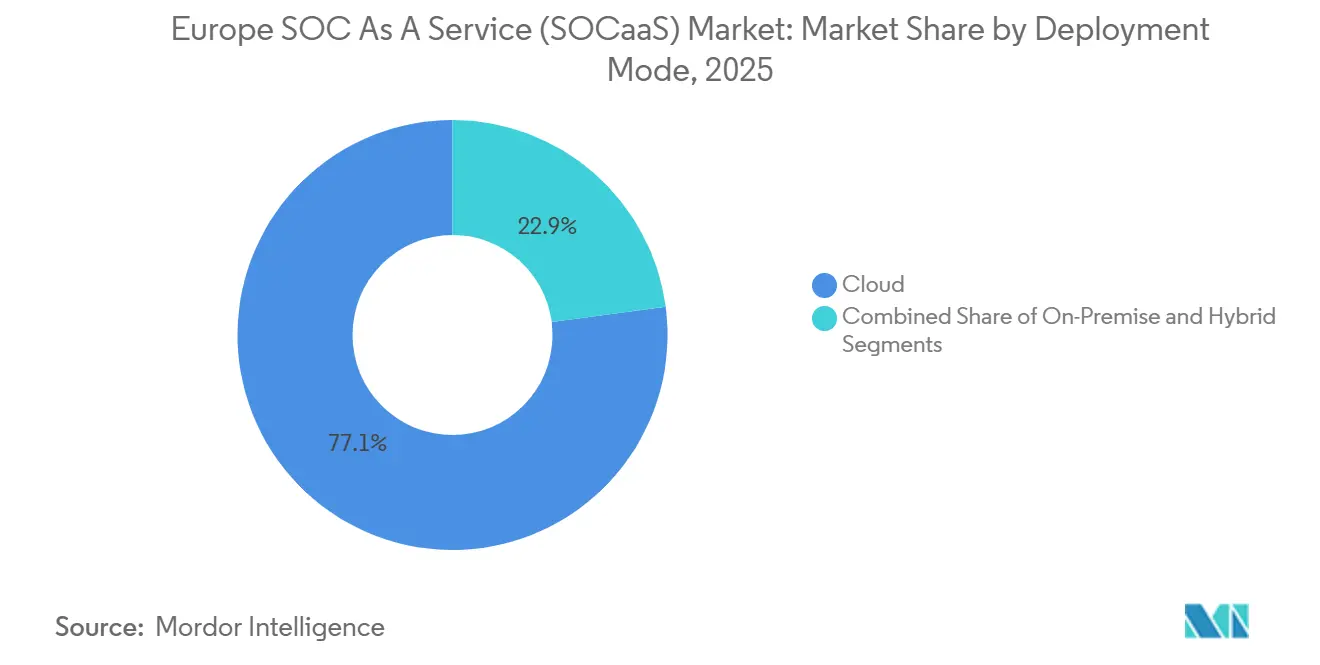
- By deployment mode, cloud implementations accounted for 77.09% of spending in 2025, while hybrid configurations expanded at a 14.89% CAGR across the forecast horizon.
- By security type, network security commanded 29.41% share of the Europe SOC As A Service market size in 2025 and cloud security is projected to climb at 14.96% CAGR to 2031.
Note: Market size and forecast figures in this report are generated using Mordor Intelligence’s proprietary estimation framework, updated with the latest available data and insights as of 2026.
Europe SOC As A Service (SOCaaS) Market Trends and Insights
Drivers Impact Analysis*
| Driver | (~) % Impact on CAGR Forecast | Geographic Relevance | Impact Timeline |
|---|---|---|---|
| Rise in Adoption of Pay-per-Use Opex Model | +1.80% | Pan-European, strongest in SME-dense economies such as Italy, Spain, Poland | Medium term (2-4 years) |
| Rapid Cloud Migration Among SMEs | +2.30% | Germany, France, Netherlands, Nordics with high SaaS penetration | Short term (≤ 2 years) |
| Mounting Cyber-Insurance Prerequisites for 24x7 Monitoring | +1.50% | United Kingdom, Germany, France where cyber-insurance adoption exceeds 40% | Medium term (2-4 years) |
| EU NIS2 Directive Amplifying Compliance Demand | +3.10% | All EU member states, acute in critical infrastructure sectors | Short term (≤ 2 years) |
| Generative AI-Powered Threat Hunting Capabilities | +2.00% | Early adopters in Nordics, Germany, United Kingdom | Medium term (2-4 years) |
| Surge in Managed XDR Bundling by Telcos and MSPs | +1.90% | Markets with incumbent telco dominance: Spain, France, Italy | Short term (≤ 2 years) |
| Increasing Availability of Sovereign European Clouds | +1.70% | Germany, France, Netherlands with national data-sovereignty mandates | Long term (≥ 4 years) |
| Source: Mordor Intelligence | |||
EU NIS2 Compliance Mandate
NIS2 widened the pool of regulated entities from roughly 2,000 to more than 160,000, compelling even mid-sized utilities, hospitals, and transport operators to maintain continuous monitoring or face fines up to EUR 10 million (USD 10.7 million).[1]European Union Agency for Cybersecurity, “NIS2 Directive Overview,” enisa.europa.eu As few of these organizations can staff an in-house SOC around the clock, providers offering audit ready dashboards and automated incident reporting enjoy a sustained demand floor. German and French regulators reinforce the directive with national data-residency rules, effectively steering contracts toward vendors running data centers inside each country. Compared with the United States three-day reporting allowance, Europe’s 24-hour window increases urgency and justifies premium pricing for AI enhanced detection.
Rapid Cloud Migration Among SMEs
Eurostat recorded that 45% of EU firms with 10-249 employees used cloud services in 2024, up from 38% three years earlier.[2]European Data Protection Board, “EU Cloud Code of Conduct,” edpb.europa.eu This expansion dissolves the traditional perimeter, exposing identity and API layers that legacy firewalls miss. Budget constrained SMEs rarely field a dedicated security professional yet face the same ransomware surge as larger peers. Onboarding to SOCaaS platforms that auto-discover workloads inside Microsoft 365 or Google Workspace therefore offers high protection for a predictable monthly fee. Average total cost of ownership, including tooling and staff, runs roughly one-sixth of an in-house build, creating a clear economic argument.
Generative-AI Threat Hunting
Commercial SOC platforms embedded with large language models let junior analysts query logs in plain English, draft remediation scripts, and summarize incidents for executives. Microsoft Security Copilot pilots show phishing triage falling from 45 minutes to under 5 minutes.[3]Microsoft Investor Relations, “Security Copilot Pilot Results,” microsoft.com Faster triage shrinks attacker dwell time, reducing ransom leverage and regulatory penalties. Providers differentiate by fine-tuning models on European legal texts so that auto-generated reports align with NIS2 and GDPR language, removing hours of manual compliance work. The same models train on fresh threat intelligence every few hours, giving mid-market customers a level of analytical depth once reserved for global banks.
XDR Bundling by Telcos and MSPs
Incumbent telecom operators’ pair extended detection and response with connectivity, software defined wide area networking, and cloud hosting. Telefonica Tech reported 32% cybersecurity revenue growth in 2025 after packaging XDR with SD-WAN across Spain.[4]Telefonica, “Annual Report 2025,” telefonica.com Orange Cyberdefense injects network telemetry from its backbone into correlation engines, spotting anomalies before they cross into customer endpoints. These models let telcos monetize existing infrastructure, drop marginal delivery costs, and undercut standalone security vendors on price.
Restraints Impact Analysis*
| Restraint | (~) % Impact on CAGR Forecast | Geographic Relevance | Impact Timeline |
|---|---|---|---|
| Data Residency and Sovereignty Complexities | -1.20% | Germany, France, Austria with strict localization mandates | Medium term (2-4 years) |
| Scarcity of European SOC-Grade Cyber Talent | -1.50% | Pan-European, acute in Eastern Europe and Southern Europe | Long term (≥ 4 years) |
| Hidden Long-Term TCO in Multi-Tenant SIEM | -0.80% | Cost-sensitive SMEs in Southern and Eastern Europe | Medium term (2-4 years) |
| Integration Friction with Legacy OT Environments | -0.90% | Manufacturing hubs in Germany, Italy, Czech Republic | Long term (≥ 4 years) |
| Source: Mordor Intelligence | |||
Cyber Talent Scarcity
Europe lacked roughly 350,000 cybersecurity professionals in 2025, and median hiring time for a tier-two analyst exceeded four months in major economies. Wage inflation raises provider costs, and some vendors cap new customer intake until staffing pipelines catch up. Solutions include near-shoring to Romania and Bulgaria, heavy automation, and university partnerships like Orange Cyberdefense’s dual-track master’s program targeting 200 graduates per year by 2027. Despite these tactics, limited headcount slows onboarding speed and can constrain service quality during major incident surges.
Data Residency and Sovereignty Rules
German, French, and Austrian regulations compel providers to store logs within national borders and forbid access by non-EU legal entities. Vendors must maintain separate data planes and analyst pools, raising capital requirements and operational complexity. Multinationals operating across several jurisdictions end up stitching together multiple SOC feeds, which can increase mean time to detect. Sovereign cloud initiatives such as Gaia-X promise relief but have slipped behind schedule, so compliance remains a moving target through the medium term.
*Our forecasts treat driver/restraint impacts as directional, not additive. The impact forecasts reflect baseline growth, mix effects, and variable interactions.
Segment Analysis
By Organization Size: SMEs Widen Growth Lead
Small and medium-sized enterprises account for a modest portion of total spending today, yet they are forecast to grow at a 15.68% CAGR between 2026 and 2031, overtaking large enterprises in incremental demand. Many SMEs came under NIS2 jurisdiction only in 2024, triggering a scramble for affordable 24x7 monitoring. Arctic Wolf’s fixed-fee bundle at USD 5,000 per month, launched in 2025, removes unpredictable event-volume pricing and resonates with firms managing fewer than 250 users. In contrast, large enterprises that already run internal SOCs primarily outsource burst capacity or specialized functions, which tempers their growth rate. Nonetheless, big firms still represent 58.38% of Europe's SOC As A Service market share in 2025 because their infrastructures span multiple data centers, clouds, and operational technology networks.
Providers deploy separate go-to-market motions. For SMEs, vendors stress time to value, guided setup wizards, and pre-configured playbooks that attach to Microsoft 365 and Salesforce without professional services. For global conglomerates, contracts revolve around bespoke service level agreements, threat intelligence subscriptions, and executive tabletop exercises. As a result, the Europe SOC As A Service market size captured by SMEs is expected to almost triple by 2031, while large enterprise spending roughly doubles.


By End User: Healthcare Accelerates
Banking financial services and insurance entities remain the top spenders, holding 24.53% of revenue in 2025 thanks to the Digital Operational Resilience Act. Yet healthcare is the fastest climber, advancing at 15.01% CAGR through 2031. Ransomware campaigns targeting hospitals rose 210% between 2023 and 2025, forcing clinical networks that historically underinvested in cybersecurity to sign multi-year SOCaaS contracts. Insurance renewals now require documented 24x7 monitoring, driving up funnel conversion.
Meanwhile, manufacturing firms struggle to integrate legacy programmable logic controllers that lack logging, slowing uptake but opening niche demand for OT aware offerings like Fortinet’s 2025 FortiSOC launch. Government buyers expand as national budgets allocate ring fenced funds, but procurement fragmentation across municipalities tempers immediate adoption.
By Service Type: Threat Intelligence Outpaces
Managed detection and response is foundational, securing 32.27% share in 2025. However, threat intelligence subscriptions grow faster at 15.84% because enterprises increasingly seek early warning of industry specific adversaries. IBM X-Force and Thales publish sector tailored feeds that customers ingest directly into SIEM correlation engines. Security monitoring alone, chosen by clients retaining in-house response teams, expands steadily but below the market average.
Incident response retainers sell briskly amid rising ransomware, with per incident fees sometimes exceeding USD 200,000. Managed SIEM demand softens as cloud native stacks reduce infrastructure footprints, though certain heavily regulated banks still prefer provider operated SIEMs for audit familiarity.
By Deployment Mode: Hybrid Picks Up Pace
Cloud deployments dominate, making up 77.09% of the total, underscoring the appeal of scalability and operational expenditure alignment in multi-tenant platforms. These platforms allow businesses to scale their operations efficiently while optimizing costs, making them a preferred choice across various industries. However, hybrid models, which meld on-premises collectors with cloud analytics, are witnessing a robust growth rate of 14.89% CAGR. This growth is driven by the need for flexibility and the ability to balance data processing between local and cloud environments. Industries such as manufacturing, utilities, and transportation are channeling sanitized logs from their operational technology into cloud engines, but only after a local preprocessing step to ensure latency and safety. This preprocessing ensures that sensitive data is handled securely while maintaining real-time operational efficiency.
The introduction of the EU Cloud Code of Conduct certification in 2025 bolsters the confidence of risk officers, facilitating the transition of analytics workloads off-site. This certification provides a standardized framework for data protection and compliance, addressing key concerns for organizations operating in regulated environments. While the trend leans away from pure on-premises adoption, sovereign agencies managing classified data still have a pressing need for air-gapped appliances. These agencies prioritize security and data sovereignty, necessitating solutions that operate independently of external networks. This niche demand is being met by the innovative "portable SOC in a box" solution, which offers a compact and secure option for managing sensitive data in isolated environments.

By Security Type: Cloud Centric Controls Rise
In 2025, network security commanded 29.41% of the spending, but its growth is waning. This shift is largely attributed to the rise of zero trust architectures, which are moving control points away from traditional perimeter firewalls and towards identities and workloads. Zero trust architectures emphasize the principle of "never trust, always verify," requiring continuous authentication and authorization for users and devices, which reduces reliance on perimeter-based security models. Meanwhile, cloud security is making significant strides, boasting a robust 14.96% CAGR. This growth is driven by the increasing adoption of cloud-native applications and the migration of workloads to cloud environments. Key controls like cloud security posture management, container runtime protection, and identity governance are not just standalone measures; they actively feed telemetry into Security Operations Center (SOC) workstreams.
This integration is enhancing the prominence of preventative alerts, overshadowing traditional network anomaly logs. These preventative alerts enable SOC teams to proactively address potential threats, reducing response times and improving overall security posture. Endpoint detection remains a linchpin in the SOC playbook, underscoring the importance of host-level containment and memory forensics. Endpoint detection and response (EDR) solutions are critical for identifying and mitigating threats at the device level, ensuring that compromised endpoints are swiftly isolated to prevent lateral movement within networks. As microservices become ubiquitous and developers increasingly expose APIs, application security is gaining traction. This surge in demand is particularly evident for runtime self-protection monitoring. Runtime application self-protection (RASP) solutions provide real-time protection by detecting and blocking attacks as they occur within applications. The proliferation of APIs, driven by the need for seamless integration and communication between services, has heightened the risk of vulnerabilities, making robust application security measures indispensable for organizations.
Geography Analysis
Germany, the United Kingdom, and France collectively generated more than half of Europe SOC As A Service market revenue in 2025. Germany’s March 2025 procurement rule requiring in-country hosting funnelled contracts to PlusServer and Orange Cyberdefense, while limiting bids from non-European vendors. The United Kingdom’s National Cyber Security Centre earmarked GBP 200 million (USD 253 million) to extend SOCaaS access to local councils, enlarging the public sector pool. France’s ANSSI demanded residency and annual audits, further localizing vendor selection.
The Netherlands and Sweden emerge as innovation hubs. Amsterdam’s dense data center cluster attracts IBM, NTT Security, and Cloudflare SOC investments, and Dutch tax incentives trim setup costs. Stockholm benefits from high fiber penetration and cloud usage, making Nordic midsize enterprises early adopters of AI infused SOC platforms. Spain and Italy ride national recovery and resilience funds amounting to EUR 1.2 billion (USD 1.28 billion) and EUR 900 million (USD 963 million) respectively, channelling grants toward municipal SOC procurement and SME subsidies.
Central and Eastern European markets, including Poland and the Czech Republic, show smaller absolute spending yet record high growth rates as voucher programs and sector guidance close the maturity gap. Poland’s August 2025 cybersecurity voucher covers up to EUR 50,000 (USD 53,500) for SME adoption, and Czech energy regulators publish OT security checklists. As regional digital transformation accelerates, the share of Europe SOC As A Service market size attributed to these economies will edge upward though Western Europe remains dominant.
Regulatory Landscape
The Europe SOC as a Service (SOCaaS) market operates within a tightening EU cybersecurity compliance framework led by the NIS2 Directive (Directive (EU) 2022/2555). NIS2 brings managed security service providers and cloud computing providers into scope and expands the number of regulated entities to more than 160,000. The directive has been further operationalized through Commission Implementing Regulation (EU) 2024/2690 (October 2024), which raises the specificity of technical and procedural expectations for regulated organizations and their security suppliers, including incident handling and reporting readiness.
For financial-sector buyers, the Digital Operational Resilience Act (DORA, Regulation (EU) 2022/2554) became fully applicable on January 17, 2025. DORA functions as a lex specialis by raising requirements for ICT risk management and third-party oversight across regulated financial entities. Alongside this, national data-residency and sovereignty requirements in Germany and France affect provider selection, pushing buyers toward vendors that can provide in-region log storage, processing, and auditability for SOCaaS contracts.
Competitive Landscape
The Europe SOC as a Service (SOCaaS) market is moderately fragmented, with IBM, SecureWorks, and Fortinet competing beside European specialists such as Orange Cyberdefense, Atos, and Thales Group. Strategic alliances between telecom carriers and security pure plays intensify as bundled connectivity plus SOC propositions resonate with midsized enterprises. Orange Cyberdefense expanded its footprint through a USD 169 million investment in new German and Polish facilities, showcasing the sovereign-cloud model’s appeal.
Technology differentiation orbits around AI-driven automation. IBM leverages Watson to triage high-volume alerts, while Microsoft Sentinel’s cloud-native analytics attract customers favouring tight integration with Azure workloads. Thales augmented its database-security capabilities via its USD 3.6 billion Imperva acquisition, signalling a push toward data-centric monitoring solutions. European vendors promote local processing, multilingual analyst teams, and country-specific certifications to outmanoeuvre U.S. rivals in regulated verticals.
White-space opportunities concentrate in operational-technology and 5G network security, where expertise remains scarce. ETSI’s certification frameworks encourage standardization, but providers able to embed OT protocol parsing and industrial threat-intelligence feeds earn premium margins. As managed security spending converges with connectivity budgets, telecom incumbents may acquire niche providers to capture end-to-end value chains, gradually raising the market’s concentration index without tipping into oligopoly.
Europe SOC As A Service (SOCaaS) Industry Leaders
Thales
Connectwise LLC
Atos SE
Fortinet Inc.
Wipro Limited
- *Disclaimer: Major Players sorted in no particular order

Market Opportunities and Future Outlook
Compliance-driven outsourcing and audit-ready operations create a recurring whitespace, especially as NIS2 expands obligations for mid-sized utilities, hospitals, and transport operators, and for supplier ecosystems that may not maintain 24x7 internal SOC coverage. This supports SOCaaS propositions that combine continuous monitoring with governance artifacts, including dashboards, evidence retention, and incident-reporting workflows, mapped to NIS2 expectations and sector rules such as DORA for BFSI buyers. Data-residency constraints also shape demand, reinforcing interest in in-country log storage and sovereign-cloud deployments.
Providers are further packaging AI-enabled detection and investigation to address talent scarcity and shorten triage cycles. Atos has already moved on SOC workflow enhancements by integrating Google Threat Intelligence into its cybersecurity services portfolio (April 2026), and by adding a virtual SOC analyst capability powered by Qevlar AI (October 2025). Similar sovereign-AI positioning is also building through multi-party ecosystems, including Atos joining CrowdStrike Project QuiltWorks (June 2026). In parallel, channel-led compliance packaging is expanding for the SME base, including ConnectWise strengthening MSP-oriented NIS2 compliance and cloud security capabilities through its SkyKick acquisition (September 2024).
Recent Industry Developments
- April 2026: Atos integrates Google Threat Intelligence into its global cybersecurity services portfolio, including 17 Security Operations Centers. It improves SOCaaS with integrated threat intel across the EU footprint, strengthening AI driven threat detection and rapid incident response across ATOS SOC network.
- February 2026: Alaris Security, Decanos, Deutsche Telekom announced a partnership to deliver autonomous SOC-as-a-Service to enterprises across Germany, Austria, Switzerland, and broader EU with sovereign-cloud hosting. The partnership provides autonomous SOCaaS with in-region hosting for governance and compliance, expanding EU-wide SOC capacity under sovereign-cloud model.
- January 2026: VanRoey acquired The Collective, strengthening its SOC services and Microsoft stack security offerings. The consolidation consolidates SOC capabilities and MS-stack security offerings in Europe, accelerating VanRoey’s growth in MS-based security services and SOC delivery.


Research Methodology Framework and Report Scope
Market Definition and Coverage
For this methodology, the Europe SOC as a Service market includes third-party delivered, subscription-based security operations capabilities that provide continuous monitoring, detection, triage, and response support for customer environments.
Scope exclusions: We exclude one-time advisory projects, standalone security tools sold without a managed SOC service layer, and purely in-house SOC staffing costs.
Segmentation Overview
- By Organization Size
- Small and Medium-Sized Enterprises
- Large Enterprises
- By End User
- IT and Telecom
- BFSI
- Retail and Consumer Goods
- Healthcare
- Manufacturing
- Government
- Other End Users
- By Service Type
- Managed Detection and Response
- Security Monitoring
- Vulnerability Assessment
- Incident Response
- Threat Intelligence
- Managed SIEM
- Other Service Types
- By Deployment Mode
- Cloud
- On-Premise
- Hybrid
- By Security Type
- Network Security
- Endpoint Security
- Application Security
- Cloud Security
- Other Security Types
- By Country
- Germany
- United Kingdom
- France
- Italy
- Spain
- Netherlands
- Austria
- Belgium
- Sweden
- Rest of Europe
Data Sources, Market Sizing, and Validation
Desk Research
Desk research starts by mapping the demand pool for outsourced monitoring in Europe and the compliance triggers that push 24x7 coverage. We relied on public sources such as ENISA publications, the European Commission updates on NIS2, Eurostat digital economy datasets, and national cyber agency guidance, along with incident trend reporting from reputable CERT bodies and peer-reviewed security studies.
To turn this into a usable model, we also reviewed company annual reports, cybersecurity practice updates in investor materials, association websites, and trusted press coverage on managed security demand. Where needed, paid subscriptions were used for company financials and news screening, patent look-ups on detection analytics, and shipment-level trade signals for supporting infrastructure. The sources listed here are illustrative only, and many other references were also used for data collection, cross-checks, and clarification.
Primary Interviews and Surveys
Primary work focused on validating what is counted as SOCaaS in real contracts, and on testing pricing and service mix assumptions across major European countries. We spoke with security leaders, operational managers, and delivery-side experts to confirm adoption patterns, response coverage expectations, and how add-ons like threat hunting or incident response retainers are priced. Feedback was used to close gaps where public data is thin, and then to pressure-test the final market totals and growth story.
Distribution of primary research fieldwork respondents
| Company type | Respondent position |
|---|---|
| Top tier: 26% | CXOs: 15% |
| Mid tier: 58% | Functional/Unit leaders: 34% |
| Smaller Players: 16% | Managers: 51% |
Market-Sizing & Forecasting
Sizing begins with a top-down build that reconstructs the Europe SOCaaS revenue pool by linking managed security service spend to adoption of outsourced monitoring, and then filtering it by what is typically delivered as a SOC subscription in the region. Once the initial total is formed, it is corroborated with selective bottom-up checks such as sampled provider revenue cues, channel conversations on average contract values, and a simple price times volume sanity check for common service bundles.
Key inputs used in the model include regulated-entity coverage pressure from NIS2 timelines, staffing scarcity signals for security analysts, cloud and hybrid workload growth that expands monitored telemetry volumes, incident frequency and severity trends that change service uptake, and contract packaging patterns such as co-managed SOC versus fully managed delivery. For forecasting, we used scenario analysis with a base case that is then adjusted through expert inputs on budget pacing, pricing resets, and how quickly regulated mid-market firms move from partial coverage to continuous monitoring. Where bottom-up signals were incomplete, gaps were handled by applying conservative ranges for adoption and average pricing, followed by a review loop to keep outputs realistic.
Data Validation & Update Cycle
Validation is done through multiple checks so the numbers do not rely on one data stream. We compare results against independent signals like managed security services growth rates, regulatory compliance timelines, and observed pricing direction from interviews, and then we revisit outliers that look too high or too low for specific countries.
Before sign-off, the model is reviewed in steps, including internal peer review of assumptions and a second pass on calculations that drive the largest share of the total. If a major variance shows up, we re-contact relevant respondents to confirm whether the change is real or caused by definition mismatch. Reports are refreshed annually, with interim updates when material events shift budgets, and a final pre-delivery refresh pass is completed so clients receive the latest view.
Mordor Intelligence's Europe Soc As A Service Market Size Measured Against Other Published Estimates
Different published market values can look far apart because teams often count different service layers, use different base years, and apply different pricing logic for multi-year contracts. In this market, the most common differences come from whether co-managed engagements are counted, how incident response retainers are treated, and how quickly average prices are assumed to shift with automation.
The main gap comes from whether co-managed SOC subscriptions and response-led add-ons are treated as part of the same revenue pool, where Mordor Intelligence counts SOCaaS only when ongoing monitoring is contractually delivered and priced as a recurring service across the covered European footprint.
Benchmark comparison
| Source | Market Size | Gaps in Research Methodology |
|---|---|---|
| Mordor Intelligence | USD 3.54 B (2025) | |
| Regional Consultancy A | USD 6.47 B (2025) | Uses a broader managed security services lens that can pull in adjacent MDR and consulting revenue, and it applies a higher implied average contract value across mid-market buyers. |
| Industry Tracker B | USD 1.26 B (2024) | Uses an earlier base year and a narrower definition that can undercount hybrid and co-managed delivery, which typically pushes the starting value down before forecasting forward. |
Looking at the spread, the largest drivers are scope discipline and base-year timing rather than arithmetic differences. When service coverage is tied back to recurring monitoring contracts and checked against adoption and pricing signals, the resulting number is easier to explain and to reproduce with the same inputs.


Key Questions Answered in the Report
What is the projected value of Europe SOC As A Service market by 2031?
The market is forecast to reach USD 8.18 billion by 2031, expanding at a 14.59% CAGR from 2026.
Which user segment is growing fastest in adopting SOCaaS across Europe?
Healthcare organizations lead growth with a 15.01% CAGR as ransomware threats and insurance prerequisites intensify.
Why are SMEs increasingly turning to SOCaaS solutions?
Cloud migration exposes SMEs to new attack surfaces while limited staff and budgets make outsourced 24x7 monitoring a cost effective defense.
How do data residency rules influence provider selection?
Germany and France require in country log storage, pushing buyers toward vendors operating national data centers or sovereign clouds.
Which service type is expected to outpace others through 2031?
Threat intelligence subscriptions are set to grow fastest as firms shift from reactive alert triage to proactive adversary tracking.
Page last updated on:





