
Market Overview
| Study Period | 2020 - 2031 |
|---|---|
| Forecast Data Period | 2026 - 2031 |
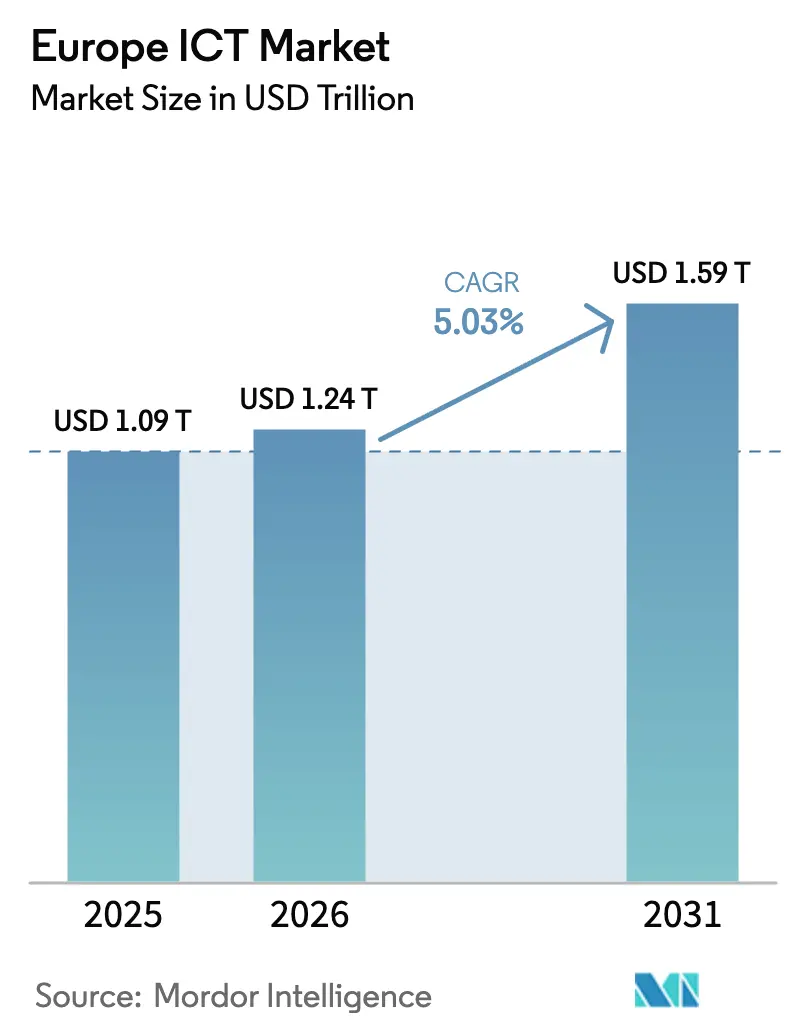
| Base Year Market Size (2025) | USD 1.09 Trillion |
| Market Size (2026) | USD 1.24 Trillion |
| Market Size (2031) | USD 1.59 Trillion |
| Growth Rate (2026 - 2031) | 5.03 % |
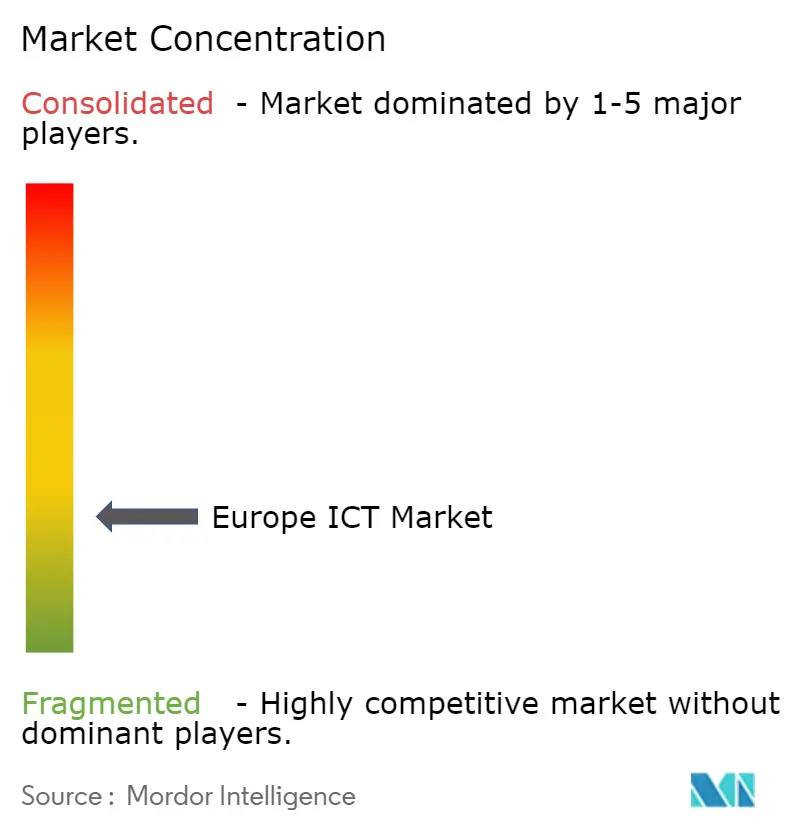
| Market Concentration | Low |
Major Players *Disclaimer: Major Players sorted in no particular order Image © Mordor Intelligence. Reuse requires attribution under CC BY 4.0. | |
Europe ICT Market Analysis by Mordor Intelligence
The Europe ICT Market size is expected to increase from USD 1.09 trillion in 2025 to USD 1.24 trillion in 2026 and reach 1.59 trillion by 2031, growing at a CAGR of 5.03% over 2026-2031. Strong sovereign-cloud mandates, sustained 5G roll-outs, and expanding edge infrastructure are boosting capital expenditure, while Digital Decade grants continue to subsidize broadband and enterprise cloud adoption. Heightened cybersecurity requirements under NIS2, the EU Green Deal’s efficiency targets for data centers, and the rapid pivot toward generative-AI workloads are reshaping vendor roadmaps and compressing time-to-market for new solutions. Competitive intensity is sharpening as hyperscalers address data-residency scrutiny with sovereign offerings and regional champions leverage local compliance expertise to win public-sector deals. The convergence of industrial IoT, edge analytics, and 5G standalone networks is spawning new B2B revenue streams, particularly in manufacturing hubs that demand sub-10-millisecond latency.
Key Report Takeaways
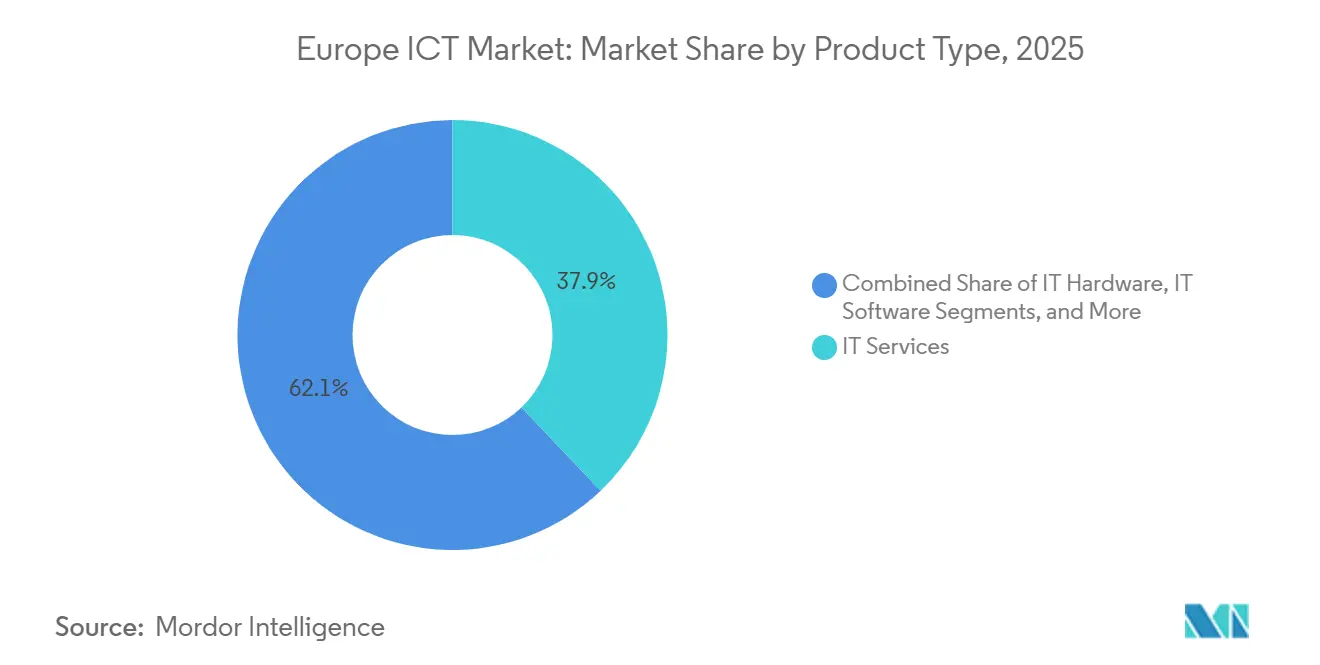
- By product type, IT services led with 37.89% market share in 2025 while IT security and cybersecurity held 7.26% CAGR growth leadership between 2026-2031, outpacing legacy IT hardware.
- By enterprise size, large enterprises retained 71.92% of Europe ICT market share in 2025, while SMEs posted the fastest projected CAGR at 5.41% through 2031.
- By vertical, healthcare advanced at a 6.02% CAGR during 2026-2031, eclipsing banking, financial services, and insurance in growth momentum even as the latter commanded an 18.07% revenue share in 2025.
- By country, Germany led with a 20.04% contribution to the Europe ICT market size in 2025, but Spain recorded the highest 8.13% CAGR outlook to 2031.
Note: Market size and forecast figures in this report are generated using Mordor Intelligence’s proprietary estimation framework, updated with the latest available data and insights as of January 2026.
Market Trends and Insights
Drivers Impact Analysis of Europe ICT Market*
| Driver | (~) % Impact on CAGR Forecast | Geographic Relevance | Impact Timeline |
|---|---|---|---|
| Accelerated EU Digital Decade Funding 2021-2030 Catalyzing Cloud and 5G Roll-outs | +0.9% | Pan-European, with concentration in Germany, France, Netherlands, Nordics | Medium term (2-4 years) |
| Surge in Sovereign Cloud and Data Residency Requirements Post-Schrems II Ruling | +1.2% | Pan-European, particularly France, Germany, Netherlands | Short term (≤ 2 years) |
| Industrial Edge Computing Demand Driven by Europe's Industry 4.0 Corridors | +0.8% | Germany, Italy, France, Spain (manufacturing hubs) | Medium term (2-4 years) |
| Rising ICT Sustainability Mandates (EU Green Deal) Fueling Green Data Centres | +0.6% | Nordics, Netherlands, Germany (renewable energy leaders) | Long term (≥ 4 years) |
| O-RAN Trials and Early 5G Standalone Deployments Enabling New B2B Services | +0.7% | United Kingdom, Germany, France, Italy | Medium term (2-4 years) |
| Generative AI Upskilling Programmes Stimulating Software and Consulting Spend | +0.9% | Pan-European, with early adoption in United Kingdom, Germany, France | Short term (≤ 2 years) |
| Source: Mordor Intelligence | |||
Accelerated EU Digital Decade Funding 2021-2030 Catalyzing Cloud and 5G Roll-outs
Large-scale public funding is front-loading network infrastructure timelines. By December 2025, member states had already invested EUR 58 billion toward gigabit connectivity and rural 5G coverage, compressing project cycles that previously stretched to the end of the decade. Vodafone Germany alone switched on 15,000 5G standalone sites in 2025, opening network-slicing pathways for automotive telematics and remote surgery.[1]Vodafone, “5G Stand-Alone Roll-outs in Germany,” vodafone.com SME migration incentives covering up to half of cloud-adoption costs expanded the addressable base for platform vendors, evidenced by a 34% year-on-year rise in SME cloud take-up in 2025. Funding delays tied to state-aid reviews, however, slowed disbursements in Italy and Spain, highlighting execution risk within the bloc.
Surge in Sovereign Cloud and Data-Residency Requirements Post-Schrems II Ruling
The invalidation of the EU-US Privacy Shield triggered sweeping workload repatriation. By 2025, nearly two-thirds of large European enterprises had shifted sensitive data to EU-domiciled providers or on-premises stacks. OVHcloud booked double-digit revenue growth on the back of public-sector wins, while Deutsche Telekom partnered with a major hyperscaler to deliver a Kubernetes-based sovereign cloud aligned with German federal rules. Colocation operators followed suit, expanding low-latency facilities in Frankfurt, Amsterdam, and Paris to serve finance and public-sector users that demand strict jurisdictional control. Elevated legal-review costs continue to lengthen migration cycles, yet overall momentum favors providers with clear data-sovereignty credentials.
Industrial Edge-Computing Demand Driven by Industry 4.0 Corridors
Automotive, machinery, and packaging clusters deployed thousands of new edge nodes in 2025 to support real-time quality control, predictive maintenance, and autonomous-mobile-robot coordination. Strategic partnerships, such as Siemens-Microsoft, embedded analytics directly on the plant floor, cutting unplanned downtime by almost one-quarter across early deployments.[2]Siemens, “Azure Industrial IoT Partnership,” siemens.com Targeted EU-level grants helped Italy and France bring edge platforms to SMEs that traditionally lacked capital for such upgrades, while latency-sensitive use cases validated hardware investments by Schneider Electric and ABB. The region’s emphasis on advanced manufacturing ensures edge installations will remain a growth engine through the medium term.
Rising ICT Sustainability Mandates Under the EU Green Deal Fueling Green Data Centers
New facilities must now achieve a sub-1.3 PUE and source at least 75% renewable electricity by 2027, accelerating corporate power-purchase agreements in wind-and-hydro-rich Nordic countries. Global cloud operators committed multi-billion-euro budgets to carbon-free energy procurement, and retrofits such as direct-to-chip liquid cooling are cutting cooling loads by 40%. The January 2026 lift in carbon-credit prices under the EU ETS rendered coal-powered capacity economically untenable, pushing operators toward locations with abundant renewables. These measures create a dual benefit of lower operating costs and stronger ESG positioning.
Restraints Impact Analysis of Europe ICT Market*
| Restraint | (~) % Impact on CAGR Forecast | Geographic Relevance | Impact Timeline |
|---|---|---|---|
| Energy-Intensive Data Centres Facing Escalating Power and Carbon Taxes | -0.5% | Pan-European, acute in Germany, Netherlands, Belgium | Short term (≤ 2 years) |
| Persistent Digital Skills Gap Slowing Project Timelines | -0.7% | Pan-European, severe in Germany, Netherlands, Nordics | Medium term (2-4 years) |
| Fragmented Spectrum Policies Hindering 5G Economies of Scale | -0.4% | Pan-European, particularly Italy, Spain, Eastern Europe | Medium term (2-4 years) |
| Heightened Cyber-Sovereignty Concerns Limiting US Hyperscaler Penetration | -0.3% | France, Germany, Netherlands, public sector across Europe | Short term (≤ 2 years) |
| Source: Mordor Intelligence | |||
Energy-Intensive Data Centers Facing Escalating Power and Carbon Taxes
Data-center electricity demand hit 104 terawatt-hours in 2025, with hubs in Frankfurt, Amsterdam, and Dublin accounting for almost two-thirds of consumption. A EUR 90-per-tonne carbon-allowance price, effective January 2026, raised operating expenses for non-renewable sites by low-double-digit percentages.[3]European Environment Agency, “EU Emissions Trading System,” eea.europa.eu National interventions reinforce the pressure: Ireland’s moratorium on new Dublin connections and the Netherlands’ energy tax on large facilities are prompting operators to place incremental capacity in Nordic markets or to co-locate near renewable-generation assets. Participation in demand-response programs is compulsory for new German sites above 10 MW, forcing architectural redesigns and accelerating the adoption of battery-backed microgrids.
Persistent Digital-Skills Gap Slowing Project Timelines
Europe lacked roughly half a million ICT professionals in 2025, with Germany alone reporting 96,000 open roles in cloud engineering and cybersecurity. Vacancy rates exceeded 8% across several member states, delaying smart-city initiatives and 5G network deployments by up to nine months. Wage inflation is further compressing service-provider margins, as median salaries for cloud-certified talent in Frankfurt climbed to EUR 85,000 in 2025. EU-sponsored upskilling programs have yet to reach scale, enrolling fewer than 15% of their multi-year targets, which means integration partners must continue to rely on near-shoring and global-delivery centers to bridge capability gaps.
*Our forecasts treat driver/restraint impacts as directional, not additive. The impact forecasts reflect baseline growth, mix effects, and variable interactions.
Europe ICT Market Segment Analysis
By Product Type:
Security Spend Overtakes Legacy IT HorizonsIT security and cybersecurity are projected to expand at a 7.26% CAGR, buoyed by the NIS2 directive’s 24-hour incident-reporting rule that covers 18 critical sectors. Identity and access management stands out, reflecting EU-wide zero-trust mandates that require multi-factor authentication across banking and public services. Cloud-security posture-management tools are growing as enterprises automate compliance checks, while endpoint protection faces price compression due to bundled offerings from major operating-system vendors. Meanwhile, the Europe ICT market size for IT services retains scale leadership, yet automation-rich platform offerings are shrinking traditional consulting effort. Hardware refresh cycles continue to stretch as hybrid work stabilizes, compressing demand for desktop and notebook replacements. Communication-services revenues remain steady due to vendor consolidation and unified-communications bundles that lower total cost of ownership for distributed workforces. Infrastructure spending tilts toward edge form factors, partially offsetting softer demand for large on-premises servers.
Second-generation security controls that combine threat-intelligence feeds with machine-learning analytics are spreading beyond critical infrastructure to mid-market users, signaling a deeper addressable base. Network-security spend benefits from 5G core launches, which embed distributed denial-of-service mitigation at the edge. Application-security adoption also rises as software suppliers face liability under the Cyber Resilience Act, incentivizing secure-by-design practices. Collectively, these patterns confirm that security allocations will continue to capture a rising share of the Europe ICT market.



By Enterprise Size:
SMEs Narrow the Digital-Transformation GapLarge enterprises commanded 71.92% of Europe ICT market share in 2025, driven by complex ERP, supply-chain, and AI-training workloads. Yet small and medium-sized enterprises are forecast to log a 5.41% CAGR, shrinking the adoption divide. Voucher schemes in Germany, Spain, and France subsidize up to half of cloud-migration or e-commerce costs, unlocking latent demand among firms with fewer than 250 employees. Low-code development platforms allow “citizen developers” to automate workflows without specialist coding, reducing dependency on scarce IT talent. On the downside, limited cybersecurity maturity leaves many SMEs vulnerable to ransomware, spurring managed-security-service providers to introduce per-endpoint packages that fit constrained budgets.
Large-enterprise spending is increasingly oriented toward platform modernization and data-sovereignty compliance, reinforcing demand for sovereign-cloud stacks and hybrid architectures. SMEs, conversely, are gravitating toward bundled SaaS suites that integrate CRM, marketing automation, and analytics at predictable monthly rates. Hybrid work patterns persist for more than 70% of SMEs, supporting ongoing investment in collaboration and endpoint-management tools.
By End-User Vertical:
Healthcare Surges, BFSI Maintains ScaleBanking, financial services, and insurance retained an 18.07% revenue share in 2025, propelled by open-banking API traffic that more than doubled over two years. Healthcare is slated to grow at a 6.02% CAGR through 2031, as the European Health Data Space mandates cross-border interoperability of electronic health records. Telemedicine remains a mainstream service in primary care, and EU-funded hospital modernization programs in France and Germany are fast-tracking upgrades to EHRs, e-prescribing, and medical imaging. Government and public-sector spend steadied after pandemic peaks but still backs large identity-and-cloud projects such as the EU Digital Identity Wallet. Manufacturing advances stem from Industry 4.0 investments that deploy thousands of edge nodes for real-time analytics, while retail adoption of omnichannel platforms supports inventory visibility across stores and online channels.
The Europe ICT market size for energy and utilities climbs with smart-meter deployments that enable demand-response billing, whereas telecom operators balance network roll-out costs with internal IT-budget constraints. Other segments, including transportation, logistics, education, and hospitality, show steady mid-single-digit expansion as AI-enhanced scheduling and route-optimization applications mature.

Geography Analysis
Germany ICT Market
Germany remains the largest spender, with industrial automation and sovereign-cloud compliance shaping enterprise roadmaps. Automotive OEMs invested heavily in software-defined architectures in 2025, while federal digital strategy funds drove fiber backbone upgrades toward nationwide gigabit coverage. An uptick in ransomware incidents, including a high-profile port outage, catalyzed accelerated cybersecurity roll-outs across logistics and critical infrastructure operators. Persistent talent shortages and wage inflation, however, elongate implementation cycles.
Spain ICT Market
Spain’s momentum builds on expansive fiber networks and Next Generation EU grants that prioritize rural connectivity and SME innovation. National 5G standalone deployments support network slicing for logistics hubs in Madrid and Barcelona, while regional programs in Catalonia and the Basque Country finance edge-computing pilots for manufacturing SMEs. Progressive digital-skills initiatives complement the infrastructure push, compressing adoption barriers for cloud ERP and CRM solutions.
Broader European Markets
France advances digital sovereignty goals by shifting sensitive workloads to certified providers and funding modernization of tax and healthcare systems. Public-sector contracts underpin steady services revenue for domestic integrators, and a vibrant AI-start-up ecosystem benefits from government-backed research hubs. Meanwhile, the United Kingdom navigates post-Brexit data-adequacy assessments that delay certain cross-border migrations, and Italy accelerates digital-public-administration projects supported by recovery funds. The Netherlands, Nordics, and Eastern Europe round out regional dynamics, each leveraging specific advantages - interconnection density, renewable energy, or near-shoring talent pools - to attract ICT investment.
Regulatory Landscape
Europe’s ICT regulatory environment is shaped by EU-wide frameworks that tighten obligations on cybersecurity, data protection, and operational resilience, while also steering public procurement toward data-residency and sovereignty requirements. NIS2 raises baseline controls and accelerates incident reporting, reinforced by supply-chain guidance from the NIS Cooperation Group, which published an ICT Supply Chain Security Toolbox to help Member States assess and mitigate risks across critical ICT assets.
EU digital strategy instruments also keep influencing investment priorities in connectivity, cloud, and skills. The European Commission’s State of the Digital Decade package and the Digital Decade Policy Programme 2030 provide a shared scoreboard and policy direction for infrastructure and digital public services, while EU Green Deal sustainability requirements add operating constraints for data centers, including tighter efficiency and renewable-power targets that vendors must reflect in facility design and cloud capacity planning.
Value Chain Analysis
The Europe ICT value chain spans upstream semiconductor and hardware ecosystems, midstream network and cloud infrastructure, and downstream software, cybersecurity, and IT services delivered through distributors, system integrators, and managed service providers. The emphasis on technological sovereignty is reshaping sourcing and vendor selection across the chain, with EU programs promoting a more self-reliant “European technology stack” and encouraging buyers, particularly in the public sector and regulated industries, to prioritize jurisdictional controls and verifiable compliance.
Infrastructure build-outs and sovereign-cloud architectures increasingly rely on regional colocation and connectivity hubs, while enterprise transformation demand feeds platform vendors and services partners that can combine hybrid requirements with sovereign constraints. Participation in EU strategic computing initiatives shows how global OEMs and service providers plug into the regional stack, including EuroHPC JU deployments where vendors such as Dell supply hardware into flagship AI/HPC systems, supporting downstream software platforms, integration, security tooling, and managed operations.
Competitive Landscape
Europe’s ICT landscape is moderately fragmented, with the top 10 vendors holding about 38% of total revenue. Global hyperscalers continue to scale infrastructure but increasingly partner with regional operators to deliver sovereign clouds that satisfy GDPR and sector-specific mandates. OVHcloud broadened its footprint to 42 data centers across 12 countries by January 2026, targeting public-sector and financial-services clients that require strict data-residency guarantees. Deutsche Telekom teamed with a leading platform provider to launch a sovereign Kubernetes stack aimed at German agencies, blending public-cloud functionality with on-premises control.
Indian heritage service providers increased their share of European outsourcing contracts by leveraging cost-competitive delivery models and robust ISO 27001 compliance, intensifying price competition for incumbents. Cybersecurity specialists gained traction in the SME segment by offering bundled managed-detection-and-response subscriptions that undercut enterprise-grade alternatives. In networking, Ericsson and Nokia vie for Open RAN deployments, while colocation operators such as Equinix expand edge facilities to capture latency-sensitive workloads from finance and gaming customers.
Strategic differentiation increasingly hinges on verticalized solutions, AI-native feature sets, and transparent ESG credentials, all of which influence procurement decisions in a region defined by stringent regulatory oversight.
Europe ICT Industry Leaders
IBM Corporation
Dell Technologies Inc.
Microsoft Corporation
Amazon Web Services, Inc.
SAP SE
- *Disclaimer: Major Players sorted in no particular order
Europe ICT Market Companies Covered in this Report
- Hewlett Packard Enterprise Development LP
- Dell Technologies Inc.
- Apple Inc.
- Sony Europe B.V.
- Samsung Electronics Co., Ltd.
- Deutsche Telekom AG (T-Systems)
- IBM Corporation
- Capgemini SE
- Microsoft Corporation
- Oracle Corporation
- SAP SE
- Amazon Web Services, Inc.
- Google Cloud (Alphabet Inc.)
- Cisco Systems, Inc.
- Atos SE
- Accenture plc
- Fujitsu Limited
- Salesforce, Inc.
- Ericsson AB
- Nokia Corporation
- Schneider Electric SE
- Equinix, Inc.
- OVHcloud
- Orange Business Services
- Telefonica Tech
- Tata Consultancy Services Limited
- Infosys Limited
- Cognizant Technology Solutions
- NetApp, Inc.
- Sophos Ltd.
- Avast plc
- Darktrace plc
- Kaspersky Lab
- VMware Inc.
- ServiceNow, Inc.
- Zoom Video Communications, Inc.
- Logitech International S.A.

Market Opportunities and Future Outlook
Sovereign cloud, regulated-workload modernization, and secure digital infrastructure remain key whitespace areas as enterprises align cloud roadmaps with data-residency, cyber-resilience, and supply-chain assurance requirements. A concrete signal is hyperscaler investment and productization around sovereignty in Europe, including AWS launching its European Sovereign Cloud and partnering with regional telecom and public-sector channels, and Microsoft’s planned Azure region build-out in Poland (announced December 2025), which adds in-region capacity for government and regulated buyers.
AI-centric infrastructure and services are also expanding addressable spend across data center capacity, edge platforms, and enterprise application modernization. EuroHPC JU’s network of AI factories provides an institutional anchor for AI adoption across member states, and large enterprise transformation programs, such as Nokia’s agreement to use RISE with SAP on Microsoft Azure, point to ongoing demand for integration, security, and governance tooling across multi-cloud and hybrid environments. Sustainability constraints on data centers also narrow vendor differentiation toward efficiency improvements, renewable-backed capacity, and compliance-ready reporting and optimization services.
Recent Industry Developments in Europe ICT Market
- July 2026: AWS awarded a contract with UK HM Revenue & Customs (HMRC) to assist with the exit of three managed data centers (April 2026 - April 2033). This expands AWS footprint in EU public sector infrastructure and increases sovereign-cloud capacity planning for European workloads. The outcome enhances AWS role in European public sector data residency compliant operations.
- June 2026: Multi-year agreement to move Nokia’s enterprise transformation to RISE with SAP on Microsoft Azure. The collaboration accelerates cloud-native transformation for large enterprises with mixed on-prem and cloud environments. It strengthens the SAP, Microsoft, and Dell ecosystem across Europe.
- May 2026: Vodafone enters a multi-year strategic collaboration with AWS to provide sovereign cloud services to German businesses and public authorities. The partnership rolls out sovereign cloud offerings for public sector and enterprise customers in Germany. It reflects a broader sovereign cloud trend in Europe, shaping data residency and regional cloud procurement dynamics.


Europe ICT Market Report Scope and Research Methodology
Market Definition and Coverage
For this study, the Europe ICT market covers spending on information and communication technologies across Europe, including IT hardware, software, services, cybersecurity, and communication services, measured in value terms.
Scope exclusions: Consumer electronics that are not used for computing or connectivity, as well as media and content subscriptions, are not counted under this market sizing.
Segments Covered in This Report
- By Product Type
- IT Hardware
- Computer Hardware
- Networking Equipment
- Peripherals
- IT Software
- IT Services
- IT Consulting and Implementation
- IT Outsourcing (ITO)
- Business Process Outsourcing (BPO)
- Managed Security Services
- Cloud and Platform Services
- IT Infrastructure
- IT Security/Cybersecurity
- Application Security
- Cloud Security
- Data Security
- Network Security
- Endpoint Security
- Infrastructure Protection
- Integrated Risk Management
- Identity and Access Management (IAM)
- Communication Services
- Fixed Voice and Data
- Mobile Voice and Data
- Unified Communications and Collaboration
- IT Hardware
- By Enterprise Size
- Small and Medium-Sized Enterprises
- Large Enterprises
- By End-User Industry Vertical
- BFSI
- Government and Public Sector
- Oil and Gas
- IT and Telecom
- Retail, E-Commerce and Consumers
- Manufacturing and Industrial
- Energy and Utilities
- Healthcare
- Other End-User Industry Verticals
- By Country
- United Kingdom
- Germany
- France
- Italy
- Spain
- Netherlands
- Nordics
- Rest of Europe
Data Sources, Market Sizing, and Validation
Desk Research
Desk research sets the frame for what should be counted as ICT in Europe and what should not. We start with official and public datasets that explain the macro context and digital priorities, such as Eurostat ICT usage and broadband indicators, the European Commission Digital Decade reporting, and OECD digital economy statistics.
To keep the market model grounded, we also review sources that help with spend signals and price direction, such as ITU telecom indicators, national regulator publications on mobile and fixed services, and public procurement portals for large ICT tenders. For company-level context, annual reports, investor presentations, and reputable business press are reviewed to understand product mix shifts, contract timing, and guidance on currency effects. In parallel, a paid subscription database is used selectively for company financials, contract tracking, and patent lookups to cross-check directional claims. The examples above are not exhaustive, and other public sources were also used for collection, validation, and clarification.
Primary Interviews and Surveys
Primary work is used to sanity-check the demand drivers and the pricing logic behind the model, especially where public data is delayed or reported in different formats. We speak with a mix of telecom operators and channel partners, enterprise buyers, and service delivery leaders, and then we validate assumptions across major European buying markets before finalizing the estimate.
Distribution of primary research fieldwork respondents
| Company type | Respondent position |
|---|---|
| Top tier: 35% | CXOs: 22% |
| Mid tier: 43% | Functional/Unit leaders: 31% |
| Smaller Players: 22% | Managers: 47% |
Market-Sizing & Forecasting
Sizing starts with a top-down build that reconstructs Europe ICT value by mapping published spend pools into consistent buckets, followed by country normalization and rollups to a regional total. The totals are then corroborated with selective bottom-up approximations, where sampled supplier revenues, channel checks, and typical ASP times shipment volume are used to test whether the top-level number behaves realistically.
Key inputs in the model include telecom service revenue trends, enterprise IT services spend direction, software subscription mix shifts, device and server replacement cycles, and cloud infrastructure build-out indicators. Because currency can move the reported value meaningfully, average annual exchange rates are applied consistently by year, and then checked against the timing of price updates that interviewees describe. For forecasting, we use scenario analysis supported by forward indicators, such as expected GDP and business investment direction, 5G and fiber rollout pace, and cybersecurity compliance-driven budget allocations, which are then reviewed with primary respondents.
Where a bottom-up cross-check is incomplete, the gap is handled through conservative peer-group benchmarking and ratio checks (for example, services-to-software mix ranges by country), and then adjusted only when multiple signals align.
Data Validation & Update Cycle
Validation is done through repeated variance checks across segments and countries so unusual jumps get flagged early. We also compare the output against independent signals, such as telecom regulator revenue series, large deal announcements, and public budget programs, and then we re-check any outliers with follow-up calls when needed.
Before sign-off, the model and assumptions go through multi-step internal reviews, where inputs, currency treatment, and segment boundaries are verified. Reports are refreshed annually, and interim updates are made when major events materially change demand or pricing. Right before delivery, a final pass is completed so clients receive the most current view that matches the latest available data.
Mordor Intelligence's Europe Ict Market Size Compared Against Other Published Estimates
Published numbers for Europe ICT often differ because the timing and the definition of spend are not handled the same way across sources. Differences usually show up when one estimate leans on current-year budgets while another relies on historical reporting, and when currency conversion is applied at different points in the model.
A practical driver is refresh cadence, since fast-moving items like software subscriptions, cloud infrastructure pricing, and telecom tariff changes can shift the run-rate within a year, affecting ASP assumptions and mix splits. When exchange rates are aligned to annual averages and cross-checked against segment revenue signals before totals are locked, Mordor Intelligence ends up closer to a repeatable spend boundary than figures that treat Europe as a single converted number without similar checks.
Benchmark comparison
| Source | Market Size | Gaps in Research Methodology |
|---|---|---|
| Mordor Intelligence | USD 1.24 T (2026) | |
| Trade Journal A | USD 1.10 T (2024) | This figure is presented as near-term ICT spending and is sensitive to budget-cycle timing, with limited visibility on how telecom services and infrastructure are separated from broader IT spend, which can compress the total versus a fuller ICT bucket. |
| Industry Tracker B | USD 1.28 T (2025) | The estimate is framed as Europe IT spending and may apply a different segment boundary between IT and communication services, while also reflecting a specific forecast update point that can shift currency conversion and price escalation assumptions. |
Looking across the three figures, most of the spread can be explained by year selection and what each publisher classifies as ICT versus narrower IT spend, followed by differences in how prices and exchange rates are applied. By keeping the boundary explicit and checking totals against segment-level signals, the final number stays traceable to clear inputs and can be updated in a consistent way as new data arrives.


Key Questions Answered in the Report
How large is the Europe ICT market in 2026 and what growth is expected?
The market stands at USD 1.24 trillion in 2026 and is forecast to reach USD 1.59 trillion by 2031, reflecting a 5.03% CAGR.
Which product segment is expanding the fastest?
IT security and cybersecurity leads, supported by NIS2 compliance, posting a 7.26% CAGR over 2026-2031.
Why is Spain growing faster than other European countries?
Spain benefits from EUR 20 billion of Next Generation EU grants that finance broadband, 5G, and SME digitalization, resulting in an 8.13% CAGR outlook.
What drives healthcare technology investment across Europe?
The European Health Data Space regulation mandates cross-border electronic-health-record interoperability by 2027, accelerating hospital spending on EHR and telemedicine solutions.
How are sustainability mandates affecting data centers?
The EU Green Deal imposes strict efficiency and renewable-energy targets, prompting operators to adopt liquid cooling and secure green power contracts to control operating costs.
What role do sovereign clouds play in Europe’s ICT strategy?
Sovereign clouds address GDPR data-residency requirements, leading many public-sector agencies and regulated industries to migrate sensitive workloads to EU-domiciled infrastructure.
Page last updated on:


 Your data is secure and never sold or shared.


