
Market Overview
| Study Period | 2021 - 2031 |
|---|---|
| Forecast Data Period | 2026 - 2031 |
| Base Year Market Size (2025) | 1.11 Terawatt |
| Market Volume (2026) | 1.20 Terawatt |
| Market Volume (2031) | 1.81 Terawatt |
| Growth Rate (2026 - 2031) | 8.51 % |
| Market Concentration | Low |
Major Players *Disclaimer: Major Players sorted in no particular order Image © Mordor Intelligence. Reuse requires attribution under CC BY 4.0. | |
Europe Renewable Energy Market Analysis by Mordor Intelligence
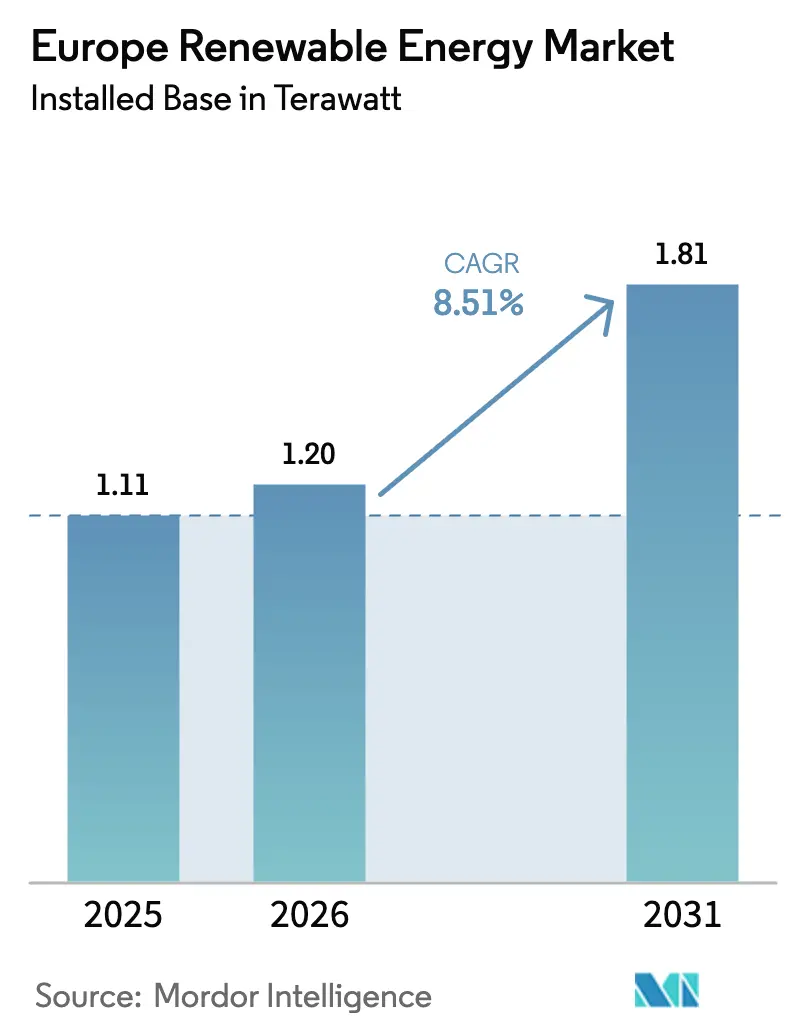
The Europe Renewable Energy Market size in terms of installed base is expected to grow from 1.11 Terawatt in 2025 to 1.20 Terawatt in 2026 and is forecast to reach 1.81 Terawatt by 2031 at 8.51% CAGR over 2026-2031.
The robust trajectory is propelled by the EU’s REPowerEU requirement to cover 45% of final energy demand with renewables by 2030, the EU-ETS carbon allowance price that passed EUR 80 per tonne in early 2025, and ever-cheaper solar and onshore-wind LCOE that outcompetes new gas capacity in most hours. Offshore-wind auction volumes, green-hydrogen quotas, and corporate PPAs from hyperscale data-center and steel producers are pulling projects forward, shrinking development lead times, and intensifying competition for grid-connection slots. Hybrid plants that co-locate wind, solar, and batteries already supply 12% of new builds and lower LCOE by 20-30% versus standalone assets. The European renewable energy market benefits from integrated utilities bundling generation, storage, and retail; yet margin compression in turbine manufacturing is triggering strategic pivots toward long-term service contracts and digital-twin analytics.
Key Report Takeaways
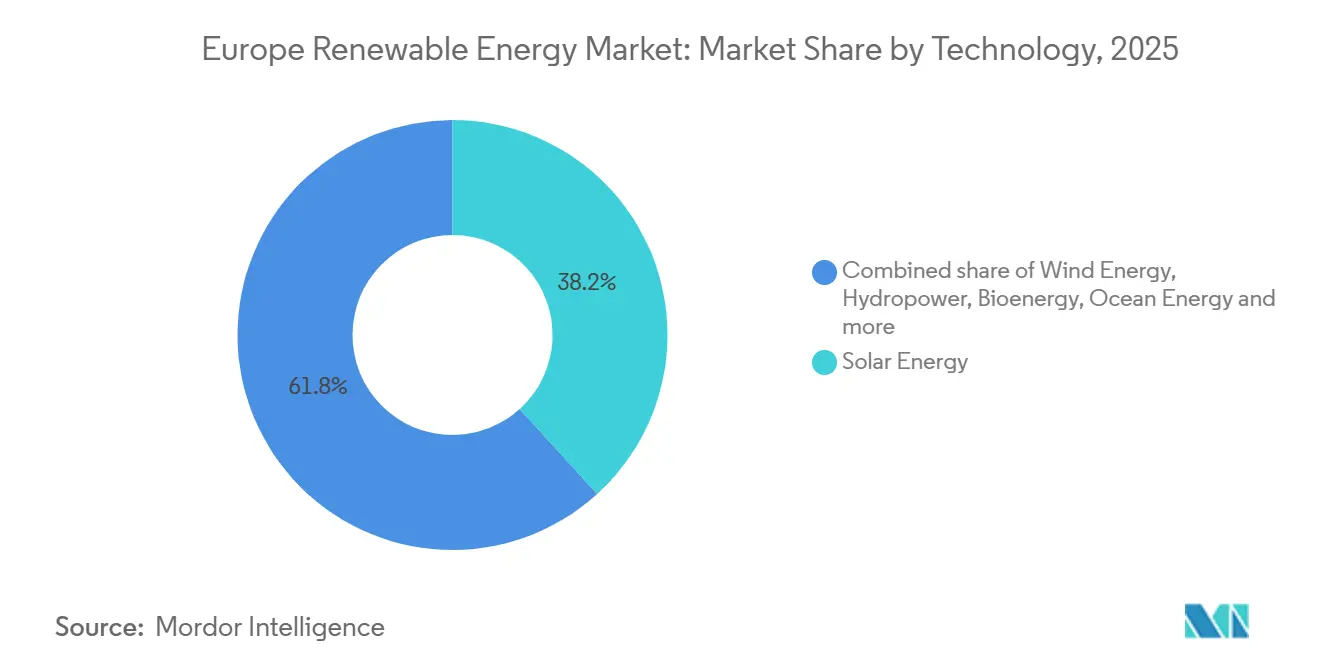
- By technology, solar commanded 38.24% of Europe's renewable energy market share in 2025. Ocean energy is projected to expand at a 31.83% CAGR through 2031.
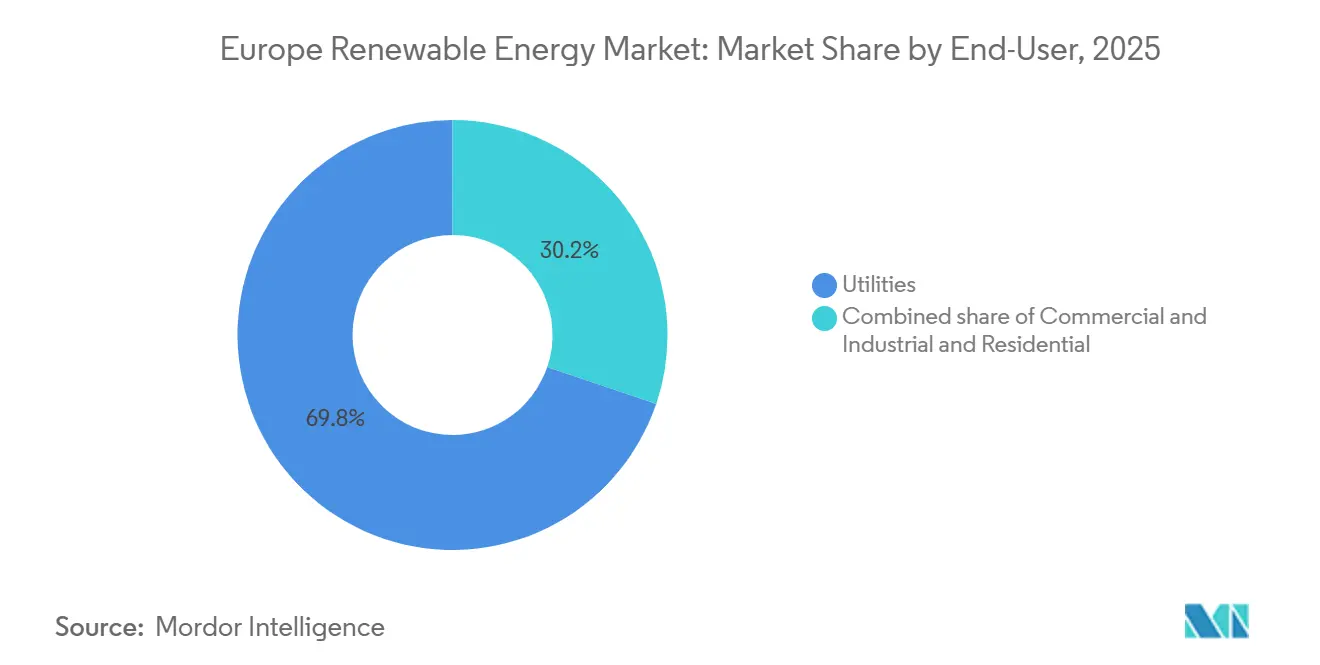
- By end-user, utilities led with 69.81% share of the European renewable energy market size in 2025. Residential installations are forecast to advance at an 11.19% CAGR between 2026-2031.
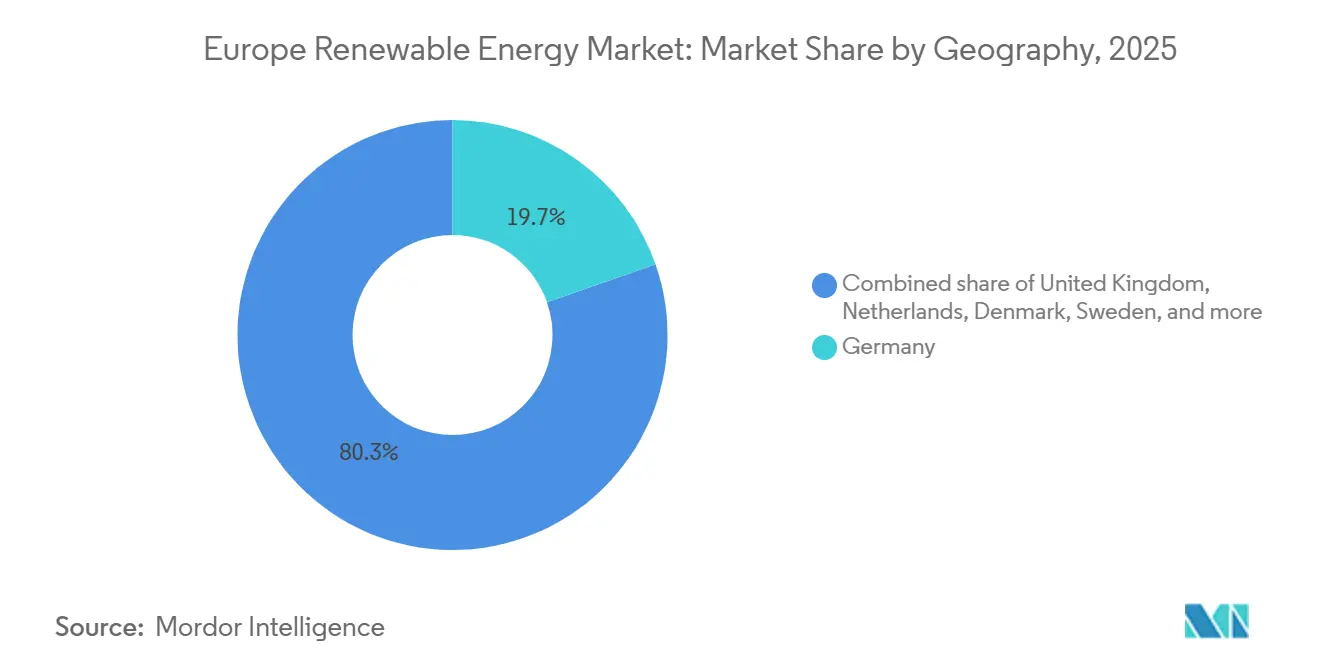
- By geography, Germany accounted for 19.67% of Europe's renewable energy market size in 2025. The United Kingdom is forecast to grow fastest at 12.41% CAGR to 2031.
Note: Market size and forecast figures in this report are generated using Mordor Intelligence’s proprietary estimation framework, updated with the latest available data and insights as of January 2026.
Market Trends and Insights
Drivers Impact Analysis of Europe Renewable Energy Market*
| Driver | (~) % Impact on CAGR Forecast | Geographic Relevance | Impact Timeline |
|---|---|---|---|
| EU "Fit-for-55" & REPowerEU 45% target by 2030 | +2.1% | Pan-European, strongest in Germany, Netherlands, Denmark | Long term (≥ 4 years) |
| Rapid LCOE decline in solar & onshore wind | +1.8% | Global, with accelerated adoption in Spain, Italy, Greece | Medium term (2-4 years) |
| Rising EU-ETS carbon price tilting merit-order | +1.5% | Core EU markets (Germany, France, Poland), limited effect in non-ETS Norway | Short term (≤ 2 years) |
| Offshore-wind build-out backed by EU strategies | +1.3% | North Sea basin (UK, Netherlands, Denmark, Germany), Baltic (Poland, Sweden) | Long term (≥ 4 years) |
| Corporate PPAs from data-centre & heavy-industry clusters | +0.9% | Nordics (data centers), Germany & France (steel, chemicals) | Medium term (2-4 years) |
| Green-hydrogen quotas anchoring new RES capacity | +0.7% | Iberia (Spain, Portugal), Germany, Netherlands | Long term (≥ 4 years) |
| Source: Mordor Intelligence | |||
Fit-for-55 & REPowerEU 45% Target
The REPowerEU plan elevates the 2030 renewables target to 45% of final energy, with Germany pledging 80% renewable electricity and the Netherlands aiming for 21 GW offshore wind by 2030.[1]European Commission, “REPowerEU Plan,” europa.eu Fast-track permitting in designated “go-to” areas cuts average lead times below two years and trims WACC by 50-100 bps, yet reaching the headline goal still hinges on synchronous grid reinforcement.
Rapid Solar and Onshore-Wind LCOE Decline
Utility-scale solar in Southern Europe achieved EUR 25-30 per MWh in 2025 after bifacial-module and tracker gains, while high-resource onshore-wind sites reached EUR 30-35 per MWh, enabling subsidy-free auctions in Spain and merchant builds in Italy.[2]International Renewable Energy Agency, “Renewable Power Generation Costs 2025,” irena.org Investor appetite is shifting toward merchant projects that exploit intraday volatility, even as narrower margins accelerate developer consolidation.
Rising EU-ETS Carbon Price
An average allowance price of EUR 82 per tonne in 1H 2025 rendered coal uneconomic for most hours and forced 4.2 GW of German lignite retirements. Long-term industrial PPAs are locking in wind supply for steel and chemical clusters to hedge against escalating carbon costs.
Offshore-Wind Build-Out Strategies
The EU targets 60 GW offshore wind by 2030 and 300 GW by 2050, with UK seabed leases, Germany’s 5.5 GW 2025 tender, and the 3.5 GW Bornholm Energy Island underpinning the pipeline. Turbine ratings have jumped to 15-18 MW, lowering installed costs 15-20% and turning offshore wind into a quasi-baseload resource in North Sea grids.
Restraints Impact Analysis of Europe Renewable Energy Market*
| Restraint | (~) % Impact on CAGR Forecast | Geographic Relevance | Impact Timeline |
|---|---|---|---|
| Grid congestion & interconnection bottlenecks | -1.2% | Germany (North-South), Iberia-France, Italy (North-South) | Short term (≤ 2 years) |
| Retroactive policy shifts & tariff claw-backs | -0.6% | Spain, Italy, Greece (inframarginal taxes, tariff revisions) | Medium term (2-4 years) |
| Price-inflated supply chains (transformers, subsea cables) | -0.5% | Pan-European, acute in offshore wind (North Sea, Baltic) | Short term (≤ 2 years) |
| Local opposition/biodiversity litigation delays | -0.4% | France (onshore wind), Germany (raptor habitats), UK (coastal zones) | Medium term (2-4 years) |
| Source: Mordor Intelligence | |||
Grid Congestion & Interconnection Bottlenecks
Curtailment erased 8 TWh of wind and solar output in 2025, costing EUR 800 million in unrealized revenue. Limited capacity from Spain into France and from Nordic hubs into Central Europe suppresses merchant capture rates, driving co-located battery deployment despite 10-15% higher capex.[3]European Network of Transmission System Operators for Electricity, “Ten-Year Network Development Plan 2025,” entso-e.eu
Retroactive Policy Shifts
Spain’s windfall levy, Italy’s tariff index caps, and Greece’s revenue claw-backs trimmed project IRRs 8-12% for legacy assets and widened WACC 50-100 bps for new builds. Developers now favor corporate PPAs and capacity-market hedges to ring-fence regulatory risk.
*Our forecasts treat driver/restraint impacts as directional, not additive. The impact forecasts reflect baseline growth, mix effects, and variable interactions.
Europe Renewable Energy Market Segment Analysis
By Technology:
Ocean Surge, Solar ScaleSolar held 38.24% of Europe's renewable energy market share in 2025, reflecting broad rooftop adoption and utility builds across Iberia. Ocean energy is on track for a 31.83% CAGR to 2031, buoyed by Scotland's commercial tidal arrays and Portugal's wave pilots.[4]Ocean Energy Europe, “EU Market Outlook 2025,” oceanenergy-europe.eu
Utility-grade solar remains the volume anchor of the European renewable energy market, yet developers increasingly hybridize with batteries to smooth intraday volatility and satisfy green-hydrogen offtake contracts. Offshore wind, now standardizing 15-18 MW machines, contributes growing baseload hours at 50-55% capacity factors. Pumped-storage hydro, 12-14% of capacity, is being uprated for six-plus-hour storage duty. Bioenergy and geothermal preserve niche roles but supply key flexibility in Nordic and volcanic belts.



By End-User:
Utility Dominance, Residential UpswingUtilities accounted for 69.81% of Europe's renewable energy market size in 2025, leveraging green-bond access and balance-sheet depth to win capacity auctions. Residential systems, forecast to rise at an 11.19% CAGR through 2031, gain from subsidy-backed batteries and improved net-metering in Germany and Italy.
Utilities now bundle generation, demand-response, and retail tariffs, monetizing distributed energy through virtual power plants. Residential uptake exceeds 20% of peak-day supply in parts of Bavaria and Flanders, prompting DSOs to install smart inverters and local flexibility markets. Commercial-industrial rooftops and virtual PPAs deliver hedge value for data centers and auto plants, rounding out the demand stack of the European renewable energy market.
Geography Analysis
Western Europe Renewable Energy Market
Germany retained 19.67% of Europe's renewable energy market size in 2025, under Energiewende mandates that target 80% renewable electricity by 2030. The United Kingdom is set to grow fastest at 12.41% CAGR through 2031, propelled by 8 GW of new offshore leases and competitive CfD strike prices. Spain and France each stood near 13% of capacity; Spain continues merchant solar growth while France accelerates offshore wind in Normandy and Brittany.
Broader European Markets
Italy, at 8-9%, concentrates solar in high-insolation south, while the Netherlands pairs rooftop solar with North Sea wind to reach 6-7% share. Denmark and Sweden punch above their weight per capita, the former sourcing 80% of electricity from wind and the latter balancing hydropower and wind. The rest of Europe cohort, Poland, Greece, Portugal, Belgium, and Ireland, collectively supplied one-quarter of capacity in 2025 and presents the next wave of greenfield builds supported by EU Just Transition funds and lower permitting friction. Weak Iberia-France and Baltic-Central Europe links still localize price risk, dampening project valuations by up to 15% versus well-meshed grids.
Regulatory Landscape
The European renewable energy market is shaped by an EU-wide policy backbone anchored by Fit-for-55 and REPowerEU, including the 45% renewables share target in final energy demand by 2030, alongside the EU Emissions Trading System (EU-ETS), which continues to influence generation dispatch and corporate decarbonization economics. In March 2026, the European Commission launched a public consultation on the post-2030 renewable energy legislative framework, with a legislative proposal scheduled for late 2026, indicating an active rulemaking pipeline that developers and offtakers are already factoring into long-dated contracting and permitting strategies.
Industrial policy and procurement rules are also tightening around sustainability and supply security. The Net-Zero Industry Act (Regulation (EU) 2024/1735) and the Critical Raw Materials Act (Regulation (EU) 2024/1252) reinforce domestic manufacturing and raw-material resilience for key renewable technologies and components. On 20 March 2026, Commission Implementing Regulation (EU) 2026/718 set minimum environmental sustainability requirements for public procurement of onshore and offshore wind, applicable to procurement procedures launched on or after 30 June 2026, adding compliance requirements that can shape OEM selection, tender design, and documentation in wind build-outs.
Competitive Landscape
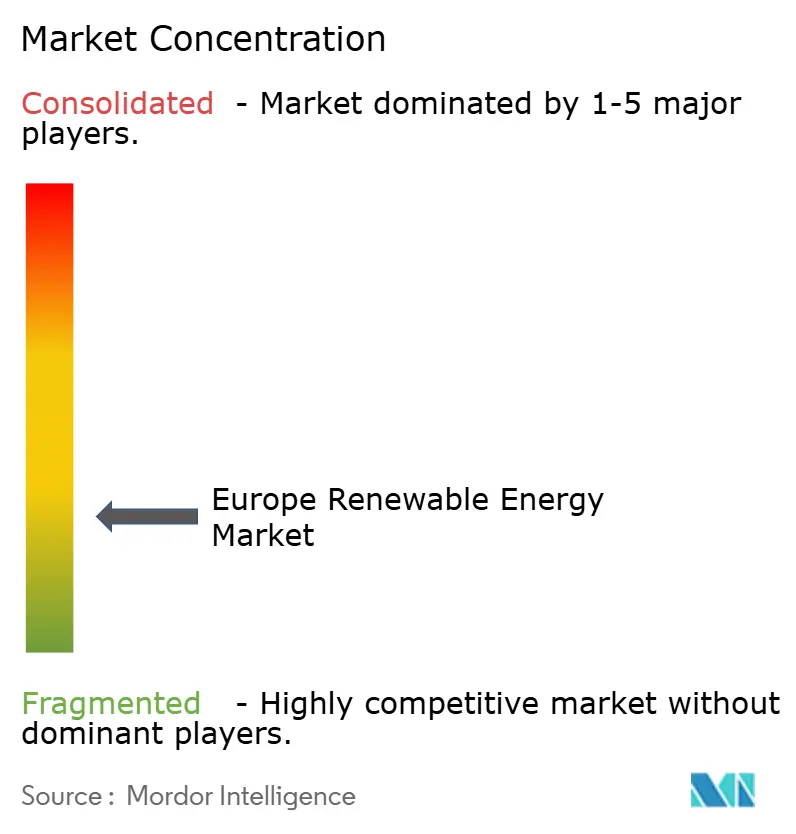
The top 10 developers control roughly 40-45% of installed renewable capacity, yielding a moderate concentration in the European renewable energy market. Ørsted and RWE link offshore wind with green-hydrogen offtake, securing 10-15-year revenue lines that shave financing costs. Vestas, Siemens Gamesa, and Nordex offset shrinking turbine margins by expanding 30-year service contracts and digital diagnostics that boost lifecycle revenue 30-35%.
Scale and vertical integration are becoming prerequisites: RWE and Vattenfall deploy 15-18 MW offshore turbines that cut foundations 30-40% per GW, while Enel and Iberdrola pair solar with four-hour batteries to arbitrage peak spreads. Hybrid solar-wind-storage plants reduce curtailment 20-30% and already represent 12% of new builds, offering white-space for niche specialists in floating offshore and tidal-stream demonstrations. M&A continues as TotalEnergies bought half of EDPR’s Iberian solar pipeline and Engie merged Belgian assets with Ocean Winds to boost auction competitiveness, illustrating strategic alignment toward portfolio scale and balance-sheet reach.
Europe Renewable Energy Industry Leaders
Enel Green Power S.p.A.
Iberdrola Renovables S.A.
Ørsted A/S
RWE Renewables GmbH
EDF Renewables
- *Disclaimer: Major Players sorted in no particular order
Europe Renewable Energy Market Companies Covered in this Report
- Enel Green Power S.p.A.
- Iberdrola Renovables S.A.
- Ørsted A/S
- RWE Renewables GmbH
- EDF Renewables
- Engie SA (Renewables)
- Acciona Energía S.A.
- Statkraft AS
- EDP Renováveis S.A.
- Vattenfall AB (Renewables)
- Vestas Wind Systems A/S
- Siemens Gamesa Renewable Energy S.A.
- Nordex SE
- Hanwha Q Cells GmbH
- TotalEnergies Renewables
- Repsol Renovables
- ContourGlobal PLC
- Abengoa SA
- Andritz AG
- BayWa r.e. AG

Market Opportunities and Future Outlook
Electrification and grid build-out programs are creating near-term whitespace for renewable generation, flexibility, and system-integration solutions, particularly where grid congestion and curtailment limit merchant capture. In July 2026, the European Commission presented an Electrification Action Plan that links a rise in electricity use (from 23% to 46% by 2040) to lower fossil-fuel import costs, strengthening demand pull for renewables paired with storage, demand response, and grid services. The Commission also published a toolbox to increase public participation in renewable energy projects on 17 July 2026, providing implementation frameworks aimed at local opposition and permitting friction, which remains a recurring constraint for onshore wind and network expansions.
On the commercial side, bankable offtake structures and scaled project execution are continuing to open opportunity for developers, utilities, and service providers that can combine build, optimize, and hedge. Iberdrola's 245 MW Fenix photovoltaic plant in Italy, supplying 1,000 GWh of certified solar electricity to retailer Pam Panorama under a 10-year PPA, points to room for corporate and retail-linked PPAs beyond traditional utility procurement. Offshore wind execution progress supports opportunities across installation, O&M, and grid-connection supply chains, including RWE reaching the halfway milestone at Denmark's 1.1 GW Thor offshore wind farm (36 of 72 turbines installed by July 2026). At the platform level, large owners are adding capacity and flexibility capabilities, with Enel Green Power commissioning 1.6 GW of new renewable capacity in Q1 2026 and Iberdrola reporting higher battery storage capacity in H1 2026, reinforcing demand for storage integration, dispatch optimization, and congestion-management services.
Recent Industry Developments in Europe Renewable Energy Market
- July 2026: Iberdrola S.A. commenced a long-term solar PPA with Pam Panorama for 1 TWh of energy in Italy. The arrangement extends its European solar footprint and supports monetization of solar assets in Italy.
- July 2026: Ørsted A/S signed a seven-year PPA with the Gode Wind 1 partnership in Germany. The deal improves revenue visibility for offshore wind projects and supports the German offshore wind portfolio.
- July 2026: Enel S.p.A. inaugurated the BESS4HYDRO system at the Dossi hydroelectric plant in Valbondione, Italy, integrating renewable production with storage as a single market unit. The system combines hydro output with storage to smooth power delivery. The project expands Enel's integrated renewable-storage approach in Italy.


Europe Renewable Energy Market Report Scope and Research Methodology
Market Definition and Coverage
For this report, the market is defined as renewable power capacity installed in Europe, measured in gigawatts and mapped by technology using grid-connected and operating assets as the core counting unit.
Scope exclusions: We exclude conventional fossil and nuclear capacity, and we do not count uncommissioned pipeline projects until they are operational and recorded in public capacity statistics.
Segments Covered in This Report
- By Technology
- Solar Energy (PV and CSP)
- Wind Energy (Onshore and Offshore)
- Hydropower (Small, Large, PSH)
- Bioenergy
- Geothermal
- Ocean Energy (Tidal and Wave)
- By End-User
- Utilities
- Commercial and Industrial
- Residential
- By Geography
- Germany
- United Kingdom
- Spain
- France
- Italy
- Netherlands
- Denmark
- Sweden
- Rest of Europe
Data Sources, Market Sizing, and Validation
Desk Research
Desk research was used to build the base capacity pool and to set boundaries so the same asset is not counted twice across technologies and countries. We mainly rely on official energy statistics and policy trackers, such as Eurostat renewable energy statistics, European Commission policy publications, ENTSO-E power system data, and IRENA country and regional capacity series.
To support the build, we also review national grid operator releases, energy ministry updates, and public auction and permitting disclosures where available, followed by annual reports and investor presentations for cross checks on commissioning timelines. When needed, paid subscriptions for company financials, patent databases, and shipment-level import export checks are used to validate selected assumptions like equipment flow signals and developer activity. This list is not exhaustive, and many other public and subscription sources were referred to for data collection, validation, and clarification during the research process.
Primary Interviews and Surveys
Primary work focused on validating what is actually getting commissioned and grid connected, and understanding practical delays that do not always show up in headline targets. We spoke with a mix of utilities, independent power producers, developers, EPC and service firms, and also grid and policy focused experts across major European markets, so model inputs could be corrected where desk signals were lagging.
Distribution of primary research fieldwork respondents
| Company type | Respondent position |
|---|---|
| Top tier: 28% | CXOs: 14% |
| Mid tier: 57% | Functional/Unit leaders: 32% |
| Smaller Players: 15% | Managers: 54% |
Market-Sizing & Forecasting
Sizing starts from a top-down capacity reconstruction where country-level installed renewable capacity series and annual additions are assembled, then normalized to a consistent Europe coverage and technology mapping. Once the base is set, results are corroborated using selective bottom-up approximations, such as sampled project commissioning checks, developer pipeline to commissioning ratios, and ASP-like proxies only when they help explain unusual jumps.
Key model inputs include annual renewable capacity additions by technology, grid connection and curtailment signals where published, auction awarded volumes versus realized builds, repowering activity for mature wind fleets, and policy timing markers that affect permitting and build cycles. Where country level splits are not fully disclosed, gaps are handled by using the nearest official series, validated through interview-based adjustment factors and then rechecked against regional totals.
For forecasting, scenario analysis is used because build rates are strongly influenced by permitting speed, grid readiness, and tender calendars, which can change quickly. The base case is anchored to visible auction schedules, national targets, and recent completion rates, and then stress tested with conservative and accelerated paths suggested by primary respondents.
Data Validation & Update Cycle
Outputs are checked in several steps so the final totals stay consistent with independent energy system signals. We run variance checks across countries and technologies, review outliers against commissioning news and official revisions, and then route the model through a second analyst review before sign-off.
Reports are refreshed annually, with interim updates done when major policy changes, large commissioning revisions, or unexpected deployment slowdowns are observed. Before delivery, a fresh data pass is completed so clients receive the latest updated view, followed by re-contact triggers when field feedback indicates a material shift from earlier assumptions.
Mordor Intelligence's Europe Renewable Energy Market Sizing Compared With Other Published Estimates
Published estimates for Europe renewable energy often differ because the market can be measured as installed capacity, electricity generation, or spending, and each choice shifts the total in a big way. Timing also matters because capacity statistics get revised, and some studies anchor to targets rather than what is already operating.
By tracking operating, grid connected capacity and refresh timing notes within the model, Mordor Intelligence keeps the total tied to installed base (1.11 TW in 2025) instead of mixing it with revenue pools like EPC value, equipment sales, or renewable investment flows. The biggest gaps usually come from whether repowering is treated as net new capacity, whether behind the meter solar is counted consistently across countries, and whether currency conversion and constant dollar assumptions are used for any value based estimates.
Benchmark comparison
| Source | Market Size | Gaps in Research Methodology |
|---|---|---|
| Mordor Intelligence | USD 1.11 T (2025) | |
| Regional Consultancy A | USD 289.10 B (2024) | Reported as a value based market and typically counts spending across equipment and project development, which makes it not directly comparable to an installed capacity installed base number. |
| Industry Advisory B | USD 145.00 B (2024) | Uses a narrower investment or transaction value lens and may apply conservative build assumptions, which can understate scale when measured as total operating capacity. |
Taken together, the spread is mainly explained by what is being counted and when it is counted, rather than by small math differences. Our approach is repeatable because it starts from observable capacity series, applies clear inclusion rules, and then adjusts only where field validation shows a consistent gap.


Key Questions Answered in the Report
How large is Europe’s renewable energy capacity today, and what is the projected growth by 2031?
Capacity stands at 1,204.66 GW in 2026 and is expected to reach 1,811.91 GW by 2031, advancing at an 8.51% CAGR.
Which technology segment is expanding fastest through 2031?
Ocean-energy projects, mainly tidal and wave, are forecast to grow at a 31.83% CAGR, outpacing all other segments.
Which country currently holds the largest share of capacity, and which is growing quickest?
Germany leads with 19.67% of regional capacity in 2025, while the United Kingdom shows the fastest expansion at a 12.41% CAGR to 2031.
What factors are driving corporate power-purchase agreements in the region?
Rising data-center electricity demand, heavy-industry decarbonization goals, and the EU Carbon Border Adjustment Mechanism are pushing PPA volumes to record highs.
What are the biggest short-term obstacles to new renewable builds?
Grid congestion, limited cross-border interconnections, and supply-chain cost inflation are curbing output and raising capital costs.
Page last updated on:





