
Market Overview
| Study Period | 2021 - 2031 |
|---|---|
| Base Year Market Size (2025) | USD 38.66 Billion |
| Market Size (2026) | USD 40.64 Billion |
| Market Size (2031) | USD 52.16 Billion |
| Growth Rate (2026 - 2031) | 5.12 % |
| Fastest Growing Market | Middle East and Africa |
| Largest Market | Europe |
Major Players *Disclaimer: Major Players sorted in no particular order Image © Mordor Intelligence. Reuse requires attribution under CC BY 4.0. | |
Europe, Middle East and Africa (EMEA) Elastomers Market Analysis by Mordor Intelligence
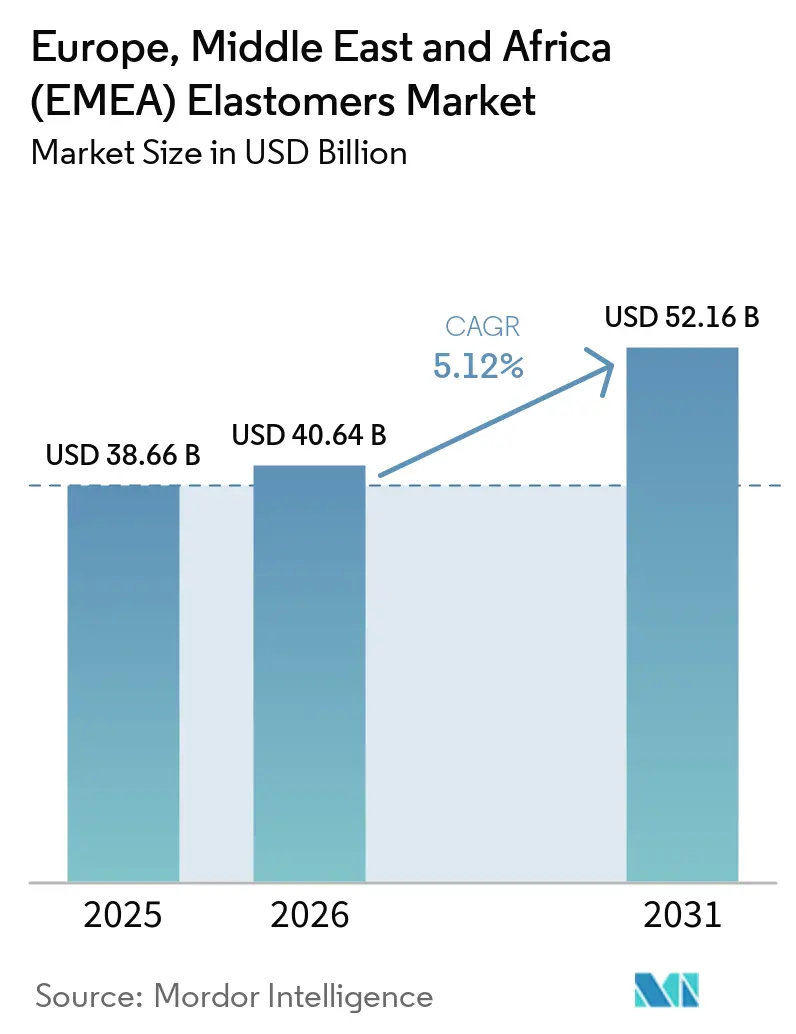
The Europe, Middle East And Africa (EMEA) Elastomers Market size was valued at USD 38.66 billion in 2025 and is estimated to grow from USD 40.64 billion in 2026 to reach USD 52.16 billion by 2031, at a CAGR of 5.12% during the forecast period (2026-2031). The Europe, Middle East and Africa (EMEA) elastomers market is being shaped by vehicle electrification, which raises material requirements for high-voltage seals, thermal management parts, and battery systems as manufacturers adapt to more demanding electrical and thermal conditions. Healthcare demand also supports a shift toward thermoplastic elastomers and silicone in tubing, catheters, and diagnostic assemblies, where safety, validation, and material consistency affect supplier selection. Circular material requirements are encouraging suppliers to develop grades with recycled or bio-based content, particularly for automotive applications that increasingly require documented material credentials. Europe remains the largest regional demand center, while the Middle East and Africa are projected to grow faster as petrochemical investment expands, compounding specialty-material activity, and automotive production develops in selected locations. Feedstock volatility and tighter tire-wear rules remain important constraints for producers in the Europe, Middle East and Africa (EMEA) elastomers market, since they increase development work, create input-cost exposure, and place more emphasis on integrated supply positions.
Key Report Takeaways
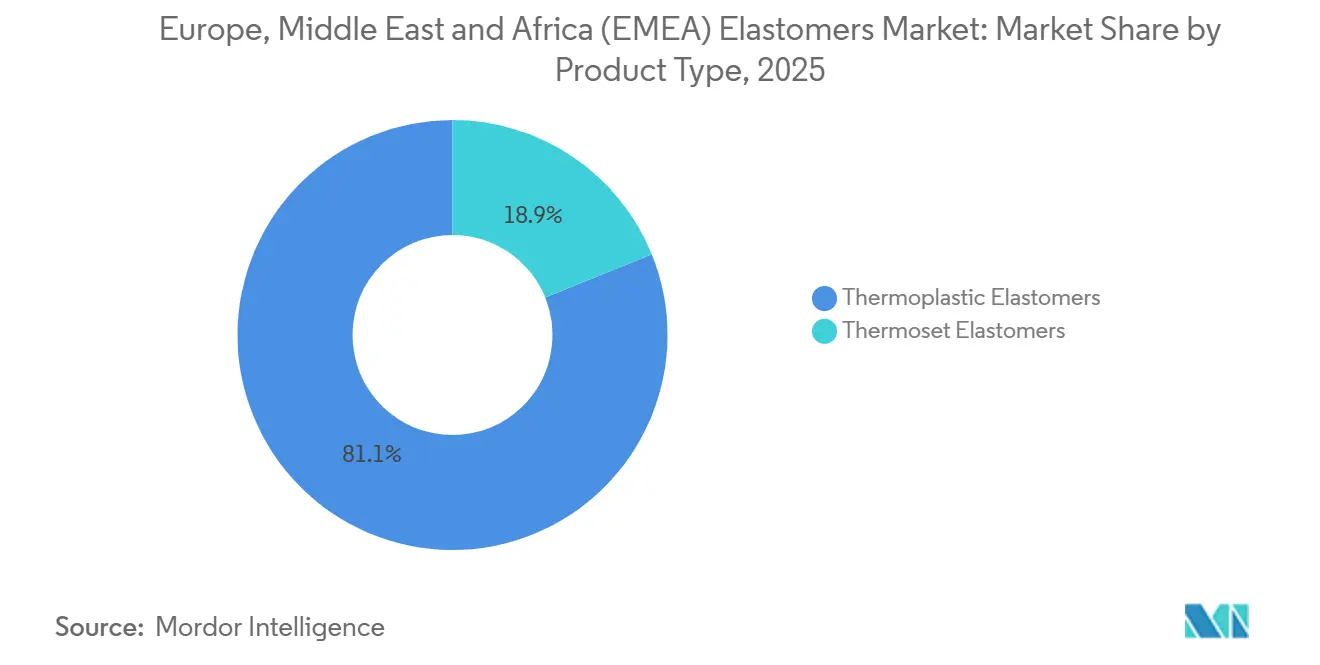
- By product type, thermoplastic elastomers held 81.12% of the Europe, Middle East and Africa (EMEA) elastomers market share in 2025 and are projected to advance at a 5.67% CAGR through 2031.
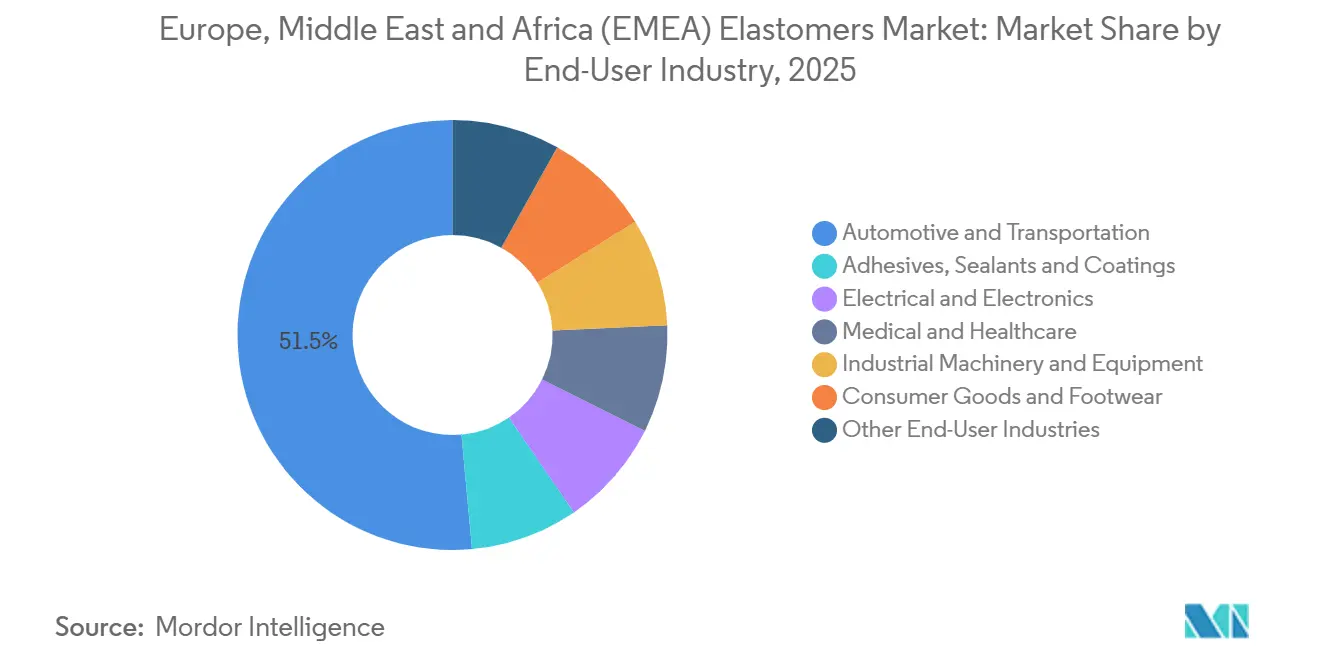
- By end-user industry, automotive and transportation held 51.45% of the Europe, Middle East and Africa (EMEA) elastomers market share in 2025, while medical and healthcare are projected to advance at a 6.06% CAGR through 2031.
- By geography, Europe held 42.67% of the Europe, Middle East and Africa (EMEA) elastomers market share in 2025, while the Middle East and Africa is projected to advance at a 5.81% CAGR through 2031.
Note: Market size and forecast figures in this report are generated using Mordor Intelligence’s proprietary estimation framework, updated with the latest available data and insights as of January 2026.
Market Trends and Insights
Drivers Impact Analysis of Europe, Middle East and Africa (EMEA) Elastomers Market*
| Driver | (~) % Impact on CAGR Forecast | Geographic Relevance | Impact Timeline |
|---|---|---|---|
| EV Lightweighting and High-Voltage Component Adoption | +1.5% | Europe core, spillover to MEA | Short term (≤ 2 years) |
| Medical-Grade PVC-Free Tubing and Device Demand | +1.0% | Europe (Germany, France, UK); MEA expanding | Medium term (2–4 years) |
| Asia-Pacific Construction and Infrastructure Expansion | +0.8% | Global, with EMEA producers serving export demand | Medium term (2–4 years) |
| Demand for Recyclable and Circular-Ready Elastomer Grades | +0.6% | Europe; early gains in Germany, France, Nordic Countries | Long term (≥ 4 years) |
| Hydrogen Electrolyzer and Fuel-Cell Sealing Requirements | +0.5% | Europe core, spillover to Saudi Arabia and UAE | Long term (≥ 4 years) |
| Source: Mordor Intelligence | |||
EV Lightweighting and High-Voltage Component Adoption
Vehicle electrification is creating a material upgrade cycle across the Europe, Middle East and Africa (EMEA) elastomers market, because new powertrain systems place different demands on sealing, insulation, thermal control, and flame resistance than conventional vehicle systems. An 800-volt battery pack requires higher dielectric strength and flame resistance than conventional weatherstrip applications, so material selection is moving beyond grades designed mainly for exterior sealing. Silicone, fluoroelastomer, and thermoplastic polyurethane are therefore gaining relevance in connector seals, battery thermal-interface gaskets, and other components exposed to electrical and heat-management demands. Germany recorded 545,000 battery electric vehicle registrations in 2025, equal to a 19.1% share, and registrations are projected to reach 740,000 units in 2026, or 25% of the total. The change raises the value of specified elastomers even where conventional engine-mount demand declines, and it increases the importance of suppliers that can qualify materials for demanding vehicle programs, support component designers, and meet the documentation requirements associated with automotive production.
Medical-Grade PVC-Free Tubing and Device Demand
Medical procurement is supporting specialty demand in the Europe, Middle East and Africa (EMEA) elastomers market, particularly where fluid-handling systems need materials with consistent performance, patient-safety credentials, and traceable production controls. Hospitals and device manufacturers are replacing plasticized polyvinyl chloride (PVC) in fluid-handling assemblies with thermoplastic elastomers and silicone, which can be selected for specific processing and application requirements. This transition applies to infusion tubing, catheterization systems, and diagnostic-device components, rather than to a single product category. The material selection process is shaped by chemical safety expectations, the need for reliable processing, and the strict documentation expected in regulated settings, which means that suppliers must demonstrate performance through qualification rather than through price alone. British National Health Service procurement benchmarks for phthalate-free tubing support wider consideration of similar requirements in European tenders and make certification capability more commercially relevant. International Organization for Standardization (ISO) 10993 and International Organization for Standardization 13485 requirements continue to create a high qualification threshold for healthcare suppliers, which favors companies with established validation and quality systems.
Asia-Pacific Construction and Infrastructure Expansion
Construction activity in Asia-Pacific is creating an export opportunity for selected producers in the Europe, Middle East and Africa (EMEA) elastomers market, even though local manufacturing investment is also reshaping how regional demand is served. Waterproofing membranes, expansion-joint seals, and adhesive compounds are among the applications connected to infrastructure activity, where durability and reliable material performance are central requirements across building and civil-engineering projects. BASF inaugurated its world-scale Verbund site in Zhanjiang, China, in March 2026, with the site producing thermoplastic polyurethanes, engineering plastics, and downstream intermediates for local supply. This capacity reflects the importance of supplying construction-linked material demand close to major Asian markets while retaining consistent access to downstream inputs and technical support. EMEA suppliers retain relevant formulation expertise in ethylene propylene diene monomer (EPDM) and polysulfide sealants, although local production raises the need to differentiate through product performance, technical service, and established customer qualifications.
Demand for Recyclable and Circular-Ready Elastomer Grades
Circularity requirements are changing product development priorities across the Europe, Middle East and Africa (EMEA) elastomers market, particularly for suppliers working with automotive customers that increasingly consider recycled content and traceability. The European Commission’s Circular Economy Act is due for adoption in 2026 and is intended to support a single market for secondary raw materials and demand for recycled content[1]. HEXPOL’s Dryflex Circular post-consumer recycled (PCR) thermoplastic elastomer grades contain 25% to 50% post-consumer recycled content from automotive sources. The company stated that these grades reduced product carbon footprints by 25% compared with virgin grades and were in production for European original equipment manufacturers. The Elast2Sustain program, launched in October 2024, is addressing mechanical and chemical recycling of end-of-life thermoplastic elastomers and bio-based families derived from carbon dioxide capture. Certification and mass-balance capability are likely to become more important purchasing requirements for compounders supplying the region, because customers need documented evidence that a material meets both performance and circular-content expectations.
Restraints Impact Analysis of Europe, Middle East and Africa (EMEA) Elastomers Market*
| Restraint | (~) % Impact on CAGR Forecast | Geographic Relevance | Impact Timeline |
|---|---|---|---|
| Crude Oil, Monomer and Petrochemical Feedstock Volatility | -1.0% | Global; concentrated impact on European producers with naphtha-linked cost structures | Short term (≤ 2 years) |
| Microplastic, Tire-Wear and Synthetic-Rubber Regulations | -0.7% | Europe core; expanding to MEA under REACH-aligned frameworks | Medium term (2–4 years) |
| Concentrated Supply of Specialty Monomers and High-Purity Grades | -0.5% | Global; most acute for EMEA compounders sourcing from Asia | Long term (≥ 4 years) |
| Source: Mordor Intelligence | |||
Crude Oil, Monomer and Petrochemical Feedstock Volatility
Feedstock exposure remains a material constraint for the Europe, Middle East and Africa (EMEA) elastomers market, because synthetic materials depend on petrochemical inputs that can change in price before selling contracts are adjusted. Synthetic elastomer producers depend on butadiene, styrene, and ethylene-propylene monomers whose costs reflect crude oil and naphtha movements across the wider chemical value chain. This issue is most acute for companies without integrated feedstock positions, since they have less ability to manage cost exposure internally or secure supply when conditions change quickly. Producers with captive access to key intermediates have more protection during abrupt changes in input costs and can better manage continuity of supply for strategically important customers. The supply concentration for specialty monomers and high-purity grades adds a longer-term procurement risk for EMEA compounders that source from Asia, especially where material qualifications limit the ability to switch suppliers quickly in the Europe, Middle East and Africa (EMEA) elastomers market.
Microplastic, Tire-Wear and Synthetic-Rubber Regulations
European tire-wear rules will require changes in some synthetic-rubber compound designs, particularly for suppliers that have not already invested in low-abrasion material development. Euro 7, Regulation (EU) 2024/1257, is set to enter into force in November 2026 and introduces legally binding particle-emission limits for tire and brake wear. The requirement places tire compounds more directly within vehicle type-approval considerations and links material formulation to the wider compliance process for vehicle producers. The European Commission has identified tire abrasion as a principal source within its objective to reduce microplastic emissions by 30% by 2030. Commission Regulation (EU) 2023/2055 also restricts synthetic polymer microparticles in products placed on the European Union market. Suppliers will need to balance lower abrasion performance targets with durability, safety, and production cost requirements, which can increase development and qualification work before new tire compounds enter production.
*Our forecasts treat driver/restraint impacts as directional, not additive. The impact forecasts reflect baseline growth, mix effects, and variable interactions.
Europe, Middle East and Africa (EMEA) Elastomers Market Segment Analysis
By Product Type:
Thermoplastic Elastomers Lead on Recyclability and Processing GainsThermoplastic elastomers held 81.12% of the Europe, Middle East and Africa (EMEA) elastomers market share in 2025 and are projected to advance at a 5.67% CAGR through 2031. The position reflects processing advantages, a broad application base, and growing interest in materials that can be recovered after use. Thermoplastic elastomer grades can support short-cycle injection molding, in-line deburring, material recovery, and applications requiring both elastic performance and efficient production. These characteristics have helped them gain use in automotive weather seals, under-hood hose assemblies, and interior soft-touch surfaces, where manufacturers seek both functional performance and efficient fabrication. The Europe, Middle East and Africa (EMEA) elastomers market size represented by this category benefits from its fit with circular-material requirements and from demand for materials that can be processed in established high-volume manufacturing operations.
Thermoset elastomers continue to serve tires, heavy-duty conveyor belts, and industrial sealing systems, where product requirements often remain difficult to meet through direct substitution. These uses often require the dynamic mechanical properties provided through crosslinking, and their role remains relevant in applications where operating conditions place a premium on long-term resilience. However, crosslinked EPDM does not offer the same recovery options as many thermoplastic materials, which is relevant where customers are considering end-of-life material pathways. The gap supports continuing interest in thermoplastic alternatives in adjacent applications without eliminating the role of thermosets in demanding use cases. KURARAY CO., LTD.’s SEPTON BIO series uses sugarcane-sourced beta-farnesene and can contain up to 80% bio-based content while retaining properties associated with petroleum-derived hydrogenated styrene block copolymers.
By End-User Industry:
Automotive and Transportation Anchors Revenue, While Medical and Healthcare AccelerateAutomotive and transportation held 51.45% of the Europe, Middle East and Africa (EMEA) elastomers market share in 2025. Tire, weatherseal, and under-hood applications link demand to the region’s established vehicle manufacturing footprint. Electrification is changing the material mix within this demand, even as vehicle production remains central to regional consumption and supplier planning. Battery systems require greater use of high-value silicone and fluoroelastomer grades in selected parts that must manage heat, electrical exposure, and demanding service conditions. The Europe, Middle East and Africa (EMEA) elastomers market size linked to automotive demand remains supported by the depth of regional original equipment manufacturer and supplier networks, including relationships required to qualify materials for vehicle programs.
Medical and healthcare are projected to advance at a 6.06% CAGR through 2031. The segment is gaining support from the replacement of PVC with thermoplastic elastomers and silicone in infusion therapy, catheterization, and diagnostic fluid-handling systems, where material purity and validation are important. Material suppliers must meet demanding safety and certification requirements before entering institutional procurement channels, which can support established producers with documented quality processes. Electrical and electronics is also gaining relevance through electric vehicle battery-management systems and data center activity, with halogen-free cable jackets needing Underwriters Laboratories 94 V-0 fire-performance requirements and limited toxic-gas release under fire conditions. Consumer goods and footwear, industrial machinery and equipment, and adhesives, sealants, and coatings account for the remaining demand, while construction activity and electric vehicle structural bonding support polyurethane use where thermal and vibration demands are high.

Geography Analysis
Europe Elastomers Market
Europe held 42.67% of the Europe, Middle East and Africa (EMEA) elastomers market share in 2025, supported by the concentration of vehicle production, integrated chemical operations, and the region’s established recycled-content supply chain. Automotive original equipment manufacturers, integrated chemical sites, and recycled-content supply chains support the region’s position because they connect material production, compounding, and end-use demand within a mature industrial base, rather than leaving each stage dependent on distant suppliers. Volkswagen Group, BMW, Mercedes-Benz, and Audi support demand for weather seals, interior surfaces, and battery gaskets, while their supplier networks also require materials that can be delivered consistently for production schedules and vehicle-program specifications. Ludwigshafen, Leverkusen, and Marl provide important integrated production infrastructure for automotive supply and help producers connect feedstocks with downstream elastomer applications through existing chemical and logistics networks.
The United Kingdom, France, Italy, and Spain remain important European demand centers with established automotive, industrial, and healthcare-linked consumption. The United Kingdom’s National Health Service procurement requirements for phthalate-free tubing add healthcare-related demand alongside automotive activity and reinforce the importance of validated material options for medical fluid handling. Production capacity has also shifted toward Poland and the Czech Republic in some cases, reflecting the need to maintain cost-efficient, duty-free delivery to European Union assembly plants. The change shows how trade conditions, location decisions, and proximity to vehicle assembly influence the Europe, Middle East and Africa (EMEA) elastomers market. It also reinforces the role of regional compounding capacity in serving vehicle programs that operate on just-in-time schedules and need dependable access to qualified materials.
MEA Elastomers Market
The Middle East and Africa is projected to advance at a 5.81% CAGR through 2031. Saudi Arabia and the United Arab Emirates are expanding downstream petrochemical activity, which supports a move from feedstock exports toward compounding and specialty formulations that can serve domestic and export customers in the Europe, Middle East and Africa (EMEA) elastomers market. Covestro AG is assessing a facility in the United Arab Emirates while planning a new world-scale methylene diphenyl diisocyanate (MDI) production train at its Shanghai integrated site, a combination that shows the company’s continued focus on major downstream polyurethane supply opportunities[2]. Morocco’s automotive manufacturing base, including Renault and Stellantis assembly operations, supports demand for locally qualified elastomer compounds, while Egypt and Nigeria add demand for waterproofing, gaskets, and cable jacketing associated with construction and industrial-zone activity.
Competitive Landscape
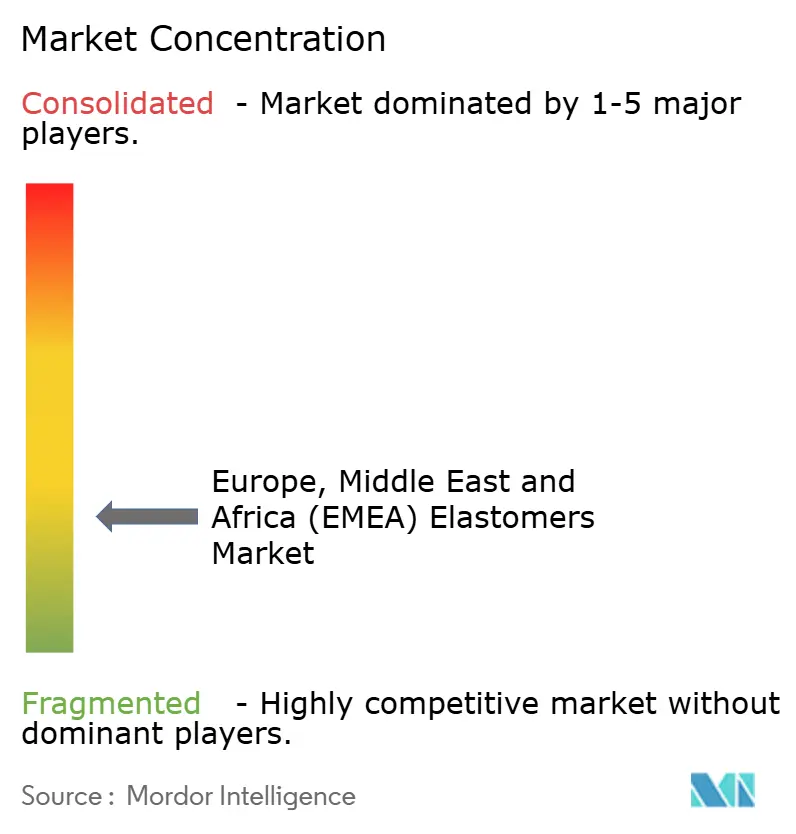
The Europe, Middle East and Africa (EMEA) elastomers market is highly fragmented, with the top five players including Dow, BASF, Exxon Mobil Corporation, ARLANXEO, and Covestro AG. Integrated petrochemical producers, specialty compounders, and tire-grade suppliers use different competitive approaches that reflect their respective positions in the value chain, their underlying feedstock access, and the range of customers they can serve. Integrated producers have cost advantages where they control access to key feedstocks, while specialty compounders compete through certification, application support, and material performance in medical, electronics, and hydrogen uses, where qualification is often lengthy. Regional and global tire-grade suppliers compete on manufacturing scale, established customer relationships, and their ability to meet changing tire-compound specifications without compromising product durability or production reliability. This structure creates stronger price pressure in standard grades than in high-performance formulations, where qualification periods, technical requirements, and the cost of changing established materials can reduce direct substitution.
BASF uses its Ludwigshafen integrated site to supply intermediates, including butadiene, polyether polyols, and thermoplastic polyurethane inputs. ARLANXEO maintains a synthetic-rubber presence through hydrogenated nitrile butadiene rubber and EPDM assets in the Netherlands and Germany, while LANXESS serves specialty requirements for fluid-resistant and under-hood uses. ARLANXEO and Covestro AG advanced sustainable chloroprene rubber production in 2025 using International Sustainability and Carbon Certification PLUS-certified materials. Covestro AG stated that the change reduced the Baypren portfolio’s global warming potential by an average of 20%, demonstrating how sustainability credentials can be incorporated into a product’s competitive position alongside traditional price, processing, and material-performance considerations. Wacker Chemie AG opened a specialty silicone production site in the Karlovy Vary region of the Czech Republic in April 2026 to support its European manufacturing footprint for electric vehicle and renewable-energy applications.
Hydrogen-grade elastomers and bio-content grades with audited mass-balance certification remain important opportunities in the Europe, Middle East and Africa (EMEA) elastomers market, because these applications require performance evidence beyond standard material specifications. Seals in proton exchange membrane electrolyzers must maintain gas-tightness over lifetimes longer than 10 years and at pressures above 30 bar, which favors materials and suppliers able to meet demanding technical requirements. Continental developed a synthetic-rubber cooling hose for hydrogen truck drivetrains in February 2025 to reduce ion migration into coolant circuits, offering an example of application-specific product development by a major supplier. Exxon Mobil Corporation, Mitsui Chemicals, Inc., and Momentive serve specialized applications in medical products, high-temperature sealing, and electronics. Huntsman International LLC and Covestro AG develop polyurethane elastomers for structural electric vehicle bonding and LG Chem and Shin-Etsu Chemical Co., Ltd. compete in specialty compounding tenders with Korean and Japanese production scale.
Europe, Middle East and Africa (EMEA) Elastomers Industry Leaders
-
ARLANXEO
-
Dow
-
BASF
-
Exxon Mobil Corporation
-
Covestro AG
- *Disclaimer: Major Players sorted in no particular order
Europe, Middle East and Africa (EMEA) Elastomers Market Companies Covered in this Report
- Arkema
- ARLANXEO
- BASF
- Covestro AG
- Dow
- Exxon Mobil Corporation
- Huntsman International LLC
- KCC Corporation
- KURARAY CO., LTD.
- LANXESS
- LG Chem
- Mitsui Chemicals, Inc.
- Momentive
- Shin-Etsu Chemical Co., Ltd.
- Wacker Chemie AG
Read Analysis of Europe, Middle East and Africa (EMEA) Elastomers Companies
Recent Industry Developments in Europe, Middle East and Africa (EMEA) Elastomers Market
- May 2026: Univar Solutions expanded its partnership with Dow to distribute silicone additives for plastics and composites across Europe, the Middle East and Africa. The wider distribution network supports regional demand for elastomer and polymer formulations requiring improved processing, performance, and sustainability.
- May 2026: Omya Performance Polymer expanded its BASF Elastollan TPU distribution agreement to France, Switzerland, North Africa, Israel, and the Middle East, effective July 2026. The expansion increases regional access to thermoplastic polyurethane elastomers for automotive, medical, industrial, consumer, and other applications.
Europe, Middle East and Africa (EMEA) Elastomers Market Report Scope
Elastomers are flexible polymeric materials that can undergo significant deformation and recover their original shape after the applied force is removed. They provide elasticity, resilience, and durability for a range of engineered and consumer applications.
The Europe, Middle East And Africa (EMEA) Elastomers Market is segmented by product type, end-user industry, and geography. By product type, the market is segmented into thermoplastic elastomers and thermoset elastomers. By end-user industry, the market is segmented into automotive and transportation, electrical and electronics, medical and healthcare, industrial machinery and equipment, consumer goods and footwear, adhesives, sealants and coatings, and other end-user industries. The report also covers the market size and forecasts for elastomers in 11 countries across Europe, Middle East And Africa (EMEA). For each segment, the market sizing and forecasts have been done on the basis of value (USD).
Segmentation Overview
By Product Type
| Thermoplastic Elastomers |
| Thermoset Elastomers |
By End-User Industry
| Automotive and Transportation |
| Electrical and Electronics |
| Medical and Healthcare |
| Industrial Machinery and Equipment |
| Consumer Goods and Footwear |
| Adhesives, Sealants and Coatings |
| Other End-User Industries |
By Geography
| Europe | Germany |
| United Kingdom | |
| France | |
| Italy | |
| Spain | |
| NORDIC Countries | |
| Russia | |
| Rest of Europe | |
| Middle East and Africa | Saudi Arabia |
| United Arab Emirates | |
| South Africa | |
| Egypt | |
| Nigeria | |
| Rest of Middle East and Africa |
| By Product Type | Thermoplastic Elastomers | |
| Thermoset Elastomers | ||
| By End-User Industry | Automotive and Transportation | |
| Electrical and Electronics | ||
| Medical and Healthcare | ||
| Industrial Machinery and Equipment | ||
| Consumer Goods and Footwear | ||
| Adhesives, Sealants and Coatings | ||
| Other End-User Industries | ||
| By Geography | Europe | Germany |
| United Kingdom | ||
| France | ||
| Italy | ||
| Spain | ||
| NORDIC Countries | ||
| Russia | ||
| Rest of Europe | ||
| Middle East and Africa | Saudi Arabia | |
| United Arab Emirates | ||
| South Africa | ||
| Egypt | ||
| Nigeria | ||
| Rest of Middle East and Africa | ||
Key Questions Answered in the Report
What is the size of the Europe, Middle East and Africa (EMEA) elastomers market?
The Europe, Middle East and Africa (EMEA) elastomers market stands at USD 40.64 billion in 2026 and is projected to reach USD 52.16 billion by 2031.
What is driving demand for elastomers in EMEA?
Vehicle electrification, healthcare material substitution, recyclable grades, and hydrogen sealing requirements are supporting demand in the Europe, Middle East and Africa (EMEA) elastomers market.
Which product led the market share in 2025?
Thermoplastic elastomers led with 81.12% share in 2025 because they support efficient processing and material recovery.
Which end-user industry led the market share in 2025?
Automotive and transportation held 51.45% share in 2025, supported by tires, weather seals, under-hood components, and electric vehicle applications.