
Market Overview
| Study Period | 2019 - 2031 |
|---|---|
| Forecast Data Period | 2026 - 2031 |
| Base Year Market Size (2025) | USD 40.20 Billion |
| Market Size (2026) | USD 46.12 Billion |
| Market Size (2031) | USD 90.89 Billion |
| Growth Rate (2026 - 2031) | 14.53 % |
| Market Concentration | Medium |
Major Players
*Disclaimer: Major Players sorted in no particular order Image © Mordor Intelligence. Reuse requires attribution under CC BY 4.0. |
|
Europe Electric Motors For Electric Vehicle Market Analysis by Mordor Intelligence
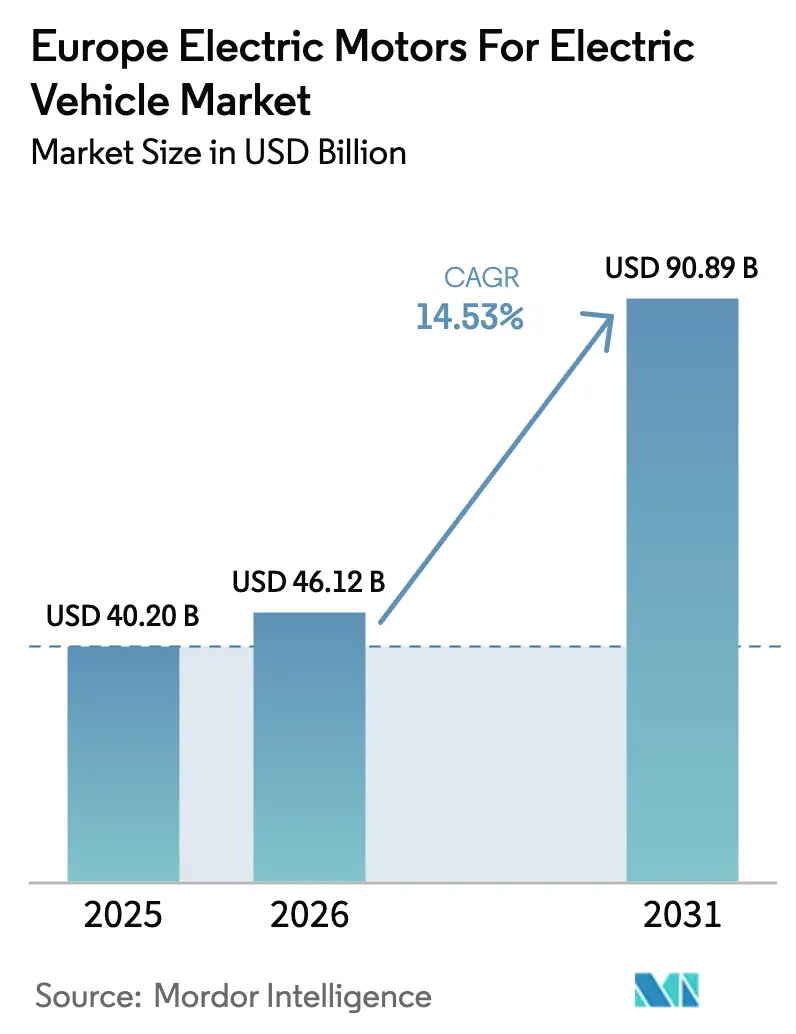
The European electric motors for the electric vehicle market are expected to grow from USD 40.20 billion in 2025 to USD 46.12 billion in 2026 and are forecast to reach USD 90.89 billion by 2031, advancing at a 14.53% CAGR during the forecast period (2026-2031). Tighter European Union fleet–average CO₂ limits, rapid battery cost deflation, and platform-level standardization by leading automakers are accelerating electric-motor demand at a pace that outstrips pure consumer-driven adoption. Persistent price swings in rare-earth materials are nudging OEMs to evaluate magnet-free motor designs; however, power-density requirements mean that permanent-magnet synchronous motors still dominate the volume. Rising investments in integrated e-drive production lines, especially those co-locating motor, inverter, and gearbox manufacturing, are compressing time-to-market and lowering landed costs. Germany currently leads regional revenue, but the expansion of Eastern Europe and government incentives in Spain and Poland are reshaping the supply chain footprint across the continent[1]“Regulation (EU) 2025/1214 on CO₂ Emission Performance Standards,” European Commission, europa.eu.
Key Report Takeaways
- By motor type, permanent-magnet synchronous motors held 58.71% of the European electric motors market share for the electric vehicle market in 2025, while switched-reluctance motors are forecast to climb at a 16.97% CAGR through 2031.
- By vehicle type, battery electric vehicles commanded 72.88% of the European electric motors market share for the electric vehicle market in 2025. In contrast, fuel-cell electric cars are expected to post the fastest growth rate of 19.81% through 2031.
- By application, passenger cars accounted for 64.78% of the European electric motor market share for the electric vehicle market in 2025, and off-road electric equipment is projected to expand at a 15.36% CAGR through 2031.
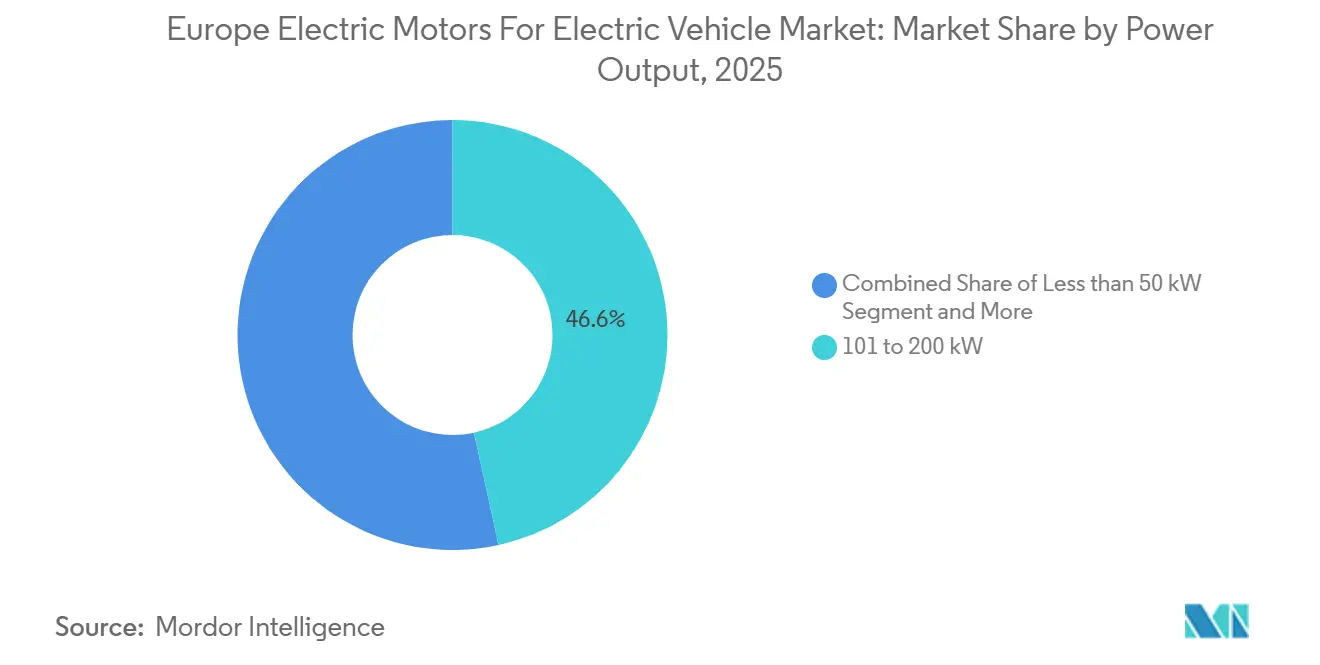
- By power output, the 101-to-200 kW bracket captured 46.56% of the European electric motors market share for the electric vehicle market in 2025, while motors above 400 kW are expected to advance at a 17.33% CAGR through 2031.
- By cooling method, liquid-cooled designs represented 62.76% of the European electric motors market share for the electric vehicle market in 2025 and are projected to track an 18.76% CAGR to 2031.
- By country, Germany led the European electric motors for the electric vehicle market with a 27.33% share in 2025; however, Poland is on track for the fastest growth, with a 16.27% CAGR through 2031.
Note: Market size and forecast figures in this report are generated using Mordor Intelligence’s proprietary estimation framework, updated with the latest available data and insights as of January 2026.
Europe Electric Motors For Electric Vehicle Market Trends and Insights
Drivers Impact Analysis*
| Driver | (~)% Impact on CAGR Forecast | Geographic Relevance | Impact Timeline |
|---|---|---|---|
| EU CO₂ Fleet-Average Targets | +3.2% | Germany, France, Italy, Spain, Netherlands, Belgium | Short term (≤ 2 years) |
| Decline in Battery USD/kWh | +2.8% | Germany, United Kingdom, France, Poland, Czech Republic | Medium term (2-4 years) |
| OEM Electrification Road-Maps | +2.5% | Germany, France, Spain, Italy, United Kingdom | Medium term (2-4 years) |
| Spain's 2024 PERTE VEC 2 Program | +1.8% | Spain, Portugal | Long term (≥ 4 years) |
| Demand from Retrofit E-Powertrains | +1.5% | United Kingdom, France, Germany, Italy, Netherlands | Short term (≤ 2 years) |
| AI-Driven Motor-Inverter Co-Design | +1.2% | Germany, Sweden, France, Austria | Long term (≥ 4 years) |
| Source: Mordor Intelligence | |||
Stricter EU CO₂ Fleet-Average Targets for 2025 and 2030
The European Union’s Regulation 2025/1214 lowered the 2025 fleet-average limit to 93.6 g CO₂/km till 2029 and set a 49.5 g CO₂/km ceiling for 2034, pairing steep non-compliance fines with the expiration of the super-credit mechanism at the end of 2025[2]"CO2 emissions performance of new passenger cars in Europe", European Environment Agency, eea.europa.eu. Automakers now accelerate BEV launches, irrespective of short-term profitability, because every percentage-point gap in the electric-vehicle mix can trigger hundreds of millions of euros in penalties. Platform production is therefore being front-loaded at factories in Zwickau, Emden, and Tychy, with suppliers scaling hairpin stator and rotor lines accordingly. The regulation effectively ties motor demand to statutory ceilings rather than consumer preference, pushing European electric motors for the electric vehicle market onto a policy-driven growth path.
Rapid Decline in Battery USD/kWh Enabling Affordable BEVs
Average pack prices slid from USD 153/kWh in 2022 to USD 111/kWh in 2024 and are on track to fall below USD 80/kWh by 2026. Crossing this threshold enables B- and C-segment BEVs to reach purchase-price parity with internal-combustion cars without subsidies, thereby expanding the potential motor customer base by tens of millions of vehicles. Renault’s 2025 R5 E-Tech launch at EUR 25,000 illustrates how lower battery costs free pricing headroom to specify higher-efficiency, 110 kW permanent-magnet motors. Component suppliers, meanwhile, have trimmed assembly labor per motor by nearly one-third, thanks to copper hairpin winding and integrated inverters. Yet the shift toward lithium-iron-phosphate batteries—with their lower energy density—requires motors to deliver better efficiency across a broader torque band, highlighting the delicate balance between cost, range, and rare-earth demand.
OEM Electrification Road-Maps and Platform Shifts
Volkswagen’s MEB, Stellantis’s STLA-Medium, and BMW’s Neue Klasse platforms standardize motor mountings, thermal interfaces, and inverter packaging to unlock economies of scale. For example, integrating silicon-carbide MOSFETs directly inside the motor housing has trimmed high-voltage cabling by more than a meter while increasing power density by roughly 30%. Design consolidation shifts the competitive advantage from bespoke motor geometry to manufacturing scale and thermal-management expertise, prompting Tier 1 suppliers to invest in multi-gigawatt lines across Germany, Spain, and Austria. Platform commonality also simplifies over-the-air updates that tweak torque curves within the same hardware envelope, converting software into a fresh battleground for differentiation. As more models ride on shared architectures, the European electric motors for the electric vehicle market reinforce its volume-driven cost curve and vertically integrate critical sub-assemblies.
Spain’s 2024 PERTE VEC 2 Program Anchoring New E-Drive Supply Chains
The EUR 3 billion program launched in 2024 channels public funds into Valencian and Aragonese clusters, subsidizing hairpin stator, rotor assembly, and coil laser-welding equipment. Vitesco and Schaeffler have already commissioned a combined nameplate capacity shortening logistics corridor to Iberian and southern French vehicle plants. Mandatory private co-investment ensures a long-term commitment, while a parallel workforce re-skilling initiative covers 12,000 technicians across Spain. Lead times for specialized insertion machinery nevertheless stretch to 18 months, creating a temporary bottleneck that slows complete capacity ramp-up until 2028. Even so, the initiative positions Spain as a pivotal production node and boosts regional resilience against supply-chain shocks.
Restraints Impact Analysis*
| Restraint | (~)% Impact on CAGR Forecast | Geographic Relevance | Impact Timeline |
|---|---|---|---|
| Price Volatility and Supply-Chain Risk | -1.5% | Germany, France, Italy, Spain, Poland, Czech Republic | Medium term (2-4 years) |
| High CAPEX | -1.3% | Germany, Spain, France, United Kingdom, Poland | Short term (≤ 2 years) |
| Grid Connection Queues | -0.9% | United Kingdom, Germany, Netherlands, Belgium | Short term (≤ 2 years) |
| Talent Shortage | -0.8% | Germany, France, Austria, Sweden, Netherlands | Long term (≥ 4 years) |
| Source: Mordor Intelligence | |||
Rare-Earth Magnet Price Volatility and Supply-Chain Risk
Neodymium-praseodymium oxide peaked near USD 68,000 per metric ton in early 2025 before sliding to USD 54,000 by year-end, a 26% swing that destabilized quarterly gross margins for many Tier 1 suppliers. Forward contracts can cushion some volatility but carry hefty premiums, further squeezing profit. Substituting ferrite magnets reduces power density by up to 20%, necessitating design changes that few OEMs are willing to accept for mainstream passenger cars. Recycling initiatives in Saxony aim to recover 2,000 metric tons annually by 2028; however, this covers less than 5% of the projected European demand. Until domestic extraction or large-scale recycling becomes a viable option, magnet pricing remains a structural headwind.
High CAPEX for Advanced Hair-Pin Winding and Liquid-Cooling Lines
Transitioning from round-wire to hairpin stators requires an investment of EUR 8-12 million in automated insertion and laser-welding equipment per production line, while adding liquid-cooling capability pushes the investment past EUR 15 million for mid-volume facilities. Payback periods often exceed 24 months, a stretch for smaller Tier 2 firms. Once installed, these capital-intensive lines become geographically “sticky,” making relocation to lower-cost countries economically unviable over a 10-year depreciation cycle. The hurdle effectively raises barriers to entry and favors incumbents with stronger balance sheets, slowing the diffusion of next-generation winding technologies.
*Our forecasts treat driver/restraint impacts as directional, not additive. The impact forecasts reflect baseline growth, mix effects, and variable interactions.
Segment Analysis
By Motor Type: PMSM Dominance Faces SRM Challenge
Permanent Magnet Synchronous Motors (PMSMs) commanded 58.71% of the European electric motors for the electric vehicle market share in 2025, as their power density allows automakers to meet interior-space targets without resizing vehicle subframes. Induction motors are often used in dual-motor all-wheel-drive configurations, where their lower cost offsets the penalties associated with partial-load efficiency. BLDC units maintained a foothold in two- and three-wheelers due to their simplicity and compatibility with air cooling. At the same time, brushed DC motors have largely been replaced by BLDC units in mainstream automotive use. SRM volume is rising quickly—forecasted to increase at a 16.97% CAGR through 2031, because magnet-free designs hedge against rare-earth volatility.
SRM gains come with engineering trade-offs: higher torque ripple and acoustic noise demand sophisticated control algorithms that in turn require costlier silicon-carbide inverters. Nevertheless, suppliers unveiled 150 kW SRM prototypes that achieve over 90% rated-load efficiency, significantly narrowing the gap with PMSM. Induction motor adoption remains steady where battery packs exceed 75 kWh, as the impact on range is less severe. Overall, technology mix shifts will continue, yet PMSM remains the anchor of the European electric motors for the electric vehicle market through 2031.




By Vehicle Type: BEV Leadership, FCEV Momentum
BEVs absorbed 72.88% of the market share in 2025 on the strength of Volkswagen ID models, Stellantis platforms, and Tesla’s sustained Model Y sales. FCEVs are expanding at a 19.81% CAGR through 2031, driven by hydrogen-refueling corridors that now span 250 stations across Germany, France, and the Netherlands. The PHEV share is eroding under stricter real-world CO₂ testing, prompting OEMs to reallocate their R&D budgets toward full-electric architectures. HEVs still serve regions with patchy charging networks but generate lower motor revenue because power ratings often stay below 50 kW.
In heavy-duty trucks, dual 180 kW liquid-cooled PMSMs in FCEVs are designed to offset the fuel-cell response lag, marking a departure from BEV standards. While BEVs dominate in volume, the growth of FCEVs not only offers an incremental boost but also diversifies the demand landscape for European electric motors for the electric vehicle market.
By Application: Passenger Cars Lead, Off-Road Surges
Passenger cars accounted for 64.78% of the European electric motors for the electric vehicle market share in 2025, mirroring Europe’s car-centric mobility patterns and the concentration of BEV releases in the C- and D-segments. Off-road and industrial EVs-such as electric excavators, wheel loaders, and port equipment-are projected to grow at a 15.36% CAGR through 2031, as urban construction and harbor authorities impose zero-tailpipe emissions mandates. E-commerce fleet electrification pledges propel the share of commercial vans and medium trucks. Two-wheelers and three-wheelers are concentrated in southern urban centers.
Harsh operating conditions in off-road segments favor ruggedized induction motors with IP67 enclosures, while passenger-car motors prioritize compactness and efficiency. Commercial-vehicle stop-start cycles create thermal spikes, driving adoption of active cooling even for sub-100 kW units. These nuanced duty-cycle differences make application segmentation a key lens for forecasting market size.
By Power Output: Mid-Range Dominates, High-Power Accelerates
Motors rated 101-200 kW captured 46.56% of the European electric motors for the electric vehicle market in 2025, as they meet acceleration benchmarks for mainstream C-segment cars without incurring the premium costs associated with vehicles of this class. Units above 400 kW, essential for heavy-duty trucks and articulated buses, are the fastest-growing slice at a 17.33% CAGR through 2031, albeit from a smaller base. The 51-100 kW bracket serves entry-level BEVs and urban delivery vans, where cost sensitivities dictate air-cooled architectures.
Thermal management becomes the primary design constraint beyond 250 kW, necessitating the use of oil-spray or direct liquid-cooled stator windings to prevent magnet demagnetization. Silicon-carbide inverters now unlock peak efficiencies of 98% or higher, even at 550 kW, enabling OEMs to maintain range without oversizing battery packs. These high-power advances expand the upper boundary of Europe's electric motors for the electric vehicle market size as commercial applications electrify.
By Cooling Method: Liquid Cooling Ascends
Liquid-cooled motors held 62.76% of the European electric motors for the electric vehicle market share in 2025 and are on track for an 18.76% CAGR through 2031, a trajectory tied to rising continuous power demands above 150 kW. Air-cooled designs retain 37.24% share, focusing on vehicles below 100 kW where bill-of-materials savings of USD 400-600 per unit remain decisive. Above 150 kW, air cooling requires oversized stators, which add 6 kg of copper and steel, thereby nullifying any weight advantage.
Liquid cooling’s complexity introduces a leak risk and parasitic power draw of roughly 150-200 W; yet, the 20-25% volume reduction it permits frees valuable packaging space for larger battery packs. Southern Europe’s high ambient temperatures further tilt the balance toward liquid-cooled systems, reinforcing a structural shift already underway in the European electric motor market for electric vehicles.
Geography Analysis
Germany accounted for 27.33% of the European electric motors for the electric vehicle market share in 2025, leveraging Volkswagen’s Zwickau and Emden plants, BMW’s Munich R&D center, and a dense supplier base that enables rapid prototyping and validation cycles. Proximity between engineering and production shortens development timelines by as much as nine months, making Germany a vital hub in the European electric motor market for electric vehicles. Poland is emerging as the fastest-growing geography with a 16.27% CAGR through 2031, driven by Stellantis’s Tychy electrification, LG Energy Solution’s cell capacity ramp-up, and lower labor costs that compress landed cost per motor by double-digit percentages. France follows, anchored by Renault’s vertically integrated ElectriCity complex, which co-locates battery, motor, and final assembly under one roof, significantly reducing logistics buffers.
The United Kingdom retained a significant portion of volume despite post-Brexit tariff uncertainty, due to high localization at Nissan Sunderland and the presence of supply-chain clusters in the Northeast. Italy benefits from Stellantis' investments in Melfi and Mirafiori, while Spain leverages PERTE VEC 2 subsidies to attract new motor component lines. A “rest-of-Europe” cohort, comprising the Czech Republic, Hungary, Romania, and Slovakia, primarily serves just-in-sequence shipments into German vehicle plants.
Germany’s dominance is underpinned by workforce expertise and infrastructure maturity, yet rising wage costs are encouraging suppliers to diversify eastward. Poland’s grid, which is still reliant on coal for more than 60% of its generation, pushes industrial electricity prices above German averages, partly eroding its labor-cost advantage. France’s integrated supply chain reduces working-capital requirements, bolstering project cash flow and making it an attractive blueprint for other countries. Spain’s ramp-up timeline means its full capacity effect will not materialize until the next decade. Still, early indicators suggest a durable southward shift in the European electric motor market for electric vehicles.
Regulatory Landscape
EU regulatory pressure on vehicle CO2 emissions and type-approval requirements continues to support demand for traction motors and integrated e-drives across Europe. In addition to the fleet-average CO2 constraints cited in the report context, UN Regulation No. 177 entered into force on 26 September 2025, establishing harmonized procedures to determine power for hybrid and pure electric vehicles with multiple propulsion machines, which tightens the technical boundary conditions for motor and inverter integration.
On the compliance and industrial-policy side, Regulation (EU) 2024/1257 (Euro 7) introduces technical requirements relevant to electric powertrains, including electric motors and traction batteries. From 29 November 2026, authorities must refuse type-approval for new M1 and N1 vehicle types that do not meet the updated standards. Separately, the European Commission has used trade and subsidy-linked measures that influence sourcing and localization decisions, including Commission Implementing Regulation (EU) 2026/330 (9 February 2026) adjusting countervailing duties on battery electric vehicles imported from China following a partial interim review, along with 2025-2026 actions under the European Commission Automotive Package that link eligibility for public support and procurement to Union-origin and resilience criteria.
Value Chain Analysis
The value chain covers raw materials such as electrical steel, copper, insulation varnishes, and NdFeB magnet inputs for PMSMs, then moves through upstream components including laminations/plate packs, shafts, bearings, hairpin windings, rotor assemblies, and housings with associated thermal interfaces. Power electronics come next, led by inverters and control units, followed by final assembly of motors and integrated e-drive units (motor + inverter + gearbox). This is then completed by OEM integration, homologation and validation, and aftermarket service.
Manufacturing intensity is rising as suppliers and OEMs scale automation for hairpin insertion and laser-welding, integrate liquid cooling, and expand end-of-line testing. That shifts cost and operational risk toward suppliers with stable local industrial infrastructure near vehicle plants. Recent European localization steps reflect this: Audi started series production of the MEBeco electric drive unit at Győr (Hungary) in June 2026, including in-house production of plate packs and rotors, and BMW commissioned a second Gen6 e-drive motor line at Steyr (Austria) in April 2026 to expand output capacity.
Competitive Landscape
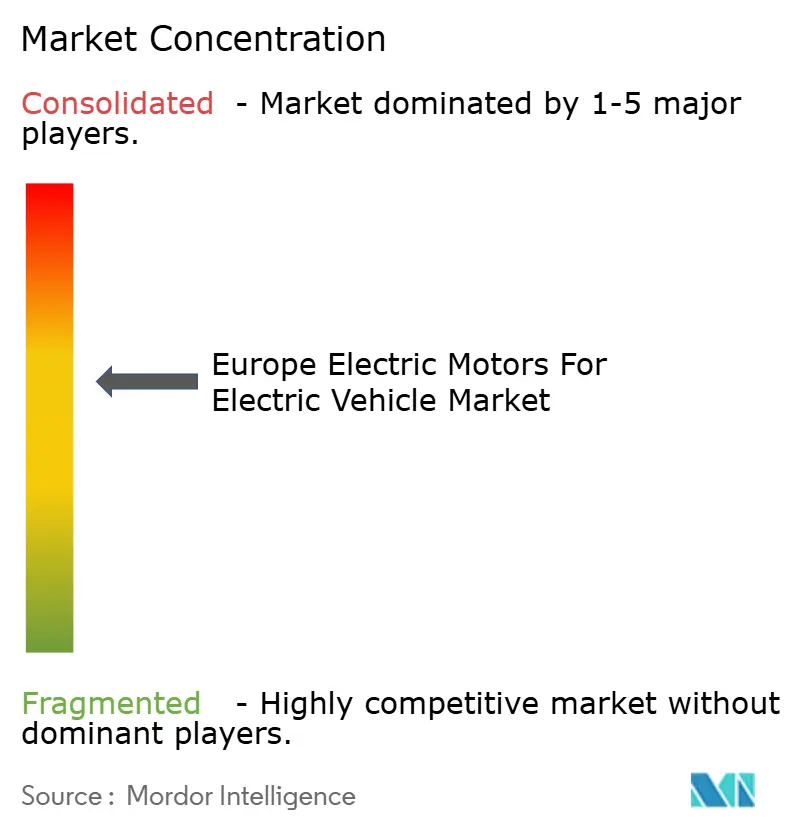
The European electric motors for the electric vehicle market exhibit moderate concentration, with Robert Bosch GmbH, Siemens AG, ZF Friedrichshafen AG, Valeo SA, and Nidec Corporation collectively accounting for the majority of the 2025 revenue. Tier 1 integrators increasingly bundle inverter and gearbox functions into a single e-drive, capturing more value per unit and tightening supplier-OEM collaboration. YASA’s axial-flux motor, adopted by Mercedes-Benz AMG models in 2025, delivers significantly higher torque density than radial-flux designs, signaling that topology innovation remains a potent disruptor.
In-wheel motor specialists, such as Elaphe and Protean, target urban vehicles where eliminating half-shafts offsets the added unsprung mass; however, adoption remains niche due to ride-quality penalties at higher speeds. Retrofit-kit providers have carved out a high-margin aftermarket for commercial vans, serving fleet operators who are keen to comply with low-emission zone mandates without purchasing new vehicles. Intellectual property filings underscore the innovation race: the European Patent Office logged 347 electric motor control applications in 2025, reflecting intensified R&D competition.
Regulatory shifts also shape strategy. The EU’s Ecodesign for Sustainable Products Regulation, effective in 2026, requires detailed disassembly roadmaps and verification of recycled content, favoring suppliers with robust reverse logistics and recycling partnerships. Rare-earth price volatility is prompting larger players to integrate vertically into magnet production, while smaller entrants diversify into switched-reluctance architectures to minimize their exposure. These dynamics collectively sustain a competitive yet consolidating landscape across the European electric motor market for electric vehicles.
Europe Electric Motors For Electric Vehicle Industry Leaders
-
Robert Bosch GmbH
-
Siemens AG
-
Valeo SA
-
ZF Friedrichshafen AG
-
Nidec Corporation
- *Disclaimer: Major Players sorted in no particular order

Market Opportunities and Future Outlook
Policy-linked localization requirements create specific capacity opportunities for European motor, rotor, and lamination production, as public procurement and financial support schemes increasingly emphasize Union-origin and resilience criteria. With the European Commission Automotive Package (December 2025) and subsequent 2026 proposals on origin requirements for electric vehicles in public procurement and support schemes, OEMs and Tier 1s increasingly map motor and e-drive component content, which makes domestically produced subassemblies such as stator plate packs, rotors, housings, and power electronics integration more relevant in awarded programs.
In-region industrialization moves in 2026 also support demand for advanced manufacturing services, equipment, and high power-density designs. Mercedes-Benz ramped axial-flux motor series production at Berlin-Marienfelde in June 2026, Audi initiated MEBeco e-drive series production at Győr with internal rotor and plate-pack processes in June 2026, and BMW expanded Gen6 motor output at Steyr via a second production line in April 2026. Magnet-risk mitigation continues to widen design pathways in 800V platforms, including Valeo and MAHLE's iBEE inner brushless electrical excitation (EESM) motor system introduced in November 2025, which broadens the addressable design space beyond PMSM-heavy sourcing and supports supplier differentiation via materials strategy, manufacturability, and integrated thermal management.
Recent Industry Developments
- May 2026: Robert Bosch GmbH secured a major order from Mercedes-Benz to supply high volumes of electric motors into the 2030s for next-generation electric powertrains. The award supports long-cycle utilization for European motor manufacturing and reflects OEM preference for scalable, integrated e-drive supply backed by proven industrial capacity.
- November 2025: Valeo SA and MAHLE announced the iBEE (Inner Brushless Electrical Excitation) motor system, an externally excited synchronous motor concept positioned for 800V architectures and higher-efficiency operation without permanent magnets. The development expands the competitive set of traction motor technologies in Europe and supports sourcing strategies that reduce exposure to rare-earth price volatility.
- April 2025: Valeo SA and PanGood announced co-development of a high-efficiency integrated axial-flux generator system for extended range electric vehicles (EREVs). The collaboration targets compact, high power-density electrified powertrain architectures and broadens the applications where axial-flux-based machines can compete alongside radial-flux traction motors.


Research Methodology Framework and Report Scope
Market Definition and Coverage
For this study, the market covers electric motors used for vehicle propulsion in electric vehicles across Europe, counted in value terms based on OEM and supplier sales for motors fitted on new vehicles.
Scope exclusions: The sizing does not include non-traction motors used for auxiliary functions (such as pumps, fans, and window or seat motors).
Segmentation Overview
-
By Motor Type
- DC Brushed Motors
- DC Brushless Motors (BLDC)
- Induction Motors (AC)
- Permanent Magnet Synchronous Motors (PMSM)
- Switched Reluctance Motors (SRM)
-
By Vehicle Type
- Battery Electric Vehicles (BEVs)
- Hybrid Electric Vehicles (HEVs)
- Plug-in Hybrid Electric Vehicles (PHEVs)
- Fuel Cell Electric Vehicles (FCEVs)
-
By Application
- Two-Wheelers
- Three-Wheelers
- Passenger Cars
- Commercial Vehicles
- Off-Road / Industrial EVs
-
By Power Output
- Less than 50 kW
- 51 to 100 kW
- 101 to 200 kW
- 201 to 400 kW
- Above 400 kW
-
By Cooling Method
- Air-Cooled Motors
- Liquid-Cooled Motors
-
By Country
- Germany
- United Kingdom
- France
- Italy
- Spain
- Rest of Europe
Data Sources, Market Sizing, and Validation
Desk Research
Desk research starts with building a clean demand and policy picture for Europe, since EV motor demand follows vehicle production, registrations, and emissions rules. We use public sources such as the European Commission releases on CO2 standards, the European Automobile Manufacturers Association (ACEA) for registrations, and national transport statistics offices for the country split.
To ground volumes and trade flows, we also refer to sources such as Eurostat, UN Comtrade, and customs and tariff datasets that help us sanity-check import and export movement for relevant motor and drivetrain categories. Company annual reports, investor presentations, and press releases are then reviewed to map capacity expansions, platform launches, and supplier footprints, supported by a paid subscription used mainly for company financials, shipment-level trade checks, and patent lookups. These examples are not exhaustive, and many other public sources were reviewed for data collection, validation, and clarification during the study.
Primary Interviews and Surveys
Primary work is used to validate what desk research cannot fully explain, especially around motor content per vehicle, typical power ranges, cooling choices, and how the hybrid versus battery electric mix shifts motor value. We spoke with vehicle-side teams, component suppliers, and channel participants across key European markets, so assumptions could be tested, adjusted, and then triangulated before finalization.
Distribution of primary research fieldwork respondents
| Company type | Respondent position |
|---|---|
| Top tier: 34% | CXOs: 14% |
| Mid tier: 44% | Functional/Unit leaders: 34% |
| Smaller Players: 22% | Managers: 52% |
Market-Sizing & Forecasting
Sizing is built with a top-down demand reconstruction that starts from Europe EV production and registrations, and then applies motor-fitment logic by powertrain type to arrive at motor volumes, which are then valued using typical price bands. Once that total is formed, we corroborate it with selective bottom-up checks such as sampled motor ASP times implied volumes, supplier revenue splits disclosed in filings, and spot channel checks that help catch over-counting.
Inputs used in the model include EV registrations and production by country, BEV versus HEV versus PHEV mix, motors per vehicle where dual-motor setups are common, average power-output bands (below and above 50 kW), and cooling method split (air-cooled versus liquid-cooled) since it changes content value. Where direct country data is thin, gaps are handled by proxying from nearby markets with similar adoption and by validating the ratio through expert calls.
Forecasts are developed using scenario analysis, where EV penetration paths, policy timelines, and localized manufacturing shifts are used to create a base case, followed by sensitivity checks on motor ASP progression and technology mix changes such as permanent-magnet versus induction share.
Data Validation & Update Cycle
Outputs are checked against independent signals like EV unit trends, major platform launch cadence, and visible capacity additions in Europe, and then inconsistencies are flagged for rework. We also run variance checks at country level so one market does not absorb unrealistic growth that conflicts with registrations or production.
Before sign-off, the model and assumptions go through a multi-step analyst review, and interview respondents are re-contacted when a key input shifts meaningfully or when a country result looks out of pattern. The report is refreshed annually, with interim updates when material events occur, and a final pre-delivery pass is completed so the view reflects the latest available public data.
Mordor Intelligence's Europe Electric Motors for Electric Vehicle Market Size Versus Other Published Estimates
Published market sizes for Europe EV traction motors often differ because the scope boundary, the powertrain set included, and the way pricing is carried forward are not the same across studies. Differences also show up when some estimates lean on unit-only growth without fully re-checking motor content per vehicle and the regional build mix.
Key gap drivers usually come from whether hybrids are fully counted, whether two-wheelers are included, and whether the sizing tracks motor value at the motor level versus bundling broader e-drive content. Currency timing and the refresh cycle also matter because Europe EV volumes and motor ASPs can shift quickly with incentives, model launches, and local production moves.
Benchmark comparison
| Source | Market Size | Gaps in Research Methodology |
|---|---|---|
| Mordor Intelligence | USD 40.20 B (2025) | |
| Regional Consultancy A | USD 32.90 B (2024) | The estimate is anchored to a 2024 base and appears to emphasize traction motors by vehicle demand, which can understate value if dual-motor fitment and higher-power, liquid-cooled setups are not consistently applied across Europe. |
| Industry Publisher B | USD 18.70 B (2026) | This figure starts later and looks more conservative on what gets counted as the motor value, which can happen when only selected traction-motor categories are priced in and country build shifts are not fully reflected year to year. |
The table shows a wide spread that is mostly explained by year alignment and what is being counted as motor value. In Mordor Intelligence's model, the market is limited to traction motors used in EV propulsion across Europe (with vehicle type, power-output, and cooling method reflected), rather than a narrower subset or a broader e-drive bundle. When those scope and pricing choices are made explicit and then checked against registrations, production, and supplier signals, the resulting market value becomes easier to reproduce and compare across years.


Key Questions Answered in the Report
What was the Europe electric motors for electric vehicle market size in 2026?
The market reached USD 46.12 billion in 2026 and is projected to rise to USD 90.89 billion by 2031.
Which motor technology currently leads adoption?
Permanent-magnet synchronous motors held 58.71% of 2025 installations, making them the dominant technology in the region.
Which country is growing fastest for electric-motor production?
Poland shows the highest 2026-2031 CAGR at 16.27% due to new OEM platforms and battery-cell capacity additions.
Why are liquid-cooled motors gaining share?
Rising continuous power requirements above 150 kW favor liquid cooling because it removes heat more efficiently, allowing smaller, lighter designs that improve vehicle packaging.
How does rare-earth price volatility impact suppliers?
Swings in neodymium-praseodymium oxide prices can compress quarterly gross margins by several hundred basis points, prompting forward-contracting and exploration of magnet-free architectures.
Page last updated on:


 Your data is secure and never sold or shared.


