
Middle East and Africa Digital Workplace Market Size and Share
Market Overview
| Study Period | 2020 - 2031 |
|---|---|
| Forecast Data Period | 2026 - 2031 |
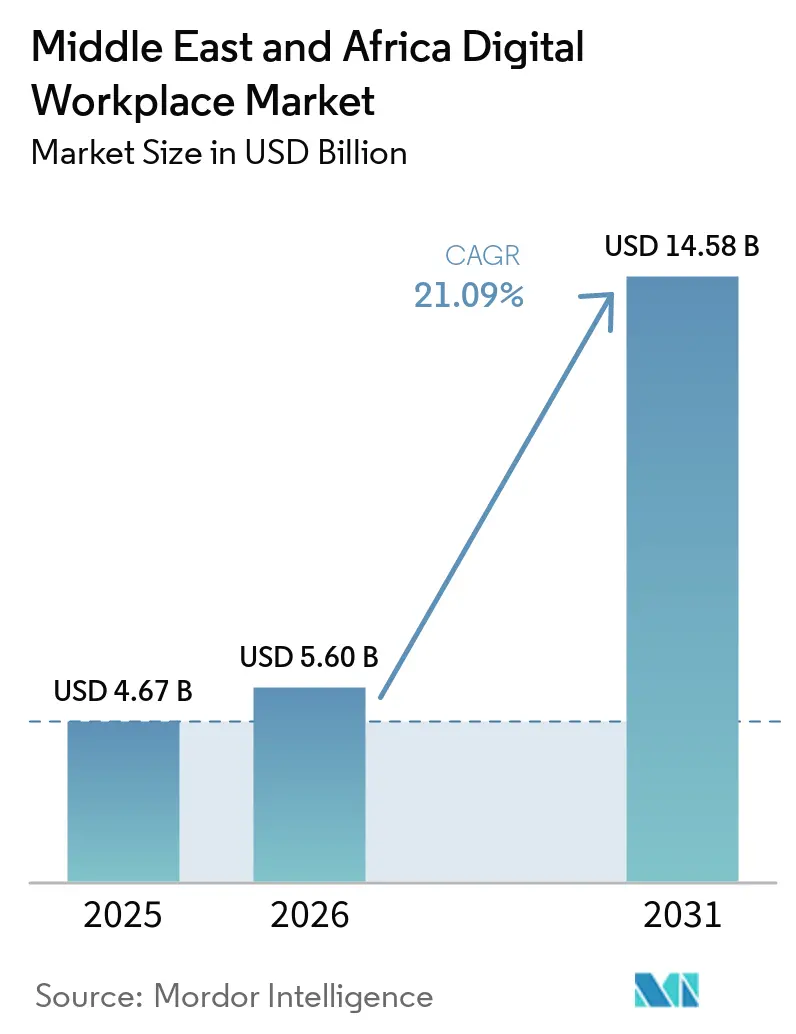
| Base Year Market Size (2025) | USD 4.67 Billion |
| Market Size (2026) | USD 5.60 Billion |
| Market Size (2031) | USD 14.58 Billion |
| Growth Rate (2026 - 2031) | 21.09 % |
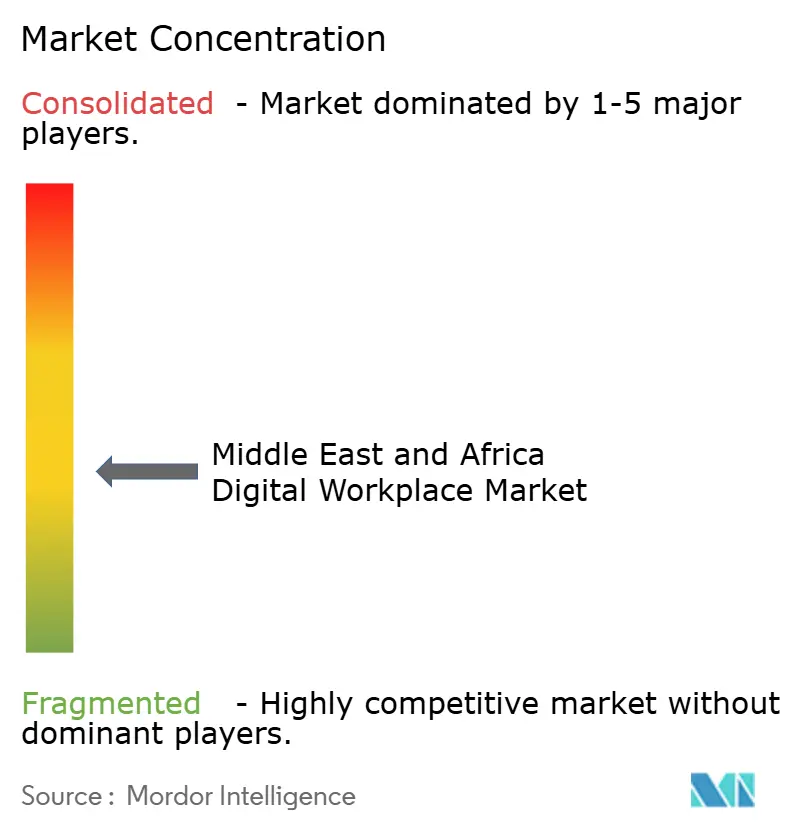
| Market Concentration | Medium |
Major Players *Disclaimer: Major Players sorted in no particular order Image © Mordor Intelligence. Reuse requires attribution under CC BY 4.0. | |
Middle East and Africa Digital Workplace Market Analysis by Mordor Intelligence
The Middle East and Africa digital workplace market size is projected to expand from USD 4.67 billion in 2025 and USD 5.6 billion in 2026 to USD 14.58 billion by 2031, registering a CAGR of 21.09% between 2026 and 2031. The growth path reflects a clear shift from basic workplace digitization toward broader enterprise modernization across collaboration, workflow, endpoint control, and employee support. Public sector technology programs in the Gulf have kept digital workplace spending high, which has also influenced buying behavior across financial services, energy, logistics, and large service organizations. Compliance rules around data residency and cybersecurity have made certified cloud and security capabilities more important in vendor selection across the Middle East and Africa digital workplace market. Large account deployments are also shaping procurement standards for smaller buyers, as platform choices made by ministries, telecom groups, and major enterprises often serve as regional reference models.
Key Report Takeaways
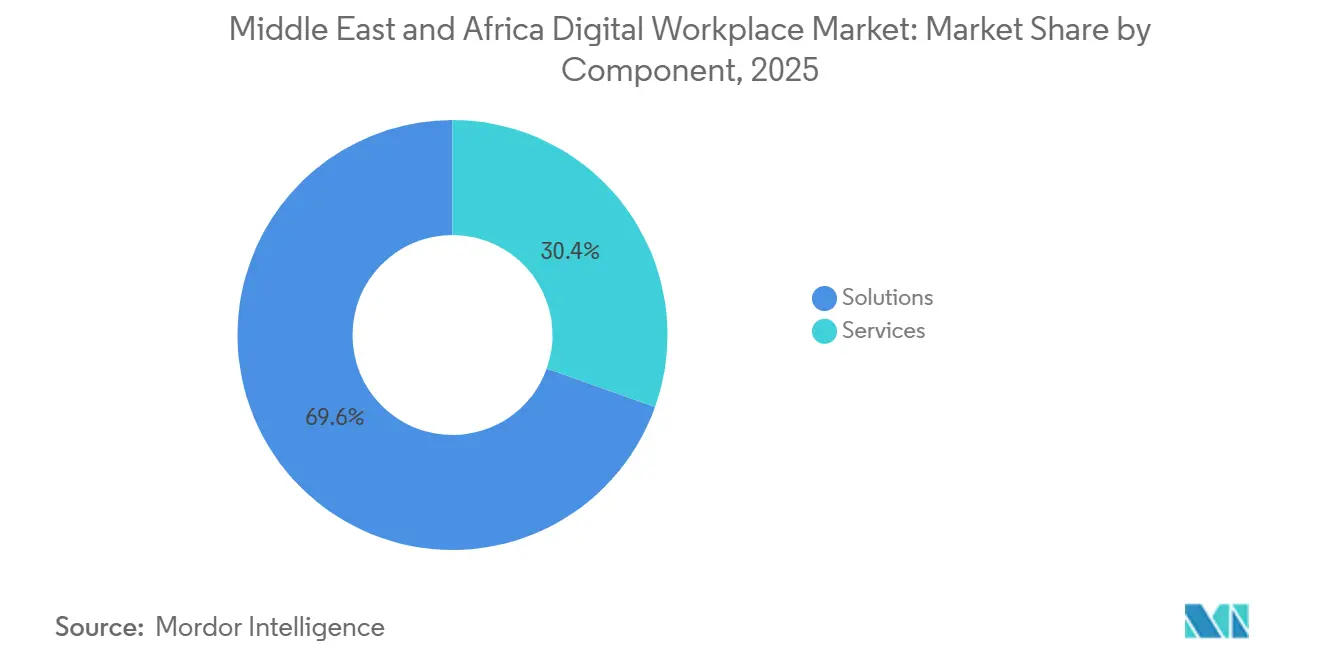
- By component, solutions held 69.56% share of the Middle East and Africa digital workplace market in 2025, and are projected to grow at a 22.43% CAGR through 2031.
- By deployment mode, cloud held 63.19% of the market in 2025 and is projected to expand at a 22.56% CAGR through 2031.
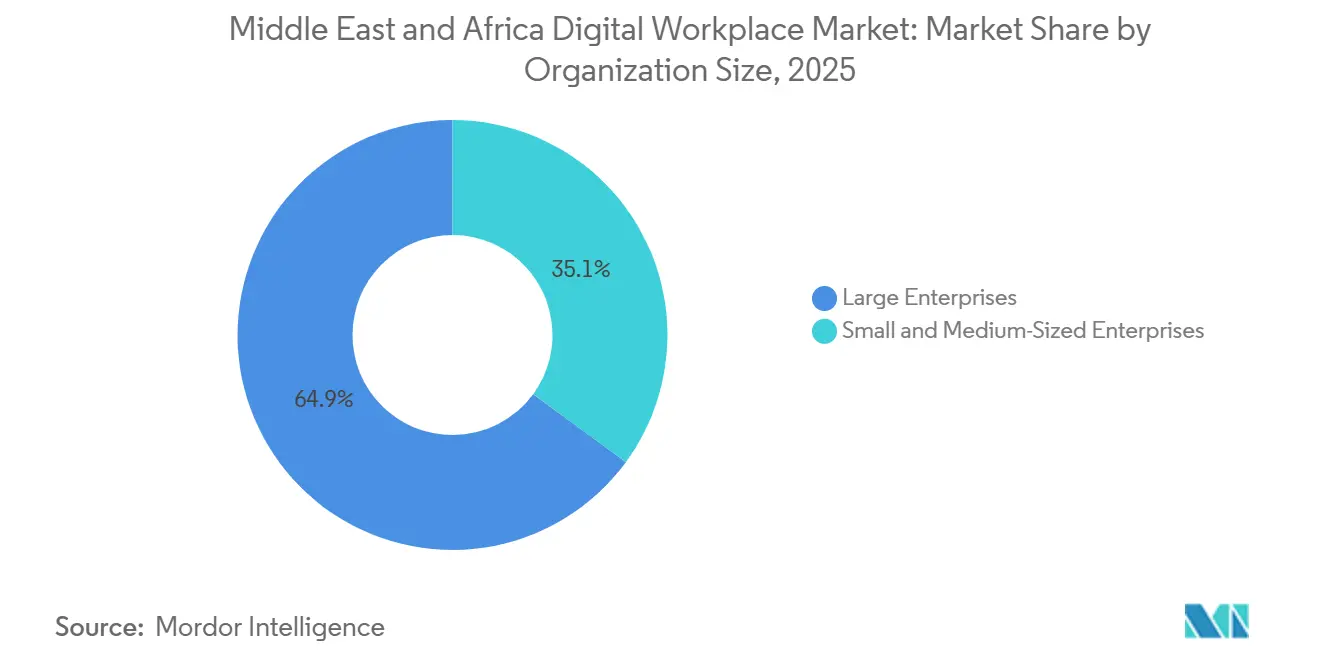
- By organization size, large enterprises accounted for 64.93% of the market in 2025, while Small and Medium-Sized Enterprises are projected to grow at a 21.74% CAGR through 2031.
- By end-user industry, government and public sector held 23.18% of the Middle East and Africa digital workplace market share in 2025, while healthcare is projected to expand at a 22.05% CAGR through 2031.
- By geography, Saudi Arabia accounted for 27.68% of regional revenue in 2025, while the United Arab Emirates is projected to grow at a 22.16% CAGR through 2031.
Note: Market size and forecast figures in this report are generated using Mordor Intelligence’s proprietary estimation framework, updated with the latest available data and insights as of January 2026.
Market Trends and Insights
Drivers Impact Analysis of Middle East and Africa Digital Workplace Market*
| Driver | (~) % Impact on CAGR Forecast | Geographic Relevance | Impact Timeline |
|---|---|---|---|
| Rising Demand for Hybrid Work Across Distributed Enterprises | +5.0% | Global, concentrated in GCC and South Africa | Short term (≤ 2 years) |
| Accelerating Cloud Migration of Workplace Infrastructure | +4.5% | Saudi Arabia and UAE core, spillover to Egypt and South Africa | Medium term (2-4 years) |
| Growing Need for Secure Endpoint and Identity Control | +3.8% | Global, highest in regulated sectors across GCC | Medium term (2-4 years) |
| Increasing Adoption of Employee Experience Platforms and Digital Front Doors | +2.8% | GCC core, expanding to Turkey and South Africa | Medium term (2-4 years) |
| Expansion of Workflow Automation and Knowledge Management Use Cases | +2.2% | Global, with early gains in UAE, Saudi Arabia, and South Africa | Long term (≥ 4 years) |
| Rising Demand for Virtual Desktop Infrastructure and Cloud PC in Regulated Environments | +1.6% | GCC core, spillover to Nigeria and Kenya | Medium term (2-4 years) |
| Source: Mordor Intelligence | |||
Rising Demand for Hybrid Work Enablement Across Distributed Enterprises
Hybrid work in the region has moved beyond a short-term work arrangement and now functions as a structural operating requirement for many large employers. In the Middle East and Africa digital workplace market, this demand is strongest among organizations that manage large project sites, multiple offices, field teams, and cross-border operations simultaneously. Mega-project activity in Saudi Arabia has reinforced the need for continuous coordination among remote sites, command centers, and headquarters to sustain collaboration and device management. Cisco’s broader Saudi expansion in 2025, including cloud services, data centers, local manufacturing plans, and support for AI talent development, strengthened the infrastructure needed for connected workplace environments. In African markets such as South Africa and Nigeria, workforce mobility across dispersed operating locations often matters more than home-based remote work when organizations evaluate workplace platforms. Vendors that combine communications, endpoint governance, multilingual usability, and secure access are therefore better placed to win new rollout cycles in the Middle East and Africa digital workplace market.
Accelerating Cloud Migration of Workplace Infrastructure
Cloud migration is increasingly being treated as a compliance and operating model decision rather than only a cost discussion across the Middle East and Africa digital workplace market. Saudi Arabia and the UAE had previously slowed some enterprise adoption because ministries, banks, and other regulated organizations needed proof of local hosting and tighter control over sensitive data. Microsoft confirmed that its Saudi Arabia East region will be available for customer workloads from Q4 2026, which reduces this friction by adding in-country availability zones for cloud workloads and workplace applications.[1] e& enterprise’s OneCloud offer reflected the same shift in the UAE, where sovereign hyperscale infrastructure has been positioned to support cloud and AI workloads inside local data center environments. As these options expand, more buyers can modernize productivity suites without weakening residency compliance or service continuity. The result is that cloud-native workplace platforms are becoming easier to justify for organizations that had stayed on older on-premises models for regulatory reasons.
Growing Need for Secure Endpoint and Identity Control
Secure endpoint and identity controls have become a central buying criterion as organizations add more devices, access points, and automated actions to everyday work systems. The challenge is no longer limited to employee laptops and phones, because software agents, copilots, and workflow automations also introduce non-human identities that require governance. ManageEngine expanded Endpoint Central in March 2026 to include endpoint detection and response and secure private access across major desktop and mobile operating systems, demonstrating how endpoint management is being more closely tied to security operations. CPX Holding also introduced a Unified Identity Fabric approach in April 2026 to extend dynamic privilege controls across human, machine, and agentic identities in the UAE. This matters in the Middle East and Africa digital workplace market because public-sector and regulated-enterprise buyers increasingly expect security, access control, and audit support to be embedded rather than added later. Vendors that cannot demonstrate unified governance across users, devices, and software agents will be in a weaker position in larger procurement cycles.
Increasing Adoption of Employee Experience Platforms and Digital Front Doors
Employee experience platforms are gaining more attention as organizations move beyond basic email and collaboration tools and place greater emphasis on retention, internal support, and smoother daily workflows. This trend is especially visible in GCC markets, where employers want workplace tools that align with localization programs, support multilingual use, and enable more service-led employee interactions. e& enterprise deployed an Arabic-first Microsoft 365 Copilot to more than 50,000 UAE staff in 2026, showing that Arabic-language readiness has become a practical deployment issue rather than a future roadmap feature. That development is important because language performance affects trust, usability, and rollout success across large and regulated organizations in the Middle East and Africa digital workplace market. Vendors that can demonstrate production-grade Arabic natural language capabilities reduce procurement risk and shorten evaluation cycles. ServiceNow’s 2026 EmployeeWorks launch also aligned with this direction, as buyers increasingly want conversational support and end-to-end workflow completion in a single employee-facing interface.
Restraints Impact Analysis of Middle East and Africa Digital Workplace Market*
| Restraint | (~) % Impact on CAGR Forecast | Geographic Relevance | Impact Timeline |
|---|---|---|---|
| Uneven Digital Infrastructure Quality Across Countries | -3.2% | Sub-Saharan Africa core, including Nigeria, Kenya, and Tanzania, with a partial impact in Egypt | Long term (≥ 4 years) |
| Budget Constraints and Long Enterprise Sales Cycles | -2.4% | Global, the highest impact on SMEs and public sector buyers in Africa | Short term (≤ 2 years) |
| Data Sovereignty and Cross-Border Compliance Complexity | -1.8% | MEA cross-border operations, with national-level impact in Saudi Arabia | Medium term (2-4 years) |
| Fragmented Legacy Application Environments and Integration Burden | -1.2% | Global, particularly pronounced in government and oil and gas enterprises | Long term (≥ 4 years) |
| Source: Mordor Intelligence | |||
Uneven Digital Infrastructure Quality Across Countries
Infrastructure quality still varies widely across countries, creating uneven readiness in the Middle East and Africa digital workplace market. Microsoft’s Global AI Diffusion Report for Q1 2026 placed South Africa at 23.1% generative AI adoption among working-age people, while Nigeria stood at 10.1%, highlighting clear differences in digital readiness and reliable access. This gap affects workplace software directly because cloud-first architectures often require low-bandwidth, hybrid, or offline-capable variants as vendors expand beyond the GCC and South Africa. Power instability and uneven broadband quality can lengthen implementation timelines, weaken user experience, and reduce reliability for collaboration-heavy workloads. Buyers may still want modern tools, but practical deployment risk stays higher in markets where uptime is harder to maintain. This keeps the addressable opportunity below its full potential even when enterprise interest is visible.
Budget Constraints and Long Enterprise Sales Cycles
Budget constraints and long procurement cycles remain a practical barrier, especially outside the GCC and among smaller organizations with limited digital budgets. Many buyers still face inflationary pressures, currency volatility, or layered approval processes that delay purchase decisions and reduce the initial contract scope for new workplace platforms. This is particularly relevant for SMEs, where per-seat enterprise pricing can still appear high against local alternatives or partial software stacks. Tamkeen’s 2025 partnership with Zoho showed that public support can lower barriers by giving eligible Bahraini SMEs subsidized access to an integrated business software suite for 2 years. Zoho’s USD 5 million initiative with areeba across the Middle East made the same point, because adoption often improves when pricing, onboarding, and local reach are addressed together. In the Middle East and Africa digital workplace market, vendors that rely solely on direct enterprise sales may therefore find SME expansion slower than headline growth rates suggest.
*Our forecasts treat driver/restraint impacts as directional, not additive. The impact forecasts reflect baseline growth, mix effects, and variable interactions.
Middle East and Africa Digital Workplace Market Segment Analysis
By Component:
Solutions-First Strategies Shape Platform ConsolidationSolutions held 69.56% of the Middle East and Africa digital workplace market share in 2025, making them the clear lead component across the region. This position reflects sustained demand for integrated suites that combine communications, endpoint management, mobility, employee support, workflow tools, and desktop virtualization in one controlled environment. The Middle East and Africa digital workplace market is moving toward platform consolidation as organizations seek fewer vendors, fewer interfaces, and clearer governance across distributed workforces. Buyers also face growing pressure to keep workplace controls auditable, which naturally favors broader solution stacks over disconnected point products. Virtual desktop infrastructure and cloud PC tools are gaining more attention in government, banking, and oil and gas, where local hosting and centralized control help reduce residency and access concerns.
Microsoft’s Saudi Arabia East region is expected to support a broader wave of cloud PC and managed desktop deployments from Q4 2026 onward, especially among organizations that waited for local availability before expanding cloud-based work environments. Services accounted for the remaining 30.44% of the market in 2025, indicating that implementation, managed support, and advisory work remain necessary for enterprise adoption. Many organizations still lack the in-house teams needed to configure policy layers, user journeys, integrations, and security controls at full deployment scale. This is why services continue to matter even when solution suites dominate revenue, because the software purchase alone rarely delivers value without strong setup and operating support. Rising interest from foreign managed service providers in the United Arab Emirates also suggests that the services layer of the Middle East and Africa digital workplace market is becoming more competitive as rollout size and complexity increase.
By Deployment Mode:
Cloud Gains Ground on Data Residency ClarityCloud accounted for 63.19% of the market in 2025, and the Middle East and Africa digital workplace market size for cloud deployment is projected to expand at a 22.56% CAGR through 2031. The growth case improved as local hyperscale zones reduced the long-standing conflict between compliance needs and scalable cloud operations. For many buyers, especially in ministries and regulated sectors, the availability of local hosting changed cloud from a policy issue into a practical modernization path. Microsoft’s Saudi Arabia East region will give organizations more confidence in cloud-based workplace rollouts that need local data residency and continuity planning.
On-premises deployment still matters for ministries, defense entities, and oil and gas operators that require air-gapped environments or tighter physical control over systems and data. This means the Middle East and Africa digital workplace market will not adopt a single deployment model, as security posture and operating context still differ widely by buyer type. Hybrid setups are also gaining ground among large enterprises that want cloud-based orchestration for collaboration and analytics but keep selected workloads on site for latency or control reasons. That pattern is especially relevant where operational technology and office technology need to coexist without sharing the same hosting model. Certified cloud security standards also continue to favor providers that can demonstrate auditability, resilience, and local service support, which strengthens the position of well-prepared vendors in the Middle East and Africa digital workplace market.
By Organization Size:
Enterprises Anchor Spend, SMEs Accelerate FastestLarge enterprises held 64.93% of the Middle East and Africa digital workplace market share in 2025, giving them the strongest influence over product standards, integration design, and procurement expectations. Government entities, national oil companies, telecom groups, and major financial institutions drive much of this spending because they buy at high seat counts and require deeper governance. Their deployments often involve collaboration, endpoint control, employee support, and workflow automation within a single buying cycle, which increases contract size and implementation complexity. Large buyers also tend to shape what becomes acceptable in the wider market, because smaller firms often follow platform choices already validated by major local accounts. This part of the Middle East and Africa digital workplace industry, therefore, sets the operating benchmarks that mid-market and smaller firms later adapt to their own budgets.
The Middle East and Africa digital workplace market size for Small and Medium-Sized Enterprises is projected to expand at 21.74% CAGR from 2026 to 2031. Growth in this segment is being supported by government-backed digitization programs, lighter cloud entry costs, and demand for tools that combine productivity with workforce compliance and business administration. Tamkeen’s partnership with Zoho in Bahrain and Zoho’s regional initiative with areeba showed that subsidized access, easier onboarding, and integrated software bundles can widen SME adoption.[2] Small and Medium-Sized Enterprises also tend to prefer modular platforms that reduce implementation effort and avoid the need for large in-house IT teams. Vendors with clear pricing, Arabic readiness, and simplified deployment models are likely to perform best as this part of the Middle East and Africa digital workplace market continues to broaden.
By End-User Industry:
Government Anchors Demand While Healthcare AcceleratesThe government and public sector accounted for 23.18% of the market in 2025, while healthcare is expected to expand at a 22.05% CAGR through 2031. Public sector demand remains the backbone of the Middle East and Africa digital workplace market, as national digital programs create repeat-buying cycles and formal workplace modernization mandates. These organizations are moving beyond simple digitization and increasingly seeking secure platforms that support AI-enabled workflows, employee service delivery, centralized endpoint control, and improved internal coordination. Procurement in this segment tends to be structured, compliance-heavy, and large-scale, making public deployments influential reference points for the wider market. Healthcare is growing faster because hospitals and health systems need stronger employee-facing platforms to support wider digital care networks and more connected operating models.
Healthcare buyers are placing more weight on bilingual interfaces, secure hosting, workflow visibility, and readiness to integrate with broader health information environments. This gives vendors with strong governance and deployment credibility a better position than those that only compete on standalone collaboration features. IT and telecommunications companies remain highly active because they already work closely with global platform vendors and often serve as local proof points for other sectors. BFSI and energy and utilities also remain important because both sectors require audit-ready access control and dependable governance across distributed teams. Retail, education, manufacturing, and legal and professional services are earlier in the adoption cycle, but cloud maturity and lower deployment barriers are helping them move forward across the Middle East and Africa digital workplace market.
Geography Analysis
Saudi Arabia Digital Workplace Market
Saudi Arabia accounted for 27.68% of the Middle East and Africa digital workplace market in 2025, making it the largest national market in the region. The Kingdom remains the primary reference geography because large public programs, enterprise modernization, and sovereign technology requirements are advancing simultaneously. Saudi Arabia designated 2026 as the Year of AI, which kept AI deployment, literacy, and sovereign compute investment high on the national agenda. Microsoft’s Saudi Arabia East cloud region is expected to be available for customer workloads from Q4 2026, strengthening local data residency options for workplace platforms across sectors. Bahrain, Qatar, Oman, and Kuwait add smaller but steady demand, and Bahrain’s Tamkeen program showed how policy tools can reduce digital entry barriers for SMEs.
United Arab Emirates Digital Workplace Market
The United Arab Emirates is the fastest-growing geography in the Middle East and Africa digital workplace market, with a 22.16% CAGR projected through 2031. Its growth is tied to a broader AI and cloud agenda that has pushed workplace software closer to core digital infrastructure rather than treating it as optional office technology. Microsoft’s planned USD 15.2 billion investment in the United Arab Emirates between 2026 and 2029, including AI and cloud capacity expansion, provides the backbone needed for larger workplace rollouts in both public and private settings. This additional capacity matters for organizations that need local performance, cloud scalability, and clearer compliance pathways simultaneously. The United Arab Emirates also acts as a launch base for Arabic-language workplace tools, sovereign cloud offers, and managed service models that are later extended to nearby markets.
South Africa and Nigeria Digital Workplace Market
South Africa and Nigeria form the largest African demand centers within the Middle East and Africa digital workplace market, but they are moving at different speeds. Microsoft’s Global AI Diffusion Report placed South Africa at 23.1% generative AI adoption among working-age people in Q1 2026, while Nigeria stood at 10.1%, underscoring the readiness gap across the continent.[3] South Africa benefits from stronger enterprise readiness, while Nigeria’s large workforce and broadband investment support medium-term upside for affordable cloud suites. Regional pricing efforts from vendors such as Zoho and local partners will matter more in Africa, where adoption often depends on manageable entry costs and simple deployment paths.
Competitive Landscape
The Middle East and Africa digital workplace market is moderately fragmented at the platform layer, where a limited group of global vendors leads collaboration, endpoint control, and workflow software. The same market is more fragmented in implementation, managed services, and localization, where regional integrators hold stronger advantages in language support, local compliance knowledge, and government access. This split keeps competition balanced, because platform scale alone does not guarantee successful deployment in each country or sector. As a result, vendor strength is being judged as much by certification depth, service reach, and regional fit as by software breadth.
Microsoft and e& enterprise strengthened their strategic partnership in June 2025 to develop and deploy AI and data-driven workplace solutions across the United Arab Emirates, Saudi Arabia, Egypt, Turkey, and Qatar. That move reinforced a common pattern in the Middle East and Africa digital workplace market, where hyperscalers rely on telecom and cloud partners to widen enterprise reach and reduce local execution friction. Cisco also expanded its Saudi presence in 2025 through cloud services, data centers, AI talent development, and local manufacturing plans, linking network infrastructure more closely with workplace platform opportunities.[4] These actions matter because many enterprise buyers in the region prefer vendors that can support connectivity, security, and collaboration through one broader relationship. They also raise switching costs once a vendor is embedded across workplace software and the underlying infrastructure.
Competitive white space remains strongest in Arabic-native employee experience tools for the mid-market, low-bandwidth workplace suites for sub-Saharan deployments, and packaged compliance services for regulated buyers. ServiceNow’s 2026 product push around autonomous workflows and employee-facing AI showed that the next layer of competition is moving toward guided work execution rather than only communication features. The Middle East and Africa digital workplace market also leaves room for specialists that can simplify rollout for SMEs without removing core governance controls. Large vendors will likely keep leading enterprise platform decisions, but local and niche providers can still win by improving implementation speed, language fit, and post-deployment support. This balance explains why the overall market remains competitive even though a few global brands are visible across major accounts.
Middle East and Africa Digital Workplace Industry Leaders
-
Microsoft Corporation
-
Google LLC
-
Cisco Systems, Inc.
-
Citrix Systems, Inc.
-
SAP SE
- *Disclaimer: Major Players sorted in no particular order
Middle East and Africa Digital Workplace Market Companies Covered in this Report
- Microsoft Corporation
- Google LLC
- International Business Machines Corporation
- Cisco Systems, Inc.
- Citrix Systems, Inc.
- SAP SE
- Oracle Corporation
- Dell Technologies Inc.
- HP Inc.
- Lenovo Group Limited
- Samsung Electronics Co., Ltd.
- Zoho Corporation Pvt. Ltd.
- ServiceNow, Inc.
- Jamf Holding Corp.
- Sophos Group plc
- Fortinet, Inc.
Recent Industry Developments in Middle East and Africa Digital Workplace Market
- May 2026: ServiceNow launched Autonomous Workforce and EmployeeWorks at Knowledge 2026, delivering a combined solution integrating Moveworks' conversational AI with autonomous workflows for MEA enterprise and government buyers. ServiceNow also unveiled Project Arc, an autonomous desktop AI agent secured by NVIDIA OpenShell runtime and governed by ServiceNow AI Control Tower, extending agentic AI governance from desktops to data centers.
- April 2026: The UAE government announced a plan for 50% of federal services to be delivered by AI agents within two years, requiring federal employees to undergo AI training overseen by a dedicated government task force. The initiative directly mandates large-scale procurement of AI-native workplace platforms and autonomous workflow infrastructure across all federal entities.
- April 2026: Cisco powered the new smart office headquarters of Qiddiya Investment Company in Riyadh's Diplomatic Quarter using Wi-Fi 7, Catalyst switches, IoT-enabled sensor solutions, and human-centric workspace design, establishing a smart workplace reference architecture for Vision 2030 mega-project entities.
- March 2026: ManageEngine, a Zoho Corporation division, expanded its Endpoint Central unified endpoint management and security platform to include endpoint detection and response and secure private access, offering IT and security teams a single platform for threat detection, response, and access enforcement across Windows, macOS, Linux, ChromeOS, mobile, and specialized endpoints in Dubai.
Middle East and Africa Digital Workplace Market Report Scope
The Middle East and Africa Digital Workplace Market report provides a comprehensive analysis of the adoption and integration of digital workplace solutions across industries in the region. It examines key trends, drivers, and challenges shaping the market, with a focus on technologies such as cloud computing, collaboration tools, and enterprise mobility. The report also evaluates the competitive landscape, market dynamics, and growth opportunities, offering insights into how organizations are transforming their work environments to enhance productivity and employee engagement.
The Middle East And Africa Digital Workplace Market is Segmented by Component [Solutions (Unified Communication and Collaboration, Unified Endpoint Management, Enterprise Mobility Management, Employee Experience Platforms and Intranet, Workflow Automation and Knowledge Management, and Virtual Desktop Infrastructure and Cloud PC), and Services], Deployment Mode (Cloud, On-Premises, and Hybrid), Organization Size (Large Enterprises, and Small and Medium-Sized Enterprises), End-User Industry (IT and Telecommunications, BFSI, Healthcare, Manufacturing, Retail, Government and Public Sector, Education, Energy and Utilities, Legal and Professional Services, and Other End-User Industries), and Geography [Middle East (Saudi Arabia, United Arab Emirates, Turkey, Israel, and Rest of Middle East), and Africa (South Africa, Egypt, Nigeria, Kenya, and Rest of Africa)]. The Market Sizes and Forecasts are Provided in Terms of Value (USD).
Segmentation Overview
| Solutions | Unified Communication and Collaboration |
| Unified Endpoint Management | |
| Enterprise Mobility Management | |
| Employee Experience Platforms and Intranet | |
| Workflow Automation and Knowledge Management | |
| Virtual Desktop Infrastructure and Cloud PC | |
| Services |
| Cloud |
| On-Premises |
| Hybrid |
| Large Enterprises |
| Small and Medium-Sized Enterprises |
| IT and Telecommunications |
| BFSI |
| Healthcare |
| Manufacturing |
| Retail |
| Government and Public Sector |
| Education |
| Energy and Utilities |
| Legal and Professional Services |
| Other End-User Industries |
| Middle East | Saudi Arabia |
| United Arab Emirates | |
| Turkey | |
| Israel | |
| Rest of Middle East | |
| Africa | South Africa |
| Egypt | |
| Nigeria | |
| Kenya | |
| Rest of Africa |
| By Component | Solutions | Unified Communication and Collaboration |
| Unified Endpoint Management | ||
| Enterprise Mobility Management | ||
| Employee Experience Platforms and Intranet | ||
| Workflow Automation and Knowledge Management | ||
| Virtual Desktop Infrastructure and Cloud PC | ||
| Services | ||
| By Deployment Mode | Cloud | |
| On-Premises | ||
| Hybrid | ||
| By Organization Size | Large Enterprises | |
| Small and Medium-Sized Enterprises | ||
| By End-User Industry | IT and Telecommunications | |
| BFSI | ||
| Healthcare | ||
| Manufacturing | ||
| Retail | ||
| Government and Public Sector | ||
| Education | ||
| Energy and Utilities | ||
| Legal and Professional Services | ||
| Other End-User Industries | ||
| By Geography | Middle East | Saudi Arabia |
| United Arab Emirates | ||
| Turkey | ||
| Israel | ||
| Rest of Middle East | ||
| Africa | South Africa | |
| Egypt | ||
| Nigeria | ||
| Kenya | ||
| Rest of Africa | ||
Key Questions Answered in the Report
What is the size of the Middle East and Africa digital workplace market?
The Middle East and Africa digital workplace market stood at USD 4.67 billion in 2025, reached USD 5.6 billion in 2026, and is forecast to reach USD 14.58 billion by 2031 at a 21.09% CAGR.
Which deployment model is expanding fastest across the region?
Cloud is the fastest-growing deployment mode, with a projected 22.56% CAGR through 2031, supported by in-country cloud infrastructure and stronger data residency options.
Which organization type drives most spending on workplace platforms?
Large enterprises led spending with a 64.93% share in 2025, while SMEs are growing faster and are projected to expand at a 21.74% CAGR through 2031.
Which end-user group leads current demand, and which one is growing fastest?
Government and public sector led with a 23.18% share in 2025, while healthcare is the fastest-growing vertical with a 22.05% CAGR through 2031.
Which countries matter most for regional demand?
Saudi Arabia was the largest country market with 27.68% share in 2025, while the UAE is the fastest-growing geography at a 22.16% CAGR. South Africa and Nigeria remain the most important African demand centers.
What competitive factors matter most for vendors in this space?
Sovereign cloud readiness, Arabic-language capability, secure endpoint and identity control, and strong local partnerships are the main factors shaping vendor success across the region.