
ESG Audit and Assurance Software Market Size and Share
Market Overview
| Study Period | 2020 - 2031 |
|---|---|
| Market Size (2026) | USD 1.14 Billion |
| Market Size (2031) | USD 2.26 Billion |
| Growth Rate (2026 - 2031) | 14.67 % |
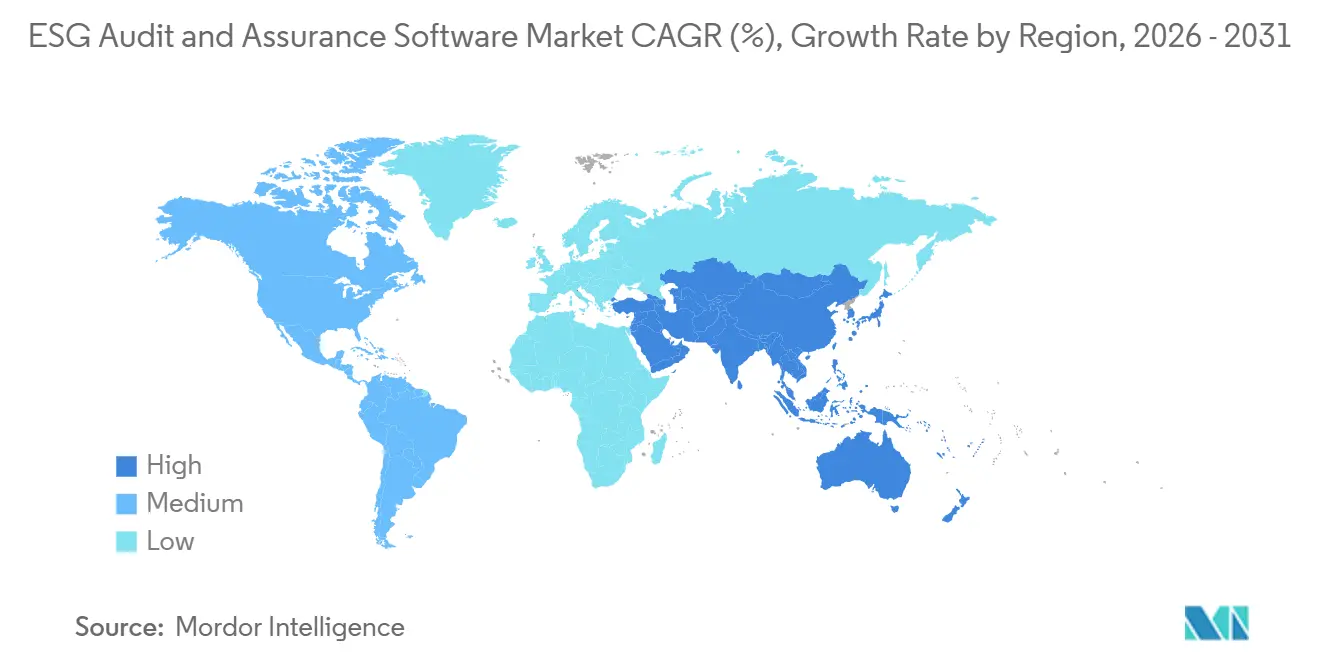
| Fastest Growing Market | Asia-Pacific |
| Largest Market | North America |
| Market Concentration | Medium |
Major Players *Disclaimer: Major Players sorted in no particular order Image © Mordor Intelligence. Reuse requires attribution under CC BY 4.0. | |
ESG Audit and Assurance Software Market Analysis by Mordor Intelligence
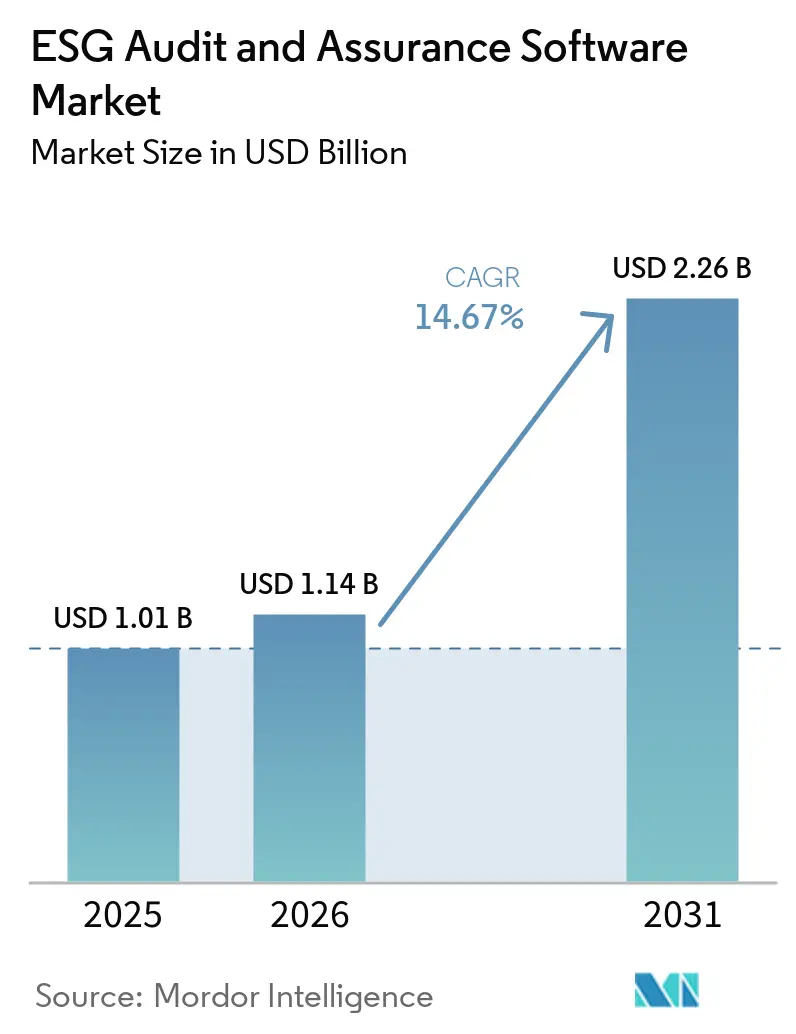
The ESG Audit and Assurance Software Market size was USD 1.01 billion in 2025, USD 1.14 billion in 2026, and is forecast to reach USD 2.26 billion by 2031, growing at a CAGR of 14.67% during 2026-2031. Demand is being sustained by overlapping disclosure and assurance requirements across major economies, which has moved ESG software spending closer to an operating requirement than a discretionary technology purchase. Buyers are increasingly looking for platforms that can handle disclosure mapping, evidence capture, controls testing, and auditor access within a single workflow, which is raising the value of integrated products. Competition is also shifting as large vendors pair software with assurance support, while smaller specialists continue to compete in narrower use cases. Cloud delivery, AI-assisted validation, and audit-ready data lineage remain central product priorities because reporting standards keep changing, and enterprises need systems that can adjust without disrupting live programs. The clearest growth openings remain in SME onboarding, supply-chain data collection, and single-platform workflows that connect ESG reporting with assurance preparation.
Key Report Takeaways
- By geography, North America held 36.53% of the ESG Audit and Assurance Software Market in 2025, while Asia-Pacific is projected to expand at a 19.83% CAGR through 2031.
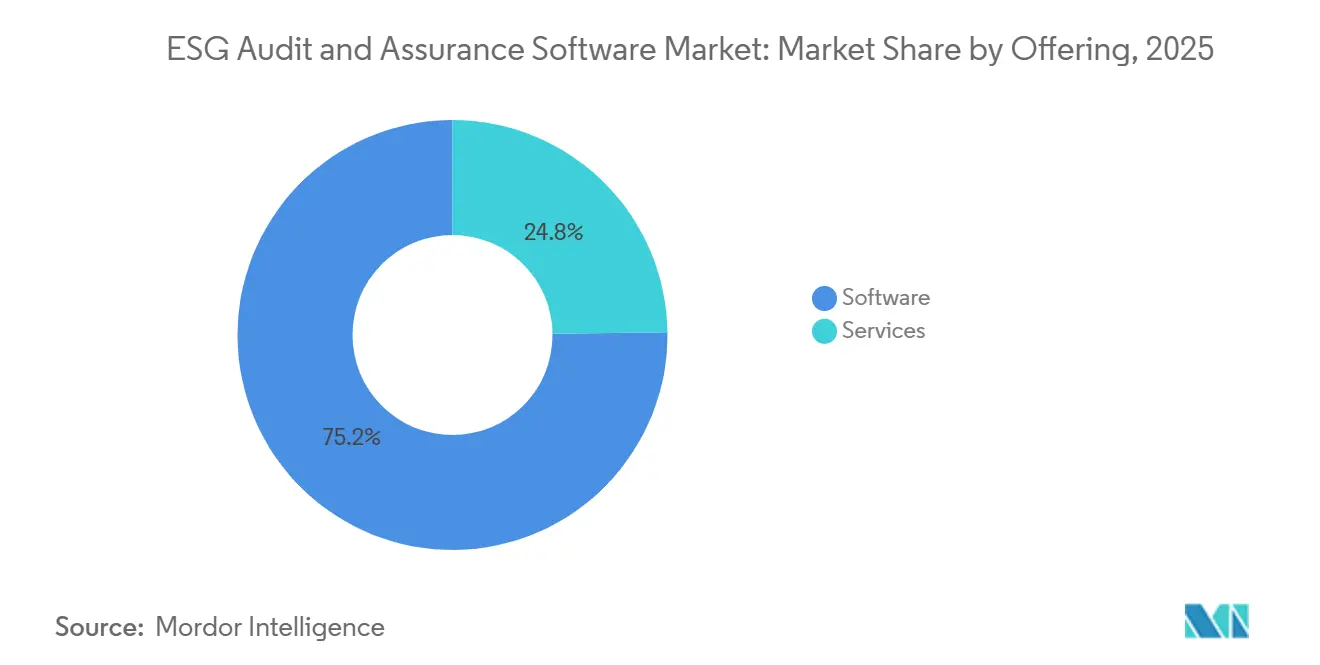
- By offering software solutions commanded 75.21% share in 2025, while services are projected to grow at a 17.12% CAGR through 2031.
- By deployment, cloud-based deployment accounted for 58.13% of the market in 2025, while hybrid deployment is expected to expand at a 18.23% CAGR through 2031.
- By enterprise size, large enterprises held 81.12% share in 2025, while small and medium enterprises are projected to grow at a 19.13% CAGR through 2031.
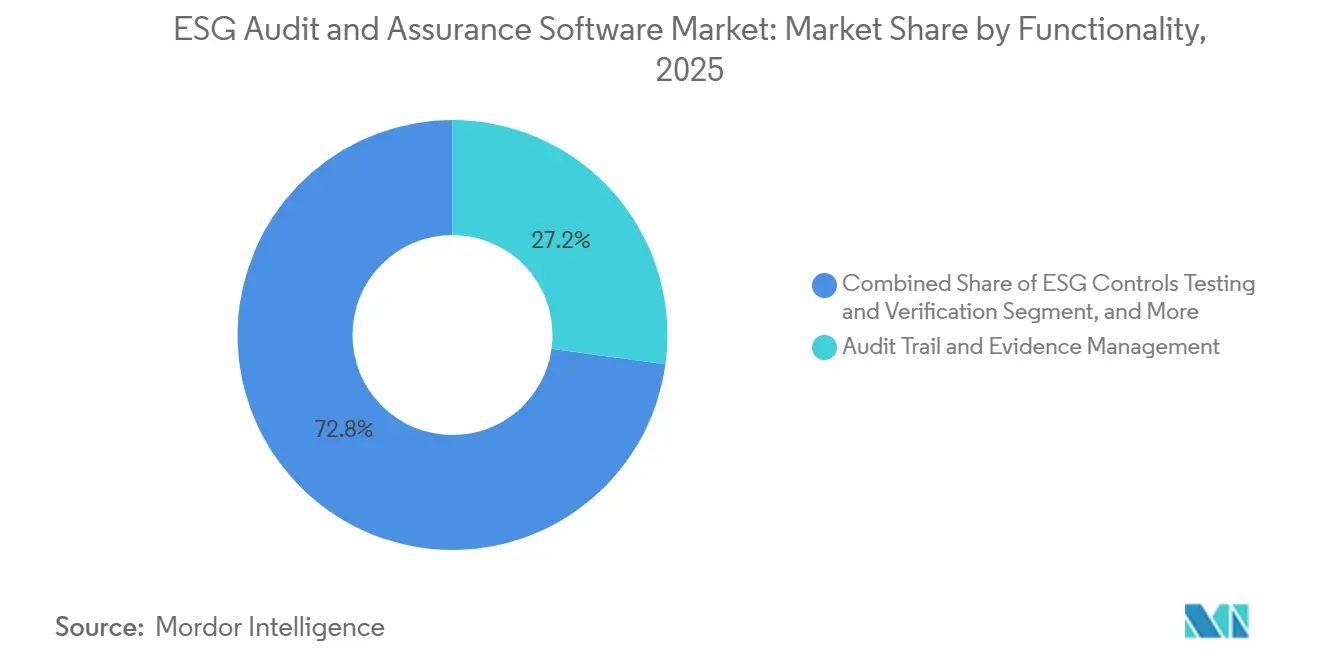
- By functionality, audit trail and evidence management captured 27.18% of the market in 2025, while ESG controls, testing, and verification are expected to advance at a 20.43% CAGR through 2031.
- By end-use industry, BFSI accounted for 22.17% share in 2025, while manufacturing and industrial end users are projected to expand at an 18.73% CAGR through 2031.
Note: Market size and forecast figures in this report are generated using Mordor Intelligence’s proprietary estimation framework, updated with the latest available data and insights as of January 2026.
Market Trends and Insights
Drivers Impact Analysis of ESG Audit and Assurance Software Market*
| Driver | (~) % Impact on CAGR Forecast | Geographic Relevance | Impact Timeline |
|---|---|---|---|
| Rising Mandatory ESG Disclosure Regimes | +3.5% | Global, with highest density in Europe, North America, and Asia-Pacific | Short term (≤ 2 years) |
| Investor Demand for Audit-Ready ESG Data | +2.8% | Global, with stronger maturity in Europe, the Middle East and Africa, and North America | Medium term (2-4 years) |
| Shift From Spreadsheet-Based Reporting to Unified Platforms | +2.4% | Global | Short term (≤ 2 years) |
| Cloud Adoption Among Mid-Market and SME Buyers | +2.1% | Global, with notable spillover to the Middle East and Africa and South America | Medium term (2-4 years) |
| AI-Assisted Data Validation and Exception Detection | +1.8% | Global, with early-adopter concentration in North America and Asia-Pacific | Medium term (2-4 years) |
| Supply-Chain Traceability Requirements for Scope 3 Assurance | +1.6% | Global, with strongest pull from Europe and California-linked reporting ecosystems | Long term (≥ 4 years) |
| Source: Mordor Intelligence | |||
Rising Mandatory ESG Disclosure Regimes
Mandatory disclosure cycles are now serving as direct buying triggers for the ESG Audit and Assurance Software Market, as reporting and assurance timelines have become too complex to manage manually. The EU CSRD timetable, the revised scoping debate around Omnibus I, and the move toward ISSA 5000-based assurance are keeping companies focused on systems that support recurring compliance work rather than one-off reporting projects.[1] Japan is adding to this demand as SSBJ preparation continues, with vendors already positioning products around the new disclosure structure. In Europe, differences in local transposition have not reduced demand; instead, they have spread procurement across multiple waves and increased the value of preconfigured assurance workflows. As a result, the ESG Audit and Assurance Software Market remains active across diverse buyer cohorts rather than being tied to a single filing season.
Investor Demand for Audit-Ready ESG Data
Investor pressure is supporting the ESG Audit and Assurance Software Market, even where regulation remains unsettled, because asset owners and asset managers now expect ESG information to be traceable and consistent. Surveys reported that respondents continued to highlight gaps in coverage, quality, and consistency, indicating that raw ESG data is no longer sufficient for institutional decision-making. The same survey also showed strong preference for regulation- and ISSB-aligned disclosures, which underscores the value of software that can document source data and support assurance reviews. BNP Paribas found that 48% of institutional investors expected higher budget allocations for ESG data acquisition and analysis, while PwC reported that 78% of investors linked sustainability information to better engagement, reinforcing the commercial case for audit-ready disclosure systems. As a result, the ESG Audit and Assurance Software Market is benefiting from a second demand channel driven by capital markets and stewardship requirements, not just regulation.
Shift from Spreadsheet-Based Reporting to Unified Platforms
The move away from spreadsheet-led reporting is now a core growth driver for the ESG Audit and Assurance Software Market, as companies need controlled workflows, not just data-collection templates. Workiva stated that its next-generation GRC platform supports more than 6,600 organizations and over 85% of the Fortune 1,000, indicating that large enterprises are already consolidating audit, risk, and control functions into broader governance platforms.[2] SAP also said its Sustainability Control Tower roadmap includes a Regulatory Readiness AI agent that can assemble materiality-based scopes and map existing metrics to new regulations, reflecting how major enterprise software vendors are integrating ESG assurance tasks into their existing systems. AWS showed that banking sustainability reporting workflows could move from 8-10 weeks to hours when cloud-native AI pipelines and audit trails were implemented, highlighting the process gap between manual methods and integrated platforms. This is why the ESG Audit and Assurance Software Market is shifting toward systems that combine workflow control, data lineage, and review evidence into a single operating layer.[3]
Cloud Adoption Among Mid-Market and SME Buyers
Cloud delivery is expanding the addressable market for ESG Audit and Assurance Software by enabling smaller buyers to achieve lower friction onboarding and faster deployment. The SME cohort is becoming more important as listed smaller companies and suppliers to large multinationals face rising requests for structured ESG data, which makes template-led cloud products easier to justify than service-heavy programs. A strategic partnership in October 2025 moved carbon accounting clients onto a broader platform, showing how vendors are using partnerships to lower build costs and fill specialist product gaps for customers that cannot fund custom development. Hybrid architectures are still gaining ground because many buyers want cloud-based ESG workflow management while keeping sensitive operational and financial records in existing enterprise systems. That balance is helping the ESG Audit and Assurance Software Market reach mid-market and SME buyers without requiring full system replacement at the start of adoption.
Restraints Impact Analysis of ESG Audit and Assurance Software Market*
| Restraint | (~) % Impact on CAGR Forecast | Geographic Relevance | Impact Timeline |
|---|---|---|---|
| High Cost of Controls, Integration, and Audit Trails | -2.3% | Global, most acute in mid-market and SME tiers | Medium term (2-4 years) |
| ESG Data Fragmentation Across Enterprise and Supplier Systems | -1.8% | Global, highest in manufacturing and extended supply chains | Medium term (2-4 years) |
| Shortage of ESG Reporting, Controls, and Assurance Talent | -1.2% | Global, concentrated in Asia-Pacific and South America | Medium term (2-4 years) |
| Standards Volatility Requiring Frequent Reconfiguration | -0.9% | Global, most acute in Europe because of ESRS revisions in 2026 | Short term (≤ 2 years) |
| Source: Mordor Intelligence | |||
High Cost of Controls, Integration, and Audit Trails
Implementation costs remain a real constraint on the ESG Audit and Assurance Software Market, especially for first-time buyers who must connect ESG workflows with ERP, HR, procurement, and finance systems. The source document states that first-year costs for a mid-size enterprise range from USD 50,000 to USD 200,000, while recurring annual costs add USD 30,000 to USD 100,000, which keeps the barrier high for buyers with fragmented system estates. The main pressure point is integration rather than license price because data model harmonization and connector work often extends deployment far beyond the original project plan. A similar problem was described in banking sustainability workflows, where manual document handling and disconnected evidence trails consumed 8-10 weeks per cycle before automation was introduced. This keeps the ESG Audit and Assurance Software Market tilted toward vendors that can provide prebuilt connectors and faster proof of control, not just broader feature lists.
ESG Data Fragmentation Across Enterprise and Supplier Systems
Data fragmentation continues to slow the ESG Audit and Assurance Software Market because buyers often discover that platform adoption does not remove upstream inconsistency across business units and suppliers. Institutional investors still cited data coverage gaps and cross-vendor inconsistencies, indicating that the problem persists even after companies invest in ESG tooling. The issue is sharper in manufacturing and other supply-chain-heavy sectors because Scope 3 data must be gathered from many independent entities that use different methods and controls. More than USD 2.5 trillion in procurement spend is now governed through sustainability risk insights platforms, and partnerships with other vendors show that ecosystems are trying to close the supplier data gap through shared carbon data flows. Even so, the ESG Audit and Assurance Software Market still has a long way to go before full supplier-level data lineage becomes routine across large industrial networks.[4]
*Our forecasts treat driver/restraint impacts as directional, not additive. The impact forecasts reflect baseline growth, mix effects, and variable interactions.
ESG Audit and Assurance Software Market Segment Analysis
By Offering:
Software Platforms Lead, Professional Services Grow FastSoftware solutions held 75.21% of the ESG Audit and Assurance Software Market share in 2025, indicating that most buyers preferred platforms that delivered recurring updates, structured controls, and built-in audit trails. This reflects the practical need for systems that can support repeated disclosure cycles across multiple frameworks rather than one-time implementation projects. Workiva reported Q1 2026 revenue of USD 247 million, up 20% year over year, with subscription and support revenue up 21%, pointing to continued demand for ongoing software access rather than episodic delivery. The same filing showed a 97% gross retention rate and a 112% net retention rate, indicating that platform users are expanding use after initial adoption rather than pulling back.
Services are projected to grow at a 17.12% CAGR through 2031, reflecting the operational burden many companies face during first deployment and assurance cycles. Buyers often need help with implementation, training, controls validation, and audit preparation simultaneously, making advisory support part of the buying decision rather than a separate add-on. Workiva's March 2026 GRC launch highlighted Deloitte and Touche LLP as a co-delivery partner for enterprise rollouts, illustrating how software vendors are tying product deployment more closely to assurance and controls support. This is making the offering mix in the ESG Audit and Assurance Software Market more dependent on the delivery ecosystem's strength, especially when buyers want platform functionality and assurance readiness within a single commercial motion.
By Deployment:
Cloud Holds The Lead, Hybrid Gains The Fastest GroundCloud-based deployment accounted for 58.13% of the ESG Audit and Assurance Software Market in 2025, underscoring buyers' preference for platforms that can be updated quickly as rules change across jurisdictions. This model suits companies that need centralized workflow control for CSRD, ISSB, and SSBJ-related activities without maintaining separate local installations. Roadmaps from major vendors show that ongoing regulatory mapping and readiness updates are easier to manage in cloud-oriented environments. Cloud deployment also aligns with the broader market direction by shortening update cycles and reducing the burden of local system maintenance.
Hybrid deployment is projected to expand at an 18.23% CAGR through 2031, making it the fastest-growing model in the ESG Audit and Assurance Software Market. Buyers adopt this approach when they want cloud-based governance, disclosure, and evidence workflows while keeping sensitive records inside existing on-premise systems. Vendor strategies reflect this mixed infrastructure reality, suggesting that full cloud migration will not happen at the same pace across all industries. Hybrid growth is therefore less about delaying modernization and more about fitting ESG controls into the system architecture companies already trust for financial and operational data.
By Enterprise Size:
Large Enterprises Anchor Revenue, SMEs Expand FasterLarge enterprises commanded 81.12% of the ESG Audit and Assurance Software Market in 2025, reflecting the concentration of mandatory disclosure obligations, multi-entity complexity, and larger software budgets within that buyer group. These companies usually need deeper functionality, including multi-framework mapping, evidence management, controls testing, and auditor-facing review access. Workiva reported 2,575 customers with annual contract values above USD 100,000 in Q1 2026, up 24% year over year, and 265 customers with annual contract values above USD 500,000, up 39% year over year, indicating that high-value enterprise accounts continue to scale within the platform category. That pattern supports the view that the ESG Audit and Assurance Software Market remains heavily revenue-weighted toward large accounts once core controls and evidence systems are installed.
SMEs are projected to grow at a 19.13% CAGR through 2031, which makes them the fastest-expanding enterprise-size cohort in the ESG Audit and Assurance Software Market. Growth is being supported by direct reporting obligations for some smaller listed companies and by indirect pressure from large customers that need supplier ESG data in structured formats. EcoVadis said its network already governs more than USD 2.5 trillion in procurement spend and is targeting 300,000 rated companies by 2030, which indicates how broad the pull on suppliers is becoming. This is gradually lowering the entry barrier in the ESG Audit and Assurance Software Market as AI-led onboarding and preconfigured workflows make it easier for smaller organizations to begin with narrower use cases and expand later.
By Functionality:
Evidence Management Leads, Controls Testing Rises FastestAudit trail and evidence management accounted for 27.18% of the ESG Audit and Assurance Software Market in 2025, making it the largest functionality block in the market. That lead reflects a simple buyer priority, assurance work depends on clear evidence chains that auditors can inspect without rebuilding the reporting trail by hand. Workiva's platform messaging in 2026 continued to emphasize audit, risk, and controls workflows, which align with demand for immutable records, structured review steps, and governed documentation. The wider functionality mix, including data collection, analytics, reporting assurance, and compliance management, now competes less as stand-alone modules and more as connected layers around evidence and review.
ESG controls testing and verification are projected to grow at a 20.43% CAGR through 2031, which makes it the fastest-rising functionality in the ESG Audit and Assurance Software Market. This reflects the shift from narrative sustainability reporting to structured control testing that more closely resembles financial audit practice. Workiva's March 2026 relaunch specifically added AI-driven controls testing workflows, which signals that vendors now see attestation and verification as a decisive product battleground. As assurance expectations mature, buyers in the ESG Audit and Assurance Software Market are placing more weight on whether a platform can prove who reviewed what, when it changed, and how exceptions were handled.

By End-Use Industry:
BFSI Leads Today, Manufacturing Sets The Growth PaceBFSI accounted for 22.17% of the ESG Audit and Assurance Software Market in 2025, making it the largest end-use vertical by revenue. Financial institutions face layered disclosure, risk, and supervision requirements, underscoring the need for evidence-based workflows and repeatable controls. SAP Fioneer positioned its ESG KPI Engine around CSRD, ECB, and PRA requirements, demonstrating how sector-focused solutions are being built for finance and risk teams that need auditable ESG records rather than broad sustainability dashboards. This depth of requirement helps explain why the ESG Audit and Assurance Software Market has strong structural demand from banks, insurers, asset managers, and other financial entities.
Manufacturing and industrial users are projected to expand at a 18.73% CAGR through 2031, making them the fastest-growing end-use group in the ESG Audit and Assurance Software Market. The main driver is the need to document embedded emissions, supplier data, and production-linked carbon metrics in forms that can withstand external review. EcoVadis said its Retail Impact Initiative brought together major retail groups to share supplier sustainability information through common dashboards, which illustrates how large buyers are building sector-wide ESG data infrastructure that connected software platforms can use. That dynamic is widening the use of the ESG Audit and Assurance Software industry beyond corporate reporting teams and into supplier engagement, procurement oversight, and product-level carbon documentation.
Geography Analysis
North America ESG Audit and Assurance Software Market
North America held 36.53% of the ESG Audit and Assurance Software Market share in 2025, maintaining its leading regional position. The region benefited from deep BFSI adoption, strong institutional investor pressure for audit-ready ESG data, and a compliance environment in which state-level action continued to matter even as federal rulemaking remained contested. Morgan Stanley's 2025 Sustainable Signals survey showed that institutional investors were embedding sustainability data into investment processes, risk management, and reporting workflows, which supports continuing demand for systems that can document provenance and consistency. That demand base gives the ESG Audit and Assurance Software Market in North America resilience because it does not depend on a single regulatory trigger. A combination of investor scrutiny, enterprise governance needs, and the broader move toward assurance-ready data infrastructure is supporting it.
Europe ESG Audit and Assurance Software Market
Europe contributed a significant share in 2025 and remained the most structurally developed assurance environment for the ESG Audit and Assurance Software Market. CSRD filing cycles, local assurance requirements, and multi-country reporting complexity continued to keep software demand active even as implementation timing shifted between cohorts. France's dedicated ESG audit practice at KPMG and the broader push toward structured sustainability assurance in large European companies show how software adoption is increasingly tied to formal review processes, not only disclosure preparation. Europe, therefore, remains the region where product depth, evidence quality, and assurance workflow readiness are tested most directly.
APAC, South America and MEA ESG Audit and Assurance Software Market
Asia-Pacific is projected to grow at a 19.83% CAGR through 2031, which makes it the fastest-growing geography in the ESG Audit and Assurance Software Market. Japan is a major contributor because vendors are already aligning products to SSBJ disclosure requirements, and Wolters Kluwer stated in 2025 that CCH Tagetik had achieved full compliance with the new standards. India, South Korea, and Australia are also adding momentum as listed entities face wider expectations for structured sustainability disclosure and review. South America is still in earlier stages of development, but multinational subsidiaries and the direction toward ISSB-linked reporting are creating a clearer entry path for platform adoption. The Middle East and Africa are also gaining traction through exchange-led disclosure requirements and national sustainability programs, which broaden the regional base of the ESG Audit and Assurance Software Market beyond its traditional centers.
Competitive Landscape
The ESG Audit and Assurance Software Market remains moderately fragmented, with large platform vendors and a long tail of specialists competing across different functional layers and buyer sizes. Workiva, Diligent, EcoVadis, Sphera, and Intelex continue to represent the better-capitalized group, able to pursue enterprise accounts with broader platform narratives. Workiva's Q1 2026 results showed USD 247 million in quarterly revenue and 265 customers with annual contract value above USD 500,000, indicating that scaled vendors are consolidating high-value deployments even as the field remains open below the top tier. At the same time, competition is shifting away from stand-alone reporting tools and toward systems that can combine disclosure, controls, evidence, and review. This is keeping the ESG Audit and Assurance Software Market active on both ends: large vendors are broadening platform depth, while smaller vendors are defending narrower specialty positions.
Strategic partnerships have become one of the clearest competitive tools in the ESG Audit and Assurance Software Market, as no vendor can build every required capability alone. Diligent took an equity position in Persefoni and transitioned carbon accounting clients to Persefoni's platform in October 2025, demonstrating a willingness to extend product coverage through partnerships rather than internal buildout. EcoVadis partnered with Watershed in March 2026 to address the Scope 3 primary data gap, and then linked its Carbon Data Network with Workiva in May 2026, which shows a similar ecosystem approach centered on supplier carbon data and governed reporting workflows. Workiva also used its March 2026 platform relaunch to highlight Deloitte & Touche LLP as a co-delivery partner for enterprise rollouts, reinforcing the value of combining software with implementation and assurance support. These moves show that the ESG Audit and Assurance Software Market is increasingly being shaped by delivery ecosystems rather than isolated product features.
AI is becoming the next visible point of separation in the ESG Audit and Assurance Software Market, especially in controls testing, anomaly detection, and supplier data handling. Persefoni launched an agentic AI tool in May 2026 for emissions analysis and target verification, while EcoVadis selected Google Cloud's Gemini Enterprise platform in April 2026 to accelerate workflow automation and data quality assurance. Even with that momentum, white space remains in privacy-preserving supplier data exchange and in automated controls documentation that can satisfy formal assurance reviews at scale. This leaves room for new competition, but the bar to entry is rising because buyers now expect evidence integrity, workflow governance, and partner-backed delivery from the start.
Recent Industry Developments in ESG Audit and Assurance Software Market
- May 2026: EcoVadis and Workiva announced a strategic partnership to connect EcoVadis' primary supplier carbon data with the Workiva Carbon platform, enabling mutual customers to move from industry-average Scope 3 estimates to granular, audit-ready sustainability reporting. The partnership positions EcoVadis as the data engine for supplier carbon engagement while Workiva manages calculation, disclosure, and governed integrated reporting across financial and non-financial data flows.
- May 2026: Persefoni AI, Inc. unveiled a new Agentic AI agent designed to accelerate emissions analysis and automate the pathway to net-zero target verification. The agent enables autonomous, real-time GHG data interrogation, scenario modeling, and controls flagging, a material advance over rule-based validation architectures that require manual input to initiate exception detection.
- April 2026: EcoVadis partnered with Google Cloud, selecting the Gemini Enterprise agentic platform to power AI-driven workflow automation, supplier scoring acceleration, and ESG data quality assurance across its Carbon Data Network. The agreement extended EcoVadis' AI strategy by embedding large-scale foundation models directly into its core sustainability intelligence and supplier engagement processes.
- March 2026: EcoVadis and Watershed announced a strategic partnership to close the Scope 3 primary data gap, combining EcoVadis' Product Carbon Footprint Calculator and Carbon Data Reliability Level framework with Watershed's enterprise carbon platform, to deliver audit-grade supplier-specific emissions data for investor-grade Scope 3 accounting.
Global ESG Audit and Assurance Software Market Report Scope
The ESG Audit and Assurance Software market refers to platforms and services that enable organizations to validate, verify, and assure the accuracy of their environmental, social, and governance (ESG) data and disclosures. These solutions provide functionalities such as ESG data collection and validation, audit trail and evidence management, controls testing and verification, analytics and benchmarking, disclosure assurance, and compliance audit management. By embedding assurance mechanisms into ESG reporting workflows, these platforms help enterprises strengthen transparency, ensure regulatory compliance, enhance stakeholder trust, and align with global sustainability standards while reducing risks associated with inaccurate or incomplete ESG disclosures.
The ESG Audit and Assurance Software market report is segmented by Offering (Software, and Services), Deployment (Cloud, On-Premise, and Hybrid), Enterprise Size (Large Enterprises, and Small and Medium Enterprises), Functionality (ESG Data Collection and Validation, Audit Trail and Evidence Management, ESG Controls Testing and Verification, Analytics and Benchmarking, Reporting and Disclosure Assurance, and Compliance and Regulatory Audit Management), End-Use Industry (IT and Telecom, BFSI, Manufacturing, Energy and Utilities, Retail and E-Commerce, Construction and Infrastructure, Government and Public Sector, Healthcare and Life Sciences, and Other End-User Industries), and Geography (North America, South America, Europe, Asia-Pacific, Middle East, and Africa). The Market Forecasts are Provided in Terms of Value (USD).
Segmentation Overview
| Software |
| Services |
| Cloud |
| On-Premise |
| Hybrid |
| Large Enterprises |
| Small And Medium Enterprises |
| ESG Data Collection and Validation |
| Audit Trail and Evidence Management |
| ESG Controls Testing and Verification |
| Analytics and Benchmarking |
| Reporting and Disclosure Assurance |
| Compliance and Regulatory Audit Management |
| IT and Telecom |
| BFSI |
| Manufacturing |
| Energy and Utilities |
| Retail and E-Commerce |
| Construction and Infrastructure |
| Government and Public Sector |
| Healthcare and Life Sciences |
| Other End-User Industries |
| North America | United States | |
| Canada | ||
| Mexico | ||
| South America | Brazil | |
| Argentina | ||
| Rest of South America | ||
| Europe | United Kingdom | |
| Germany | ||
| France | ||
| Italy | ||
| Spain | ||
| Netherlands | ||
| Russia | ||
| Rest of Europe | ||
| Asia-Pacific | China | |
| Japan | ||
| India | ||
| South Korea | ||
| Australia and New Zealand | ||
| Rest of Asia-Pacific | ||
| Middle East and Africa | Middle East | Saudi Arabia |
| United Arab Emirates | ||
| Rest of Middle East | ||
| Africa | South Africa | |
| Nigeria | ||
| Rest of Africa | ||
| By Offering | Software | ||
| Services | |||
| By Deployment | Cloud | ||
| On-Premise | |||
| Hybrid | |||
| By Enterprise Size | Large Enterprises | ||
| Small And Medium Enterprises | |||
| By Functionality | ESG Data Collection and Validation | ||
| Audit Trail and Evidence Management | |||
| ESG Controls Testing and Verification | |||
| Analytics and Benchmarking | |||
| Reporting and Disclosure Assurance | |||
| Compliance and Regulatory Audit Management | |||
| By End-Use Industry | IT and Telecom | ||
| BFSI | |||
| Manufacturing | |||
| Energy and Utilities | |||
| Retail and E-Commerce | |||
| Construction and Infrastructure | |||
| Government and Public Sector | |||
| Healthcare and Life Sciences | |||
| Other End-User Industries | |||
| By Geography | North America | United States | |
| Canada | |||
| Mexico | |||
| South America | Brazil | ||
| Argentina | |||
| Rest of South America | |||
| Europe | United Kingdom | ||
| Germany | |||
| France | |||
| Italy | |||
| Spain | |||
| Netherlands | |||
| Russia | |||
| Rest of Europe | |||
| Asia-Pacific | China | ||
| Japan | |||
| India | |||
| South Korea | |||
| Australia and New Zealand | |||
| Rest of Asia-Pacific | |||
| Middle East and Africa | Middle East | Saudi Arabia | |
| United Arab Emirates | |||
| Rest of Middle East | |||
| Africa | South Africa | ||
| Nigeria | |||
| Rest of Africa | |||
Key Questions Answered in the Report
What is the current and forecast value of the ESG Audit and Assurance Software Market?
The ESG Audit and Assurance Software Market was valued at USD 1.01 billion in 2025 and is forecast to reach USD 2.26 billion by 2031, at a 14.67% CAGR during 2026-2031.
Which region leads revenue generation in ESG audit and assurance software?
North America led with a 36.53% share in 2025, supported by strong BFSI demand, investor pressure for audit-ready ESG data, and a layered compliance environment.
Which region is growing the fastest for ESG audit and assurance software adoption?
Asia-Pacific is the fastest-growing region, with a projected 19.83% CAGR through 2031 as new disclosure frameworks and multinational reporting requirements expand.
Which product category dominates spending in this space?
Software solutions held 75.21% share in 2025 because buyers preferred scalable platforms that can manage updates, evidence trails, and recurring assurance workflows.
What functionality is seeing the fastest expansion in ESG assurance platforms?
ESG controls testing and verification is projected to grow at a 20.43% CAGR through 2031 as buyers move from narrative reporting toward structured controls and attestable review workflows.
Which end-use sector creates the strongest demand today and which one is rising fastest?
BFSI led with a 22.17% share in 2025 because of strict disclosure and risk oversight needs, while manufacturing is projected to grow the fastest at an 18.73% CAGR through 2031.