
Enzymes Market Size and Share
Market Overview
| Study Period | 2021 - 2031 |
|---|---|
| Market Size (2026) | USD 15.10 Billion |
| Market Size (2031) | USD 20.33 Billion |
| Growth Rate (2026 - 2031) | 6.13 % |
| Fastest Growing Market | Asia-Pacific |
| Largest Market | North America |
| Market Concentration | Medium |
Major Players *Disclaimer: Major Players sorted in no particular order Image © Mordor Intelligence. Reuse requires attribution under CC BY 4.0. | |
Enzymes Market Analysis by Mordor Intelligence
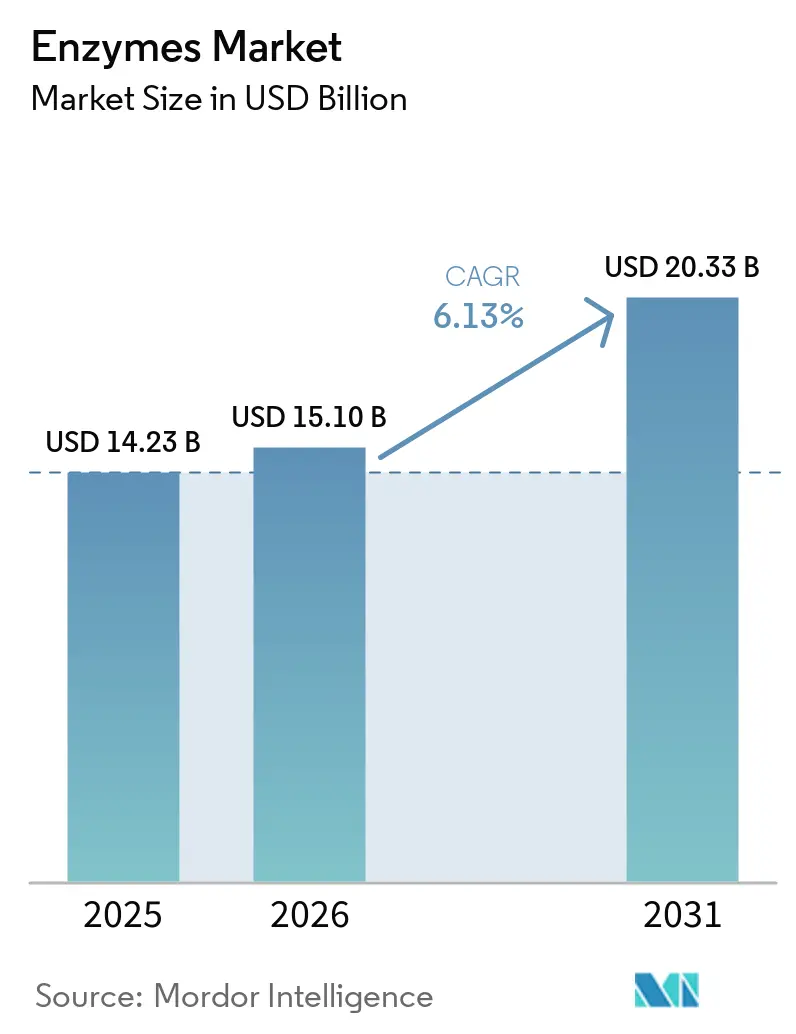
The enzymes market was valued at USD 14.23 billion in 2025 and is estimated to grow to USD 15.1 billion in 2026, with projections indicating it will reach USD 20.33 billion by 2031, registering a CAGR of 6.13% during 2026–2031. Market growth is primarily driven by the increasing adoption of enzyme-based solutions, which enhance process efficiency, improve performance, and support sustainable production practices. The rising demand for naturally derived and environmentally friendly alternatives is fostering the replacement of conventional chemical processes with enzyme technologies. Additionally, advancements in biotechnology, enzyme engineering, and fermentation techniques are facilitating the development of highly efficient enzymes with enhanced stability, specificity, and functionality, thereby broadening their commercial applications.
Key Report Takeaways
- By product type, industrial enzymes led with 64.52% share in 2025, while specialty enzymes are forecast to expand at a 7.23% CAGR through 2031.
- By source, microbial enzymes held 61.23% share in 2025, while animal enzymes recorded the highest projected CAGR at 6.58% through 2031.
- By type, carbohydrases accounted for 43.29% share in 2025, while proteases are advancing at a 6.91% CAGR through 2031.
- By application, Food and Beverages accounted for 35.26% share in 2025, while Pharmaceuticals and Biotechnology is forecast to grow at a 7.11% CAGR through 2031.
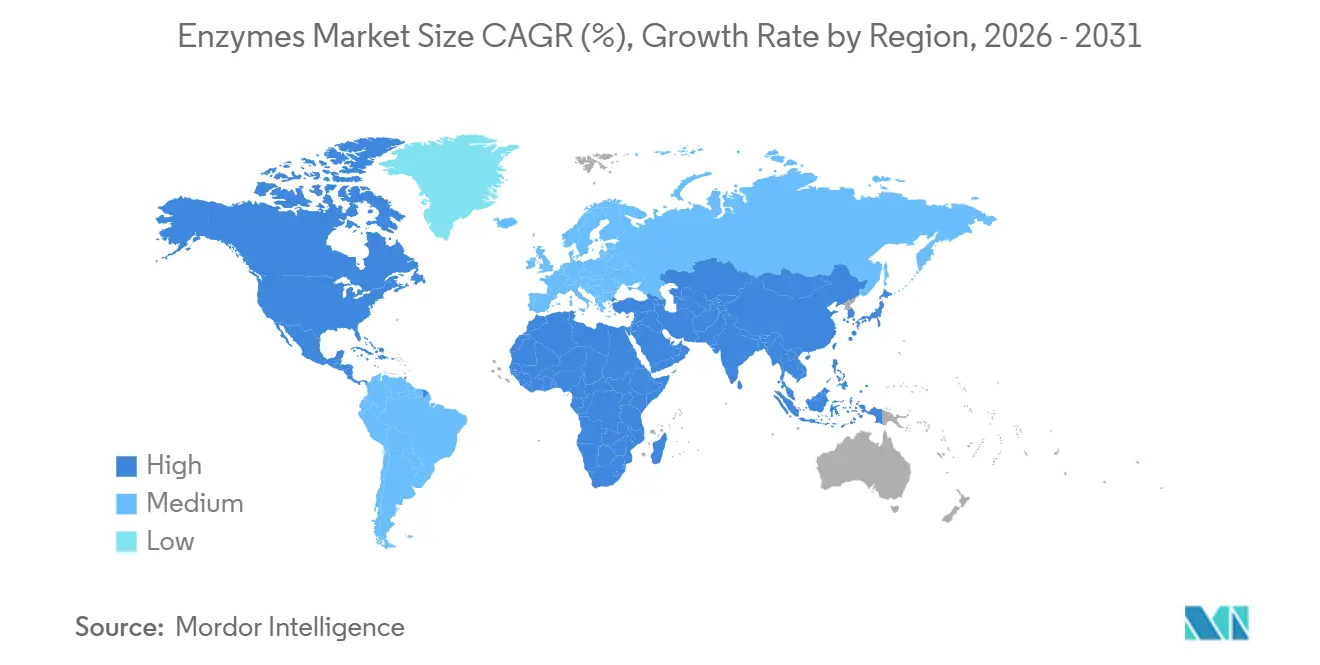
- By geography, North America held 31.87% share in 2025, while Asia-Pacific recorded the highest projected CAGR at 7.06% through 2031.
Note: Market size and forecast figures in this report are generated using Mordor Intelligence’s proprietary estimation framework, updated with the latest available data and insights as of January 2026.
Market Trends and Insights
Drivers Impact Analysis of Enzymes Market*
| Driver | (~) % Impact on CAGR Forecast | Geographic Relevance | Impact Timeline |
|---|---|---|---|
| Rising health-conscious consumer behaviour | +0.9% | Global | Short term (≤ 2 years) |
| Growth of clean-label and natural ingredient trends | +0.8% | North America and Europe | Short term (≤ 2 years) |
| Technological advancements in enzyme engineering | +1.2% | Global | Medium term (2–4 years) |
| Expansion of biofuel production and renewable energy initiatives | +0.7% | North America, Europe, South America | Medium term (2–4 years) |
| Expansion of precision fermentation capacity | +0.6% | Asia-Pacific, North America | Medium term (2–4 years) |
| Shift toward low-energy, low-waste processing | +0.5% | Europe, North America | Long term (≥ 4 years) |
| Source: Mordor Intelligence | |||
Rising health-conscious consumer behaviour
The increasing focus on health-conscious consumer behavior is driving growth in the enzymes market. Consumers are seeking products that promote better nutrition, wellness, and an improved quality of life. Greater awareness of healthier lifestyles has led to the adoption of enzyme-based solutions that enhance product functionality, improve nutritional value, and support natural processing methods. There is a growing preference for clean-label, naturally derived, and minimally processed products, which has boosted the demand for enzymes as effective biological alternatives to traditional processing methods. Enzymes contribute to improved digestibility, enhanced functional benefits, and the development of products that align with changing wellness trends. Furthermore, rising interest in preventive health, ingredient transparency, and sustainable production practices is motivating manufacturers to integrate enzyme technologies into their innovation strategies.
Growth of clean-label and natural ingredient trends
The growing preference for clean-label and natural ingredients is driven by consumer demand for products made with transparent, naturally derived, and sustainable solutions. Enzymes are increasingly adopted as they help manufacturers reduce reliance on synthetic additives and harsh chemical processes while maintaining product quality, functionality, and performance. The rising consumer focus on ingredient transparency, simpler formulations, and naturally processed products has promoted the use of enzyme-based technologies as effective biological alternatives. For example, according to the International Food Information Council (IFIC), in 2024, 36% of Americans identified “natural” or “organic” labels as important factors when choosing food, unde rscoring the increasing preference for naturally positioned products [1]. This trend is encouraging manufacturers to adopt enzyme solutions that enable cleaner production methods, enhanced product characteristics, and sustainable processing practices.
Technological advancements in enzyme engineering
Technological advancements in enzyme engineering are driving growth in the enzymes market. Innovations in biotechnology are facilitating the development of enzymes with enhanced efficiency, stability, specificity, and performance. Techniques such as protein engineering, directed evolution, recombinant DNA technology, and computational enzyme design enable researchers to modify enzyme structures and create optimized solutions for specific applications. These advancements address traditional challenges related to enzyme sensitivity, operating conditions, and production efficiency, leading to wider adoption across various industries. The integration of artificial intelligence, machine learning, and advanced screening technologies is further expediting enzyme discovery and shortening development timelines by identifying improved enzyme variants with superior functional properties. Furthermore, ongoing improvements in fermentation processes, microbial strain development, and enzyme formulation technologies are supporting scalable and cost-effective production.
Expansion of biofuel production and renewable energy initiatives
The expansion of biofuel production and renewable energy initiatives is significantly driving the enzymes market, as industries increasingly adopt enzyme-based technologies to enhance the efficiency and sustainability of biological conversion processes. Enzymes are essential in facilitating feedstock breakdown, improving conversion efficiency, increasing yields, and minimizing the environmental impact of traditional processing methods. The growing focus on reducing reliance on fossil-based resources and transitioning to cleaner energy solutions has heightened the demand for advanced enzyme technologies that support more efficient renewable fuel production. According to The Energy Institute (EI), global biofuel production in 2024 reached 2.3 million barrels of oil equivalent per day, highlighting the ongoing growth in renewable energy adoption worldwide. This increasing production capacity is fostering the development of high-performance enzymes with enhanced stability, activity, and cost efficiency.
Restraints Impact Analysis of Enzymes Market*
| Restraint | (~) % Impact on CAGR Forecast | Geographic Relevance | Impact Timeline |
|---|---|---|---|
| Stringent and fragmented regulatory approval paths | -0.8% | Global | Long term (≥ 4 years) |
| High cost of downstream purification and formulation | -0.6% | Global | Medium term (2–4 years) |
| Dependence on feedstock-grade fermentation inputs | -0.4% | APAC, South America | Medium term (2–4 years) |
| Availability of alternative chemical-based processing solutions | -0.3% | North America and | Short term (≤ 2 years) |
| Source: Mordor Intelligence | |||
Stringent and fragmented regulatory approval paths
The stringent and fragmented regulatory approval processes are limiting the growth of the enzymes market. Manufacturers must navigate complex safety assessments, adhere to quality standards, and meet region-specific approval requirements before commercialization. Differences in regulatory frameworks across various markets pose challenges in areas such as documentation, testing procedures, labeling standards, and approval timelines, complicating the global launch of enzyme-based products. Companies are required to provide evidence of enzyme safety, purity, production consistency, and potential impacts through extensive evaluations, resulting in longer development cycles and increased compliance efforts. Furthermore, evolving regulations related to biotechnology-derived enzymes, genetically modified production systems, and novel enzyme formulations create uncertainty for manufacturers and may delay product launches.
High cost of downstream purification and formulation
The high costs associated with downstream purification and formulation are hindering the growth of the enzymes market. Complex processing requirements significantly increase production expenses, posing challenges to achieving cost-efficient commercialization. Following enzyme production, multiple steps such as purification, separation, concentration, and stabilization are often necessary to ensure enzyme purity, activity, consistency, and performance. These processes make downstream processing one of the most resource-intensive stages. The use of advanced purification technologies, specialized equipment, skilled personnel, and stringent quality control measures further escalates manufacturing costs, particularly for high-performance and specialized enzyme products. Moreover, maintaining enzyme stability during formulation, storage, and transportation necessitates advanced stabilization techniques, protective additives, and optimized conditions, adding to operational complexity.
*Our forecasts treat driver/restraint impacts as directional, not additive. The impact forecasts reflect baseline growth, mix effects, and variable interactions.
Enzymes Market Segment Analysis
By Product Type:
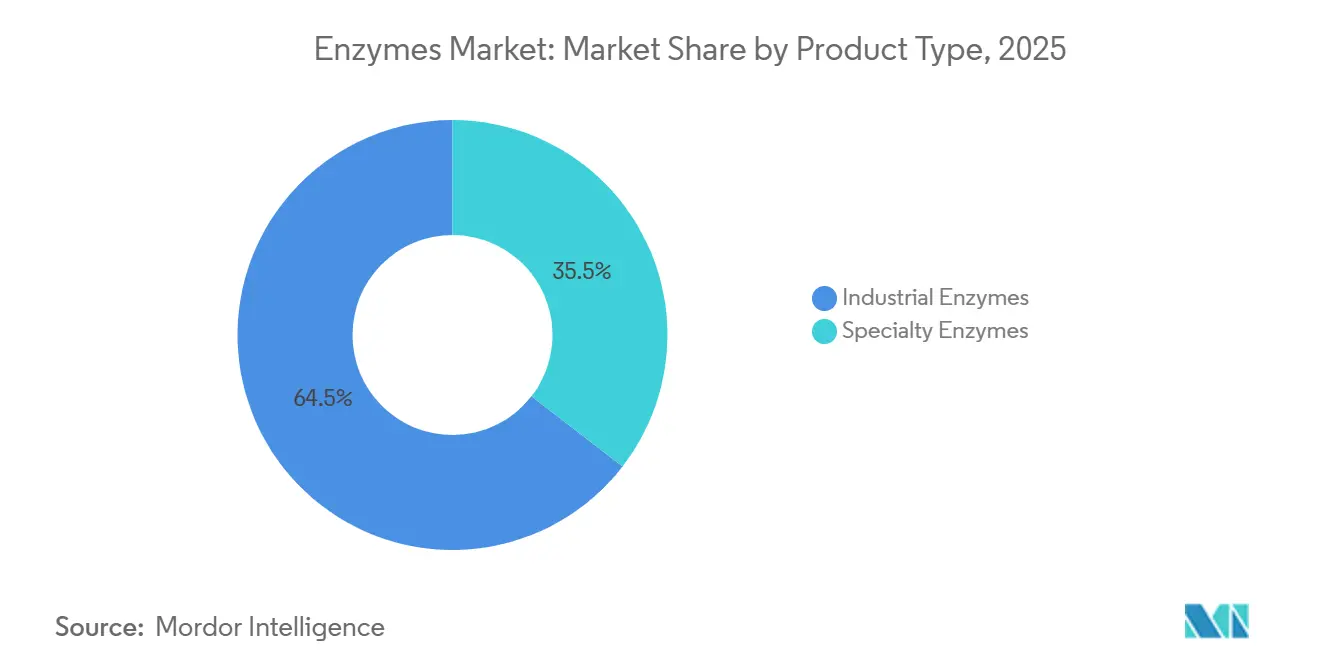
Specialty Enzymes Gain Ground on Industrial BaseThe industrial enzymes segment accounted for 64.52% of the global enzymes market share in 2025, driven by the growing shift toward sustainable, efficient, and bio-based processing solutions. This growth is attributed to enzymes' ability to enhance process efficiency, improve product quality, reduce processing time, and decrease reliance on conventional chemical methods. The increasing preference for environmentally friendly production practices has further accelerated enzyme adoption, as they operate under mild conditions, reduce energy consumption, and minimize waste generation. Advancements in enzyme engineering, protein modification, and fermentation technologies have enhanced enzyme stability, specificity, and performance, enabling broader commercial applications. The rising demand for high-performance biological catalysts, improved manufacturing productivity, and customized enzyme solutions has fostered innovation and large-scale production in this segment.
The specialty enzymes segment is projected to be the fastest-growing product type, with a CAGR of 7.23% during 2026–2031. This growth is driven by increasing demand for highly specific and advanced enzyme solutions. Continuous advancements in enzyme modification, protein engineering, and biotechnology are improving enzyme efficiency, selectivity, and functional performance. The rising preference for precision-based biological solutions has accelerated the development of customized enzymes tailored for targeted processes and optimized outcomes. Innovations in recombinant technologies and enzyme optimization techniques are enabling the creation of enzymes with enhanced stability, extended activity duration, and improved compatibility across diverse operating conditions.
By Source:
Microbial Dominance Persists, Animal Enzymes Attract Niche InvestmentThe microbial-sourced enzymes segment accounted for 61.23% of the global enzymes market share in 2025, driven by their high production efficiency, scalability, and consistent enzyme quality. The segment's growth is attributed to the advantages of microorganisms, such as faster growth cycles, ease of cultivation, and the ability to produce large quantities of enzymes through controlled processes. Advancements in microbial strain improvement, fermentation technologies, and genetic engineering have significantly enhanced enzyme yield, purity, stability, and functional performance, making microbial sources a preferred choice for commercial enzyme production. Their adaptability for modifications, including improved temperature tolerance, enhanced activity, and extended operational stability, has further increased their adoption across various applications. Additionally, the growing emphasis on sustainable production methods and the development of cost-effective enzyme manufacturing techniques have bolstered the reliability and efficiency of microbial enzyme production.
The animal-sourced enzymes segment is expected to grow at a CAGR of 6.58% during 2026–2031, fueled by the rising demand for naturally derived enzymes with high catalytic efficiency and specialized functional properties. The segment's growth is supported by the unique biochemical characteristics of animal-derived enzymes, such as strong specificity, reliability, and effectiveness in targeted processes. Advances in extraction, purification, and stabilization technologies have improved enzyme quality, consistency, and performance, facilitating broader commercial acceptance. Enhanced processing methods have also increased enzyme recovery efficiency while preserving biological activity and functional integrity. Furthermore, the focus on developing highly purified enzyme formulations and innovations aimed at improving stability, safety, and performance under diverse conditions is driving the segment's growth prospects.
By Type:
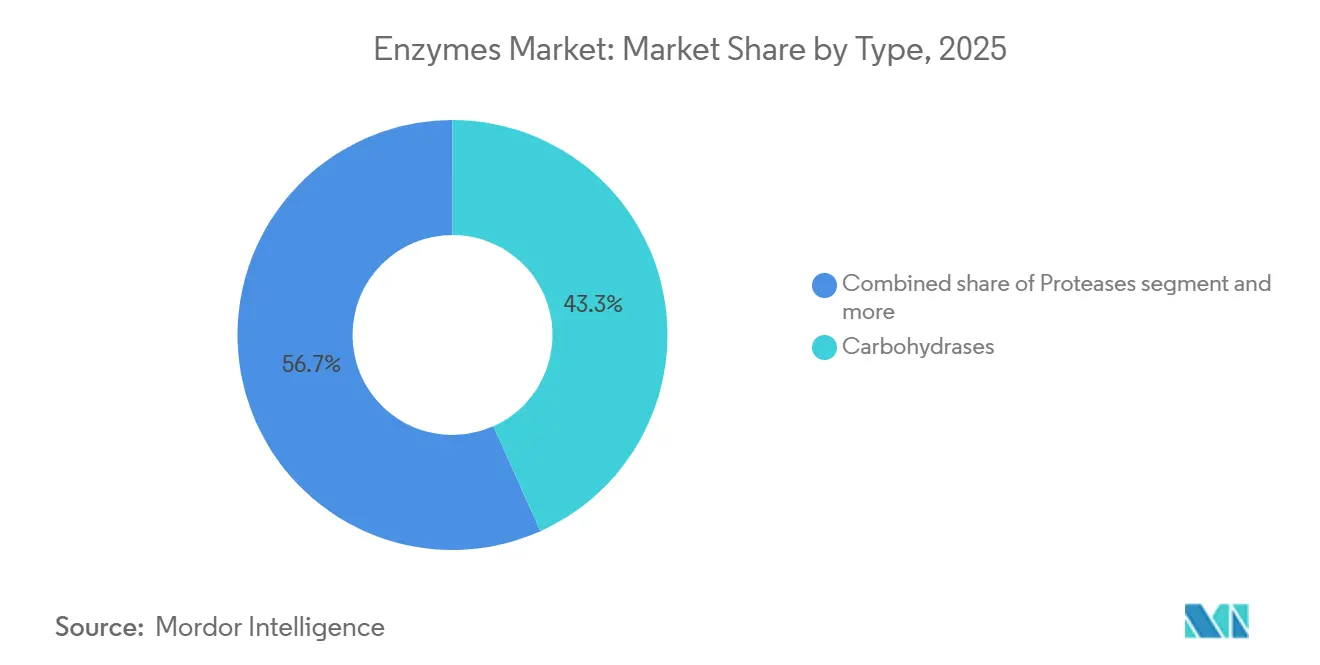
Carbohydrases Lead, Proteases Driven by Pharma and DetergentsThe carbohydrases segment accounted for 43.29% of the enzymes market share in 2025, driven by its high efficiency, broad functionality, and ability to enhance processing performance in various enzyme-based operations. This growth is attributed to the capability of carbohydrases to break down complex carbohydrates into simpler molecules, thereby improving conversion efficiency, consistency, and overall process optimization. Their strong catalytic properties, operational flexibility, and functionality under controlled processing conditions have led to increased adoption as reliable biological solutions. Advancements in enzyme engineering, microbial production techniques, and formulation technologies have further enhanced the stability, activity, and performance of carbohydrases.
The proteases segment is projected to grow at a CAGR of 6.91% during 2026–2031, driven by the rising demand for highly efficient enzymes capable of targeted protein modification and improved functional performance. This growth is supported by ongoing innovations in enzyme optimization, protein engineering, and advancements in biotechnology, which have improved enzyme stability, specificity, and effectiveness across diverse processing environments. The increasing adoption of advanced biological catalysts, coupled with a grow

By Application:
Food Holds Largest Share, Pharma Biotechnology AcceleratesThe food and beverages segment accounted for 35.26% of the global enzymes market share in 2025, driven by the growing adoption of enzyme-based solutions to enhance processing efficiency, improve product quality, and support innovation in production methods. Enzymes are increasingly valued for their ability to accelerate natural reactions, improve consistency, optimize processing conditions, and reduce reliance on conventional additives and chemical-based techniques. The industry's focus on clean-label formulations, natural processing aids, and sustainable manufacturing practices has further bolstered enzyme utilization. According to Eurostat, the number of enterprises in the food and beverage service activities industry in Europe reached 1.58 million in 2024, an increase of 60,000 enterprises from 2021 to 2024, reflecting the expanding industry ecosystem and the growing demand for efficient processing solutions [2].
The pharmaceuticals and biotechnology segment is expected to grow at a CAGR of 7.11% during 2026–2031, driven by the increasing adoption of enzyme-based technologies for advanced biological processes and precision-focused solutions. This growth is supported by rising research activities, advancements in enzyme engineering, and the growing demand for highly specific biological catalysts with enhanced efficiency and reliability. Developments in recombinant technologies, protein engineering, and enzyme optimization methods are improving enzyme stability, selectivity, and performance, enabling the creation of more advanced enzyme-based solutions. The emphasis on targeted approaches, high-purity formulations, and innovative biological processes has further accelerated the demand for specialized enzymes with improved functionality.
Geography Analysis
North America Enzymes Market
North America accounted for 31.87% of the global enzymes market share in 2025, supported by a well-established enzyme production and utilization ecosystem, advancements in biotechnology, and widespread adoption of enzyme-based solutions in industrial processes. The region's growth is driven by a mature industrial enzyme ecosystem, particularly in large-scale corn wet milling, soy processing, and ethanol production, which sustain the demand for efficient biological catalysts. According to the United States Department of Agriculture (USDA), total soy bean production for 2025/2026 is projected at 115.99 million metric tons, ensuring a steady supply of agricultural feedstocks for enzyme-driven processing activities [3]. Additionally, increasing investments in enzyme engineering, fermentation technologies, and sustainable processing practices continue to reinforce North America's leadership in the global enzymes market.
APAC and Europe Enzymes Market
Asia-Pacific is expected to be the fastest-growing region, with a projected CAGR of 7.06% during 2026–2031. This growth is fueled by the rapid expansion of biotechnology capabilities, increasing industrial adoption of enzyme-based processes, and rising demand for sustainable and efficient production technologies. Europe remains one of the largest regions in the enzymes market, supported by a strong regulatory emphasis on sustainability, advanced research infrastructure, and the development of innovative enzyme technologies. The region's commitment to bio-based solutions, circular production practices, and continuous improvements in enzyme performance underpins steady market expansion. Europe's focus on sustainability and innovation ensures its continued prominence in the global enzymes market.
MEA and South America Enzymes Market
South America and the Middle East and Africa are emerging regions in the global enzymes market, driven by increasing awareness of enzyme-based technologies, improving industrial capabilities, and growing adoption of sustainable processing methods. South America is experiencing growth due to the expansion of biological processing activities and the greater use of enzyme solutions to enhance productivity and efficiency. In the Middle East and Africa, the gradual adoption of advanced enzyme technologies is supported by the modernization of production processes and a growing interest in sustainable alternatives.
Competitive Landscape
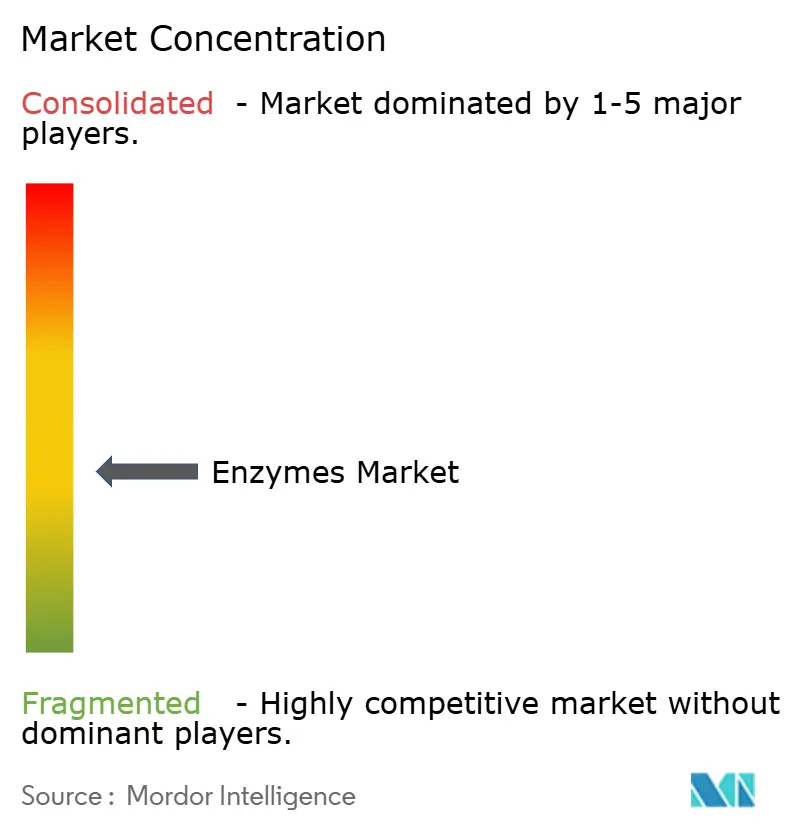
The global enzymes market is moderately consolidated, with key players such as Novozymes A/S, International Flavors & Fragrances Inc., DSM-Firmenich AG, BASF SE, and Kerry Group plc maintaining strong positions. These companies leverage extensive enzyme portfolios, advanced biotechnology capabilities, and continuous innovation strategies. Their focus includes developing high-performance enzyme solutions through protein engineering, microbial optimization, and advanced fermentation technologies to enhance enzyme efficiency, stability, and functionality. Strong research capabilities, global production networks, and investments in sustainable bio-based technologies enable these players to remain competitive and meet the growing demand for specialized enzyme solutions.
Market participants are expanding their presence through strategic partnerships, acquisitions, production capacity enhancements, and technology-driven advancements to strengthen their capabilities in emerging enzyme applications. Regional specialists and technology-focused companies are gaining momentum by targeting innovative areas such as RNA therapeutic manufacturing, enzymatic PET recycling, and cross-species feed enzyme platforms. The adoption of precision biotechnology, enzyme customization, and advanced bioprocessing techniques is driving companies to expand their research pipelines and develop next-generation enzyme solutions with enhanced performance characteristics.
The competitive landscape is evolving as established companies and emerging biotechnology firms emphasize differentiation through sustainability, efficiency, and specialized enzyme development. Companies are increasingly investing in novel enzyme discovery platforms, artificial intelligence-assisted enzyme design, and scalable manufacturing technologies to improve production efficiency and accelerate commercialization. As demand for sustainable biological catalysts grows, competition is expected to intensify, with market players focusing on innovation, cost optimization, and collaborative strategies to strengthen their positions in the global enzymes market.
Enzymes Industry Leaders
-
Novozymes A/S
-
International Flavors and Fragrances Inc.
-
DSM-Firmenich AG
-
BASF SE
-
Kerry Group plc
- *Disclaimer: Major Players sorted in no particular order
Enzymes Market Companies Covered in this Report
- Novozymes A/S
- International Flavors and Fragrances Inc.
- DSM-Firmenich AG
- BASF SE
- Kerry Group plc
- Associated British Foods plc
- Amano Enzyme Inc.
- Advanced Enzyme Technologies Ltd.
- AB Enzymes GmbH
- Codexis, Inc.
- Biocatalysts Ltd.
- Enzyme Development Corporation
- Chr. Hansen Holding A/S
- Merck KGaA
- Thermo Fisher Scientific Inc.
- Promega Corporation
- Takara Bio Inc.
- F. Hoffmann-La Roche Ltd.
- Sanofi S.A.
- Enzyme Solutions Inc.
Recent Industry Developments in Enzymes Market
- June 2026: Amano Enzyme Introduced Pea Protein Enzyme at Bridge2Food to Reduce Off-Notes Without Reformulation. The product, ProBoost Neutra, is designed to enhance the emulsification and solubility of pea protein isolate while minimizing off-notes.
- April 2026: Kerry Group has inaugurated an expanded biotechnology manufacturing hub in Ireland. This facility enhances industrial-scale production of lactase enzymes, supporting dairy producers globally in scaling up lactose-free and sugar-reduced dairy products.
- October 2025: BASF collaborated with International Flavors & Fragrances Inc. to advance the development of IFF’s Designed Enzymatic Biomaterials technology platform and to create next-generation enzyme technologies for fabric care, dish care, personal care, and industrial cleaning applications.
Global Enzymes Market Report Scope
An enzyme is a biological macromolecule, usually a protein, that acts as a biological catalyst, accelerating chemical reactions without being consumed in the process. The enzymes market is segmented by product type, source, type, application, and geography. Based on product type, the market is segmented into industrial enzymes and specialty enzymes. Based on source, the market is segmented into plant, microbial, and animal-based enzymes. Based on type, the market is segmented into carbohydrases, proteases, lipases, and others. Based on application, the market is segmented into food and beverages, pharmaceuticals and biotechnology, diagnostics and clinical testing, detergents and household care, biofuels and industrial processing, animal feed, textiles and leather, paper and pulp, and others. Based on geography, the market is segmented into North America, Europe, Asia-Pacific, South America, and Middle East and Africa. The Market Forecasts are Provided in Both Value (USD) and Volume (Tons).
| Industrial Enzymes |
| Specialty Enzymes |
| Plant |
| Microbial |
| Animal |
| Carbohydrases |
| Proteases |
| Lipases |
| Others |
| Food and Beverages |
| Pharmaceuticals and Biotechnology |
| Diagnostics and Clinical Testing |
| Detergents and Household Care |
| Biofuels and Industrial Processing |
| Animal Feed |
| Textiles and Leather |
| Paper and Pulp |
| Others |
| North America | United States |
| Canada | |
| Mexico | |
| Rest of North America | |
| Europe | United Kingdom |
| Germany | |
| France | |
| Italy | |
| Spain | |
| Netherlands | |
| Poland | |
| Belgium | |
| Sweden | |
| Rest of Europe | |
| Asia-Pacific | China |
| Japan | |
| India | |
| Australia | |
| Indonesia | |
| South Korea | |
| Thailand | |
| Singapore | |
| Rest of Asia-Pacific | |
| South America | Brazil |
| Argentina | |
| Colombia | |
| Chile | |
| Peru | |
| Rest of South America | |
| Middle East and Africa | South Africa |
| Saudi Arabia | |
| United Arab Emirates | |
| Nigeria | |
| Egypt | |
| Morocco | |
| Turkey | |
| Rest of Middle East and Africa |
| By Product Type | Industrial Enzymes | |
| Specialty Enzymes | ||
| By Source | Plant | |
| Microbial | ||
| Animal | ||
| By Type | Carbohydrases | |
| Proteases | ||
| Lipases | ||
| Others | ||
| By Application | Food and Beverages | |
| Pharmaceuticals and Biotechnology | ||
| Diagnostics and Clinical Testing | ||
| Detergents and Household Care | ||
| Biofuels and Industrial Processing | ||
| Animal Feed | ||
| Textiles and Leather | ||
| Paper and Pulp | ||
| Others | ||
| By Geography | North America | United States |
| Canada | ||
| Mexico | ||
| Rest of North America | ||
| Europe | United Kingdom | |
| Germany | ||
| France | ||
| Italy | ||
| Spain | ||
| Netherlands | ||
| Poland | ||
| Belgium | ||
| Sweden | ||
| Rest of Europe | ||
| Asia-Pacific | China | |
| Japan | ||
| India | ||
| Australia | ||
| Indonesia | ||
| South Korea | ||
| Thailand | ||
| Singapore | ||
| Rest of Asia-Pacific | ||
| South America | Brazil | |
| Argentina | ||
| Colombia | ||
| Chile | ||
| Peru | ||
| Rest of South America | ||
| Middle East and Africa | South Africa | |
| Saudi Arabia | ||
| United Arab Emirates | ||
| Nigeria | ||
| Egypt | ||
| Morocco | ||
| Turkey | ||
| Rest of Middle East and Africa | ||
Key Questions Answered in the Report
What is the current size of the enzymes market?
The enzymes market stands at USD 15.1 billion in 2026 and is projected to reach USD 20.33 billion by 2031 at a 6.1% CAGR.
Which product category leads enzyme demand?
Industrial enzymes lead demand with 64.52% share in 2025 because they are widely used in food processing, detergents, textiles, and biofuels.
Which application is growing fastest for enzymes?
Pharmaceuticals and Biotechnology is the fastest-growing application, with a projected 7.11% CAGR through 2031, supported by nucleic acid synthesis, antibody production, and API manufacturing.
Why are microbial enzymes so dominant?
Microbial enzymes held 61.23% share in 2025 because fermentation-based production is scalable, cost efficient, and well suited to modern strain engineering.