
Employee Skills Assessment and Mapping Platform Market Size and Share
Market Overview
| Study Period | 2020 - 2031 |
|---|---|
| Market Size (2026) | USD 1.92 Billion |
| Market Size (2031) | USD 2.92 Billion |
| Growth Rate (2026 - 2031) | 8.72 % |
| Fastest Growing Market | Asia-Pacific |
| Largest Market | North America |
| Market Concentration | Medium |
Major Players *Disclaimer: Major Players sorted in no particular order Image © Mordor Intelligence. Reuse requires attribution under CC BY 4.0. | |
Employee Skills Assessment and Mapping Platform Market Analysis by Mordor Intelligence
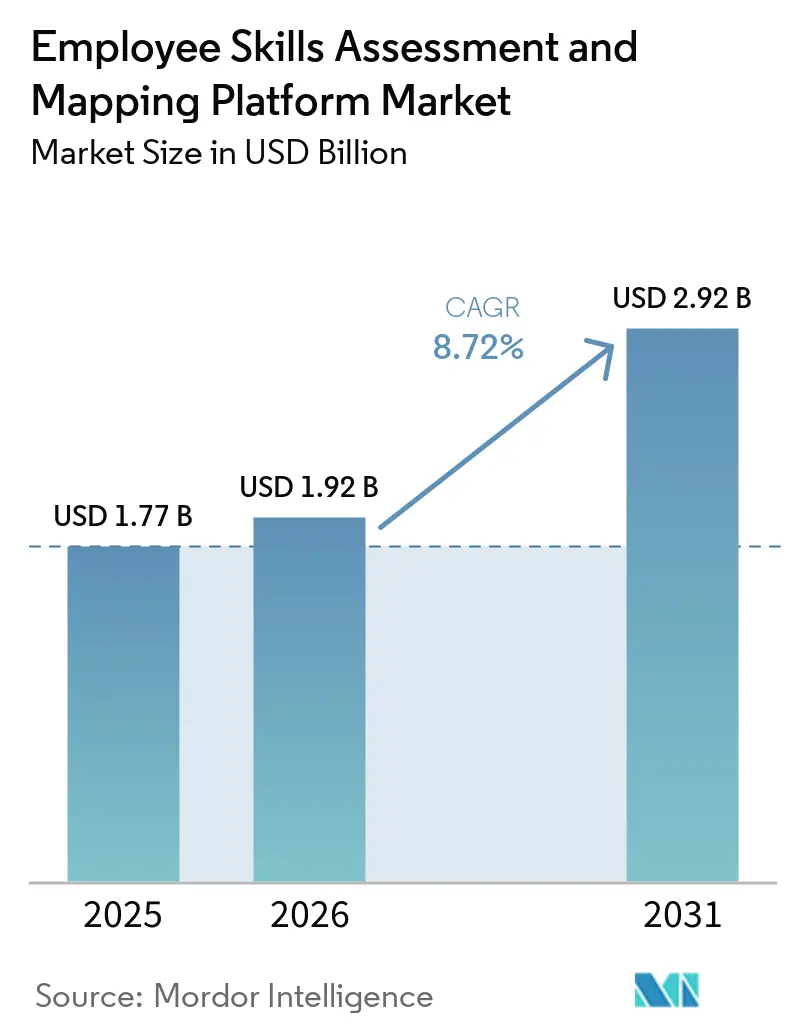
The employee skills assessment and mapping platform market size is expected to be USD 1.77 billion in 2025, USD 1.92 billion in 2026, and reach USD 2.92 billion by 2031, growing at a CAGR of 8.72% from 2026 to 2031. Accelerated digital transformation, shrinking job half-lives, and an expanding menu of AI-augmented workflows are pushing enterprises to retire static competency inventories and adopt real-time skills-intelligence engines. Vendors that embed knowledge-graph taxonomies and integrate with learning-experience platforms are becoming indispensable to chief learning officers because they compress time-to-competency and shrink reliance on external hiring. Demand is strongest where compliance mandates, wage inflation, and talent scarcity converge, most visibly in technology, financial services, and healthcare. Competitive intensity remains moderate because platform breadth now competes with algorithmic precision, keeping room for both full-suite HCM vendors and niche assessment specialists to flourish.
Key Report Takeaways
- By application, Learning and Development led with 36.14% revenue share in 2025, while Succession Planning is projected to expand at a 10.45% CAGR through 2031.
- By deployment, cloud architectures accounted for 62.11% of the employee skills assessment and mapping platform market share in 2025, whereas hybrid models are forecast to register the fastest CAGR at 11.12% between 2026 and 2031.
- By organization size, Large Enterprises generated 68.19% of 2025 revenue, yet Small and Medium Enterprises are anticipated to advance at an 11.42% CAGR over the same period.
- By industry vertical, IT and Telecommunications captured 24.55% of 2025 revenue, whereas Healthcare and Life Sciences is positioned to grow at a 9.91% CAGR through 2031.
- By geography, North America captured 37.21% share in 2025, and Asia-Pacific is the fastest-growing region with a 10.78% CAGR through 2031.
Note: Market size and forecast figures in this report are generated using Mordor Intelligence’s proprietary estimation framework, updated with the latest available data and insights as of January 2026.
Market Trends and Insights
Drivers Impact Analysis of Employee Skills Assessment and Mapping Platform Market*
| Driver | (~) % Impact on CAGR Forecast | Geographic Relevance | Impact Timeline |
|---|---|---|---|
| Rapid Digital Transformation of Learning and Development Functions | +2.3% | Global with early concentration in North America and Western Europe | Medium term (2-4 years) |
| Rising Need for Real-Time Skill Visibility in Agile Workforce Planning | +2.1% | Global, especially IT and Telecommunications and BFSI | Short term (≤ 2 years) |
| Growing Compliance Mandates in Safety-Critical Industries | +1.6% | North America and Europe for healthcare, Asia-Pacific for manufacturing | Medium term (2-4 years) |
| Adoption of Dynamic Skills Taxonomies Powered by Knowledge Graphs | +1.4% | North America and Europe, spillover to Asia-Pacific tech hubs | Long term (≥ 4 years) |
| Shift Toward Skills-Based Pay Architectures | +0.8% | North America and Western Europe, limited uptake in emerging markets | Long term (≥ 4 years) |
| Expansion of Public-Private Reskilling Funds Targeting Mid-Career Workers | +0.6% | Asia-Pacific (Singapore, India, China) and European Union | Medium term (2-4 years) |
| Source: Mordor Intelligence | |||
Rapid Digital Transformation of Learning and Development Functions
Corporate learning teams are abandoning annual curricula in favor of continuous, personalized development pathways that depend on live skills dashboards. A 2025 Mercer study found 91% of enterprises reshaping workforce strategies around AI, positioning skills-mapping platforms as the data backbone for adaptive learning. Cloud-native learning-experience platforms now ingest assessment results, project-management artifacts, and code-repository commits to refresh employee profiles after every task or certification. This integration lets L&D leaders target budgets where analytics predict the highest capability lift, cutting time-to-competency for critical roles by up to 40%. As skills data loop into internal talent marketplaces, internal hiring cycles accelerate and external recruiting spend falls.
Rising Need for Real-Time Skill Visibility in Agile Workforce Planning
Sprint-based delivery models require workforce planners to match talent to projects in days, not quarters. Skills platforms that connect with collaboration tools and version-control systems capture emergent capabilities as teams execute live work. McKinsey analysis reported 18% lower contractor spend at firms using real-time skills intelligence in 2025. Financial institutions are applying the same tools to navigate ISO 20022 migration by mapping current staff against new messaging requirements and designing micro-upskilling bursts that shield institutional knowledge.
Growing Compliance Mandates in Safety-Critical Industries
The Joint Commission’s revised standards require U.S. hospitals to prove continuous competency verification after January 2025, a shift that accelerated platform uptake in healthcare. ISO 45001 pushes manufacturers toward periodic assessments for high-risk tasks. Platforms that tie simulation scores, certificates, and peer reviews into a single audit trail help compliance teams automate recertification reminders and generate regulator-ready reports across multiple sites.
Adoption of Dynamic Skills Taxonomies Powered by Knowledge Graphs
Knowledge-graph architectures treat skills as interconnected nodes with weighted relationships, allowing platforms to infer adjacency and decay rates. PwC case studies in 2025 showed that graph-based taxonomies lifted internal placement rates by up to 35%. Financial-services firms use this capability to redirect mainframe developers into cloud roles by charting skill bridges and prescribing tailored learning. Alignment with open standards such as ESCO and IEEE P2997 is emerging as a differentiator that future-proofs data interoperability.
Restraints Impact Analysis of Employee Skills Assessment and Mapping Platform Market*
| Restraint | (~) % Impact on CAGR Forecast | Geographic Relevance | Impact Timeline |
|---|---|---|---|
| Data Privacy Concerns Around Employee Profiling | -1.2% | Europe under GDPR and EU AI Act, North America under CCPA and state laws | Short term (≤ 2 years) |
| Integration Complexities with Legacy Human Resource Information System Stacks | -0.9% | Global, most acute in large enterprises with ageing ERP cores | Medium term (2-4 years) |
| Algorithmic Bias in AI-Driven Skill Inference Engines | -0.6% | North America and Europe, rising scrutiny in Asia-Pacific | Medium term (2-4 years) |
| Resistance from Labor Unions Over Continuous Assessment Practices | -0.4% | Europe and North America unionized sectors | Long term (≥ 4 years) |
| Source: Mordor Intelligence | |||
Data Privacy Concerns Around Employee Profiling
GDPR classifies granular skill profiles as personal data that require clear consent and usage limits, and the EU AI Act designates many HR analytics tools as high-risk systems.[1] Enforcement guidance issued in 2025 warns employers that continuous behavioral monitoring may trigger Article 22 rights to explanation. Parallel statutes such as the California Consumer Privacy Act are adding similar guardrails in the United States. Vendors are responding with granular consent workflows, anonymization pipelines, and localized data-storage options, but these steps inflate implementation cost and dampen algorithmic performance.
Integration Complexities With Legacy Human Resource Information System Stacks
Many large enterprises run two-decade-old ERPs that rely on batch file transfers and rigid data models. A 2025 Deloitte technology survey found 62% of HR leaders citing integration complexity as their top adoption barrier, pushing total cost of ownership up by as much as 60% when middleware and data reconciliation are required. Vendors are rolling out pre-built connectors and data-federation layers, yet edge cases such as contingent workers and multiple HRIS instances still force manual workarounds that erode confidence in the employee skills assessment and mapping platform market.
*Our forecasts treat driver/restraint impacts as directional, not additive. The impact forecasts reflect baseline growth, mix effects, and variable interactions.
Employee Skills Assessment and Mapping Platform Market Segment Analysis
By Application:
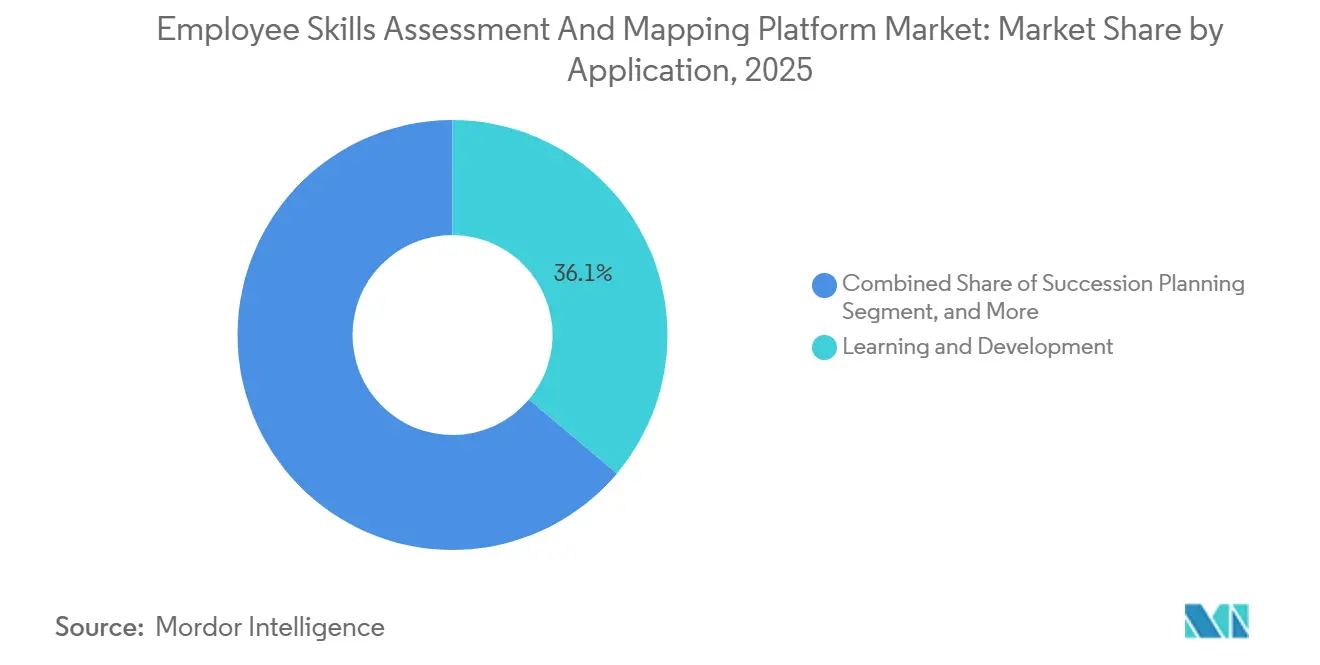
Succession Planning Gains MomentumSuccession Planning is projected to grow at 10.45% through 2031, making it the fastest-expanding use case within the employee skills assessment and mapping platform market. Enterprises are shifting from tenure-based promotion lists to readiness dashboards that rank internal talent months before leadership transitions. This pivot drives sustained investment because executive roles left vacant reduce revenue momentum and increase recruitment costs. Learning and Development, which commanded 36.14% of the employee skills assessment and mapping platform market share in 2025, continues to anchor demand, but organizations now look beyond training administration and focus on monetizing skill data for workforce decisions.
Performance Management and Recruitment workflows benefit from skills-embedded feedback cycles and richer applicant screening, which shortens hiring timelines. Compliance Management grows where regulators demand audit-quality credentialing, especially in healthcare and manufacturing. Emerging internal talent marketplaces connect skills assessments directly to gig-style project boards, closing capability gaps without inflating headcount. Together these shifts reinforce the employee skills assessment and mapping platform market as a cornerstone of data-driven HR strategy.

By Deployment:
Hybrid Models Balance Sovereignty and AgilityHybrid architectures are set to advance at an 11.12% CAGR between 2026 and 2031, reflecting enterprise attempts to satisfy data-residency rules while still accessing cloud analytics. Cloud deployments remain dominant at 62.11% of 2025 revenue because their elastic compute scales large-volume assessments with no capital outlay. On-premises installations persist in government and defense, yet they lag in innovation cadence.
Modern vendors now split personally identifiable data to local storage while pushing anonymized skill vectors to cloud engines for benchmarking. European organizations favor this design to comply with GDPR cross-border transfer restrictions, and similar patterns appear in highly regulated Asian markets. The hybrid surge signals that the employee skills assessment and mapping platform market is adapting architectures rather than forcing binary deployment choices.
By Organization Size:
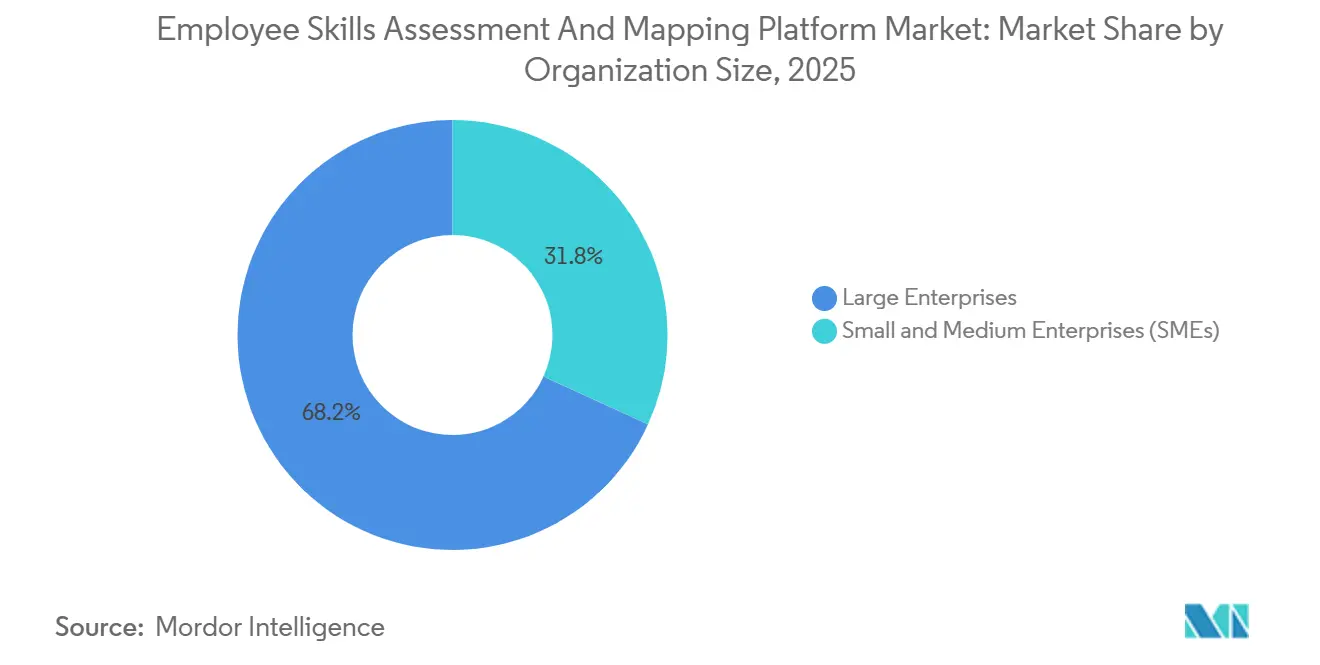
SMEs Close the Capability GapSmall and Medium Enterprises are forecast to expand at 11.42% through 2031, outpacing Large Enterprises as modular, API-first tools remove integration headaches. Usage-based pricing and self-service onboarding shrink sales cycles, making enterprise-grade analytics viable for firms without HRIS integration teams.[2] Large Enterprises still generated 68.19% of 2025 revenue, leveraging bigger budgets to deploy end-to-end talent suites.
Yet competitive labor markets push SMEs to offer comparable growth pathways, and lightweight mobile assessments meet that need. The democratization of sophisticated HR tech widens the total addressable employee skills assessment and mapping platform market by unlocking thousands of mid-sized customers that previously relied on spreadsheets.
By Industry Vertical:
Compliance Lifts Healthcare DemandHealthcare and Life Sciences is projected to grow at 9.91% over the forecast window, driven by mandates for continuous competency verification tied to patient safety and reimbursement models. IT and Telecommunications led revenue in 2025 with 24.55% share because rapid technology churn makes skill obsolescence costly.
Banking, Financial Services and Insurance adopts platforms to handle new regulatory requirements such as ISO 20022, while Manufacturing uses assessments to pair robotics expertise with traditional machining knowledge. Retail and E-Commerce apply mobile assessments to manage promotion pipelines for high-turnover frontline staff. Collectively these dynamics reinforce the employee skills assessment and mapping platform industry as an essential layer for sectors balancing regulation, innovation, and workforce transformation.
Geography Analysis
North America Employee Skills Assessment and Mapping Platform Market
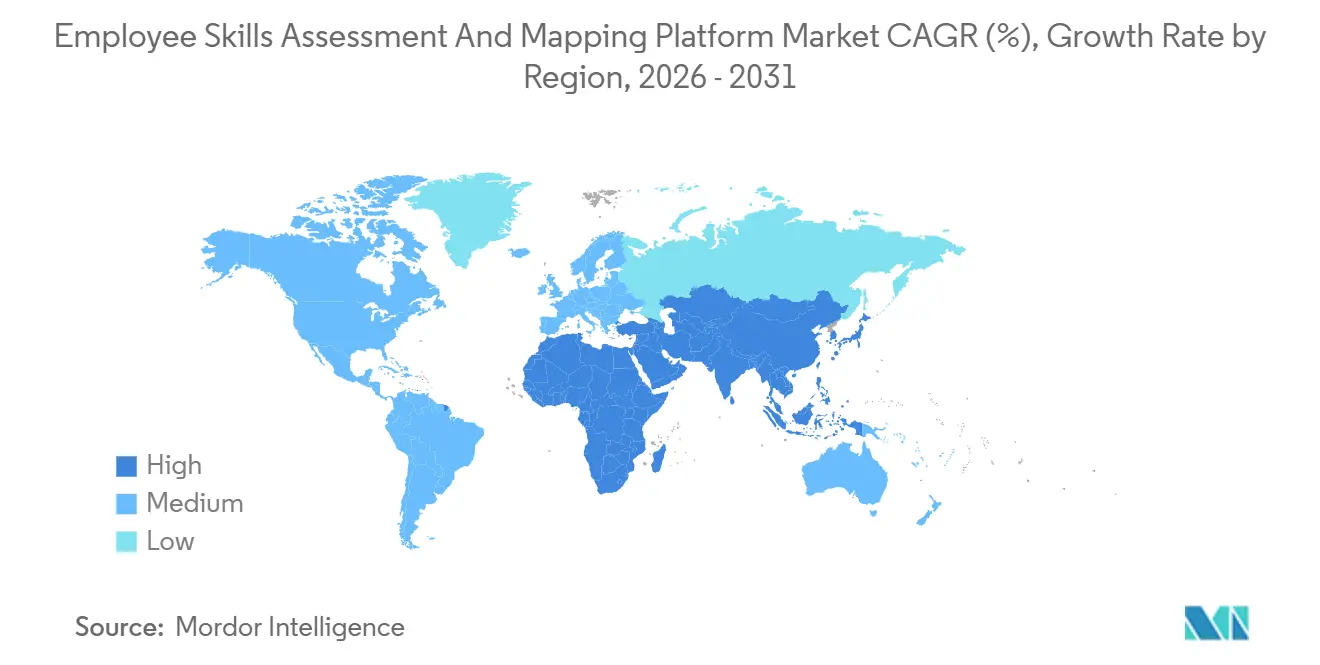
North America accounted for 37.21% of 2025 revenue, propelled by early adoption in technology, finance, and healthcare. Enterprises in the region deploy platforms to mitigate wage inflation and talent shortages by boosting internal mobility. Canada benefits from federal subsidies that offset platform costs for mid-sized employers, while Mexico’s BPO sector deploys assessments to prove workforce quality to multinational clients.
APAC Employee Skills Assessment and Mapping Platform Market
Asia-Pacific is forecast to grow at 10.78% through 2031, the fastest regional rate in the employee skills assessment and mapping platform market. Singapore’s SkillsFuture initiative allocates SGD 4 billion (USD 3 billion) for lifelong learning, encouraging firms to align with national credential frameworks. India’s National Skill Development Corporation partners with platform vendors to certify millions of workers across manufacturing and services. China channels public funds into digital upskilling, creating large installed bases that move from one-time assessments to continuous monitoring.
EMEA and South America Employee Skills Assessment and Mapping Platform Market
Europe balances strict privacy regulation with public investment in lifelong learning. Organizations in Germany, the United Kingdom, and France adopt platforms to navigate automation and sustainability demands under the European Skills Agenda.[3] Southern Europe leverages EU structural funds to modernize vocational training. The Middle East sees growth through diversification initiatives in Saudi Arabia and the United Arab Emirates, while South America and Africa remain early-stage, with uptake led by multinationals needing standardized skills data for local workforces.
Competitive Landscape
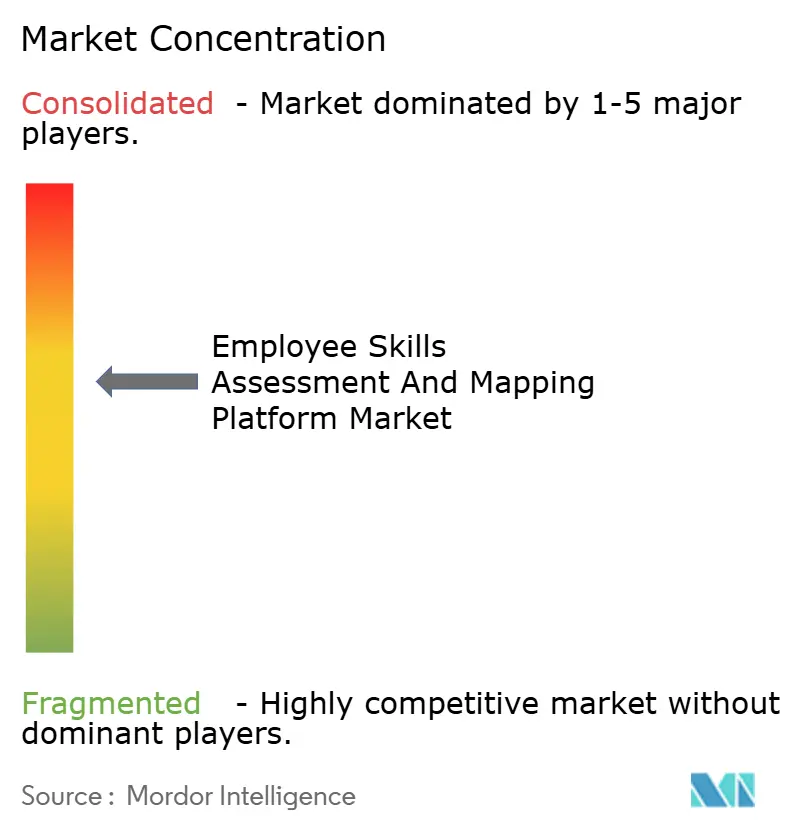
The employee skills assessment and mapping platform market is moderately fragmented. Established HCM suites embed skills modules to upsell existing payroll and performance customers, while niche specialists compete on algorithmic depth in technical screening, psychometrics, and compliance credentialing. Platform breadth versus algorithmic precision defines one competitive axis, and proprietary ontologies versus open standards defines another.
Vendors seeking breadth are acquiring content libraries, learning-experience platforms, and internal marketplace providers to deliver an integrated value chain from assessment to redeployment. Algorithmic specialists differentiate through AI-based inference, knowledge graphs, and predictive gap analysis that detect non-obvious matches and future skill shortages. Enterprises with diverse technology stacks often run dual-vendor strategies, taking broad HCM functionality from suite providers while retaining specialized assessment engines for mission-critical roles.
Opportunities persist among blue-collar and frontline segments where mobile-first, offline-capable assessments are scarce. Emerging disruptors focus on integration with shift scheduling and time tracking to reach logistics, retail, and healthcare providers that lack desktop access. Alignment with standards such as IEEE P2997 and the ESCO ontology confers interoperability benefits and qualifies vendors for government-funded reskilling programs, shaping future platform selection criteria.
Employee Skills Assessment and Mapping Platform Industry Leaders
-
Cornerstone OnDemand, Inc.
-
Workday, Inc.
-
LinkedIn Corporation
-
Degreed, Inc.
-
Skillsoft Corporation
- *Disclaimer: Major Players sorted in no particular order
Employee Skills Assessment and Mapping Platform Market Companies Covered in this Report
- Cornerstone OnDemand, Inc.
- Workday, Inc.
- Degreed, Inc.
- Skillsoft Corporation
- Pluralsight, Inc.
- Udacity, Inc.
- Coursera Inc.
- LinkedIn Corporation
- SHL Group Ltd.
- Talview, Inc.
- Mercer LLC
- Pearson plc
- iMocha Inc.
- HackerRank, Inc.
- Harver B.V.
- Vervoe, Inc.
- Codility Ltd.
- Thomas International Ltd.
- Psytech International Ltd.
Recent Industry Developments in Employee Skills Assessment and Mapping Platform Market
- April 2026: Workday announced a USD 250 million expansion of its skills-intelligence platform, integrating real-time project data to refresh employee profiles.
- March 2026: Cornerstone OnDemand partnered with the European Commission’s ESCO framework to embed standardized taxonomies and unlock EU reskilling funds.
- February 2026: Degreed acquired a knowledge-graph startup for an estimated USD 85 million to accelerate inferential skill matching.
- January 2026: LinkedIn launched Skills Graph, a public API mapping 40,000 skills and their adjacency relationships.
Global Employee Skills Assessment and Mapping Platform Market Report Scope
Platforms in the Employee Skills Assessment and Mapping Platform market evaluate employee skills, gauge proficiency levels, and align capabilities with job roles or competency frameworks. Utilizing assessments, skill taxonomies, and data analytics, these solutions pinpoint gaps and developmental needs. They facilitate strategic workforce planning, reskilling efforts, and tailored learning recommendations. The market includes both standalone skills intelligence tools and skills modules integrated within talent suites.
The Employee Skills Assessment and Mapping Platform Market Report is Segmented by Application (Learning and Development, Performance Management, Succession Planning, Recruitment and Hiring, Compliance Management, and Other Applications), Deployment (Cloud, On-Premises, and Hybrid), Organization Size (Small and Medium Enterprises [SMEs], and Large Enterprises), Industry Vertical (IT and Telecommunications, Banking Financial Services and Insurance, Manufacturing, Healthcare and Life Sciences, Retail and E-Commerce, Government, Education, and Other Industry Verticals), and Geography (North America, South America, Europe, Asia-Pacific, Middle East, and Africa). The Market Forecasts are Provided in Terms of Value (USD).
Segmentation Overview
| Learning and Development |
| Performance Management |
| Succession Planning |
| Recruitment and Hiring |
| Compliance Management |
| Other Applications |
| Cloud |
| On-Premises |
| Hybrid |
| Small and Medium Enterprises (SMEs) |
| Large Enterprises |
| IT and Telecommunications |
| Banking, Financial Services and Insurance |
| Manufacturing |
| Healthcare and Life Sciences |
| Retail and E-Commerce |
| Government |
| Education |
| Other Industry Verticals |
| North America | United States |
| Canada | |
| Mexico | |
| South America | Brazil |
| Argentina | |
| Rest of South America | |
| Europe | Germany |
| United Kingdom | |
| France | |
| Italy | |
| Spain | |
| Russia | |
| Rest of Europe | |
| Asia-Pacific | China |
| India | |
| Japan | |
| South Korea | |
| Australia and New Zealand | |
| Rest of Asia-Pacific | |
| Middle East | Saudi Arabia |
| United Arab Emirates | |
| Turkey | |
| Rest of Middle East | |
| Africa | South Africa |
| Nigeria | |
| Rest of Africa |
| By Application | Learning and Development | |
| Performance Management | ||
| Succession Planning | ||
| Recruitment and Hiring | ||
| Compliance Management | ||
| Other Applications | ||
| By Deployment | Cloud | |
| On-Premises | ||
| Hybrid | ||
| By Organization Size | Small and Medium Enterprises (SMEs) | |
| Large Enterprises | ||
| By Industry Vertical | IT and Telecommunications | |
| Banking, Financial Services and Insurance | ||
| Manufacturing | ||
| Healthcare and Life Sciences | ||
| Retail and E-Commerce | ||
| Government | ||
| Education | ||
| Other Industry Verticals | ||
| By Geography | North America | United States |
| Canada | ||
| Mexico | ||
| South America | Brazil | |
| Argentina | ||
| Rest of South America | ||
| Europe | Germany | |
| United Kingdom | ||
| France | ||
| Italy | ||
| Spain | ||
| Russia | ||
| Rest of Europe | ||
| Asia-Pacific | China | |
| India | ||
| Japan | ||
| South Korea | ||
| Australia and New Zealand | ||
| Rest of Asia-Pacific | ||
| Middle East | Saudi Arabia | |
| United Arab Emirates | ||
| Turkey | ||
| Rest of Middle East | ||
| Africa | South Africa | |
| Nigeria | ||
| Rest of Africa | ||
Key Questions Answered in the Report
What is the current employee skills assessment and mapping platform market size?
The market stood at USD 1.92 billion in 2026 and is projected to reach USD 2.92 billion by 2031, expanding at an 8.72% CAGR (Mordor Intelligence).
Which deployment model will grow the fastest by 2031?
Hybrid architectures are forecast to post the highest CAGR at 11.12% because they balance data-sovereignty requirements with cloud analytics advantages.
Why is Succession Planning a high-growth application?
Organizations are replacing tenure-based promotion lists with skills-based readiness dashboards, driving a 10.45% CAGR for Succession Planning modules.
How are privacy regulations affecting adoption in Europe?
GDPR and the EU AI Act classify detailed skill profiles as high-risk data, forcing vendors to add consent workflows and limiting short-term growth.
What differentiates vendors in this market?
Leaders integrate knowledge-graph taxonomies, AI-based inference, and open standards compliance, enabling real-time insights and interoperability.