
Employee Upskilling And Reskilling Platform Market Size and Share
Market Overview
| Study Period | 2020 - 2031 |
|---|---|
| Market Size (2026) | USD 61.98 Billion |
| Market Size (2031) | USD 100.91 Billion |
| Growth Rate (2026 - 2031) | 10.24 % |
| Fastest Growing Market | Asia-Pacific |
| Largest Market | North America |
| Market Concentration | Low |
Major Players *Disclaimer: Major Players sorted in no particular order Image © Mordor Intelligence. Reuse requires attribution under CC BY 4.0. | |
Employee Upskilling And Reskilling Platform Market Analysis by Mordor Intelligence
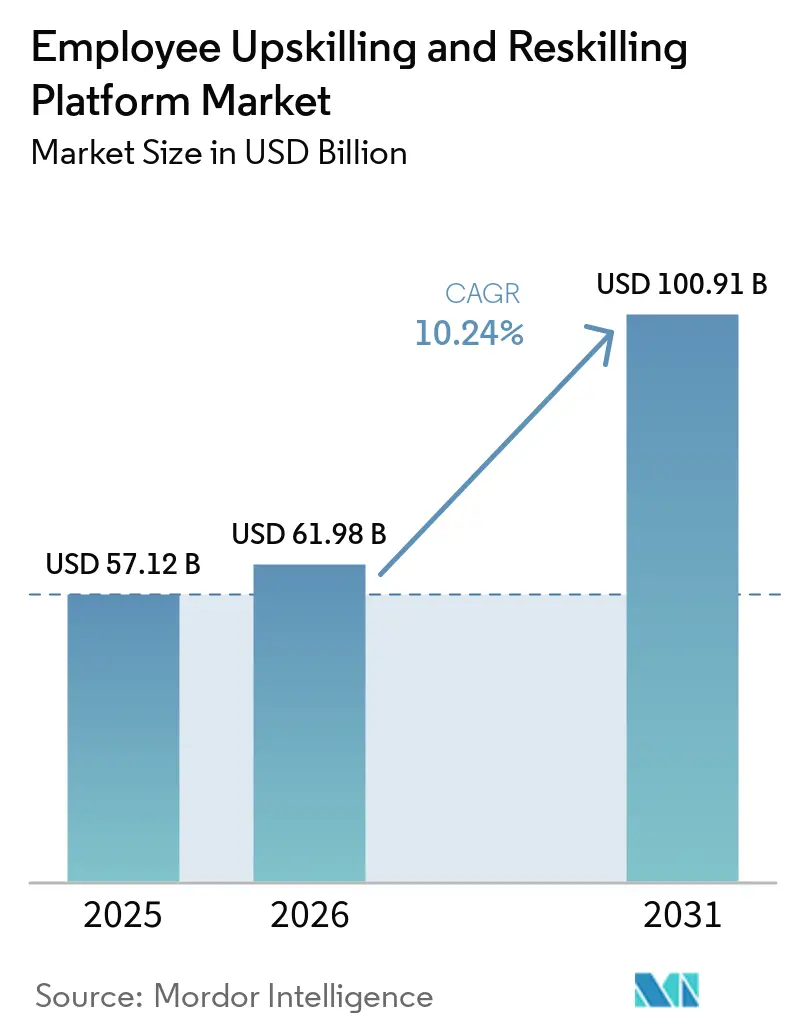
The employee upskilling and reskilling platform market size reached USD 57.12 billion in 2025 and is forecast to reach USD 100.91 billion by 2031 at a CAGR of 10.24% over 2026-2031. The employee upskilling and reskilling platform market is expanding because enterprises now treat skills renewal as an operating requirement rather than a discretionary HR program. AI-led automation is shortening the useful life of technical skills, which is keeping demand elevated for structured learning systems that can update content, track progress, and support distributed workforces. The employee upskilling and reskilling platform market is also benefiting from the spread of hybrid work and from the growing use of learning tools inside collaboration environments such as Slack, Microsoft Teams, and Workday. Buyers are increasingly favoring platforms that combine content delivery with skills intelligence, verified assessments, workflow integration, and measurable reporting from the start. Competitive activity is strengthening as scaled vendors pursue consolidation and mid-tier providers respond through deeper specialization, stronger integrations, and more role-based learning design.
Key Report Takeaways
- By training focus, Technical and Digital Skills held 34.81% of the market in 2025 and is projected to grow at a 12.81% CAGR through 2031.
- By deployment mode, Cloud-based delivery led with 68.42% share in 2025, while Hybrid deployment is forecast to expand at a 13.22% CAGR through 2031
- By enterprise size, Large enterprises accounted for 71.42% of the market share in 2025, while Small and Medium-Sized Enterprises are projected to record the fastest growth at a 12.61% CAGR through 2031.
- By end-user industry vertical, IT and Telecommunications held a 24.71% share in 2025, while Healthcare and Life Sciences are expected to expand at a 13.52% CAGR through 2031.
- By geography, North America led with a 38.91% share in 2025, while Asia-Pacific is projected to grow at a 14.11% CAGR through 2031.
Note: Market size and forecast figures in this report are generated using Mordor Intelligence’s proprietary estimation framework, updated with the latest available data and insights as of January 2026.
Market Trends and Insights
Drivers Impact Analysis of Employee Upskilling And Reskilling Platform Market*
| Driver | (~) % Impact on CAGR Forecast | Geographic Relevance | Impact Timeline |
|---|---|---|---|
| Ai And Automation-Driven Skills Obsolescence | +2.8% | Global, with strongest demand concentration in North America and APAC technology hubs | Short term (≤ 2 years) |
| Shift Toward Skills-First Talent Strategies | +2.1% | North America and EU core markets, spill-over into APAC enterprise clusters | Medium term (2-4 years) |
| Remote And Hybrid Work Normalizing Digital Learning | +1.8% | Global, accelerated adoption in North America and EU | Short term (≤ 2 years) |
| Compliance And Audit-Ready Training Demand | +1.4% | North America and EU, APAC spill-over via multinationals | Medium term (2-4 years) |
| Ai Governance And Model-Risk Training Needs | +1.1% | EU primary, North America secondary, early demand in Singapore and UAE | Medium term (2-4 years) |
| Software Workflow Change Driving Continuous Micro-Upskilling | +0.8% | Global, distributed across all enterprise segments | Long term (≥ 4 years) |
| Source: Mordor Intelligence | |||
Ai And Automation-Driven Skills Obsolescence
AI-driven automation has become a major driver of workforce training budgets across the employee upskilling and reskilling platform market. The World Economic Forum reported that 39% of core workforce skills are expected to change by 2030, keeping enterprises focused on continuous learning rather than periodic retraining. The IMF stated in early 2026 that 1 in 10 job vacancies in advanced economies already required at least 1 entirely new skill, with wage premiums of 3% per new skill and up to 15% for workers combining several new capabilities.[1] This keeps the employee upskilling and reskilling platform market closely tied to operational change, because training workers on AI tools often speeds up their adoption and creates new rounds of skills renewal. The World Economic Forum also found that AI and big data skills were more than 30 times more likely to require full or hybrid transformation than empathy and active listening, underscoring the centrality of technical learning to enterprise demand. Skillsoft’s 2025 and 2026 product positioning around AI-native skills intelligence and AI-assisted content creation reflects the need for content libraries to be refreshed more quickly in the employee upskilling and reskilling platform market.
Shift Toward Skills-First Talent Strategies
The move toward skills-first talent management is changing how buyers evaluate platforms in the employee upskilling and reskilling platform market. Enterprises are shifting away from one-time course purchases and are placing more value on systems that can map skills, validate capability, and connect learning with internal mobility.[2] Coursera’s Skill Tracks launch in September 2025 clearly demonstrated this transition by linking jobs, skills, and learning content through labor market data and a proprietary skills taxonomy, rather than relying solely on broad content catalogs. Docebo described its 365Talents acquisition as a move from skills insight to skills execution, with continuous signals from work activity, experience, and learning being used to detect gaps and guide action. The employee upskilling and reskilling platform market is, therefore, moving closer to workforce infrastructure, as shared skills taxonomies now sit between HR systems, learning systems, and talent planning tools. Vendors with stronger ontology engines and skills inference tools are gaining relevance because buyers increasingly need a common language that connects learning activity to staffing and role decisions. That shift continues to widen the role of the employee upskilling and reskilling platform market beyond course delivery alone.
Remote And Hybrid Work Normalizing Digital Learning
Hybrid work has removed many of the old barriers that favored classroom-based training over digital delivery in the employee upskilling and reskilling platform market. The World Economic Forum reported that 50% of workers completed training or reskilling in 2025, up from 41% in 2023, suggesting broader acceptance of digital learning formats across organizations. This increase has supported the employee upskilling and reskilling platform market, as mobile-first and asynchronous formats fit more naturally with distributed schedules and mixed work patterns. Go1’s product direction and Morgan rollout inside Slack and Microsoft Teams show how vendors are placing learning directly inside work streams rather than asking employees to leave their daily systems. Udemy’s February 2026 integration with Glean followed the same pattern by placing role-aligned content into AI agents, workflows, and enterprise search experiences. Japan’s Ministry of Economy, Trade, and Industry also targeted 2.3 million Digital Promotion Personnel by the end of FY2026, which supports the policy backdrop for digital learning adoption in the region.[3]
Compliance And Audit-Ready Training Demand
Compliance has become a more visible buying trigger in the employee upskilling and reskilling platform market, as enterprises seek verified records, role-based delivery, and traceable completion data. 360Learning’s Workday partnership explicitly linked learning performance and compliance completion data to Workday’s compliance frameworks, demonstrating that audit-readiness is no longer treated as a secondary feature. Go1’s product roadmap also added compliance capability systems, reflecting steady demand for structured training controls and clearer evidence that employees completed required learning. Schoox and Go1 extended content coverage and compliance-tracking formats across hospitality, retail, and food service use cases, pointing to demand beyond traditional office functions. The employee upskilling and reskilling platform market benefits from this pattern because compliance-oriented purchases are usually tied to operating requirements and reporting cycles, rather than solely to discretionary learning goals. As a result, platforms that combine assessments, workflows, and auditable records are gaining an advantage in regulated, process-heavy environments across the employee upskilling and reskilling market.
Restraints Impact Analysis of Employee Upskilling And Reskilling Platform Market*
| Restraint | (~) % Impact on CAGR Forecast | Geographic Relevance | Impact Timeline |
|---|---|---|---|
| Difficulty Proving Learning Roi | -2.1% | Global, most acute in cost-constrained organizations in South America and Africa | Short term (≤ 2 years) |
| Integration Complexity Across Hr And Collaboration Stacks | -1.6% | North America and EU enterprise segments, emerging in APAC enterprise clusters | Short term (≤ 2 years) |
| Employee Distrust Of Skill Graphs And Workforce Surveillance | -1.1% | Europe, strongest GDPR sensitivity, and North America | Medium term (2-4 years) |
| Data Residency And Ai Transparency Constraints | -0.8% | EU, China, India, and jurisdictions with strict localization mandates | Medium term (2-4 years) |
| Source: Mordor Intelligence | |||
Difficulty Proving Learning Roi
The inability to prove business impact remains one of the clearest limits on expansion in the employee upskilling and reskilling platform market. Schoox introduced its Learning Impact Suite in late 2025 specifically to help learning leaders deliver measurable business impact, which shows how central outcome tracking has become to buyer expectations. Docebo framed the 365Talents transaction around workforce analytics and the automated identification of capability gaps, again pointing to the pressure vendors face to connect learning activity with readiness and performance signals. Without a credible skills baseline, course-completion numbers do not indicate whether an organization actually improved productivity, mobility, or operational resilience. This issue becomes harder in AI-enabled workplaces because gains in output can come from a mix of human learning, software automation, and workflow redesign rather than from training alone. Vendors that can combine assessments, skills graphs, and workforce analytics are therefore better placed to win longer contracts in the employee upskilling and reskilling platform market.
Integration Complexity Across Hr And Collaboration Stacks
Integration complexity remains a major friction point for the employee upskilling and reskilling platform market because many buyers already operate layered HR and collaboration stacks. Enterprises want user profiles, learning histories, compliance data, and skills records to move cleanly across HCM, LMS, talent, and collaboration tools. Pluralsight’s April 2026 release added Cloud Connect for Workday, Cornerstone LMS, SuccessFactors, and Edcast, which shows how strongly procurement criteria now favor deep interoperability. 360Learning also expanded into Workday and UKG environments with bidirectional synchronization and automatic user and course syncing, reinforcing the same demand signal in the employee upskilling and reskilling platform market.[4] Once these links are in place, switching platforms becomes harder because the cost and disruption of rebuilding integrations often outweigh product-level gains. The lack of a universal skills-data structure continues to raise implementation effort, especially for large enterprises using multi-vendor technology environments across the employee upskilling and reskilling platform market.
*Our forecasts treat driver/restraint impacts as directional, not additive. The impact forecasts reflect baseline growth, mix effects, and variable interactions.
Employee Upskilling And Reskilling Platform Market Segment Analysis
By Training Focus:
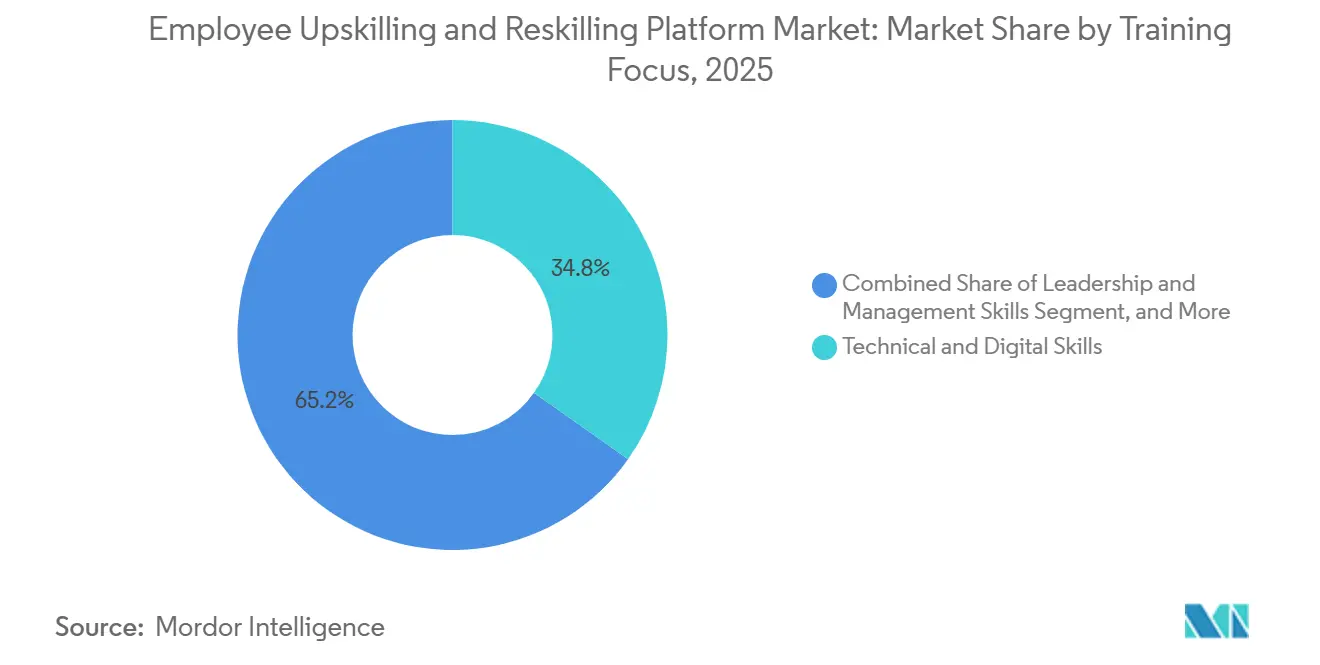
Digital Skills Anchor Revenue As Leadership Demand DeepensTechnical and Digital Skills held 34.81% of the employee upskilling and reskilling platform market share in 2025 and is projected to expand at a 12.81% CAGR through 2031. That position reflects how strongly enterprise budgets are being pulled toward AI operations, data literacy, and cybersecurity as core work continues to change. The World Economic Forum reported that AI and big data skills are among the fastest-rising priorities for employers, which supports continued spending on technical content libraries and assessments. Coursera’s Skill Tracks launch also showed that large platforms are organizing learning around role and proficiency needs in software, IT, data, and GenAI rather than only around broad course categories.
Leadership and Management Skills continue to build relevance as managers are asked to guide teams through technology change, shifting workflows, and more distributed operating models. The World Economic Forum’s skills outlook still ranks analytical thinking, resilience, flexibility, leadership, and social influence among the key capability areas employers expect to prioritize, underscoring demand outside purely technical domains. Compliance and Regulatory Skills and Frontline and Operational Skills remain structurally important because their learning budgets are more closely tied to procedures, audits, and role execution than to discretionary development goals. The employee upskilling and reskilling platform market, therefore, continues to reward vendors that can support both fast-changing digital content and more durable operational training needs within the same environment.

By Deployment Mode:
Hybrid Deployments Accelerate Enterprise AdoptionCloud-based delivery accounted for 68.42% of the employee upskilling and reskilling platform market size in 2025, while hybrid deployment is projected to grow at a 13.22% CAGR through 2031. Cloud remains the default choice for many buyers because it lowers entry barriers, shortens deployment time, and supports centralized content management and AI-driven personalization. At the same time, the employee upskilling and reskilling platform market is seeing stronger demand for hybrid models as employers try to balance flexibility with tighter control over sensitive employee and skills data. This pattern is especially relevant in regulated settings where learning systems are increasingly connected to workforce records, performance systems, and governance processes.
Pluralsight’s 2026 rollout showed that deployment value now depends heavily on how easily a platform fits into established HR and talent architectures, rather than where it is hosted. Workflow-embedded learning through Slack, Microsoft Teams, Glean, and other enterprise tools also supports flexible architectures that can move content and signals across controlled environments. The employee upskilling and reskilling industry is therefore shifting from a simple cloud-versus-on-premises discussion to a broader question of interoperability, governance, and user continuity. Vendors that deliver a consistent experience across cloud and controlled environments are taking a larger share of regulated enterprise demand in the employee upskilling and reskilling platform market.
By End User Enterprise Size:
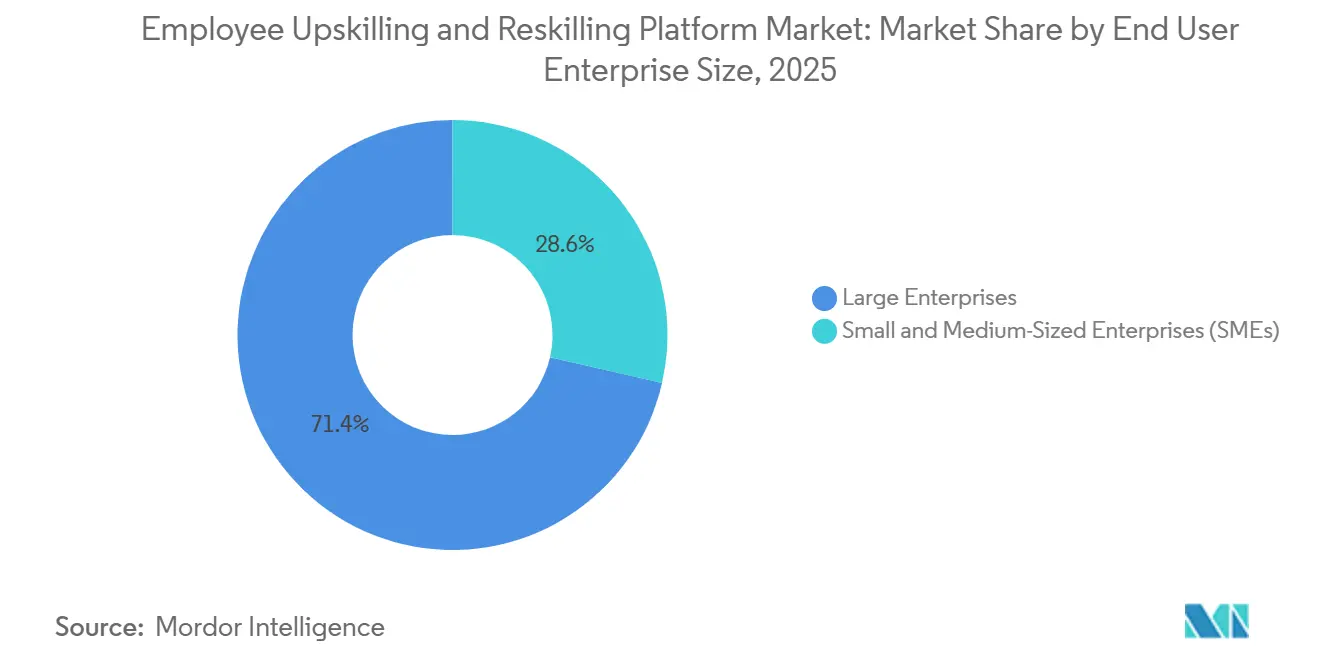
Large Enterprises Dominate, SMEs Gain MomentumLarge enterprises accounted for 71.42% of the employee upskilling and reskilling platform market size in 2025, while small and medium-sized enterprises are forecast to grow at a 12.61% CAGR through 2031. Large organizations still lead because they can support multi-year contracts, maintain dedicated learning teams, and absorb complex integration work across large employee bases. They are also pushing the employee upskilling and reskilling platform market beyond traditional LMS use cases by asking vendors to connect learning completion with skills intelligence, workforce planning, and internal mobility. That pressure helps explain why scaled providers are investing more heavily in analytics, skills inference, and interoperability than in content breadth alone.
SMEs are expanding faster because SaaS delivery and AI-assisted authoring reduce the cost and operating burden of rolling out structured learning. LearnUpon said the full integration of Courseau, now branded Create+, allows subject matter experts to build learning experiences up to 50 times faster, which is especially relevant for smaller employers with lean teams. Go1’s contextual learning model also points to rising demand for tools that fit daily workflows without requiring extensive design or administrative overhead. As barriers to setup and content production fall, the employee upskilling and reskilling industry is attracting a wider SME buyer base to structured digital learning.
By End User Industry Vertical:
Healthcare Investment Reshapes Vertical DynamicsIT and Telecommunications held 24.71% of the employee upskilling and reskilling platform market share in 2025, while healthcare and life sciences are projected to grow at a 13.52% CAGR through 2031. IT and telecom remain the largest verticals because rapid AI adoption, software development cycles, and cybersecurity exposure create constant pressure to renew technical skills. Healthcare is expanding faster because learning demand now extends beyond annual compliance refreshers and increasingly includes new digital tools, AI use governed by policy, documentation support, and workflow changes. The employee upskilling and reskilling platform market is therefore seeing stronger demand for vertical design in content, assessments, reporting, and skills mapping rather than generic learning libraries alone.
BFSI remains an important buyer group because training is closely tied to operating policy, risk control, and traceable completion records inside large institutions. Manufacturing and retail continue to create opportunities for microlearning and distributed training models because daily tasks change, requiring short, repeatable instruction at the point of work. Government and public-sector demand is growing more gradually because procurement cycles and data controls remain heavier than in many private-sector settings, even as digital workforce plans advance. Vendors with deeper vertical alignment are likely to outperform broad libraries when buyers need learning systems that reflect real roles, regulated processes, and workforce planning needs in the employee upskilling and reskilling platform market.
Geography Analysis
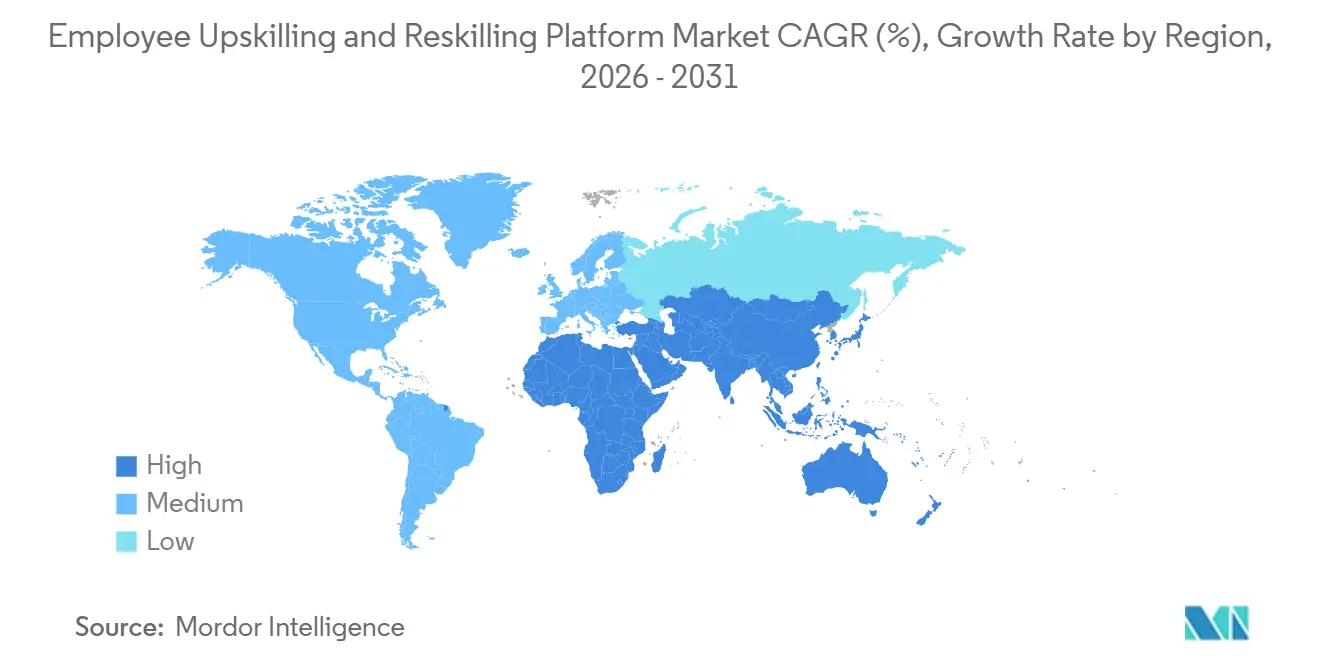
North America and Europe Employee Upskilling and Reskilling Platform Market
North America accounted for 38.91% of the employee upskilling and reskilling platform market size in 2025. The region benefits from mature enterprise software adoption, a large installed base of corporate learning tools, and the presence of several global platform vendors and content ecosystems. The United States remains the most influential country market because employers are dealing with frequent skill changes and higher expectations for AI readiness across both knowledge work and frontline roles. Europe has a different demand profile in the employee upskilling and reskilling platform market, as buyers place greater emphasis on governed learning records, role-based AI literacy, and tighter data-handling standards in enterprise environments.
APAC Employee Upskilling and Reskilling Platform Market
Asia-Pacific is projected to grow at a 14.11% CAGR through 2031, the fastest pace among regions. Japan stands out because the Ministry of Economy, Trade, and Industry has set a target of 2.3 million Digital Promotion Personnel by the end of FY2026 under its Society 5.0 direction, keeping digital workforce capability high on the policy agenda. Across the wider region, large labor pools and persistent digital skills gaps support scalable platform delivery more than instructor-led models alone can provide. The employee upskilling and reskilling platform market is also benefiting from public and private initiatives that keep structured learning aligned with national competitiveness and workforce transition goals. LearnUpon’s Sydney expansion, after an 80% increase in Asia-Pacific headcount over 2 years, shows that vendors are treating the region as a long-term growth priority rather than a secondary sales market.
South America and MEA Employee Upskilling and Reskilling Platform Market
South America, the Middle East, and Africa accounted for a smaller share of the employee upskilling and reskilling platform market in 2025, but they remain important growth markets for lighter digital learning models. In South America, cost sensitivity and uneven HR technology maturity make proof of ROI and simple deployment especially important for wider adoption. In the Middle East, more than 43% of tasks were expected to be delivered autonomously by 2030 in Saudi Arabia and the UAE, indicating strong workforce repositioning needs. Africa is still in earlier stages of development, but the Reskilling Revolution initiative has kept the region within broader accelerator and workforce transition programs that support long-term interest in scalable digital learning.
Competitive Landscape
Competitive Landscape
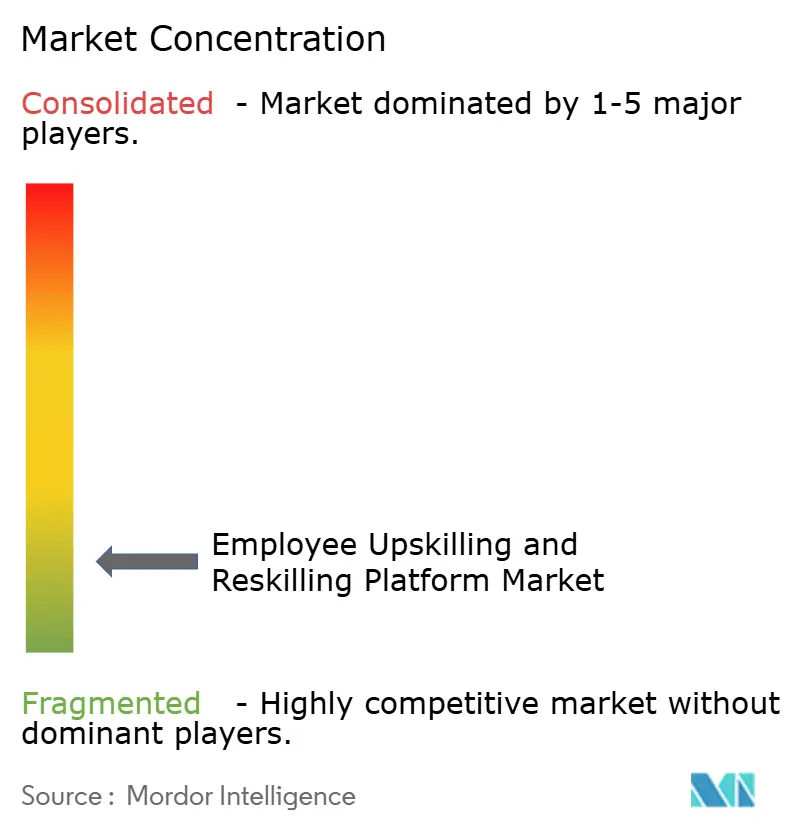
The employee upskilling and reskilling platform market remained moderately fragmented in 2025, with revenue still spread across mid-tier providers and niche specialists rather than being concentrated among a handful of vendors. The largest recent step toward consolidation came in May 2026 when Coursera completed its combination with Udemy, creating a platform with 290 million combined learners, 18,000 enterprise customers, projected annual revenue above USD 1.5 billion, and expected run-rate cost synergies of USD 115 million within 24 months. That move gives scale players stronger advantages in content amortization, customer reach, and skills-data accumulation across the employee upskilling and reskilling platform market. It also raises pressure on smaller vendors to compete through vertical depth, sharper workflow fit, or stronger interoperability rather than through catalog breadth alone.
Docebo’s January 2026 acquisition of 365Talents for USD 54.6 million demonstrated a second competitive path: building stronger skills intelligence and workforce analytics within the platform rather than simply adding more courses. Docebo said the combined offering would use continuous signals from work activity, experience, and learning to automate skills detection and remediation, directly addressing buyer demand for measurable workforce readiness. Pluralsight’s April 2026 launch followed a different route, pairing an expanded AI Sandbox with new enterprise integrations that more closely connect skill-building to existing HR and talent systems. 360Learning’s Workday and UKG integrations reinforced how strongly large-enterprise procurement now depends on clean data movement across workforce systems. Skillsoft’s AI-native skills intelligence platform and LX Design Studio also show that faster content creation and stronger skills visibility are becoming central points of competition in the employee upskilling and reskilling platform market.
White space remains strongest in regulated training, frontline enablement, and SME-focused platforms where broad enterprise suites do not always fit buyer needs. Go1’s workflow-embedded learning model and Schoox’s expanded content partnership illustrate the appeal of mobile-friendly, distributed formats for operational and frontline environments. LearnUpon’s regional expansion and Create+ authoring capability show that vendors are also addressing content bottlenecks and geographic white space simultaneously. Overall, the employee upskilling and reskilling platform market still offers room for specialized providers, even as larger vendors build advantage through M&A, AI-native design, and deeper enterprise integrations.
Employee Upskilling And Reskilling Platform Industry Leaders
-
Udemy, Inc.
-
Skillsoft Corp.
-
Docebo Inc.
-
Coursera, Inc.
-
D2L Inc.
- *Disclaimer: Major Players sorted in no particular order
Employee Upskilling And Reskilling Platform Market Companies Covered in this Report
- Coursera, Inc.
- Udemy, Inc.
- Degreed, Inc.
- Docebo Inc.
- Skillsoft Corp.
- D2L Inc.
- LearnUpon Limited
- Absorb Software Inc.
- Axonify Inc.
- OpenSesame Inc.
- 360Learning SA
- Litmos US, L.P.
- Go1 Pty Limited
- Valamis Group Oy
- Intellum, Inc.
- Fuse Universal Ltd.
- Thrive Learning Limited
- Rise To Limited, trading as Learn Amp
- Rallyware, Inc.
- Schoox, LLC
Recent Industry Developments in Employee Upskilling And Reskilling Platform Market
- May 2026: Pearson and Salesforce formed a multi-year partnership integrating Pearson’s Faethm, Credly, and assessment tools with Salesforce CRM to boost AI readiness, anticipate role needs, and validate skills with recognized credentials.
- May 2026: Coursera and Udemy completed their merger, creating a platform with 290 million learners, 18,000 enterprise customers, and projected revenues above USD 1.5 billion, with USD 115 million in expected cost synergies, positioning them as the leading, scaled player in AI-powered skills development.
- April 2026: Cognizant launched Skillspring™, an AI-native conversational learning platform using agent-driven tutoring, dynamic content, and real-time skills-to-role mapping to advance enterprise AI readiness.
- April 2026: Pluralsight rolled out an expanded AI Sandbox with models like ChatGPT 5-mini, Claude 4.5, and Llama 3.3, plus new integrations with Workday, Cornerstone, and SuccessFactors to embed skill verification into HR and talent workflows.
Global Employee Upskilling And Reskilling Platform Market Report Scope
The employee upskilling and reskilling platform market refers to digital solutions that enable organizations to continuously train, assess, and redeploy their workforce through AI-driven content, skills mapping, compliance tracking, and workflow integration. These platforms support enterprise agility by aligning learning with evolving job roles, regulatory needs, and long-term workforce transformation goals.
The Global Employee Upskilling and Reskilling Platform Market Report is segmented by Training Focus (Technical and Digital Skills, Leadership and Management Skills, Compliance and Regulatory Skills, Functional Business Skills, and Frontline and Operational Skills), Deployment Mode (Cloud-Based, On-Premises, amd Hybrid), Enterprise Size (Large Enterprises, and Small and Medium-Sized Enterprises), Industry Vertical (IT and Telecommunications, Banking Financial Services and Insurance, Healthcare and Life Sciences, Manufacturing, Retail and E-commerce, and Government and Public Sector), and Geography (North America, South America, Europe, Asia-Pacific, Middle East, and Africa). The Market Forecasts are Provided in Terms of Value (USD).
Segmentation Overview
| Technical and Digital Skills |
| Leadership and Management Skills |
| Compliance and Regulatory Skills |
| Functional Business Skills |
| Frontline and Operational Skills |
| Cloud-Based |
| On-Premises |
| Hybrid |
| Large Enterprises |
| Small and Medium-Sized Enterprises (SMEs) |
| IT and Telecommunications |
| BFSI |
| Healthcare and Life Sciences |
| Manufacturing |
| Retail and E-commerce |
| Government and Public Sector |
| North America | United States |
| Canada | |
| Mexico | |
| South America | Brazil |
| Argentina | |
| Chile | |
| Rest of South America | |
| Europe | Germany |
| United Kingdom | |
| France | |
| Italy | |
| Spain | |
| Rest of Europe | |
| Asia-Pacific | China |
| India | |
| Japan | |
| South Korea | |
| Australia and New Zealand | |
| Rest of Asia-Pacific | |
| Middle East | Saudi Arabia |
| United Arab Emirates | |
| Turkey | |
| Qatar | |
| Rest of Middle East | |
| Africa | South Africa |
| Egypt | |
| Nigeria | |
| Kenya | |
| Rest of Africa |
| By Training Focus | Technical and Digital Skills | |
| Leadership and Management Skills | ||
| Compliance and Regulatory Skills | ||
| Functional Business Skills | ||
| Frontline and Operational Skills | ||
| By Deployment Mode | Cloud-Based | |
| On-Premises | ||
| Hybrid | ||
| By End User Enterprise Size | Large Enterprises | |
| Small and Medium-Sized Enterprises (SMEs) | ||
| By End User Industry Vertical | IT and Telecommunications | |
| BFSI | ||
| Healthcare and Life Sciences | ||
| Manufacturing | ||
| Retail and E-commerce | ||
| Government and Public Sector | ||
| By Geography | North America | United States |
| Canada | ||
| Mexico | ||
| South America | Brazil | |
| Argentina | ||
| Chile | ||
| Rest of South America | ||
| Europe | Germany | |
| United Kingdom | ||
| France | ||
| Italy | ||
| Spain | ||
| Rest of Europe | ||
| Asia-Pacific | China | |
| India | ||
| Japan | ||
| South Korea | ||
| Australia and New Zealand | ||
| Rest of Asia-Pacific | ||
| Middle East | Saudi Arabia | |
| United Arab Emirates | ||
| Turkey | ||
| Qatar | ||
| Rest of Middle East | ||
| Africa | South Africa | |
| Egypt | ||
| Nigeria | ||
| Kenya | ||
| Rest of Africa | ||
Key Questions Answered in the Report
What is the current size of the employee upskilling and reskilling platform market?
The employee upskilling and reskilling platform market reached USD 57.12 billion in 2025 and is projected to reach USD 100.91 billion by 2031 at a CAGR of 10.24%.
Which training focus leads revenue growth?
Technical and Digital Skills led with 34.81% share in 2025 and is also the fastest-growing training focus with a 12.81% CAGR through 2031.
Why are enterprises investing more in these platforms now?
Demand is rising because AI is changing job requirements quickly, hybrid work has normalized digital learning, and companies want stronger skills visibility, verified assessments, and workflow integration.
Which deployment model is growing the fastest?
Hybrid deployment is growing the fastest at a 13.22% CAGR through 2031, even though cloud-based deployment remained the largest format with a 68.42% share in 2025.
Which industries are driving demand the most?
IT and Telecommunications held the largest vertical share at 24.71% in 2025, while Healthcare and Life Sciences is expected to grow the fastest at a 13.52% CAGR through 2031.
Which region offers the strongest growth outlook?
Asia-Pacific has the strongest regional growth outlook with a projected 14.11% CAGR through 2031, while North America remained the largest regional market with a 38.91% share in 2025.