
Electricity Retailing Market Size and Share
Market Overview
| Study Period | 2021 - 2031 |
|---|---|
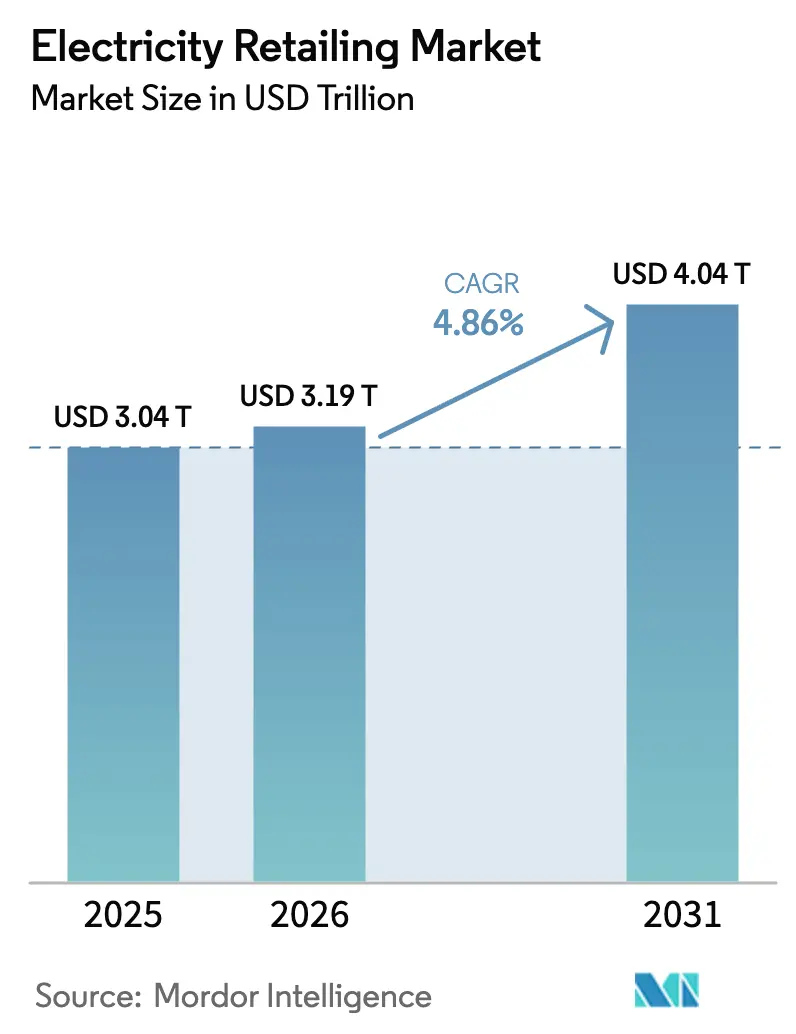
| Market Size (2026) | USD 3.19 Trillion |
| Market Size (2031) | USD 4.04 Trillion |
| Growth Rate (2026 - 2031) | 4.86 % |
| Fastest Growing Market | Asia Pacific |
| Largest Market | Asia Pacific |
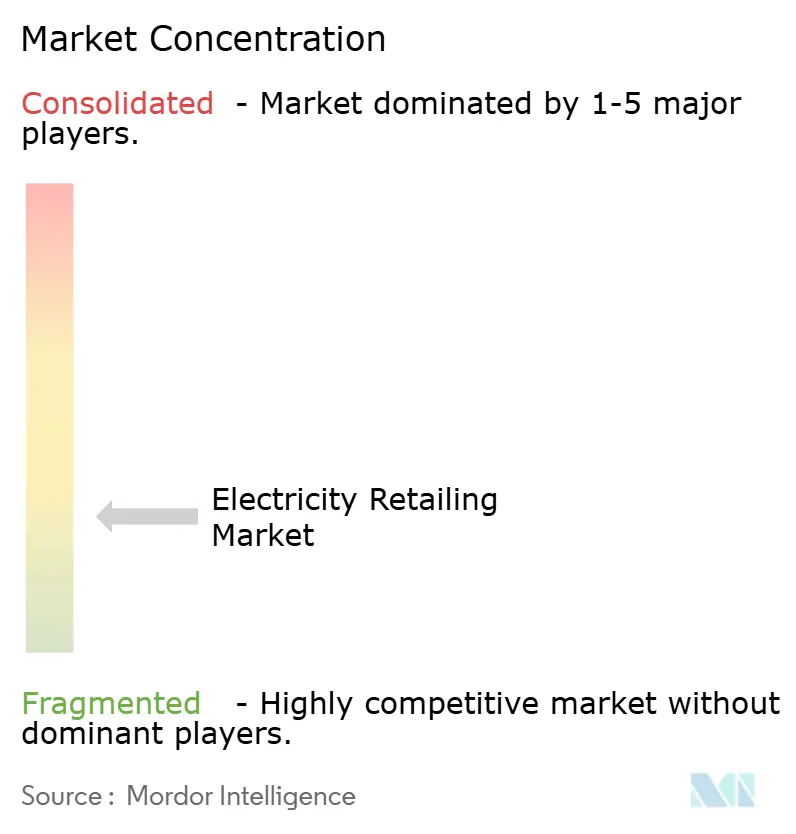
| Market Concentration | Low |
Major Players *Disclaimer: Major Players sorted in no particular order Image © Mordor Intelligence. Reuse requires attribution under CC BY 4.0. | |
Electricity Retailing Market Analysis by Mordor Intelligence
The Electricity Retailing Market size was valued at USD 3.04 trillion in 2025 and estimated to grow from USD 3.19 trillion in 2026 to reach USD 4.04 trillion by 2031, at a CAGR of 4.86% during the forecast period (2026-2031).
The continued electrification of transport, sustained investment in renewable-rich grids, and the accelerating digitalization of customer interfaces are expanding revenue pools for retailers worldwide. The Asia-Pacific region retained its leadership on the supply side, while data-center demand and rapid public-charging rollouts in North America and Europe created unprecedented load growth opportunities. Utilities that deployed advanced metering infrastructure captured granular consumption data, which underpinned new tariff innovations. At the same time, margin volatility intensified as regulators extended default tariffs to shield vulnerable customers and prosumers offset part of their demand through rooftop solar and batteries. Technology-enabled entrants exploited these cross-currents by offering bundled services, reshaping the competitive landscape of the electricity retailing market.
Key Report Takeaways
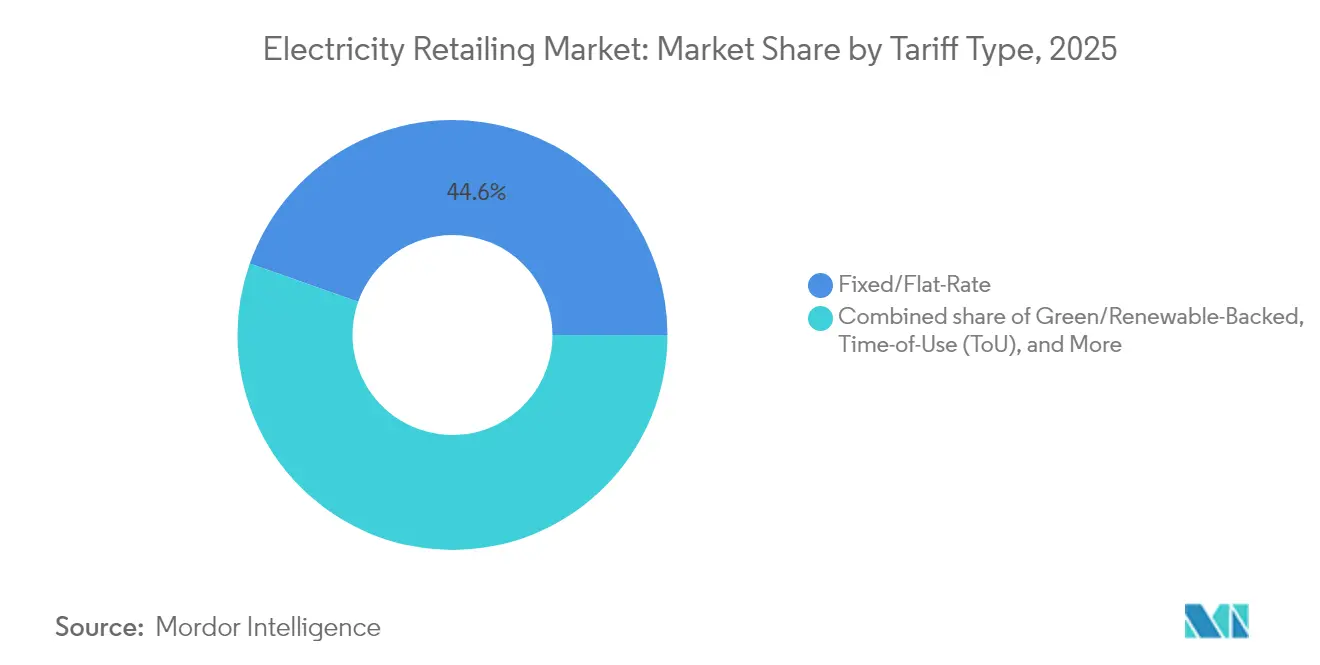
- By tariff type, fixed/flat-rate tariffs held 44.61% of the electricity retailing market share in 2025, while Green/Renewable-Backed tariffs are forecast to record a 7.38% CAGR through 2031.
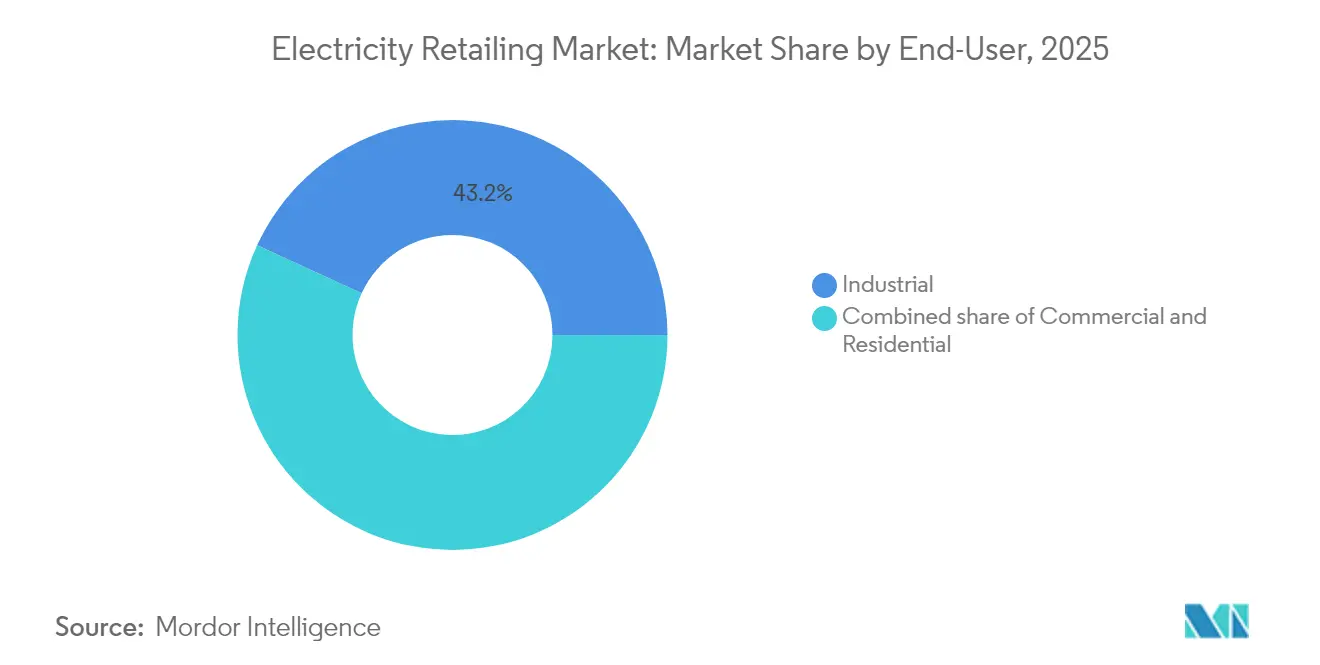
- By end-user industrial segment accounted for 43.15% of the electricity retailing market size in 2025; the commercial segment is projected to advance at a 5.92% CAGR through 2031.
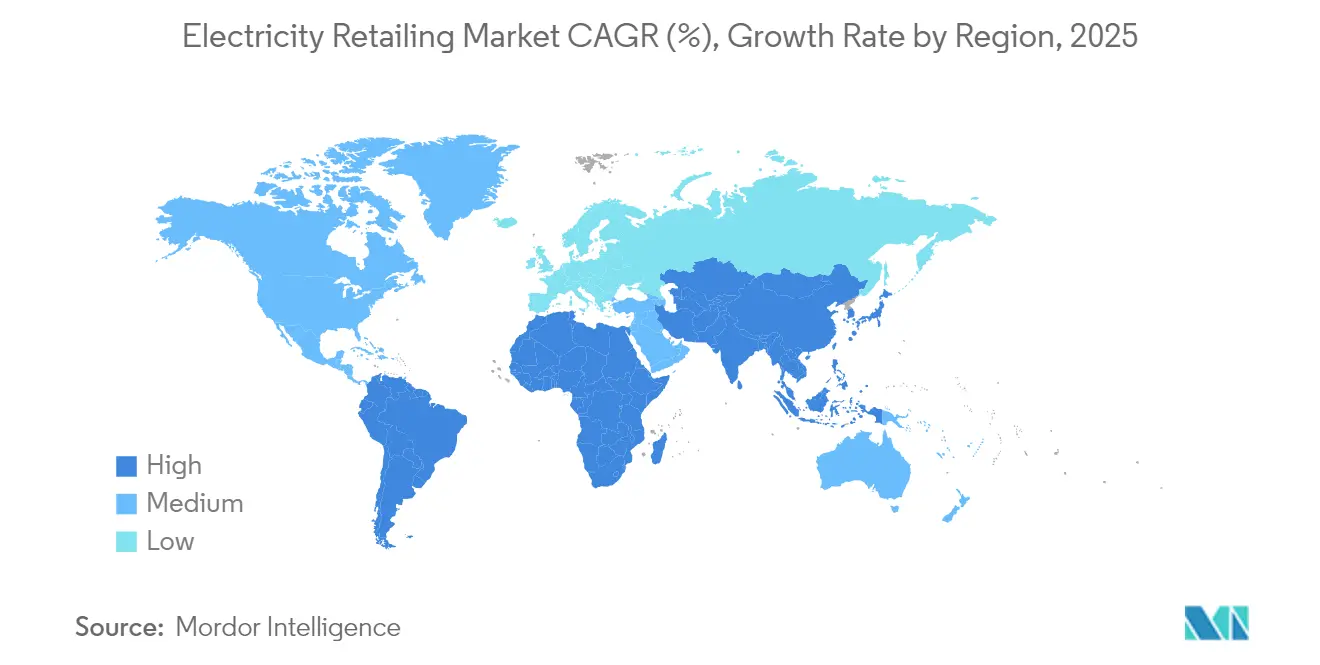
- By geography, the Asia-Pacific region commanded a 46.02% revenue share of the electricity retailing market in 2025 and is poised for a 5.72% CAGR during the forecast period.
- Six legacy suppliers controlled 91% of the United Kingdom’s retail volumes in 2024, reflecting an oligopolistic structure amid 23 licensed competitors.
- Microsoft’s 10.5 GW global renewable PPA with Brookfield was the largest single buyer contract signed to date, underscoring the corporate tilt toward 24/7 clean-energy supply.
Note: Market size and forecast figures in this report are generated using Mordor Intelligence’s proprietary estimation framework, updated with the latest available data and insights as of 2026.
Market Trends and Insights
Drivers Impact Analysis of Electricity Retailing Market*
| Driver | (~) % Impact on CAGR Forecast | Geographic Relevance | Impact Timeline |
|---|---|---|---|
| Surging EV-charging load in urban grids | +1.20% | North America, Europe, China | Medium term (2-4 years) |
| Digitally enabled switching & price-comparison portals | +0.80% | Europe, North America, Australia | Short term (≤ 2 years) |
| Universal smart-meter roll-outs | +0.90% | Europe, Australia, Japan | Medium term (2-4 years) |
| Retailer entry into behind-the-meter BESS aggregation | +0.70% | North America, Australia, Germany | Long term (≥ 4 years) |
| Blockchain-based peer-to-peer energy trading pilots | +0.30% | Australia, Europe, select US states | Long term (≥ 4 years) |
| Corporate 24/7 renewable PPAs as retail products | +1.10% | North America, Europe, Global | Medium term (2-4 years) |
| Source: Mordor Intelligence | |||
Surging EV-Charging Load in Urban Grids
Electric vehicle uptake is reshaping urban demand curves, with California expected to have more than 2 million EVs on the road by 2025 and projections indicating 12.5 million units on the road by 2035. North American utilities reported capital expenditures for charging infrastructure in 2024 that nearly doubled the prior-year outlays, underscoring the scale of electrification momentum. Load flexibility programs are enabling data-center operators to curtail usage at peak times to secure interconnection, and pilot virtual power plant (VPP) projects in Texas have demonstrated 40% customer-bill savings when batteries are charged during low-price hours and then discharged during system peaks.(1)These initiatives highlight how the electricity retailing market is evolving toward bidirectional, service-rich models.
Digitally Enabled Switching & Price-Comparison Portals
Consumer access to real-time offers expanded rapidly; by 2025, 90% of UK households were aware of time-of-use tariffs, even though fewer than half were inclined to switch. Germany is legislating mandatory dynamic tariffs by 2025, creating space for algorithmic advisers that help end-users align their consumption with renewable output patterns. Retailers that built intuitive, app-based journeys achieved reduced churn while attracting digitally savvy customers, thereby accentuating platform competition across the electricity retailing market.
Universal Smart-Meter Roll-Outs (EU, AUS, JP)
Spain, Sweden, and Finland have already exceeded 95% meter penetration, whereas Germany and the UK are seeking to catch up after experiencing technical and privacy-related delays. Australia is committed to near-universal deployment by 2030, yet customer complaints about estimated billing climbed to 13% in the latest fiscal year. Smart-meter data now feeds demand response, vehicle-to-grid, and granular credit-risk analytics, forming a cornerstone for dynamic products in the electricity retailing market.
Retailer Entry into Behind-the-Meter BESS Aggregation
California increased installed battery storage in the CAISO footprint from 500 MW in 2020 to 11,200 MW by mid-2024, with half of this capacity co-located with solar generation. The Netherlands' TSO, TenneT, projected that up to 12.7 GW of batteries could be connected by 2030, reinforcing the revenue logic for aggregation services. Retailers are rolling out zero-up-front subscription offers that guarantee customers fixed-price energy sourced from on-site solar plus battery dispatch, a differentiator that is redefining customer value capture within the electricity retailing market.
Restraints Impact Analysis of Electricity Retailing Market*
| Restraint | (~) % Impact on CAGR Forecast | Geographic Relevance | Impact Timeline |
|---|---|---|---|
| Margin squeeze from regulated default tariffs & price caps | -1.80% | Europe, Australia, regulated US markets | Short term (≤ 2 years) |
| Load erosion from prosumer self-consumption | -1.10% | Australia, California, Germany, Spain | Medium term (2-4 years) |
| Credit-risk spike amid rising household energy debt | -0.70% | UK, Europe, select US states | Short term (≤ 2 years) |
| Grid-usage levies on retailers in high-RES markets | -0.90% | Germany, Australia, Denmark | Medium term (2-4 years) |
| Source: Mordor Intelligence | |||
Margin Squeeze from Regulated Default Tariffs & Price Caps
The Australian Default Market Offer for 2025-26 increased residential tariff ceilings by up to 8.9%, reflecting higher wholesale-cost pass-through while restricting retailer margin upside. German household prices averaged EUR 0.4519 per kWh in 2024, with more than half attributable to taxes and levies, thereby compressing the retailer differentiation potential. Similar interventions in South Korea saddled incumbent KEPCO with mounting debt, underscoring how policy objectives can distort the electricity retailing market’s risk-return profile.
Credit-Risk Spike Amid Rising Household Energy Debt
By late 2024, UK arrears exceeded GBP 2.9 billion, prompting suppliers to raise bad-debt provisions and tighten onboarding credit checks.(2) Continental Europe faced similar stress as Italy’s default-service arrears climbed 27% year-on-year despite government bill-relief schemes. Retailers are rolling out pre-pay options, installment plans, and targeted energy-efficiency advisory services to contain receivables risk. Fintech-style propensity-to-pay analytics, fed by smart meter data, are reducing disconnection events, although privacy concerns persist. Elevated debt costs compress working capital, reducing strategic headroom at a time when the electricity retailing market requires record investment in digital systems and customer acquisition.
*Our forecasts treat driver/restraint impacts as directional, not additive. The impact forecasts reflect baseline growth, mix effects, and variable interactions.
Electricity Retailing Market Segment Analysis
By Tariff Type:
Green Products Outpace Legacy PlansFixed/Flat-Rate plans maintained a 44.61% share in 2025 as households prioritised bill certainty amid price volatility. Green/Renewable-backed offers grew at a 7.38% CAGR, propelled by corporate supply chains seeking low-carbon Scope 2 footprints and consumers aligning their lifestyle choices with climate values. Spanish households on the regulated dynamic tariff saved 8-11% annually when shifting usage to solar-rich afternoon hours. Dynamic/Real-Time pricing, still niche, flourished where smart-meters covered virtually all endpoints, notably in Sweden and Finland. Subscription-style Energy-as-a-Service models, exemplified by ABB’s zero-capex battery bundle, represent the electricity retailing market’s shift from commodity sales to integrated solutions.
The competitive arena increasingly prizes digital engagement and behavioural insights. Retailers investing in AI-driven usage forecasting and gamified mobile dashboards report churn rates that are 40% lower than those of their peers. In deregulated US states, app-based brands have captured millennials by combining renewable offsets with cashback loyalty, reaffirming that customer experience, rather than tariff mechanics, drives differentiation across the electricity retailing industry.

By End-User:
Commercial Load AcceleratesIndustrial customers represented 43.15% of 2025 volumes; however, hyperscale data center growth propelled the Commercial segment to a 5.92% CAGR outlook, potentially risking local grid-capacity bottlenecks in Virginia, Ohio, and Frankfurt. Retailers supplying these campuses increasingly negotiate capacity-reservation charges and curtailment clauses to manage 24/7 operations. Residential electrification through heat pumps and vehicle charging is steady but constrained by upfront appliance costs.
Commercial buyers also pioneer 24/7 PPAs and behind-the-meter batteries, unlocking ancillary-service revenues that offset retail rates. Simultaneously, industrial process electrification—from steel hydrogen furnaces to semiconductor fabs—could add 120 TWh to the 2030 baseline demand in the Asia-Pacific alone, diluting the Industrial segment’s historical volatility and enhancing the electricity retailing market’s resilience to macroeconomic cycles.
Geography Analysis
APAC Electricity Retailing Market
Asia-Pacific led with 46.02% share and a 5.72% CAGR outlook, undergirded by Guangdong’s 650 billion kWh provincial exchange and India’s renewable buildout pipeline exceeding 70 GW. Widening wholesale-retail spreads in Japan and South Korea attract fintech-enabled entrants despite tariff-cap uncertainties.
Europe Electricity Retailing Market
Europe grappled with structurally high taxes and levies that comprised 54% of German household bills in 2024; however, advanced grid digitalization offers a platform for dynamic pricing and demand response. Nordic retailers leverage near-100% smart-meter coverage to market hourly green certificates, illustrating how innovation offsets regulatory drag.
North America Electricity Retailing Market
North America experienced unprecedented commercial load requests—Xcel Energy alone reviewed 6.7 GW of data center interconnection proposals—while abundant gas and accelerating renewables cushioned wholesale cost spikes. State-by-state regulation produces a mosaic of risk-return profiles, but healthy liquidity and sophisticated hedging underpin a robust electricity retailing market size for investors.
Regulatory Landscape
Electricity retailing remains shaped by country-level market design, with a persistent tension between consumer-protection measures (default tariffs, price caps, arrears management) and the need to enable flexibility, digital switching, and new service revenues. In Australia, reform discussions spanning consumer energy protections and reliability settings have drawn active participation from retailers such as AGL alongside DCCEEW, the Australian Energy Market Commission (AEMC), and the Essential Services Commission (ESC). The 2025-26 Default Market Offer also acts as a visible benchmark that constrains headline pricing in parts of the National Electricity Market.
In Europe and China, policy shifts are also changing procurement and participation rules. France moved into a post-ARENH framework from January 1, 2026, with the CRE overseeing the transition toward the VNU scheme and Nuclear Production Allocation Contracts (CAPN). This changes how retailers secure supply and manage wholesale exposure. In China, central guidance issued in March 2026 to unify national electricity market rules and strengthen governance, alongside work on a 2026 Electricity Law revision, formalizes independent energy storage as a market participant and clarifies access to ancillary services. This supports broader competition and new retail-linked flexibility offerings, while tightening oversight of cross-provincial pricing and interventions.
Competitive Landscape
The electricity retailing market features moderate concentration. Legacy incumbents dominate meter-point counts in Japan, Germany, and parts of the US; yet, digital challengers now capture a growing share of switchers in deregulated zones. Iberdrola has earmarked EUR 41 billion through 2026 for network reinforcement and renewables, while Duke Energy’s USD 83 billion 2025-2029 capital expenditure plan targets grid modernization—moves that defend incumbent scale advantages.
Platform-centric newcomers deploy AI-based tariff selection, micro-PPA aggregation, and real-time carbon tracking. UK data show that six large suppliers still controlled 91% of residential accounts in 2024, but app-only suppliers grew their customer bases by 35% year-on-year, underscoring the latent churn potential. M&A remains selective: Eni Gas e Luce’s purchase of Aldro Energía granted immediate Iberian beachhead access without organic license hurdles.
Technology capabilities now outweigh pure buying power. Sonnen’s Texas VPP monetises FERC Order 2222 market access for aggregated residential batteries, whereas ABB’s BESS-as-a-Service removes capital constraints for SMEs. Coupled with blockchain pilots and peer-to-peer initiatives, these models signal a shift from tariff competition to platform ecosystems, a defining trajectory for the electricity retailing market.
Electricity Retailing Industry Leaders
-
AGL Energy Ltd.
-
China Huadian Corporation LTD. (CHD)
-
Electricite de France SA.
-
Engie SA
-
Duke Energy Corporation
- *Disclaimer: Major Players sorted in no particular order
Electricity Retailing Market Companies Covered in this Report
- State Grid Corporation of China
- Enel S.p.A.
- Electricite de France (EDF)
- E.ON SE
- Iberdrola SA
- Engie SA
- Duke Energy Corp.
- Southern Company
- Xcel Energy
- AGL Energy Ltd.
- Origin Energy
- NRG Energy Inc.
- NextEra Energy
- KEPCO
- China Huadian Corp.
- Tata Power
- CLP Holdings
- Octopus Energy
- EnBW
- Fortum Oyj
Market Opportunities and Future Outlook
Retailers have whitespace to monetize flexibility and low-carbon procurement as regulation and technology broaden who can participate in power markets. The planned 2026 revision of China’s Electricity Law, which formalizes independent energy storage as a market participant and sets criteria for foreign-invested participation in ancillary services, supports new retail propositions that bundle supply with behind-the-meter storage, demand response, and aggregation services, particularly in provinces where cross-provincial pricing and market rules are being unified. Separate program evidence also points to a growing project and retrofit pipeline: China Huadian has highlighted energy-saving and emissions-reduction actions and referenced a large set of generating-unit retrofits, alongside investments in hydrogen electrolysis and hybrid energy storage projects. That widens the addressable base for retailers and aggregators seeking dispatchable clean products and flexibility-backed tariffs.
In Europe, the post-ARENH transition in France from January 1, 2026, creates procurement-driven product redesign opportunities as retailers rely more on wholesale sourcing and own-generation strategies under the new framework overseen by the CRE. This supports differentiated offers for commercial customers seeking around-the-clock clean supply, building on observed momentum for corporate PPAs (for example, Microsoft’s 10.5 GW global renewable PPA with Brookfield). In mature retail markets facing bill stress and tighter default tariffs, smart-meter enabled credit-risk analytics and structured payment products (prepay, installments) also create an identifiable service opportunity that targets elevated arrears while reducing churn and bad-debt costs.
Recent Industry Developments in Electricity Retailing Market
- July 2026: China Huadian Corporation Ltd. announced that a 4x50-megawatt wind power plant in Dak Lak province, Vietnam, reaches full-capacity commercial operation. The launch expands Southeast Asia renewable generation capacity and improves regional supply mix and grid integration with new wind assets.
- June 2026: EDF signed strategic energy agreements with the Sultanate of Oman for renewable energy and energy storage projects, including Al Kamil Solar PV IPP and Wadi Dayqah pumped-storage. The agreements diversify EDF's Middle East renewables portfolio and storage stack, advancing EDF’s diversification and project pipeline in high-growth markets.
- May 2026: AGL Energy Ltd. updated FY26 guidance at Macquarie Australia conference; underlying EBIT guidance narrowed to 2.06 - 2.18 billion AUD; underlying NPAT guidance raised to 610 - 680 million AUD. The updated guidance signals asset mix optimization and earnings stability in a transitioning market.
Electricity Retailing Market Report Scope and Research Methodology
Market Definition and Coverage
For this study, the electricity retailing market is the value of electricity sold by retailers to end users through regulated and deregulated channels, measured as retail electricity revenue in USD across major economies.
Scope exclusions: We exclude wholesale power trading, transmission and distribution network asset revenues, and pure metering or billing software that is not bundled into the electricity supply charge.
Segments Covered in This Report
- By Tariff Type
- Fixed/Flat-Rate
- Time-of-Use (ToU)
- Dynamic/Real-Time
- Green/Renewable-Backed
- Subscription-Based (EaaS)
- By End-User
- Residential
- Commercial
- Industrial
- By Geography
- North America
- United States
- Canada
- Mexico
- Europe
- Germany
- United Kingdom
- France
- Italy
- NORDIC Countries
- Russia
- Rest of Europe
- Asia-Pacific
- China
- India
- Japan
- South Korea
- ASEAN Countries
- Rest of Asia-Pacific
- South America
- Brazil
- Argentina
- Rest of South America
- Middle East and Africa
- Saudi Arabia
- United Arab Emirates
- South Africa
- Egypt
- Rest of Middle East and Africa
- North America
Data Sources, Market Sizing, and Validation
Desk Research
Desk research set the factual base for consumption, pricing, and policy context before we built the model. We leaned on public energy statistics and price series such as those from the International Energy Agency, the US Energy Information Administration, Eurostat, and national energy regulators that publish tariff orders and retail price components.
To keep the numbers comparable across countries, we also reviewed sources such as audited utility annual reports, stock exchange filings, investor presentations, and official grid and market operator publications. In a few places, subscription tools for company financials, news, and import and export checks were used to speed up cross verification and to track corporate actions that can shift retail revenue reporting. The desk research sources listed here are illustrative only, and many other public datasets and documents were also used for data collection, validation, and research clarification.
Primary Interviews and Surveys
Primary work was used to test the key assumptions that drive retail revenue, especially how retail tariffs are formed and how much of the final bill is treated as energy supply versus pass through items. We spoke with a mix of retailer and utility leaders, regulatory specialists, and large customer energy managers across APAC, EMEA, and the Americas so gaps from desk findings could be closed and the totals could be reconciled to real procurement and billing practices.
Distribution of primary research fieldwork respondents
| Company type | Respondent position | Region |
|---|---|---|
| Top tier: 25% | CXOs: 12% | APAC: 43% |
| Mid tier: 57% | Functional/Unit leaders: 42% | EMEA: 33% |
| Smaller Players: 18% | Managers: 46% | Americas: 24% |
Market-Sizing & Forecasting
We sized the market using a top-down demand pool build up, where country level electricity consumption by end users is converted into value using retail price per kWh series, and then adjusted for known tax and levy treatment in the bill. The totals were then checked using selective bottom-up approximations, mainly retailer revenue roll ups in sampled countries, channel checks on regulated tariff filings, and sampled (kWh x average bill rate) calculations so the scale stays realistic.
The model uses a small set of repeatable inputs that can be sourced and refreshed, such as total electricity consumption (TWh), shifts in customer mix across residential, commercial, and industrial loads, retail price movements by tariff type, inflation and fuel pass through behavior, and deregulation progress that changes how supply margins are captured. Where a country has gaps in public price series or has complex bill structures, proxy price logic from comparable markets was applied and then the implied revenue was rechecked against reported utility retail segments.
For forecasting, we applied scenario analysis supported by a light multivariate regression on consumption growth and retail price drivers, and then the outcomes were stress tested with primary feedback on expected tariff revisions, subsidy rollbacks, and renewable procurement impacts on delivered prices. This keeps the forecast tied to a few real levers, and it also helps us handle periods when tariff caps or one time bill credits distort reported averages.
Data Validation & Update Cycle
Validation was done in steps so that large variances were caught early. We compared outputs against independent signals like national retail price publications, regulator tariff schedules, and reported utility retail revenue splits, and then we revisited any country that showed abnormal revenue per kWh versus its peers.
Before sign off, the model goes through multi analyst reviews where assumptions are challenged, and we re contact sources if a tariff change, currency swing, or reporting restatement materially affects the time series. Reports refresh annually with interim updates for material events, and a final pre delivery pass is completed so clients receive the latest updated view.
Mordor Intelligence's Electricity Retailing Market Size Versus Other Published Estimates
Published market sizes for electricity retailing often do not match because the line between energy supply revenue and pass through charges is treated differently across countries, and some publishers anchor on different base years. Currency timing also matters since retail power bills and national statistics can be reported at different cutoffs, which then shifts the USD conversion.
In our refresh cycle, retail price per kWh series and tariff updates are rechecked close to the base year, and implied revenue per kWh is validated back to consumption totals and bill components, which is why the USD 3.19 T (2026) value shown by Mordor Intelligence can differ from estimates that use older average price windows or blended tax treatments.
Benchmark comparison
| Source | Market Size | Gaps in Research Methodology |
|---|---|---|
| Mordor Intelligence | USD 3.19 T (2026) | |
| Industry Almanac A | USD 3.01 T (2024) | Values net end user consumption using average annual retail prices per kWh that include taxes and levies, and the earlier year can miss later tariff resets and true ups. |
| Newswire Summary B | USD 4.38 T (2029) | Uses a fixed CAGR from a 2022 starting point with limited visibility on how tariff components, price caps, and currency conversion dates are refreshed through volatile pricing periods. |
The spread is mostly explained by year alignment and by whether taxes, levies, and regulated pass through items are folded into the same revenue line. When the value is rebuilt from consumption and refreshed retail price series, the result is easier to reproduce and easier to update as policies and tariffs shift.
Key Questions Answered in the Report
How large is global electricity retail revenue today?
The electricity retailing market size reached USD 3.19 trillion in 2026 and is projected to climb to USD 4.04 trillion by 2031.
Which tariff category grows the fastest toward 2031?
Green/Renewable-Backed plans chart a 7.38% CAGR thanks to corporate sustainability mandates and consumer climate awareness.
Why are commercial loads expanding more quickly than industrial loads?
Hyperscale datacentres and AI compute clusters boost commercial demand, driving a 5.92% CAGR versus slower industrial growth.
What role do smart meters play in retailer strategy?
Near-real-time data enable dynamic pricing, demand response, and credit analytics, underpinning new service models.
How are retailers addressing customer energy debt?
Suppliers are deploying pre-pay options, installments, and data-driven risk scoring to temper rising arrears.
Which region leads market share and growth?
Asia-Pacific holds 46.02% share and a 5.72% CAGR outlook, propelled by large-scale electrification and renewables investment.