Electric Vehicles Market Analysis by Mordor Intelligence
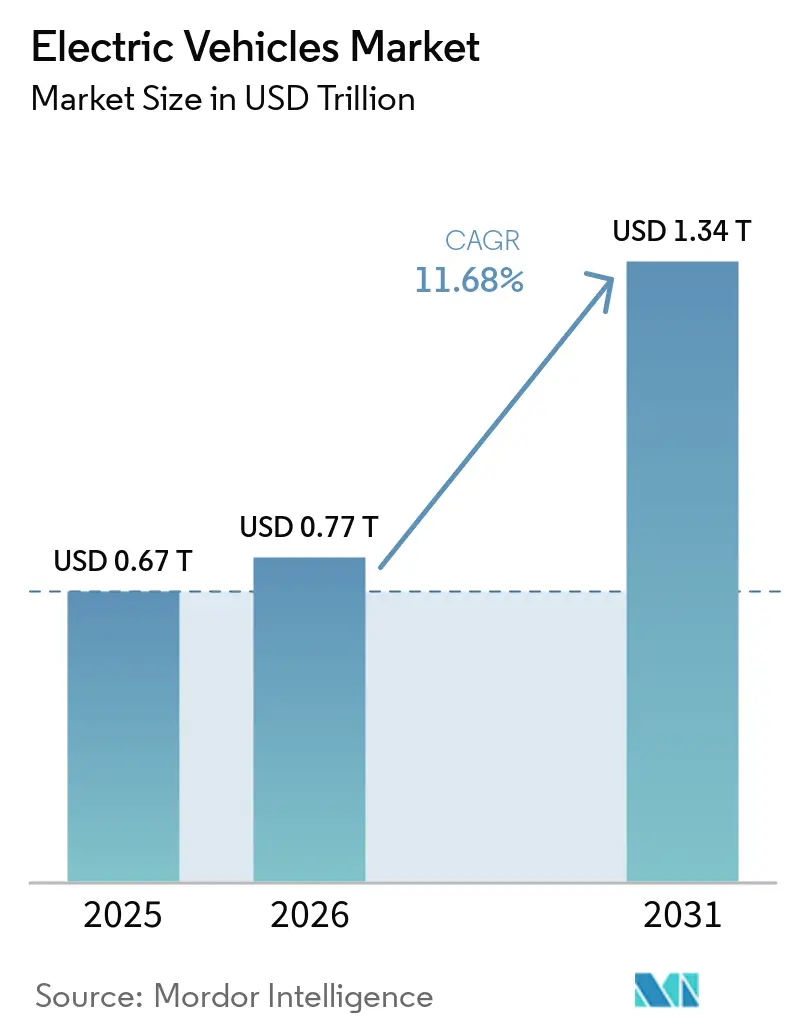
The electric vehicles market size is estimated at USD 0.77 trillion in 2026 and is projected to be USD 0.86 trillion in 2027, reaching USD 1.46 trillion by 2032, growing at a CAGR of 11.2% from 2027 to 2032. The market volume is estimated at 22.22 million units in 2026 and is projected to be 25 million units in 2027, reaching 45.05 million units by 2032, growing at a CAGR of 12.5% from 2027 to 2032.
Falling pack prices widen automakers’ pricing options, while China’s efficiency requirements favor more efficient vehicle designs. Corporate fleet procurement extends demand into vans and freight trucks, whose adoption depends on route charging. Manufacturers can address these applications through commercial-vehicle formats and in-house electric-drive production. Grid queues can delay charging sites, while mineral-price shocks can raise vehicle prices, limiting how quickly lower pack costs reach buyers.
Key Report Takeaways
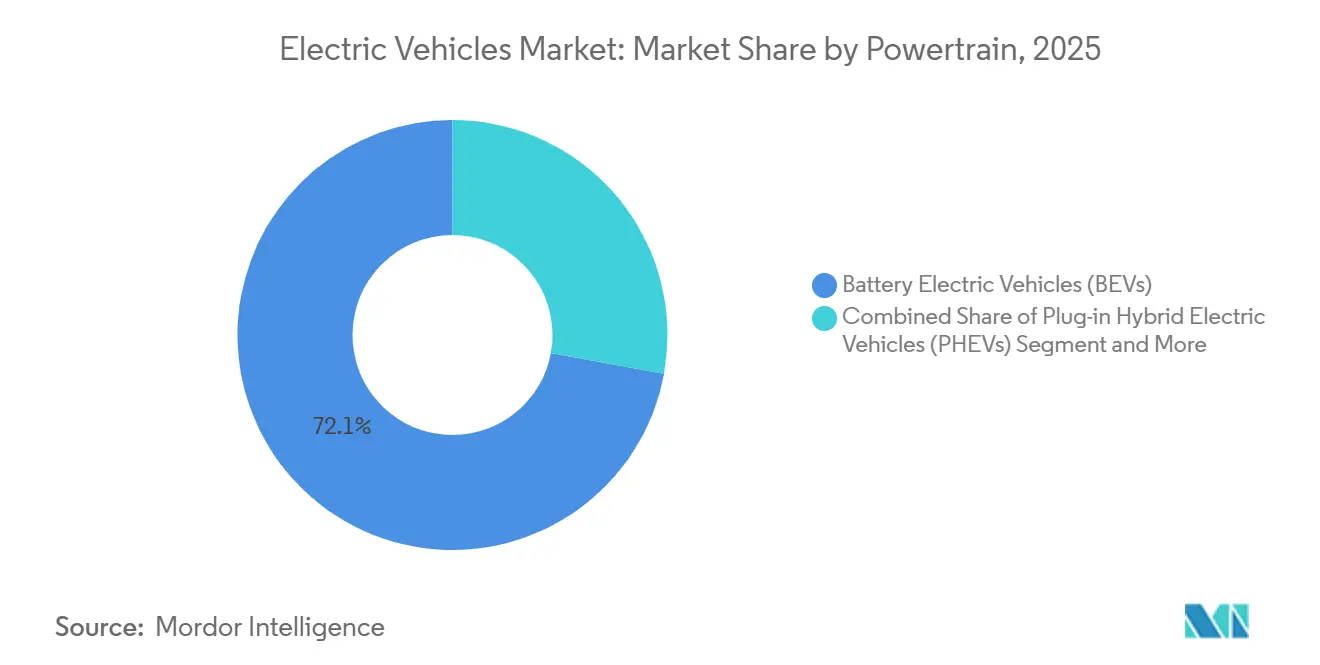
- By powertrain, battery electric vehicles (BEVs) led with a 73.2% electric vehicles market share in 2026 and are forecast to be the fastest-growing segment, with a CAGR of 12.9% from 2027 to 2032.
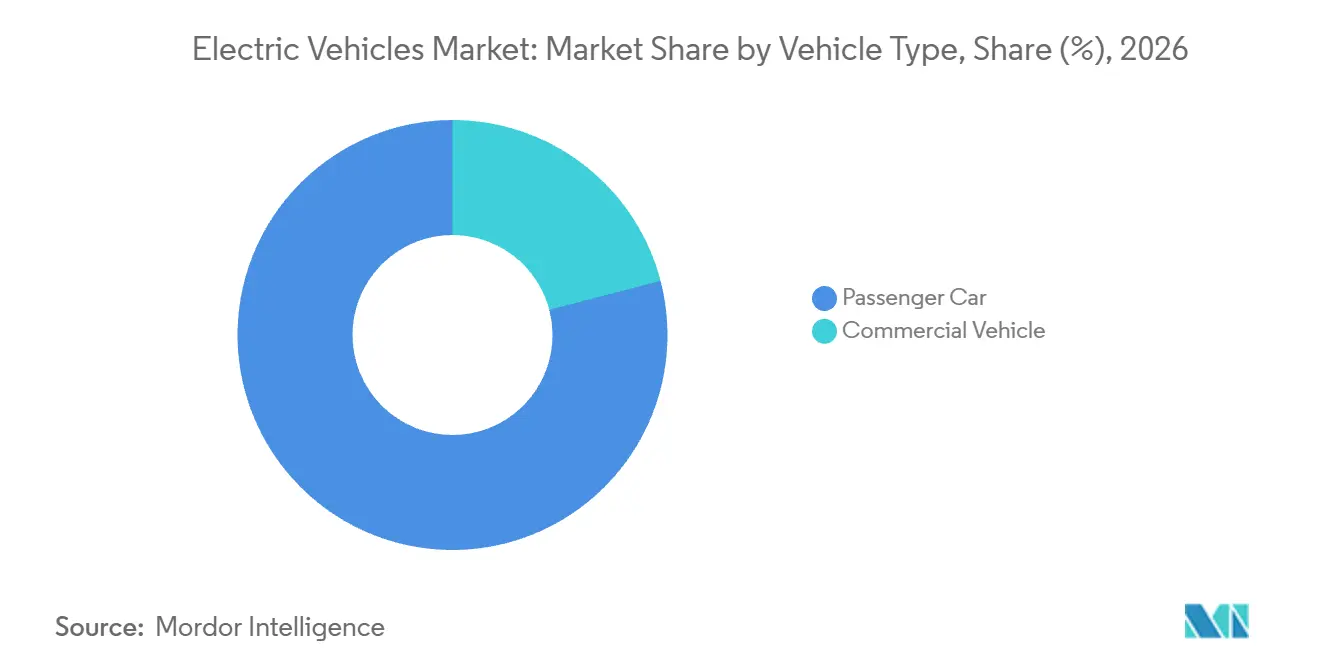
- Passenger cars led vehicle types with a 79.05% share of the electric vehicles market size in 2026, while commercial vehicles are projected to grow fastest at a CAGR of 12.5% from 2027 to 2032.
- Among battery chemistries, lithium nickel manganese cobalt oxide (NMC) led with 41.65% of new EV sales value in 2026, while lithium iron phosphate (LFP) is forecast to grow fastest at a CAGR of 14.2% from 2027 to 2032.
- In motor architecture, permanent-magnet synchronous motors (PMSM/IPM) led with a 68.13% share of new EV sales value in 2026, and this segment is projected to grow fastest at a CAGR of 12.8% from 2027 to 2032.
- By range, vehicles covering 200-400 kilometers led with a 40.61% share of new EV sales value in 2026, while those covering 400-600 kilometers are forecast to grow fastest at a CAGR of 12.2% from 2027 to 2032.
- Mid-voltage vehicles operating at 200-400 V led voltage classes with a 46.68% share of new EV sales value in 2026, while high-voltage vehicles operating at 400-800 V are projected to grow fastest at a CAGR of 14.2% from 2027 to 2032.
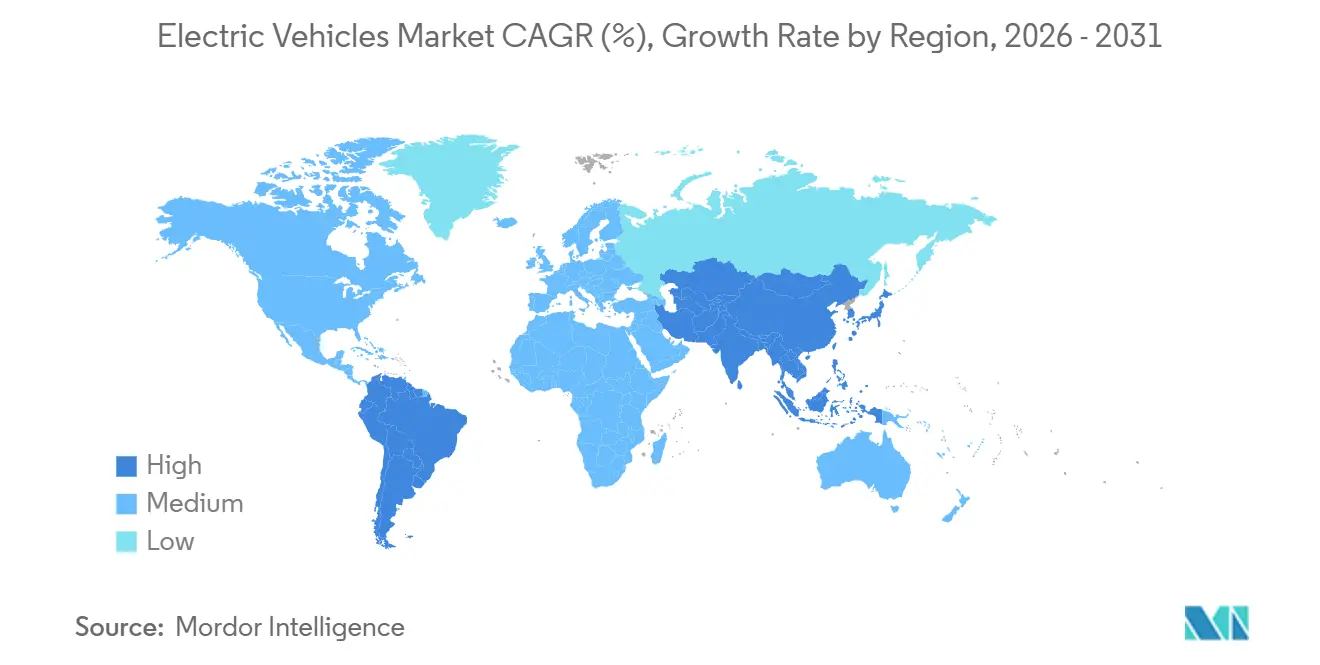
- Among regions, Asia-Pacific led with a 53.24% share of new EV sales value in 2026 and is forecast to be the fastest-growing region at a CAGR of 13.4% from 2027 to 2032.
Note: Market numbers in this report are based on Mordor Intelligence's proprietary estimation framework, which combines nine months of actuals with Q4 projections for base year 2026.
Market Trends and Insights
Drivers Impact Analysis of Electric Vehicles Market*
| Driver | (~) % Impact on CAGR Forecast | Geographic Relevance | Impact Timeline |
|---|---|---|---|
| Battery-Pack Cost Per kWh Keeps Falling | +4.5% | China, Europe and North America | Short term (≤ 2 years) |
| Ultra-Rapid (Above 350 kW) Charger Roll-Outs Along Freight Corridors | +3% | Europe’s Scandinavian-Mediterranean and North Sea-Baltic corridors | Medium term (2-4 years) |
| Tightening Fleet-Average Fuel-Consumption Standards in China and CO2 Standards in Europe | +4% | China and European Union member states | Medium term (2-4 years) |
| Corporate-Fleet Decarbonization Procurement Mandates | +2.5% | Austria, France, Germany, Italy and the United Kingdom | Short term (≤ 2 years) |
| Silicon-Anode Penetration Boosting Above 600 Km Segment | +0.8% | United States and European passenger-vehicle markets | Medium term (2-4 years) |
| Secondary-Use Battery Value-Chain Lowering TCO | +0.4% | Spain and India | Long term (≥ 4 years) |
| Source: Mordor Intelligence | |||
Battery-Pack Cost Per kWh Keeps Falling
Lower pack prices give automakers room to improve vehicle affordability without requiring an equivalent reduction in other manufacturing costs. BloombergNEF’s global average lithium-ion battery-pack price across multiple end uses fell 8% from 2024 to USD 108 per kWh in 2025. BEV packs averaged USD 99 per kWh in the 2025 survey, the lowest price within its transport segment. This was the second year BEV packs stayed below USD 100 per kWh. Manufacturers can use lower pack costs to fund cheaper vehicles or additional capacity, so model positioning determines whether buyers gain affordability or range.
Ultra-Rapid (Above 350 kW) Charger Roll-Outs Along Freight Corridors
Electric-truck adoption depends on charging coverage that supports routes beyond an operator’s own depot. In April 2026, the European Alternative Fuels Observatory (EAFO) recorded 373 operational heavy-duty charging locations, 2,405 recharging points and 1,225 stations across 21 European countries from data focused on sites meeting the 350 kW criterion.[2] This operating infrastructure gives truck buyers a more concrete basis for considering public charging within their route plans. On June 8, 2026, ministers from 9 EU member states endorsed charging roadmaps for zero-emission trucks along the Scandinavian-Mediterranean and North Sea-Baltic TEN-T corridors. Corridor coordination can complement site deployment by directing attention to the connections between logistics destinations. Operating charging coverage can consequently define which freight operators are practical customers for a manufacturer’s electric-truck offering.
Tightening Fleet-Average Fuel-Consumption Standards in China and CO2 Standards in Europe
Manufacturers face pressure to improve electric-vehicle efficiency as well as increase electrified sales. Published June 30, 2025, and effective January 1, 2026, China’s GB 27999-2025 sets 2026-2030 company-average passenger-car fuel-consumption requirements. The standard includes BEV and plug-in hybrid electric vehicle (PHEV) electricity use and tightens targets about 48% overall versus the prior version.[1] For 2025-2029, EU fleet-average CO₂ targets for new cars and vans are 15% below the 2021 baseline, with 2025-2027 compliance assessed across those 3 years. That flexibility allows individual-year shortfalls to be offset within the period without removing the reduction requirement. Together, these frameworks support electric-vehicle demand while giving manufacturers a reason to compete on energy efficiency alongside powertrain substitution.
Corporate-Fleet Decarbonization Procurement Mandates
Corporate fleet commitments can concentrate electric-vehicle demand into substantial, identifiable procurement programs. EV100 members deployed almost 24,000 electric vehicles in emerging markets during member-selected one-year reporting periods ending no later than October 2025. Those additions brought members’ cumulative deployment total since joining the initiative to approximately 70,000 vehicles. In June 2025, Amazon announced plans to add nearly 5,000 Mercedes-Benz electric vans across Austria, France, Germany, Italy and the United Kingdom. Such programs create opportunities for manufacturers to address a fleet operator’s vehicle requirements across several national operations. Winning a corporate fleet account can therefore provide a route into multiple countries through one transportation network, concentrating the commercial value of fleet-specific vehicle development.
Restraints Impact Analysis of Electric Vehicles Market*
| Restraint | (~) % Impact on CAGR Forecast | Geographic Relevance | Impact Timeline |
|---|---|---|---|
| Grid-Upgrade Bottlenecks at the Distribution Level | -1.7% | Congested areas in the Netherlands | Medium term (2-4 years) |
| Critical-Minerals (Li, Ni) Supply-Chain Concentration Risk | -1.2% | China and Indonesia | Medium term (2-4 years) |
| Warranty-Period Residual-Value Uncertainty in Emerging Markets | -0.7% | Emerging markets including India | Medium term (2-4 years) |
| Cyber-Security and OTA-Update Compliance Costs | -0.4% | European Union member states | Short term (≤ 2 years) |
| Source: Mordor Intelligence | |||
Grid-Upgrade Bottlenecks at the Distribution Level
Distribution-level congestion can constrain vehicle adoption by postponing the charging access needed to support it. TNO’s 2026 research reported a queue including public-charger connections in Laadwerk concession municipalities across North Holland, Utrecht and Flevoland. Amsterdam and the city of Utrecht organize their own concessions. Dutch priority rules applying from July 1, 2026, to new or upgraded connection requests in congested areas can place a hospital ahead of a charging-point applicant. Satellite chargers offer an alternative if new transport agreements cannot be arranged in time. Charging providers in congested areas therefore cannot schedule new public chargers independently of the network queue, so access to distribution capacity can constrain the charging provision needed for EV adoption.
Critical-Minerals (Li, Ni) Supply-Chain Concentration Risk
New refining output does not automatically give automakers a more geographically diverse battery-material supply base. China accounted for 70% of global lithium refining in 2026. Indonesia supplied virtually all global refined nickel supply growth from 2023 to 2025. In its 2026 modeling, the International Energy Agency (IEA) indicated that tripling battery-material prices would raise final prices for electric vehicles and storage systems by around 5%. That potential pass-through can constrain price-sensitive vehicle purchases even without a corresponding increase in assembly costs. Automakers therefore cannot rely on expanding mineral output alone to protect future vehicle affordability, because additional upstream supply can preserve geographic exposure and leave new-vehicle prices vulnerable to a battery-material shock.
*Our forecasts treat driver/restraint impacts as directional, not additive. The impact forecasts reflect baseline growth, mix effects, and variable interactions.
Electric Vehicles Market Segment Analysis
By Powertrain:
Battery-Electric Scale Broadens Across RegionsBattery electric vehicles (BEVs) accounted for a 73.2% share of the electric vehicles market size in 2026 and are the fastest-growing segment, with a forecast CAGR of 12.9% from 2027 to 2032. In Europe, BEVs’ portion of electric-car sales rose from 55% in 2020 to nearly 70% in 2025. The IEA linked that shift to emissions standards favoring zero-emission vehicles. BEVs represented 80% of electric-car sales in emerging and developing economies outside China in 2025, compared with 65% in major markets. That breadth makes a BEV development program relevant to both mature and emerging car buyers.
In Southeast Asia, BEVs represented more than 90% of electric-car sales in 2025. That mix gives manufacturers expanding there a strongly battery-electric starting point for vehicle-program decisions. Fuel cell electric vehicles have a distinct freight application in Hyundai Motor Company’s March 19, 2026, announcement of an 8-truck XCIENT deployment for the Kahirós timber-logistics project in Uruguay. The announced fleet ties truck supply to the project’s green-hydrogen infrastructure, creating an application-specific route for the supplier. Powertrain suppliers consequently face distinct commercial routes, from regional battery-electric car demand to the announced Uruguay deployment’s combined truck and hydrogen-infrastructure requirements.

By Vehicle Type:
Passenger Scale Meets Commercial Fleet ExpansionPassenger cars represented a 79.05% electric vehicles market share in 2026, making them the largest segment. The International Council on Clean Transportation (ICCT) reported over 20 million electric-vehicle sales globally in its 2025 light-duty coverage and said one in 4 cars sold worldwide was electric. China accounted for 71% of global EV production in that light-duty vehicle analysis. The combination of widespread adoption and concentrated manufacturing makes customer location and production location separate commercial decisions for a vehicle supplier. Passenger-car expansion can consequently reward manufacturers able to reach buyers across national markets.
Commercial vehicles are the fastest-growing segment, with a forecast CAGR of 12.5% from 2027 to 2032. Global electric medium- and heavy-freight trucks, including reclassified delivery vans weighing at least 3.5 metric tons, sold over 400,000 vehicles in 2025. That volume doubled from 2024 and represented 9% of truck sales worldwide. Electric light commercial vehicles, defined as weighing up to 3.5 metric tons, sold over 430,000 vehicles in 2025, up 45% year over year. The opportunity therefore spans lighter delivery vehicles and heavier freight applications, which calls for separate commercial programs around each operating workload.
By Battery Chemistry:
Vehicle Programs Anchor Chemistry ChoicesLithium nickel manganese cobalt oxide (NMC) was the largest segment, accounting for 41.65% of new EV sales value in 2026. In August 2026, LG Energy Solution Michigan-Lansing announced plans to produce NMC cells for Toyota battery electric vehicles. The intended applications include the 2027 Highlander EV, with vehicle assembly planned at Toyota Motor Manufacturing Kentucky in Georgetown. This connects the chemistry’s commercial opportunity to a named automaker’s vehicle-development program and planned assembly footprint. For NMC suppliers, access to such programs creates a route to future demand before retail sales begin.
Lithium iron phosphate (LFP) is the fastest-growing segment, with a forecast CAGR of 14.2% from 2027 to 2032. The IEA’s LFP grouping, including lithium iron manganese phosphate, exceeded 55% of battery capacity in new EVs registered globally in 2025, up from nearly 50% in 2024. Its analysis also linked uptake in emerging and developing economies outside China to imports of Chinese-manufactured vehicles and batteries. This creates routes for chemistry adoption through both complete vehicles and the battery supply chain. Imported vehicles and batteries therefore carry LFP into destination markets from Chinese production.
By Motor Architecture:
Industrial Scale Meets Specialized PerformancePermanent-magnet synchronous motors (PMSM/IPM) were the largest segment with a 68.13% share of new EV sales value in 2026 and are the fastest-growing segment, with a forecast CAGR of 12.8% from 2027 to 2032. By February 9, 2026, Volkswagen Group Components’ Kassel plant had produced 1 million APP550 electric drive units used in Volkswagen, Škoda and CUPRA vehicles. Volkswagen identifies the APP550 motor as a three-phase permanent-magnet synchronous design. The group reported around 20% lower energy use, around 75% more torque and around 40% more power than the predecessor drive system at the same dimensions. The package supports vehicle differentiation through efficiency and performance together.
A motor choice also creates a sourcing decision for the vehicle manufacturer. The Advanced Propulsion Centre UK (APC UK) attributes permanent-magnet designs’ automotive appeal to performance and efficiency, while identifying rare-earth sourcing as a supply-chain and geopolitical risk. That exposure makes sourcing resilience a separate decision from the performance characteristics favoring these designs. In June 2026, Mercedes-Benz began large-scale production of an electric axial-flux motor in Berlin-Marienfelde for the high-performance Mercedes-AMG GT 4-Door Coupe.[3] Specialized production programs such as the AMG GT 4-Door Coupe’s axial-flux motor give other architectures a commercial foothold in high-performance models.
By Range:
Rated Distance Defines Different Buyer RequirementsMid-range vehicles covering 200-400 kilometers were the largest segment, with a 40.61% share of new EV sales value in 2026. Within the 200-400 kilometer interval, a model near the lower boundary and one near the upper boundary address different distance requirements. For an operator whose route falls inside that interval, the choice turns on the model’s specific rated capability and the charging stops that route would require.
Long-range vehicles covering 400-600 kilometers are the fastest-growing segment, with a forecast CAGR of 12.2% from 2027 to 2032. By November 4, 2025, a small number of Mercedes-Benz eActros 600 trucks with a stated range above 500 kilometers were operating through Amazon’s carrier partners in its UK network. Daimler Truck’s own 500-kilometer rating for the eActros 600 comes from internal long-haul testing with a 4x2 tractor, a gross combination weight of 40 metric tons and an outside temperature of 20°C. Commercial viability in this class depends on matching the intended freight route to qualified range conditions.
By Voltage:
Established Platforms Meet Faster-Charging ArchitecturesMid-voltage vehicles operating at 200-400 V were the largest segment, with a 46.68% share of new EV sales value in 2026. Tesla’s Model Y manual gives a 345 V DC battery rating before about July 2025 and 350 V DC for 5-seat or 365 V DC for 6-seat versions afterward. China-made Model Y wholesale sales, including exports, totaled 538,994 vehicles in 2025, down 3.18% from 2024. Rated between 345 V and 365 V, a model of this wholesale scale illustrates the vehicle base behind the class’s lead, even though its 2025 total was lower than in 2024.
High-voltage vehicles operating at 400-800 V are the fastest-growing segment, with a forecast CAGR of 14.2% from 2027 to 2032. In 2025, Porsche reported Taycan charging from 10% to 80% state of charge in 18 minutes at suitable 800 V DC stations, at up to 320 kW, 50 kW above its predecessor. Ultra-high-voltage vehicles gained a distinct architecture when BYD launched its 1,000 V Super e-Platform on March 17, 2025, supporting megawatt flash charging. The commercial benefit depends on suitable charging access, tying vehicle differentiation to an operating network capable of realizing the stated charging performance.
Geography Analysis
Asia-Pacific Electric Vehicles Market
Asia-Pacific accounted for a 53.24% share of the electric vehicles market size in 2026 and is the fastest-growing region, with a forecast CAGR of 13.4% from 2027 to 2032. Southeast Asian electric-car sales more than doubled in 2025 to nearly 20% of car sales. Viet Nam, Indonesia and Thailand led that expansion, giving the regional opportunity several distinct national demand centers. In the first quarter of 2026, electric-car sales in Asia-Pacific excluding China grew 80% year over year. In the ICCT’s 2025 light-duty analysis, China accounted for approximately 62% of global EV sales and was the largest producer, anchoring regional demand and supply as growth outside China broadened the customer base.
Europe’s electric-car sales increased more than 30% in 2025 to 4.2 million, or 28% of new-car sales, with 1 million additional sales versus 2024. That penetration gives manufacturers a substantial addressable car-buying population. In North America, the United States recorded electric cars at just under 10% of car sales in 2025, and a year-end sales decline coincided with the end of federal EV tax credits. The US pattern makes demand timing a separate commercial risk from annual adoption depth, complicating a manufacturer’s allocation of vehicles across these 2 regions.
Country selection and powertrain selection create different entry decisions in South America and Middle-East and Africa, illustrated by Brazil, the United Arab Emirates and Morocco. Brazil registered 181,542 plug-in electric vehicles in 2025, comprising 101,364 plug-in hybrids and 80,178 battery-electric vehicles. Moroccan automaker Neo Motors began selling its first electric model in early 2026, adding a domestic supplier’s offering in an African country. Middle Eastern electric-car sales reached around 75,000 in 2025, up more than 40% year over year, with the United Arab Emirates accounting for almost half. Brazil’s mix makes powertrain breadth a concrete commercial consideration, while the UAE’s almost-half share of Middle Eastern sales gives one national market a large weight in regional entry plans.
Regulatory Framework and Outlook
The comparison assesses selected jurisdictions from the perspective of manufacturers of new electric vehicles weighing market access and compliance burdens. Germany’s EU framework sets a zero-emission fleet CO₂ target for new cars and vans from 2035. In December 2025, the European Commission proposed a 90% tailpipe-emissions reduction target from 2035, with the remaining 10% compensated through EU-made low-carbon steel or e-fuels and biofuels. The proposal would give manufacturers more compliance options while the existing regulation provides a clear zero-emission direction.
Regulatory Table of Electric Vehicles Market
| Decision factor | United States | Germany | China | Brazil | Saudi Arabia |
|---|---|---|---|---|---|
| Primary authority | Environmental Protection Agency | European Commission for EU fleet standards | Ministry of Industry and Information Technology and State Taxation Administration | Ministry of Development, Industry, Trade and Services | Saudi Standards, Metrology and Quality Organization |
| Key instruments or direction | February 2026 highway-vehicle GHG repeal | Regulation (EU) 2019/631 and proposed 2035 target revision | 2026-2027 tax-relief technical criteria and 2026 standards work plan | MOVER requirements from June 1, 2025 and cradle-to-grave carbon-footprint requirements scheduled from January 1, 2027 | EV Technical Regulation Version 3 and completed 2026 consultation on proposed CISPR 36:2023 adoption |
| Commercial effect | Future GHG measurement, control and reporting duties ended; traditional air-pollutant rules continue | Manufacturer-specific fleet CO₂ compliance for new cars and vans | Listed-model tax relief requires energy-use criteria and PHEV conditional equivalent all-electric range of at least 100 kilometers | Manufacturers and importers register energy-efficiency, including well-to-wheel CO₂e, and recyclability commitments for new vehicles | M- and N-category EVs designed to exceed 25 kilometers per hour require supplier conformity |
| Current policy attractiveness | High | High | Medium | Medium | Medium |
| Future direction of policy attractiveness | No change | Easing | Hardening | Hardening | No change |
| Source: Mordor Intelligence | |||||
The United States rates High with No change because the final GHG repeal removes future duties while traditional air-pollutant rules continue. Germany’s High rating reflects a clear fleet-compliance framework, and the proposed 2035 flexibility supports an Easing direction. China’s 2026-2027 tax-relief criteria and tighter company-average fuel-consumption targets under GB 27999-2025, effective January 1, 2026, support Medium and Hardening, as do Brazil’s mandatory requirements and scheduled January 2027 carbon-footprint duties. Saudi Arabia’s EV Technical Regulation Version 3 supports Medium, while the July 6, 2026, close of consultation on proposed CISPR 36:2023 leaves the operative conformity framework as the basis for No change.
Value Chain Stages
The comparison follows value capture from lithium processing through battery-cell supply to integration into complete vehicles. By July 2026, CATL had supplied NCM cells for Volkswagen’s MEB platform since 2018. Its cumulative deliveries to Volkswagen then exceeded 200 GWh across 45 models and 8 brands. That customer relationship illustrates how one upstream supplier can serve multiple vehicle programs, while the automaker captures the value of integrating components into a finished product.
Value Chain Analysis Table of Electric Vehicles Market
| Primary activity | Key participants | Value capture | Bottleneck | Resilience response |
|---|---|---|---|---|
| Lithium extraction and processing | Lithium resource and processing operators such as Albemarle | Lithium-product sales | Matching material grade to downstream cell processing | Qualify product grades for the intended cell process |
| Battery-cell manufacturing | Cell manufacturers such as CATL and Panasonic Energy | Battery-cell sales | Concentrated cell and active-material production | Qualify an additional regional cell source and its material supply |
| Electric-drive and complete-vehicle integration | Integrated automakers such as Volkswagen AG, through Volkswagen Group Components | Complete-vehicle sales incorporating internally produced drives | Coordinating cell supply with drive and vehicle integration | Link vehicle ramp-up to qualified subsystem readiness |
| Source: Mordor Intelligence | ||||
China accounted for over 80% of global battery-cell production in 2025, while active-material and precursor capacity and expertise were also heavily concentrated there. Establishing cell production elsewhere therefore addresses only part of the supply-chain exposure when upstream materials share the same geographic exposure. The structural opportunity is to connect qualified material alternatives with cell manufacturing and vehicle integration, because a new assembly location alone does not diversify every stage supporting it.
Competitive Landscape
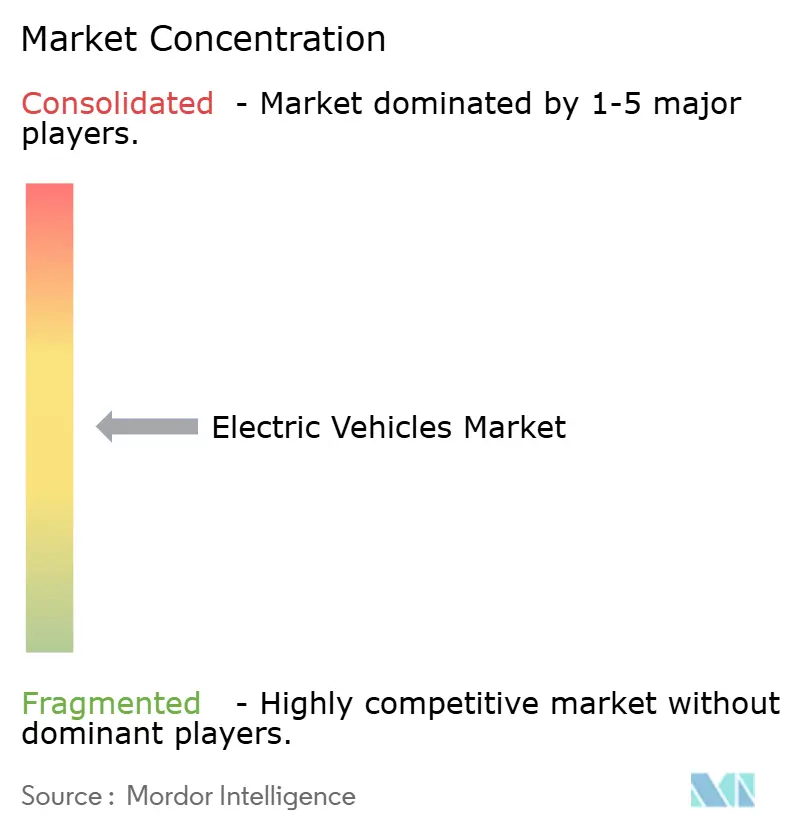
Competition is moderately concentrated, combining large vehicle groups and electric-vehicle specialists with different production structures and vehicle portfolios. Major participants include Stellantis N.V., Tesla Inc., Toyota Motor Corporation, Volkswagen AG and BYD Company Ltd. Tesla’s reported vehicle sales totaled 1,636,129 in 2025, 8.5% fewer than in 2024.
Stellantis Pro One, the group’s commercial-vehicle division, began production of the Cargo Box BEV light commercial vehicle at its Atessa plant in Italy on July 3, 2025. Toyota and Lexus retail BEV sales reached 243,000 in FY2026, covering April 1, 2025, to March 31, 2026, compared with 145,000 in FY2025. Atessa already manufactured Stellantis large vans, placing the new electric model within an established commercial-vehicle production operation. Electric-vehicle specialists consequently face incumbent expansion in both production offerings and retail sales scale.
Volkswagen Group Components’ Kassel plant produced over 850,000 electric drives in 2025, around 24% more than in 2024. This depth in component manufacturing makes industrialization capability a competitive consideration alongside the design of the finished vehicle. BYD reached a cumulative milestone in July 2026 when its Xi’an plant produced its 17 millionth plug-in vehicle, a Seal 08. Under EU fleet CO₂ limits, Volkswagen’s new passenger-car fleet in the EU, Norway and Iceland averaged 100 g CO₂/km against its 95 g CO₂/km target in 2025, subject to European Commission confirmation. The reported 5 g CO₂/km gap gives Volkswagen a regulatory incentive to translate Kassel’s expanded drive output into a larger battery-electric contribution to its passenger-car sales mix.
Electric Vehicles Industry Leaders
-
Stellantis N.V.
-
Tesla Inc.
-
Toyota Motor Corporation
-
Volkswagen AG
-
BYD Company Ltd.
- *Disclaimer: Major Players sorted in no particular order
Electric Vehicles Market Companies Covered in this Report
- BYD Company Ltd.
- Tesla Inc.
- SAIC Motor
- Volkswagen AG
- Hyundai Motor Company
- Nissan Motor Co. Ltd.
- Stellantis N.V.
- Mercedes-Benz Group AG (Mercedes-Benz)
- General Motors
- Ford Motor Company
- Toyota Motor Corporation
- BMW AG
- Honda Motor Co. Ltd.
- Volvo Car AB
- Rivian Automotive LLC
- Lucid Group Inc.
- NIO Inc.
- Tata Motors Passenger Vehicles Ltd.
Recent Industry Developments in Electric Vehicles Market
- Oct 2026: Stellantis Figueruelas began assembling Leapmotor’s B10 electric SUV in Zaragoza, Spain.
- Sep 2026: Audi began production of the fully electric A2 e-tron at its Ingolstadt site in Germany.
- Aug 2026: Škoda Auto, part of Volkswagen Group, launched series production of the all-electric Peaq at its main plant in Mladá Boleslav, Czechia.
Scope and Methodology
Segmentation Overview
By Powertrain
| Battery Electric Vehicles (BEVs) |
| Plug-in Hybrid Electric Vehicles (PHEVs) |
| Fuel Cell Electric Vehicles (FCEVs) |
By Vehicle Type
| Passenger Car | Hatchback |
| Sedan | |
| Sports Utility Vehicle/Crossover | |
| Multi-purpose Vehicle | |
| Commercial Vehicle | Light Commercial Vehicle |
| Medium and Heavy-duty Truck | |
| Bus |
By Battery Chemistry
| Lithium Iron Phosphate (LFP) |
| Lithium Nickel Manganese Cobalt Oxide (NMC) |
| Lithium Nickel Cobalt Aluminum Oxide (NCA) |
| Others |
By Motor Architecture
| Permanent-Magnet Synchronous Motors (PMSM/IPM) |
| Induction Motors (IM) |
| Others (SRM, Axial Flux, etc.) |
By Range
| Short (0-200 km) |
| Mid (200-400 km) |
| Long (400-600 km) |
| Ultra-Long (Above 600 km) |
By Voltage
| Low Voltage (Below 200 V) |
| Mid Voltage (200-400 V) |
| High Voltage (400-800 V) |
| Ultra-High Voltage (Above 800 V) |
By Geography
| North America | United States |
| Canada | |
| Rest of North America | |
| South America | Brazil |
| Argentina | |
| Rest of South America | |
| Europe | Germany |
| United Kingdom | |
| France | |
| Italy | |
| Spain | |
| Rest of Europe | |
| Asia-Pacific | China |
| India | |
| Japan | |
| South Korea | |
| Rest of Asia-Pacific | |
| Middle-East and Africa | United Arab Emirates |
| Saudi Arabia | |
| South Africa | |
| Turkey | |
| Rest of Middle-East and Africa |
| By Powertrain | Battery Electric Vehicles (BEVs) | |
| Plug-in Hybrid Electric Vehicles (PHEVs) | ||
| Fuel Cell Electric Vehicles (FCEVs) | ||
| By Vehicle Type | Passenger Car | Hatchback |
| Sedan | ||
| Sports Utility Vehicle/Crossover | ||
| Multi-purpose Vehicle | ||
| Commercial Vehicle | Light Commercial Vehicle | |
| Medium and Heavy-duty Truck | ||
| Bus | ||
| By Battery Chemistry | Lithium Iron Phosphate (LFP) | |
| Lithium Nickel Manganese Cobalt Oxide (NMC) | ||
| Lithium Nickel Cobalt Aluminum Oxide (NCA) | ||
| Others | ||
| By Motor Architecture | Permanent-Magnet Synchronous Motors (PMSM/IPM) | |
| Induction Motors (IM) | ||
| Others (SRM, Axial Flux, etc.) | ||
| By Range | Short (0-200 km) | |
| Mid (200-400 km) | ||
| Long (400-600 km) | ||
| Ultra-Long (Above 600 km) | ||
| By Voltage | Low Voltage (Below 200 V) | |
| Mid Voltage (200-400 V) | ||
| High Voltage (400-800 V) | ||
| Ultra-High Voltage (Above 800 V) | ||
| By Geography | North America | United States |
| Canada | ||
| Rest of North America | ||
| South America | Brazil | |
| Argentina | ||
| Rest of South America | ||
| Europe | Germany | |
| United Kingdom | ||
| France | ||
| Italy | ||
| Spain | ||
| Rest of Europe | ||
| Asia-Pacific | China | |
| India | ||
| Japan | ||
| South Korea | ||
| Rest of Asia-Pacific | ||
| Middle-East and Africa | United Arab Emirates | |
| Saudi Arabia | ||
| South Africa | ||
| Turkey | ||
| Rest of Middle-East and Africa | ||
Market Definition
- Vehicle Type - The category includes passenger cars, commercial vehicles, and two-wheelers.
- Vehicle Body Type - TUnder Passenger Cars, the category includes Hatchbacks, Sedans, Sports Utility Vehicles, and Multi-purpose Vehicles; for Commercial Vehicles, it covers Light Commercial Pick-up Trucks, Light Commercial Vans, Medium-duty Commercial Trucks, Heavy-duty Commercial Trucks, and Medium and Heavy Duty Buses; and for Two-Wheelers, it encompasses Scooters and Motorcycles.
- Fuel Category - The category exclusively covers electric propulsion systems, including various types such as HEV (Hybrid Electric Vehicles), PHEV (Plug-in Hybrid Electric Vehicles), BEV (Battery Electric Vehicles), and FCEV (Fuel Cell Electric Vehicles).
| Keyword | Definition |
|---|---|
| Electric Vehicle (EV) | A vehicle which uses one or more electric motors for propulsion. Includes cars, buses, and trucks. This term includes all-electric vehicles or battery electric vehicles and plug-in hybrid electric vehicles. |
| BEV | A BEV relies completely on a battery and a motor for propulsion. The battery in the vehicle must be charged by plugging it into an outlet or public charging station. BEVs do not have an ICE and hence are pollution-free. They have a low cost of operation and reduced engine noise as compared to conventional fuel engines. However, they have a shorter range and higher prices than their equivalent gasoline models. |
| PEV | A plug-in electric vehicle is an electric vehicle that can be externally charged and generally includes all-electric vehicles as well as plug-in hybrids. |
| Plug-in Hybrid EV | A vehicle that can be powered either by an ICE or an electric motor. In contrast to normal hybrid EVs, they can be charged externally. |
| Internal combustion engine | An engine in which the burning of fuels occurs in a confined space called a combustion chamber. Usually run with gasoline/petrol or diesel. |
| Hybrid EV | A vehicle powered by an ICE in combination with one or more electric motors that use energy stored in batteries. These are continually recharged with power from the ICE and regenerative braking. |
| Commercial Vehicles | Commercial vehicles are motorized road vehicles designed for transporting people or goods. The category includes light commercial vehicles (LCVs) and medium and heavy-duty vehicles (M&HCV). |
| Passenger Vehicles | Passenger cars are electric motor– or engine-driven vehicles with at least four wheels. These vehicles are used for the transport of passengers and comprise no more than eight seats in addition to the driver’s seat. |
| Light Commercial Vehicles | Commercial vehicles that weigh less than 6,000 lb (Class 1) and in the range of 6,001–10,000 lb (Class 2) are covered under this category. |
| M&HDT | Commercial vehicles that weigh in the range of 10,001–14,000 lb (Class 3), 14,001–16,000 lb (Class 4), 16,001–19,500 lb (Class 5), 19,501–26,000 lb (Class 6), 26,001–33,000 lb (Class 7) and above 33,001 lb (Class 8) are covered under this category. |
| Bus | A mode of transportation that typically refers to a large vehicle designed to carry passengers over long distances. This includes transit bus, school bus, shuttle bus, and trolleybuses. |
| Diesel | It includes vehicles that use diesel as their primary fuel. A diesel engine vehicle have a compression-ignited injection system rather than the spark-ignited system used by most gasoline vehicles. In such vehicles, fuel is injected into the combustion chamber and ignited by the high temperature achieved when gas is greatly compressed. |
| Gasoline | It includes vehicles that use gas/petrol as their primary fuel. A gasoline car typically uses a spark-ignited internal combustion engine. In such vehicles, fuel is injected into either the intake manifold or the combustion chamber, where it is combined with air, and the air/fuel mixture is ignited by the spark from a spark plug. |
| LPG | It includes vehicles that use LPG as their primary fuel. Both dedicated and bi-fuel LPG vehicles are considered under the scope of the study. |
| CNG | It includes vehicles that use CNG as their primary fuel. These are vehicles that operate like gasoline-powered vehicles with spark-ignited internal combustion engines. |
| HEV | All the electric vehicles that use batteries and an internal combustion engine (ICE) as their primary source for propulsion are considered under this category. HEVs generally use a diesel-electric powertrain and are also known as hybrid diesel-electric vehicles. An HEV converts the vehicle momentum (kinetic energy) into electricity that recharges the battery when the vehicle slows down or stops. The battery of HEV cannot be charged using plug-in devices. |
| PHEV | PHEVs are powered by a battery as well as an ICE. The battery can be charged through either regenerative breaking using the ICE or by plugging into some external charging source. PHEVs have a better range than BEVs but are comparatively less eco-friendly. |
| Hatchback | These are compact-sized cars with a hatch-type door provided at the rear end. |
| Sedan | These are usually two- or four-door passenger cars, with a separate area provided at the rear end for luggage. |
| SUV | Popularly known as SUVs, these cars come with four-wheel drive, and usually have high ground clearance. These cars can also be used as off-road vehicles. |
| MPV | These are multi-purpose vehicles (also called minivans) designed to carry a larger number of passengers. They carry between five and seven people and have room for luggage too. They are usually taller than the average family saloon car, to provide greater headroom and ease of access, and they are usually front-wheel drive. |
Research Methodology
Mordor Intelligence follows a four-step methodology in all its reports.
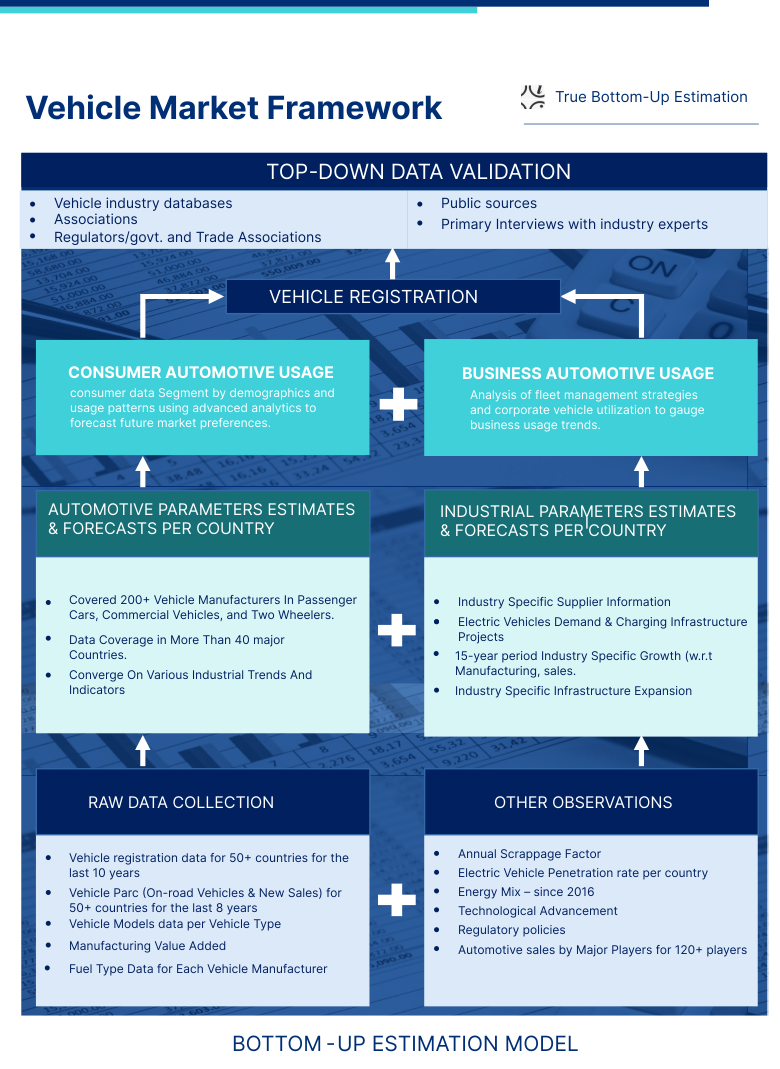
- Step-1: Identify Key Variables: To build a robust forecasting methodology, the variables and factors identified in Step-1 are tested against available historical market numbers. Through an iterative process, the variables required for market forecast are set and the model is built based on these variables.
- Step-2: Build a Market Model: Market-size estimations for the historical and forecast years have been provided in revenue and volume terms. Market revenue is calculated by multiplying the sales volume with their respective average selling price (ASP). While estimating ASP factors like average inflation, market demand shift, manufacturing cost, technological advancement, and varying consumer preference, among others have been taken into account.
- Step-3: Validate and Finalize: In this important step, all market numbers, variables, and analyst calls are validated through an extensive network of primary research experts from the market studied. The respondents are selected across levels and functions to generate a holistic picture of the market studied.
- Step-4: Research Outputs: Syndicated Reports, Custom Consulting Assignments, Databases & Subscription Platforms.