
Electric Three-wheeler Battery Management System Market Size and Share
Market Overview
| Study Period | 2019 - 2031 |
|---|---|
| Market Size (2026) | USD 292.33 Million |
| Market Size (2031) | USD 481.82 Million |
| Growth Rate (2026 - 2031) | 10.51 % |
| Fastest Growing Market | South America |
| Largest Market | Asia-Pacific |
| Market Concentration | Medium |
Major Players *Disclaimer: Major Players sorted in no particular order Image © Mordor Intelligence. Reuse requires attribution under CC BY 4.0. | |
Electric Three-wheeler Battery Management System Market Analysis by Mordor Intelligence
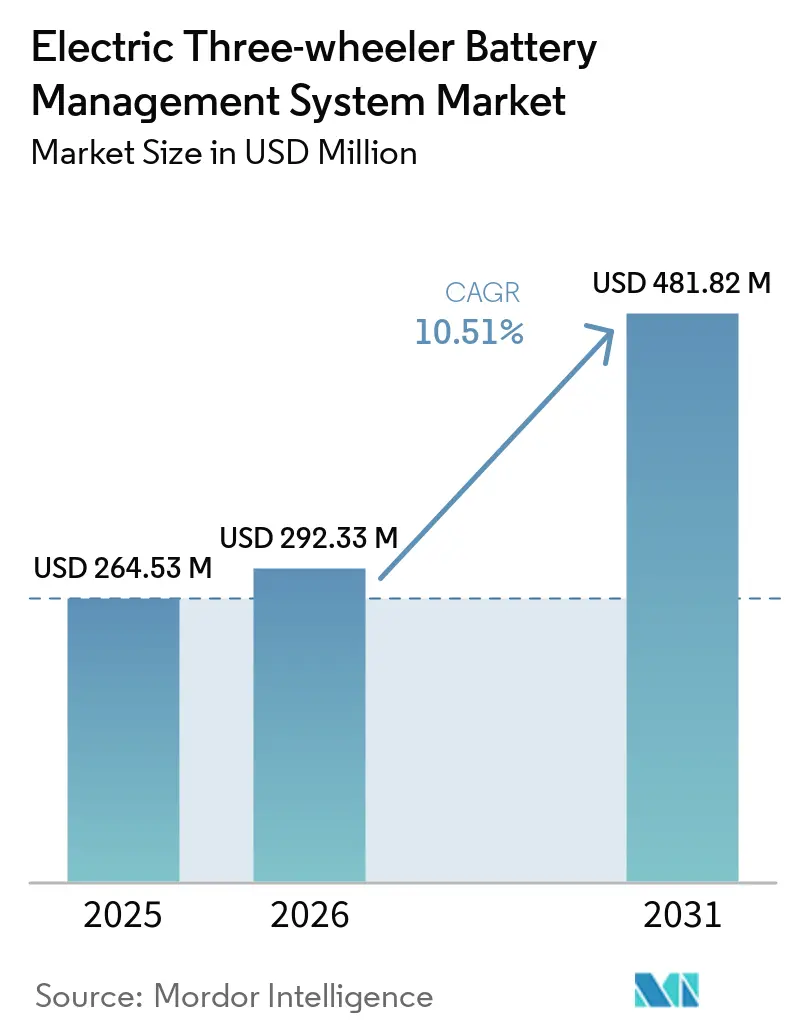
The electric three-wheeler battery management system market size was valued at USD 264.53 million in 2025, is estimated at USD 292.33 million in 2026, and is projected to reach USD 481.82 million by 2031, at a CAGR of 10.51% during the forecast period (2026-2031). Lithium iron phosphate (LFP) battery prices reached parity with lead-acid batteries, accelerating OEM migration to LFP battery packs. These packs significantly reduce the total cost of ownership over their operational life. Policy incentives in India, Brazil, and China reduce vehicle payback periods, encouraging fleet operators to accelerate the replacement of diesel and CNG vehicles. Component innovation continues to prioritize integrated circuits and wireless communication modules, which reduce copper cabling requirements per pack and enable over-the-air firmware updates. Competition is increasingly focused on cybersecurity-ready wireless BMS designs and edge-AI prognostics that can predict cell end-of-life well in advance.
Key Report Takeaways
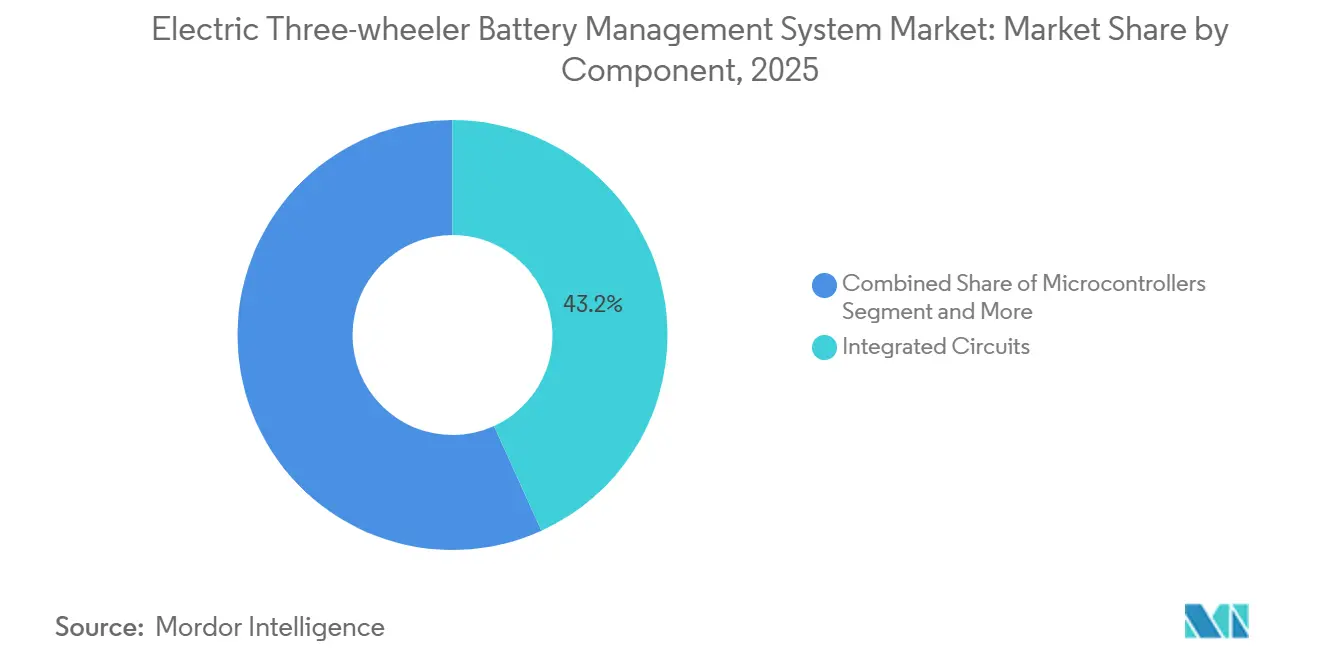
- By component, integrated circuits led with 43.16% of the electric three-wheeler battery management system market share in 2025, while communication interface ICs are projected to post the fastest 11.53% CAGR through 2031.
- By topology, centralized systems accounted for 38.15% of the market in 2025, and wireless architectures are forecast to expand at a 11.57% CAGR to 2031.
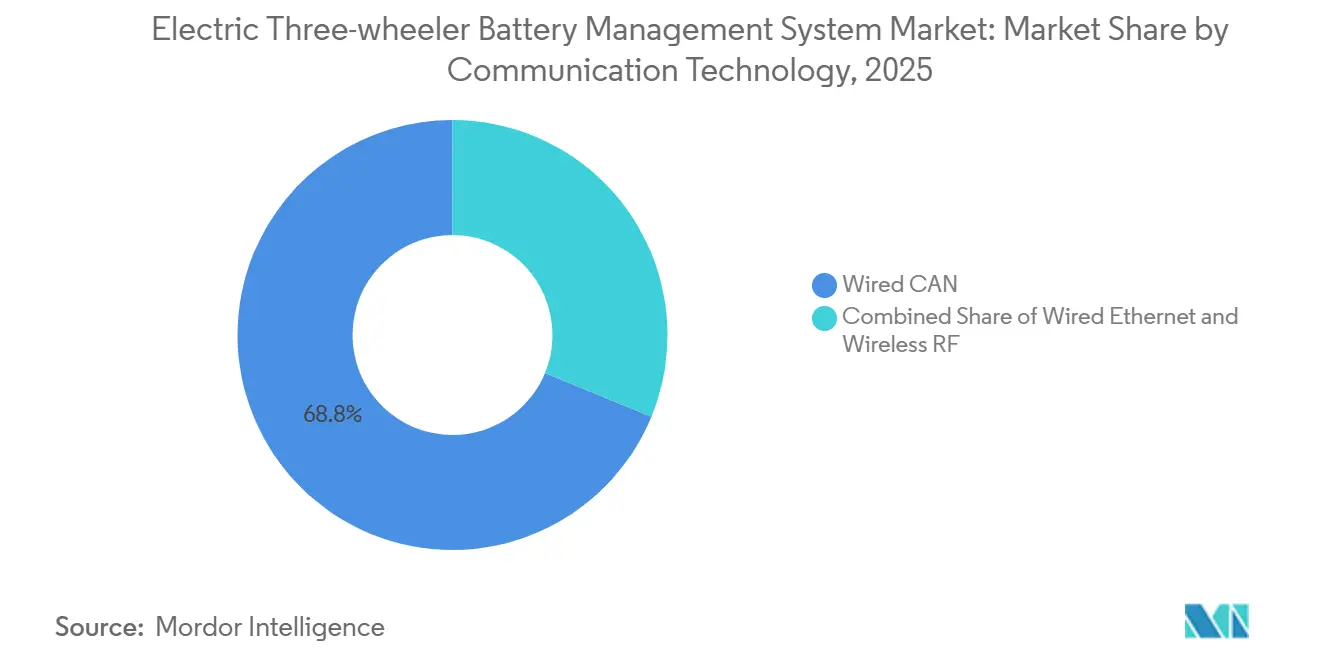
- By communication technology, wired CAN protocols retained a 68.83% share in 2025, whereas wireless RF solutions are advancing at a 11.59% CAGR through 2031.
- By battery chemistry, lithium iron phosphate (LFP) captured a 51.23% share of the market in 2025 and is also the fastest-growing chemistry, with a 12.54% CAGR expected through 2031.
- By application, passenger carriers dominated with 63.37% market share in 2025, while cargo three-wheelers represent the quickest growth trajectory at a 12.61% CAGR to 2031.
- By sales channel, OEM-fitted systems held 73.35% of 2025 revenue; aftermarket retrofit installations are projected to rise at a 12.63% CAGR over 2026-2031.
- By geography, Asia-Pacific led with a 58.24% share in 2025, and South America is poised to grow the fastest at an 11.66% CAGR through 2031.
Note: Market size and forecast figures in this report are generated using Mordor Intelligence’s proprietary estimation framework, updated with the latest available data and insights as of January 2026.
Market Trends and Insights
Drivers Impact Analysis of Electric Three-wheeler Battery Management System Market*
| Driver | (~) % Impact on CAGR Forecast | Geographic Relevance | Impact Timeline |
|---|---|---|---|
| Mainstream EV-Policy Push and Purchase Incentives | +2.3% | Asia-Pacific (India, China), South America (Brazil), spill-over to Middle East and Africa | Medium term (2-4 years) |
| Rapid Lithium-Ion Cost Decline and Lithium Iron Phosphate (LFP) Shift | +1.8% | Global, concentrated in Asia-Pacific manufacturing hubs | Short term (≤ 2 years) |
| OEM Migration to In-House Wireless BMS | +1.5% | Asia-Pacific (China, South Korea), North America (Tesla supply chain) | Medium term (2-4 years) |
| Edge-AI Prognostics for Swap-Ready Packs | +1.4% | Asia-Pacific (India, China), early pilots in Southeast Asia | Long term (≥ 4 years) |
| Standardisation of CAN-FD Protocols in India | +1.2% | India, with adoption spill-over to Bangladesh, Sri Lanka | Short term (≤ 2 years) |
| Secondary-Life Battery Monetisation Models | +1.0% | Global, led by EU circular-economy mandates, Asia-Pacific adoption | Long term (≥ 4 years) |
| Source: Mordor Intelligence | |||
Mainstream EV-Policy Push and Purchase Incentives
National programs are closing the cost gap between electric and combustion three-wheelers. India’s PM E-DRIVE scheme earmarked INR 10,900 crore (USD 1.3 billion) for demand subsidies of INR 10,000-50,000 (~ USD 103 - ~ USD 518) per vehicle, while Brazil’s Programa Mover set aside BRL 19.3 billion (USD 3.8 billion) for IPI Verde tax relief. These measures shorten fleet payback from five to under three years and accelerate the scrappage of diesel three-wheelers. China extended NEV purchase-tax exemptions through 2027, broadening eligibility to low-speed cargo variants. Incentives are increasingly linked to safety compliance, compelling BMS suppliers to integrate multi-point thermal sensors and active cell balancing that meet AIS-156 escape-time requirements [1].
Rapid Lithium-Ion Cost Decline and Lithium Iron Phosphate Shift
Lithium Iron Phosphate (LFP) cell prices dropped to USD 81 per kWh in 2025, overtaking NMC on lifecycle cost and achieving parity with lead-acid when durability is considered. CATL and BYD added 40 GWh of LFP cathode capacity during 2024-2025, while Indian pack assemblers localized LFP integration to gain import-duty advantages. LFP’s thermal stability permits passive cooling in 80% of passenger three-wheelers operating in 40-50 °C ambient conditions. The flatter voltage curve forces BMS designs to adopt 14-bit ADC fuel-gauge ICs that hold ±3% state-of-charge accuracy and maintain warranty obligations [2].
OEM Migration to In-House Wireless BMS
LG Innotek brought an 800 V wireless BMS into mass production in 2024, reducing pack assembly costs by 15-20% by eliminating cabling. Mahindra Electric and Piaggio began in-house wireless BMS programs in 2025, aiming for a 30-40% margin uplift. Wireless designs enable modular hot-swap packs for battery-as-a-service operators but introduce RF cybersecurity exposure that remains outside mandatory regulation until at least 2027. Early pilots report 40% assembly-time savings and a 2-3 year lifecycle extension via remote firmware upgrades [3].
Standardization of CAN-FD Protocols in India
AIS-156 Amendment 2 mandates high-speed CAN-FD from the current year onward, replacing legacy CAN 2.0B. The higher bandwidth supports thermal telemetry across multiple cell modules and RFID-based battery traceability. Following the regulation, NXP and Infineon transceivers accounted for a significant share of India’s BMS sockets. Fleet operators that use CAN-FD telematics gateways reduce connectivity hardware spending substantially. However, a skills gap persists among Tier-2 retrofit workshops, which often lack CAN-FD diagnostic tools.
Restraints Impact Analysis of Electric Three-wheeler Battery Management System Market*
| Restraint | (~) % Impact on CAGR Forecast | Geographic Relevance | Impact Timeline |
|---|---|---|---|
| Semiconductor Supply-Chain Volatility | -1.5% | Global, acute in APAC assembly hubs reliant on Taiwan/Korea fabs | Short term (≤ 2 years) |
| Limited Thermal Envelope in Tropical Use | -0.8% | South Asia (India, Bangladesh), Southeast Asia (Indonesia, Thailand), Sub-Saharan Africa | Medium term (2-4 years) |
| Cyber-Security Vulnerabilities in Low-Cost BMS | -0.6% | APAC (India, China), MEA markets with nascent regulatory oversight | Medium term (2-4 years) |
| Skills Gap in Tier-2 Retrofit Installers | -0.5% | India (Tier-2/3 cities), Southeast Asia, Sub-Saharan Africa | Short term (≤ 2 years) |
| Source: Mordor Intelligence | |||
Semiconductor Supply-Chain Volatility
Lead times for automotive-grade microcontrollers have declined significantly since the supply-chain disruptions of the pandemic but remain considerably longer than pre-pandemic levels. Analog process-node capacity remains constrained, as consumer-device applications offer higher margins than automotive contracts. Indian BMS integrators now dual-source microcontrollers, a strategy that can substantially increase non-recurring engineering costs. Taiwan and South Korea continue to dominate the supply of power MOSFETs, leaving the electric three-wheeler battery management system market vulnerable to geopolitical disruptions.
Limited Thermal Envelope in Tropical Use
Ambient temperatures of 45-50 °C in India and Indonesia drive pack surface temperatures to 60-65 °C, forcing BMS thermal derating that cuts available power by up to 30%. Low-cost air cooling cannot manage sustained urban duty cycles, pushing cargo variants to adopt liquid cooling that adds USD 150-200 per vehicle. Phase-change materials piloted in 2025 lowered cell temperature by 5-8 °C but remain uneconomical for sub-USD 3,000 three-wheelers. Elevated heat accelerates capacity fade and shortens pack life from six to four years, pressuring fleet total cost of ownership.
*Our forecasts treat driver/restraint impacts as directional, not additive. The impact forecasts reflect baseline growth, mix effects, and variable interactions.
Electric Three-wheeler Battery Management System Market Segment Analysis
By Component:
Communication ICs Drive Wireless TransitionIntegrated circuits accounted for 43.16% of the electric three-wheeler battery management system market size in 2025. Within this group, communication interface ICs posted the highest 11.53% CAGR, reflecting OEM preference for cable-less topologies that save 2-3 kg of wiring and allow over-the-air updates. Texas Instruments and Analog Devices dominate centralized AFE sockets, but Nordic Semiconductor RF transceivers gain share as wireless meshes scale to 20-plus modules per pack. Cost pressure intensifies on cutoff MOSFETs, where Chinese vendors underbid incumbents by 30-40%. Functional-safety-compliant microcontrollers such as Renesas RL78 rise in passenger carrier segments to meet ASIL-B requirements.
Second-generation fuel-gauge ICs that incorporate impedance spectroscopy improve state-of-health accuracy from ±10% to ±3%, empowering battery-as-a-service operators to plan swap-station inventory precisely. Passive components contract at a slower 9.8% CAGR because miniaturized wireless modules reduce discrete counts per board.

By Topology:
Wireless Systems Challenge Centralized DominanceCentralized designs still hold 38.15% of 2025 revenue, but wireless systems are set to grow at 11.57% CAGR. Wireless BMS removes up to 25 minutes of assembly labor and USD 15-20 of copper per pack. Modular BMS holds a significant share, serving battery packs commonly used in three-wheelers. Distributed architectures remain a niche segment because they carry a substantial cost premium. However, swap-ready ecosystems favor these architectures, as module-level tracking enables residual-value monetization. Electromagnetic noise from motor inverters is driving vendors to adopt frequency-hopping spread-spectrum technology to maintain signal integrity.
Compliance drives selection: AIS-156 thermal propagation rules favor modular designs that isolate faults, while centralized systems meet the same benchmark only after adding redundant sensing that inflates bill-of-materials cost. Wireless vendors such as Panorama and LG Innotek are vertically integrating into pack assembly, squeezing margins for traditional harness suppliers.
By Communication Technology:
Dominance by Wired CANWired CAN protocols accounted for a 68.83% share of the electric three-wheeler battery management system (BMS) market in 2025, driven by their high-speed, secure, and reliable communication capabilities. This established technology remains dominant in urban transit applications due to its strong resistance to interference.
Meanwhile, wireless RF solutions are gaining traction and are projected to grow at a CAGR of 11.59% through 2031, as manufacturers aim to reduce wiring harness complexity. These emerging wireless architectures improve vehicle efficiency by reducing weight and enable greater scalability for remote monitoring and maintenance.
By Battery Chemistry:
LFP Dominance Reshapes BMS RequirementsLFP captured 51.23% electric three-wheeler battery management system market share in 2025 and is projected to retain leadership at a 12.54% CAGR. Price parity with lead-acid plus a 3,000-cycle life makes LFP the default chemistry for Asia-Pacific fleets. NMC stays relevant in premium segments because its 180-220 Wh/kg energy density extends range above 120 km. LFP’s flat discharge curve forces higher-resolution ADCs and more advanced algorithms, increasing BMS cost by USD 3-5 versus NMC packs. Low-temperature penalties limit LFP in Northern China and Russia, where NMC still supplies winter-resilient models.
Second-life economics reinforce LFP preference: residual capacity above 70% after 3,000 cycles aligns with stationary storage demand. BMS firmware now logs 10-year operational history to validate resale value, a feature not yet standard on NMC systems.
By Application:
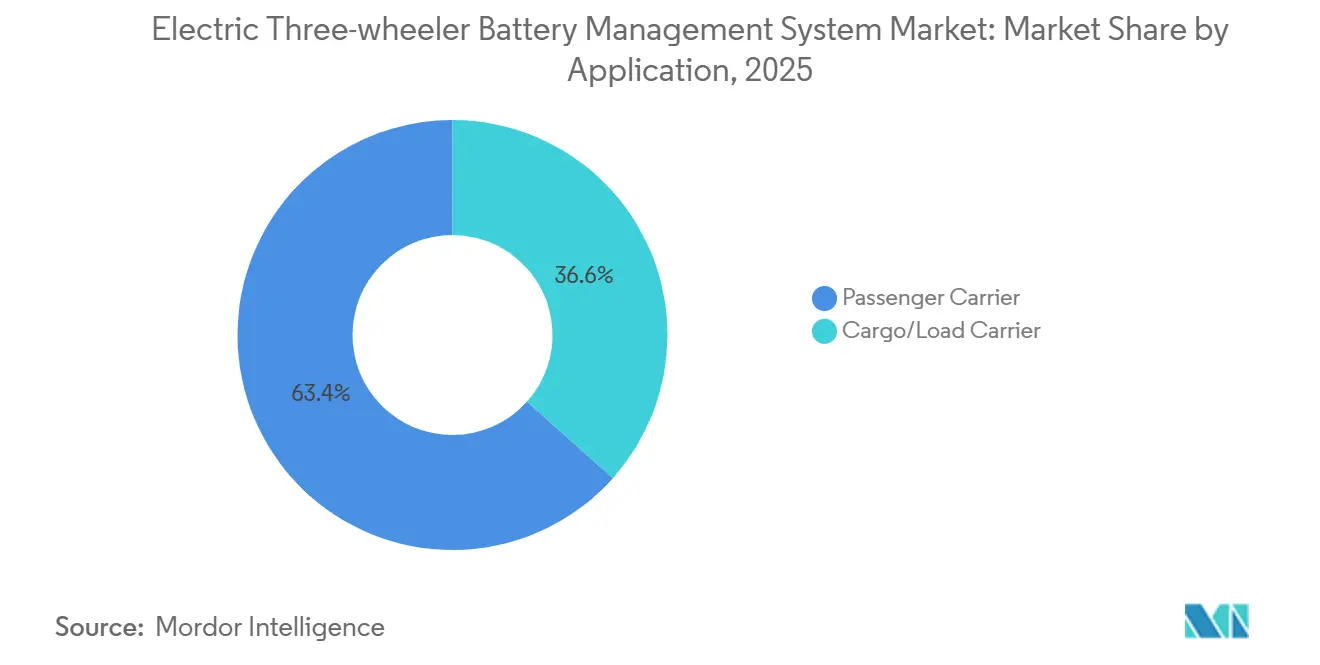
Cargo Segment Accelerates on E-Commerce TailwindsPassenger carriers represented 63.37% of the electric three-wheeler battery management system market size in 2025, yet cargo three-wheelers exhibit a faster 12.61% CAGR through 2031. E-commerce delivery bans on diesel vehicles in 50-plus Indian cities drive adoption of 10-15 kWh packs requiring 150-200 A discharge capability. Battery swapping compresses downtime to five minutes, essential for four duty cycles a day. Cargo packs demand additional balancing channels that add USD 20-30 per BMS, while passenger variants prioritize cost and stick to centralized wired designs.
Energy-to-payload trade-offs remain tight: each 50 kg payload increment reduces range by 8-10%, incentivizing over-sized packs that further escalate BMS complexity. Regulatory overload protection at 1.5 C in cargo vehicles also shapes firmware parameters distinct from passenger carriers.
By Sales Channel:
Aftermarket Retrofit Gains MomentumOEM-fitted systems secured 73.35% share in 2025, but retrofit BMS is expanding at 12.63% CAGR as fleets convert millions of legacy three-wheelers. Retrofit kits priced at USD 1,200-1,800 include battery pack and BMS installation yet face compatibility hurdles across diverse 48-60 V architectures.
Retrofitted vehicles installed before 2026 avoid AIS-156 mandates, creating a two-tier compliance market. Smartphone-based diagnostics help bridge the skills gap in Tier-2 cities lacking CAN-FD scan tools, reducing troubleshooting time from 12 to 3 hours. OEMs counter with battery-as-a-service financing that lowers upfront cost and locks fleets into proprietary wireless BMS ecosystems.
Geography Analysis
APAC Electric Three-wheeler Battery Management System Market
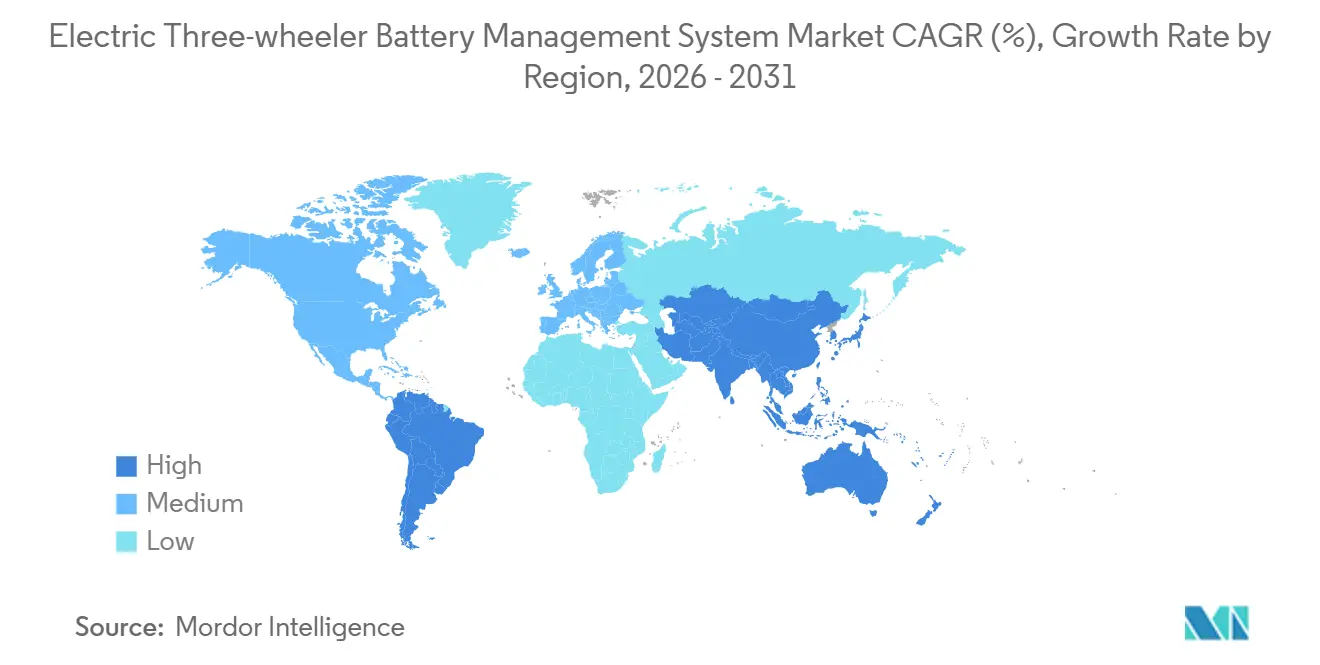
Asia Pacific is projected to account for 58.24% of revenue in 2025, driven by India’s 700,000-unit fleet and China’s push to expand rural logistics. The region’s electric three-wheeler battery management system market benefits from combined federal and state subsidies, which reduce vehicle payback periods to less than 2.5 years in Gujarat, Maharashtra, and Tamil Nadu.
South America and ASEAN Electric Three-wheeler Battery Management System Market
South America is projected to be the fastest-growing region, with a CAGR of 10.66%. Brazil’s Programa Mover provides substantial IPI Verde tax relief for electric vehicles (EVs) with significant local content, while Colombia offers preferential import-duty reductions for locally assembled three-wheelers. Southeast Asia represents a meaningful share of current demand. Indonesia’s regulation aims to accelerate the adoption of electric two- and three-wheelers over the medium term; however, high import tariffs on battery cells hinder progress.
EMEA and North America Electric Three-wheeler Battery Management System Market
The Middle East and Africa account for a smaller but notable share of demand, led by airport logistics pilot programs in the UAE. However, high ambient temperatures and the lack of subsidies limit mass adoption. Europe and North America remain niche markets with a limited combined share of demand. Nevertheless, planned diesel bans in urban cores across the European Union may increase demand for electric cargo three-wheelers in the coming years.
Competitive Landscape
Semiconductor vendors account for a significant share of component value. Infineon, Texas Instruments, and NXP lead the supply of analog front-end (AFE) components and microcontroller units (MCUs). Indian integrators, including Exicom and Octillion, focus on localized thermal solutions designed for tropical climates. Battery manufacturers are increasingly pursuing vertical integration to gain greater control over component quality, supply security, and system-level performance.
LG Energy Solution and Panasonic have expanded from cell production into module manufacturing, achieving substantially higher gross margins than stand-alone battery management system (BMS) providers. This shift demonstrates the commercial advantages of integrated battery manufacturing and allows suppliers to capture more value across the battery value chain. Edge AI-based prognostics and cybersecurity capabilities increasingly differentiate market leaders from laggards by enhancing battery health monitoring, predictive maintenance, and protection against cyber threats.
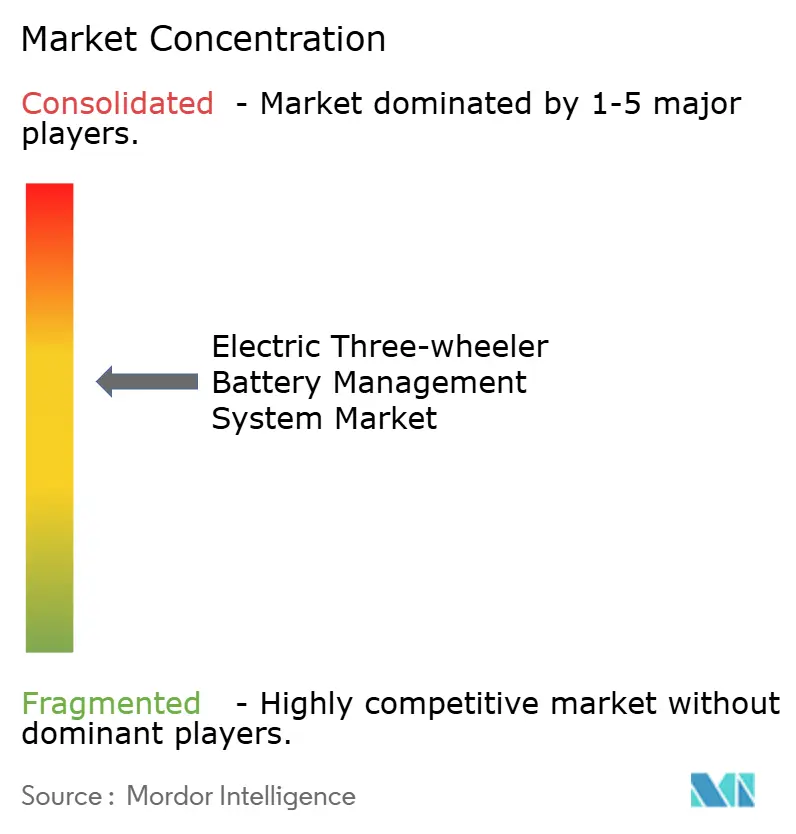
Sensata has filed multiple patents for impedance-based cell-aging models, underscoring the growing emphasis on advanced battery diagnostics and lifecycle management. NXP’s S32K3 MCU incorporates a hardware security module compliant with ISO/SAE 21434, supporting secure automotive battery management applications. The absence of interoperability standards across battery swap-station ecosystems keeps the market moderately fragmented. However, it also creates opportunities for standards-based wireless BMS providers to consolidate market share by delivering compatible, scalable, and secure solutions.
Electric Three-wheeler Battery Management System Industry Leaders
-
Exicom Tele-Systems
-
Infineon Technologies AG
-
NXP Semiconductors
-
Sensata Technologies
-
Renesas Electronics
- *Disclaimer: Major Players sorted in no particular order
Electric Three-wheeler Battery Management System Market Companies Covered in this Report
- Exicom Tele-Systems
- Trontek Batteries
- Lithium Balance A/S
- Daly BMS
- Octillion Power Systems
- Sensata Technologies
- CATL
- Bosch Mobility Solutions
- Infineon Technologies AG
- NXP Semiconductors
- Texas Instruments
- Renesas Electronics
- AVL List GmbH
Recent Industry Developments in Electric Three-wheeler Battery Management System Market
- June 2026: Texas Instruments officially introduced the BQ79826Z-Q1, a 26-channel battery monitor featuring an integrated smart electrochemical impedance spectroscopy (EIS) engine for advanced battery monitoring applications.
- October 2025: NXP Semiconductors unveiled the industry’s first battery management system (BMS) chipset with built-in Electrochemical Impedance Spectroscopy (EIS), enabled by hardware-based nanosecond synchronization. This technology supports precise battery monitoring and management by enabling synchronized impedance measurements across battery cells.
- March 2025: Renesas Electronics introduced R-BMS F (Ready Battery Management System with Fixed Firmware), an all-in-one, pre-validated hardware and software solution. The system significantly reduces development timelines for original equipment manufacturers (OEMs) developing lightweight lithium-ion battery configurations with 3 to 10 series-connected cells for electric three-wheelers (e3Ws) and e-bikes.
Global Electric Three-wheeler Battery Management System Market Report Scope
The scope of the report includes Component (Integrated Circuits, Cut-off FETs and Drivers, Temperature Sensors, Fuel-Gauge/Current-Measurement Devices, Microcontrollers, Communication Interface ICs, and Other Components), Topology (Centralized, Modular, Distributed, and Wireless (Cable-less)), Communication Technology (Wired CAN, Wired Ethernet, and Wireless RF), Battery Chemistry (Lithium Iron Phosphate (LFP), Nickel Manganese Cobalt (NMC), and Lead-acid), Application (Passenger Carrier and Cargo/Load Carrier), Sales Channel (OEM-Fitted and Aftermarket/Retrofit), and Geography (North America, South America, Europe, Asia-Pacific, and Middle East and Africa). The Market Forecasts are Provided in Terms of Value (USD).
| Integrated Circuits |
| Cut-off FETs and Drivers |
| Temperature Sensors |
| Fuel-Gauge/Current-Measurement Devices |
| Microcontrollers |
| Communication Interface ICs |
| Other Components |
| Centralized |
| Modular |
| Distributed |
| Wireless (Cable-less) |
| Wired CAN |
| Wired Ethernet |
| Wireless RF |
| LFP |
| NMC |
| Lead-acid |
| Passenger Carrier |
| Cargo/Load Carrier |
| OEM-fitted |
| Aftermarket/Retrofit |
| North America | United States |
| Canada | |
| Rest of North America | |
| South America | Brazil |
| Argentina | |
| Rest of South America | |
| Europe | Germany |
| United Kingdom | |
| France | |
| Italy | |
| Spain | |
| Russia | |
| Rest of Europe | |
| Asia-Pacific | China |
| India | |
| Japan | |
| South Korea | |
| Australia and New Zealand | |
| Rest of Asia-Pacific | |
| Middle East and Africa | United Arab Emirates |
| Saudi Arabia | |
| Turkey | |
| South Africa | |
| Egypt | |
| Rest of Middle East and Africa |
| By Component | Integrated Circuits | |
| Cut-off FETs and Drivers | ||
| Temperature Sensors | ||
| Fuel-Gauge/Current-Measurement Devices | ||
| Microcontrollers | ||
| Communication Interface ICs | ||
| Other Components | ||
| By Topology | Centralized | |
| Modular | ||
| Distributed | ||
| Wireless (Cable-less) | ||
| By Communication Technology | Wired CAN | |
| Wired Ethernet | ||
| Wireless RF | ||
| By Battery Chemistry | LFP | |
| NMC | ||
| Lead-acid | ||
| By Application | Passenger Carrier | |
| Cargo/Load Carrier | ||
| By Sales Channel | OEM-fitted | |
| Aftermarket/Retrofit | ||
| By Geography | North America | United States |
| Canada | ||
| Rest of North America | ||
| South America | Brazil | |
| Argentina | ||
| Rest of South America | ||
| Europe | Germany | |
| United Kingdom | ||
| France | ||
| Italy | ||
| Spain | ||
| Russia | ||
| Rest of Europe | ||
| Asia-Pacific | China | |
| India | ||
| Japan | ||
| South Korea | ||
| Australia and New Zealand | ||
| Rest of Asia-Pacific | ||
| Middle East and Africa | United Arab Emirates | |
| Saudi Arabia | ||
| Turkey | ||
| South Africa | ||
| Egypt | ||
| Rest of Middle East and Africa | ||
Key Questions Answered in the Report
How big is the electric three-wheeler battery management system market in 2026?
The market stands at USD 292.33 million in 2026 and is on track to reach USD 481.82 million by 2031.
What CAGR is expected for battery management systems in electric three-wheelers through 2031?
A 10.51% CAGR is forecast for the 2026-2031 period.
Which chemistry dominates batteries in electric three-wheelers?
Lithium Iron Phosphate holds 51.23% market share in 2025 and continues to grow faster than NMC through 2031.
What is the fastest-growing regional market for these systems?
South America leads with a 11.66% CAGR, driven by Brazil’s Programa Mover incentives.
Why are wireless BMS designs gaining traction?
They eliminate up to 3 kg of cabling, cut assembly time by 40%, and enable hot-swap packs for battery-as-a-service models.