
Automotive Battery Management Systems Market Size and Share
Market Overview
| Study Period | 2020 - 2031 |
|---|---|
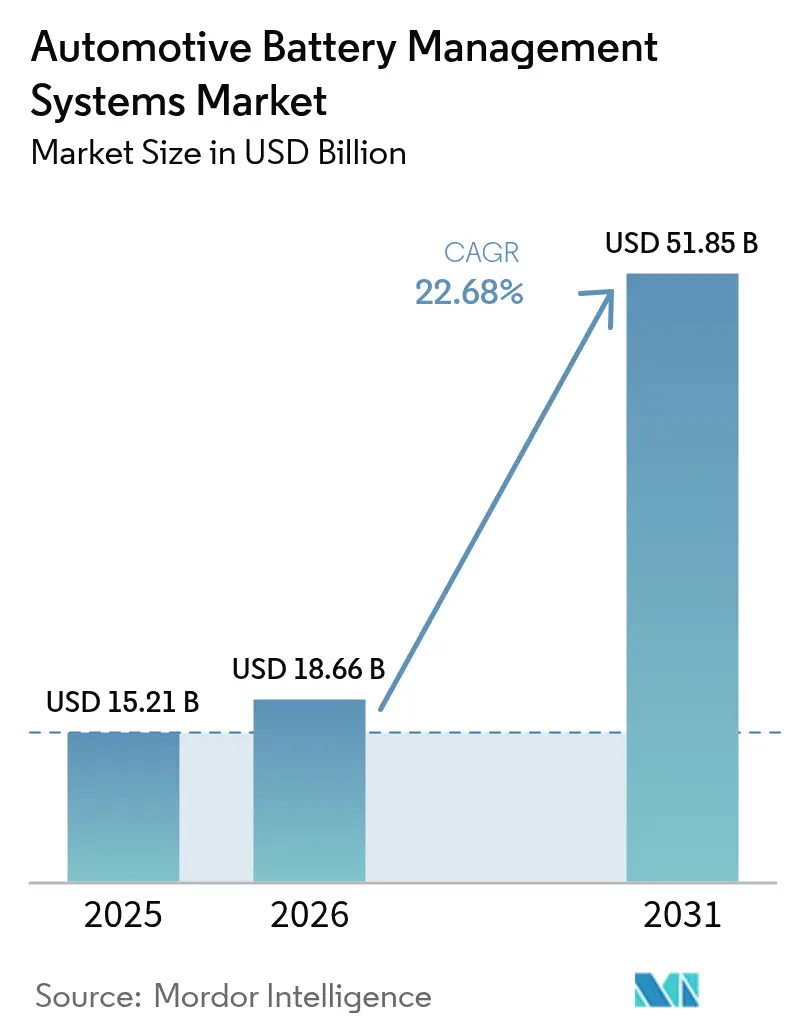
| Market Size (2026) | USD 18.66 Billion |
| Market Size (2031) | USD 51.85 Billion |
| Growth Rate (2026 - 2031) | 22.68 % |
| Fastest Growing Market | Middle East and Africa |
| Largest Market | Asia-Pacific |
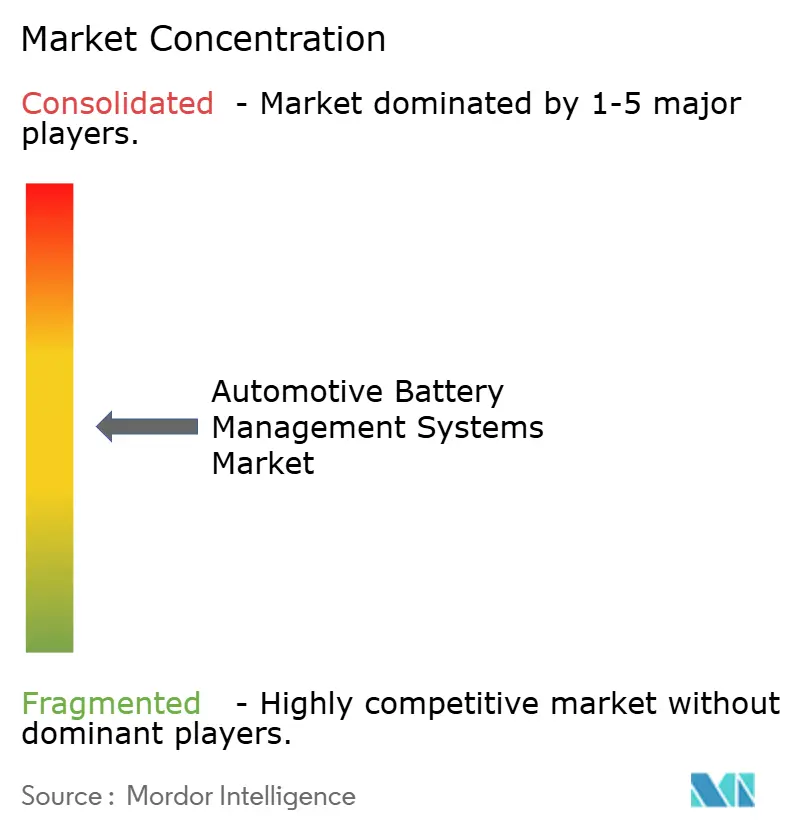
| Market Concentration | Medium |
Major Players *Disclaimer: Major Players sorted in no particular order Image © Mordor Intelligence. Reuse requires attribution under CC BY 4.0. | |
Automotive Battery Management Systems Market Analysis by Mordor Intelligence
The automotive battery management system market size in 2026 is estimated at USD 18.66 billion, growing from 2025 value of USD 15.21 billion with 2031 projections showing USD 51.85 billion, growing at 22.68% CAGR over 2026-2031. This expansion mirrors the global pivot from internal-combustion engines toward electrified propulsion, where a battery management system (BMS) functions as the vehicle’s central nervous system. Regulatory pressure, notably ISO 21434 cybersecurity rules that came into force for new vehicle models in 2024, is accelerating demand for cyber-secure designs. At the same time, rapid migration from hard-wired to modular and wireless topologies is trimming harness weight, boosting energy density, and shortening assembly time. Wireless solutions such as NXP’s ultra-wideband BMS, released for OEM trials in 2025, exemplify how next-generation architectures can align safety, efficiency, and cost goals.[1] Heightened electric-vehicle (EV) sales targets, falling battery pack cost, and mainstream adoption of lithium-iron-phosphate (LFP) chemistries continue to stimulate design upgrades that place more intelligence at the cell and module level, reinforcing a robust growth path for the automotive battery management system market.
Key Report Takeaways
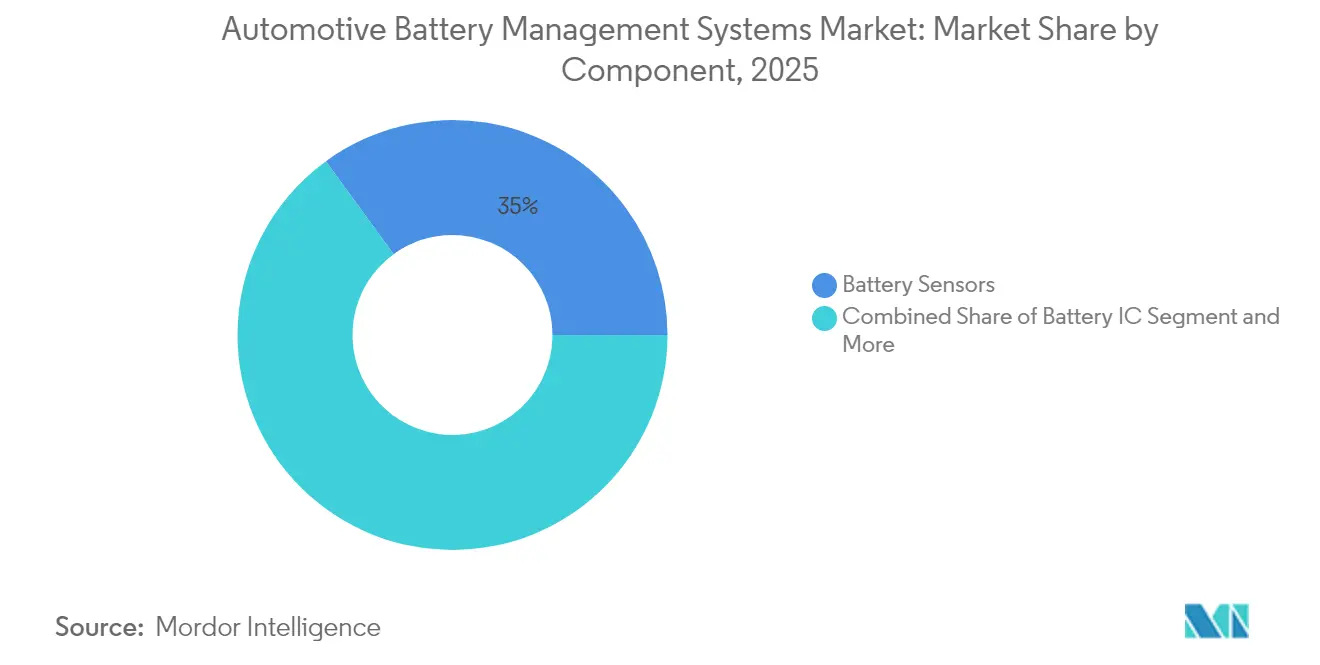
- By component, Battery Sensors held 35.02% of the automotive battery management system market share in 2025 and are expanding at a 24.12% CAGR through 2031.
- By topology, Modular systems led with a 48.42% revenue share in 2025; Wireless topology is projected to surge at a 33.82% CAGR to 2031.
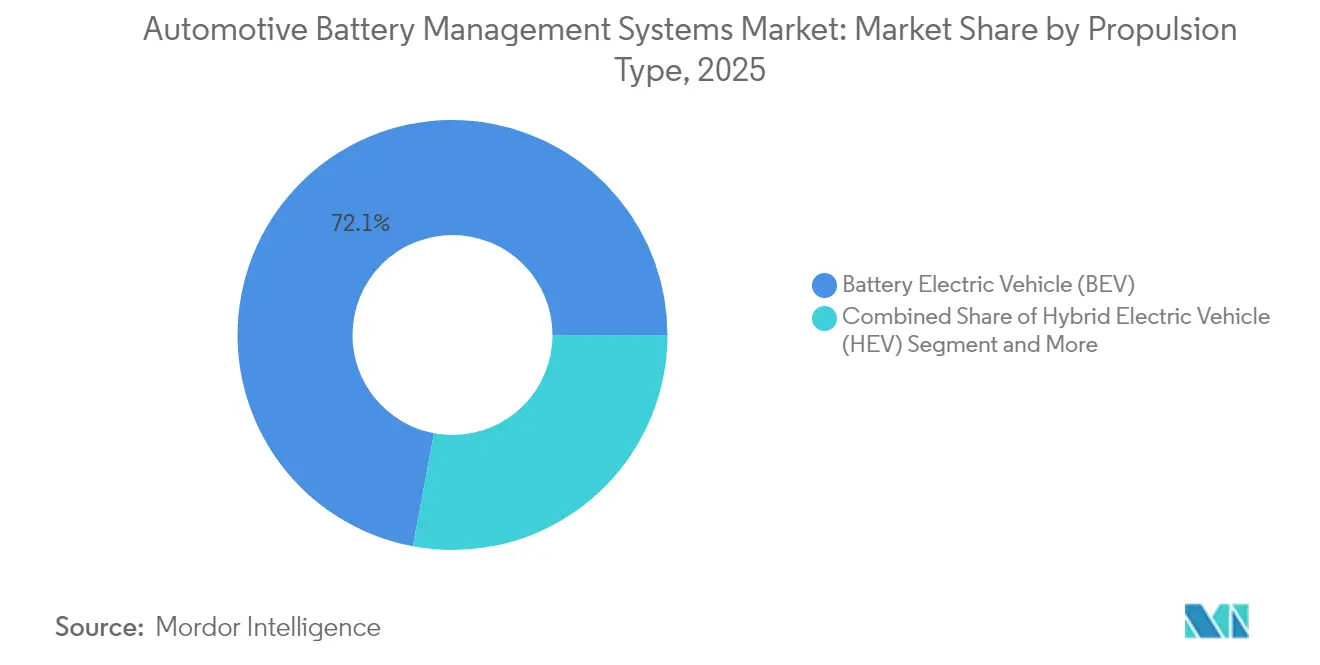
- By propulsion type, Battery Electric Vehicles captured 72.05% share of the automotive battery management system market size in 2025, whereas Fuel-Cell Electric Vehicles are forecast to advance at a 36.41% CAGR over 2026-2031.
- By vehicle type, Passenger Cars accounted for a 54.04% stake in 2025 and are expanding at a 24.73% CAGR toward 2031.
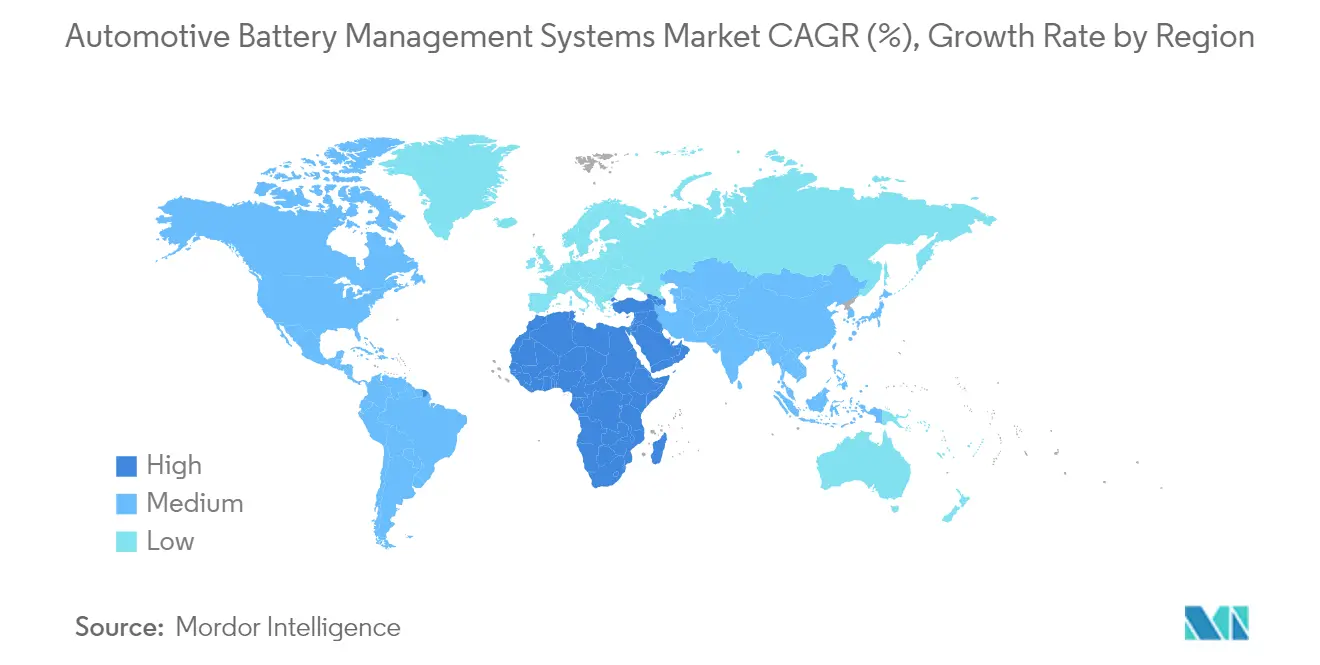
- By geography, Asia-Pacific dominated with a 60.77% slice of the automotive battery management system market in 2025, while the Middle East and Africa region is accelerating at a 26.9% CAGR through 2031.
Note: Market size and forecast figures in this report are generated using Mordor Intelligence’s proprietary estimation framework, updated with the latest available data and insights as of 2026.
Global Automotive Battery Management Systems Market Trends and Insights
Drivers Impact Analysis*
| Driver | (~) % Impact on CAGR Forecast | Geographic Relevance | Impact Timeline |
|---|---|---|---|
| EV Sales Mandates Widening Globally | +5.5% | EU, China, United States | Medium term (2-4 years) |
| Falling Cost of Battery Packs | +4.2% | APAC and emerging markets | Short term (≤ 2 years) |
| Shift from Centralized to Modular and Wireless Topologies | +3.3% | North America, EU | Medium term (2-4 years) |
| Soaring Demand for LFP Chemistry requiring Advanced Active Balancing | +3.1% | China, North America | Short term (≤ 2 years) |
| ISO 21434-driven Cyber-secure BMS Demand | +2.2% | EU, North America | Short term (≤ 2 years) |
| OEM move to In-house BMS ASIC Design to cut IP Royalty Cost | +1.7% | Germany, Japan, South Korea, United States | Long term (≥ 4 years) |
| Source: Mordor Intelligence | |||
EV sales mandates widening globally
Binding ZEV policies in regions such as the EU and California raise the baseline for durability, range retention, and transparency of battery health. Euro 7 rules will be effective in 2026, and California’s Advanced Clean Cars II demands 80% range retention for 150,000 miles, compelling BMS suppliers to incorporate more refined state-of-health analytics and degradation modeling. Harmonizing rules incentivize global platforms to adopt one compliance-ready architecture, elevating the automotive battery management system market as OEMs avoid region-specific designs. Suppliers that already embed adaptive algorithms gain a head start, whereas legacy providers face added validation cycles and cost.
Falling cost of battery packs
Rapid declines in lithium-ion battery-pack prices are reshaping cost structures. Mainstream LFP packs averaged USD 75 per kWh in 2024, and pilot sodium-ion runs have demonstrated costs as low as USD 10 per kWh. As cells get cheaper, OEMs can allocate larger portions of the battery budget to smarter BMS functions, such as predictive analytics and wireless connectivity, rather than focusing solely on hardware cost reduction. This shift toward higher value content per pack reinforces demand for advanced battery management solutions across the automotive battery management system market.
Shift from centralized to modular and wireless topologies
Manufacturers are adopting modular boards linked by wireless nodes that can be reconfigured by software, cutting up to 90% of copper harnesses. Analog Devices and NXP have demonstrated ISO 21434-compliant wireless stacks that maintain precision measurement while simplifying pack assembly. These designs improve serviceability and lay the groundwork for over-the-air BMS firmware updates, a key requirement for software-defined vehicles. Rapid uptake of wireless units is therefore set to enlarge the automotive battery management system market over the medium term.
Soaring demand for LFP chemistry requiring advanced active balancing
LFP’s flat discharge profile complicates SOC estimation, pushing vendors to integrate multi-physics sensors, adaptive Kalman filtering, and active balancing circuits. CATL’s 1,000-km Shenxing PLUS cell illustrates that performance gaps are closing, yet stable voltage still hampers traditional monitoring.[2] Suppliers delivering hardware-agnostic algorithms capable of handling cell-to-cell drift secure a premium in the automotive battery management system market, particularly for commercial fleets that value safety and low total cost of ownership.
Restraints Impact Analysis*
| Restraint | (~) % Impact on CAGR Forecast | Geographic Relevance | Impact Timeline |
|---|---|---|---|
| Thermal-runaway recalls Raising Warranty Reserves | -2.7% | North America, Global | Short term (≤ 2 years) |
| Acute Power-Semiconductor Shortages | -2.2% | APAC production hubs | Short term (≤ 2 years) |
| Post-2027 EU Battery-passport Traceability Overheads | -1.5% | EU, export markets | Medium term (2-4 years) |
| AI-based Predictive BMS still Lacks Functional-safety Certification | -1.3% | Global premium segments | Long term (≥ 4 years) |
| Source: Mordor Intelligence | |||
Thermal-runaway recalls raising warranty reserves
High-profile fire events have led to sizable recalls, forcing automakers to boost warranty accruals and adopt conservative pack design. Samsung SDI’s multi-brand recall and Hyundai Mobis’ development of self-extinguishing modules underscore industry urgency. Added cost for insulation, fire suppression, and redundant sensors can slow deployment of experimental BMS functions, tempering near-term growth in the automotive battery management system market.
Acute power-semiconductor shortages
Shortfalls in IGBTs and high-current MOSFETs are disrupting the production of active balancing boards, resulting in redesigns involving secondary suppliers and increased procurement costs. BMS vendors relying on single-sourced dies or legacy lithography nodes have encountered schedule delays. While fabs in Japan, Malaysia, and the US are expanding capacity, limited availability continues to be a challenge that hampers volume ramp-ups for the automotive battery management system market over the next one to two years.
*Our forecasts treat driver/restraint impacts as directional, not additive. The impact forecasts reflect baseline growth, mix effects, and variable interactions.
Segment Analysis
By Component: Integration Intensifies around Battery ICs
Battery Sensors captured 35.02% of the automotive battery management system market share in 2025, and the segment is forecast to post a 24.12% CAGR through 2031. Wider deployment of multi-physics sensing, covering temperature, pressure, off-gas, and humidity, allows OEMs to move from passive protection toward real-time predictive diagnostics. Adoption accelerates as regulators demand enhanced thermal-runaway detection and as fleet operators seek granular data to optimize duty cycles and warranty coverage. Integrating CO₂ and H₂ sensors into module-level boards improves early-warning capabilities, helping avoid costly recalls and downtime. As EV packs scale above 800 V, high-resolution shunt and Hall-effect sensors become indispensable for accurate state-of-charge and state-of-health estimation, cementing the segment’s long-term expansion path.
Tight cell-level voltage accuracy, now reaching ±2 mV, enables finer charge balancing and extended pack life, making IC precision a decisive purchase criterion. Leading chipmakers have fused measurement, balancing, and communication blocks onto single dies, shrinking board footprints and simplifying automotive qualifications. The residual “Other electronics and materials” bucket, encompassing thermally conductive gap fillers, aerogel sheets, and phase-change composites, continues to broaden as energy density rises, calling for superior heat-spreading and insulation solutions.

By Topology: Modular Dominance with Wireless Momentum
In 2025, Modular arrangements accounted for 48.42% of the automotive battery management system market share, reflecting OEM preference for scalable sub-battery modules that can be rearranged without wholesale redesign. Box-level isolation of sensing and actuation delivers fault tolerance suited to commercial fleets and high-utilization ride-hailing vehicles. Incremental hardware blocks also facilitate rapid line-side replacement, lifting vehicle uptime.
Wireless designs are scaling rapidly, showing a 33.82% CAGR across 2026-2031 as antenna miniaturization, secure mesh protocols, and certified RF stacks reach production maturity. Eliminating daisy-chain harnesses cuts pack weight and opens valuable cubic centimeters for active cooling plates or extra cells. Centralized topologies continue in entry-price passenger cars, where minimal components trump expandability, whereas niche distributed architectures meet extreme redundancy mandates in motorsports and aerospace crossover programs, cushioning product diversity inside the automotive battery management system market.
By Propulsion Type: BEV Lead Spurs FCEV Uptake
Battery Electric Vehicles, responsible for 72.05% of sector revenue in 2025, have set the benchmark for pack capacity, thermal loads, and software update cadence, creating scale economies for BMS suppliers. High-energy packs demand multi-layer monitoring, driving continual firmware revisions that validate over-the-air workflows across the automotive battery management system market.
Fuel-Cell Electric Vehicles, although smaller in absolute volumes, post the fastest 36.41% CAGR as automakers use hybrid stacks that merge ultra-capacitors, hydrogen cells, and buffer batteries. These mixed energy architectures need BMS units adept at juggling transient loads, cold-start behavior, and hydrogen safety norms. The Hybrid Electric and Plug-in Hybrid segments offer interim revenue, allowing suppliers to validate algorithms in varied duty cycles before full BEV deployment.
By Vehicle Type: Passenger Cars Scale While Commercial Fleets Tighten Specs
Passenger Cars produced both the largest 54.04% revenue slice and a robust 24.73% CAGR, driven by mainstream adoption across compact and mid-size classes. High unit counts spread R&D cost, letting suppliers amortize ASIL-D compliance, secure bootloaders, and advanced diagnostics. As EV options proliferate in sub-USD 25,000 brackets, OEMs expect BMS features once reserved for premium trims, broadening total addressable demand inside the automotive battery management system market.
Light Commercial Vehicles benefit from passenger-car technology trickle-down yet require extended duty-cycle validation, while Medium and Heavy Commercial Vehicles necessitate ruggedized casings, redundant contactors, and fleet telematics tie-ins. Two- and Three-Wheelers in Southeast Asia and Africa prize stripped-down BMS boards with essential safety gates at rock-bottom prices, sustaining volume even if per-unit revenue is thin. Specialty off-highway equipment deploys enhanced thermal envelopes and wide-temperature electronics that later migrate into mainstream cars, illustrating cross-segment innovation flow.
Geography Analysis
Asia-Pacific retained a commanding 60.77% share of the automotive battery management system market in 2025. China’s vertically integrated battery value chain—from upstream refining to final vehicle assembly—compresses cost structures and quickens design iterations. Government purchase incentives, favorable license-plate policies in megacities, and a mature charging ecosystem lift EV penetration and reinforce BMS unit shipments. Supply-chain leverage even extends to Europe and North America, as Chinese cell and module suppliers open factories in Poland, Hungary, and Nevada to secure tariff-free access and shorten logistics lanes.
The Middle East and Africa region, although emerging from a low base, is the fastest-growing region with a 26.9% CAGR through 2031. Dubai, Riyadh, and Cairo are rolling out e-bus corridors and last-mile delivery electrification targets that demand heat-tolerant BMS designs. Public-private alliances channel investment into grid-tied battery storage, creating adjacent sales for repurposed vehicle packs and second-life BMS software.
North America gains momentum as the Inflation Reduction Act galvanizes domestic cell and module manufacturing. Investments by BMW, Toyota, and Hyundai in the Carolinas, Georgia, and Ontario shrink reliance on Asian imports and underpin local sourcing of BMS boards. Europe remains a regulatory trailblazer, with the upcoming battery passport pushing traceability features that increase system complexity and software content. Such requirements elevate per-vehicle revenue and differentiate suppliers ready with secure cloud pipelines, sustaining a healthy overall outlook for the automotive battery management system market.
Regulatory Landscape
Safety, cybersecurity, and lifecycle transparency rules are increasingly shaping automotive BMS architecture. UNECE Regulation No. 100 (R100) (REESS safety for M and N category vehicles) has made stricter battery safety requirements applicable to new type approvals since September 2023, reinforcing the need for robust monitoring and fault handling at the pack and module level. Alongside this, ISO/SAE 21434 cybersecurity requirements that came into force for new vehicle models in 2024 raise the bar for secure boot, authenticated communications, and secure update paths as baseline BMS design requirements in markets aligning with UNECE WP.29 cyber provisions.
In Europe, Regulation (EU) 2023/1542 (EU Battery Regulation) extends BMS data availability beyond in-vehicle protection functions by requiring battery information that supports user access to state-of-health and expected lifetime indicators. It also introduces battery passport obligations for EV batteries from February 18, 2027. In the United States, NHTSA has advanced work around EV battery safety and proposed an update via FMVSS No. 305a to replace FMVSS No. 305, tightening requirements for electric shock protection and standardizing information to support emergency response, which increases the value of standardized pack data interfaces and event reporting inside BMS implementations.
Value Chain Analysis
The BMS value chain spans automotive-grade semiconductors (battery monitoring ICs, microcontrollers, isolation, power management), sensing elements, embedded software (SOC/SOH estimation, balancing, diagnostics, cybersecurity), and electronics manufacturing services for PCB assembly (often through IATF 16949-qualified partners). It also includes final OEM/Tier-1 integration, covering software flashing, calibration, and end-of-line validation. Tight functional-safety and cybersecurity validation cycles (ISO 26262 and ISO/SAE 21434) make second-sourcing difficult, so upstream semiconductor availability and qualification timelines feed directly into downstream pack and vehicle ramp schedules.
Recent supplier strategies also point to vertical integration and co-development across critical nodes of the chain. In June 2024, LG Energy Solution signed an MoU with Analog Devices to co-develop battery management ICs and fast-charging algorithms, and in December 2024 it announced commercialization of SoC-based BMS diagnostics on the Qualcomm Snapdragon Digital Chassis, signaling closer coupling between battery analytics and vehicle compute platforms. At the system level, Eberspaecher and Farasis Energy Europe entered an exclusive strategic partnership in February 2025 for development and production of 12 V and 48 V battery systems, illustrating how module and low-voltage battery suppliers bundle BMS know-how with cell sourcing and localized manufacturing to meet OEM delivery and validation requirements.
Competitive Landscape
Competition is moderate, featuring established semiconductor houses, niche software players, and OEM in-house units. Texas Instruments, Analog Devices, and NXP anchor the precision measurement field, leveraging decades of quality-management know-how and deep functional-safety portfolios. Their reference designs shorten OEM verification time, preserving market relevance even as price pressure mounts.
Software-oriented challengers such as Eatron Technologies and Twaice promote edge analytics and physics-based digital twins capable of predicting remaining useful life. These firms partner with cloud hyperscalers to offer subscription models tied to fleet uptime, injecting recurring revenue streams into the automotive battery management system market. OEMs, intent on owning battery IP, have launched joint ASIC design centers; Volkswagen’s Cariad venture, Renault’s Ampere spin-off, and Stellantis’ efforts with Foxconn illustrate vertical integration momentum.
Wireless BMS certification has emerged as a niche capability. Test-equipment specialists like Rohde & Schwarz provide RF compliance suites, while hardware vendors bundle over-the-air update frameworks to meet ISO 21434 threat analysis.[3] Material innovators developing ceramic-filled gap pads and intumescent coatings complete the ecosystem, creating a multi-faceted playing field where electronic, software, and materials science skills intersect.
Automotive Battery Management Systems Industry Leaders
-
LG Energy Solution
-
Panasonic (Ficosa)
-
CATL
-
Robert Bosch GmbH
-
Continental AG
- *Disclaimer: Major Players sorted in no particular order
Market Opportunities and Future Outlook
Near-term whitespace is emerging where compliance-driven data transparency and cybersecurity intersect with pack design shifts toward modular and wireless architectures. The EU Battery Regulation (Regulation (EU) 2023/1542) introduces battery passport obligations for EV batteries starting February 18, 2027 and elevates state-of-health and lifetime information access, which supports demand for BMS software and data pipelines that persist across first life, service, and secondary use. This aligns with the report trend toward wireless topologies and secure stacks, including OEM trials of ultra-wideband wireless BMS introduced for evaluations in 2025, expanding the scope for secure communications, device identity, and lifecycle traceability features embedded at the BMS level.
Opportunities also extend beyond core pack monitoring into software-defined diagnostics and cross-domain integration that can reduce recall exposure and improve fleet uptime. LG Energy Solution has signaled this direction through its move to commercialize SoC-based BMS diagnostics on Qualcomm Snapdragon Digital Chassis (December 2024), showing a packaging pathway where BMS analytics, vehicle compute, and OTA update frameworks are bundled together rather than sold as discrete electronics. Interoperability standardization efforts also open space for BMS platforms that support consistent safety, identification, and data exchange across multiple pack formats, including ANSI EVSP roadmap (June 2023) and the Stan4SWAP initiative for swappable battery systems, particularly for high-utilization segments such as light commercial fleets and two-/three-wheelers.
Recent Industry Developments
- April 2026: CATL signed a three-year 60 GWh sodium-ion battery procurement agreement with energy storage system integrator HyperStrong. While centered on sodium-ion supply, the scale accelerates learning on new chemistries and pack behaviors that can feed into automotive-grade monitoring, balancing, and diagnostics strategies across cell platforms.
- February 2025: Eberspaecher and Farasis Energy Europe entered an exclusive strategic partnership to develop and produce 12 V and 48 V battery systems, combining BMS know-how with cell and system integration capabilities. The move strengthens vertically coordinated supply for low-voltage electrification architectures that increasingly coexist with high-voltage systems in modern vehicle platforms.
- June 2024: LG Energy Solution signed an MoU with Analog Devices to co-develop battery management integrated circuits and fast-charging algorithms. This aligns a major cell maker with a leading BMIC supplier, tightening the feedback loop between cell characteristics and monitoring silicon to improve safety margins and charging performance.
Research Methodology Framework and Report Scope
Market Definition and Coverage
This market covers battery management systems used in road and off-highway automotive applications, where electronics and embedded software monitor, balance, and protect traction battery packs during charging and driving.
Scope exclusions: Stationary energy storage, consumer electronics battery management, and 12-volt starter battery monitoring products are excluded from this sizing.
Segmentation Overview
- By Component
- Battery IC
- Battery Sensors
- Other Electronics and Materials
- By Topology
- Centralized
- Modular
- Distributed
- Wireless
- By Propulsion Type
- Hybrid Electric Vehicle (HEV)
- Plug-in Hybrid Electric Vehicle (PHEV)
- Battery Electric Vehicle (BEV)
- Fuel-Cell Electric Vehicle (FCEV)
- By Vehicle Type
- Passenger Cars
- Light Commercial Vehicles
- Medium and Heavy Commercial Vehicles
- Two and Three-Wheelers
- Off-Highway and Specialty Vehicles
- By Geography
- North America
- United States
- Canada
- Rest of North America
- South America
- Brazil
- Argentina
- Rest of South America
- Europe
- Germany
- United Kingdom
- France
- Spain
- Italy
- Russia
- Rest of Europe
- Asia-Pacific
- China
- Japan
- India
- South Korea
- Australia
- Rest of Asia-Pacific
- Middle East and Africa
- Saudi Arabia
- United Arab Emirates
- Turkey
- Egypt
- South Africa
- Rest of Middle East and Africa
- North America
Data Sources, Market Sizing, and Validation
Desk Research
Desk research was used to set the factual base for the model and to keep assumptions realistic before we spoke with industry participants. We typically referred to public sources such as International Energy Agency EV outlook data, OICA vehicle production statistics, national transport and energy agencies, UN Comtrade trade codes for relevant electronics, and standards and regulatory references such as ISO 21434.
To translate those signals into a market model, we also reviewed company annual reports, investor presentations, and credible press coverage to understand product positioning and typical content-per-vehicle trends. When needed, paid subscriptions focused on company financials and intelligence, news and financials, patent databases, and shipment-level trade datasets were used to cross-check timing of launches and technology direction. These desk research sources are illustrative only, and other public documents and datasets were also used during collection, validation, and clarification.
Primary Interviews and Surveys
Primary work was used to pressure-test the desk assumptions around what is counted as automotive BMS, the typical system content shipped with a vehicle, and how pricing changes with battery voltage, pack size, and architecture. We covered views from OEM-facing component suppliers, engineering and quality stakeholders, and channel participants across APAC, EMEA, and the Americas so regional adoption differences and policy timing could be reflected in the final sizing.
Distribution of primary research fieldwork respondents
| Company type | Respondent position | Region |
|---|---|---|
| Top tier: 28% | CXOs: 18% | APAC: 41% |
| Mid tier: 54% | Functional/Unit leaders: 23% | EMEA: 33% |
| Smaller Players: 18% | Managers: 59% | Americas: 26% |
Market-Sizing & Forecasting
Our sizing starts with a top-down demand pool build where electrified vehicle parc additions and production by region are converted into an addressable base, then adjusted for BMS penetration by propulsion type and the typical BMS content packaged with each traction battery pack. To keep the model grounded, the totals were corroborated with selective bottom-up approximations using sampled price bands multiplied by implied unit volumes, followed by channel checks on what is actually shipped versus what is designed-in.
Key inputs in this market include EV and hybrid production trends, average pack voltage classes, the share of modular and distributed architectures, battery chemistry shifts that influence monitoring requirements, and the pace of software feature additions tied to safety and cybersecurity requirements. When data gaps appear, we handle them first with region and vehicle-type proxies, and then revisit the proxy using interview feedback until it sits within an explainable range.
For forecasting, scenario analysis was applied around electrification adoption and architecture migration (for example, how quickly wireless and modular designs move from premium to mass platforms). The scenarios were translated into annual values using smoothed trend paths so short-term spikes did not overstate the long-run curve. Assumptions like price erosion and content growth were checked with practitioners, so the forecast reflects realistic supplier and OEM planning cycles.
Data Validation & Update Cycle
Validation is done through stepwise triangulation where model outputs are compared against independent signals such as vehicle production, EV registrations, and the implied electronics content per vehicle, then reviewed for outliers by geography and year. When an anomaly shows up, we revisit the assumptions, re-check the underlying series, and re-contact select respondents if the variance cannot be explained with documented evidence.
Before sign-off, the model and key assumptions go through multiple analyst reviews so arithmetic, unit handling, and currency timing stay consistent across the full time series. Reports are refreshed annually, and interim updates are made when material events occur, such as regulation changes or major shifts in EV production plans. Right before delivery, a fresh review pass is completed so clients receive the most current view that can be supported with traceable steps.
Mordor Intelligence's Automotive Battery Management Systems Market Estimate Compared With Other Published Estimates
Published market sizes for automotive battery management systems can look far apart, even when they sound like they cover the same topic. Most of the spread comes from what each publisher treats as an automotive BMS, the base year chosen, and how fast pricing is assumed to change as volumes scale.
In this study, the main gap drivers are scope and counting logic, since some estimates fold in general battery management across non-automotive uses or include low-voltage battery monitoring alongside traction packs. Timing choices also matter because exchange rates, EV production swings, and technology shifts like modular and wireless designs can change the outcome depending on when the data is refreshed, which is why the exclusions for stationary storage and 12-volt systems are enforced and the year-to-year checks remain consistent, a modeling choice applied by Mordor Intelligence.
Benchmark comparison
| Source | Market Size | Gaps in Research Methodology |
|---|---|---|
| Mordor Intelligence | USD 18.66 B (2026) | |
| Global Consultancy A | USD 13.91 B (2026) | Uses a different base-year framing and often applies a narrower in-vehicle scope that leans on propulsion segmentation without clearly stating whether service-replacement content, embedded software value, or certain off-highway electrified use cases are included. |
| Industry Publisher B | USD 5.13 B (2024) | Reports sales revenue with a 2024 base year and a unit-volume lens, which can undercount higher-content architectures and newer software-heavy systems when the definition is focused on specific BMS types and limited application categories. |
Taken together, the table shows that scope and base-year choices explain most of the difference, with pricing and content-per-vehicle assumptions adding a second layer of variation. By keeping the demand pool tied to electrified vehicle output and applying clear inclusion and exclusion rules, we end up with a number that can be rechecked using the same inputs year after year.
Key Questions Answered in the Report
What is the projected value of the automotive battery management system market by 2031?
The market is expected to reach USD 51.85 billion in 2031, growing at a 22.68% CAGR from 2026.
Which component currently dominates the automotive battery management system market?
Battery Sensors lead the field, accounting for 35.02% of 2025 revenue thanks to their essential role in precise cell monitoring.
Why are wireless topologies gaining traction in battery management systems?
Wireless architecture removes bulky wiring harnesses, cut pack weight, and support flexible module layouts while meeting new cybersecurity mandates.
Which region is forecast to grow the fastest in the automotive battery management system market?
The Middle East and Africa is projected to expand at a 26.9% CAGR between 2026 and 2031 due to new e-mobility programs and infrastructure investment.