
Market Overview
| Study Period | 2022 - 2031 |
|---|---|
| Forecast Data Period | 2026 - 2031 |
| Historical Data Period | 2022 - 2024 |
| Growth Rate | 5.11 % |
| Market Concentration | Medium |
Major Players *Disclaimer: Major Players sorted in no particular order Image © Mordor Intelligence. Reuse requires attribution under CC BY 4.0. | |
Egypt Oil And Gas Downstream Market Analysis by Mordor Intelligence
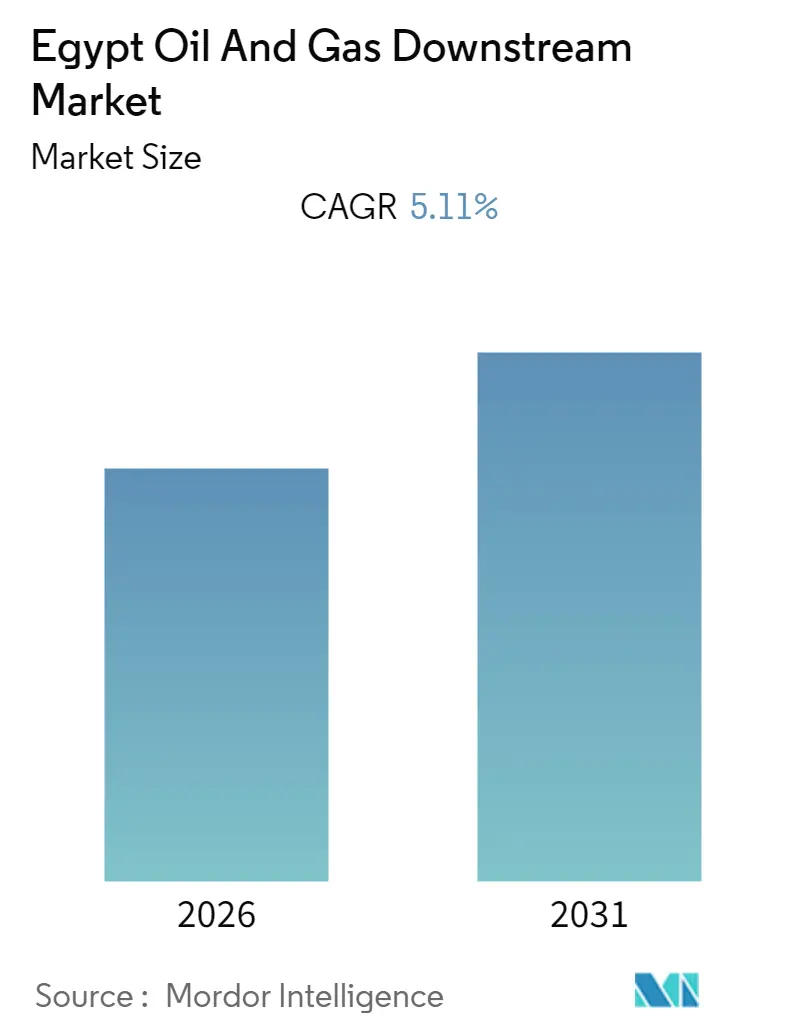
The Egypt Oil and Gas Downstream Market size is expected to register a CAGR of 5.11% during the forecast period.
The Egyptian oil and gas downstream market was negatively affected by COVID-19 due to the oil price crash and a decrease in the demand for refined petroleum products. However, the market rebounded in 2021.
- Over the medium term, factors such as supportive government policies and efforts to grow the downstream sector, coupled with upcoming projects, are expected to drive the market studied.
- On the other hand, the high capital investment and a lack of financing from international oil and gas companies are expected to hinder the growth of the market in the coming years.
- However, favorable investment policies by private players in the sector are expected to provide a significant opportunity for the market players.
Note: Market size and forecast figures in this report are generated using Mordor Intelligence’s proprietary estimation framework, updated with the latest available data and insights as of 2026.
Egypt Oil And Gas Downstream Market Trends and Insights
Refineries to Dominate the Market
- The refineries sector has dominated the Egyptian oil and gas downstream market in recent years and is expected to continue to do so during the forecast period.
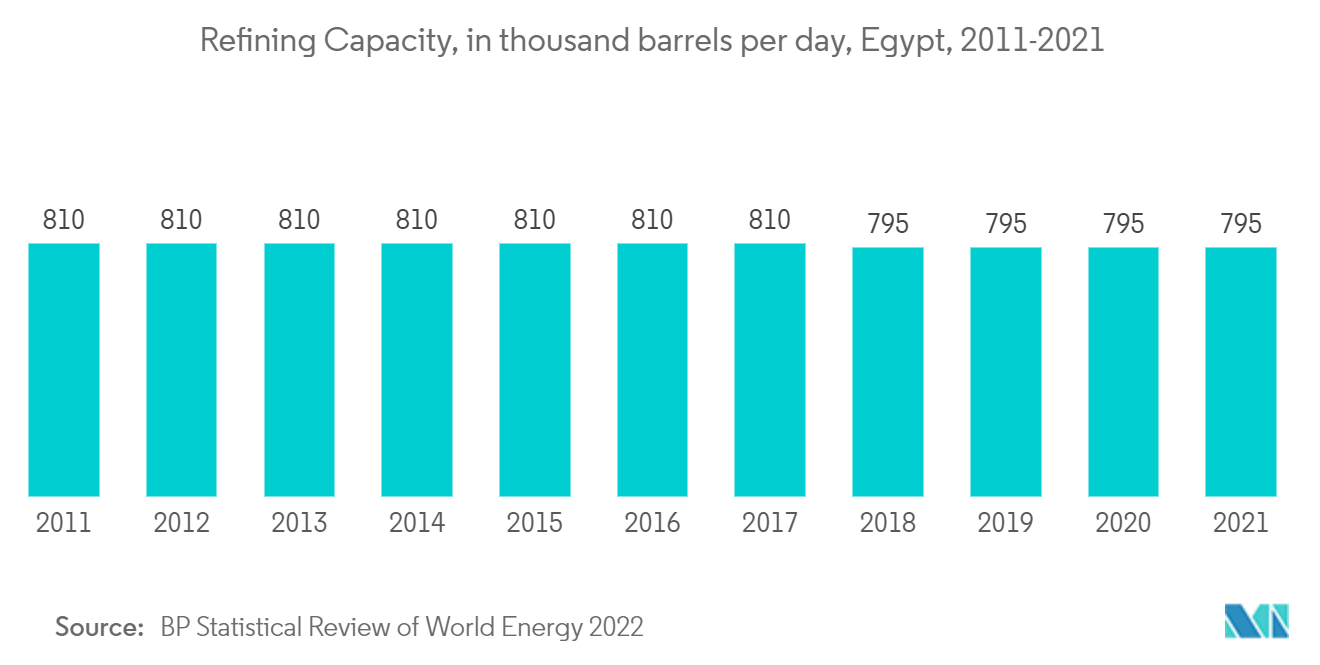
- The country's refining capacity has remained relatively constant, i.e., 810-795 thousand barrels per day, in recent years, mainly due to a lack of new and expansion projects in the sector.
- The Government of Egypt has adopted a strategic policy to expand the refinery infrastructure in the country, which includes the development of new refineries and the upgradation of existing ones. This development is anticipated to boost the downstream industry in the country.
- In August 2021, the Egyptian Minister of Petroleum and Mineral Resources announced that five primary refining and petrochemical projects are being implemented, with investments of about USD 14 billion.
- The refineries in Egypt are old and have remained underutilized for years. Therefore, improvement is key for the development of Egypt as the energy hub in the region. Currently, the refineries in Egypt mostly process crude oil that is domestically produced, and the refined products are sold to local markets.
- The existing refineries in the country are required to be upgraded to produce high-end products, such as diesel, LPG, or gasoline. The current setup of the refinery plants in the country does not meet the EU market standards for vehicle fuels that ensure the emissions are within acceptable limits. Hence, the upgrading of refineries is likely to benefit future exports from the country.
- Therefore, owing to such factors, the refinery sector is expeetcd to dominate the country's oil and gas downstream market in the future.


Growing Oil and Gas Consumption to Drive the Market
- Egypt is a developing country and has witnessed a significant increase in its oil and gas consumption in recent years, mainly due to the rising industrial and commercial sectors and increasing population.
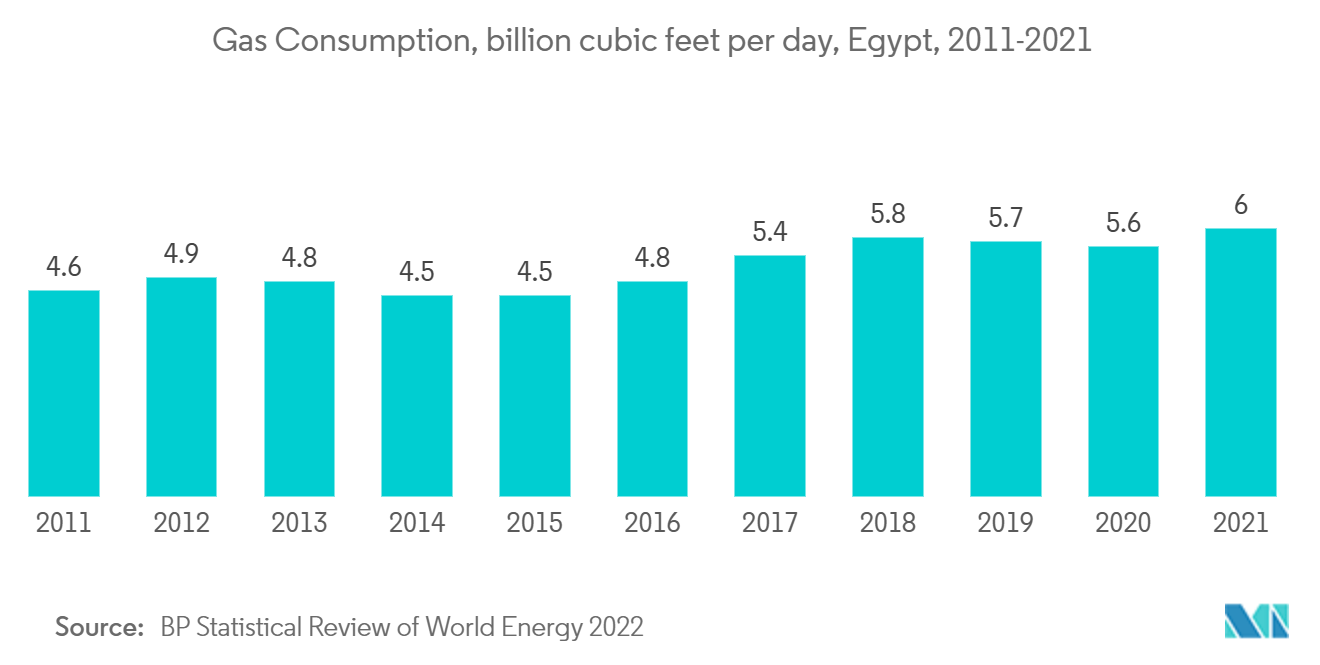
- Though the oil consumption in the country has remained slightly stagnant during the last decade, it is slowly rising and is expected to show significant growth during the forecast period. Gas consumption in the country rose by over 30%, from 4.6 billion cubic feet per day in 2011 to 6 billion cubic feet per day in 2021.
- A rapid increase in the demand for gas is expected to continue during the forecast period and beyond, fueled by the increasing economy and growing industrial and commercial sectors.
- In 2018, the country signed an important energy MoU (memorandum of understanding) with the European Energy Commission, thus becoming an energy hub in the region. In recent years, the country has been able to sign concession agreements with international companies, which are driving the oil and gas sector.
- All such factors are expected to help drive the Egyptian oil and gas downstream market during the forecast period.
Regulatory Landscape
Egypts downstream oil and gas activities are governed by the Ministry of Petroleum and Mineral Resources (MoPMR), with the Gas Regulatory Authority (GasReg) acting as the dedicated downstream gas regulator under Law No. 196 of 2017. The law covers licensing and regulation for gas transmission, distribution, regasification, and storage. In practice, the framework combines state stewardship of strategic assets with regulated access and oversight for downstream gas infrastructure, alongside sector programs led by the Ministry to improve asset utilization and operational efficiency.
Fuel-market governance also includes administered pricing mechanisms, where petroleum product prices are set through official resolutions and adjusted to reflect subsidy and cost-balancing objectives. The regulatory push toward tighter downstream control has also included mandated digital monitoring and control measures across petroleum product distribution and marketing, including SCADA and related systems, to improve traceability and supply management across the national network.
Value Chain Analysis
Egypts downstream value chain starts with crude supply sourced mainly from domestic production, supplemented by imports when required. The crude is processed through an established refining base dominated by state-linked operators, and refining throughput feeds domestic wholesale and retail markets for gasoline, diesel, LPG, and other products. Petrochemicals then convert refinery streams and other hydrocarbons into higher-value derivatives. A key structural feature is the predominance of legacy assets, which keeps utilization and product slate flexibility as central operational constraints and reinforces the importance of upgrade projects and debottlenecking.
Midstream and downstream logistics depend on extensive national infrastructure for liquids handling, including 88 petroleum pipelines totaling more than 6,334 km and 14 petroleum ports supporting annual trade volumes above 90 million metric tons. This enables both coastal supply and inland distribution. Recent project activity reflects value chain modernization and import substitution, including the MIDOR Alexandria refinery expansion to 160,000 barrels per stream day with Euro 5 product upgrades (completed July 2024) and progress at the Assiut diesel complex, where ANOPC connected and activated a main power hub at the first electrical station in July 2026 as part of commissioning readiness.
Competitive Landscape
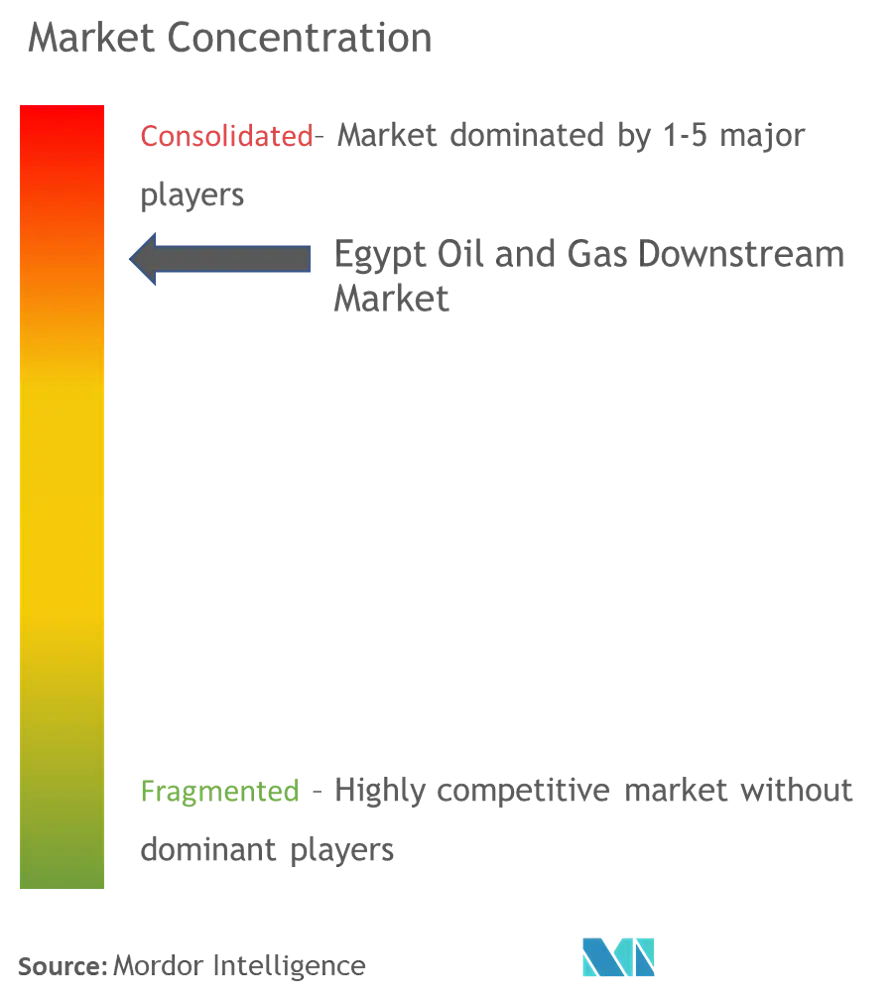
The Egyptian oil and gas market is consolidated. Some of the key players are (in no particular order) Egyptian General Petroleum Company, Shell PLC, TotalEnergies SE, ExxonMobil Corporation, and Egyptian Petrochemicals Holding Company.
Egypt Oil And Gas Downstream Industry Leaders
Egyptian General Petroleum Company
ExxonMobil Corporation
Egyptian Petrochemicals Holding Company
TotalEnergies SE
Shell plc
- *Disclaimer: Major Players sorted in no particular order

Market Opportunities and Future Outlook
A near-term opportunity is brownfield refinery modernization that targets higher-yield transport fuels and Euro 5-compliant products, aligning with government efforts to reduce dependency on imports for gasoline and diesel. This is supported by 2026 actions across multiple assets, including Cairo Petroleum Refining Company initiating an expansion and maintenance project in June 2026 to lift petrol output and reduce the import bill, and MIDOR stating it reached full operational capacity of 160,000 bbl/d in February 2026 following expansion and modernization.
Project-led opportunities also extend to upgrading conversion depth and petrochemical integration to raise value capture from each barrel and improve feedstock utilization. The Assiut National Oil Processing Company (ANOPC) diesel complex, nearing completion as reported in 2026, is designed for 2.8 million tons per year of Euro 5 diesel along with naphtha, butane, coke, and sulfur, creating downstream openings in product logistics, blending, and supporting services. Parallel investment planning across state-linked refiners, including FY 2026/27 budgets for Suez Oil Processing Company and Nasr Petroleum Company and ASORCs FY 2026/27 plan to refine 4.2 million tons, points to sustained demand for EPC capabilities, digital upgrades, storage and handling expansions, and energy-efficiency solutions inside the refining system.
Recent Industry Developments
- July 2026: Assiut National Oil Processing Company (ANOPC) connected and powered the main electricity hub for the first station at the Assiut diesel production complex. The step advances commissioning readiness for a major new source of Euro 5 diesel supply, strengthening domestic product availability and associated distribution planning across Upper Egypt.
- June 2026: Cairo Petroleum Refining Company initiated an expansion and maintenance project at its Cairo refinery complex aimed at increasing petrol output and cutting the national import bill by around USD 70 million per month. This reflects a policy-backed focus on import substitution through brownfield upgrades rather than relying on greenfield capacity alone.
- July 2024: Middle East Oil Refinery (MIDOR) completed the expansion and modernization of its Alexandria refinery, lifting capacity to about 160,000 barrels per stream day and upgrading output to Euro 5 specifications. This increases the availability of higher-quality fuels and improves the flexibility of the domestic refining slate.


Research Methodology Framework and Report Scope
Market Definition and Coverage
For this methodology, the Egypt oil and gas downstream market covers the in-country assets and activities that convert crude into usable products and move those products toward sale, with sizing anchored to refining capacity across operating sites.
Scope exclusions: Upstream exploration and production and midstream transmission are excluded, and crude oil production volumes are not treated as downstream demand.
Segmentation Overview
- Refineries
- Market Overview
- Key Project Information
- Petrochemical Pants
- Market Overview
- Key Project Information
Data Sources, Market Sizing, and Validation
Desk Research
Desk research set the starting structure for the model by pinning down Egypt refining capacity, utilization context, and product slate signals that influence run rates. We referenced public sources such as the Ministry of Petroleum and Mineral Resources releases, CAPMAS energy statistics, OPEC and IEA publications, and World Bank macro series to frame demand drivers like transport activity and industrial output.
On the supply side, we used refinery level disclosures that are available in annual reports, investor presentations, and reputable press coverage to track expansions, turnarounds, and commissioning timelines. Where needed, we also used paid subscriptions for company financials and patent databases to cross-check investment cycles and technology upgrades that affect throughput and yields. The desk research sources listed here are not exhaustive, and many other public documents and datasets were also consulted for data collection, validation, and clarification.
Primary Interviews and Surveys
Primary interviews and surveys were used to test whether capacity additions translate into practical throughput, since nameplate capacity alone can overstate the real market in maintenance-heavy years. We spoke with downstream operators, EPC and maintenance participants, product marketers, and large end-user buyers in Egypt to confirm utilization ranges, typical downtime patterns, and how product mix shifts with pricing signals and policy actions.
Distribution of primary research fieldwork respondents
| Company type | Respondent position |
|---|---|
| Top tier: 33% | CXOs: 15% |
| Mid tier: 46% | Functional/Unit leaders: 25% |
| Smaller Players: 21% | Managers: 60% |
Market-Sizing & Forecasting
The core sizing logic uses a top-down reconstruction from Egypt refining capacity, which is then adjusted using expected utilization and project timing to estimate the effective downstream scale for each year. To keep totals realistic, we corroborated the results using selective bottom-up approximations such as sampled refinery throughput checks, indicative output shares by key product groups, and sanity checks against import and export movements for refined products.
Key inputs in the model include announced capacity expansions and commissioning dates, planned and unplanned turnaround schedules, utilization ranges discussed by industry experts, domestic fuel consumption direction (transport and power-related), and inflation and currency conversion timing for any value normalization checks used in the final review. Forecasting is done using scenario analysis, because policy changes, feedstock availability, and upgrade timing can shift utilization more than a smooth trend would suggest. When plant-level information is incomplete, the gap is handled through conservative utilization proxies based on similar Egyptian assets and recent operating history shared in interviews, and then the assumption is re-tested during validation.
Data Validation & Update Cycle
Validation is done by comparing model outputs against independent signals such as announced refinery run plans, recent commissioning progress, and trade flows for refined products, and then checking whether the implied utilization looks reasonable for the year being sized. Any sharp jumps are reviewed in a second pass, and we re-contact relevant respondents when project timing, outage duration, or policy assumptions appear to be driving the change.
Before sign-off, the model and assumptions are reviewed in steps so input choices, calculations, and unit consistency are easy to trace. Reports are refreshed annually, and interim updates are made when there are material events like major commissioning delays, unexpected outages, or new policy actions that affect throughput. Right before delivery, a final pass is performed so clients receive the latest updated view based on newly available public information and confirmed expert feedback.
Mordor Intelligence's Egypt Oil and Gas Downstream Market Sizing Compared With Other Published Estimates
Published estimates for Egypt downstream often do not match because the word downstream is treated differently across studies, and the sizing unit is not always the same. Differences also come from how each publisher treats utilization versus nameplate capacity, and whether the number reflects a current operating year or a forward-looking year.
Some published figures fold in broad downstream revenues across fuels, lubricants, and petrochemicals, and they can also blend retail and distribution value pools into one headline number. In Mordor Intelligence, the estimate is kept tied to refinery capacity based sizing for Egypt and then adjusted through utilization and project timing checks, which helps keep marketing and retail revenue components out of the total.
Benchmark comparison
| Source | Market Size | Gaps in Research Methodology |
|---|---|---|
| Mordor Intelligence | USD 0.00 B (2024) | |
| Global Consultancy A | USD 20.31 B (2023) | Uses a revenue-defined downstream scope that can include fuels, lubricants, chemicals, and broader value-chain revenues, so the figure is not directly comparable to a capacity-anchored downstream sizing approach. |
| Industry Publisher B | USD 8.20 B (2024) | Product basket appears narrower and may apply different inclusion of petrochemicals and NGLs, and the treatment of utilization and conversion timing is not clearly stated, which can compress the market size versus broader definitions. |
The spread in the table mainly comes down to scope and unit choice, since revenue pool totals will naturally sit far above a capacity-anchored sizing view. By keeping assumptions tied to observable capacity changes and realistic utilization ranges, the final number remains easier to replicate and to explain during planning discussions.


Key Questions Answered in the Report
What is the current Egypt Oil and Gas Downstream Market size?
The Egypt Oil and Gas Downstream Market is projected to register a CAGR of 5.11% during the forecast period (2026-2031)
Who are the key players in Egypt Oil and Gas Downstream Market?
Egyptian General Petroleum Company, ExxonMobil Corporation, Egyptian Petrochemicals Holding Company, TotalEnergies SE and Shell plc are the major companies operating in the Egypt Oil and Gas Downstream Market.
What years does this Egypt Oil and Gas Downstream Market cover?
The report covers the Egypt Oil and Gas Downstream Market historical market size for years: 2021, 2022, 2023 and 2024. The report also forecasts the Egypt Oil and Gas Downstream Market size for years: 2026, 2027, 2028, 2029, 2030 and 2031.
Page last updated on:





